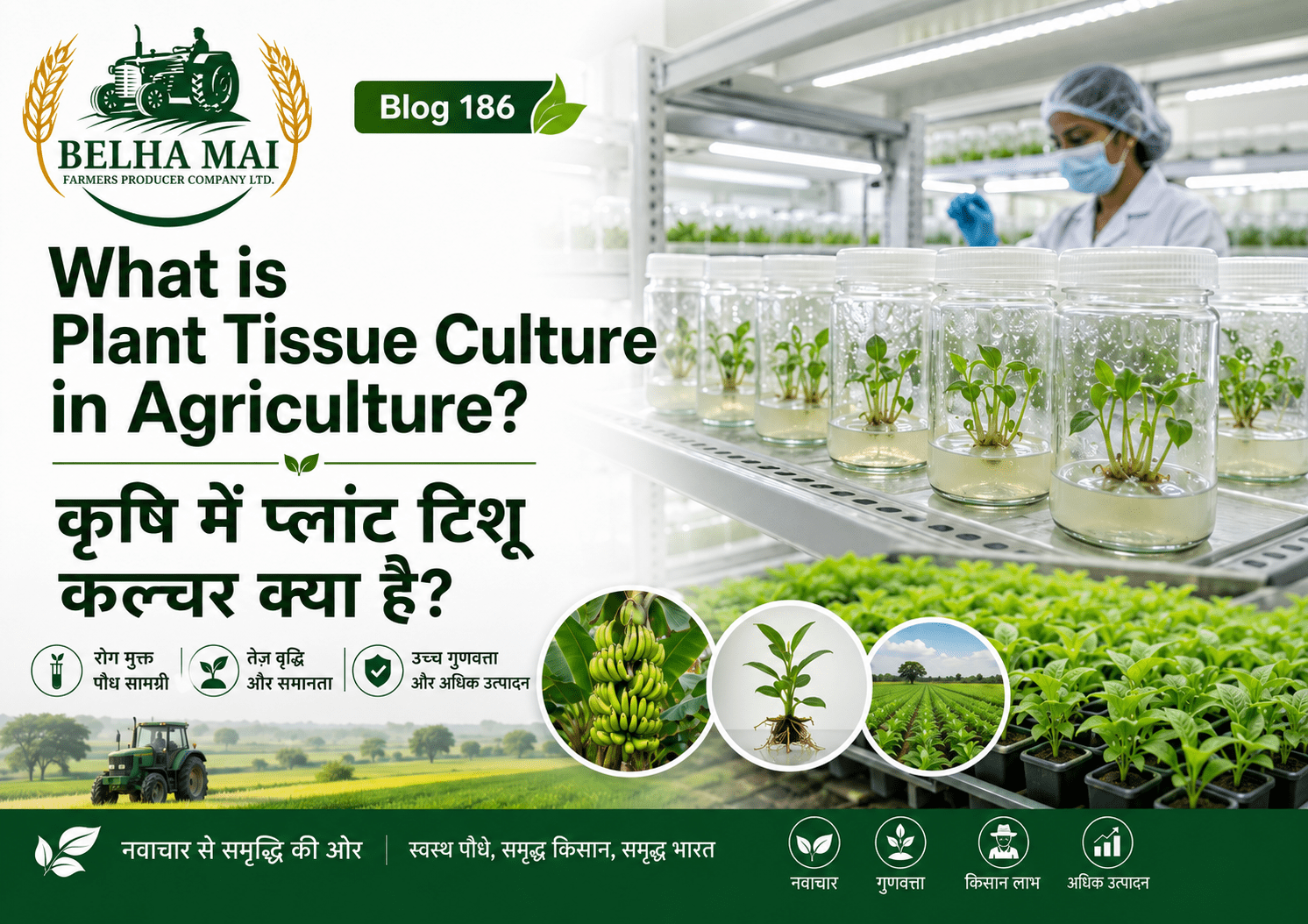
कृषि में प्लांट टिशू कल्चर क्या है?
Introduction
Plant tissue culture in agriculture is one of the most important modern technologies used for producing healthy, disease-free and uniform plants under controlled laboratory conditions. In simple words, plant tissue culture means growing a new plant from a small part of an existing plant, such as a cell, tissue, shoot tip, bud or meristem, in a sterile environment with proper nutrients. This technology is very useful in horticulture, fruit crops, plantation crops and commercial nursery development because it helps produce large numbers of quality plants in less space and within a planned time.
कृषि में प्लांट टिशू कल्चर एक महत्वपूर्ण आधुनिक तकनीक है, जिसके माध्यम से नियंत्रित प्रयोगशाला वातावरण में स्वस्थ, रोग-मुक्त और समान गुणवत्ता वाले पौधे तैयार किए जाते हैं। सरल भाषा में, प्लांट टिशू कल्चर का अर्थ है किसी पौधे के छोटे भाग, जैसे कोशिका, ऊतक, शूट टिप, कली या मेरिस्टेम से नया पौधा तैयार करना। यह प्रक्रिया स्वच्छ वातावरण, उचित पोषक तत्वों और वैज्ञानिक देखरेख में की जाती है। यह तकनीक बागवानी, फलदार पौधों, प्लांटेशन फसलों और व्यावसायिक नर्सरी विकास के लिए बहुत उपयोगी है क्योंकि इससे कम जगह में अधिक संख्या में गुणवत्तापूर्ण पौधे तैयार किए जा सकते हैं।
Meaning of Plant Tissue Culture in Agriculture
Plant tissue culture in agriculture is a scientific method of plant propagation where selected plant parts are grown on a nutrient medium inside bottles, jars or culture vessels. These plant parts multiply under controlled temperature, humidity and light conditions. After proper growth, the small plantlets are transferred from the laboratory to nursery conditions, hardened gradually, and then supplied to farmers for field planting. The main purpose of plant tissue culture in agriculture is to produce true-to-type, healthy and high-quality planting material.
कृषि में प्लांट टिशू कल्चर पौधों के प्रसार की एक वैज्ञानिक विधि है, जिसमें चुने हुए पौधे के भागों को पोषक माध्यम पर बोतलों, जार या कल्चर वेसल में उगाया जाता है। ये पौधे नियंत्रित तापमान, आर्द्रता और प्रकाश की स्थिति में बढ़ते हैं। उचित वृद्धि के बाद छोटे पौधों को प्रयोगशाला से नर्सरी वातावरण में लाया जाता है, धीरे-धीरे हार्डनिंग की जाती है और फिर किसानों को खेत में लगाने के लिए उपलब्ध कराया जाता है। कृषि में प्लांट टिशू कल्चर का मुख्य उद्देश्य सही किस्म, स्वस्थ और उच्च गुणवत्ता वाली पौध सामग्री तैयार करना है।
Why Plant Tissue Culture is Important for Farmers
Plant tissue culture in agriculture is important for farmers because the quality of planting material directly affects crop growth, yield, uniformity and income. If a farmer plants weak, infected or poor-quality plants, the crop may suffer from disease, uneven growth and low productivity. Tissue culture plants are produced under scientific conditions, so they are usually more uniform, healthy and suitable for commercial cultivation. For farmers growing banana, papaya, strawberry, bamboo, ornamental plants and many horticulture crops, tissue culture can become a strong tool for better crop planning.
कृषि में प्लांट टिशू कल्चर किसानों के लिए इसलिए महत्वपूर्ण है क्योंकि पौध सामग्री की गुणवत्ता सीधे फसल की वृद्धि, उत्पादन, समानता और आय को प्रभावित करती है। यदि किसान कमजोर, रोगग्रस्त या खराब गुणवत्ता वाले पौधे लगाते हैं, तो फसल में बीमारी, असमान वृद्धि और कम उत्पादन की समस्या आ सकती है। टिशू कल्चर पौधे वैज्ञानिक परिस्थितियों में तैयार किए जाते हैं, इसलिए वे सामान्यतः अधिक समान, स्वस्थ और व्यावसायिक खेती के लिए उपयुक्त होते हैं। केला, पपीता, स्ट्रॉबेरी, बांस, सजावटी पौधे और कई बागवानी फसलें उगाने वाले किसानों के लिए टिशू कल्चर बेहतर फसल योजना का मजबूत साधन बन सकता है।
How Plant Tissue Culture Works
The process of plant tissue culture in agriculture starts with the selection of a healthy mother plant. A small plant part is taken from this mother plant and cleaned carefully to remove contamination. This plant part is then placed on a nutrient medium containing minerals, vitamins, sugar and plant growth regulators. Under controlled laboratory conditions, the plant tissue starts multiplying and forms many small shoots. These shoots are later rooted, hardened in nursery conditions and finally converted into field-ready plants.
कृषि में प्लांट टिशू कल्चर की प्रक्रिया एक स्वस्थ मदर प्लांट के चयन से शुरू होती है। इस मदर प्लांट से पौधे का छोटा भाग लिया जाता है और संक्रमण हटाने के लिए उसे सावधानीपूर्वक साफ किया जाता है। इसके बाद इस भाग को ऐसे पोषक माध्यम पर रखा जाता है जिसमें खनिज, विटामिन, शर्करा और पौध वृद्धि नियंत्रक मौजूद होते हैं। नियंत्रित प्रयोगशाला स्थितियों में पौधे का ऊतक बढ़ना शुरू करता है और कई छोटे शूट तैयार होते हैं। बाद में इन शूट्स में जड़ें विकसित की जाती हैं, नर्सरी में हार्डनिंग की जाती है और अंत में उन्हें खेत में लगाने योग्य पौधों में बदला जाता है।
Main Stages of Plant Tissue Culture
Plant tissue culture in agriculture usually includes important stages such as selection of mother plant, sterilization, culture initiation, multiplication, rooting, hardening and field transfer. Each stage is very important because even a small mistake can affect plant quality. Proper hygiene, skilled technicians, good laboratory practices and nursery management are necessary for successful tissue culture plant production. This is why tissue culture is not just a laboratory process, but a complete value chain from mother plant to farmer field.
कृषि में प्लांट टिशू कल्चर में आमतौर पर मदर प्लांट का चयन, स्टरलाइजेशन, कल्चर इनिशिएशन, मल्टीप्लिकेशन, रूटिंग, हार्डनिंग और खेत में रोपाई जैसे महत्वपूर्ण चरण शामिल होते हैं। प्रत्येक चरण बहुत महत्वपूर्ण है क्योंकि छोटी सी गलती भी पौधों की गुणवत्ता को प्रभावित कर सकती है। सफल टिशू कल्चर पौध उत्पादन के लिए स्वच्छता, प्रशिक्षित तकनीशियन, अच्छी प्रयोगशाला प्रणाली और बेहतर नर्सरी प्रबंधन आवश्यक है। इसलिए टिशू कल्चर केवल प्रयोगशाला की प्रक्रिया नहीं है, बल्कि मदर प्लांट से किसान के खेत तक की पूरी वैल्यू चेन है।
Benefits of Plant Tissue Culture in Agriculture
Plant tissue culture in agriculture offers many benefits such as rapid multiplication of plants, disease-free planting material, uniform crop growth, better survival rate and planned supply of plants. It is especially useful when traditional propagation is slow, seasonal or unable to produce large quantities of plants. Tissue culture also helps preserve elite varieties and multiply superior planting material for commercial farming. For FPOs and nurseries, this technology can create a reliable business model based on quality plant supply.
कृषि में प्लांट टिशू कल्चर के कई लाभ हैं, जैसे पौधों का तेज प्रसार, रोग-मुक्त पौध सामग्री, समान फसल वृद्धि, बेहतर जीवित रहने की क्षमता और पौधों की योजनाबद्ध आपूर्ति। यह तकनीक विशेष रूप से तब उपयोगी होती है जब पारंपरिक पौध प्रसार धीमा, मौसमी या बड़ी संख्या में पौधे तैयार करने में असमर्थ हो। टिशू कल्चर उत्कृष्ट किस्मों को संरक्षित करने और श्रेष्ठ पौध सामग्री को व्यावसायिक खेती के लिए बढ़ाने में भी मदद करता है। FPOs और नर्सरियों के लिए यह तकनीक गुणवत्तापूर्ण पौध आपूर्ति पर आधारित एक मजबूत व्यवसाय मॉडल बना सकती है।
Crops Where Tissue Culture is Commonly Used
Plant tissue culture in agriculture is commonly used in crops like banana, potato, sugarcane, bamboo, strawberry, orchids, medicinal plants and several horticulture crops. In India, banana tissue culture has become very popular because it helps farmers get uniform plants and better crop management. Tissue culture also has future opportunities in mango, amla, guava, papaya, fig, jamun and agroforestry plants, especially when combined with high-tech nursery systems and scientific hardening practices.
कृषि में प्लांट टिशू कल्चर का उपयोग केला, आलू, गन्ना, बांस, स्ट्रॉबेरी, ऑर्किड, औषधीय पौधे और कई बागवानी फसलों में किया जाता है। भारत में केले का टिशू कल्चर काफी लोकप्रिय हो चुका है क्योंकि इससे किसानों को समान पौधे और बेहतर फसल प्रबंधन में मदद मिलती है। भविष्य में आम, आंवला, अमरूद, पपीता, अंजीर, जामुन और एग्रोफॉरेस्ट्री पौधों में भी टिशू कल्चर की संभावनाएं बढ़ सकती हैं, खासकर जब इसे हाई-टेक नर्सरी और वैज्ञानिक हार्डनिंग प्रणाली के साथ जोड़ा जाए।
Role of Tissue Culture in High-Tech Nursery Development
Plant tissue culture in agriculture becomes more powerful when it is connected with a high-tech nursery. A tissue culture laboratory can produce plantlets, but the nursery plays a major role in hardening, acclimatization, grading and field-ready plant supply. Without proper nursery management, laboratory plantlets may not perform well in farmers’ fields. Therefore, a complete model should include tissue culture lab, polyhouse, shade net house, mist chamber, hardening unit, mother plant block and farmer training support.
कृषि में प्लांट टिशू कल्चर तब अधिक प्रभावी होता है जब इसे हाई-टेक नर्सरी से जोड़ा जाता है। टिशू कल्चर प्रयोगशाला छोटे पौधे तैयार कर सकती है, लेकिन नर्सरी हार्डनिंग, वातावरण के अनुकूलन, ग्रेडिंग और खेत में लगाने योग्य पौधों की आपूर्ति में प्रमुख भूमिका निभाती है। यदि नर्सरी प्रबंधन सही नहीं हो, तो प्रयोगशाला में तैयार पौधे किसानों के खेत में अच्छा प्रदर्शन नहीं कर सकते। इसलिए एक पूर्ण मॉडल में टिशू कल्चर लैब, पॉलीहाउस, शेडनेट हाउस, मिस्ट चेंबर, हार्डनिंग यूनिट, मदर प्लांट ब्लॉक और किसान प्रशिक्षण सहायता शामिल होनी चाहिए।
Importance for FPOs
Plant tissue culture in agriculture can create a new opportunity for Farmer Producer Organizations because FPOs are directly connected with farmers and can understand local crop demand. An FPO can aggregate demand for quality plants, develop nursery infrastructure, supply certified planting material and provide technical guidance to farmers. This can improve farmer income and also create a sustainable revenue model for the FPO. For Belha Mai FPO, tissue culture and high-tech nursery development can become a strong step towards horticulture value chain strengthening.
कृषि में प्लांट टिशू कल्चर Farmer Producer Organizations के लिए एक नई संभावना पैदा कर सकता है क्योंकि FPOs सीधे किसानों से जुड़े होते हैं और स्थानीय फसल मांग को समझ सकते हैं। एक FPO गुणवत्तापूर्ण पौधों की मांग को एकत्र कर सकता है, नर्सरी इंफ्रास्ट्रक्चर विकसित कर सकता है, प्रमाणित पौध सामग्री की आपूर्ति कर सकता है और किसानों को तकनीकी मार्गदर्शन दे सकता है। इससे किसानों की आय में सुधार हो सकता है और FPO के लिए स्थायी राजस्व मॉडल भी बन सकता है। Belha Mai FPO के लिए टिशू कल्चर और हाई-टेक नर्सरी विकास बागवानी वैल्यू चेन को मजबूत करने की दिशा में एक महत्वपूर्ण कदम बन सकता है।
Disease-Free Planting Material
One of the biggest advantages of plant tissue culture in agriculture is the possibility of producing disease-free planting material. Many crops suffer because diseases are carried from infected planting material to the new crop. When healthy mother plants are selected and proper laboratory procedures are followed, tissue culture can reduce the risk of disease transmission. This is especially useful for crops where planting material plays a major role in long-term productivity, such as banana, fruit crops and plantation crops.
कृषि में प्लांट टिशू कल्चर का सबसे बड़ा लाभ रोग-मुक्त पौध सामग्री तैयार करने की संभावना है। कई फसलों में बीमारी संक्रमित पौध सामग्री से नई फसल तक पहुंचती है। जब स्वस्थ मदर प्लांट का चयन किया जाता है और प्रयोगशाला प्रक्रिया सही तरीके से अपनाई जाती है, तो टिशू कल्चर बीमारी के प्रसार के जोखिम को कम कर सकता है। यह विशेष रूप से उन फसलों के लिए उपयोगी है जहां पौध सामग्री लंबे समय तक उत्पादन को प्रभावित करती है, जैसे केला, फलदार फसलें और प्लांटेशन फसलें।
Uniform Growth and Better Crop Planning
Plant tissue culture in agriculture helps farmers get uniform plants, which means the plants grow at a similar pace and produce more uniform crops. Uniformity helps in irrigation planning, fertilizer application, pest management, harvesting and marketing. When the crop is uniform, farmers can manage the field more efficiently and buyers also get better-quality produce. This is very important for commercial farming, contract farming, export-oriented farming and institutional supply chains.
कृषि में प्लांट टिशू कल्चर किसानों को समान पौधे उपलब्ध कराने में मदद करता है, जिसका अर्थ है कि पौधे लगभग समान गति से बढ़ते हैं और फसल अधिक समान होती है। समानता सिंचाई योजना, खाद प्रबंधन, कीट नियंत्रण, कटाई और विपणन में मदद करती है। जब फसल समान होती है, तो किसान खेत का प्रबंधन अधिक प्रभावी ढंग से कर सकते हैं और खरीदारों को भी बेहतर गुणवत्ता का उत्पादन मिलता है। यह व्यावसायिक खेती, कॉन्ट्रैक्ट फार्मिंग, निर्यात-उन्मुख खेती और संस्थागत सप्लाई चेन के लिए बहुत महत्वपूर्ण है।
Challenges in Plant Tissue Culture
Plant tissue culture in agriculture also has some challenges. It requires skilled manpower, laboratory infrastructure, clean working conditions, electricity, quality control and proper nursery hardening. The initial investment can be high, and farmers must be guided properly before using tissue culture plants. If plantlets are not hardened properly or if farmers do not follow correct planting practices, field performance may be affected. Therefore, training, technical support and reliable nursery management are essential.
कृषि में प्लांट टिशू कल्चर की कुछ चुनौतियां भी हैं। इसके लिए प्रशिक्षित मानव संसाधन, प्रयोगशाला इंफ्रास्ट्रक्चर, स्वच्छ कार्य वातावरण, बिजली, गुणवत्ता नियंत्रण और सही नर्सरी हार्डनिंग की आवश्यकता होती है। प्रारंभिक निवेश अधिक हो सकता है और किसानों को टिशू कल्चर पौधों के उपयोग से पहले सही मार्गदर्शन देना जरूरी है। यदि पौधों की हार्डनिंग सही नहीं हुई या किसान सही रोपाई पद्धति नहीं अपनाते, तो खेत में पौधों का प्रदर्शन प्रभावित हो सकता है। इसलिए प्रशिक्षण, तकनीकी सहायता और विश्वसनीय नर्सरी प्रबंधन आवश्यक है।
Plant Tissue Culture and Horticulture Value Chain
Plant tissue culture in agriculture is not only about producing plants; it is also about strengthening the complete horticulture value chain. Quality planting material leads to better production, better production supports aggregation, aggregation supports processing, and processing supports branding and market linkage. When farmers receive healthy plants and proper guidance, the entire value chain becomes stronger. This is why tissue culture, high-tech nursery, cold storage, grading, dehydration, branding and traceability should be seen as connected parts of modern agriculture.
कृषि में प्लांट टिशू कल्चर केवल पौधे तैयार करने तक सीमित नहीं है; यह पूरी बागवानी वैल्यू चेन को मजबूत करने का माध्यम भी है। गुणवत्तापूर्ण पौध सामग्री से बेहतर उत्पादन होता है, बेहतर उत्पादन से एग्रीगेशन मजबूत होता है, एग्रीगेशन से प्रोसेसिंग को आधार मिलता है और प्रोसेसिंग से ब्रांडिंग तथा बाजार लिंक बढ़ते हैं। जब किसानों को स्वस्थ पौधे और सही मार्गदर्शन मिलता है, तो पूरी वैल्यू चेन मजबूत होती है। इसलिए टिशू कल्चर, हाई-टेक नर्सरी, कोल्ड स्टोरेज, ग्रेडिंग, डिहाइड्रेशन, ब्रांडिंग और ट्रेसबिलिटी को आधुनिक कृषि के जुड़े हुए हिस्सों के रूप में देखना चाहिए।
Belha Mai FPO Vision
Belha Mai Farmers Producer Company Ltd. believes that future agriculture must move towards quality planting material, scientific nursery systems, value addition and market linkage. Plant tissue culture in agriculture can support this vision by helping farmers access better plants for horticulture and agroforestry. Through high-tech nursery development, farmer training, crop planning and value chain infrastructure, Belha Mai FPO aims to support farmers with practical solutions that can improve productivity, income and long-term sustainability.
Belha Mai Farmers Producer Company Ltd. का मानना है कि भविष्य की कृषि को गुणवत्तापूर्ण पौध सामग्री, वैज्ञानिक नर्सरी प्रणाली, मूल्य संवर्धन और बाजार लिंक की दिशा में आगे बढ़ना होगा। कृषि में प्लांट टिशू कल्चर इस विजन को मजबूत कर सकता है क्योंकि इससे किसानों को बागवानी और एग्रोफॉरेस्ट्री के लिए बेहतर पौधे मिल सकते हैं। हाई-टेक नर्सरी विकास, किसान प्रशिक्षण, फसल योजना और वैल्यू चेन इंफ्रास्ट्रक्चर के माध्यम से Belha Mai FPO किसानों को ऐसे व्यावहारिक समाधान देना चाहता है जो उत्पादकता, आय और दीर्घकालिक स्थिरता को बढ़ा सकें।
Conclusion
Plant tissue culture in agriculture is a powerful technology for producing healthy, uniform and disease-free plants. It can help farmers improve productivity, reduce risk and adopt better horticulture practices. However, its success depends on proper laboratory process, nursery hardening, farmer training and reliable supply systems. For India’s farmers and FPOs, plant tissue culture can become an important part of high-tech agriculture, horticulture development and rural value chain growth.
कृषि में प्लांट टिशू कल्चर स्वस्थ, समान और रोग-मुक्त पौधे तैयार करने की एक शक्तिशाली तकनीक है। यह किसानों को उत्पादकता बढ़ाने, जोखिम कम करने और बेहतर बागवानी पद्धतियां अपनाने में मदद कर सकता है। हालांकि इसकी सफलता सही प्रयोगशाला प्रक्रिया, नर्सरी हार्डनिंग, किसान प्रशिक्षण और विश्वसनीय आपूर्ति प्रणाली पर निर्भर करती है। भारत के किसानों और FPOs के लिए प्लांट टिशू कल्चर हाई-टेक कृषि, बागवानी विकास और ग्रामीण वैल्यू चेन वृद्धि का महत्वपूर्ण हिस्सा बन सकता है।
FAQ
What is plant tissue culture in agriculture?
Plant tissue culture in agriculture is a scientific method of producing new plants from small plant parts under sterile laboratory conditions using a nutrient medium.
कृषि में प्लांट टिशू कल्चर एक वैज्ञानिक विधि है जिसमें पौधे के छोटे भाग से स्वच्छ प्रयोगशाला वातावरण में पोषक माध्यम की सहायता से नए पौधे तैयार किए जाते हैं।
Why is plant tissue culture useful for farmers?
Plant tissue culture is useful for farmers because it can provide healthy, uniform and disease-free planting material, which supports better crop growth and productivity.
टिशू कल्चर किसानों के लिए उपयोगी है क्योंकि इससे स्वस्थ, समान और रोग-मुक्त पौध सामग्री मिल सकती है, जो बेहतर फसल वृद्धि और उत्पादन में मदद करती है।
Which crops are commonly produced through tissue culture?
Banana, potato, sugarcane, bamboo, strawberry, orchids and several horticulture crops are commonly produced through tissue culture.
केला, आलू, गन्ना, बांस, स्ट्रॉबेरी, ऑर्किड और कई बागवानी फसलें टिशू कल्चर के माध्यम से तैयार की जाती हैं।
Is plant tissue culture useful for FPOs?
Yes, plant tissue culture can be useful for FPOs because it creates opportunities in quality plant supply, nursery business, farmer training and horticulture value chain development.
हां, प्लांट टिशू कल्चर FPOs के लिए उपयोगी हो सकता है क्योंकि इससे गुणवत्तापूर्ण पौध आपूर्ति, नर्सरी व्यवसाय, किसान प्रशिक्षण और बागवानी वैल्यू चेन विकास के अवसर बनते हैं।
Is tissue culture farming expensive?
Tissue culture plants may cost more than ordinary plants, but their uniformity, quality and disease-free nature can support better crop performance when proper farming practices are followed.
टिशू कल्चर पौधे सामान्य पौधों की तुलना में महंगे हो सकते हैं, लेकिन उनकी समानता, गुणवत्ता और रोग-मुक्त प्रकृति सही खेती पद्धति अपनाने पर बेहतर फसल प्रदर्शन में मदद कर सकती है।
Internal Links Section
👉 Why small farmers struggle in India — https://belhamaifpo.com/agriculture/why-small-farmers-struggle-in-india/
👉 Mango Farming in India: Complete Guide —https://belhamaifpo.com/agriculture/mango-farming-in-india/
👉 Rajvi Bhog Food Products: Complete Guide —https://belhamaifpo.com/agriculture/rajvi-bhog-food-products-quality-export-guide/
👉 Honey Processing in India: Complete Guide —https://belhamaifpo.com/agriculture/honey-processing-in-india-complete-guide/
👉 Belha Mai FPO Website —https://belhamaifpo.com/
👉 Benefits of Tissue Culture Plants for Farmers — https://belhamaifpo.com/agriculture/benefits-of-tissue-culture-plants-for-farmers/
👉 Tissue Culture vs Traditional Plant Propagation —https://belhamaifpo.com/agriculture/tissue-culture-vs-traditional-plant-propagation/
👉 Banana Tissue Culture Farming in India —https://belhamaifpo.com/agriculture/banana-tissue-culture-farming-in-india/
👉 Mango Tissue Culture Plants: Opportunities and Challenges —https://belhamaifpo.com/agriculture/mango-tissue-culture-plants-opportunities-challenges/
👉 Role of Tissue Culture in Horticulture Development —https://belhamaifpo.com/agriculture/role-of-tissue-culture-in-horticulture-development/
👉 How Tissue Culture Ensures Disease-Free Planting Material —https://belhamaifpo.com/agriculture/how-tissue-culture-ensures-disease-free-planting-material/
👉 Commercial Tissue Culture Lab Setup in India —https://belhamaifpo.com/agriculture/commercial-tissue-culture-lab-setup-in-india/
👉 What is a High-Tech Nursery in Agriculture? — https://belhamaifpo.com/agriculture/what-is-a-high-tech-nursery-in-agriculture/
👉 Benefits of High-Tech Nurseries for Farmers —https://belhamaifpo.com/agriculture/benefits-of-high-tech-nurseries-for-farmers/
👉 Nursery Management Practices for Fruit Plants —https://belhamaifpo.com/agriculture/nursery-management-practices-for-fruit-plants/
👉 Role of Nurseries in Improving Crop Productivity — https://belhamaifpo.com/agriculture/role-of-nurseries-in-improving-crop-productivity/
👉 Protected Cultivation and Nursery Development —https://belhamaifpo.com/agriculture/protected-cultivation-and-nursery-development/
👉 How Quality Planting Material Increases Yield —https://belhamaifpo.com/agriculture/how-quality-planting-material-increases-yield/
👉 What is Agroforestry and Its Benefits —https://belhamaifpo.com/agriculture/what-is-agroforestry-and-its-benefits/
👉 Role of Agroforestry in Climate Resilience — https://belhamaifpo.com/agriculture/role-of-agroforestry-in-climate-resilience/
👉 Best Agroforestry Models in India —https://belhamaifpo.com/agriculture/best-agroforestry-models-in-india/
👉 Economic Benefits of Tree-Based Farming — https://belhamaifpo.com/agriculture/economic-benefits-of-tree-based-farming/
👉 Bamboo Cultivation Opportunities in India — https://belhamaifpo.com/agriculture/bamboo-cultivation-opportunities-in-india/
👉 Neem and Mahua Plantation for Rural Income —https://belhamaifpo.com/agriculture/neem-and-mahua-plantation-for-rural-income/
👉 Importance of Cold Storage in Agriculture — https://belhamaifpo.com/agriculture/importance-of-cold-storage-in-agriculture/
👉 What is a Ripening Chamber and How It Works — https://belhamaifpo.com/agriculture/what-is-a-ripening-chamber-and-how-it-works/
👉 Sorting and Grading in Agriculture Explained —https://belhamaifpo.com/agriculture/sorting-and-grading-in-agriculture-explained/
👉 Dehydration of Fruits and Vegetables: Complete Guide — https://belhamaifpo.com/agriculture/dehydration-of-fruits-and-vegetables-complete-guide/
👉 Benefits of Food Processing for Farmers —https://belhamaifpo.com/agriculture/benefits-of-food-processing-for-farmers/
👉 Reducing Post-Harvest Losses Through Infrastructure — https://belhamaifpo.com/agriculture/reducing-post-harvest-losses-through-infrastructure/
👉 How Agri Supply Chains Work in India —https://belhamaifpo.com/agriculture/how-agri-supply-chains-work-in-india/
👉 Importance of Branding in Agriculture Products —https://belhamaifpo.com/agriculture/importance-of-branding-in-agriculture-products/
👉 Export of Dehydrated Fruits and Vegetables from India —https://belhamaifpo.com/agriculture/export-of-dehydrated-fruits-and-vegetables-from-india/
👉 QR Code Traceability in Agriculture Supply Chain —https://belhamaifpo.com/agriculture/qr-code-traceability-in-agriculture-supply-chain/
External Authority Links
👉 National Horticulture Board — https://nhb.gov.in/
👉 Ministry of Agriculture & Farmers Welfare — https://agriwelfare.gov.in/
👉 Department of Biotechnology, Government of India — https://dbtindia.gov.in/
👉 ICAR — https://icar.org.in/
👉 APEDA — https://apeda.gov.in/
Follow Belha Mai FPO for More Updates
Website: https://belhamaifpo.com/
Facebook: https://www.facebook.com/profile.php?id=61561043486818
YouTube: https://www.youtube.com/channel/UC9ZvojoTMCa7mU1-Q_Bh60A
LinkedIn: https://www.linkedin.com/in/abhay-singh-ab5568280/
Instagram: https://instagram.com/belhamaifpo
Belha Mai FPO is working to support farmers through better information, technology, market linkage, value addition, FPO awareness and rural development.