फलों और सब्जियों का डिहाइड्रेशन: पूरी जानकारी
Introduction
Dehydration of fruits and vegetables is one of the most useful food processing methods for reducing post-harvest losses and increasing farmer income. Many fruits and vegetables are seasonal and perishable, which means they spoil quickly after harvest if they are not stored, processed or sold in time. Dehydration removes moisture from fresh produce and helps increase shelf life, reduce wastage and create value-added products such as dried mango slices, amla powder, dried vegetables, flakes, chips and powders.
फलों और सब्जियों का डिहाइड्रेशन कटाई-बाद नुकसान कम करने और किसान आय बढ़ाने की सबसे उपयोगी फूड प्रोसेसिंग पद्धतियों में से एक है। कई फल और सब्जियां मौसमी तथा जल्दी खराब होने वाली होती हैं, जिसका अर्थ है कि कटाई के बाद यदि उन्हें समय पर भंडारित, प्रोसेस या बेचा न जाए तो वे जल्दी खराब हो जाती हैं। डिहाइड्रेशन ताजे उत्पादन से नमी हटाता है और शेल्फ लाइफ बढ़ाने, बर्बादी कम करने तथा dried mango slices, amla powder, dried vegetables, flakes, chips और powders जैसे मूल्य संवर्धित उत्पाद बनाने में मदद करता है।
Meaning of Dehydration
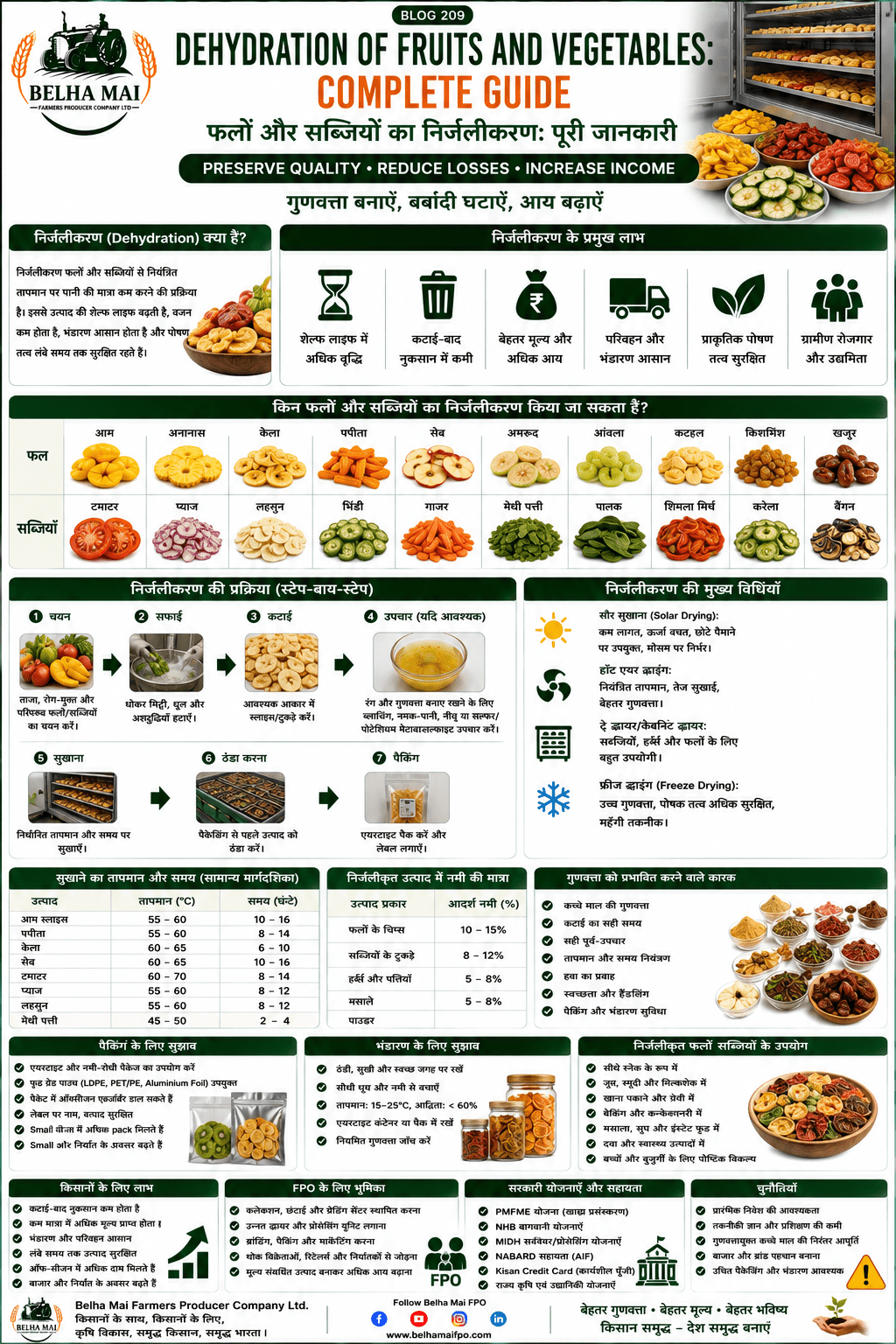
Dehydration of fruits and vegetables means removing water or moisture from fresh produce using controlled heat, air movement or other drying methods. Since microorganisms need moisture to grow, reducing moisture helps slow down spoilage. Dehydrated products are lighter, easier to transport and can be stored for a longer period when packed properly. This makes dehydration an important technology for farmers, FPOs, food processors and rural enterprises.
फलों और सब्जियों का डिहाइड्रेशन का अर्थ है नियंत्रित गर्मी, हवा के प्रवाह या अन्य सुखाने की विधियों का उपयोग करके ताजे उत्पादन से पानी या नमी हटाना। चूंकि सूक्ष्मजीवों को बढ़ने के लिए नमी की आवश्यकता होती है, इसलिए नमी कम करने से खराब होने की गति धीमी होती है। डिहाइड्रेटेड उत्पाद हल्के, परिवहन में आसान और सही पैकिंग के साथ लंबे समय तक सुरक्षित रखे जा सकते हैं। इसलिए डिहाइड्रेशन किसानों, FPOs, फूड प्रोसेसरों और ग्रामीण उद्यमों के लिए महत्वपूर्ण तकनीक है।
Why Dehydration is Important in Agriculture
Dehydration of fruits and vegetables is important because farmers often receive low prices during peak harvest season when supply is high. If produce is not sold quickly, it may spoil and cause losses. Dehydration allows farmers and FPOs to convert perishable produce into stable products with longer shelf life. This helps in better market timing, value addition and income improvement.
फलों और सब्जियों का डिहाइड्रेशन महत्वपूर्ण है क्योंकि peak harvest season में जब बाजार में आपूर्ति अधिक होती है, तब किसानों को अक्सर कम कीमत मिलती है। यदि उत्पादन जल्दी नहीं बिकता, तो वह खराब हो सकता है और नुकसान दे सकता है। डिहाइड्रेशन किसानों और FPOs को जल्दी खराब होने वाले उत्पादन को अधिक शेल्फ लाइफ वाले स्थिर उत्पादों में बदलने की सुविधा देता है। इससे बेहतर बाजार समय, मूल्य संवर्धन और आय सुधार में मदद मिलती है।
Reducing Post-Harvest Losses
One of the biggest benefits of dehydration of fruits and vegetables is reduction of post-harvest losses. Fruits and vegetables contain high moisture and spoil quickly due to heat, microorganisms, improper handling and poor storage. Dehydration reduces moisture and slows down spoilage. Instead of throwing away unsold or surplus produce, farmers can process it into dried products and sell it later.
फलों और सब्जियों के डिहाइड्रेशन का सबसे बड़ा लाभ कटाई-बाद नुकसान को कम करना है। फल और सब्जियों में अधिक नमी होती है और वे गर्मी, सूक्ष्मजीवों, गलत handling और खराब भंडारण के कारण जल्दी खराब हो जाती हैं। डिहाइड्रेशन नमी कम करता है और खराब होने की गति धीमी करता है। बिना बिके या अतिरिक्त उत्पादन को फेंकने के बजाय किसान उसे dried products में प्रोसेस करके बाद में बेच सकते हैं।
Increasing Shelf Life
Dehydration of fruits and vegetables increases shelf life by reducing moisture content. Fresh fruits and vegetables may last only a few days without cold storage, but dehydrated products can last much longer when packed and stored correctly. Longer shelf life gives farmers and FPOs more time to sell, transport and market products. It also helps reach distant markets where fresh produce may not survive easily.
फलों और सब्जियों का डिहाइड्रेशन नमी की मात्रा कम करके शेल्फ लाइफ बढ़ाता है। ताजे फल और सब्जियां कोल्ड स्टोरेज के बिना केवल कुछ दिनों तक टिक सकती हैं, लेकिन सही पैकिंग और भंडारण के साथ डिहाइड्रेटेड उत्पाद अधिक समय तक टिक सकते हैं। लंबी शेल्फ लाइफ किसानों और FPOs को उत्पाद बेचने, परिवहन करने और मार्केटिंग के लिए अधिक समय देती है। यह दूरस्थ बाजारों तक पहुंचने में भी मदद करता है, जहां ताजा उत्पादन आसानी से सुरक्षित नहीं रह पाता।
Value Addition Through Dehydration
Dehydration of fruits and vegetables is a strong value addition opportunity. Fresh produce often has low price during peak season, but dried products can command better value when quality, packaging and branding are strong. Mango can become dried mango slices or aamchur, amla can become amla powder or dried amla, onion can become onion flakes, and tomato can become dried tomato slices or powder. Value addition helps farmers move beyond raw produce selling.
फलों और सब्जियों का डिहाइड्रेशन मजबूत मूल्य संवर्धन अवसर है। peak season में ताजे उत्पादन की कीमत अक्सर कम होती है, लेकिन quality, packaging और branding मजबूत हो तो dried products बेहतर मूल्य प्राप्त कर सकते हैं। आम dried mango slices या आमचूर बन सकता है, आंवला amla powder या dried amla बन सकता है, प्याज onion flakes बन सकता है और टमाटर dried tomato slices या powder बन सकता है। मूल्य संवर्धन किसानों को कच्चा उत्पादन बेचने से आगे बढ़ने में मदद करता है।
Suitable Fruits for Dehydration
Many fruits are suitable for dehydration, including mango, amla, banana, papaya, pineapple, apple, guava, jackfruit, fig, dates, grapes and berries. The right fruit should be selected based on availability, quality, demand and processing suitability. Fruits used for dehydration should be mature, clean and free from major damage or disease. Poor-quality raw material gives poor-quality dehydrated products.
कई फल डिहाइड्रेशन के लिए उपयुक्त हैं, जैसे आम, आंवला, केला, पपीता, अनानास, सेब, अमरूद, कटहल, अंजीर, खजूर, अंगूर और berries। सही फल का चयन उपलब्धता, गुणवत्ता, मांग और processing suitability के आधार पर करना चाहिए। डिहाइड्रेशन के लिए उपयोग किए जाने वाले फल परिपक्व, साफ और बड़े damage या disease से मुक्त होने चाहिए। खराब गुणवत्ता वाला कच्चा माल खराब गुणवत्ता वाला डिहाइड्रेटेड उत्पाद देता है।
Suitable Vegetables for Dehydration
Many vegetables are also suitable for dehydration, including onion, garlic, tomato, carrot, bitter gourd, green chilli, spinach, fenugreek leaves, curry leaves, okra, cabbage, beetroot and brinjal. Dehydrated vegetables are useful for households, hotels, ready-to-cook products, spice mixes and food processing units. Vegetable dehydration can become a strong rural enterprise opportunity when linked with quality control and buyer demand.
कई सब्जियां भी डिहाइड्रेशन के लिए उपयुक्त हैं, जैसे प्याज, लहसुन, टमाटर, गाजर, करेला, हरी मिर्च, पालक, मेथी पत्ती, करी पत्ता, भिंडी, पत्ता गोभी, चुकंदर और बैंगन। डिहाइड्रेटेड सब्जियां घरों, होटलों, ready-to-cook products, spice mixes और food processing units के लिए उपयोगी हैं। quality control और buyer demand से जुड़ने पर vegetable dehydration मजबूत ग्रामीण उद्यम अवसर बन सकता है।
Dehydration Process Step by Step
Dehydration of fruits and vegetables usually starts with selection of good raw material. The produce is then washed, cleaned and sorted to remove damaged or diseased items. After that, it may be peeled, sliced, cut or treated depending on the product. The prepared produce is dried using solar drying, hot air drying, tray drying, cabinet drying, freeze drying or other methods. Finally, the dried product is cooled, packed, labelled and stored properly.
फलों और सब्जियों का डिहाइड्रेशन सामान्यतः अच्छे कच्चे माल के चयन से शुरू होता है। इसके बाद उत्पादन को धोया, साफ किया और damaged या diseased items हटाने के लिए sorted किया जाता है। फिर product के अनुसार उसे छीलना, slice करना, cut करना या treatment देना पड़ सकता है। तैयार उत्पादन को solar drying, hot air drying, tray drying, cabinet drying, freeze drying या अन्य methods से सुखाया जाता है। अंत में dried product को cool, pack, label और proper storage में रखा जाता है।
Sorting and Grading Before Dehydration
Sorting and grading are very important before dehydration of fruits and vegetables. Damaged, rotten, diseased or overripe produce can reduce the quality of the final product. Uniform size and thickness help drying happen evenly. If slices are uneven, some pieces may remain moist while others become over-dried. Proper sorting and grading improve product quality, safety and market value.
फलों और सब्जियों के डिहाइड्रेशन से पहले छंटाई और ग्रेडिंग बहुत महत्वपूर्ण है। damaged, rotten, diseased या overripe produce अंतिम product की quality को कम कर सकता है। समान size और thickness से drying समान रूप से होती है। यदि slices uneven हैं, तो कुछ pieces में moisture रह सकता है जबकि कुछ over-dried हो सकते हैं। सही sorting और grading product quality, safety और market value सुधारती है।
Washing and Cleaning
Washing and cleaning are essential in dehydration of fruits and vegetables because dirt, dust, pesticide residue and microorganisms must be reduced before processing. Clean water should be used, and the produce should be handled hygienically. Poor washing can affect product safety and buyer confidence. FPOs and processors should follow food safety practices from the beginning of the dehydration process.
फलों और सब्जियों के डिहाइड्रेशन में washing और cleaning आवश्यक हैं क्योंकि processing से पहले मिट्टी, धूल, pesticide residue और microorganisms को कम करना जरूरी है। साफ पानी का उपयोग करना चाहिए और production को hygienically handle करना चाहिए। खराब washing product safety और buyer confidence को प्रभावित कर सकती है। FPOs और processors को dehydration process की शुरुआत से ही food safety practices अपनानी चाहिए।
Cutting and Slicing
Cutting and slicing affect the quality of dehydration. Fruits and vegetables should be cut into uniform thickness so that drying is even. Very thick pieces take longer to dry, while very thin pieces may become too brittle. Product type also decides the cut style. Mango may be sliced, amla may be cut or shredded, onion may be sliced, and leafy vegetables may be chopped. Good cutting improves appearance and drying efficiency.
Cutting और slicing dehydration की quality को प्रभावित करते हैं। फल और सब्जियों को समान thickness में काटना चाहिए ताकि drying समान हो। बहुत मोटे pieces सूखने में अधिक समय लेते हैं, जबकि बहुत पतले pieces बहुत brittle हो सकते हैं। product type भी cut style तय करता है। आम को slice किया जा सकता है, आंवला को cut या shred किया जा सकता है, प्याज को slice किया जा सकता है और leafy vegetables को chop किया जा सकता है। अच्छी cutting appearance और drying efficiency सुधारती है।
Pre-Treatment Before Dehydration
Some fruits and vegetables need pre-treatment before dehydration to protect colour, taste and quality. Pre-treatment may include blanching, dipping in salt solution, lemon juice, citric acid solution or other approved treatments depending on product type. For example, some fruits may darken after cutting if not treated properly. Pre-treatment should be done scientifically and safely to maintain product quality.
कुछ फल और सब्जियों को colour, taste और quality बचाने के लिए dehydration से पहले pre-treatment की आवश्यकता होती है। product type के अनुसार pre-treatment में blanching, salt solution, lemon juice, citric acid solution या अन्य approved treatments शामिल हो सकते हैं। उदाहरण के लिए, कुछ fruits cutting के बाद proper treatment न मिलने पर dark हो सकते हैं। product quality बनाए रखने के लिए pre-treatment वैज्ञानिक और सुरक्षित तरीके से करना चाहिए।
Solar Drying
Solar drying is one of the oldest and simplest methods of dehydration of fruits and vegetables. It uses sunlight and air to remove moisture. Traditional open sun drying is low-cost but may expose produce to dust, insects, birds and uneven drying. Improved solar dryers are better because they protect produce and improve drying quality. Solar drying can be useful for small farmers and FPOs when hygiene and quality are maintained.
Solar drying फलों और सब्जियों के डिहाइड्रेशन की सबसे पुरानी और सरल विधियों में से एक है। इसमें नमी हटाने के लिए sunlight और air का उपयोग होता है। traditional open sun drying कम लागत वाली होती है, लेकिन इससे produce dust, insects, birds और uneven drying के संपर्क में आ सकता है। improved solar dryers बेहतर होते हैं क्योंकि वे produce को protect करते हैं और drying quality सुधारते हैं। hygiene और quality बनाए रखी जाए तो solar drying छोटे किसानों और FPOs के लिए उपयोगी हो सकती है।
Hot Air Drying
Hot air drying is a common method of dehydration of fruits and vegetables where heated air is circulated around the produce to remove moisture. It is faster and more controlled than open sun drying. Tray dryers and cabinet dryers commonly use hot air drying. This method is useful for producing better-quality dried fruits and vegetables at small and medium processing levels.
Hot air drying फलों और सब्जियों के dehydration की सामान्य विधि है, जिसमें heated air को produce के आसपास circulate करके moisture हटाया जाता है। यह open sun drying से तेज और अधिक controlled होती है। Tray dryers और cabinet dryers सामान्यतः hot air drying का उपयोग करते हैं। यह method small और medium processing levels पर बेहतर quality वाले dried fruits and vegetables बनाने के लिए उपयोगी है।
Tray Dryer and Cabinet Dryer
Tray dryer and cabinet dryer are commonly used in small and medium-scale dehydration units. Sliced fruits or vegetables are spread on trays and dried under controlled temperature and airflow. These dryers are suitable for FPOs, rural enterprises and small processors because they are more manageable than large industrial dryers. Proper loading, temperature control and drying time are important for good quality.
Tray dryer और cabinet dryer small और medium-scale dehydration units में commonly used होते हैं। sliced fruits या vegetables को trays पर फैलाकर controlled temperature और airflow में सुखाया जाता है। ये dryers FPOs, rural enterprises और small processors के लिए उपयुक्त हैं क्योंकि वे large industrial dryers की तुलना में more manageable होते हैं। अच्छी quality के लिए proper loading, temperature control और drying time महत्वपूर्ण हैं।
Freeze Drying
Freeze drying is an advanced dehydration method where moisture is removed from frozen produce under vacuum. It helps preserve colour, flavour, texture and nutrition better than many other drying methods. However, freeze drying requires high investment and technical operation. It is more suitable for premium products, export products, high-value fruits and specialized food businesses.
Freeze drying एक advanced dehydration method है, जिसमें frozen produce से vacuum में moisture हटाया जाता है। यह colour, flavour, texture और nutrition को कई अन्य drying methods से बेहतर preserve करता है। हालांकि freeze drying में high investment और technical operation की जरूरत होती है। यह premium products, export products, high-value fruits और specialized food businesses के लिए अधिक उपयुक्त है।
Moisture Control
Moisture control is the most important part of dehydration of fruits and vegetables. If too much moisture remains, the product can spoil due to microbial growth. If the product becomes too dry, it may lose quality, colour and texture. The correct final moisture level depends on the product type and market requirement. Processors should use proper testing and quality control to ensure safe storage.
Moisture control फलों और सब्जियों के dehydration का सबसे महत्वपूर्ण हिस्सा है। यदि बहुत अधिक moisture रह जाए, तो microbial growth के कारण product खराब हो सकता है। यदि product बहुत ज्यादा dry हो जाए, तो quality, colour और texture कम हो सकते हैं। सही final moisture level product type और market requirement पर निर्भर करता है। safe storage सुनिश्चित करने के लिए processors को proper testing और quality control अपनाना चाहिए।
Packaging of Dehydrated Products
Packaging is very important for dehydrated fruits and vegetables because dried products can absorb moisture from the air. Moisture-proof packaging helps maintain crispness, colour, flavour and shelf life. Products may be packed in food-grade pouches, laminated packs, jars or vacuum packs depending on product type and market. Proper labelling should include product name, net weight, batch number, packing date and FSSAI details where applicable.
डिहाइड्रेटेड fruits and vegetables के लिए packaging बहुत महत्वपूर्ण है क्योंकि dried products हवा से moisture absorb कर सकते हैं। moisture-proof packaging crispness, colour, flavour और shelf life बनाए रखने में मदद करती है। product type और market के अनुसार products को food-grade pouches, laminated packs, jars या vacuum packs में pack किया जा सकता है। proper labelling में product name, net weight, batch number, packing date और जहां लागू हो वहां FSSAI details शामिल होनी चाहिए।
Storage of Dehydrated Products
Dehydrated fruits and vegetables should be stored in a cool, dry and clean place away from direct sunlight and moisture. If storage conditions are poor, products may absorb moisture, lose flavour or develop spoilage. Proper storage helps maintain quality until sale or consumption. FPOs and processors should regularly check product condition, packaging integrity and storage hygiene.
डिहाइड्रेटेड fruits and vegetables को direct sunlight और moisture से दूर cool, dry और clean place में store करना चाहिए। यदि storage conditions खराब हों, तो products moisture absorb कर सकते हैं, flavour खो सकते हैं या spoilage develop हो सकता है। proper storage sale या consumption तक quality बनाए रखने में मदद करता है। FPOs और processors को product condition, packaging integrity और storage hygiene नियमित रूप से check करना चाहिए।
Uses of Dehydrated Fruits
Dehydrated fruits can be used as snacks, bakery ingredients, breakfast mixes, trail mixes, sweets, health foods, tea blends, school nutrition products and processed food ingredients. Mango slices, dried amla, banana chips, dried fig and dried apple have strong market potential when quality and packaging are good. Dehydrated fruit products can also support online sales and institutional supply.
Dehydrated fruits का उपयोग snacks, bakery ingredients, breakfast mixes, trail mixes, sweets, health foods, tea blends, school nutrition products और processed food ingredients के रूप में हो सकता है। Mango slices, dried amla, banana chips, dried fig और dried apple में quality और packaging अच्छी होने पर मजबूत market potential होता है। Dehydrated fruit products online sales और institutional supply को भी support कर सकते हैं।
Uses of Dehydrated Vegetables
Dehydrated vegetables are useful in soups, ready-to-cook foods, spice mixes, instant foods, hotel kitchens, army supply, institutional kitchens and food processing industries. Onion flakes, garlic flakes, dried tomato, dried spinach, dried carrot and dried chilli can have strong demand if processed hygienically. Dehydrated vegetables reduce cooking preparation time and improve year-round availability.
Dehydrated vegetables soups, ready-to-cook foods, spice mixes, instant foods, hotel kitchens, army supply, institutional kitchens और food processing industries में उपयोगी हैं। Onion flakes, garlic flakes, dried tomato, dried spinach, dried carrot और dried chilli की demand strong हो सकती है, यदि उन्हें hygienically process किया जाए। Dehydrated vegetables cooking preparation time कम करते हैं और year-round availability सुधारते हैं।
Amla Dehydration Opportunity
Amla dehydration is a strong opportunity because amla has high value in health, nutrition, Ayurveda, food processing and herbal markets. Amla can be converted into dried amla, amla powder, amla candy, amla flakes and other value-added products. For Pratapgarh and nearby amla-growing regions, dehydration can reduce wastage and create rural processing businesses. FPOs can aggregate amla and process it into branded products.
आंवला डिहाइड्रेशन एक मजबूत अवसर है क्योंकि आंवला health, nutrition, Ayurveda, food processing और herbal markets में high value रखता है। आंवला को dried amla, amla powder, amla candy, amla flakes और अन्य value-added products में बदला जा सकता है। Pratapgarh और आसपास के amla-growing regions के लिए dehydration wastage कम कर सकता है और rural processing businesses बना सकता है। FPOs आंवला aggregate करके branded products में process कर सकते हैं।
Mango Dehydration Opportunity
Mango dehydration is another strong opportunity for farmers and FPOs. Mango can be processed into dried mango slices, aamchur, mango powder and other processed products. During peak mango season, prices may fall due to high supply, and some fruits may remain unsold. Dehydration gives FPOs a way to convert surplus mango into shelf-stable products for domestic and export-oriented markets.
आम डिहाइड्रेशन किसानों और FPOs के लिए एक और मजबूत अवसर है। आम को dried mango slices, आमचूर, mango powder और अन्य processed products में बदला जा सकता है। peak mango season में high supply के कारण prices गिर सकते हैं और कुछ फल unsold रह सकते हैं। dehydration FPOs को surplus mango को domestic और export-oriented markets के लिए shelf-stable products में बदलने का अवसर देता है।
Dehydration and Farmer Income
Dehydration of fruits and vegetables can improve farmer income by reducing wastage, increasing shelf life and creating higher-value products. Farmers may not always get good prices for fresh produce, especially during glut periods. But dehydrated products can be stored, branded and sold over a longer period. When FPOs organize processing and marketing, small farmers can receive better returns from the same crop.
फलों और सब्जियों का डिहाइड्रेशन wastage कम करके, shelf life बढ़ाकर और higher-value products बनाकर farmer income सुधार सकता है। farmers को fresh produce के लिए हमेशा अच्छी कीमत नहीं मिलती, विशेष रूप से glut periods में। लेकिन dehydrated products को store, brand और longer period में sell किया जा सकता है। जब FPOs processing और marketing को organize करते हैं, तो small farmers उसी crop से better returns प्राप्त कर सकते हैं।
Dehydration and FPO Business Model
Dehydration of fruits and vegetables can become a strong FPO business model. An FPO can aggregate fresh produce from member farmers, sort and grade it, process it through dehydration, pack it under a brand and sell it to retailers, institutions, processors or online customers. This model can support rural employment, reduce crop losses and build a value chain from farm to finished product.
फलों और सब्जियों का डिहाइड्रेशन मजबूत FPO business model बन सकता है। एक FPO member farmers से fresh produce aggregate कर सकता है, उसे sort और grade कर सकता है, dehydration के माध्यम से process कर सकता है, brand के अंतर्गत pack कर सकता है और retailers, institutions, processors या online customers को बेच सकता है। यह model rural employment को support कर सकता है, crop losses कम कर सकता है और farm से finished product तक value chain बना सकता है।
Quality and Food Safety
Quality and food safety are very important in dehydration of fruits and vegetables. Products must be prepared in a clean processing area with hygienic handling, safe water, proper drying and food-grade packaging. If quality is poor, dehydrated products may lose buyer trust. FSSAI compliance, proper labelling, batch records and quality testing are important for commercial dehydration businesses.
फलों और सब्जियों के dehydration में quality और food safety बहुत महत्वपूर्ण हैं। products को clean processing area में hygienic handling, safe water, proper drying और food-grade packaging के साथ तैयार करना चाहिए। यदि quality poor हो, तो dehydrated products buyer trust खो सकते हैं। commercial dehydration businesses के लिए FSSAI compliance, proper labelling, batch records और quality testing महत्वपूर्ण हैं।
Branding and Market Linkage
Dehydration of fruits and vegetables gives better results when products are branded and linked with the right market. Plain dried products may get limited value, but branded, clean, well-packed and properly labelled products can reach premium buyers. FPOs can sell through local markets, wholesale buyers, retailers, institutional buyers, e-commerce platforms and export channels. Market linkage should be planned before starting production.
फलों और सब्जियों का dehydration तब बेहतर परिणाम देता है जब products को brand करके सही market से जोड़ा जाए। साधारण dried products को limited value मिल सकती है, लेकिन branded, clean, well-packed और properly labelled products premium buyers तक पहुंच सकते हैं। FPOs local markets, wholesale buyers, retailers, institutional buyers, e-commerce platforms और export channels के माध्यम से बेच सकते हैं। production शुरू करने से पहले market linkage की योजना बनानी चाहिए।
Export Opportunities
Dehydrated fruits and vegetables can have export opportunities when quality, food safety, packaging and compliance standards are met. Products like dried mango, dried amla, onion flakes, garlic flakes, dried vegetables and fruit powders may find demand in international markets. Export requires proper documentation, quality certification, packaging standards and buyer linkage. FPOs should approach export gradually with expert guidance.
डिहाइड्रेटेड fruits and vegetables में export opportunities हो सकती हैं, यदि quality, food safety, packaging और compliance standards पूरे किए जाएं। dried mango, dried amla, onion flakes, garlic flakes, dried vegetables और fruit powders जैसे products की international markets में demand हो सकती है। Export के लिए proper documentation, quality certification, packaging standards और buyer linkage जरूरी होते हैं। FPOs को expert guidance के साथ धीरे-धीरे export की ओर बढ़ना चाहिए।
Equipment Needed for Dehydration
The equipment needed for dehydration of fruits and vegetables depends on scale and product type. Basic equipment may include washing tanks, cutting tables, slicers, blanching unit, trays, solar dryer, tray dryer, cabinet dryer, weighing scale, sealing machine, packaging material and storage racks. Larger units may need automatic dryers, pulpers, grinders, metal detectors, quality testing equipment and cold storage support.
फलों और सब्जियों के dehydration के लिए equipment scale और product type पर निर्भर करता है। basic equipment में washing tanks, cutting tables, slicers, blanching unit, trays, solar dryer, tray dryer, cabinet dryer, weighing scale, sealing machine, packaging material और storage racks शामिल हो सकते हैं। larger units को automatic dryers, pulpers, grinders, metal detectors, quality testing equipment और cold storage support की जरूरत हो सकती है।
Challenges in Dehydration Business
Dehydration of fruits and vegetables has challenges such as raw material quality, drying consistency, electricity cost, equipment investment, food safety compliance, packaging cost, market competition and buyer trust. If drying is not done properly, products may spoil or lose quality. If market linkage is weak, products may remain unsold. Therefore, FPOs and entrepreneurs should start with proper training, small batches and clear buyer demand.
फलों और सब्जियों के dehydration business में raw material quality, drying consistency, electricity cost, equipment investment, food safety compliance, packaging cost, market competition और buyer trust जैसी चुनौतियां हैं। यदि drying सही तरीके से न हो, तो products खराब हो सकते हैं या quality खो सकते हैं। यदि market linkage weak हो, तो products unsold रह सकते हैं। इसलिए FPOs और entrepreneurs को proper training, small batches और clear buyer demand के साथ शुरुआत करनी चाहिए।
Government Schemes and Support
Dehydration of fruits and vegetables may receive support under food processing, horticulture, post-harvest management, cold chain, PMFME, MSME, FPO and rural enterprise schemes depending on eligibility and project design. Farmers and FPOs should check with Ministry of Food Processing Industries, National Horticulture Board, agriculture department, horticulture department, NABARD, MSME and other official agencies. Scheme rules may change, so updated verification is necessary.
फलों और सब्जियों के dehydration को eligibility और project design के अनुसार food processing, horticulture, post-harvest management, cold chain, PMFME, MSME, FPO और rural enterprise schemes से support मिल सकता है। farmers और FPOs को Ministry of Food Processing Industries, National Horticulture Board, agriculture department, horticulture department, NABARD, MSME और other official agencies से जानकारी लेनी चाहिए। योजना नियम बदल सकते हैं, इसलिए updated verification जरूरी है।
Belha Mai FPO Vision
Belha Mai Farmers Producer Company Ltd. believes that dehydration of fruits and vegetables can become a powerful tool for reducing post-harvest losses and improving farmer income. For crops like mango, amla and vegetables, dehydration can support value addition, branding, storage, institutional supply and export readiness. Through aggregation, sorting, grading, dehydration, packaging and market linkage, Belha Mai FPO aims to build stronger rural food processing value chains.
Belha Mai Farmers Producer Company Ltd. का मानना है कि फलों और सब्जियों का dehydration कटाई-बाद नुकसान कम करने और farmer income सुधारने का शक्तिशाली साधन बन सकता है। आम, आंवला और सब्जियों जैसी फसलों के लिए dehydration value addition, branding, storage, institutional supply और export readiness को support कर सकता है। aggregation, sorting, grading, dehydration, packaging और market linkage के माध्यम से Belha Mai FPO मजबूत rural food processing value chains बनाना चाहता है।
Conclusion
Dehydration of fruits and vegetables is a practical and profitable food processing method when done scientifically. It reduces moisture, increases shelf life, reduces wastage, improves transportability and creates value-added products. For farmers and FPOs, dehydration can convert seasonal surplus into branded products with better market potential. Success depends on quality raw material, proper sorting, hygienic processing, correct drying, moisture-proof packaging, food safety compliance and strong market linkage.
फलों और सब्जियों का dehydration वैज्ञानिक तरीके से किया जाए तो यह व्यावहारिक और लाभकारी food processing method है। यह नमी कम करता है, shelf life बढ़ाता है, wastage घटाता है, transportability सुधारता है और value-added products बनाता है। farmers और FPOs के लिए dehydration seasonal surplus को बेहतर market potential वाले branded products में बदल सकता है। सफलता quality raw material, proper sorting, hygienic processing, correct drying, moisture-proof packaging, food safety compliance और strong market linkage पर निर्भर करती है।
FAQ
What is dehydration of fruits and vegetables?
Dehydration of fruits and vegetables is the process of removing moisture from fresh produce to increase shelf life and reduce spoilage.
फलों और सब्जियों का dehydration ताजे उत्पादन से नमी हटाने की प्रक्रिया है, जिससे shelf life बढ़ती है और खराबी कम होती है।
Which fruits are suitable for dehydration?
Mango, amla, banana, papaya, pineapple, apple, guava, fig, dates and grapes are suitable for dehydration depending on quality and market demand.
आम, आंवला, केला, पपीता, अनानास, सेब, अमरूद, अंजीर, खजूर और अंगूर quality और market demand के अनुसार dehydration के लिए उपयुक्त हैं।
Which vegetables can be dehydrated?
Onion, garlic, tomato, carrot, chilli, spinach, fenugreek leaves, curry leaves, okra, beetroot and cabbage can be dehydrated.
प्याज, लहसुन, टमाटर, गाजर, मिर्च, पालक, मेथी पत्ती, करी पत्ता, भिंडी, चुकंदर और पत्ता गोभी को dehydrated किया जा सकता है।
How does dehydration increase farmer income?
Dehydration increases farmer income by reducing wastage, increasing shelf life and converting low-priced fresh produce into value-added products.
Dehydration wastage कम करके, shelf life बढ़ाकर और कम कीमत वाले fresh produce को value-added products में बदलकर farmer income बढ़ाता है।
Can FPOs start a dehydration business?
Yes, FPOs can start dehydration businesses by aggregating produce, sorting and grading, processing, packaging, branding and linking products with markets.
हां, FPOs produce aggregate करके, sorting और grading करके, processing, packaging, branding और market linkage के माध्यम से dehydration business शुरू कर सकते हैं।
Internal Links Section
👉 High-Tech Nursery in India: Complete Guide — https://belhamaifpo.com/agriculture/high-tech-nursery-in-india-complete-guide/
👉 Importance of Cold Storage in Agriculture —https://belhamaifpo.com/agriculture/importance-of-cold-storage-in-agriculture/
👉 What is a Ripening Chamber and How It Works — https://belhamaifpo.com/agriculture/what-is-a-ripening-chamber-and-how-it-works/
👉 Sorting and Grading in Agriculture Explained —https://belhamaifpo.com/agriculture/sorting-and-grading-in-agriculture-explained/
👉 Mango Farming in India: Complete Guide —https://belhamaifpo.com/agriculture/mango-farming-in-india/
👉 Amla Farming in India: Complete Guide — https://belhamaifpo.com/agriculture/amla-farming-in-india/
👉 How Quality Planting Material Increases Yield — https://belhamaifpo.com/agriculture/how-quality-planting-material-increases-yield/
👉 Protected Cultivation and Nursery Development —https://belhamaifpo.com/agriculture/protected-cultivation-and-nursery-development/
👉 Economic Benefits of Tree-Based Farming —https://belhamaifpo.com/agriculture/economic-benefits-of-tree-based-farming/
👉 Why small farmers struggle in India — https://belhamaifpo.com/agriculture/why-small-farmers-struggle-in-india/
👉 Rajvi Bhog Food Products: Complete Guide — https://belhamaifpo.com/agriculture/rajvi-bhog-food-products-quality-export-guide/
👉 Belha Mai FPO Website — https://belhamaifpo.com/
External Authority Links
👉 Ministry of Food Processing Industries — https://mofpi.gov.in/
👉 National Horticulture Board — https://nhb.gov.in/
👉 Ministry of Agriculture & Farmers Welfare — https://agriwelfare.gov.in/
👉 APEDA — https://apeda.gov.in/
👉 FSSAI — https://fssai.gov.in/
👉 NABARD — https://nabard.org/
👉 MSME — https://msme.gov.in/
Follow Belha Mai FPO for More Updates
Website: https://belhamaifpo.com/
Facebook: https://www.facebook.com/profile.php?id=61561043486818
YouTube: https://www.youtube.com/channel/UC9ZvojoTMCa7mU1-Q_Bh60A
LinkedIn:https://www.linkedin.com/in/abhay-singh-ab5568280/
Instagram: https://instagram.com/belhamaifpo
Belha Mai FPO is working to support farmers through better information, technology, market linkage, value addition, FPO awareness and rural development.