भारत में कृषि सप्लाई चेन कैसे काम करती है?
Introduction
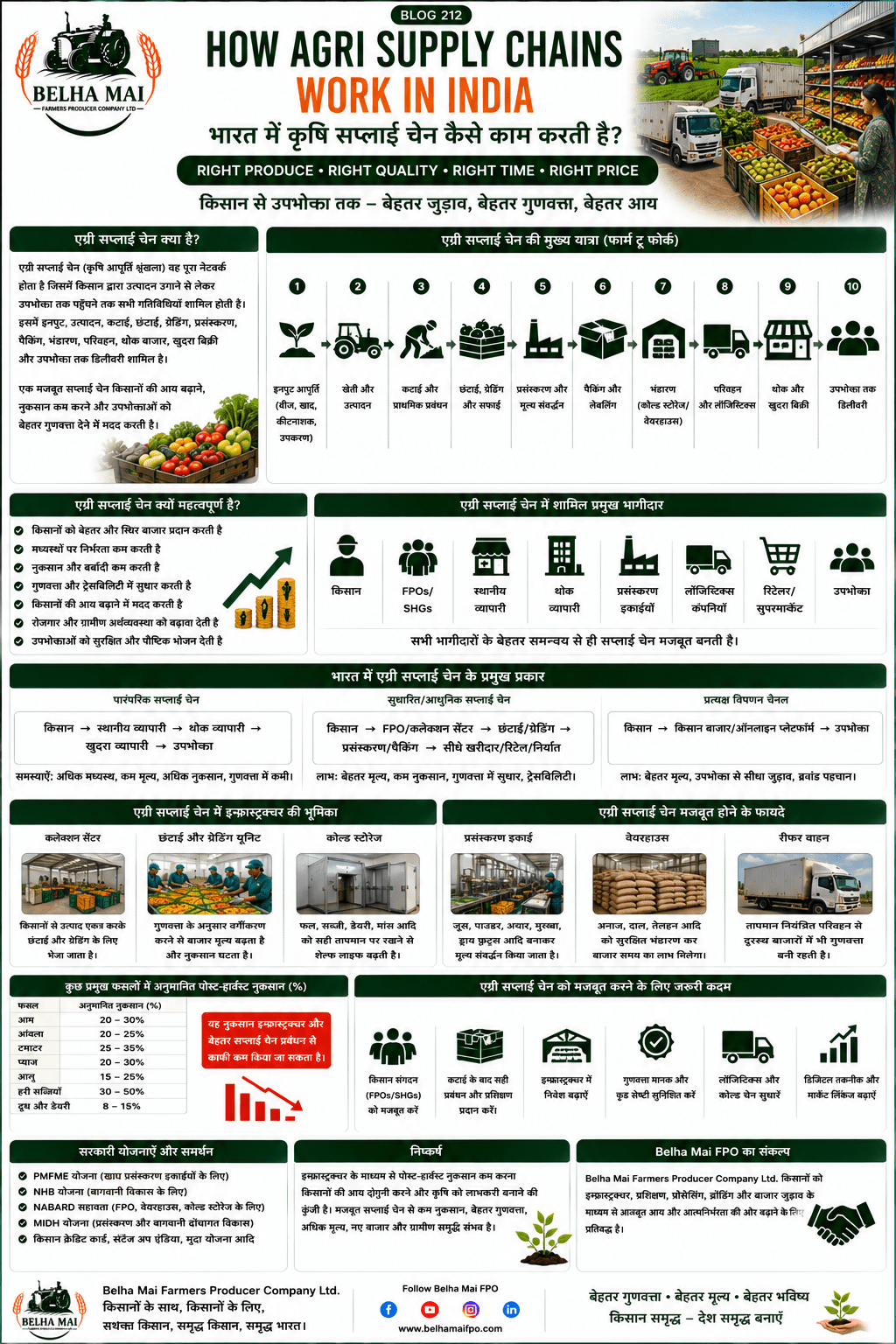
How Agri Supply Chains Work in India it is the systems that connect farmers with consumers, traders, processors, retailers, exporters and institutions. A crop does not simply move from farm to plate in one step. It passes through many stages such as harvesting, aggregation, cleaning, sorting, grading, storage, processing, packaging, transport and marketing. When the agri supply chain is weak, farmers receive lower prices, post-harvest losses increase and consumers may pay more for lower-quality products.
भारत में कृषि सप्लाई चेन वह प्रणाली है जो किसानों को उपभोक्ताओं, व्यापारियों, प्रोसेसरों, रिटेलर्स, निर्यातकों और संस्थानों से जोड़ती है। कोई भी फसल खेत से सीधे थाली तक एक ही कदम में नहीं पहुंचती। वह harvesting, aggregation, cleaning, sorting, grading, storage, processing, packaging, transport और marketing जैसे कई चरणों से गुजरती है। जब कृषि सप्लाई चेन कमजोर होती है, तो किसानों को कम कीमत मिलती है, कटाई-बाद नुकसान बढ़ता है और उपभोक्ताओं को कम गुणवत्ता के उत्पाद के लिए अधिक कीमत देनी पड़ सकती है।
Meaning of Agri Supply Chain
Agri supply chain means the complete journey of agricultural produce from input supply and farm production to final consumption. It includes seed, fertilizer, farm machinery, crop production, harvesting, primary processing, aggregation, storage, transport, wholesale trade, retail sale, processing and consumer delivery. Agri supply chains in India are very important because they decide how much value farmers receive and how efficiently food reaches consumers.
कृषि सप्लाई चेन का अर्थ है कृषि उत्पादन की पूरी यात्रा, जो input supply और farm production से final consumption तक जाती है। इसमें seed, fertilizer, farm machinery, crop production, harvesting, primary processing, aggregation, storage, transport, wholesale trade, retail sale, processing और consumer delivery शामिल हैं। भारत में कृषि सप्लाई चेन बहुत महत्वपूर्ण है क्योंकि यही तय करती है कि किसानों को कितना मूल्य मिलेगा और भोजन उपभोक्ताओं तक कितनी कुशलता से पहुंचेगा।
Why Agri Supply Chains Matter
Agri supply chains in India matter because farmers often produce good crops but lose value after harvest due to poor market linkage, weak storage, middlemen dependence and lack of processing. A strong supply chain reduces wastage, improves quality, increases transparency and creates better income opportunities. For small farmers, supply chain support is especially important because they cannot individually handle transport, storage, grading and buyer negotiation at scale.
भारत में कृषि सप्लाई चेन इसलिए महत्वपूर्ण है क्योंकि किसान अक्सर अच्छी फसल पैदा करते हैं, लेकिन कटाई के बाद कमजोर market linkage, कमजोर storage, middlemen dependence और processing की कमी के कारण value खो देते हैं। मजबूत supply chain wastage कम करती है, quality सुधारती है, transparency बढ़ाती है और बेहतर income opportunities बनाती है। छोटे किसानों के लिए supply chain support विशेष रूप से महत्वपूर्ण है क्योंकि वे व्यक्तिगत रूप से transport, storage, grading और buyer negotiation को बड़े स्तर पर संभाल नहीं पाते।
Main Stages of Agri Supply Chains in India
Agri supply chains in India usually begin with input supply and crop production. After harvest, produce moves to aggregation, sorting, grading, packing, storage, processing, transport, wholesale markets, retail markets and finally consumers. In some cases, produce may go directly from farmer to consumer, but in most cases it passes through multiple actors. Every stage adds cost, risk and value, depending on how well the system is managed.
भारत में कृषि सप्लाई चेन सामान्यतः input supply और crop production से शुरू होती है। कटाई के बाद उत्पादन aggregation, sorting, grading, packing, storage, processing, transport, wholesale markets, retail markets और अंत में consumers तक जाता है। कुछ मामलों में उत्पादन सीधे किसान से उपभोक्ता तक जा सकता है, लेकिन अधिकतर मामलों में यह कई actors से होकर गुजरता है। हर stage cost, risk और value जोड़ती है, यह इस बात पर निर्भर करता है कि system कितनी अच्छी तरह manage होता है।
Input Supply Stage
The first stage of agri supply chains in India is input supply. Farmers need seeds, fertilizers, pesticides, bio-inputs, irrigation support, machinery and technical guidance before production begins. If input quality is poor or input availability is delayed, crop productivity can suffer. FPOs can help farmers access genuine inputs, bulk purchase benefits and timely advisory. A strong input supply stage creates the foundation for better production.
भारत में कृषि सप्लाई चेन का पहला चरण input supply है। किसानों को production शुरू होने से पहले seeds, fertilizers, pesticides, bio-inputs, irrigation support, machinery और technical guidance की जरूरत होती है। यदि input quality खराब हो या input availability देर से हो, तो crop productivity प्रभावित हो सकती है। FPOs किसानों को genuine inputs, bulk purchase benefits और timely advisory उपलब्ध कराने में मदद कर सकते हैं। मजबूत input supply stage बेहतर production की नींव बनाता है।
Farm Production Stage
Farm production is the core stage of the supply chain where farmers grow crops, fruits, vegetables, grains, honey, livestock products or other agricultural produce. Production quality depends on seeds, soil, water, weather, crop management, plant protection and farmer knowledge. Agri supply chains in India become stronger when production is planned according to market demand, quality standards and buyer requirements.
Farm production supply chain का मुख्य चरण है, जहां किसान crops, fruits, vegetables, grains, honey, livestock products या अन्य agricultural produce तैयार करते हैं। Production quality seeds, soil, water, weather, crop management, plant protection और farmer knowledge पर निर्भर करती है। भारत में कृषि सप्लाई चेन तब मजबूत होती है जब production को market demand, quality standards और buyer requirements के अनुसार plan किया जाता है।
Harvesting Stage
Harvesting is a critical stage in agri supply chains in India because wrong harvesting time can reduce quality and market value. Fruits harvested too early may not ripen properly, and vegetables harvested too late may lose freshness. Grains harvested with high moisture may suffer storage problems. Farmers need crop-specific harvesting guidance so that quality remains strong from the beginning of the supply chain.
Harvesting भारत में कृषि सप्लाई चेन का critical stage है क्योंकि गलत harvesting time quality और market value को कम कर सकता है। बहुत जल्दी तोड़े गए fruits सही तरीके से ripen नहीं हो सकते, और बहुत देर से harvested vegetables freshness खो सकती हैं। High moisture के साथ harvested grains में storage problems हो सकती हैं। किसानों को crop-specific harvesting guidance की जरूरत होती है ताकि supply chain की शुरुआत से ही quality मजबूत रहे।
Aggregation Stage
Aggregation means collecting produce from many farmers at one place. This is very important in Indian agriculture because most farmers have small quantities. A buyer may not come to every small farmer separately, but if an FPO aggregates produce from many farmers, the volume becomes attractive. Aggregation improves bargaining power, reduces transport cost and makes sorting, grading, storage and marketing easier.
Aggregation का अर्थ है कई किसानों का उत्पादन एक जगह इकट्ठा करना। भारतीय कृषि में यह बहुत महत्वपूर्ण है क्योंकि अधिकांश किसानों के पास छोटी मात्रा होती है। कोई buyer हर छोटे किसान के पास अलग-अलग नहीं आ सकता, लेकिन यदि FPO कई किसानों का produce aggregate करे, तो volume attractive बन जाता है। Aggregation bargaining power सुधारता है, transport cost कम करता है और sorting, grading, storage तथा marketing को आसान बनाता है।
Sorting and Grading Stage
Sorting and grading are important stages in agri supply chains in India. Sorting removes damaged, diseased or poor-quality produce, while grading separates good produce according to size, colour, maturity and quality. This helps farmers sell premium produce at better prices and use lower-grade produce for processing. Without sorting and grading, mixed produce often receives lower market value.
Sorting और grading भारत में कृषि सप्लाई चेन के महत्वपूर्ण चरण हैं। Sorting damaged, diseased या poor-quality produce को हटाती है, जबकि grading अच्छे produce को size, colour, maturity और quality के अनुसार अलग करती है। इससे किसान premium produce को better prices पर बेच सकते हैं और lower-grade produce को processing में उपयोग कर सकते हैं। Sorting और grading के बिना mixed produce को अक्सर lower market value मिलती है।
Packing Stage
Packing protects agricultural produce during storage, transport and sale. Good packing reduces damage, improves appearance and builds buyer confidence. Fruits and vegetables may require crates, cartons or pouches, while grains and processed products may need bags, packets or jars. Agri supply chains in India become more professional when packing is clean, standardised and linked with proper labelling.
Packing storage, transport और sale के दौरान agricultural produce की रक्षा करती है। अच्छी packing damage कम करती है, appearance सुधारती है और buyer confidence बनाती है। Fruits और vegetables को crates, cartons या pouches की जरूरत हो सकती है, जबकि grains और processed products को bags, packets या jars की आवश्यकता हो सकती है। भारत में कृषि सप्लाई चेन तब अधिक professional बनती है जब packing clean, standardised और proper labelling से जुड़ी हो।
Storage Stage
Storage is a key stage in agri supply chains in India. Perishable products like fruits and vegetables may need cold storage, while grains, pulses and seeds need dry and safe warehouses. Without proper storage, farmers are forced to sell immediately at low prices or face spoilage. Storage gives farmers and FPOs holding power and helps them sell when market prices are better.
Storage भारत में कृषि सप्लाई चेन का key stage है। Fruits और vegetables जैसे perishable products को cold storage की जरूरत हो सकती है, जबकि grains, pulses और seeds को dry और safe warehouses चाहिए। Proper storage के बिना किसान low prices पर तुरंत बेचने या spoilage झेलने के लिए मजबूर हो जाते हैं। Storage farmers और FPOs को holding power देता है और बेहतर market prices पर sale में मदद करता है।
Cold Chain Stage
Cold chain is the temperature-controlled part of agri supply chains in India. It includes pre-cooling, cold storage, refrigerated transport and retail cold display. Cold chain is important for fruits, vegetables, dairy, flowers, meat, fish and processed foods. If the cold chain breaks, quality can decline quickly. A strong cold chain reduces losses and helps farmers reach premium and distant markets.
Cold chain भारत में कृषि सप्लाई चेन का temperature-controlled हिस्सा है। इसमें pre-cooling, cold storage, refrigerated transport और retail cold display शामिल हैं। Cold chain fruits, vegetables, dairy, flowers, meat, fish और processed foods के लिए महत्वपूर्ण है। यदि cold chain टूट जाती है, तो quality जल्दी घट सकती है। मजबूत cold chain losses कम करती है और किसानों को premium तथा distant markets तक पहुंचने में मदद करती है।
Processing Stage
Processing adds value to agricultural produce by converting raw products into finished or semi-finished products. Mango can become pulp or dried slices, amla can become powder or candy, wheat can become atta or dalia, and honey can be filtered, tested and bottled. Agri supply chains in India become more profitable when farmers and FPOs participate in processing instead of selling only raw produce.
Processing raw products को finished या semi-finished products में बदलकर agricultural produce में value add करती है। Mango pulp या dried slices बन सकता है, amla powder या candy बन सकता है, wheat atta या dalia बन सकता है, और honey filter, test और bottle किया जा सकता है। भारत में कृषि सप्लाई चेन तब अधिक profitable बनती है जब farmers और FPOs केवल raw produce बेचने के बजाय processing में भाग लेते हैं।
Transport and Logistics Stage
Transport and logistics move agricultural produce from farm to collection centre, packhouse, warehouse, processing unit, wholesale market, retail store or consumer. Poor transport causes delay, damage and quality loss. Good logistics planning includes proper vehicles, crates, route planning, delivery timing and documentation. Agri supply chains in India need better logistics to reduce losses and improve farmer returns.
Transport और logistics agricultural produce को farm से collection centre, packhouse, warehouse, processing unit, wholesale market, retail store या consumer तक ले जाते हैं। Poor transport delay, damage और quality loss पैदा करता है। Good logistics planning में proper vehicles, crates, route planning, delivery timing और documentation शामिल होते हैं। भारत में कृषि सप्लाई चेन को losses कम करने और farmer returns सुधारने के लिए better logistics की जरूरत है।
Wholesale Market Stage
Wholesale markets or mandis are still a major part of agri supply chains in India. Farmers or traders bring produce to these markets, where it is sold to wholesalers, commission agents, retailers or processors. Mandis provide a market platform, but farmers may face price fluctuation, high deductions, quality mixing and dependence on intermediaries. FPOs can help farmers negotiate better and explore alternative channels.
Wholesale markets या mandis अभी भी भारत में कृषि सप्लाई चेन का बड़ा हिस्सा हैं। किसान या traders इन markets में produce लाते हैं, जहां इसे wholesalers, commission agents, retailers या processors को बेचा जाता है। Mandis market platform देती हैं, लेकिन किसानों को price fluctuation, high deductions, quality mixing और intermediaries पर dependence जैसी समस्याएं हो सकती हैं। FPOs किसानों को better negotiation और alternative channels खोजने में मदद कर सकते हैं।
Retail and Consumer Stage
The final stage of agri supply chains in India is retail and consumer delivery. Produce may reach consumers through local shops, supermarkets, online platforms, weekly markets, institutional kitchens or direct farmer markets. Consumers want quality, freshness, safety and fair price. A strong supply chain ensures that farmers receive better value while consumers receive better products.
भारत में कृषि सप्लाई चेन का अंतिम stage retail और consumer delivery है। Produce local shops, supermarkets, online platforms, weekly markets, institutional kitchens या direct farmer markets के माध्यम से consumers तक पहुंच सकता है। Consumers quality, freshness, safety और fair price चाहते हैं। Strong supply chain सुनिश्चित करती है कि किसानों को better value मिले और consumers को better products मिलें।
Traditional Agri Supply Chain
In a traditional agri supply chain, produce usually moves from farmer to village trader, then to mandi, wholesaler, retailer and finally consumer. This chain may be long and include many intermediaries. Long chains can increase cost and reduce farmer share in consumer price. However, traditional chains still exist because they provide quick buying, credit support and market access in many areas.
Traditional agri supply chain में produce सामान्यतः farmer से village trader, फिर mandi, wholesaler, retailer और अंत में consumer तक जाता है। यह chain लंबी हो सकती है और कई intermediaries शामिल कर सकती है। Long chains cost बढ़ा सकती हैं और consumer price में farmer share कम कर सकती हैं। हालांकि traditional chains अभी भी मौजूद हैं क्योंकि वे कई क्षेत्रों में quick buying, credit support और market access प्रदान करती हैं।
Modern Agri Supply Chain
A modern agri supply chain uses aggregation, packhouses, cold storage, processing, digital records, buyer contracts, logistics planning and quality standards. It reduces unnecessary handling and improves efficiency. FPOs, startups, processors, retailers and exporters can build modern supply chains with farmers. This helps reduce losses, improve quality and create better market opportunities.
Modern agri supply chain aggregation, packhouses, cold storage, processing, digital records, buyer contracts, logistics planning और quality standards का उपयोग करती है। यह unnecessary handling कम करती है और efficiency सुधारती है। FPOs, startups, processors, retailers और exporters किसानों के साथ modern supply chains बना सकते हैं। इससे losses कम होते हैं, quality सुधरती है और better market opportunities बनती हैं।
Direct-to-Consumer Supply Chain
Direct-to-consumer supply chain connects farmers or FPOs directly with consumers through farmers’ markets, online platforms, community buying, subscription models or local delivery. This can increase farmer share and improve consumer trust. However, it requires branding, packaging, logistics, quality consistency and customer service. It is suitable for selected products and locations when managed professionally.
Direct-to-consumer supply chain farmers या FPOs को farmers’ markets, online platforms, community buying, subscription models या local delivery के माध्यम से directly consumers से जोड़ती है। इससे farmer share बढ़ सकता है और consumer trust सुधर सकता है। हालांकि इसके लिए branding, packaging, logistics, quality consistency और customer service की जरूरत होती है। यह selected products और locations के लिए उपयुक्त है, जब इसे professionally manage किया जाए।
Role of FPOs in Agri Supply Chains
FPOs play a powerful role in agri supply chains in India because they organize small farmers into collective business units. An FPO can aggregate produce, supply inputs, provide training, create collection centres, manage sorting and grading, arrange storage, start processing and negotiate with buyers. FPOs reduce the weakness of small individual farmers and help them participate in larger markets.
FPOs भारत में कृषि सप्लाई चेन में शक्तिशाली भूमिका निभाते हैं क्योंकि वे छोटे किसानों को collective business units में organize करते हैं। एक FPO produce aggregate कर सकता है, inputs supply कर सकता है, training दे सकता है, collection centres बना सकता है, sorting और grading manage कर सकता है, storage arrange कर सकता है, processing शुरू कर सकता है और buyers से negotiate कर सकता है। FPOs छोटे individual farmers की weakness कम करते हैं और उन्हें larger markets में भाग लेने में मदद करते हैं।
Role of Infrastructure
Infrastructure is the backbone of agri supply chains in India. Collection centres, packhouses, cold storage, warehouses, ripening chambers, dehydration units, processing units, testing labs and transport vehicles help protect produce and improve value. Without infrastructure, farmers remain dependent on immediate sale. With infrastructure, produce can be handled professionally and linked with better markets.
Infrastructure भारत में कृषि सप्लाई चेन की backbone है। Collection centres, packhouses, cold storage, warehouses, ripening chambers, dehydration units, processing units, testing labs और transport vehicles produce की रक्षा करते हैं और value सुधारते हैं। Infrastructure के बिना farmers immediate sale पर dependent रहते हैं। Infrastructure के साथ produce को professionally handle करके better markets से जोड़ा जा सकता है।
Role of Digital Technology
Digital technology is becoming important in agri supply chains in India. Mobile apps, farmer databases, digital payments, inventory management, traceability systems, weather alerts, market price information and e-commerce platforms can improve transparency and efficiency. Digital tools help FPOs plan procurement, manage stock, connect with buyers and track payments. Technology can reduce confusion and improve coordination.
Digital technology भारत में कृषि सप्लाई चेन में महत्वपूर्ण होती जा रही है। Mobile apps, farmer databases, digital payments, inventory management, traceability systems, weather alerts, market price information और e-commerce platforms transparency और efficiency सुधार सकते हैं। Digital tools FPOs को procurement plan करने, stock manage करने, buyers से connect करने और payments track करने में मदद करते हैं। Technology confusion कम करके coordination सुधार सकती है।
Role of Food Processing in Supply Chains
Food processing strengthens agri supply chains by converting raw produce into value-added products. Processing reduces dependence on fresh market prices and helps farmers sell products with longer shelf life. It also creates rural employment and supports branding. Agri supply chains in India become stronger when processing is located near production clusters and connected with markets.
Food processing raw produce को value-added products में बदलकर agri supply chains को मजबूत करती है। Processing fresh market prices पर dependence कम करती है और farmers को longer shelf life वाले products बेचने में मदद करती है। यह rural employment बनाती है और branding को support करती है। भारत में कृषि सप्लाई चेन तब मजबूत होती है जब processing production clusters के पास हो और markets से connected हो।
Challenges in Agri Supply Chains in India
Agri supply chains in India face many challenges such as fragmented landholdings, small produce volumes, weak storage, poor grading, high transport cost, delayed payments, price volatility, weak processing, lack of cold chain and limited market information. Farmers often have low bargaining power. These challenges can be reduced through FPOs, infrastructure, digital tools, value addition and stronger buyer linkages.
भारत में कृषि सप्लाई चेन कई challenges का सामना करती है, जैसे fragmented landholdings, small produce volumes, weak storage, poor grading, high transport cost, delayed payments, price volatility, weak processing, lack of cold chain और limited market information। किसानों की bargaining power अक्सर कम होती है। इन challenges को FPOs, infrastructure, digital tools, value addition और stronger buyer linkages के माध्यम से कम किया जा सकता है।
How Strong Supply Chains Increase Farmer Income
Strong agri supply chains in India increase farmer income by reducing losses, improving quality, lowering transport cost, creating better market access and enabling value addition. When farmers sell organized, graded and packed produce, buyers trust them more. When FPOs aggregate produce and negotiate collectively, farmers get better bargaining power. Strong supply chains help farmers capture more value from the same crop.
भारत में मजबूत कृषि सप्लाई चेन losses कम करके, quality सुधारकर, transport cost घटाकर, better market access बनाकर और value addition को enable करके farmer income बढ़ाती है। जब किसान organized, graded और packed produce बेचते हैं, तो buyers उन्हें अधिक trust करते हैं। जब FPOs produce aggregate करके collectively negotiate करते हैं, तो किसानों की bargaining power बढ़ती है। Strong supply chains किसानों को उसी crop से अधिक value capture करने में मदद करती हैं।
Supply Chain for Mango
Mango supply chain includes harvesting at proper maturity, sorting, grading, ripening, cold storage, packing, transport, wholesale or retail sale, processing and export where possible. Mango is highly sensitive to handling and ripening. A strong mango supply chain can reduce wastage and increase value through fresh fruit sale, pulp, dried mango slices, aamchur and branded mango products.
Mango supply chain में proper maturity पर harvesting, sorting, grading, ripening, cold storage, packing, transport, wholesale या retail sale, processing और जहां संभव हो export शामिल हैं। Mango handling और ripening के प्रति highly sensitive है। Strong mango supply chain wastage कम कर सकती है और fresh fruit sale, pulp, dried mango slices, aamchur तथा branded mango products के माध्यम से value बढ़ा सकती है।
Supply Chain for Amla
Amla supply chain includes harvesting, cleaning, sorting, grading, storage, processing and marketing. Amla can be sold fresh, but it has strong value addition potential through powder, candy, murabba, juice and dried amla. For amla-growing regions, FPO-led supply chains can help farmers move beyond raw selling and enter processing, branding and institutional markets.
Amla supply chain में harvesting, cleaning, sorting, grading, storage, processing और marketing शामिल हैं। Amla fresh बेचा जा सकता है, लेकिन इसमें powder, candy, murabba, juice और dried amla के माध्यम से strong value addition potential है। Amla-growing regions में FPO-led supply chains किसानों को raw selling से आगे बढ़ाकर processing, branding और institutional markets में प्रवेश कराने में मदद कर सकती हैं।
Supply Chain for Grains and Staples
Grain and staple supply chains include procurement, cleaning, drying, storage, milling, packaging, branding and distribution. Wheat can become atta, maida, suji and dalia. Rice can be cleaned, graded and packed. Millets can become flour and value-added products. Strong grain supply chains can help FPOs build branded food products and supply retail or institutional buyers.
Grain और staple supply chains में procurement, cleaning, drying, storage, milling, packaging, branding और distribution शामिल हैं। Wheat atta, maida, suji और dalia बन सकता है। Rice clean, grade और pack किया जा सकता है। Millets flour और value-added products बन सकते हैं। Strong grain supply chains FPOs को branded food products बनाने और retail या institutional buyers को supply करने में मदद कर सकती हैं।
Supply Chain for Honey
Honey supply chain includes beekeeping, honey extraction, filtration, moisture control, testing, storage, bottling, labelling and marketing. Loose honey may receive lower value, while tested, processed and branded honey can enter better markets. FPOs can aggregate honey from beekeepers and develop brands with quality assurance. Strong honey supply chains can support beekeepers and rural enterprises.
Honey supply chain में beekeeping, honey extraction, filtration, moisture control, testing, storage, bottling, labelling और marketing शामिल हैं। Loose honey को lower value मिल सकती है, जबकि tested, processed और branded honey better markets में enter कर सकता है। FPOs beekeepers से honey aggregate करके quality assurance के साथ brands develop कर सकते हैं। Strong honey supply chains beekeepers और rural enterprises को support कर सकती हैं।
Government Schemes and Support
Agri supply chains in India may receive support through agriculture, horticulture, food processing, cold chain, warehouse, PMFME, FPO, MSME, NABARD, APEDA and rural enterprise schemes depending on eligibility and project design. Farmers and FPOs should check updated information from official sources before investment. Scheme rules may change, so proper project planning and verification are necessary.
भारत में कृषि सप्लाई चेन को eligibility और project design के अनुसार agriculture, horticulture, food processing, cold chain, warehouse, PMFME, FPO, MSME, NABARD, APEDA और rural enterprise schemes से support मिल सकता है। Farmers और FPOs को investment से पहले official sources से updated information check करनी चाहिए। Scheme rules बदल सकते हैं, इसलिए proper project planning और verification आवश्यक है।
Belha Mai FPO Vision
Belha Mai Farmers Producer Company Ltd. believes that strong agri supply chains in India can improve farmer income, reduce post-harvest losses and create rural enterprises. Through aggregation, sorting, grading, storage, dehydration, food processing, packaging, branding and market linkage, Belha Mai FPO aims to connect farmers with better markets. A strong supply chain can turn farming from only production into a complete value chain business.
Belha Mai Farmers Producer Company Ltd. का मानना है कि भारत में मजबूत कृषि सप्लाई चेन farmer income सुधार सकती है, post-harvest losses कम कर सकती है और rural enterprises बना सकती है। Aggregation, sorting, grading, storage, dehydration, food processing, packaging, branding और market linkage के माध्यम से Belha Mai FPO किसानों को better markets से जोड़ना चाहता है। Strong supply chain खेती को केवल production से complete value chain business में बदल सकती है।
Conclusion
Agri supply chains in India connect farmers with consumers through many stages such as input supply, production, harvesting, aggregation, sorting, grading, packing, storage, processing, transport, wholesale, retail and final consumption. A weak supply chain reduces farmer income and increases losses, while a strong supply chain improves quality, market access, bargaining power and value addition. For farmers and FPOs, understanding and improving the agri supply chain is essential for building sustainable and profitable agriculture.
भारत में कृषि सप्लाई चेन input supply, production, harvesting, aggregation, sorting, grading, packing, storage, processing, transport, wholesale, retail और final consumption जैसे कई stages के माध्यम से किसानों को consumers से जोड़ती है। Weak supply chain farmer income कम करती है और losses बढ़ाती है, जबकि strong supply chain quality, market access, bargaining power और value addition सुधारती है। Farmers और FPOs के लिए sustainable और profitable agriculture बनाने के लिए agri supply chain को समझना और सुधारना आवश्यक है।
FAQ
What are agri supply chains in India?
Agri supply chains in India are the systems that move agricultural produce from farmers to consumers through aggregation, grading, storage, processing, transport and marketing.
भारत में कृषि सप्लाई चेन वह system है जो agricultural produce को aggregation, grading, storage, processing, transport और marketing के माध्यम से farmers से consumers तक पहुंचाता है।
Why are agri supply chains important for farmers?
Agri supply chains are important because they reduce losses, improve quality, increase market access, support value addition and help farmers get better prices.
कृषि सप्लाई चेन इसलिए महत्वपूर्ण है क्योंकि यह losses कम करती है, quality सुधारती है, market access बढ़ाती है, value addition को support करती है और farmers को better prices दिलाने में मदद करती है।
What is the role of FPOs in agri supply chains?
FPOs help farmers by aggregating produce, arranging inputs, creating collection centres, sorting and grading produce, managing storage and connecting with better buyers.
FPOs produce aggregate करके, inputs arrange करके, collection centres बनाकर, produce sorting और grading करके, storage manage करके और better buyers से जोड़कर किसानों की मदद करते हैं।
How does cold storage help agri supply chains?
Cold storage helps agri supply chains by reducing spoilage, maintaining quality, increasing shelf life and allowing farmers to sell at better market timing.
Cold storage spoilage कम करके, quality बनाए रखकर, shelf life बढ़ाकर और किसानों को better market timing पर sell करने की सुविधा देकर agri supply chains को help करता है।
How can food processing improve agri supply chains?
Food processing improves agri supply chains by converting raw produce into value-added products with better shelf life, branding and market value.
Food processing raw produce को better shelf life, branding और market value वाले value-added products में बदलकर agri supply chains को improve करती है।
Internal Links Section
👉 High-Tech Nursery in India: Complete Guide —https://belhamaifpo.com/agriculture/high-tech-nursery-in-india-complete-guide/
👉 Reducing Post-Harvest Losses Through Infrastructure — https://belhamaifpo.com/agriculture/reducing-post-harvest-losses-through-infrastructure/
👉 Benefits of Food Processing for Farmers — https://belhamaifpo.com/agriculture/benefits-of-food-processing-for-farmers/
👉 Dehydration of Fruits and Vegetables: Complete Guide — https://belhamaifpo.com/agriculture/dehydration-of-fruits-and-vegetables-complete-guide/
👉 Sorting and Grading in Agriculture Explained — https://belhamaifpo.com/agriculture/sorting-and-grading-in-agriculture-explained/
👉 Importance of Cold Storage in Agriculture — https://belhamaifpo.com/agriculture/importance-of-cold-storage-in-agriculture/
👉 What is a Ripening Chamber and How It Works —https://belhamaifpo.com/agriculture/what-is-a-ripening-chamber-and-how-it-works/
👉 Mango Farming in India: Complete Guide —https://belhamaifpo.com/agriculture/mango-farming-in-india/
👉 Amla Farming in India: Complete Guide —https://belhamaifpo.com/agriculture/amla-farming-in-india/
👉 Rajvi Bhog Food Products: Complete Guide —https://belhamaifpo.com/agriculture/rajvi-bhog-food-products-quality-export-guide/
👉 Honey Processing in India: Complete Guide —https://belhamaifpo.com/agriculture/honey-processing-in-india-complete-guide/
👉 How Quality Planting Material Increases Yield —https://belhamaifpo.com/agriculture/how-quality-planting-material-increases-yield/
👉 Role of Nurseries in Improving Crop Productivity — https://belhamaifpo.com/agriculture/role-of-nurseries-in-improving-crop-productivity/
👉 Best Agroforestry Models in India — https://belhamaifpo.com/agriculture/best-agroforestry-models-in-india/
👉 Economic Benefits of Tree-Based Farming — https://belhamaifpo.com/agriculture/economic-benefits-of-tree-based-farming/
👉 Why small farmers struggle in India — https://belhamaifpo.com/agriculture/why-small-farmers-struggle-in-india/
👉 Belha Mai FPO Website — https://belhamaifpo.com/
External Authority Links
👉 Ministry of Agriculture & Farmers Welfare — https://agriwelfare.gov.in/
👉 Ministry of Food Processing Industries — https://mofpi.gov.in/
👉 PMFME Scheme — https://pmfme.mofpi.gov.in/
👉 National Horticulture Board — https://nhb.gov.in/
👉 APEDA — https://apeda.gov.in/
👉 FSSAI — https://fssai.gov.in/
👉 NABARD — https://nabard.org/
👉 MSME — https://msme.gov.in/
Follow Belha Mai FPO for More Updates
Website: https://belhamaifpo.com/
Facebook:https://www.facebook.com/profile.php?id=61561043486818
YouTube: https://www.youtube.com/channel/UC9ZvojoTMCa7mU1-Q_Bh60A
LinkedIn: https://www.linkedin.com/in/abhay-singh-ab5568280/
Instagram:https://instagram.com/belhamaifpo
Belha Mai FPO is working to support farmers through better information, technology, market linkage, value addition, FPO awareness and rural development.