इन्फ्रास्ट्रक्चर के माध्यम से कटाई-बाद नुकसान कम करना
Introduction
Reducing post-harvest losses is one of the most important steps for improving farmer income in India. Farmers work hard to produce fruits, vegetables, grains and other agricultural products, but a large portion of value is often lost after harvesting due to poor handling, lack of storage, weak transport, improper grading and limited processing facilities. Post-harvest infrastructure helps protect produce after harvest and ensures that farmers get better value from the crop they have already produced.
भारत में किसान आय सुधारने के लिए कटाई-बाद नुकसान कम करना सबसे महत्वपूर्ण कदमों में से एक है। किसान फल, सब्जियां, अनाज और अन्य कृषि उत्पाद तैयार करने के लिए कड़ी मेहनत करते हैं, लेकिन कटाई के बाद खराब handling, storage की कमी, कमजोर transport, improper grading और limited processing facilities के कारण अक्सर मूल्य का बड़ा हिस्सा खो जाता है। Post-harvest infrastructure कटाई के बाद उत्पादन की रक्षा करता है और यह सुनिश्चित करता है कि किसानों को पहले से तैयार फसल का बेहतर मूल्य मिले।
What are Post-Harvest Losses?
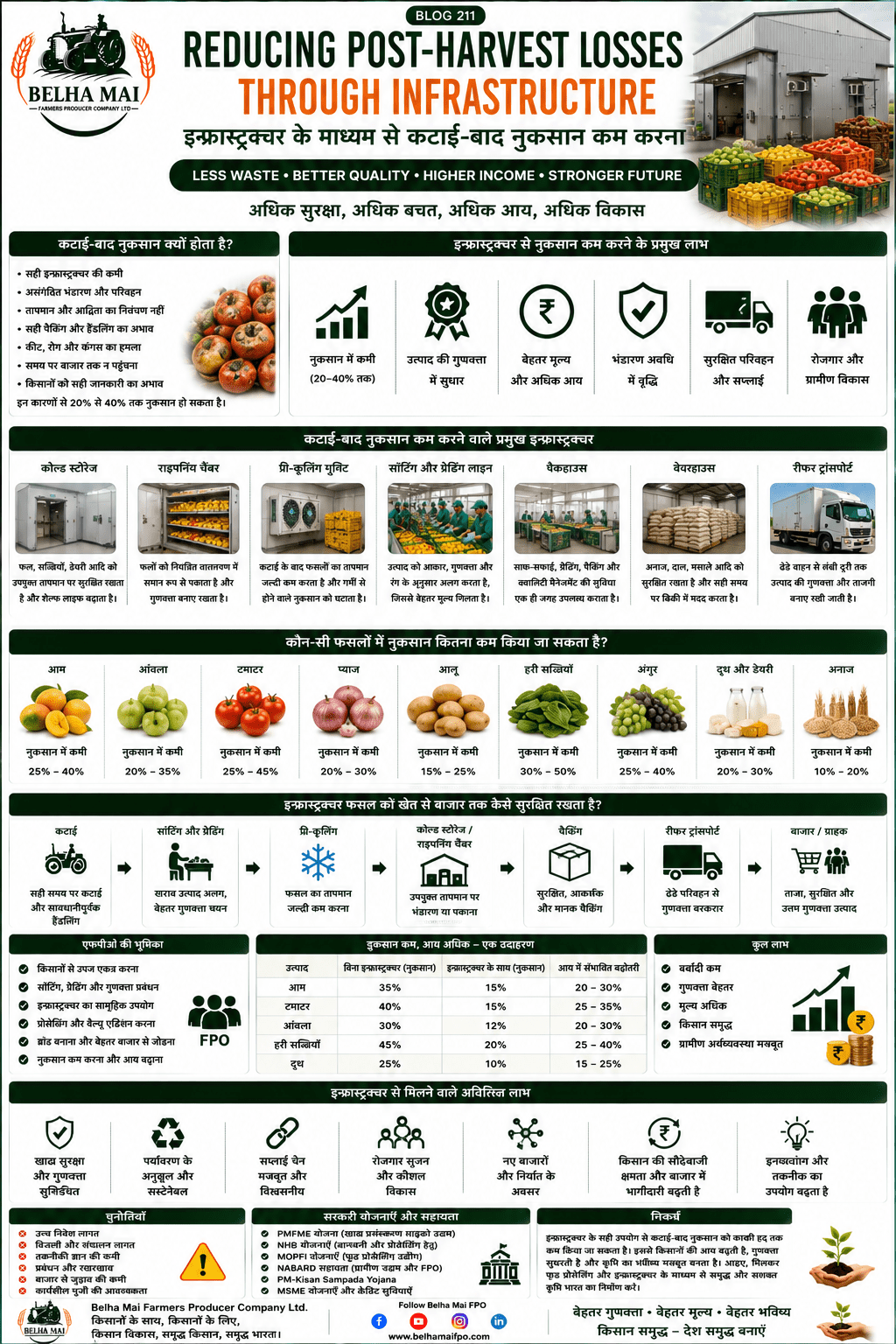
Post-harvest losses mean the loss of quantity, quality or value of agricultural produce after harvesting and before final consumption or processing. These losses can happen during harvesting, cleaning, sorting, grading, packing, storage, transport, ripening, processing or marketing. Reducing post-harvest losses means saving produce, maintaining quality and protecting farmer income through better systems and infrastructure.
कटाई-बाद नुकसान का अर्थ है कटाई के बाद और अंतिम उपभोग या प्रोसेसिंग से पहले कृषि उत्पादन की मात्रा, गुणवत्ता या मूल्य का नुकसान। यह नुकसान harvesting, cleaning, sorting, grading, packing, storage, transport, ripening, processing या marketing के दौरान हो सकता है। कटाई-बाद नुकसान कम करने का अर्थ है बेहतर systems और infrastructure के माध्यम से उत्पादन बचाना, गुणवत्ता बनाए रखना और किसान आय की रक्षा करना।
Why Post-Harvest Losses Happen
Post-harvest losses happen because many farmers do not have access to proper infrastructure after harvest. Fruits and vegetables may spoil due to heat, moisture loss, rough handling, poor packaging and delayed transport. Grains may suffer from moisture, insects, rodents and poor storage. Without cold storage, packhouses, warehouses, sorting units and processing facilities, farmers are often forced to sell quickly at low prices or face wastage.
कटाई-बाद नुकसान इसलिए होता है क्योंकि कई किसानों के पास कटाई के बाद उचित infrastructure की पहुंच नहीं होती। फल और सब्जियां heat, moisture loss, rough handling, poor packaging और delayed transport के कारण खराब हो सकती हैं। अनाज moisture, insects, rodents और poor storage से प्रभावित हो सकते हैं। cold storage, packhouses, warehouses, sorting units और processing facilities के बिना किसान अक्सर कम कीमत पर जल्दी बेचने या बर्बादी झेलने के लिए मजबूर हो जाते हैं।
Importance of Infrastructure in Reducing Losses
Reducing post-harvest losses through infrastructure is important because infrastructure creates a protective chain between farm and market. Produce needs proper handling after harvesting. If the produce is cleaned, sorted, graded, packed, stored, transported and processed properly, losses are reduced and quality improves. Infrastructure gives farmers more time, better bargaining power and better market access.
इन्फ्रास्ट्रक्चर के माध्यम से कटाई-बाद नुकसान कम करना महत्वपूर्ण है क्योंकि infrastructure खेत और बाजार के बीच एक protective chain बनाता है। कटाई के बाद उत्पादन को सही handling की आवश्यकता होती है। यदि उत्पादन को सही तरीके से clean, sort, grade, pack, store, transport और process किया जाए, तो नुकसान कम होता है और quality सुधरती है। infrastructure किसानों को अधिक समय, बेहतर bargaining power और बेहतर market access देता है।
Cold Storage Infrastructure
Cold storage is one of the most important tools for reducing post-harvest losses in fruits, vegetables, flowers, dairy and other perishable products. Cold storage slows down spoilage by controlling temperature and humidity. It helps farmers store produce for longer periods and avoid distress sales during low-price periods. For crops like mango, amla, tomato and vegetables, cold storage can protect quality and improve market timing.
Cold storage फल, सब्जियों, फूल, dairy और अन्य perishable products में कटाई-बाद नुकसान कम करने का सबसे महत्वपूर्ण साधन है। Cold storage temperature और humidity control करके खराब होने की गति धीमी करता है। यह किसानों को उत्पादन को अधिक समय तक store करने और low-price periods में distress sale से बचने में मदद करता है। आम, आंवला, टमाटर और सब्जियों जैसी crops के लिए cold storage quality बचा सकता है और market timing सुधार सकता है।
Packhouse Infrastructure
A packhouse is a facility where agricultural produce is cleaned, sorted, graded, packed and prepared for storage or transport. Packhouse infrastructure is very important for reducing post-harvest losses because it improves handling and quality control. In a good packhouse, damaged produce is removed, good produce is graded, and proper packaging is done. This reduces damage during transport and increases buyer confidence.
Packhouse एक सुविधा है जहां agricultural produce को clean, sort, grade, pack और storage या transport के लिए तैयार किया जाता है। Packhouse infrastructure कटाई-बाद नुकसान कम करने के लिए बहुत महत्वपूर्ण है क्योंकि यह handling और quality control सुधारता है। अच्छे packhouse में damaged produce हटाया जाता है, good produce को grade किया जाता है और proper packaging की जाती है। इससे transport के दौरान damage कम होता है और buyer confidence बढ़ता है।
Sorting and Grading Infrastructure
Sorting and grading infrastructure helps farmers separate produce according to quality, size, colour, maturity and market requirement. When damaged and poor-quality produce is mixed with good produce, the whole lot may get a lower price. Sorting and grading allow farmers and FPOs to sell premium produce separately, send medium-grade produce to regular markets and use lower-grade produce for processing. This reduces wastage and improves total income.
Sorting और grading infrastructure किसानों को quality, size, colour, maturity और market requirement के अनुसार production अलग करने में मदद करता है। जब damaged और poor-quality produce अच्छे उत्पादन के साथ मिल जाता है, तो पूरा lot कम कीमत पर बिक सकता है। Sorting और grading किसानों और FPOs को premium produce अलग बेचने, medium-grade produce को regular markets में भेजने और lower-grade produce को processing में उपयोग करने की सुविधा देते हैं। इससे wastage कम होता है और total income बढ़ती है।
Ripening Chamber Infrastructure
Ripening chamber infrastructure is useful for fruits like mango, banana, papaya and other climacteric fruits. Uncontrolled ripening can lead to uneven colour, poor taste, spoilage and low market value. A ripening chamber controls temperature, humidity, airflow and ethylene exposure so that fruits ripen safely and uniformly. This improves quality, reduces losses and helps farmers supply ready-to-sell fruits to better markets.
Ripening chamber infrastructure आम, केला, पपीता और अन्य climacteric fruits के लिए उपयोगी है। Uncontrolled ripening से uneven colour, poor taste, spoilage और low market value हो सकती है। Ripening chamber temperature, humidity, airflow और ethylene exposure को control करता है ताकि फल safe और uniform तरीके से पकें। इससे quality सुधरती है, losses कम होते हैं और किसान ready-to-sell fruits बेहतर markets में supply कर सकते हैं।
Warehouse Infrastructure
Warehouses are important for reducing post-harvest losses in grains, pulses, seeds, spices and dry agricultural products. Poor storage can lead to losses from moisture, insects, rodents and fungal contamination. A proper warehouse protects produce from rain, moisture, pests and theft. It also allows farmers and FPOs to hold produce and sell when prices improve. Scientific storage is essential for both quality and income protection.
Warehouses grains, pulses, seeds, spices और dry agricultural products में कटाई-बाद नुकसान कम करने के लिए महत्वपूर्ण हैं। Poor storage से moisture, insects, rodents और fungal contamination के कारण नुकसान हो सकता है। Proper warehouse उत्पादन को rain, moisture, pests और theft से बचाता है। यह farmers और FPOs को produce hold करने और price improve होने पर बेचने की सुविधा भी देता है। Scientific storage quality और income protection दोनों के लिए आवश्यक है।
Reefer Transport and Cold Chain
Reefer transport and cold chain systems are important for reducing post-harvest losses during transportation. Even if produce is stored properly, losses can happen if it is transported in hot or unsafe conditions. Refrigerated vehicles, insulated boxes and cold chain logistics help maintain temperature during movement from farm to market. This is especially important for fruits, vegetables, dairy, flowers and processed food products.
Reefer transport और cold chain systems transportation के दौरान कटाई-बाद नुकसान कम करने के लिए महत्वपूर्ण हैं। यदि produce सही storage में रखा गया हो, फिर भी hot या unsafe conditions में transport होने पर नुकसान हो सकता है। Refrigerated vehicles, insulated boxes और cold chain logistics farm से market तक movement के दौरान temperature बनाए रखने में मदद करते हैं। यह fruits, vegetables, dairy, flowers और processed food products के लिए विशेष रूप से महत्वपूर्ण है।
Dehydration and Processing Infrastructure
Dehydration and processing infrastructure help reduce post-harvest losses by converting perishable produce into shelf-stable products. Fruits and vegetables that cannot be sold fresh can be processed into dried slices, powders, pulp, juice, pickles, flakes or ready-to-cook products. This increases shelf life and creates value-added products. For FPOs, processing infrastructure can turn surplus produce into branded rural products.
Dehydration और processing infrastructure perishable produce को shelf-stable products में बदलकर कटाई-बाद नुकसान कम करने में मदद करते हैं। जो fruits और vegetables fresh market में नहीं बिक पाते, उन्हें dried slices, powders, pulp, juice, pickles, flakes या ready-to-cook products में process किया जा सकता है। इससे shelf life बढ़ती है और value-added products बनते हैं। FPOs के लिए processing infrastructure surplus produce को branded rural products में बदल सकता है।
Pre-Cooling Infrastructure
Pre-cooling is an important infrastructure for reducing losses in fruits and vegetables. After harvest, produce carries field heat, which can speed up spoilage. Pre-cooling removes this heat before storage or transport. This improves shelf life and quality. Pre-cooling is especially useful for high-value and highly perishable crops that need quick temperature management after harvest.
Pre-cooling fruits और vegetables में losses कम करने के लिए महत्वपूर्ण infrastructure है। कटाई के बाद produce में field heat रहती है, जो spoilage को तेज कर सकती है। Pre-cooling storage या transport से पहले इस heat को remove करता है। इससे shelf life और quality सुधरती है। Pre-cooling विशेष रूप से high-value और highly perishable crops के लिए उपयोगी है जिन्हें harvest के बाद quick temperature management चाहिए।
Primary Processing Centres
Primary processing centres help farmers reduce post-harvest losses at the village or cluster level. These centres may include facilities for cleaning, washing, sorting, grading, drying, packing and temporary storage. When such centres are close to farms, produce can be handled quickly after harvest. This reduces physical damage, improves quality and prepares produce for better markets.
Primary processing centres गांव या cluster level पर किसानों को कटाई-बाद नुकसान कम करने में मदद करते हैं। इन centres में cleaning, washing, sorting, grading, drying, packing और temporary storage की facilities हो सकती हैं। जब ऐसे centres farms के पास होते हैं, तो harvest के तुरंत बाद produce को handle किया जा सकता है। इससे physical damage कम होता है, quality सुधरती है और produce बेहतर markets के लिए तैयार होता है।
Collection Centres for Farmers
Collection centres are important for FPOs and farmer groups because they bring produce from many farmers to one place for aggregation. At collection centres, produce can be weighed, recorded, sorted, graded and prepared for transport. This helps reduce scattered selling and improves collective bargaining. A well-managed collection centre can become the first step in an organized farm-to-market system.
Collection centres FPOs और farmer groups के लिए महत्वपूर्ण हैं क्योंकि वे कई किसानों का produce एक जगह aggregation के लिए लाते हैं। Collection centres पर produce weigh, record, sort, grade और transport के लिए prepare किया जा सकता है। इससे scattered selling कम होती है और collective bargaining सुधरती है। Well-managed collection centre organized farm-to-market system का पहला कदम बन सकता है।
Packaging Infrastructure
Packaging infrastructure is essential for reducing post-harvest losses because poor packaging causes bruising, breakage, moisture damage and contamination. Fruits and vegetables should be packed in suitable crates, cartons or food-grade packaging depending on market requirement. Grains and dry products need moisture-safe bags or containers. Good packaging protects produce, improves appearance and increases buyer trust.
Packaging infrastructure कटाई-बाद नुकसान कम करने के लिए आवश्यक है क्योंकि poor packaging से bruising, breakage, moisture damage और contamination होती है। Fruits और vegetables को market requirement के अनुसार suitable crates, cartons या food-grade packaging में pack करना चाहिए। Grains और dry products को moisture-safe bags या containers की जरूरत होती है। Good packaging produce की रक्षा करती है, appearance सुधारती है और buyer trust बढ़ाती है।
Better Transport Infrastructure
Transport infrastructure plays an important role in reducing post-harvest losses. Poor roads, delayed vehicles, overloading and rough handling can damage produce before it reaches the market. Better transport, proper loading, crates, route planning and timely delivery can reduce losses significantly. For distant markets, cold chain transport may be necessary for perishable crops.
Transport infrastructure कटाई-बाद नुकसान कम करने में महत्वपूर्ण भूमिका निभाता है। Poor roads, delayed vehicles, overloading और rough handling से produce market पहुंचने से पहले damage हो सकता है। Better transport, proper loading, crates, route planning और timely delivery losses को काफी कम कर सकते हैं। Distant markets के लिए perishable crops में cold chain transport आवश्यक हो सकता है।
Digital Infrastructure and Traceability
Digital infrastructure can also help in reducing post-harvest losses. Farmer data, harvest planning, inventory records, storage records, batch tracking, buyer orders and transport schedules can be managed digitally. Traceability helps buyers know the source and quality history of produce. FPOs can use digital tools to manage aggregation, stock, payments and market linkage more efficiently.
Digital infrastructure भी कटाई-बाद नुकसान कम करने में मदद कर सकता है। Farmer data, harvest planning, inventory records, storage records, batch tracking, buyer orders और transport schedules को digitally manage किया जा सकता है। Traceability buyers को produce के source और quality history जानने में मदद करती है। FPOs digital tools का उपयोग aggregation, stock, payments और market linkage को अधिक efficiently manage करने के लिए कर सकते हैं।
Reducing Losses in Fruits
Reducing post-harvest losses in fruits requires careful harvesting, sorting, grading, packing, pre-cooling, cold storage, ripening chambers and transport. Fruits like mango, amla, guava, banana and papaya are sensitive to damage and spoilage. If fruit handling is poor, farmers lose both quantity and quality. Infrastructure helps protect fruit value from harvest to market.
Fruits में कटाई-बाद नुकसान कम करने के लिए careful harvesting, sorting, grading, packing, pre-cooling, cold storage, ripening chambers और transport की जरूरत होती है। आम, आंवला, अमरूद, केला और पपीता जैसे fruits damage और spoilage के प्रति sensitive होते हैं। यदि fruit handling खराब हो, तो किसान quantity और quality दोनों खो देते हैं। Infrastructure harvest से market तक fruit value की रक्षा करता है।
Reducing Losses in Vegetables
Vegetables are highly perishable and need quick post-harvest handling. Tomato, leafy vegetables, chilli, cauliflower, cabbage, capsicum, cucumber and other vegetables can lose freshness quickly. Infrastructure such as collection centres, washing units, grading lines, cold storage and proper transport can reduce vegetable losses. Better handling also helps farmers supply supermarkets, hotels and institutional buyers.
Vegetables अत्यधिक perishable होती हैं और quick post-harvest handling की जरूरत होती है। Tomato, leafy vegetables, chilli, cauliflower, cabbage, capsicum, cucumber और अन्य vegetables जल्दी freshness खो सकती हैं। Collection centres, washing units, grading lines, cold storage और proper transport जैसे infrastructure vegetable losses कम कर सकते हैं। Better handling farmers को supermarkets, hotels और institutional buyers को supply करने में भी मदद करती है।
Reducing Losses in Grains
Reducing post-harvest losses in grains requires drying, cleaning, grading and safe storage. If grains are stored with high moisture, they may develop fungal growth or insect infestation. Warehouses, dryers, moisture meters, cleaning machines and proper bags are useful infrastructure for grain storage. Scientific storage helps protect quality and allows farmers to sell when prices improve.
Grains में कटाई-बाद नुकसान कम करने के लिए drying, cleaning, grading और safe storage की जरूरत होती है। यदि grains high moisture के साथ store किए जाएं, तो fungal growth या insect infestation हो सकता है। Warehouses, dryers, moisture meters, cleaning machines और proper bags grain storage के लिए useful infrastructure हैं। Scientific storage quality बचाता है और farmers को prices improve होने पर बेचने की सुविधा देता है।
Reducing Losses in Amla and Mango
Amla and mango value chains need strong post-harvest infrastructure. Amla can be sorted, graded, stored and processed into powder, candy, murabba, juice and dried amla. Mango can be sorted, graded, ripened, cold stored and processed into pulp, dried slices, aamchur and other products. Reducing post-harvest losses in these crops can create strong income opportunities for farmers and FPOs.
Amla और mango value chains को strong post-harvest infrastructure की जरूरत होती है। Amla को sort, grade, store और powder, candy, murabba, juice तथा dried amla में process किया जा सकता है। Mango को sort, grade, ripen, cold store और pulp, dried slices, aamchur तथा अन्य products में process किया जा सकता है। इन crops में कटाई-बाद नुकसान कम करना farmers और FPOs के लिए strong income opportunities बना सकता है।
Role of FPOs in Reducing Losses
FPOs can play a major role in reducing post-harvest losses through infrastructure. An FPO can aggregate produce, set up collection centres, manage sorting and grading, create packhouses, operate cold storage, link with processing units and connect farmers with better buyers. Individual farmers may not be able to invest in infrastructure, but collectively through FPOs, such facilities become more practical and useful.
FPOs infrastructure के माध्यम से कटाई-बाद नुकसान कम करने में बड़ी भूमिका निभा सकते हैं। एक FPO produce aggregate कर सकता है, collection centres बना सकता है, sorting और grading manage कर सकता है, packhouses बना सकता है, cold storage operate कर सकता है, processing units से link कर सकता है और farmers को better buyers से जोड़ सकता है। Individual farmers infrastructure में invest नहीं कर पाते, लेकिन FPOs के माध्यम से collectively ऐसी facilities अधिक practical और useful बन जाती हैं।
Better Farmer Income
Reducing post-harvest losses directly improves farmer income because saved produce is additional income. If losses reduce, farmers can sell more quantity and better quality. Infrastructure also helps farmers avoid distress sale and reach better markets. When produce is sorted, graded, stored and processed properly, farmers can get better prices and stronger bargaining power.
कटाई-बाद नुकसान कम करना सीधे farmer income सुधारता है क्योंकि बचा हुआ produce additional income है। यदि losses कम होते हैं, तो किसान अधिक quantity और better quality बेच सकते हैं। Infrastructure किसानों को distress sale से बचाने और better markets तक पहुंचने में भी मदद करता है। जब produce को सही तरीके से sort, grade, store और process किया जाता है, तो किसानों को better prices और stronger bargaining power मिलती है।
Better Food Security
Reducing post-harvest losses also improves food security. When less food is wasted, more food reaches consumers. Better infrastructure helps maintain the quality and safety of food products. This is important not only for farmers but also for consumers, processors, traders and the country’s food system. Saving food after harvest is as important as increasing production in the field.
कटाई-बाद नुकसान कम करना food security भी सुधारता है। जब कम food waste होता है, तो अधिक food consumers तक पहुंचता है। Better infrastructure food products की quality और safety बनाए रखने में मदद करता है। यह केवल किसानों के लिए नहीं, बल्कि consumers, processors, traders और देश की food system के लिए भी महत्वपूर्ण है। कटाई के बाद food बचाना खेत में production बढ़ाने जितना ही महत्वपूर्ण है।
Rural Employment Opportunities
Post-harvest infrastructure creates rural employment opportunities. Collection centres, packhouses, cold storage, processing units, warehouses and transport systems need workers, operators, supervisors, drivers, packers and quality control staff. Women and youth can get employment in sorting, grading, packing, labelling and processing activities. This helps create a stronger rural economy.
Post-harvest infrastructure rural employment opportunities बनाता है। Collection centres, packhouses, cold storage, processing units, warehouses और transport systems को workers, operators, supervisors, drivers, packers और quality control staff की जरूरत होती है। Women और youth sorting, grading, packing, labelling और processing activities में employment प्राप्त कर सकते हैं। इससे stronger rural economy बनती है।
Infrastructure and Value Addition
Reducing post-harvest losses through infrastructure is closely linked with value addition. Once produce is protected and organized, it can be processed into better products. Fruits can become pulp, dried slices or powder. Vegetables can become flakes, pickles or ready-to-cook products. Grains can be cleaned, milled and branded. Infrastructure allows farmers and FPOs to move from raw produce selling to value-added product selling.
Infrastructure के माध्यम से कटाई-बाद नुकसान कम करना value addition से closely linked है। जब produce protected और organized हो जाता है, तो उसे better products में process किया जा सकता है। Fruits pulp, dried slices या powder बन सकते हैं। Vegetables flakes, pickles या ready-to-cook products बन सकती हैं। Grains clean, mill और brand किए जा सकते हैं। Infrastructure किसानों और FPOs को raw produce selling से value-added product selling की ओर ले जाता है।
Infrastructure and Export Readiness
Post-harvest infrastructure helps farmers and FPOs become export-ready. Export markets require quality, uniformity, grading, packaging, traceability, food safety and timely delivery. Without infrastructure, it is difficult to meet these requirements. Cold storage, packhouses, ripening chambers, testing, packaging and reefer transport can help build export-oriented agricultural value chains.
Post-harvest infrastructure farmers और FPOs को export-ready बनने में मदद करता है। Export markets को quality, uniformity, grading, packaging, traceability, food safety और timely delivery चाहिए। Infrastructure के बिना इन requirements को पूरा करना कठिन है। Cold storage, packhouses, ripening chambers, testing, packaging और reefer transport export-oriented agricultural value chains बनाने में मदद कर सकते हैं।
Challenges in Building Infrastructure
Building post-harvest infrastructure has challenges such as high investment, electricity cost, skilled manpower, maintenance, working capital, technical knowledge and assured produce volume. Infrastructure without market linkage can become underused. Therefore, farmers and FPOs should plan infrastructure according to crop type, production volume, seasonality, buyer demand and business model.
Post-harvest infrastructure बनाने में high investment, electricity cost, skilled manpower, maintenance, working capital, technical knowledge और assured produce volume जैसी चुनौतियां होती हैं। Market linkage के बिना infrastructure underused हो सकता है। इसलिए farmers और FPOs को crop type, production volume, seasonality, buyer demand और business model के अनुसार infrastructure plan करना चाहिए।
Government Schemes and Support
Post-harvest infrastructure may receive support under agriculture, horticulture, food processing, cold chain, warehouse, PMFME, FPO, MSME, NABARD and rural enterprise schemes depending on eligibility and project design. Farmers and FPOs should check updated information from National Horticulture Board, Ministry of Food Processing Industries, agriculture department, horticulture department, NABARD, MSME and other official sources before investment.
Post-harvest infrastructure को eligibility और project design के अनुसार agriculture, horticulture, food processing, cold chain, warehouse, PMFME, FPO, MSME, NABARD और rural enterprise schemes से support मिल सकता है। Farmers और FPOs को investment से पहले National Horticulture Board, Ministry of Food Processing Industries, agriculture department, horticulture department, NABARD, MSME और अन्य official sources से updated information check करनी चाहिए।
Belha Mai FPO Vision
Belha Mai Farmers Producer Company Ltd. believes that reducing post-harvest losses through infrastructure is essential for farmer income, food processing, branding and rural development. For crops like mango, amla, vegetables, grains and honey, infrastructure such as sorting, grading, cold storage, dehydration, processing, packaging and market linkage can create stronger farm-to-market systems. Belha Mai FPO aims to help farmers save more, earn more and build sustainable value chains.
Belha Mai Farmers Producer Company Ltd. का मानना है कि infrastructure के माध्यम से कटाई-बाद नुकसान कम करना farmer income, food processing, branding और rural development के लिए आवश्यक है। Mango, amla, vegetables, grains और honey जैसी crops के लिए sorting, grading, cold storage, dehydration, processing, packaging और market linkage जैसे infrastructure stronger farm-to-market systems बना सकते हैं। Belha Mai FPO किसानों को अधिक बचत, अधिक आय और sustainable value chains बनाने में मदद करना चाहता है।
Conclusion
Reducing post-harvest losses through infrastructure is one of the strongest ways to improve farmer income without increasing cultivated land. Cold storage, packhouses, sorting and grading units, ripening chambers, warehouses, reefer transport, dehydration units and processing centres help protect quality, reduce wastage and improve market value. For farmers and FPOs, infrastructure is not only a physical asset; it is the foundation of better bargaining power, value addition, branding, food security and rural prosperity.
Infrastructure के माध्यम से कटाई-बाद नुकसान कम करना cultivated land बढ़ाए बिना farmer income सुधारने का सबसे मजबूत तरीका है। Cold storage, packhouses, sorting and grading units, ripening chambers, warehouses, reefer transport, dehydration units और processing centres quality बचाते हैं, wastage कम करते हैं और market value सुधारते हैं। Farmers और FPOs के लिए infrastructure केवल physical asset नहीं है; यह better bargaining power, value addition, branding, food security और rural prosperity की नींव है।
FAQ
What are post-harvest losses?
Post-harvest losses are the losses in quantity, quality or value of agricultural produce after harvesting and before final consumption or processing.
कटाई-बाद नुकसान वह नुकसान है जो harvesting के बाद और final consumption या processing से पहले agricultural produce की quantity, quality या value में होता है।
How does infrastructure reduce post-harvest losses?
Infrastructure reduces post-harvest losses through better handling, sorting, grading, storage, cold chain, packaging, processing and transport.
Infrastructure better handling, sorting, grading, storage, cold chain, packaging, processing और transport के माध्यम से कटाई-बाद नुकसान कम करता है।
Which infrastructure is important for reducing post-harvest losses?
Important infrastructure includes cold storage, packhouse, sorting and grading units, ripening chamber, warehouse, pre-cooling unit, reefer transport, dehydration unit and processing centre.
महत्वपूर्ण infrastructure में cold storage, packhouse, sorting and grading units, ripening chamber, warehouse, pre-cooling unit, reefer transport, dehydration unit और processing centre शामिल हैं।
How can FPOs help reduce post-harvest losses?
FPOs can reduce post-harvest losses by aggregating produce, setting up collection centres, grading units, packhouses, cold storage, processing units and market linkages.
FPOs produce aggregate करके, collection centres, grading units, packhouses, cold storage, processing units और market linkages बनाकर कटाई-बाद नुकसान कम कर सकते हैं।
How does reducing post-harvest losses increase farmer income?
Reducing post-harvest losses increases farmer income by saving more produce, maintaining quality, reducing distress sale and enabling better market prices.
कटाई-बाद नुकसान कम करने से अधिक produce बचता है, quality बनी रहती है, distress sale कम होती है और बेहतर market prices मिलते हैं, जिससे farmer income बढ़ती है।
Internal Links Section
👉 High-Tech Nursery in India: Complete Guide — https://belhamaifpo.com/agriculture/high-tech-nursery-in-india-complete-guide/
👉 Importance of Cold Storage in Agriculture — https://belhamaifpo.com/agriculture/importance-of-cold-storage-in-agriculture/
👉 What is a Ripening Chamber and How It Works — https://belhamaifpo.com/agriculture/what-is-a-ripening-chamber-and-how-it-works/
👉 Sorting and Grading in Agriculture Explained — https://belhamaifpo.com/agriculture/sorting-and-grading-in-agriculture-explained/
👉 Dehydration of Fruits and Vegetables: Complete Guide — https://belhamaifpo.com/agriculture/dehydration-of-fruits-and-vegetables-complete-guide/
👉 Benefits of Food Processing for Farmers —https://belhamaifpo.com/agriculture/benefits-of-food-processing-for-farmers/
👉 Mango Farming in India: Complete Guide —https://belhamaifpo.com/agriculture/mango-farming-in-india/
👉 Amla Farming in India: Complete Guide — https://belhamaifpo.com/agriculture/amla-farming-in-india/
👉 How Quality Planting Material Increases Yield —https://belhamaifpo.com/agriculture/how-quality-planting-material-increases-yield/
👉 Protected Cultivation and Nursery Development —https://belhamaifpo.com/agriculture/protected-cultivation-and-nursery-development/
👉 Role of Nurseries in Improving Crop Productivity — https://belhamaifpo.com/agriculture/role-of-nurseries-in-improving-crop-productivity/
👉 Best Agroforestry Models in India — https://belhamaifpo.com/agriculture/best-agroforestry-models-in-india/
👉 Economic Benefits of Tree-Based Farming — https://belhamaifpo.com/agriculture/economic-benefits-of-tree-based-farming/
👉 Rajvi Bhog Food Products: Complete Guide — https://belhamaifpo.com/agriculture/rajvi-bhog-food-products-quality-export-guide/
👉 Honey Processing in India: Complete Guide — https://belhamaifpo.com/agriculture/honey-processing-in-india-complete-guide/
👉 Why small farmers struggle in India — https://belhamaifpo.com/agriculture/why-small-farmers-struggle-in-india/
👉 Belha Mai FPO Website — https://belhamaifpo.com/
External Authority Links
👉 Ministry of Food Processing Industries — https://mofpi.gov.in/
👉 PMFME Scheme — https://pmfme.mofpi.gov.in/
👉 National Horticulture Board — https://nhb.gov.in/
👉 Ministry of Agriculture & Farmers Welfare — https://agriwelfare.gov.in/
👉 APEDA — https://apeda.gov.in/
👉 FSSAI — https://fssai.gov.in/
👉 NABARD — https://nabard.org/
👉 MSME — https://msme.gov.in/
Follow Belha Mai FPO for More Updates
Website: https://belhamaifpo.com/
Facebook: https://www.facebook.com/profile.php?id=61561043486818
YouTube: https://www.youtube.com/channel/UC9ZvojoTMCa7mU1-Q_Bh60A
LinkedIn:https://www.linkedin.com/in/abhay-singh-ab5568280/
Instagram:https://instagram.com/belhamaifpo
Belha Mai FPO is working to support farmers through better information, technology, market linkage, value addition, FPO awareness and rural development.