Introduction
Challenges in Implementing SDGs at Grassroots Level are important to understand because Sustainable Development Goals can create real change only when they reach villages, farmers, women, youth, workers, and local communities. SDGs are global goals, but their success depends on local action. Poverty reduction, gender equality, decent work, climate action, soil health, water conservation, responsible production, and partnerships must happen at the grassroots level.
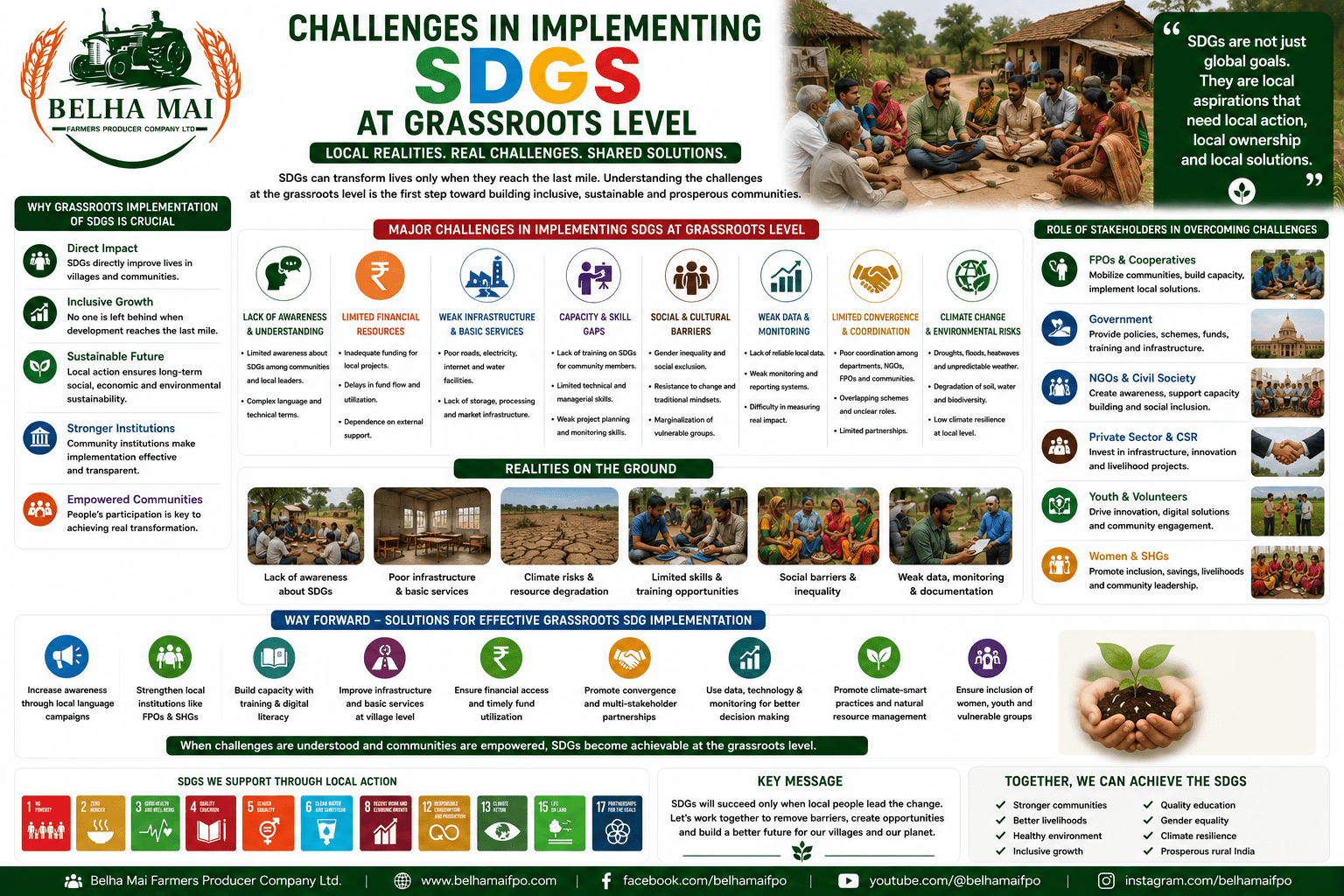
In rural India, the implementation of SDGs is not always easy. Many villages face challenges such as lack of awareness, limited finance, weak infrastructure, poor data, lack of trained human resources, low digital literacy, social barriers, climate risks, and weak coordination between institutions. These problems reduce the speed and quality of grassroots development.
Farmer Producer Organizations, NGOs, CSR organizations, government departments, banks, research institutions, SHGs, youth groups, and private partners can help overcome these challenges. When SDG implementation is connected with local institutions and community participation, development becomes more practical, measurable, and sustainable.
Challenges in Implementing SDGs at Grassroots Level and Why They Matter
Challenges in Implementing SDGs at Grassroots Level matter because development cannot remain only in reports, policies, or conferences. It must improve real lives in villages. If grassroots challenges are ignored, SDGs may remain targets on paper instead of becoming visible change.
At the grassroots level, people need better income, education, health, water, employment, markets, women empowerment, climate resilience, and sustainable agriculture. These needs are directly linked with multiple SDGs.
Understanding the challenges helps institutions design better solutions. It also helps FPOs, NGOs, CSR organizations, and government agencies work together more effectively.
Lack of Awareness About SDGs
One of the biggest challenges in implementing SDGs at grassroots level is lack of awareness. Many rural communities do not know what SDGs are or how these goals are connected with their daily life.
Terms like SDG, sustainability, climate resilience, responsible production, and gender equality may sound technical to many villagers. If people do not understand the goals, they may not participate actively.
The solution is simple communication. SDGs should be explained in local language through practical examples such as farmer income, clean water, women empowerment, school education, soil health, natural farming, and rural employment.
Limited Financial Resources
Finance is a major challenge in grassroots SDG implementation. Local institutions often have good ideas but lack funds to implement them. Villages need resources for training, infrastructure, water conservation, processing units, farm machinery, digital tools, women enterprises, and climate action.
FPOs and NGOs may also struggle with working capital, project funds, professional staff, and operational expenses. Without finance, even strong plans remain incomplete.
CSR funding, government schemes, bank finance, grants, and public-private partnerships can help solve this challenge. Finance must be linked with clear planning, transparency, and measurable impact.
Weak Rural Infrastructure
Weak infrastructure is another major barrier. Many rural areas lack proper storage, roads, irrigation systems, processing units, cold chains, digital connectivity, training centers, health services, and market facilities.
Without infrastructure, farmers cannot store produce, process products, access buyers, use digital platforms, or reduce post-harvest losses. This directly affects income and development.
Building rural infrastructure is essential for SDG implementation. Infrastructure should support agriculture, livelihoods, education, health, water, energy, digital access, and local enterprises.
Lack of Local Capacity
Grassroots SDG implementation needs trained people. Local leaders, FPO staff, SHG leaders, field workers, youth, women groups, and farmer representatives need skills in planning, documentation, finance, technology, project management, monitoring, and communication.
Many local institutions have motivation but lack technical capacity. This creates delays, errors, weak reporting, and poor project execution.
Capacity building is one of the most important solutions. Training should be practical, repeated, and linked with real work on the ground.
Weak Data and Monitoring Systems
SDG implementation requires data. Institutions need to know how many people benefited, how income changed, how women participated, how many farmers adopted sustainable practices, and what impact was created.
At grassroots level, data collection is often weak. Many local institutions do not maintain proper records. Without data, it becomes difficult to measure progress, attract partners, or improve programs.
FPOs, NGOs, CSR organizations, and government agencies should use simple digital and paper-based monitoring systems. Good documentation improves transparency and trust.
Poor Coordination Between Stakeholders
Grassroots development often involves many stakeholders, including government departments, FPOs, NGOs, CSR organizations, banks, private companies, research institutions, and community groups. If these stakeholders do not coordinate well, projects may overlap or fail.
Poor coordination can lead to duplication, delay, confusion, and wastage of resources. Sometimes multiple agencies work in the same area without sharing information.
SDG implementation needs convergence. Different institutions should work with shared goals, clear roles, regular communication, and local accountability.
Social and Cultural Barriers
Social and cultural barriers can affect SDG implementation. Gender inequality, caste barriers, low women participation, traditional mindsets, resistance to change, and exclusion of vulnerable groups can reduce the impact of development programs.
If women, small farmers, landless workers, youth, and weaker communities are not included, development remains incomplete.
Grassroots SDG implementation must be inclusive. FPOs, NGOs, SHGs, and community leaders should ensure that all groups participate in planning and benefits.
Gender Inequality at Grassroots Level
Gender equality is a major SDG issue. Rural women contribute to farming, livestock, household welfare, nutrition, and post-harvest work, but they often have limited access to finance, land, training, markets, and leadership.
Without women’s participation, grassroots development cannot become sustainable. Women must be included as farmers, entrepreneurs, leaders, workers, and decision-makers.
Connect with our previous blogs:
👉 Role of Women in Indian Agriculture — https://belhamaifpo.com/sdg-goals/role-of-women-in-indian-agriculture/
👉 How FPOs Empower Women Farmers — https://belhamaifpo.com/sdg-goals/how-fpos-empower-women-farmers/
👉 Gender Equality in Rural India: Challenges and Solutions —https://belhamaifpo.com/sdg-goals/gender-equality-in-rural-india-challenges-and-solutions/
👉 Women-led Farming Models in India —https://belhamaifpo.com/sdg-goals/women-led-farming-models-in-india/
Climate Change and Environmental Risks
Climate change is one of the biggest challenges in implementing SDGs at grassroots level. Farmers face irregular rainfall, drought, floods, heat stress, pest attacks, crop losses, and water scarcity.
These climate risks affect income, food security, health, migration, and rural stability. Development projects may fail if they do not consider climate risk.
Grassroots SDG action must include climate-resilient agriculture, water conservation, soil health, agroforestry, biodiversity protection, natural farming, and local disaster preparedness.
Soil Health Challenges
Soil health is directly linked with SDGs because it affects food security, farmer income, water use, climate resilience, biodiversity, and rural livelihoods. Declining soil organic matter, chemical imbalance, erosion, and low microbial activity can reduce productivity.
If soil health is ignored, agriculture-based SDG implementation becomes weak. Farmers may spend more on inputs and still receive lower returns.
Connect with our soil health blogs:
👉 Soil Health Challenges in Indian Agriculture —https://belhamaifpo.com/sdg-goals/soil-health-challenges-in-indian-agriculture/
👉 Importance of Organic Farming in Soil Restoration —https://belhamaifpo.com/sdg-goals/importance-of-organic-farming-in-soil-restoration/
👉 How Chemical Fertilizers Affect Soil Health — https://belhamaifpo.com/sdg-goals/how-chemical-fertilizers-affect-soil-health/
Water Scarcity and Poor Water Management
Water scarcity is a serious grassroots development challenge. Agriculture, livestock, health, sanitation, and household life all depend on water. Many villages face groundwater depletion, poor irrigation efficiency, waterlogging, and irregular rainfall.
Without water security, SDGs related to poverty, food, health, gender equality, and climate action become difficult to achieve.
Grassroots solutions include farm ponds, rainwater harvesting, micro-irrigation, mulching, water budgeting, drainage improvement, and community water management.
Biodiversity Loss
Biodiversity supports farming, nutrition, pollination, soil health, pest balance, and climate resilience. At the grassroots level, biodiversity loss happens due to monocropping, chemical overuse, loss of native seeds, tree removal, and habitat destruction.
If biodiversity declines, farming becomes more fragile and farmers face higher risk.
Connect with:
👉 Biodiversity Loss in Agriculture and Solutions —https://belhamaifpo.com/sdg-goals/biodiversity-loss-in-agriculture-and-solutions/
Low Market Access
Market access is a major challenge for grassroots SDG implementation. Farmers and rural enterprises need buyers, fair prices, packaging, branding, storage, transport, and quality standards.
If rural people produce goods but cannot sell them profitably, livelihood programs fail. Market linkage is essential for poverty reduction and rural employment.
FPOs can help solve this by aggregating produce, creating value-added products, building brands, and connecting farmers with buyers.
Weak Value Addition and Processing
Many rural areas produce agricultural raw material but do not process or package it locally. This means most value is captured outside villages. Farmers sell raw produce at low prices and buy processed goods at higher prices.
Value addition and agro-processing can create rural jobs, improve farmer income, reduce wastage, and strengthen local economies.
Connect with:
👉 How Agro-Processing Creates Rural Employment — https://belhamaifpo.com/sdg-goals/how-agro-processing-creates-rural-employment/
👉 From Subsistence Farming to Agribusiness —https://belhamaifpo.com/sdg-goals/from-subsistence-farming-to-agribusiness/
Limited Youth Participation
Youth participation is necessary for grassroots SDG implementation. Rural youth can support digital tools, farm mechanisation, processing, branding, e-commerce, logistics, data management, and entrepreneurship.
However, many youth migrate because they do not see opportunities in villages. This weakens local development capacity.
Connects with:
👉 Role of Youth in Transforming Agriculture — https://belhamaifpo.com/sdg-goals/role-of-youth-in-transforming-agriculture/
Weak Local Institutions
Strong local institutions are necessary for SDG implementation. FPOs, SHGs, cooperatives, youth groups, women groups, and village committees help organize people and sustain development activities.
Where local institutions are weak, projects may stop after external support ends. Strong institutions create ownership, accountability, and continuity.
Connect with:
👉 How Grassroots Institutions Drive Sustainable Change —https://belhamaifpo.com/sdg-goals/how-grassroots-institutions-drive-sustainable-change/
Challenges in FPO-Based SDG Implementation
FPOs can be powerful platforms for SDGs, but they also face challenges. Many FPOs need support in governance, working capital, infrastructure, staff, market linkage, technology, and professional management.
If FPOs are weak, their ability to create SDG impact becomes limited. Strong FPOs can support poverty reduction, sustainable agriculture, women empowerment, climate action, value addition, and partnerships.
Connect with:
👉 How Farmer Producer Organizations Contribute to Sustainable Development Goals — https://belhamaifpo.com/sdg-goals/how-farmer-producer-organizations-contribute-to-sustainable-development-goals/
👉 Can FPOs Transform Rural India? — https://belhamaifpo.com/sdg-goals/can-fpos-transform-rural-india/
Dependence on Short-Term Projects
Many grassroots programs are short-term. They may provide training, materials, or awareness for a limited period, but long-term support is missing. SDG implementation requires patience and continuity.
Short-term projects may create temporary activity but not lasting transformation. Rural development needs long-term handholding, capacity building, market linkage, finance, and monitoring.
Partnerships should be planned for long-term impact, not only short-term visibility.
Weak Digital Literacy
Digital tools can support SDG implementation through information, payments, schemes, data, e-commerce, training, and monitoring. But many rural communities still lack digital literacy.
If people cannot use digital tools, they may miss opportunities. Women, elderly farmers, and poorer households may face greater exclusion.
Digital literacy programs are essential for grassroots SDG success. Youth can play an important role in supporting digital inclusion.
Lack of Last-Mile Delivery
Many good schemes and programs fail because they do not reach the last mile. Farmers may not know about schemes, may lack documents, or may not understand application procedures.
Last-mile delivery requires local institutions that can guide people. FPOs, SHGs, NGOs, youth volunteers, and community workers can help bridge this gap.
SDGs become real when benefits reach the people who need them most.
Limited Community Ownership
Grassroots SDG projects succeed when communities feel ownership. If people see a project as an outside activity, they may not maintain it after the project ends.
Community ownership comes through participation, transparency, local leadership, contribution, and clear benefits.
FPOs, SHGs, NGOs, and village leaders can help build ownership by involving communities from planning to implementation.
Solution: Awareness in Simple Language
The first solution is awareness in simple language. SDGs should be explained through everyday rural issues such as farmer income, women’s role, clean water, healthy soil, education, health, employment, markets, and climate risks.
Complicated language should be avoided in village-level communication. Local examples make SDGs easier to understand.
Awareness creates participation, and participation creates ownership.
Solution: Strengthening FPOs
FPOs can become strong platforms for implementing SDGs at grassroots level. They can support farmer income, sustainable agriculture, value addition, market linkage, women participation, soil health, and climate resilience.
FPOs need capacity building, governance support, working capital, infrastructure, professional staff, technology, and partnerships.
Strengthening FPOs is one of the most practical ways to make SDGs local and measurable.
Solution: Building SHGs and Women Groups
Self-Help Groups and women groups are important for grassroots SDG action. They support savings, credit, women leadership, livelihood activities, nutrition, education, and social inclusion.
Women groups can lead initiatives in food processing, kitchen gardens, natural farming, livestock, digital literacy, and rural enterprises.
Strong women groups make SDG implementation more inclusive and effective.
Solution: CSR-FPO Partnerships
CSR organizations can support SDG implementation by partnering with FPOs. CSR can provide funding, infrastructure, training, digital tools, processing units, farm machinery, soil health programs, women empowerment projects, and climate action support.
Connect with:
👉 How CSR Can Support FPOs — https://belhamaifpo.com/sdg-goals/how-csr-can-support-fpos/
Solution: NGO Support and Community Mobilization
NGOs are important for community mobilization, awareness, capacity building, women empowerment, social inclusion, and grassroots training. NGOs can help translate SDGs into village-level action.
NGO-FPO partnerships can combine social mobilization with farmer enterprise development.
Connect with:
👉 How NGOs Contribute to Rural Transformation —https://belhamaifpo.com/sdg-goals/how-ngos-contribute-to-rural-transformation/
Solution: Public-Private Partnerships
Public-private partnerships can bring government support, corporate investment, market linkage, technology, finance, research, and local implementation together.
These partnerships can support infrastructure, sustainable agriculture, digital tools, value addition, climate action, and rural employment.
Connect with:
👉 Public-Private Partnerships in Agriculture — https://belhamaifpo.com/sdg-goals/public-private-partnerships-in-agriculture/
Solution: Better Data and Impact Measurement
Grassroots SDG implementation needs simple and reliable data systems. Local institutions should track beneficiaries, training, income changes, women participation, farmer adoption, soil health actions, market linkages, and climate activities.
Good data helps measure impact, improve programs, and attract future support.
FPOs and NGOs can use digital tools to collect and report data more effectively.
Solution: Climate-Resilient Agriculture
Climate-resilient agriculture is essential for SDG implementation. Farmers need support in soil health, water conservation, crop diversification, agroforestry, natural farming, weather advisory, and farm mechanisation.
Connect with:
👉 Future of Sustainable Agriculture in India — https://belhamaifpo.com/sdg-goals/future-of-sustainable-agriculture-in-india/
👉 Natural Farming Practices in India — https://belhamaifpo.com/sdg-goals/natural-farming-practices-in-india/
Solution: Rural Enterprise Development
SDG implementation must create livelihoods. Rural enterprises in processing, packaging, farm machinery, bio-inputs, nurseries, honey, amla, mango, millets, digital services, and local retail can create income and jobs.
Connect with:
👉 Building a Sustainable Rural Economy —https://belhamaifpo.com/sdg-goals/building-a-sustainable-rural-economy/
Solution: Youth Engagement
Youth can help implement SDGs through digital literacy, data collection, e-commerce, farm machinery, processing, social media, scheme support, and entrepreneurship.
Youth engagement brings energy and innovation to grassroots development.
Connect with:
👉 Role of Youth in Transforming Agriculture — https://belhamaifpo.com/sdg-goals/role-of-youth-in-transforming-agriculture/
Solution: Strong Partnerships
SDG implementation at grassroots level needs strong partnerships. Government departments, FPOs, NGOs, CSR organizations, banks, corporates, research institutions, technology providers, SHGs, and communities must work together.
Connect with:
👉 Why Partnerships Are Important in Rural Development —https://belhamaifpo.com/sdg-goals/why-partnerships-are-important-in-rural-development/
👉 Role of Corporates in Agriculture Development —https://belhamaifpo.com/sdg-goals/role-of-corporates-in-agriculture-development/
Belha Mai FPO and Grassroots SDG Implementation
Belha Mai Farmers Producer Company Ltd. is working to support farmers through input services, farm machinery, market linkage, value addition, digital outreach, women participation, soil health, sustainable agriculture, and rural development.
Belha Mai FPO can contribute to SDG implementation by strengthening farmer income, empowering women, involving youth, promoting soil health, supporting natural farming, building partnerships, and creating value-added rural enterprises.
For Belha Mai FPO, SDGs are not only global goals. They are practical village-level actions that can improve farmer livelihoods and rural prosperity.
Why Grassroots SDG Implementation Matters for India
India’s SDG progress depends heavily on what happens in villages. Rural communities are directly connected with poverty reduction, food security, women empowerment, climate action, water conservation, employment, and sustainable agriculture.
If grassroots institutions become strong, SDG implementation becomes practical and measurable. If local communities are ignored, SDG progress remains incomplete.
Grassroots action is therefore central to India’s sustainable development journey.
Conclusion
Challenges in Implementing SDGs at Grassroots Level include lack of awareness, limited finance, weak infrastructure, low capacity, poor data, social barriers, climate risks, weak coordination, and limited community ownership. These challenges are real, but they can be solved through local institutions, practical planning, and strong partnerships.
FPOs, NGOs, CSR organizations, government departments, banks, research institutions, private companies, SHGs, youth groups, and communities must work together to turn SDGs into grassroots reality.
For Belha Mai Farmers Producer Company Ltd., implementing SDGs at the grassroots level means building stronger farmers, empowered women, skilled youth, healthy soil, sustainable agriculture, rural enterprises, and prosperous villages.
FAQ
What are the Challenges in Implementing SDGs at Grassroots Level?
The main challenges include lack of awareness, limited finance, weak infrastructure, low capacity, poor data, weak coordination, social barriers, gender inequality, climate risks, poor market access, and limited community ownership.
Why is grassroots SDG implementation important?
Grassroots SDG implementation is important because real development happens in villages and communities. SDGs can succeed only when local people receive better livelihoods, education, health, water, employment, equality, and climate resilience.
How can FPOs support SDG implementation?
FPOs can support SDG implementation through farmer income improvement, sustainable agriculture, soil health, market linkage, value addition, women empowerment, youth participation, and rural enterprise development.
How can CSR support SDGs at grassroots level?
CSR can support grassroots SDGs through funding, infrastructure, training, digital tools, processing units, farm machinery, soil health programs, women empowerment, climate action, and partnerships with FPOs and NGOs.
What role do NGOs play in grassroots SDG implementation?
NGOs support grassroots SDG implementation through community mobilization, awareness, capacity building, women empowerment, livelihood training, social inclusion, scheme access, and monitoring.
How can Belha Mai FPO contribute to grassroots SDG implementation?
Belha Mai FPO can contribute by supporting farmers, promoting sustainable agriculture, empowering women, involving youth, improving soil health, creating market linkages, building rural enterprises, and developing strong partnerships.
Internal Links Section
👉 SDG Goals — https://belhamaifpo.com/sdg-goals/
👉 Farmer Producer Organizations Complete Guide —https://belhamaifpo.com/farmer-producer-organisation/farmer-producer-organizations-fpos/
👉 How Farmer Producer Organizations Contribute to Sustainable Development Goals —https://belhamaifpo.com/sdg-goals/how-farmer-producer-organizations-contribute-to-sustainable-development-goals/
👉 How Grassroots Institutions Drive Sustainable Change —https://belhamaifpo.com/sdg-goals/how-grassroots-institutions-drive-sustainable-change/
👉 Can FPOs Transform Rural India? — https://belhamaifpo.com/sdg-goals/can-fpos-transform-rural-india/
👉 Building a Sustainable Rural Economy —https://belhamaifpo.com/sdg-goals/building-a-sustainable-rural-economy/
👉 Role of Youth in Transforming Agriculture —https://belhamaifpo.com/sdg-goals/role-of-youth-in-transforming-agriculture/
👉 From Subsistence Farming to Agribusiness —https://belhamaifpo.com/sdg-goals/from-subsistence-farming-to-agribusiness/
👉 Future of Sustainable Agriculture in India —https://belhamaifpo.com/sdg-goals/future-of-sustainable-agriculture-in-india/
👉 Why Partnerships Are Important in Rural Development —https://belhamaifpo.com/sdg-goals/why-partnerships-are-important-in-rural-development/
👉 Role of Corporates in Agriculture Development — https://belhamaifpo.com/sdg-goals/role-of-corporates-in-agriculture-development/
👉 How CSR Can Support FPOs — https://belhamaifpo.com/sdg-goals/how-csr-can-support-fpos/
👉 Public-Private Partnerships in Agriculture —https://belhamaifpo.com/sdg-goals/public-private-partnerships-in-agriculture/
👉 How NGOs Contribute to Rural Transformation —https://belhamaifpo.com/sdg-goals/how-ngos-contribute-to-rural-transformation/
👉 Role of Women in Indian Agriculture —https://belhamaifpo.com/sdg-goals/role-of-women-in-indian-agriculture/
👉 How FPOs Empower Women Farmers — https://belhamaifpo.com/sdg-goals/how-fpos-empower-women-farmers/
👉 Soil Health Challenges in Indian Agriculture —https://belhamaifpo.com/sdg-goals/soil-health-challenges-in-indian-agriculture/
👉 Natural Farming Practices in India —https://belhamaifpo.com/sdg-goals/natural-farming-practices-in-india/
👉 Biodiversity Loss in Agriculture and Solutions — https://belhamaifpo.com/sdg-goals/biodiversity-loss-in-agriculture-and-solutions/
👉 Rajvi Bhog Food Products: Complete Guide —https://belhamaifpo.com/agriculture/rajvi-bhog-food-products-quality-export-guide/
👉 Honey Processing in India: Complete Guide —https://belhamaifpo.com/agriculture/honey-processing-in-india-complete-guide/
👉 Belha Mai FPO — https://belhamaifpo.com/
External Authority Links
👉 United Nations Sustainable Development Goals — https://sdgs.un.org/goals
👉 SDG 17: Partnerships for the Goals — https://sdgs.un.org/goals/goal17
👉 NITI Aayog SDG India Index — https://www.niti.gov.in/sdg-india-index
👉 Ministry of Rural Development — https://rural.gov.in/
👉 Ministry of Agriculture and Farmers Welfare — https://agriwelfare.gov.in/
👉 Ministry of Corporate Affairs CSR — https://www.csr.gov.in/
👉 National Rural Livelihood Mission — https://nrlm.gov.in/
👉 Small Farmers’ Agribusiness Consortium — https://sfacindia.com/
👉 National Bank for Agriculture and Rural Development — https://www.nabard.org/
Follow Belha Mai FPO for More Updates
Website: https://belhamaifpo.com/
Facebook: https://www.facebook.com/profile.php?id=61561043486818
YouTube: https://www.youtube.com/channel/UC9ZvojoTMCa7mU1-Q_Bh60A
LinkedIn:https://www.linkedin.com/in/abhay-singh-ab5568280/
Instagram:https://instagram.com/belhamaifpo
Belha Mai Farmers Producer Company Ltd. supports farmers through better information, technology, market linkage, value addition, FPO awareness, rural development, youth participation, women empowerment, soil health, SDG action, partnerships, and sustainable agriculture.