Introduction
Future of Sustainable Agriculture in India is one of the most important subjects for farmer income, food security, climate resilience, rural development, and national growth. India’s agriculture must feed a growing population, protect natural resources, improve farmer livelihoods, and remain resilient in the face of climate change.
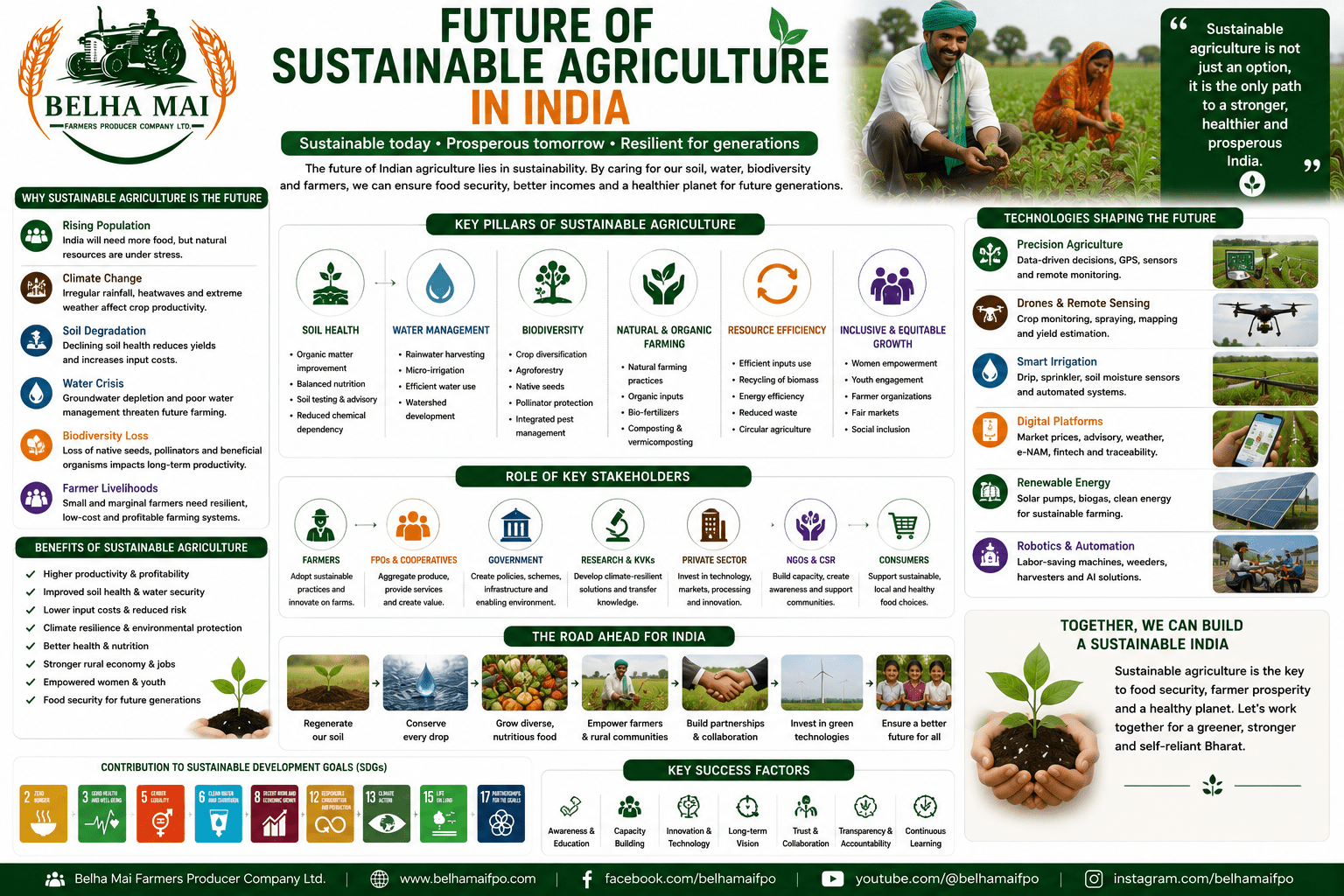
The future of farming cannot depend only on higher production. It must also focus on healthy soil, efficient water use, biodiversity protection, reduced input dependency, better farmer institutions, responsible technology, market linkages, value addition, women participation, youth engagement, and climate-smart practices.
Farmer Producer Organizations, government agencies, CSR organizations, NGOs, corporates, research institutions, banks, and technology partners will all have an important role in building the future of sustainable agriculture in India. The next phase of agriculture must be productive, profitable, inclusive, and environmentally responsible.
Future of Sustainable Agriculture in India and Why It Matters
Future of Sustainable Agriculture in India matters because agriculture is directly connected with food, livelihoods, rural employment, natural resources, and national stability. If agriculture becomes unsustainable, farmers will face higher costs, lower productivity, climate risk, and income instability.
Sustainable agriculture is not only about protecting the environment. It is also about protecting farmer income and long-term productivity. Healthy soil, water conservation, crop diversity, and responsible input use help farmers reduce risk and improve resilience.
India needs agriculture that can produce enough food while also protecting soil, water, biodiversity, and farmer livelihoods. This is the foundation of sustainable rural development.
Future of Sustainable Agriculture in India Through Soil Health
Soil health will be one of the strongest pillars of sustainable agriculture in India. Healthy soil improves crop productivity, water retention, nutrient availability, microbial activity, and climate resilience.
Farmers need soil testing, organic matter improvement, composting, balanced nutrition, crop rotation, reduced chemical misuse, and better residue management. Without healthy soil, agriculture becomes costly and less productive.
This connects with our previous blogs:
👉 Soil Health Challenges in Indian Agriculture — https://belhamaifpo.com/sdg-goals/soil-health-challenges-in-indian-agriculture/
👉 Importance of Organic Farming in Soil Restoration — https://belhamaifpo.com/sdg-goals/importance-of-organic-farming-in-soil-restoration/
👉 How Chemical Fertilizers Affect Soil Health — https://belhamaifpo.com/sdg-goals/how-chemical-fertilizers-affect-soil-health/
Future of Sustainable Agriculture in India Through Water Conservation
Water will define the future of agriculture. Many farming regions are facing groundwater depletion, irregular rainfall, drought, waterlogging, and poor irrigation efficiency. Sustainable agriculture must use water more wisely.
Farmers need rainwater harvesting, farm ponds, micro-irrigation, mulching, water budgeting, crop planning, drainage improvement, and soil organic matter improvement. Healthy soil and water conservation must work together.
FPOs, CSR organizations, government schemes, and technology providers can help farmers adopt better water management practices. Water conservation is not optional; it is central to future farming.
Future of Sustainable Agriculture in India Through Biodiversity
Biodiversity is essential for resilient agriculture. Crops, trees, pollinators, soil microbes, livestock, native seeds, and beneficial insects all support farming systems.
The future of sustainable agriculture in India must protect biodiversity through crop diversification, agroforestry, native seed conservation, pollinator protection, natural farming, organic matter, and reduced chemical misuse.
This connects with our previous blog:
👉 Biodiversity Loss in Agriculture and Solutions — https://belhamaifpo.com/sdg-goals/biodiversity-loss-in-agriculture-and-solutions/
Future of Sustainable Agriculture in India Through Natural Farming
Natural farming will play an important role in reducing input dependency, restoring soil biology, protecting biodiversity, and improving farmer self-reliance. However, it must be promoted with proper training, demonstrations, and market linkage.
Farmers need practical guidance on jeevamrut, beejamrut, mulching, intercropping, crop diversity, natural pest management, local resource use, and soil health improvement.
This connects with:
👉 Natural Farming Practices in India — https://belhamaifpo.com/sdg-goals/natural-farming-practices-in-india/
Future of Sustainable Agriculture in India Through Organic Farming
Organic farming can support soil restoration, safe food systems, biodiversity, water conservation, and better market opportunities. It can also create value-added rural brands when linked with quality, certification, packaging, and markets.
Farmers should adopt organic practices with proper planning. Organic farming needs soil restoration, transition support, input preparation, documentation, and buyer connection.
This connects with:
👉 Importance of Organic Farming in Soil Restoration — https://belhamaifpo.com/sdg-goals/importance-of-organic-farming-in-soil-restoration/
Future of Sustainable Agriculture in India Through Responsible Fertilizer Use
Chemical fertilizers will continue to have a role in agriculture, but their use must become more scientific and balanced. The future is not blind overuse; the future is soil-test-based nutrient management.
Farmers need balanced fertilization, integrated nutrient management, biofertilizers, compost, micronutrient awareness, and soil health monitoring. More fertilizer does not always mean more yield.
Responsible fertilizer use protects soil, saves money, improves crop response, and supports long-term productivity.
Future of Sustainable Agriculture in India Through FPOs
Farmer Producer Organizations will be central to the future of sustainable agriculture in India. FPOs can organize farmers, reduce input costs, provide farm services, aggregate produce, create market linkages, support value addition, promote soil health, and build rural enterprises.
Small farmers often cannot adopt new technologies, storage systems, processing units, or market systems individually. FPOs give them collective strength.
This connects with:
👉 Farmer Producer Organizations Complete Guide — https://belhamaifpo.com/farmer-producer-organisation/farmer-producer-organizations-fpos/
👉 Why FPOs are Key to Sustainable Agriculture — https://belhamaifpo.com/sdg-goals/why-fpos-are-key-to-sustainable-agriculture/
Future of Sustainable Agriculture in India Through Climate Resilience
Climate change is already affecting agriculture through heat waves, irregular rainfall, droughts, floods, pest attacks, and crop uncertainty. Sustainable agriculture must prepare farmers for these risks.
Climate-resilient farming includes soil health restoration, water conservation, crop diversification, agroforestry, weather advisory, resilient varieties, farm mechanisation, and local disaster preparedness.
FPOs can help farmers adopt climate-resilient practices collectively. Climate action must happen at the field level, not only in policy documents.
Future of Sustainable Agriculture in India Through Agroforestry
Agroforestry can improve soil health, reduce erosion, store carbon, support biodiversity, improve microclimate, and create long-term income. Trees can provide fruits, fodder, timber, biomass, shade, and ecological benefits.
Boundary plantations, fruit orchards, mixed tree-crop systems, and climate-resilient plantation models can become important for rural India.
Agroforestry links agriculture with climate action, biodiversity, and income diversification. It should become part of future sustainable agriculture planning.
Future of Sustainable Agriculture in India Through Crop Diversification
Crop diversification reduces risk and improves income stability. Farmers depending on one crop are vulnerable to price fall, pest attack, climate stress, and crop failure.
India’s future agriculture must include cereals, pulses, millets, oilseeds, vegetables, fruits, medicinal plants, fodder, livestock, beekeeping, and agroforestry. Diversity creates resilience.
FPOs can help farmers diversify based on soil, water, climate, market demand, and processing opportunities.
Future of Sustainable Agriculture in India Through Millets
Millets are important for climate resilience, nutrition, low water use, and diversified farming. Millet-based farming and value addition can support farmer income and consumer health.
Women-led millet processing, FPO-led millet brands, institutional supply, and nutrition programs can create strong rural opportunities.
Millets can become an important part of India’s sustainable agriculture future when linked with markets and consumer awareness.
Future of Sustainable Agriculture in India Through Farm Mechanisation
Farm mechanisation will remain important, especially for timely operations, reduced labour burden, improved productivity, and climate adaptation. But mechanisation must be inclusive for small farmers.
FPO-led Farm Machinery Banks and custom hiring centers can make machinery affordable. Machines for sowing, harvesting, residue management, spraying, irrigation, and post-harvest handling can improve efficiency.
This connects with:
👉 Impact of Mechanisation on Farmer Livelihoods — https://belhamaifpo.com/sdg-goals/impact-of-mechanisation-on-farmer-livelihoods/
👉 Farm Machinery Bank — https://belhamaifpo.com/farm-machinery-bank/
Future of Sustainable Agriculture in India Through Digital Agriculture
Digital agriculture will shape the future of farming. Farmers need access to weather forecasts, market prices, crop advisory, soil reports, digital payments, e-commerce, traceability, and government schemes.
Drones, sensors, mobile apps, satellite data, artificial intelligence, and digital platforms can help, but only if they are made practical and affordable for farmers.
FPOs can act as digital bridges between farmers and technology providers. Digital agriculture must support small farmers, not exclude them.
Future of Sustainable Agriculture in India Through Precision Farming
Precision farming helps farmers use inputs more efficiently. It can support better irrigation, fertilizer use, pest management, crop monitoring, and yield improvement.
However, precision farming must be adapted for Indian smallholder conditions. Technologies should be affordable, simple, service-based, and accessible through FPOs or local service providers.
The future of precision farming in India will depend on practical delivery models, not only advanced equipment.
Future of Sustainable Agriculture in India Through Renewable Energy
Renewable energy can support sustainable agriculture through solar pumps, solar dryers, cold storage, processing units, rural warehouses, and clean energy-based farm services.
Solar energy can reduce operational costs and support rural enterprises. It can also help farmers manage irrigation and processing more efficiently.
FPOs can use renewable energy in common facilities such as processing units, storage centers, and farm service hubs.
Future of Sustainable Agriculture in India Through Value Addition
Value addition will be essential for sustainable farmer income. Farmers cannot depend only on raw produce sales. Processing, packaging, branding, grading, and quality systems can help retain more value in rural areas.
FPOs can support value addition in grains, honey, amla, mango, millets, pulses, spices, fruits, vegetables, and local foods.
This connects with:
👉 How Agro-Processing Creates Rural Employment — https://belhamaifpo.com/sdg-goals/how-agro-processing-creates-rural-employment/
Future of Sustainable Agriculture in India Through Rural Employment
The future of agriculture must create jobs beyond crop production. Rural employment can come from processing, packaging, storage, logistics, farm machinery, digital services, input centers, nursery development, bio-inputs, and market operations.
Sustainable agriculture should create year-round income opportunities for farmers, women, youth, workers, and rural entrepreneurs.
This connects with:
👉 How FPOs Create Year-Round Income for Farmers — https://belhamaifpo.com/sdg-goals/how-fpos-create-year-round-income-for-farmers/
Future of Sustainable Agriculture in India Through Women Empowerment
Women are central to Indian agriculture. The future of sustainable agriculture must include women as farmers, entrepreneurs, leaders, processors, trainers, and decision-makers.
Women can lead natural farming, food processing, seed preservation, livestock, beekeeping, nursery work, value addition, SHG enterprises, and FPO activities.
This connects with:
👉 Role of Women in Indian Agriculture — https://belhamaifpo.com/sdg-goals/role-of-women-in-indian-agriculture/
👉 How FPOs Empower Women Farmers — https://belhamaifpo.com/sdg-goals/how-fpos-empower-women-farmers/
👉 Gender Equality in Rural India: Challenges and Solutions — https://belhamaifpo.com/sdg-goals/gender-equality-in-rural-india-challenges-and-solutions/
👉 Women-led Farming Models in India — https://belhamaifpo.com/sdg-goals/women-led-farming-models-in-india/
Future of Sustainable Agriculture in India Through Youth Participation
Rural youth will shape the future of agriculture. They can bring digital skills, entrepreneurship, innovation, machinery services, e-commerce, logistics, branding, and agri-business thinking.
Youth must see agriculture as an enterprise opportunity, not only traditional farming. Training, mentorship, finance, and FPO-based opportunities can help them participate.
Sustainable agriculture needs young leaders who can connect farms with technology, markets, and value addition.
Future of Sustainable Agriculture in India Through Beekeeping and Pollination
Beekeeping can support sustainable agriculture by improving pollination, biodiversity, and farmer income. Honey processing and value addition can also create rural employment.
Pollinator protection is important for horticulture, seed production, biodiversity, and farm productivity. Farmers should reduce harmful pesticide practices and maintain flowering plants and habitats.
This also connects with Belha Mai FPO’s honey and pollination vision:
👉 Honey Processing in India: Complete Guide — https://belhamaifpo.com/agriculture/honey-processing-in-india-complete-guide/
Future of Sustainable Agriculture in India Through Horticulture
Horticulture can create high-value opportunities for farmers. Fruits, vegetables, medicinal plants, flowers, and nursery crops can improve income and nutrition.
Sustainable horticulture needs water management, soil health, pest control, post-harvest handling, cold chain, grading, processing, and market linkage.
FPOs can help farmers aggregate and market horticulture produce more effectively.
Future of Sustainable Agriculture in India Through Nursery Development
Quality planting material is important for the future of agriculture. Nurseries can support horticulture, agroforestry, climate-resilient crops, and rural entrepreneurship.
High-quality nurseries can provide fruit plants, vegetable seedlings, medicinal plants, agroforestry plants, and climate-resilient planting material.
Nursery development can also create jobs for women and youth.
Future of Sustainable Agriculture in India Through Bio-Input Production
Bio-inputs such as compost, vermicompost, biofertilizers, biopesticides, and natural farming inputs can help reduce chemical dependency and improve soil health.
FPO-led bio-input units can create rural employment while supporting sustainable farming. Bio-inputs must be quality-controlled and used with proper training.
This area can become important for both soil health and rural enterprise.
Future of Sustainable Agriculture in India Through Market Linkage
Sustainable farming must be connected with markets. If farmers adopt better practices but do not receive better value, adoption may decline.
FPOs can connect farmers with buyers, processors, retailers, institutional markets, e-commerce, and value-added product chains. Market linkage is essential for making sustainability economically practical.
Farmers need both ecological sustainability and financial sustainability.
Future of Sustainable Agriculture in India Through Branding
Farmer-owned brands can play a major role in the future of agriculture. Consumers are increasingly interested in quality, traceability, safe food, local origin, and responsible production.
FPO brands can communicate farmer ownership, sustainability, rural impact, and quality. Products such as grains, honey, amla, mango, millets, pulses, and processed foods can benefit from branding.
Belha Mai FPO can strengthen this opportunity through Rajvi Bhog, Belha Bees, and future value-added products.
Future of Sustainable Agriculture in India Through Public-Private Partnerships
Public-private partnerships will be important for scaling sustainable agriculture. Government can bring schemes and policy support, private sector can bring technology and markets, CSR can bring resources, research institutions can bring knowledge, and FPOs can bring farmer participation.
This connects with our partnership blogs:
👉 Why Partnerships Are Important in Rural Development — https://belhamaifpo.com/sdg-goals/why-partnerships-are-important-in-rural-development/
👉 Role of Corporates in Agriculture Development — https://belhamaifpo.com/sdg-goals/role-of-corporates-in-agriculture-development/
👉 How CSR Can Support FPOs — https://belhamaifpo.com/sdg-goals/how-csr-can-support-fpos/
👉 Public-Private Partnerships in Agriculture — https://belhamaifpo.com/sdg-goals/public-private-partnerships-in-agriculture/
👉 How NGOs Contribute to Rural Transformation — https://belhamaifpo.com/sdg-goals/how-ngos-contribute-to-rural-transformation/
Future of Sustainable Agriculture in India and SDGs
The future of sustainable agriculture in India is closely connected with Sustainable Development Goals. It supports SDG 1 No Poverty, SDG 2 Zero Hunger, SDG 3 Good Health, SDG 5 Gender Equality, SDG 6 Clean Water, SDG 8 Decent Work, SDG 12 Responsible Production, SDG 13 Climate Action, SDG 15 Life on Land, and SDG 17 Partnerships.
Sustainable agriculture is not only an agricultural goal. It is connected with health, environment, employment, equality, climate, and rural prosperity.
This is why agriculture must be central to India’s SDG journey.
Role of Belha Mai FPO in the Future of Sustainable Agriculture
Belha Mai Farmers Producer Company Ltd. is working to support farmers through input services, farm machinery, market linkage, value addition, digital outreach, women participation, soil health, natural farming awareness, and sustainable agriculture.
The future of sustainable agriculture needs strong grassroots institutions like FPOs. Belha Mai FPO can help farmers adopt better practices, access markets, create value-added products, build partnerships, and improve rural livelihoods.
For Belha Mai FPO, sustainable agriculture means stronger farmers, healthier soil, better markets, empowered women, skilled youth, and a more resilient rural economy.
Challenges in Building Sustainable Agriculture
Sustainable agriculture faces many challenges. Farmers may fear yield loss, lack training, lack finance, lack markets, or struggle with climate uncertainty. FPOs may face weak infrastructure, limited working capital, and lack of technical support.
Technology may be costly. Organic and natural produce may not always get premium prices. Soil restoration takes time. Water conservation needs community action.
These challenges are real, but they can be solved through partnerships, training, finance, market linkage, demonstrations, and long-term planning.
Road Ahead for India
The road ahead for India should focus on farmer-centered sustainability. Sustainable agriculture must not become a burden on farmers. It must improve farmer income, reduce risk, and protect natural resources.
The key actions include soil restoration, water conservation, crop diversity, FPO strengthening, women empowerment, youth engagement, digital tools, value addition, climate resilience, and market linkage.
India’s sustainable agriculture future will be built when villages, farmers, institutions, corporates, NGOs, government, and consumers work together.
Conclusion
Future of Sustainable Agriculture in India can be understood through one clear message: farming must become productive, profitable, inclusive, and environmentally responsible. India needs healthy soil, efficient water use, biodiversity protection, natural farming, responsible technology, strong FPOs, women empowerment, youth participation, value addition, and partnerships.
Sustainable agriculture is not only the future; it is the need of the present. Farmers must be supported with knowledge, finance, infrastructure, market access, and institutional strength.
For Belha Mai Farmers Producer Company Ltd., the future of sustainable agriculture represents a path toward stronger farmers, stronger villages, healthier ecosystems, and long-term rural prosperity.
FAQ
What is the Future of Sustainable Agriculture in India?
The future of sustainable agriculture in India depends on soil health, water conservation, biodiversity, natural farming, responsible technology, FPOs, climate resilience, women empowerment, youth participation, and market-linked rural development.
Why is sustainable agriculture important for India?
Sustainable agriculture is important because it protects soil, conserves water, improves farmer income, reduces climate risk, supports food security, and protects natural resources for future generations.
How can FPOs support sustainable agriculture?
FPOs can support sustainable agriculture by organizing farmers, promoting soil health, providing farm services, supporting natural farming, creating market linkages, enabling value addition, and building partnerships.
What technologies will shape sustainable agriculture in India?
Technologies such as digital advisory, drones, remote sensing, soil testing, smart irrigation, e-commerce, traceability, renewable energy, and precision farming can support sustainable agriculture when made farmer-friendly.
How does sustainable agriculture improve farmer income?
Sustainable agriculture improves farmer income by reducing input costs, improving soil health, conserving water, diversifying crops, creating value addition, reducing risk, and connecting farmers with better markets.
How can Belha Mai FPO contribute to sustainable agriculture?
Belha Mai FPO can contribute through farmer training, soil health awareness, farm machinery access, natural farming promotion, market linkage, value addition, women empowerment, youth engagement, and partnerships.
Internal Links Section
👉 SDG Goals — https://belhamaifpo.com/sdg-goals/
👉 Farmer Producer Organizations Complete Guide — https://belhamaifpo.com/farmer-producer-organisation/farmer-producer-organizations-fpos/
👉 Why FPOs are Key to Sustainable Agriculture — https://belhamaifpo.com/sdg-goals/why-fpos-are-key-to-sustainable-agriculture/
👉 Soil Health Challenges in Indian Agriculture —https://belhamaifpo.com/sdg-goals/soil-health-challenges-in-indian-agriculture/
👉 Importance of Organic Farming in Soil Restoration — https://belhamaifpo.com/sdg-goals/importance-of-organic-farming-in-soil-restoration/
👉 How Chemical Fertilizers Affect Soil Health — https://belhamaifpo.com/sdg-goals/how-chemical-fertilizers-affect-soil-health/
👉 Biodiversity Loss in Agriculture and Solutions —https://belhamaifpo.com/sdg-goals/biodiversity-loss-in-agriculture-and-solutions/
👉 Natural Farming Practices in India —https://belhamaifpo.com/sdg-goals/natural-farming-practices-in-india/
👉 How FPOs Create Year-Round Income for Farmers —https://belhamaifpo.com/sdg-goals/how-fpos-create-year-round-income-for-farmers/
👉 How Agro-Processing Creates Rural Employment — https://belhamaifpo.com/sdg-goals/how-agro-processing-creates-rural-employment/
👉 Impact of Mechanisation on Farmer Livelihoods —https://belhamaifpo.com/sdg-goals/impact-of-mechanisation-on-farmer-livelihoods/
👉 Role of Women in Indian Agriculture — https://belhamaifpo.com/sdg-goals/role-of-women-in-indian-agriculture/
👉 How FPOs Empower Women Farmers — https://belhamaifpo.com/sdg-goals/how-fpos-empower-women-farmers/
👉 Why Partnerships Are Important in Rural Development — https://belhamaifpo.com/sdg-goals/why-partnerships-are-important-in-rural-development/
👉 Role of Corporates in Agriculture Development —https://belhamaifpo.com/sdg-goals/role-of-corporates-in-agriculture-development/
👉 How CSR Can Support FPOs — https://belhamaifpo.com/sdg-goals/how-csr-can-support-fpos/
👉 Public-Private Partnerships in Agriculture — https://belhamaifpo.com/sdg-goals/public-private-partnerships-in-agriculture/
👉 How NGOs Contribute to Rural Transformation — https://belhamaifpo.com/sdg-goals/how-ngos-contribute-to-rural-transformation/
👉 Farm Machinery Bank —https://belhamaifpo.com/farm-machinery-bank/
👉 Rajvi Bhog Food Products: Complete Guide — https://belhamaifpo.com/agriculture/rajvi-bhog-food-products-quality-export-guide/
👉 Honey Processing in India: Complete Guide — https://belhamaifpo.com/agriculture/honey-processing-in-india-complete-guide/
👉 Belha Mai FPO — https://belhamaifpo.com/
External Authority Links
👉 United Nations Sustainable Development Goals — https://sdgs.un.org/goals
👉 SDG 2: Zero Hunger — https://sdgs.un.org/goals/goal2
👉 SDG 13: Climate Action — https://sdgs.un.org/goals/goal13
👉 Ministry of Agriculture and Farmers Welfare — https://agriwelfare.gov.in/
👉 National Centre of Organic and Natural Farming — https://nconf.dac.gov.in/
👉 Soil Health Card Scheme — https://soilhealth.dac.gov.in/
👉 Indian Council of Agricultural Research — https://icar.org.in/
👉 National Bank for Agriculture and Rural Development — https://www.nabard.org/
👉 Small Farmers’ Agribusiness Consortium — https://sfacindia.com/
👉 NITI Aayog SDG India Index — https://www.niti.gov.in/sdg-india-index
Follow Belha Mai FPO for More Updates
Website: https://belhamaifpo.com/
Facebook:https://www.facebook.com/profile.php?id=61561043486818
YouTube: https://www.youtube.com/channel/UC9ZvojoTMCa7mU1-Q_Bh60A
LinkedIn: https://www.linkedin.com/in/abhay-singh-ab5568280/
Instagram: https://instagram.com/belhamaifpo
Belha Mai Farmers Producer Company Ltd. supports farmers through better information, technology, market linkage, value addition, FPO awareness, rural development, women empowerment, soil health, natural farming, partnerships, and sustainable agriculture.