Introduction
Public-Private Partnerships in Agriculture are becoming increasingly important for rural development, farmer income, sustainable agriculture, value chain improvement, and food security. Agriculture is a large and complex sector. Farmers need support in production, finance, technology, storage, processing, logistics, quality systems, market access, climate resilience, and institutional development.
Government schemes alone cannot solve every challenge. Private companies alone cannot create inclusive rural transformation without farmer trust and local institutions. Farmer Producer Organizations alone cannot scale without finance, infrastructure, technology, and market support. This is why public-private partnerships in agriculture are important.
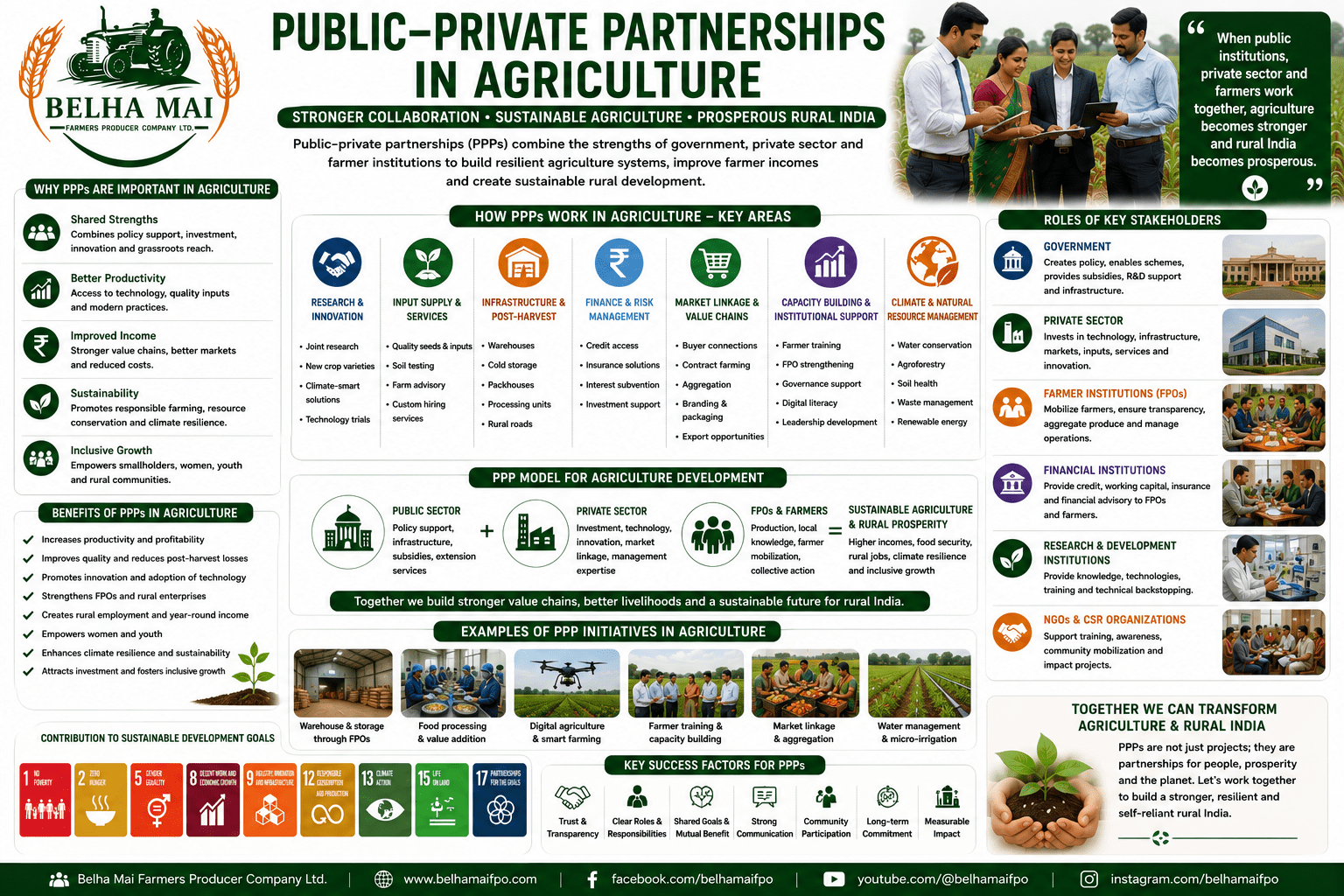
Public-private partnerships in agriculture bring together the strengths of government, private sector, FPOs, banks, research institutions, NGOs, CSR organizations, and farmers. When these partners work with shared goals and transparency, agriculture becomes more productive, profitable, inclusive, and sustainable.
Public-Private Partnerships in Agriculture and Why They Matter
Public-Private Partnerships in Agriculture matter because agricultural development needs combined strength. Government can provide schemes, policy support, infrastructure, and extension systems. The private sector can bring technology, investment, supply chain knowledge, markets, and innovation. FPOs can mobilize farmers and implement activities at the grassroots level.
Farmers need practical solutions, not isolated efforts. They need quality inputs, soil testing, machinery access, storage, processing, finance, training, market linkage, and buyer connections. A partnership model can bring all these services together.
This connects strongly with our previous blog:
👉 Why Partnerships Are Important in Rural Development — https://belhamaifpo.com/sdg-goals/why-partnerships-are-important-in-rural-development/
Public-Private Partnerships in Agriculture Through FPOs
FPOs are one of the most important grassroots institutions for public-private partnerships in agriculture. They work directly with farmers and understand local production systems, farmer needs, crop patterns, and village-level challenges.
Government departments and private companies can use FPOs as implementation partners for farmer training, input distribution, aggregation, storage, processing, market linkage, and sustainable agriculture projects.
FPOs help ensure that partnership benefits reach small and marginal farmers. This is why public-private partnerships in agriculture become more effective when FPOs are included from the planning stage.
Public-Private Partnerships in Agriculture Through Government Support
Government plays a central role in public-private partnerships in agriculture. It creates policies, schemes, subsidies, infrastructure support, training systems, extension services, and institutional frameworks.
Government departments can support agriculture PPPs through schemes for FPOs, farm mechanisation, food processing, storage, irrigation, organic farming, natural farming, soil health, livestock, horticulture, and rural enterprise.
When government support is combined with private sector efficiency and FPO grassroots reach, agriculture development becomes stronger and more practical.
Public-Private Partnerships in Agriculture Through Private Sector Participation
The private sector can bring investment, technology, market access, quality systems, processing knowledge, branding, logistics, digital tools, and innovation. These are important for helping agriculture move from raw production to value-added enterprise.
Private companies can work with FPOs for procurement, product development, processing, packaging, retail supply, export readiness, digital platforms, and institutional supply.
This connects with our previous blog:
👉 Role of Corporates in Agriculture Development — https://belhamaifpo.com/sdg-goals/role-of-corporates-in-agriculture-development/
Public-Private Partnerships in Agriculture Through CSR
CSR can become a powerful part of public-private partnerships in agriculture. CSR funds can support FPO capacity building, farmer training, processing units, farm machinery banks, soil health programs, women-led enterprises, digital inclusion, and climate resilience projects.
CSR support becomes more meaningful when it is linked with long-term farmer institution development instead of short-term activity. FPOs provide the grassroots structure needed for CSR impact.
This connects with our previous blog:
👉 How CSR Can Support FPOs — https://belhamaifpo.com/sdg-goals/how-csr-can-support-fpos/
Public-Private Partnerships in Agriculture Through Infrastructure Development
Infrastructure is a major requirement for agriculture development. Farmers need warehouses, packhouses, grading units, cold storage, processing units, farm machinery banks, collection centers, roads, irrigation systems, and digital service centers.
Public-private partnerships can help create such infrastructure by combining government schemes, private investment, CSR support, bank finance, and FPO management.
Rural infrastructure reduces wastage, improves quality, creates employment, increases bargaining power, and strengthens market access. Infrastructure development is one of the strongest areas for agriculture PPPs.
Public-Private Partnerships in Agriculture Through Market Linkages
Market linkage is one of the biggest benefits of public-private partnerships in agriculture. Farmers often produce crops but struggle to sell at fair prices due to weak buyer access, small quantities, poor storage, and limited negotiation power.
Private buyers, processors, retailers, exporters, and institutional customers can partner with FPOs to procure farmer produce in an organized manner. Government can support quality systems, infrastructure, and schemes.
When market linkage improves, farmers can reduce distress selling and receive better price realization. FPOs can aggregate produce, maintain quality, and build long-term buyer trust.
Public-Private Partnerships in Agriculture Through Value Addition
Value addition helps farmers earn more from their produce. Instead of selling raw produce, farmers and FPOs can create processed, packaged, branded, and market-ready products.
Public-private partnerships can support value addition through processing machinery, food safety training, packaging, branding, certification, finance, and buyer linkage.
This connects strongly with our previous blog:
👉 How Agro-Processing Creates Rural Employment — https://belhamaifpo.com/sdg-goals/how-agro-processing-creates-rural-employment/
Public-Private Partnerships in Agriculture Through Farm Mechanisation
Farm mechanisation improves productivity, saves time, reduces labour burden, and supports timely farming operations. But small farmers often cannot purchase machinery individually.
Public-private partnerships can support FPO-led Farm Machinery Banks, custom hiring centers, operator training, repair systems, and digital booking platforms. Government can support subsidies, private companies can provide machines and training, and FPOs can manage local operations.
This connects with:
👉 Impact of Mechanisation on Farmer Livelihoods — https://belhamaifpo.com/sdg-goals/impact-of-mechanisation-on-farmer-livelihoods/
👉 Farm Machinery Bank — https://belhamaifpo.com/farm-machinery-bank/
Public-Private Partnerships in Agriculture Through Finance
Finance is essential for farmers and FPOs. Agriculture needs working capital, crop finance, machinery loans, processing investment, storage finance, insurance, and enterprise capital.
Banks, NABARD, government schemes, CSR programs, private investors, and development agencies can support agriculture finance through partnership models. FPOs can help organize farmer demand and improve financial discipline.
Public-private partnerships in agriculture can also support credit guarantees, interest subvention, buyer-backed finance, and working capital support for FPOs.
Public-Private Partnerships in Agriculture Through Technology
Technology can improve agriculture through digital advisory, weather information, soil testing, farm monitoring, irrigation systems, drones, mobile apps, e-commerce, digital payments, traceability, and data management.
Public-private partnerships can help bring technology to farmers in a practical way. Government and research institutions can validate technologies, private companies can develop tools, and FPOs can help farmers adopt them.
Technology should be farmer-friendly, affordable, and supported with training. Without handholding, technology adoption may remain weak.
Public-Private Partnerships in Agriculture Through Soil Health
Soil health is the foundation of sustainable agriculture. Public-private partnerships can support soil testing, soil health cards, composting, bio-inputs, balanced fertilizer use, organic matter improvement, and farmer training.
Government soil health programs can be strengthened through FPO outreach, CSR support, private soil testing services, and technical institutions.
This connects with our soil health blogs:
👉 Soil Health Challenges in Indian Agriculture — https://belhamaifpo.com/sdg-goals/soil-health-challenges-in-indian-agriculture/
👉 Importance of Organic Farming in Soil Restoration — https://belhamaifpo.com/sdg-goals/importance-of-organic-farming-in-soil-restoration/
👉 How Chemical Fertilizers Affect Soil Health — https://belhamaifpo.com/sdg-goals/how-chemical-fertilizers-affect-soil-health/
Public-Private Partnerships in Agriculture Through Sustainable Agriculture
Sustainable agriculture requires soil health, water conservation, biodiversity, natural farming, responsible input use, climate resilience, and farmer training. These areas need long-term collaboration.
Government can provide policy direction, private partners can bring technology and markets, CSR can support projects, research institutions can provide knowledge, and FPOs can implement at the grassroots level.
This connects with:
👉 Why FPOs are Key to Sustainable Agriculture — https://belhamaifpo.com/sdg-goals/why-fpos-are-key-to-sustainable-agriculture/
Public-Private Partnerships in Agriculture Through Natural Farming
Natural farming needs training, demonstration, input preparation, farmer confidence, transition support, and market linkage. PPP models can support this through combined institutional support.
Government can promote natural farming schemes, technical partners can train farmers, CSR organizations can support demonstration plots, private buyers can create market demand, and FPOs can organize farmers.
This connects with:
👉 Natural Farming Practices in India — https://belhamaifpo.com/sdg-goals/natural-farming-practices-in-india/
Public-Private Partnerships in Agriculture Through Biodiversity Protection
Biodiversity protection is important for pollination, soil health, pest control, nutrition, and climate resilience. Public-private partnerships can support biodiversity-friendly agriculture through agroforestry, native seeds, pollinator protection, beekeeping, crop diversification, and organic practices.
FPOs can mobilize farmers and implement biodiversity programs at the village level. Private and CSR partners can support training, planting material, market linkage, and documentation.
This connects with:
👉 Biodiversity Loss in Agriculture and Solutions — https://belhamaifpo.com/sdg-goals/biodiversity-loss-in-agriculture-and-solutions/
Public-Private Partnerships in Agriculture Through Water Conservation
Water conservation is critical for agriculture. PPP models can support farm ponds, rainwater harvesting, watershed development, micro-irrigation, irrigation scheduling, drainage improvement, and water-use efficiency.
Government schemes can support infrastructure, private companies can bring irrigation technology, CSR can fund community assets, and FPOs can mobilize farmers.
Water conservation partnerships improve climate resilience and reduce crop risk.
Public-Private Partnerships in Agriculture Through Climate Action
Climate change is affecting farmers through irregular rainfall, heat stress, drought, floods, and pest outbreaks. Public-private partnerships can support climate-resilient agriculture through weather advisory, soil health, agroforestry, water conservation, crop diversification, farm mechanisation, and sustainable practices.
FPOs can help deliver climate solutions to farmers because they understand local cropping systems and farmer needs.
Climate action in agriculture becomes practical when partnerships turn policy goals into field-level implementation.
Public-Private Partnerships in Agriculture Through Women Empowerment
Women play a major role in agriculture, livestock, post-harvest handling, processing, nutrition, and rural livelihoods. PPP models can support women through training, finance access, processing units, leadership programs, digital literacy, machinery access, and women-led enterprises.
FPOs and SHGs can become strong platforms for women-focused PPP projects. CSR organizations, government departments, banks, and NGOs can provide support.
This connects with our women-focused blogs:
👉 Role of Women in Indian Agriculture — https://belhamaifpo.com/sdg-goals/role-of-women-in-indian-agriculture/
👉 How FPOs Empower Women Farmers — https://belhamaifpo.com/sdg-goals/how-fpos-empower-women-farmers/
👉 Gender Equality in Rural India: Challenges and Solutions — https://belhamaifpo.com/sdg-goals/gender-equality-in-rural-india-challenges-and-solutions/
👉 Women-led Farming Models in India — https://belhamaifpo.com/sdg-goals/women-led-farming-models-in-india/
Public-Private Partnerships in Agriculture Through Youth Engagement
Rural youth can play an important role in modern agriculture. They can work in digital services, machinery operations, processing units, logistics, marketing, e-commerce, data management, and agri-entrepreneurship.
Public-private partnerships can provide youth with training, internships, mentorship, finance, toolkits, and enterprise opportunities. This helps reduce migration and creates local employment.
Agriculture needs young people who see farming as a modern livelihood and enterprise opportunity.
Public-Private Partnerships in Agriculture Through Rural Employment
Agriculture development should create employment beyond crop production. PPP models can create jobs in agro-processing, packaging, storage, logistics, machinery services, digital services, input supply, quality control, and marketing.
FPOs can help organize these rural employment models by connecting farmers, workers, women, youth, and enterprises.
This connects with:
👉 How FPOs Create Year-Round Income for Farmers — https://belhamaifpo.com/sdg-goals/how-fpos-create-year-round-income-for-farmers/
Public-Private Partnerships in Agriculture Through Research Institutions
Research institutions and agricultural universities can provide technical knowledge, crop trials, soil health guidance, pest management solutions, seed improvement, water management methods, processing technologies, and climate adaptation strategies.
Private companies can help scale technology and bring market understanding. Government can support policy and programs. FPOs can test and implement solutions with farmers.
This partnership connects research with real field application.
Public-Private Partnerships in Agriculture Through NGOs
NGOs can support community mobilization, farmer training, women empowerment, natural farming, awareness programs, documentation, and social inclusion.
When NGOs partner with FPOs, government, CSR, and private sector, they can help ensure that projects remain community-centered and inclusive.
NGOs are important for building trust and participation, especially in women-focused and sustainability-focused projects.
Public-Private Partnerships in Agriculture Through Buyer Partnerships
Buyers are important partners because they create demand. A strong agriculture PPP must include market demand, otherwise production may increase without income improvement.
Processors, retailers, exporters, food companies, institutional buyers, hotels, and corporate canteens can work with FPOs to procure quality produce and value-added products.
Buyer partnerships help farmers plan production, maintain quality, reduce wastage, and improve income.
Public-Private Partnerships in Agriculture Through Export Readiness
Some FPOs can become export-ready with proper support in quality, testing, packaging, traceability, certification, food safety, logistics, and buyer communication.
Public-private partnerships can help FPOs develop export readiness through government export support, private buyer partnerships, technical training, and quality infrastructure.
Export readiness should be built gradually with strong compliance and reliable supply systems.
Public-Private Partnerships in Agriculture Through Branding
Branding helps FPOs and farmer groups sell products with identity, quality, trust, and market value. PPP models can support product branding, packaging design, labeling, photography, digital marketing, and retail placement.
FPO brands can become strong when they communicate farmer ownership, sustainability, quality, and rural impact.
Belha Mai FPO can benefit from such partnerships for products linked with grains, honey, amla, mango, millets, and value-added foods.
Public-Private Partnerships in Agriculture Through Digital Market Access
Digital market access can help farmers and FPOs reach buyers beyond local mandis. Public-private partnerships can support e-commerce, digital catalogs, online payments, order management, logistics, and customer support.
FPOs need training and systems to manage digital sales professionally. Digital platforms must be connected with packaging, inventory, dispatch, and quality control.
Digital market access can become useful when combined with strong ground operations.
Public-Private Partnerships in Agriculture Through Policy Support
Good policy support is essential for agriculture PPPs. Policies must encourage farmer inclusion, fair procurement, infrastructure development, climate action, FPO strengthening, women participation, and responsible business models.
Government can create an enabling environment where private sector participation benefits farmers and rural communities.
Policy support should also encourage transparency, accountability, and long-term sustainability in PPP projects.
Public-Private Partnerships in Agriculture and SDGs
Public-private partnerships in agriculture are strongly connected with Sustainable Development Goals. They support SDG 1 No Poverty, SDG 2 Zero Hunger, SDG 5 Gender Equality, SDG 8 Decent Work, SDG 9 Industry and Innovation, SDG 12 Responsible Production, SDG 13 Climate Action, SDG 15 Life on Land, and SDG 17 Partnerships.
SDG 17 is especially important because it focuses on partnerships for achieving development goals. Agriculture PPPs are practical examples of SDG 17 in action.
This makes public-private partnerships important for both national agricultural growth and global development priorities.
Belha Mai FPO and Public-Private Partnerships
Belha Mai Farmers Producer Company Ltd. is working to support farmers through input services, farm machinery, market linkage, value addition, digital outreach, women participation, soil health, natural farming awareness, and sustainable agriculture.
Public-private partnerships can help Belha Mai FPO scale this work by bringing together government schemes, CSR support, corporate market linkage, bank finance, research knowledge, technology tools, and farmer participation.
For Belha Mai FPO, public-private partnerships are not only about projects. They are about building long-term systems that improve farmer income, rural employment, sustainability, and village prosperity.
Why Public-Private Partnerships Matter for India’s Agriculture Future
India’s agriculture needs productivity, profitability, sustainability, innovation, and inclusion. Farmers need better services, stronger markets, lower risk, and more income opportunities.
Public-private partnerships can help create this future by connecting policy, investment, technology, markets, farmer institutions, and rural communities.
When partnerships are fair, transparent, and farmer-centered, agriculture can become a stronger engine of rural development.
Conclusion
Public-Private Partnerships in Agriculture can be understood through one clear idea: agriculture development needs shared responsibility. Government, private sector, FPOs, banks, research institutions, NGOs, CSR organizations, and farmers must work together to solve rural challenges.
These partnerships can support infrastructure, finance, technology, market linkage, value addition, mechanisation, soil health, natural farming, biodiversity, women empowerment, climate action, and rural employment.
For Belha Mai Farmers Producer Company Ltd., public-private partnerships represent a practical pathway toward stronger farmers, stronger FPOs, sustainable agriculture, and a prosperous rural India.
FAQ
What are Public-Private Partnerships in Agriculture?
Public-private partnerships in agriculture are collaborations between government, private sector, FPOs, banks, research institutions, NGOs, CSR organizations, and farmers to improve agriculture development, farmer income, infrastructure, technology, markets, and sustainability.
Why are public-private partnerships important in agriculture?
Public-private partnerships are important because agriculture needs combined support in policy, investment, technology, finance, infrastructure, market linkage, training, and grassroots implementation.
How do FPOs benefit from public-private partnerships?
FPOs benefit through capacity building, infrastructure, farm machinery, processing units, finance access, market linkages, technology, training, branding, and buyer partnerships.
How can PPPs improve farmer income?
PPPs can improve farmer income by reducing input costs, improving productivity, creating storage and processing facilities, supporting value addition, connecting farmers with buyers, and improving market access.
Can public-private partnerships support sustainable agriculture?
Yes. PPPs can support sustainable agriculture through soil health, natural farming, organic inputs, water conservation, agroforestry, biodiversity protection, climate resilience, and responsible production.
How can Belha Mai FPO use public-private partnerships?
Belha Mai FPO can use public-private partnerships for farmer services, farm machinery, agro-processing, soil health, natural farming, women empowerment, market linkage, finance access, technology, and sustainable rural development.
Internal Links Section
👉 SDG Goals — https://belhamaifpo.com/sdg-goals/
👉 Farmer Producer Organizations Complete Guide —https://belhamaifpo.com/farmer-producer-organisation/farmer-producer-organizations-fpos/
👉 Why Partnerships Are Important in Rural Development —https://belhamaifpo.com/sdg-goals/why-partnerships-are-important-in-rural-development/
👉 Role of Corporates in Agriculture Development — https://belhamaifpo.com/sdg-goals/role-of-corporates-in-agriculture-development/
👉 How CSR Can Support FPOs — https://belhamaifpo.com/sdg-goals/how-csr-can-support-fpos/
👉 How Farmer Producer Organizations Contribute to Sustainable Development Goals — https://belhamaifpo.com/sdg-goals/how-farmer-producer-organizations-contribute-to-sustainable-development-goals/
👉 Role of FPOs in Achieving Rural Development in India — https://belhamaifpo.com/sdg-goals/role-of-fpos-in-achieving-rural-development-in-india/
👉 Why FPOs are Key to Sustainable Agriculture —https://belhamaifpo.com/sdg-goals/why-fpos-are-key-to-sustainable-agriculture/
👉 How Agro-Processing Creates Rural Employment —https://belhamaifpo.com/sdg-goals/how-agro-processing-creates-rural-employment/
👉 Impact of Mechanisation on Farmer Livelihoods —https://belhamaifpo.com/sdg-goals/impact-of-mechanisation-on-farmer-livelihoods/
👉 How FPOs Create Year-Round Income for Farmers —https://belhamaifpo.com/sdg-goals/how-fpos-create-year-round-income-for-farmers/
👉 Role of Women in Indian Agriculture — https://belhamaifpo.com/sdg-goals/role-of-women-in-indian-agriculture/
👉 How FPOs Empower Women Farmers —https://belhamaifpo.com/sdg-goals/how-fpos-empower-women-farmers/
👉 Soil Health Challenges in Indian Agriculture — https://belhamaifpo.com/sdg-goals/soil-health-challenges-in-indian-agriculture/
👉 Importance of Organic Farming in Soil Restoration —https://belhamaifpo.com/sdg-goals/importance-of-organic-farming-in-soil-restoration/
👉 Natural Farming Practices in India — https://belhamaifpo.com/sdg-goals/natural-farming-practices-in-india/
👉 Biodiversity Loss in Agriculture and Solutions — https://belhamaifpo.com/sdg-goals/biodiversity-loss-in-agriculture-and-solutions/
👉 Farm Machinery Bank —https://belhamaifpo.com/farm-machinery-bank/
👉 Rajvi Bhog Food Products: Complete Guide —https://belhamaifpo.com/agriculture/rajvi-bhog-food-products-quality-export-guide/
👉 Honey Processing in India: Complete Guide — https://belhamaifpo.com/agriculture/honey-processing-in-india-complete-guide/
👉 Belha Mai FPO — https://belhamaifpo.com/
External Authority Links
👉 United Nations Sustainable Development Goals — https://sdgs.un.org/goals
👉 SDG 17: Partnerships for the Goals — https://sdgs.un.org/goals/goal17
👉 Ministry of Agriculture and Farmers Welfare — https://agriwelfare.gov.in/
👉 Ministry of Rural Development — https://rural.gov.in/
👉 Small Farmers’ Agribusiness Consortium — https://sfacindia.com/
👉 National Bank for Agriculture and Rural Development — https://www.nabard.org/
👉 Ministry of Corporate Affairs CSR — https://www.csr.gov.in/
👉 NITI Aayog SDG India Index — https://www.niti.gov.in/sdg-india-index
Follow Belha Mai FPO for More Updates
Website: https://belhamaifpo.com/
Facebook: https://www.facebook.com/profile.php?id=61561043486818
YouTube: https://www.youtube.com/channel/UC9ZvojoTMCa7mU1-Q_Bh60A
LinkedIn:https://www.linkedin.com/in/abhay-singh-ab5568280/
Instagram: https://instagram.com/belhamaifpo
Belha Mai Farmers Producer Company Ltd. supports farmers through better information, technology, market linkage, value addition, FPO awareness, rural development, women empowerment, soil health, public-private partnerships, and sustainable agriculture.