Introduction
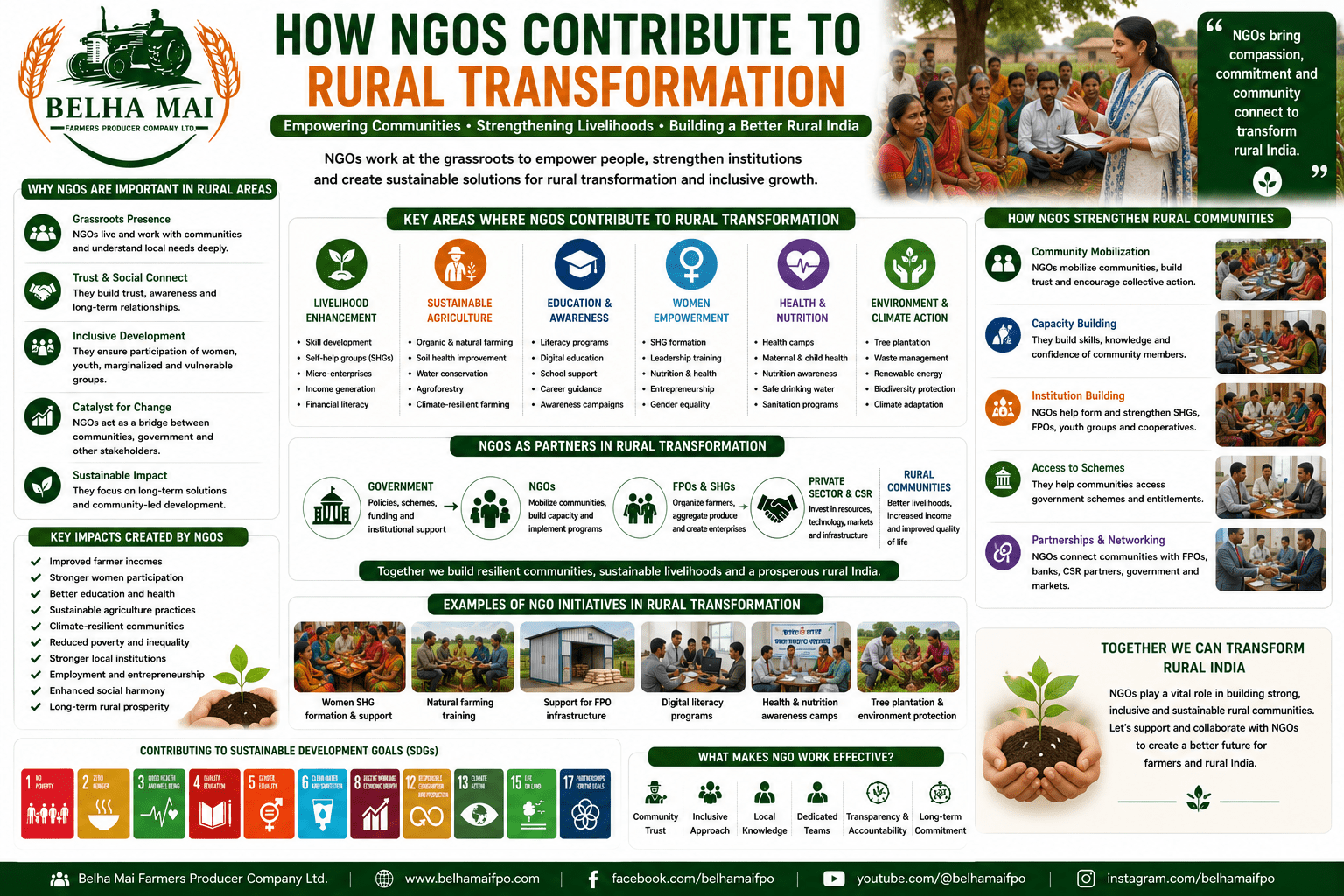
How NGOs Contribute to Rural Transformation is an important subject for rural development, sustainable agriculture, farmer livelihoods, women empowerment, social inclusion, and community-led change. Rural transformation cannot happen only through schemes, markets, or infrastructure. It also needs awareness, trust, participation, training, institution building, and long-term handholding.
Non-Governmental Organizations, commonly known as NGOs, often work closely with communities at the grassroots level. They understand local challenges, social barriers, livelihood needs, gender issues, farmer problems, and development gaps. Their strength lies in community mobilization, trust building, capacity building, and inclusive development.
NGOs contribute to rural transformation by helping rural communities access knowledge, government schemes, finance, health services, education, livelihood opportunities, sustainable agriculture, and institutional support. When NGOs work with FPOs, SHGs, CSR organizations, government departments, banks, and private partners, rural development becomes more practical and people-centered.
How NGOs Contribute to Rural Transformation Through Grassroots Presence
How NGOs Contribute to Rural Transformation begins with grassroots presence. Many NGOs work directly in villages and spend time understanding local people, local problems, and local opportunities. This gives them a deep connection with the community.
Grassroots presence helps NGOs build trust with farmers, women, youth, labourers, and vulnerable groups. Trust is important because rural communities are more likely to participate when they believe that an institution understands their reality.
This local presence allows NGOs to act as bridges between communities and larger systems such as government departments, CSR organizations, banks, FPOs, and development agencies.
How NGOs Contribute to Rural Transformation Through Community Mobilization
Community mobilization is one of the strongest contributions of NGOs. Rural development needs people to come together, discuss problems, identify priorities, and participate in solutions.
NGOs mobilize communities through village meetings, awareness campaigns, farmer groups, women groups, youth groups, training sessions, and participatory planning. They help people move from individual struggle to collective action.
Community mobilization is especially important for programs related to FPO formation, SHG development, women empowerment, sanitation, health, education, climate action, and livelihood improvement.
How NGOs Contribute to Rural Transformation Through Institution Building
Strong rural institutions are essential for long-term development. NGOs help build and strengthen institutions such as Self-Help Groups, Farmer Producer Organizations, cooperatives, village committees, youth groups, water user groups, and producer groups.
Institution building helps rural communities continue development work even after a project ends. A strong local institution can manage savings, training, market linkage, schemes, infrastructure, and community decisions.
This connects with our previous blog:
👉 How Grassroots Institutions Drive Sustainable Change — https://belhamaifpo.com/sdg-goals/how-grassroots-institutions-drive-sustainable-change/
How NGOs Contribute to Rural Transformation Through FPO Support
NGOs can play an important role in supporting Farmer Producer Organizations. Many FPOs need help in farmer mobilization, member awareness, governance, record keeping, training, business planning, market linkage, and social inclusion.
NGOs can help FPOs become more community-centered and inclusive. They can ensure that small farmers, women farmers, youth, and vulnerable groups are not left behind.
FPOs are business-oriented farmer institutions, while NGOs often bring social mobilization and capacity-building strength. Together, they can create strong rural transformation models.
How NGOs Contribute to Rural Transformation Through Women Empowerment
Women empowerment is a major area where NGOs contribute strongly. Rural women often face limited access to finance, education, mobility, land ownership, technology, markets, and leadership opportunities.
NGOs support women through Self-Help Groups, financial literacy, skill training, livelihood programs, health awareness, nutrition education, legal awareness, and leadership development.
This connects with our women-focused blogs:
👉 Role of Women in Indian Agriculture — https://belhamaifpo.com/sdg-goals/role-of-women-in-indian-agriculture/
👉 How FPOs Empower Women Farmers — https://belhamaifpo.com/sdg-goals/how-fpos-empower-women-farmers/
👉 Gender Equality in Rural India: Challenges and Solutions — https://belhamaifpo.com/sdg-goals/gender-equality-in-rural-india-challenges-and-solutions/
👉 Women-led Farming Models in India — https://belhamaifpo.com/sdg-goals/women-led-farming-models-in-india/
How NGOs Contribute to Rural Transformation Through Self-Help Groups
Self-Help Groups are powerful tools for rural transformation, especially for women. NGOs help form SHGs, train members, promote savings, support credit linkage, build confidence, and encourage income-generating activities.
SHGs help women become financially active and socially confident. They also create platforms for discussions on health, nutrition, education, livelihood, safety, and rights.
When SHGs are linked with FPOs, markets, processing units, and rural enterprises, they can become strong drivers of women-led economic development.
How NGOs Contribute to Rural Transformation Through Livelihood Development
Rural transformation must create livelihoods. NGOs support livelihood development through skill training, enterprise promotion, livestock support, agriculture improvement, food processing, crafts, digital services, and market access.
Livelihood programs help rural families earn more stable income. They reduce dependence on seasonal farming and distress migration.
NGOs can also identify local livelihood opportunities based on available resources, skills, crops, markets, and community interest. This makes livelihood development more practical and locally suitable.
How NGOs Contribute to Rural Transformation Through Farmer Training
Farmer training is essential for improving agriculture and income. NGOs organize training on crop management, soil health, pest management, organic farming, natural farming, water conservation, post-harvest handling, value addition, and market readiness.
Training helps farmers adopt better practices and reduce losses. NGOs often use simple language, field demonstrations, exposure visits, and farmer-to-farmer learning methods.
When NGOs work with FPOs, farmer training becomes more organized and can reach a larger number of farmers.
How NGOs Contribute to Rural Transformation Through Sustainable Agriculture
Sustainable agriculture is a major area of NGO contribution. NGOs promote soil health, water conservation, crop diversification, natural farming, organic farming, biodiversity protection, agroforestry, and responsible input use.
These practices help farmers reduce costs, protect natural resources, and build climate resilience. NGOs also help farmers understand the long-term value of sustainable farming.
This connects with:
👉 Why FPOs are Key to Sustainable Agriculture — https://belhamaifpo.com/sdg-goals/why-fpos-are-key-to-sustainable-agriculture/
How NGOs Contribute to Rural Transformation Through Soil Health Awareness
Soil health is central to farmer income and sustainability. NGOs can help farmers understand soil testing, organic matter, composting, balanced nutrition, crop rotation, green manuring, and reduced chemical misuse.
NGOs can organize soil health camps, demonstrations, and farmer awareness programs. They can also connect farmers with soil testing services and technical experts.
This connects with our soil health blogs:
👉 Soil Health Challenges in Indian Agriculture — https://belhamaifpo.com/sdg-goals/soil-health-challenges-in-indian-agriculture/
👉 Importance of Organic Farming in Soil Restoration — https://belhamaifpo.com/sdg-goals/importance-of-organic-farming-in-soil-restoration/
👉 How Chemical Fertilizers Affect Soil Health — https://belhamaifpo.com/sdg-goals/how-chemical-fertilizers-affect-soil-health/
How NGOs Contribute to Rural Transformation Through Natural Farming
Natural farming requires farmer confidence, training, demonstrations, local input preparation, and transition support. NGOs can play a strong role in helping farmers understand and adopt natural farming step by step.
They can organize demonstration plots, farmer groups, bio-input training, exposure visits, and awareness sessions. They can also help connect natural farming with market opportunities.
This connects with:
👉 Natural Farming Practices in India — https://belhamaifpo.com/sdg-goals/natural-farming-practices-in-india/
How NGOs Contribute to Rural Transformation Through Biodiversity Protection
Biodiversity protection is important for soil health, pollination, pest balance, nutrition, and climate resilience. NGOs can promote crop diversity, native seed conservation, pollinator protection, agroforestry, water body protection, and biodiversity awareness.
NGOs can help communities understand that biodiversity is not only about forests and wildlife. It is also about farms, seeds, soil, insects, trees, livestock, and local food systems.
This connects with:
👉 Biodiversity Loss in Agriculture and Solutions — https://belhamaifpo.com/sdg-goals/biodiversity-loss-in-agriculture-and-solutions/
How NGOs Contribute to Rural Transformation Through Climate Action
Climate change is already affecting farmers through irregular rainfall, heat stress, floods, droughts, and pest outbreaks. NGOs can help rural communities prepare for these risks.
They can support climate-resilient farming, water conservation, agroforestry, crop diversification, weather awareness, soil health, and disaster preparedness.
NGOs also help explain climate issues in simple local terms so that farmers can connect climate action with their daily farming decisions.
How NGOs Contribute to Rural Transformation Through Water Conservation
Water conservation is essential for rural development. NGOs can mobilize communities for water harvesting, farm ponds, watershed development, micro-irrigation awareness, drainage improvement, and water-use efficiency.
Water projects require community participation because water is a shared resource. NGOs are useful in building local cooperation and ownership.
When water conservation is connected with agriculture planning, farmers can reduce crop risk and improve productivity.
How NGOs Contribute to Rural Transformation Through Health and Nutrition
Rural transformation is not only about income. Health and nutrition are equally important. NGOs contribute through health camps, awareness sessions, maternal health programs, child nutrition, sanitation awareness, safe drinking water, and nutrition gardens.
Women and children benefit strongly from such programs. Better health improves productivity, education, family welfare, and overall quality of life.
Agriculture and nutrition can also be linked through kitchen gardens, pulses, millets, vegetables, fruits, dairy, poultry, and diversified farming.
How NGOs Contribute to Rural Transformation Through Education and Awareness
Education and awareness are foundation areas for NGOs. They support literacy, school enrollment, dropout prevention, digital literacy, financial literacy, health awareness, legal awareness, and livelihood education.
Awareness helps rural communities access rights, schemes, services, and opportunities. It also builds confidence and participation.
NGOs often use simple communication methods such as meetings, posters, training, videos, village campaigns, and community volunteers.
How NGOs Contribute to Rural Transformation Through Digital Literacy
Digital literacy is increasingly important in rural India. Farmers and rural families need digital skills for payments, government schemes, market prices, weather information, online learning, digital banking, and e-commerce.
NGOs can train women, youth, farmers, and FPO staff in mobile use, digital payments, online forms, WhatsApp communication, and digital record keeping.
Digital literacy helps rural communities become more connected and less dependent on middlemen or informal information sources.
How NGOs Contribute to Rural Transformation Through Financial Inclusion
Many rural families face difficulty accessing formal finance, insurance, credit, savings, and government benefits. NGOs help improve financial inclusion through SHGs, financial literacy, bank linkage, documentation support, and credit awareness.
Financial inclusion helps families invest in agriculture, livestock, education, enterprise, and emergency needs.
When NGOs connect financial inclusion with FPOs and SHGs, rural communities can build stronger economic systems.
How NGOs Contribute to Rural Transformation Through Skill Development
Skill development is important for income generation. NGOs train rural people in agriculture, livestock, food processing, tailoring, digital services, machinery operation, packaging, marketing, bookkeeping, and small enterprise management.
Skill training should be linked with real market opportunities. Training without market linkage may not create income.
NGOs can work with FPOs, CSR partners, and buyers to ensure that skill programs lead to actual employment or enterprise creation.
How NGOs Contribute to Rural Transformation Through Rural Enterprises
NGOs can help rural communities create enterprises based on local resources. These may include food processing, honey processing, amla products, mango products, millet products, dairy, goatery, poultry, nursery, bio-inputs, handicrafts, and digital services.
Enterprise development helps rural people earn locally and reduce migration. It also strengthens village economies.
FPOs can support rural enterprises by providing raw material, aggregation, branding, market linkage, and business systems.
How NGOs Contribute to Rural Transformation Through Agro-Processing
Agro-processing creates rural jobs and improves farmer income. NGOs can help mobilize workers, train women and youth, build processing skills, support hygiene practices, and connect groups with FPOs.
Processing units require trained people, quality systems, packaging, and market planning. NGOs can support the social and skill-building side of this ecosystem.
This connects with:
👉 How Agro-Processing Creates Rural Employment — https://belhamaifpo.com/sdg-goals/how-agro-processing-creates-rural-employment/
How NGOs Contribute to Rural Transformation Through Market Linkages
Market linkage is a key area where NGOs can support rural transformation. Farmers and rural producers need help with product quality, packaging, pricing, buyer communication, exhibitions, branding, and direct selling.
NGOs can connect rural groups with FPOs, buyers, CSR partners, retailers, and online platforms. They can also support producer groups in understanding market requirements.
Market linkage converts training and production into income. Without markets, livelihood projects remain incomplete.
How NGOs Contribute to Rural Transformation Through Farm Mechanisation Awareness
Farm mechanisation can reduce drudgery, save time, improve productivity, and create rural service jobs. NGOs can help farmers understand available machines, government schemes, shared machinery models, and safe machine use.
They can also support women-friendly tools and reduce manual drudgery for women farmers.
This connects with:
👉 Impact of Mechanisation on Farmer Livelihoods — https://belhamaifpo.com/sdg-goals/impact-of-mechanisation-on-farmer-livelihoods/
👉 Farm Machinery Bank — https://belhamaifpo.com/farm-machinery-bank/
How NGOs Contribute to Rural Transformation Through Youth Engagement
Rural youth are important for future agriculture and rural enterprise. NGOs can engage youth through skill training, digital literacy, entrepreneurship, sports, leadership, career guidance, and agri-business exposure.
Youth can become digital service providers, machine operators, processing workers, sales coordinators, field workers, and rural entrepreneurs.
NGOs can help youth see opportunities within rural development rather than only migration to cities.
How NGOs Contribute to Rural Transformation Through Government Scheme Access
Many rural families do not benefit from schemes because they lack awareness, documents, confidence, or guidance. NGOs can help communities understand schemes and complete applications.
They can support access to schemes related to agriculture, livelihoods, women empowerment, health, education, social security, housing, water, sanitation, and enterprise.
NGOs improve last-mile delivery by connecting government programs with real beneficiaries.
How NGOs Contribute to Rural Transformation Through CSR Partnerships
NGOs often act as implementation partners for CSR projects. They help companies identify community needs, mobilize people, implement activities, document outcomes, and measure impact.
CSR-NGO-FPO partnerships can be very powerful. CSR provides resources, NGOs provide community mobilization, FPOs provide farmer institution strength, and communities receive long-term benefit.
This connects with:
👉 How CSR Can Support FPOs — https://belhamaifpo.com/sdg-goals/how-csr-can-support-fpos/
How NGOs Contribute to Rural Transformation Through Public-Private Partnerships
NGOs can also support public-private partnerships by helping communities participate meaningfully. They ensure that projects are inclusive, locally relevant, and socially accepted.
In agriculture PPPs, NGOs can work with government, private companies, FPOs, banks, and farmers. They can support awareness, training, social inclusion, and monitoring.
This connects with:
👉 Public-Private Partnerships in Agriculture — https://belhamaifpo.com/sdg-goals/public-private-partnerships-in-agriculture/
How NGOs Contribute to Rural Transformation Through Social Inclusion
Rural development must include small farmers, marginal farmers, women, landless workers, youth, elderly people, and vulnerable communities. NGOs are often strong in identifying and including groups that may be left out.
Social inclusion ensures that development benefits do not reach only the better-connected households. It makes rural transformation fair and balanced.
NGOs can help FPOs and development partners design programs that include women, small farmers, and weaker sections.
How NGOs Contribute to Rural Transformation Through Local Leadership
NGOs help develop local leaders. These leaders may come from women groups, farmer groups, youth clubs, village committees, SHGs, FPOs, and community organizations.
Local leaders continue development work after external support reduces. They mobilize people, solve problems, communicate with institutions, and guide community action.
Leadership development is one of the most important long-term contributions of NGOs.
How NGOs Contribute to Rural Transformation Through Monitoring and Impact Documentation
NGOs can help document rural development outcomes. They can track training participation, income changes, women’s involvement, farmer adoption, scheme access, livelihood progress, and community feedback.
Good documentation helps CSR organizations, FPOs, donors, and government departments understand what is working.
Impact documentation also helps rural institutions attract future partnerships and grants.
How NGOs Contribute to Rural Transformation and SDGs
NGO work is strongly connected with Sustainable Development Goals. NGOs contribute to SDG 1 No Poverty, SDG 2 Zero Hunger, SDG 3 Good Health, SDG 4 Quality Education, SDG 5 Gender Equality, SDG 6 Clean Water, SDG 8 Decent Work, SDG 12 Responsible Production, SDG 13 Climate Action, SDG 15 Life on Land, and SDG 17 Partnerships.
NGOs help bring global development goals to the grassroots level. They translate large development ideas into village-level action.
This makes NGOs important partners for sustainable rural transformation.
Belha Mai FPO and NGO Partnerships
Belha Mai Farmers Producer Company Ltd. is working to support farmers through input services, farm machinery, market linkage, value addition, digital outreach, women participation, soil health, natural farming awareness, and sustainable agriculture.
NGO partnerships can help Belha Mai FPO strengthen community mobilization, women empowerment, farmer training, livelihood development, climate action, social inclusion, and scheme linkage.
For Belha Mai FPO, NGOs can become valuable partners because they bring community trust, field experience, social mobilization, and long-term development commitment.
Why NGO Contribution Matters for India’s Rural Future
India’s rural future depends on strong communities, strong farmer institutions, strong women, skilled youth, sustainable agriculture, and inclusive development. NGOs help build these foundations.
They work where trust, awareness, and participation are needed most. They help communities understand their rights, opportunities, and responsibilities.
NGOs may not replace government, FPOs, or markets, but they make rural development more human, inclusive, and participatory.
Conclusion
How NGOs Contribute to Rural Transformation can be understood through one clear message: rural development needs trust, participation, awareness, and institution building. NGOs bring these strengths to villages and help communities move from dependence to empowerment.
NGOs support rural transformation through community mobilization, FPO support, women empowerment, SHGs, livelihood development, sustainable agriculture, soil health, natural farming, biodiversity, education, health, digital literacy, financial inclusion, market linkage, and partnerships.
For Belha Mai Farmers Producer Company Ltd., NGO partnerships can help create stronger farmers, stronger women, stronger youth, stronger institutions, and a more sustainable rural future.
FAQ
How NGOs Contribute to Rural Transformation?
NGOs contribute to rural transformation through community mobilization, institution building, women empowerment, farmer training, livelihood development, sustainable agriculture, education, health, financial inclusion, digital literacy, and partnerships.
Why are NGOs important in rural development?
NGOs are important because they work closely with communities, build trust, understand local needs, support vulnerable groups, and help connect rural people with schemes, institutions, finance, training, and markets.
How can NGOs support FPOs?
NGOs can support FPOs through farmer mobilization, member awareness, governance training, women participation, social inclusion, capacity building, scheme linkage, livelihood training, and community trust building.
How do NGOs help women in rural areas?
NGOs help women through Self-Help Groups, skill training, financial literacy, health awareness, leadership development, livelihood programs, enterprise support, and access to schemes.
How can NGOs support sustainable agriculture?
NGOs can support sustainable agriculture through soil health awareness, natural farming, organic farming, water conservation, crop diversification, biodiversity protection, agroforestry, and farmer training.
How can Belha Mai FPO work with NGOs?
Belha Mai FPO can work with NGOs on farmer training, women empowerment, SHG-FPO linkage, sustainable agriculture, soil health, natural farming, livelihood development, scheme access, CSR projects, and rural transformation.
Internal Links Section
👉 SDG Goals —https://belhamaifpo.com/sdg-goals/
👉 Farmer Producer Organizations Complete Guide —https://belhamaifpo.com/farmer-producer-organisation/farmer-producer-organizations-fpos/
👉 Why Partnerships Are Important in Rural Development —https://belhamaifpo.com/sdg-goals/why-partnerships-are-important-in-rural-development/
👉 Role of Corporates in Agriculture Development —https://belhamaifpo.com/sdg-goals/role-of-corporates-in-agriculture-development/
👉 How CSR Can Support FPOs — https://belhamaifpo.com/sdg-goals/how-csr-can-support-fpos/
👉 Public-Private Partnerships in Agriculture —https://belhamaifpo.com/sdg-goals/public-private-partnerships-in-agriculture/
👉 How Grassroots Institutions Drive Sustainable Change — https://belhamaifpo.com/sdg-goals/how-grassroots-institutions-drive-sustainable-change/
👉 Role of FPOs in Achieving Rural Development in India — https://belhamaifpo.com/sdg-goals/role-of-fpos-in-achieving-rural-development-in-india/
👉 Why FPOs are Key to Sustainable Agriculture — https://belhamaifpo.com/sdg-goals/why-fpos-are-key-to-sustainable-agriculture/
👉 How Agro-Processing Creates Rural Employment — https://belhamaifpo.com/sdg-goals/how-agro-processing-creates-rural-employment/
👉 Impact of Mechanisation on Farmer Livelihoods —https://belhamaifpo.com/sdg-goals/impact-of-mechanisation-on-farmer-livelihoods/
👉 How FPOs Create Year-Round Income for Farmers —https://belhamaifpo.com/sdg-goals/how-fpos-create-year-round-income-for-farmers/
👉 Role of Women in Indian Agriculture —https://belhamaifpo.com/sdg-goals/role-of-women-in-indian-agriculture/
👉 How FPOs Empower Women Farmers — https://belhamaifpo.com/sdg-goals/how-fpos-empower-women-farmers/
👉 Natural Farming Practices in India — https://belhamaifpo.com/sdg-goals/natural-farming-practices-in-india/
👉 Biodiversity Loss in Agriculture and Solutions — https://belhamaifpo.com/sdg-goals/biodiversity-loss-in-agriculture-and-solutions/
👉 Belha Mai FPO — https://belhamaifpo.com/
External Authority Links
👉 United Nations Sustainable Development Goals — https://sdgs.un.org/goals
👉 SDG 17: Partnerships for the Goals — https://sdgs.un.org/goals/goal17
👉 Ministry of Rural Development — https://rural.gov.in/
👉 Ministry of Agriculture and Farmers Welfare — https://agriwelfare.gov.in/
👉 National Rural Livelihood Mission — https://nrlm.gov.in/
👉 NITI Aayog — https://www.niti.gov.in/
👉 Small Farmers’ Agribusiness Consortium — https://sfacindia.com/
👉 National Bank for Agriculture and Rural Development — https://www.nabard.org/
👉 Ministry of Corporate Affairs CSR — https://www.csr.gov.in/
Follow Belha Mai FPO for More Updates
Website: https://belhamaifpo.com/
Facebook:https://www.facebook.com/profile.php?id=61561043486818
YouTube: https://www.youtube.com/channel/UC9ZvojoTMCa7mU1-Q_Bh60A
LinkedIn:https://www.linkedin.com/in/abhay-singh-ab5568280/
Instagram:https://instagram.com/belhamaifpo
Belha Mai Farmers Producer Company Ltd. supports farmers through better information, technology, market linkage, value addition, FPO awareness, rural development, women empowerment, soil health, NGO partnerships, and sustainable agriculture.