Introduction
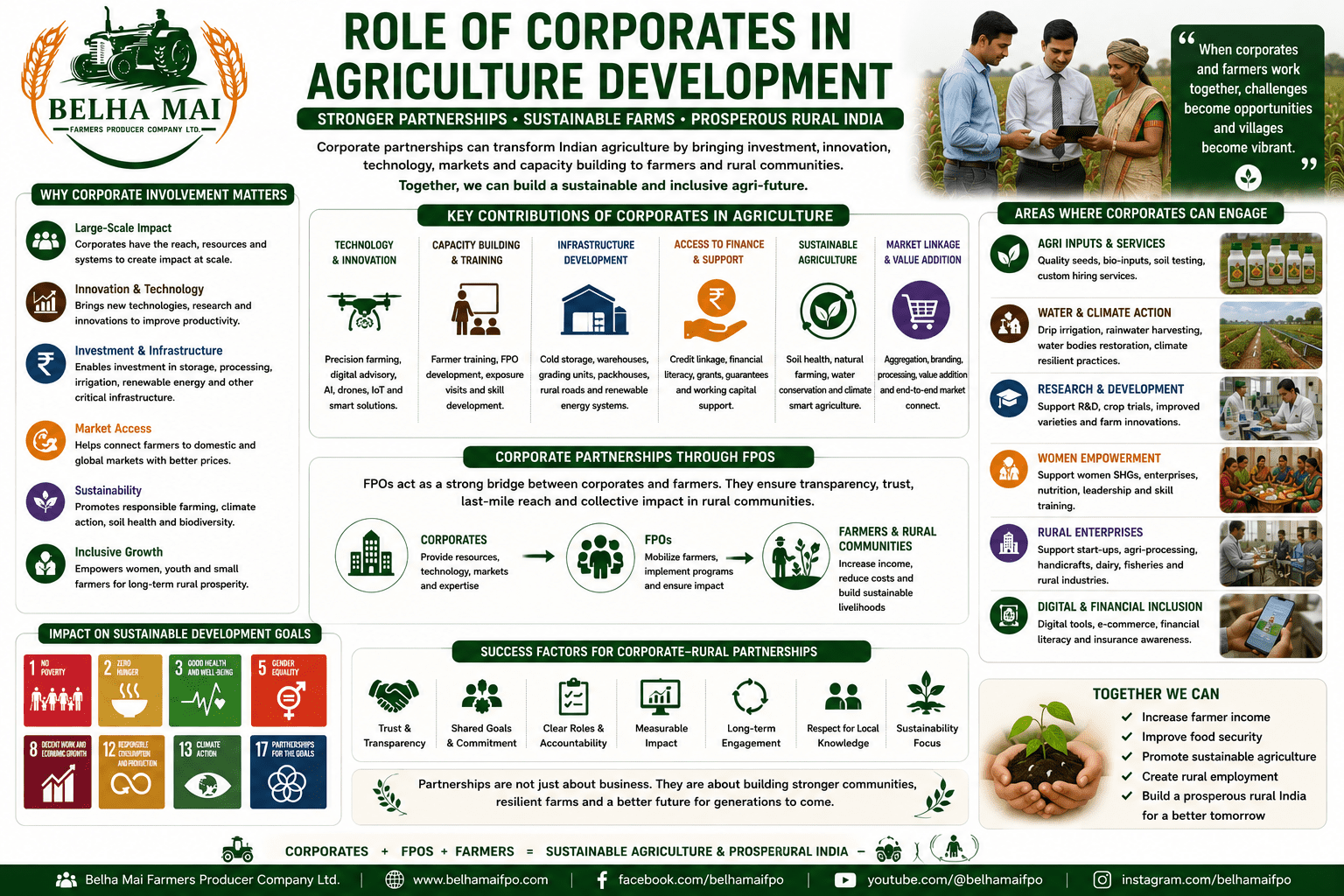
Role of Corporates in Agriculture Development is an important subject for rural transformation, farmer income, sustainable agriculture, food security, CSR impact, and public-private partnerships. Agriculture supports millions of rural families in India, but farmers face many challenges such as low income, rising input costs, weak market access, poor infrastructure, climate risks, lack of processing, and limited technology adoption.
Corporates can help address these challenges by bringing investment, technology, management systems, market networks, innovation, training, infrastructure, and long-term partnership models. When corporates work with Farmer Producer Organizations, NGOs, government departments, research institutions, and financial institutions, agriculture development can become more organized and scalable.
The role of corporates in agriculture development should not be limited to buying produce or selling inputs. Corporates can become development partners who support farmers, strengthen value chains, promote sustainability, create rural employment, empower women, and build stronger grassroots institutions.
Role of Corporates in Agriculture Development and Why It Matters
Role of Corporates in Agriculture Development matters because rural challenges are large and interconnected. Farmers need support in production, storage, processing, branding, quality, finance, technology, logistics, market access, and sustainability.
Government schemes and farmer institutions are important, but corporate participation can add speed, innovation, efficiency, and scale. Corporates can bring professional systems, supply chain knowledge, market intelligence, quality standards, digital tools, and investment capacity.
When corporate support is aligned with farmer needs, it can create strong rural impact. This is especially powerful when corporates partner with FPOs that already work directly with farmers.
Role of Corporates in Agriculture Development Through CSR
Corporate Social Responsibility can become a strong tool for agriculture development. CSR funds can support projects related to farmer livelihoods, women empowerment, soil health, climate resilience, farm mechanisation, water conservation, food processing, digital literacy, and rural infrastructure.
Agriculture-based CSR can create long-term impact because it directly supports income generation and livelihood security. Instead of short-term charity, corporates can invest in systems that help farmers become self-reliant.
FPOs can become strong implementation partners for CSR projects because they have farmer networks, local presence, and grassroots understanding.
Role of Corporates in Agriculture Development Through FPO Partnerships
FPO partnerships are one of the most practical ways for corporates to support agriculture development. FPOs work directly with farmers and understand local production, challenges, crop patterns, and community needs.
Corporates can support FPOs through training, working capital, processing infrastructure, storage, branding, digital systems, buyer linkages, quality standards, and market access. This helps FPOs become stronger rural enterprises.
This connects with our earlier blog:
👉 Why Partnerships Are Important in Rural Development — https://belhamaifpo.com/sdg-goals/why-partnerships-are-important-in-rural-development/
Role of Corporates in Agriculture Development Through Technology
Technology can transform agriculture when it reaches farmers in a practical way. Corporates can support digital advisory, weather information, soil testing tools, crop monitoring, precision farming, irrigation systems, drones, mobile apps, e-commerce, traceability, and digital payments.
However, technology must be adapted to small farmer realities. Farmers need training, handholding, local language support, and affordable models.
Corporates can work with FPOs to ensure that technology reaches farmers through trusted local institutions. FPOs can help farmers understand and adopt useful tools.
Role of Corporates in Agriculture Development Through Infrastructure
Rural agriculture needs infrastructure such as warehouses, packhouses, cold rooms, grading units, processing units, farm machinery banks, collection centers, and digital systems. Individual small farmers cannot create such infrastructure alone.
Corporates can support infrastructure through CSR, partnerships, shared investment models, and value chain development projects. Infrastructure helps reduce wastage, improve quality, strengthen market access, and create rural employment.
Infrastructure support can be especially useful for FPOs because one facility can benefit many farmers.
Role of Corporates in Agriculture Development Through Market Linkages
Market linkage is one of the most important areas where corporates can help farmers. Many farmers produce good crops but do not get fair prices because they lack direct buyer access, quality systems, packaging, logistics, and negotiation power.
Corporates can create structured buying arrangements, institutional procurement, retail supply chains, processing linkages, export opportunities, and long-term purchase agreements with FPOs.
When farmers are connected with reliable markets, agriculture becomes more profitable and predictable. Market linkage can reduce distress selling and improve farmer income.
Role of Corporates in Agriculture Development Through Value Addition
Value addition helps farmers earn more from their produce. Instead of selling raw produce at low prices, farmers can benefit from grading, cleaning, processing, packaging, branding, and marketing.
Corporates can support value addition through processing technology, product development, food safety training, packaging support, branding, distribution, and buyer connections.
This connects strongly with our previous blog:
👉 How Agro-Processing Creates Rural Employment — https://belhamaifpo.com/sdg-goals/how-agro-processing-creates-rural-employment/
Role of Corporates in Agriculture Development Through Farmer Income
Farmer income improves when production cost reduces, productivity improves, wastage declines, value addition increases, and markets become stronger. Corporates can support all these areas through targeted interventions.
They can help farmers access quality inputs, training, digital tools, storage, processing, finance, and direct markets. This improves the farmer’s position in the value chain.
Corporate partnerships should be designed to increase farmer share, not only corporate profit. A fair partnership creates long-term trust and better business outcomes.
Role of Corporates in Agriculture Development Through Soil Health
Soil health is essential for long-term agriculture development. Corporates can support soil testing campaigns, organic matter improvement, composting, bio-inputs, balanced nutrient awareness, and farmer training.
CSR projects focused on soil health can create deep impact because they improve productivity, reduce input waste, conserve water, and support climate resilience.
This connects with our soil health blogs:
👉 Soil Health Challenges in Indian Agriculture — https://belhamaifpo.com/sdg-goals/soil-health-challenges-in-indian-agriculture/
👉 Importance of Organic Farming in Soil Restoration — https://belhamaifpo.com/sdg-goals/importance-of-organic-farming-in-soil-restoration/
👉 How Chemical Fertilizers Affect Soil Health — https://belhamaifpo.com/sdg-goals/how-chemical-fertilizers-affect-soil-health/
Role of Corporates in Agriculture Development Through Sustainable Agriculture
Sustainable agriculture is important for food security, farmer income, climate resilience, and environmental protection. Corporates can support sustainable farming practices such as natural farming, organic farming, water conservation, agroforestry, crop diversification, residue management, and responsible input use.
Sustainability projects become stronger when implemented through FPOs because FPOs can mobilize farmers collectively and monitor field-level adoption.
This connects with:
👉 Why FPOs are Key to Sustainable Agriculture — https://belhamaifpo.com/sdg-goals/why-fpos-are-key-to-sustainable-agriculture/
Role of Corporates in Agriculture Development Through Natural Farming
Natural farming can reduce input costs, improve soil biology, protect biodiversity, and build climate resilience. But farmers need training, demonstration, input preparation support, and market linkage.
Corporates can support natural farming projects through CSR funding, technical partnerships, demonstration farms, farmer training, and procurement support for naturally grown produce.
This links with our previous blog:
👉 Natural Farming Practices in India — https://belhamaifpo.com/sdg-goals/natural-farming-practices-in-india/
Role of Corporates in Agriculture Development Through Biodiversity Protection
Biodiversity is important for soil health, pollination, pest control, crop resilience, nutrition, and climate adaptation. Corporates can support biodiversity-friendly agriculture through agroforestry, native seed conservation, pollinator protection, crop diversification, and natural farming projects.
Corporate support can also help create markets for biodiversity-friendly and sustainably produced farm products.
This connects with:
👉 Biodiversity Loss in Agriculture and Solutions — https://belhamaifpo.com/sdg-goals/biodiversity-loss-in-agriculture-and-solutions/
Role of Corporates in Agriculture Development Through Farm Mechanisation
Farm mechanisation helps farmers save time, reduce labour burden, improve productivity, and complete operations on time. But small farmers often cannot afford machines individually.
Corporates can support Farm Machinery Banks, custom hiring centers, operator training, maintenance systems, and digital booking platforms. Such support can benefit many small farmers through shared access.
This connects with:
👉 Impact of Mechanisation on Farmer Livelihoods — https://belhamaifpo.com/sdg-goals/impact-of-mechanisation-on-farmer-livelihoods/
👉 Farm Machinery Bank — https://belhamaifpo.com/farm-machinery-bank/
Role of Corporates in Agriculture Development Through Water Conservation
Water is one of the biggest challenges in agriculture. Corporates can support water conservation through farm ponds, drip irrigation, sprinkler systems, rainwater harvesting, watershed development, drainage improvement, and water budgeting.
Water projects create long-term benefits for farmers and communities. They improve crop stability, reduce drought risk, and support climate resilience.
FPOs can help identify farmers, mobilize communities, and support implementation at the village level.
Role of Corporates in Agriculture Development Through Climate Action
Climate change is affecting agriculture through heat stress, irregular rainfall, drought, floods, pest outbreaks, and crop uncertainty. Corporates can support climate-resilient agriculture through soil health, agroforestry, water conservation, crop diversification, weather advisory, and climate-smart technologies.
CSR and sustainability teams can align agriculture development with climate action goals. This creates measurable impact for both farmers and the environment.
Climate action through FPOs can be practical because farmers receive support through a local institution they trust.
Role of Corporates in Agriculture Development Through Women Empowerment
Women are central to agriculture, livestock, processing, post-harvest work, nutrition, and rural livelihoods. Corporates can support women farmers through training, finance access, digital literacy, processing units, packaging work, leadership programs, and market linkage.
Women-focused agriculture projects create strong development impact because women’s income often supports family welfare, education, health, and nutrition.
This connects with our women empowerment blogs:
👉 Role of Women in Indian Agriculture — https://belhamaifpo.com/sdg-goals/role-of-women-in-indian-agriculture/
👉 How FPOs Empower Women Farmers — https://belhamaifpo.com/sdg-goals/how-fpos-empower-women-farmers/
👉 Gender Equality in Rural India: Challenges and Solutions — https://belhamaifpo.com/sdg-goals/gender-equality-in-rural-india-challenges-and-solutions/
👉 Women-led Farming Models in India — https://belhamaifpo.com/sdg-goals/women-led-farming-models-in-india/
Role of Corporates in Agriculture Development Through Youth Engagement
Rural youth need opportunities in modern agriculture, agri-business, food processing, digital services, machinery operations, logistics, marketing, and rural enterprises.
Corporates can support youth through skill training, internships, entrepreneurship support, digital tools, agri-service models, and business mentorship.
Youth engagement is important because the future of agriculture depends on young people seeing farming as an enterprise, not only as traditional labour.
Role of Corporates in Agriculture Development Through Rural Employment
Agriculture development should create employment beyond seasonal crop farming. Corporates can support rural jobs through agro-processing, logistics, storage, packaging, digital services, farm machinery services, input centers, and rural enterprises.
Rural employment reduces migration pressure and strengthens village economies. It also creates opportunities for women and youth.
This connects with:
👉 How FPOs Create Year-Round Income for Farmers — https://belhamaifpo.com/sdg-goals/how-fpos-create-year-round-income-for-farmers/
Role of Corporates in Agriculture Development Through Finance Access
Farmers and FPOs often need finance for seeds, machinery, storage, processing, packaging, working capital, and business expansion. Corporates can support finance access through CSR grants, credit guarantees, working capital support, revolving funds, buyer-backed finance, and partnerships with banks.
Finance must be linked with business planning, governance, and repayment capacity. Poorly designed finance can create risk, but well-designed finance can unlock rural enterprise growth.
FPOs can help make finance more organized by aggregating farmer demand and maintaining records.
Role of Corporates in Agriculture Development Through Digital Inclusion
Digital inclusion can help farmers access market prices, weather information, crop advisory, digital payments, e-commerce, scheme information, and training videos.
Corporates can support digital literacy, farmer apps, data systems, traceability tools, and digital market platforms. Rural youth can be trained to manage digital services at the FPO level.
Digital inclusion improves transparency and helps farmers connect with wider opportunities.
Role of Corporates in Agriculture Development Through Research and Development
Research and development can improve seeds, soil practices, irrigation methods, pest management, processing technologies, packaging, storage, and climate-resilient farming.
Corporates can work with agricultural universities, ICAR institutions, startups, and FPOs to test and scale practical innovations. Farmers benefit when research is translated into field-level solutions.
FPOs can provide real-world testing grounds for farmer-friendly innovations.
Role of Corporates in Agriculture Development Through Supply Chain Development
Agricultural supply chains need quality, consistency, logistics, storage, grading, packaging, and documentation. Corporates can support supply chain development by working with FPOs and farmer groups.
A strong supply chain benefits both farmers and buyers. Farmers get better prices and reliable demand, while corporates get quality produce and traceable sourcing.
Supply chain partnerships can become long-term business relationships when built on fairness and transparency.
Role of Corporates in Agriculture Development Through Institutional Procurement
Corporates, hotels, processors, retailers, food companies, hospitals, schools, and government-linked institutions can procure produce and processed products from FPOs.
Institutional procurement creates regular demand and helps farmers plan production better. It can also support local brands and rural processing units.
For FPOs, institutional procurement can become a strong income and employment model.
Role of Corporates in Agriculture Development Through Export Readiness
Some corporates can help FPOs become export-ready by supporting quality systems, testing, packaging, traceability, food safety, logistics, and buyer connections.
Export readiness requires professional support and compliance. FPOs may need corporate or technical partners to meet these standards.
Products such as grains, processed foods, honey, fruits, and value-added rural products can benefit from export-oriented partnerships when quality and compliance systems are strong.
Role of Corporates in Agriculture Development Through Branding
Branding helps farmer-owned products enter better markets. Corporates can support packaging design, brand strategy, labeling, quality systems, marketing, digital promotion, and retail placement.
FPO brands can become powerful when they communicate farmer ownership, quality, sustainability, and rural impact.
Belha Mai FPO’s rural product and value addition work can become stronger with branding and market partnerships.
Role of Corporates in Agriculture Development Through Governance Support
FPOs need strong governance, records, business planning, audits, compliance, member communication, and professional management. Corporates can support capacity building in these areas.
Governance support may not look as visible as infrastructure, but it is essential for long-term sustainability. A well-managed FPO can handle finance, buyers, projects, and farmer services more effectively.
Corporate mentors and professional volunteers can also support FPO business systems.
Role of Corporates in Agriculture Development and SDGs
Corporate agriculture partnerships are closely connected with Sustainable Development Goals. They support SDG 1 No Poverty, SDG 2 Zero Hunger, SDG 5 Gender Equality, SDG 8 Decent Work, SDG 9 Industry and Innovation, SDG 12 Responsible Production, SDG 13 Climate Action, SDG 15 Life on Land, and SDG 17 Partnerships.
Corporates can align CSR and sustainability goals with farmer livelihood development. This creates social, environmental, and economic value.
FPO partnerships make SDG impact more grounded because they connect directly with farmers and villages.
Belha Mai FPO and Corporate Agriculture Partnerships
Belha Mai Farmers Producer Company Ltd. is working to support farmers through input services, farm machinery, market linkage, value addition, women participation, digital outreach, soil health, natural farming awareness, and sustainable agriculture.
Corporate partnerships can help Belha Mai FPO scale this work through infrastructure, processing units, machinery, finance, branding, technology, training, and market linkage.
For Belha Mai FPO, corporate partnerships are not only about funding. They are about creating long-term rural transformation through trust, shared goals, transparency, and farmer-centered development.
Why Corporate Participation Matters for India’s Agricultural Future
India’s agriculture needs investment, innovation, infrastructure, markets, sustainability, and institutional strength. Corporates can contribute to all these areas when they work responsibly and inclusively.
Corporate participation matters because agriculture cannot grow only through production. It needs value chains, processing, technology, finance, branding, logistics, and market systems.
When corporates work with FPOs and rural communities in a fair way, they can help build a stronger and more sustainable agricultural future.
Conclusion
Role of Corporates in Agriculture Development can be understood through one clear idea: corporates can bring resources, technology, markets, systems, and scale to rural agriculture. But their role becomes most meaningful when they partner with farmers and FPOs in a fair, transparent, and long-term manner.
Corporates can support CSR projects, farm mechanisation, soil health, natural farming, agro-processing, women empowerment, youth engagement, finance, digital inclusion, and market linkage.
For Belha Mai Farmers Producer Company Ltd., corporate partnerships can become a practical pathway for stronger farmers, better rural livelihoods, sustainable agriculture, value addition, and long-term village prosperity.
FAQ
What is the Role of Corporates in Agriculture Development?
The role of corporates in agriculture development includes supporting farmers through CSR, technology, infrastructure, finance, training, market linkages, value addition, sustainability, women empowerment, and partnerships with FPOs.
How can corporates support FPOs?
Corporates can support FPOs through training, processing infrastructure, farm machinery, digital tools, branding, working capital, buyer connections, quality systems, and CSR-funded livelihood projects.
Why should corporates partner with FPOs?
Corporates should partner with FPOs because FPOs work directly with farmers and can help implement agriculture development projects at the grassroots level with better trust, reach, and impact.
How do corporate partnerships improve farmer income?
Corporate partnerships improve farmer income by supporting better inputs, reduced costs, improved productivity, storage, processing, value addition, market access, quality standards, and direct buyer linkages.
Can corporates support sustainable agriculture?
Yes. Corporates can support sustainable agriculture through soil health programs, natural farming, water conservation, agroforestry, responsible input use, biodiversity protection, and climate-resilient farming.
How can Belha Mai FPO work with corporates?
Belha Mai FPO can work with corporates on farmer services, agro-processing, farm machinery, soil health, women empowerment, digital agriculture, value addition, market linkage, CSR projects, and sustainable rural development.
Internal Links Section
👉 SDG Goals — https://belhamaifpo.com/sdg-goals/
👉 Farmer Producer Organizations Complete Guide —https://belhamaifpo.com/farmer-producer-organisation/farmer-producer-organizations-fpos/
👉 Why Partnerships Are Important in Rural Development —https://belhamaifpo.com/sdg-goals/why-partnerships-are-important-in-rural-development/
👉 How Farmer Producer Organizations Contribute to Sustainable Development Goals — https://belhamaifpo.com/sdg-goals/how-farmer-producer-organizations-contribute-to-sustainable-development-goals/
👉 Role of FPOs in Achieving Rural Development in India —https://belhamaifpo.com/sdg-goals/role-of-fpos-in-achieving-rural-development-in-india/
👉 Why FPOs are Key to Sustainable Agriculture — https://belhamaifpo.com/sdg-goals/why-fpos-are-key-to-sustainable-agriculture/
👉 How Agro-Processing Creates Rural Employment —https://belhamaifpo.com/sdg-goals/how-agro-processing-creates-rural-employment/
👉 Impact of Mechanisation on Farmer Livelihoods —https://belhamaifpo.com/sdg-goals/impact-of-mechanisation-on-farmer-livelihoods/
👉 How FPOs Create Year-Round Income for Farmers —https://belhamaifpo.com/sdg-goals/how-fpos-create-year-round-income-for-farmers/
👉 Role of Women in Indian Agriculture —https://belhamaifpo.com/sdg-goals/role-of-women-in-indian-agriculture/
👉 How FPOs Empower Women Farmers —https://belhamaifpo.com/sdg-goals/how-fpos-empower-women-farmers/
👉 Soil Health Challenges in Indian Agriculture —https://belhamaifpo.com/sdg-goals/soil-health-challenges-in-indian-agriculture/
👉 Natural Farming Practices in India — https://belhamaifpo.com/sdg-goals/natural-farming-practices-in-india/
👉 Biodiversity Loss in Agriculture and Solutions —https://belhamaifpo.com/sdg-goals/biodiversity-loss-in-agriculture-and-solutions/
👉 Farm Machinery Bank — https://belhamaifpo.com/farm-machinery-bank/
👉 Rajvi Bhog Food Products: Complete Guide —https://belhamaifpo.com/agriculture/rajvi-bhog-food-products-quality-export-guide/
👉 Honey Processing in India: Complete Guide —https://belhamaifpo.com/agriculture/honey-processing-in-india-complete-guide/
👉 Belha Mai FPO — https://belhamaifpo.com/
External Authority Links
👉 Ministry of Corporate Affairs CSR — https://www.csr.gov.in/
👉 United Nations Sustainable Development Goals — https://sdgs.un.org/goals
👉 SDG 17: Partnerships for the Goals — https://sdgs.un.org/goals/goal17
👉 Ministry of Agriculture and Farmers Welfare — https://agriwelfare.gov.in/
👉 Ministry of Rural Development — https://rural.gov.in/
👉 Small Farmers’ Agribusiness Consortium — https://sfacindia.com/
👉 National Bank for Agriculture and Rural Development — https://www.nabard.org/
👉 NITI Aayog SDG India Index — https://www.niti.gov.in/sdg-india-index
Follow Belha Mai FPO for More Updates
Website: https://belhamaifpo.com/
Facebook:https://www.facebook.com/profile.php?id=61561043486818
YouTube: https://www.youtube.com/channel/UC9ZvojoTMCa7mU1-Q_Bh60A
LinkedIn: https://www.linkedin.com/in/abhay-singh-ab5568280/
Instagram: https://instagram.com/belhamaifpo
Belha Mai Farmers Producer Company Ltd. supports farmers through better information, technology, market linkage, value addition, FPO awareness, rural development, women empowerment, soil health, partnerships, corporate collaboration, and sustainable agriculture.