Introduction
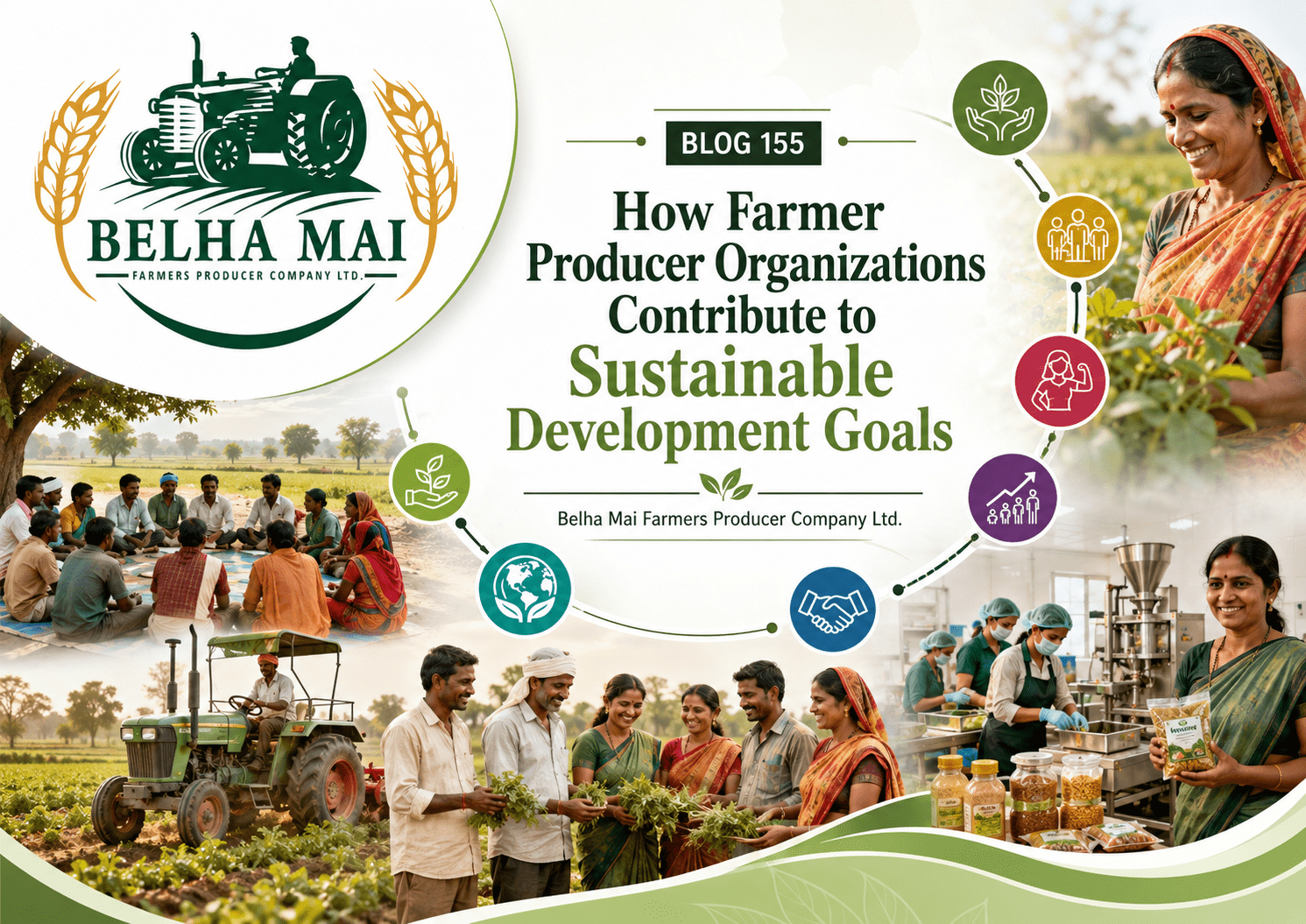
Farmer Producer Organizations are becoming one of the most important grassroots institutions for rural transformation in India. They bring small and marginal farmers together, improve their bargaining power, support better access to inputs and markets, and create opportunities for value addition, employment, and institutional partnerships. In this way, Farmer Producer Organizations contribute to Sustainable Development Goals by connecting local farming challenges with global development priorities.
The Sustainable Development Goals are not only meant for large governments, global institutions, or international organizations. They are also deeply connected with village-level action. When a Farmer Producer Organization helps farmers increase income, reduce wastage, improve soil health, promote women participation, use farm machinery, access better markets, or build partnerships, it directly contributes to sustainable development.
For an organization like Belha Mai Farmers Producer Company Ltd., the SDG approach is not only a branding subject. It is a practical development pathway. Through farmer services, input support, market linkage, farm machinery, value addition, women participation, climate-conscious agriculture, and institutional collaboration, FPOs can become strong engines of rural development.
What Are Sustainable Development Goals?
Sustainable Development Goals, also known as SDGs, are a global framework for building a better, fairer, and more sustainable world. These goals focus on poverty reduction, food security, gender equality, decent work, climate action, environmental protection, and partnerships. For rural India, many of these goals are directly connected with agriculture and farmer livelihoods.
Agriculture is not only about crop production. It is linked with income, employment, nutrition, natural resources, women’s work, climate resilience, food processing, rural entrepreneurship, and market access. This is why Farmer Producer Organizations contribute to Sustainable Development Goals in a very practical and measurable way.
When farmers remain isolated, they struggle to access quality inputs, technology, finance, government schemes, and stable markets. But when they come together through an FPO, they can build collective strength. This collective strength becomes the foundation of sustainable rural development.
Why FPOs Are Important for SDG-Based Rural Development
Farmer Producer Organizations are important because they work directly with farmers at the ground level. Unlike many development models that remain limited to policy or planning, FPOs are connected with real farmers, real crops, real villages, and real market challenges. This makes them powerful institutions for implementing sustainable development at the grassroots level.
FPOs can support farmers in many ways, including better seed access, fertilizer support, farm machinery services, soil health awareness, crop advisory, aggregation, processing, branding, packaging, and market linkage. Each of these activities contributes to better livelihoods and stronger rural economies.
This is why Farmer Producer Organizations contribute to Sustainable Development Goals not only through theory, but through daily practical action. Every time an FPO helps a farmer reduce cost, increase income, save soil, avoid wastage, or access a better market, it supports the larger SDG mission.
FPOs and SDG 1: No Poverty
One of the biggest ways Farmer Producer Organizations contribute to Sustainable Development Goals is by reducing rural poverty. Small and marginal farmers often suffer because they sell in small quantities, buy inputs at higher prices, and depend on local traders for market access. This keeps their income low and uncertain.
An FPO helps farmers overcome these problems by bringing them together. When farmers purchase inputs collectively, they may reduce costs. When they sell produce collectively, they can improve bargaining power. When the FPO creates value-added products, farmers can move beyond raw produce and participate in a better income chain.
For rural families, even a small increase in farm income can create a major difference. It can support children’s education, household nutrition, health expenses, farm reinvestment, and debt reduction. Therefore, FPOs are directly linked with poverty reduction in rural India.
FPOs and SDG 2: Food Security and Better Agriculture
FPOs also support better agriculture by helping farmers access quality inputs, technical knowledge, and improved farming practices. Food security is not only about producing more food; it is also about producing safe, nutritious, affordable, and reliable food through sustainable methods.
Through seed distribution, crop advisory, soil testing, plant protection guidance, and farmer training, FPOs can improve productivity and reduce crop losses. They can also guide farmers toward crop diversification, horticulture, pulses, millets, natural farming, and value-added food products.
In this way, Farmer Producer Organizations contribute to Sustainable Development Goals by strengthening the food system from the village level. They help farmers produce better, reduce losses, and connect farm produce with consumers, processors, institutions, and markets.
FPOs and SDG 5: Gender Equality
Women play a major role in Indian agriculture, but their contribution is often under-recognized. They work in sowing, weeding, harvesting, cleaning, grading, livestock care, seed preservation, and post-harvest activities. However, many women do not get equal access to training, finance, decision-making, ownership, or leadership opportunities.
FPOs can help change this. When women farmers become shareholders, participate in meetings, receive training, work in processing units, manage value-added products, or lead farmer groups, they become part of the formal rural economy.
Women’s participation in FPOs strengthens families and communities. It improves decision-making, increases household stability, and creates new livelihood opportunities. For this reason, FPOs can become strong vehicles for gender equality in rural India.
FPOs and SDG 8: Decent Work and Economic Growth
Rural development cannot depend only on crop production. Farmers need year-round income opportunities. FPOs can create rural employment through aggregation, sorting, grading, packaging, processing, branding, storage, transport, digital operations, and market linkage.
Agro-processing is especially important for creating rural jobs. When raw produce is converted into flour, pulses, spices, honey, amla products, mango pulp, dehydrated products, or packaged food, value is retained in the village economy. This creates work for farmers, women, youth, machine operators, packaging workers, marketing teams, and local service providers.
This is another reason why Farmer Producer Organizations contribute to Sustainable Development Goals. They help convert agriculture from a survival activity into a rural enterprise model. With better planning, FPOs can support decent work, entrepreneurship, and local economic growth.
FPOs and SDG 12: Responsible Production and Consumption
Sustainable agriculture also requires responsible production and consumption. Many farmers lose income because of poor storage, lack of processing, post-harvest wastage, and weak market planning. FPOs can reduce this problem by improving aggregation, grading, packaging, and value addition.
When an FPO creates a structured supply chain, produce can be handled more efficiently. Better packaging, processing, and storage reduce wastage. Local branding can connect farmers with consumers who want traceable and responsible food products.
Responsible production also includes safe handling, quality control, proper documentation, and compliance with food safety standards. For FPOs aiming at institutional supply, retail markets, export readiness, or CSR partnerships, these practices become very important.
FPOs and SDG 13: Climate Action
Climate change is already affecting farmers through irregular rainfall, heat stress, pest attacks, drought, floods, and changing crop cycles. Small farmers are among the most vulnerable because they have limited savings, limited irrigation, and low capacity to absorb crop failure.
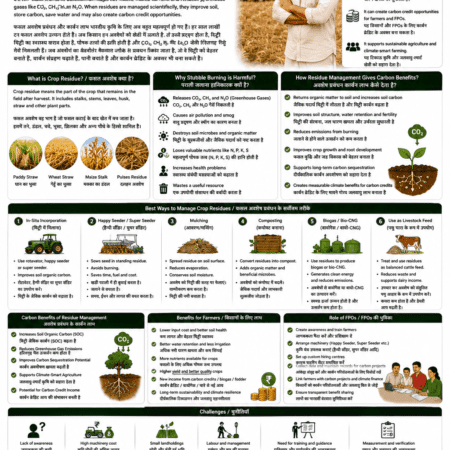
FPOs can support climate action by promoting climate-resilient farming practices. These may include soil health improvement, water conservation, crop diversification, natural farming, agroforestry, farm mechanisation, crop advisory, and reduced residue burning.
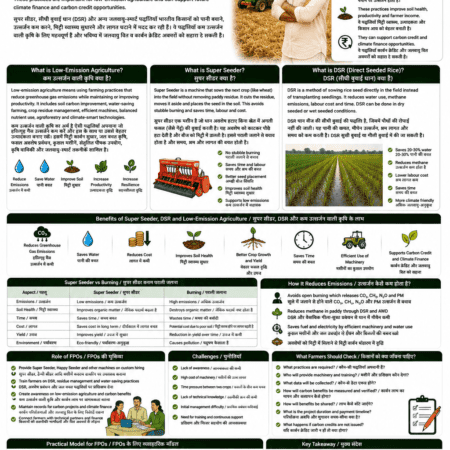
For example, access to farm machinery like Super Seeder or Direct Seeded Rice machines can reduce harmful practices and improve resource efficiency. Awareness about soil health, organic inputs, and biodiversity can also help farmers adapt to climate risks.
Through such actions, Farmer Producer Organizations contribute to Sustainable Development Goals by helping farmers become more climate-resilient and environmentally responsible.
FPOs and SDG 15: Life on Land
Agriculture depends on soil, water, biodiversity, trees, insects, pollinators, and local ecosystems. If soil fertility declines or biodiversity is lost, farmers suffer in the long term. Therefore, sustainable farming must protect land and natural resources.
FPOs can educate farmers about soil testing, organic matter, crop rotation, reduced chemical misuse, natural farming practices, tree plantation, and biodiversity-friendly agriculture. They can also promote agroforestry and horticulture models that improve income while protecting land.
When FPOs distribute trees, promote soil health, support natural farming, or create awareness about sustainable land use, they contribute directly to SDG 15. This is highly relevant for rural India, where land remains the foundation of livelihood security.
FPOs and SDG 17: Partnerships for Development
No FPO can grow alone. Rural transformation needs partnerships with government departments, financial institutions, CSR organizations, NGOs, research institutions, incubators, technology providers, processors, exporters, and buyers.
Partnerships can bring finance, training, infrastructure, market access, technology, quality systems, and grant support. For an FPO, the right partnership can create major development impact. It can help establish processing units, improve farmer training, expand digital systems, strengthen branding, or build export readiness.
This is why SDG 17 is very important for FPOs. Strong partnerships can convert local farmer institutions into powerful rural development platforms. Farmer Producer Organizations contribute to Sustainable Development Goals more effectively when they are supported by committed institutional partners.
How Belha Mai FPO Connects with the SDG Vision
Belha Mai Farmers Producer Company Ltd. is working to build a stronger farmer-led rural development model. Its work is connected with farmer services, input supply, farm machinery, market linkage, value addition, women participation, digital outreach, climate-conscious agriculture, and institutional partnerships.
The FPO’s development direction is closely aligned with important SDGs such as poverty reduction, gender equality, decent work, climate action, life on land, and partnerships. This makes Belha Mai FPO relevant not only for farmers, but also for CSR teams, NGOs, government departments, grant agencies, development partners, and institutional buyers.
The SDG vision gives Belha Mai FPO a wider identity. It shows that an FPO is not only a business entity. It is also a grassroots development institution that can connect farmer welfare with national and global development goals.
Why SDG-Aligned FPOs Matter for CSR and Grant Agencies
Many CSR organizations and grant agencies want to support rural development, but they need credible grassroots institutions to implement projects. FPOs are suitable because they already work with farmer communities and understand local needs.
An SDG-aligned FPO can help CSR and grant agencies achieve measurable impact in poverty reduction, livelihood creation, women empowerment, climate resilience, sustainable agriculture, and rural enterprise development. This makes the FPO model highly relevant for development partnerships.
For Belha Mai FPO, building strong SDG-based content is also important for visibility. When development organizations search for reliable FPOs, CSR-ready farmer institutions, or rural development partners, a well-structured SDG page and blog cluster can help them understand the organization’s seriousness and impact potential.
The Future of FPOs in Sustainable Development
The future of rural India will depend on strong farmer institutions. Individual farmers cannot easily face market volatility, climate change, technology gaps, finance problems, and post-harvest challenges alone. But collective institutions can build resilience.
FPOs can become the bridge between farmers and the future economy. They can connect agriculture with food processing, digital platforms, exports, institutional supply, climate solutions, women-led enterprises, and rural entrepreneurship.
This is why Farmer Producer Organizations contribute to Sustainable Development Goals in a powerful way. They bring together farmers, markets, technology, partnerships, and sustainability under one institutional platform.
Conclusion
Farmer Producer Organizations are not only farmer collectives; they are grassroots development engines. They reduce poverty, improve farmer income, support women, create rural employment, promote sustainable agriculture, protect natural resources, and build partnerships.
For India, FPOs can become one of the strongest models for achieving sustainable rural development. For Belha Mai Farmers Producer Company Ltd., the SDG framework provides a clear direction to present its work to farmers, partners, institutions, CSR teams, and grant agencies.
In simple words, Farmer Producer Organizations contribute to Sustainable Development Goals by turning local farmer action into long-term rural transformation.
FAQ
What are Sustainable Development Goals?
Sustainable Development Goals are global goals focused on poverty reduction, equality, decent work, climate action, environmental protection, food security, and partnerships. They provide a framework for sustainable development across countries and communities.
How do Farmer Producer Organizations contribute to Sustainable Development Goals?
Farmer Producer Organizations contribute to Sustainable Development Goals by improving farmer income, reducing poverty, supporting women farmers, creating rural employment, promoting sustainable agriculture, reducing wastage, supporting climate action, and building development partnerships.
Which SDGs are most connected with FPOs?
FPOs are strongly connected with SDG 1 No Poverty, SDG 2 Zero Hunger, SDG 5 Gender Equality, SDG 8 Decent Work and Economic Growth, SDG 12 Responsible Consumption and Production, SDG 13 Climate Action, SDG 15 Life on Land, and SDG 17 Partnerships for the Goals.
Why are FPOs important for rural development?
FPOs are important because they bring small farmers together, improve access to inputs and markets, support aggregation, create value addition opportunities, reduce costs, and build stronger rural livelihoods.
Can FPOs help CSR organizations create rural impact?
Yes. FPOs can help CSR organizations implement rural development projects because they are connected with farmers and local communities. They can support projects related to income generation, women empowerment, sustainable agriculture, climate action, agro-processing, and rural entrepreneurship.
Internal Links Section
👉 SDG Goals — https://belhamaifpo.com/sdg-goals/
👉 Farmer Producer Organizations Complete Guide — https://belhamaifpo.com/farmer-producer-organisation/farmer-producer-organizations-fpos/
👉 Why small farmers struggle in India —https://belhamaifpo.com/agriculture/why-small-farmers-struggle-in-india/
👉 Belha Mai FPO —https://belhamaifpo.com/
External Authority Links
👉 United Nations Sustainable Development Goals — https://sdgs.un.org/goals
👉 NITI Aayog SDG India Index — https://www.niti.gov.in/sdg-india-index
👉 Ministry of Agriculture and Farmers Welfare — https://agriwelfare.gov.in/
👉 Small Farmers’ Agribusiness Consortium — https://sfacindia.com/
👉 National Bank for Agriculture and Rural Development — https://www.nabard.org/
Follow Belha Mai FPO for More Updates
Website: https://belhamaifpo.com/
Facebook: https://www.facebook.com/profile.php?id=61561043486818
YouTube: https://www.youtube.com/channel/UC9ZvojoTMCa7mU1-Q_Bh60A
LinkedIn: https://www.linkedin.com/in/abhay-singh-ab5568280/
Instagram: https://instagram.com/belhamaifpo
Belha Mai Farmers Producer Company Ltd. supports farmers through better information, technology, market linkage, value addition, FPO awareness, rural development, and sustainable agriculture.