Introduction
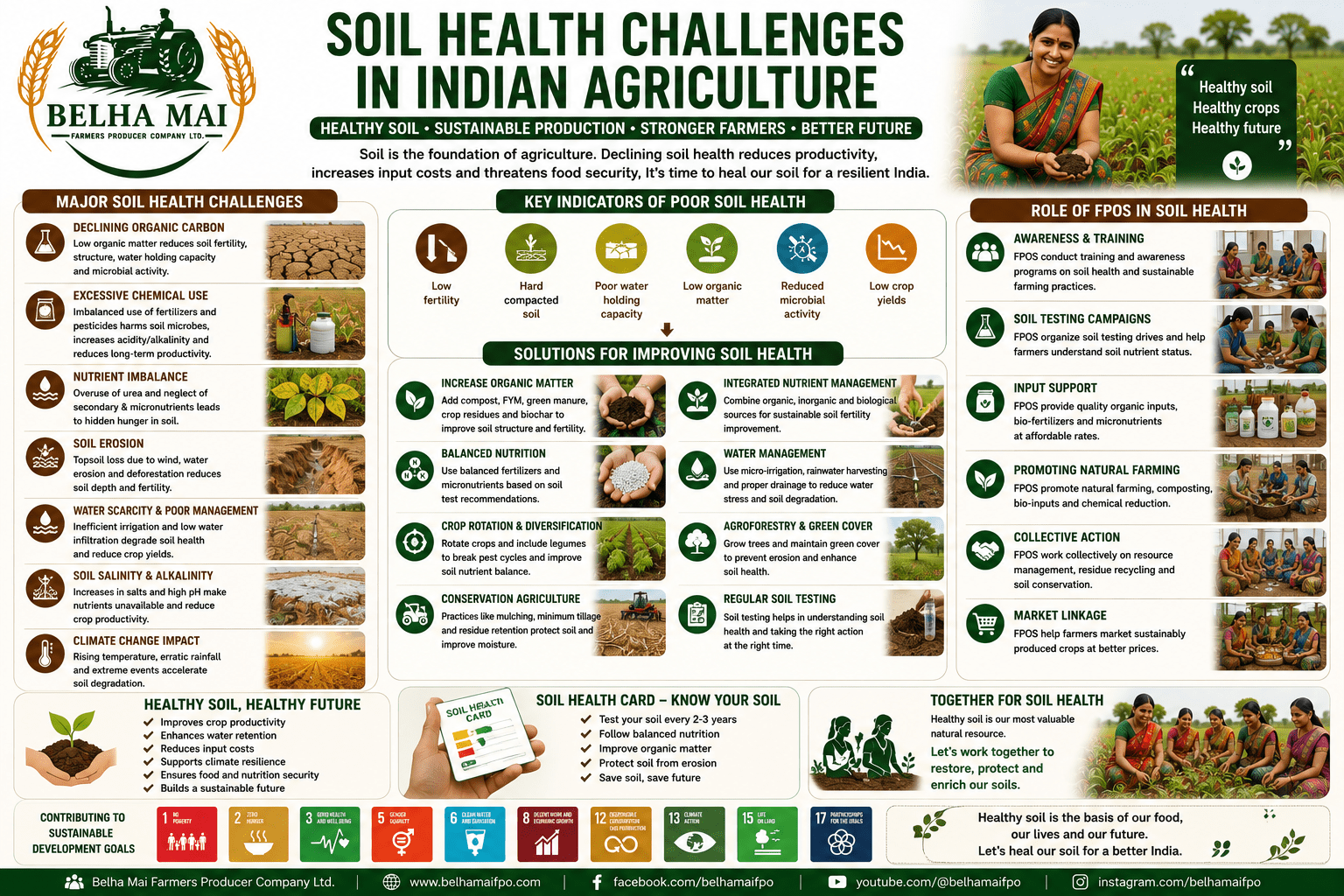
Soil Health Challenges in Indian Agriculture are among the most serious issues affecting farmer income, crop productivity, food security, and long-term sustainability. Soil is the foundation of agriculture. If soil becomes weak, farming becomes costly, crop yields decline, water use becomes inefficient, and farmers become more dependent on external inputs.
Indian agriculture has achieved major progress in food production, but intensive farming, repeated cropping, chemical overuse, low organic matter, erosion, salinity, water stress, and climate change have created pressure on soil health. Many farmers are now facing declining productivity even after using more inputs.
Soil health is not only an environmental issue. It is directly linked with farmer livelihoods. Healthy soil supports better crops, lower input costs, better water retention, stronger climate resilience, and long-term income security. Farmer Producer Organizations can play an important role in spreading soil health awareness, promoting soil testing, supporting organic inputs, and guiding farmers toward sustainable practices.
Soil Health Challenges in Indian Agriculture and Why They Matter
Soil Health Challenges in Indian Agriculture matter because soil directly affects crop growth, input efficiency, water use, food quality, and farmer income. When soil is healthy, crops grow better and require fewer corrective inputs. When soil is unhealthy, farmers may spend more on fertilizers and pesticides but still receive poor results.
Healthy soil contains organic matter, nutrients, microorganisms, good structure, moisture-holding capacity, and biological activity. It supports roots, stores water, cycles nutrients, and maintains productivity over time.
If soil health declines, agriculture becomes less profitable and more risky. This is why soil health must be treated as a central part of rural development, sustainable agriculture, and climate resilience.
Declining Organic Carbon in Indian Soils
One of the biggest soil health challenges in Indian agriculture is declining organic carbon. Organic carbon improves soil structure, moisture retention, nutrient availability, microbial activity, and crop productivity.
Many soils are losing organic matter because of intensive cultivation, crop residue burning, low use of compost, limited farmyard manure, excessive tillage, and reduced biomass return to fields. When organic carbon declines, soil becomes hard, less fertile, and less capable of holding water.
Farmers can improve organic carbon by adding compost, farmyard manure, green manure, crop residue, vermicompost, bio-inputs, and cover crops. FPOs can support this by promoting composting units, awareness programs, and organic input supply.
Nutrient Imbalance in Indian Agriculture
Nutrient imbalance is another major soil health challenge. Farmers often use more nitrogen-based fertilizers and less secondary and micronutrients. This creates imbalance in the soil and affects crop quality and productivity.
Crops require many nutrients, including nitrogen, phosphorus, potassium, sulphur, zinc, boron, iron, manganese, and other micronutrients. If one nutrient is missing, crop growth can suffer even when other fertilizers are applied.
Soil testing is important to understand actual nutrient needs. Balanced nutrition based on soil health reports can reduce wasteful input use and improve crop performance. FPOs can organize soil testing campaigns and guide farmers on balanced nutrient management.
Excessive Chemical Use and Soil Degradation
Excessive and unscientific use of chemical fertilizers and pesticides can damage soil health over time. It can reduce microbial activity, increase acidity or alkalinity, create nutrient imbalance, and affect beneficial organisms.
The issue is not only chemical use itself, but improper and excessive use without soil testing or scientific guidance. Farmers may apply inputs based on habit, neighbour advice, or market pressure rather than actual crop and soil requirements.
The solution is integrated nutrient management, integrated pest management, soil testing, bio-inputs, organic matter improvement, and responsible chemical use. FPOs can help farmers shift from input-heavy farming to knowledge-based farming.
Soil Erosion and Loss of Fertile Topsoil
Soil erosion is a serious challenge in many farming regions. Topsoil is the most fertile layer of soil, but it can be lost due to wind, water runoff, poor land management, excessive tillage, deforestation, and lack of ground cover.
When topsoil is lost, soil fertility declines and crop productivity suffers. Erosion also reduces water infiltration and increases runoff, which can further damage fields.
Solutions include contour farming, mulching, cover crops, agroforestry, grass strips, reduced tillage, bunding, water harvesting, and maintaining vegetation cover. Soil conservation must become a regular part of farm planning.
Water Scarcity and Poor Water Management
Soil health is closely linked with water. Poor irrigation practices, groundwater depletion, waterlogging, drought, and irregular rainfall can all affect soil quality and crop productivity.
Some fields suffer from water scarcity, while others suffer from excess water and poor drainage. Both conditions can damage soil structure, reduce root growth, and lower yields.
Better water management includes micro-irrigation, irrigation scheduling, mulching, rainwater harvesting, farm ponds, drainage improvement, crop selection, and soil organic matter improvement. Healthy soil holds water better and reduces drought stress.
Soil Salinity and Alkalinity
Soil salinity and alkalinity are major problems in some agricultural regions. High salt concentration or high pH can reduce nutrient availability, affect seed germination, damage roots, and reduce crop yields.
Salinity may increase due to poor irrigation water quality, poor drainage, excessive evaporation, waterlogging, and improper land management. Alkaline soils can make nutrients unavailable to plants even when nutrients are present.
Solutions include soil testing, proper drainage, gypsum application where suitable, organic matter addition, salt-tolerant crops, good irrigation practices, and scientific soil management. Farmers need technical guidance to manage these conditions properly.
Soil Compaction
Soil compaction occurs when soil particles are pressed together, reducing air space, water movement, and root growth. It can happen due to heavy machinery, repeated tillage at the same depth, livestock pressure, and poor soil moisture management.
Compacted soil makes it difficult for roots to grow. It also reduces water infiltration and increases runoff. Crops grown in compacted soil may show poor growth and low productivity.
Solutions include deep-rooted crops, reduced unnecessary tillage, organic matter improvement, controlled machinery movement, proper moisture management, and soil loosening where needed. Farmers should understand that soil structure is as important as nutrients.
Loss of Soil Microbial Activity
Soil is a living system. Microorganisms help decompose organic matter, cycle nutrients, improve soil structure, and support plant health. When microbial activity declines, soil becomes less productive.
Excessive chemical use, low organic matter, high soil disturbance, water stress, and poor management can reduce microbial life. This weakens the natural fertility of soil.
Adding compost, organic matter, biofertilizers, crop residues, green manure, and reducing unnecessary chemical pressure can help improve microbial activity. Natural farming and integrated soil health practices can also support living soil.
Climate Change and Soil Health
Climate change is making soil health challenges more serious. Higher temperatures, irregular rainfall, droughts, floods, and extreme weather events affect soil moisture, erosion, nutrient cycling, and crop growth.
During heavy rainfall, fertile soil can be washed away. During drought, soil becomes dry, hard, and biologically inactive. Heat stress can reduce soil moisture and affect crops.
Climate-resilient soil management includes organic matter improvement, mulching, water conservation, agroforestry, crop diversification, cover crops, and reduced erosion. Healthy soil is one of the best tools for climate adaptation.
Crop Residue Burning and Soil Damage
Crop residue burning harms soil health by destroying organic matter, beneficial organisms, and surface biomass. It also contributes to air pollution and climate problems.
Residue is not waste. It can be used to improve soil organic matter, support composting, protect soil from erosion, and improve moisture retention. Burning removes these benefits.
Machines such as Super Seeders, Happy Seeders, mulchers, and residue management tools can help farmers manage crop residue without burning. FPO-led machinery access can make these solutions more affordable for small farmers.
Low Awareness About Soil Testing
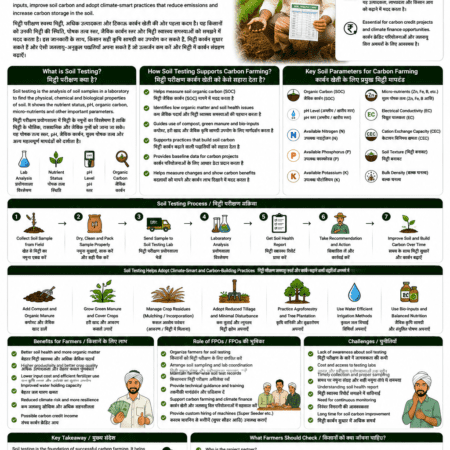
Many farmers apply fertilizers without knowing the actual nutrient status of their soil. This can lead to overuse of some nutrients and underuse of others. Soil testing helps farmers understand what the soil needs.
A soil health card or soil test report can guide balanced fertilizer use, organic matter improvement, pH correction, and micronutrient application. It can reduce unnecessary costs and improve crop response.
FPOs can organize soil testing camps, help farmers collect samples correctly, explain reports, and support follow-up action. Soil testing must be linked with practical advisory, not just reports.
Lack of Organic Matter Application
Many farms do not receive enough organic matter. Farmers may have limited access to farmyard manure, compost, crop residue, green manure, or biomass. Some residues are removed or burned instead of being returned to the soil.
Organic matter improves soil fertility, water retention, microbial activity, structure, and resilience. Without organic matter, soil becomes weak and input dependent.
FPOs can support composting, vermicompost production, bio-input units, crop residue use, and community-level organic matter campaigns. This can improve soil health while creating rural livelihood opportunities.
Monocropping and Soil Fatigue
Growing the same crop repeatedly can create soil fatigue. It may deplete specific nutrients, increase pest and disease pressure, reduce biodiversity, and weaken soil structure.
Crop rotation and diversification are important for maintaining soil health. Pulses, legumes, green manure crops, millets, oilseeds, vegetables, and agroforestry can help improve soil balance.
FPOs can guide farmers toward market-linked diversification so that soil health improvement also supports income improvement. Sustainable practices must be economically practical for farmers.
Poor Drainage and Waterlogging
Waterlogging damages soil health by reducing oxygen in the root zone. It can cause root disease, nutrient loss, salinity problems, and poor crop growth.
Poor drainage is common in low-lying fields or areas with heavy irrigation. Farmers may lose yield because crops cannot tolerate excess water.
Solutions include proper field leveling, drainage channels, raised beds, suitable crop selection, organic matter improvement, and water management. FPOs can help farmers understand local soil-water problems and adopt suitable solutions.
Soil Health and Farmer Income
Soil health directly affects farmer income. Poor soil increases input costs and reduces productivity. Healthy soil improves crop response, reduces risk, and supports better quality produce.
When farmers improve soil health, they may benefit through higher yield, lower fertilizer waste, better water use, reduced pest pressure, and improved resilience to climate stress.
Soil health is therefore an economic issue. Farmers must see soil improvement not as an extra burden, but as an investment in future income.
Soil Health and Food Security
Food security depends on productive and healthy soil. If soil health declines, long-term food production becomes risky. India’s food security cannot depend only on increasing input use. It must depend on maintaining soil fertility and ecological balance.
Healthy soil supports nutritious crops, stable production, and sustainable farming systems. It also reduces the risk of land degradation.
Soil health protection is therefore important for farmers, consumers, communities, and the nation.
Soil Health and Sustainable Development Goals
Soil health is closely connected with Sustainable Development Goals. It supports SDG 1 No Poverty, SDG 2 Zero Hunger, SDG 3 Good Health, SDG 6 Clean Water, SDG 8 Decent Work, SDG 12 Responsible Production, SDG 13 Climate Action, SDG 15 Life on Land, and SDG 17 Partnerships.
When soil is protected, agriculture becomes more sustainable and rural livelihoods become stronger. Soil health is also linked with biodiversity, climate resilience, nutrition, and responsible production.
This makes soil health a major development priority, not only an agricultural topic.
Role of FPOs in Solving Soil Health Challenges
FPOs can play a major role in solving soil health challenges in Indian agriculture. They can organize farmers, spread awareness, promote soil testing, supply quality inputs, support organic matter improvement, and create market linkages for sustainably produced crops.
FPOs can also support composting units, bio-input production, natural farming demonstrations, residue management machinery, water conservation initiatives, and crop diversification programs.
Because FPOs work directly with farmers, they can turn soil health advice into practical field action. This makes them important grassroots institutions for sustainable agriculture.
Soil Testing Through FPOs
Soil testing becomes easier when organized through FPOs. The FPO can collect soil samples from member farmers, coordinate with laboratories, distribute reports, and explain recommendations.
The real value of soil testing comes when farmers understand what the report means. FPOs can arrange training sessions where experts explain nutrient status, pH, organic carbon, and corrective measures.
Soil testing through FPOs can reduce input waste and improve crop productivity. It also helps farmers plan fertilizer use more scientifically.
Organic Inputs and Bio-Input Support Through FPOs
FPOs can support farmers by providing organic inputs, biofertilizers, biopesticides, compost, vermicompost, and natural farming inputs. These inputs can help improve soil health when used properly.
FPOs can also create local bio-input resource centers or composting units. This can create rural employment while supporting sustainable agriculture.
Input support must be combined with training. Farmers need to know how, when, and why to use organic and biological inputs for best results.
Natural Farming and Soil Restoration
Natural farming can help restore soil health by reducing input dependency, increasing biological activity, and improving organic matter use. However, farmers need proper training and realistic transition support.
FPOs can support natural farming through demonstration plots, farmer groups, bio-input preparation, training, and market linkage. Farmers should be guided step by step rather than pushed suddenly.
Natural farming can be especially useful when linked with soil health, reduced cost, local resources, and suitable markets.
Crop Rotation and Diversification
Crop rotation and diversification are practical ways to improve soil health. Legumes can improve nitrogen availability. Deep-rooted crops can improve soil structure. Mixed cropping can reduce pest pressure and support biodiversity.
FPOs can help farmers diversify crops based on local soil, climate, water availability, and market demand. This ensures that diversification is both ecological and profitable.
Crop planning through FPOs can help reduce soil fatigue and improve farmer income.
Agroforestry and Green Cover
Agroforestry can improve soil health by adding biomass, reducing erosion, improving microclimate, supporting biodiversity, and increasing long-term income. Trees can protect soil from wind and water erosion.
Farmers can grow trees along boundaries, degraded lands, or suitable farm areas. Agroforestry must be planned carefully so that it does not reduce crop productivity.
FPOs can support agroforestry through planting material, training, market linkage, and awareness about long-term benefits.
Water Management for Soil Health
Water management is essential for soil health. Both water scarcity and waterlogging can damage soil. Farmers need practices that improve water use efficiency and protect soil structure.
Solutions include mulching, micro-irrigation, rainwater harvesting, farm ponds, drainage, crop selection, soil organic matter, and irrigation scheduling.
FPOs can organize water conservation programs and connect farmers with schemes and technologies. Soil and water management must be planned together.
Residue Management and Farm Machinery
Residue management is important for soil health. Instead of burning residue, farmers can use it for mulching, composting, incorporation, or conservation agriculture.
Machines such as Super Seeders, Happy Seeders, mulchers, and other residue management tools can help farmers manage crop residue practically.
FPOs can create Farm Machinery Banks to make these machines available to small farmers. This supports soil health, climate action, and farmer income.
Capacity Building for Soil Health
Soil health improvement requires farmer training. Farmers need to understand soil testing, organic matter, nutrient balance, pest management, crop rotation, water conservation, and responsible input use.
FPOs, NGOs, CSR organizations, agricultural universities, Krishi Vigyan Kendras, and government departments can work together for farmer capacity building.
Training should be practical and field-based. Farmers learn better when they see visible results in demonstration plots.
Partnerships for Soil Health Restoration
Soil health restoration needs partnerships. Government departments, CSR organizations, research institutions, universities, FPOs, NGOs, banks, and technology providers can work together.
Partnerships can support soil testing, organic input units, training programs, composting facilities, water conservation, residue management machinery, and sustainable agriculture projects.
For CSR organizations, soil health is a strong impact area because it connects farmer income, climate action, food security, and environmental protection.
Belha Mai FPO and Soil Health
Belha Mai Farmers Producer Company Ltd. recognizes soil health as an important part of sustainable agriculture and farmer income. Healthy soil is essential for better productivity, lower input costs, climate resilience, and long-term rural prosperity.
Through farmer awareness, input services, sustainable farming guidance, farm machinery, value addition, and partnerships, FPOs like Belha Mai can help farmers move toward better soil management.
For Belha Mai FPO, soil health is not only about agriculture. It is about protecting the foundation of farmer livelihoods and rural development.
Why Soil Health Matters for India’s Future
India’s agricultural future depends on soil. If soil continues to degrade, farmers will face higher costs, lower productivity, more climate risk, and reduced income. Protecting soil is essential for food security and rural prosperity.
Healthy soil can support better crops, better nutrition, better water use, and stronger climate resilience. It can also reduce dependence on excessive external inputs.
Soil health must become a national and grassroots priority. Farmers, FPOs, government, CSR organizations, and development partners must work together to protect this valuable resource.
Conclusion
Soil Health Challenges in Indian Agriculture are serious, but they can be addressed through practical and collective action. Declining organic carbon, nutrient imbalance, chemical overuse, erosion, salinity, water stress, soil compaction, and climate impact require urgent attention.
The solutions include soil testing, organic matter improvement, balanced nutrition, water management, crop rotation, agroforestry, residue management, natural farming, and farmer training.
For Belha Mai Farmers Producer Company Ltd., soil health represents the foundation of sustainable agriculture. Healthy soil means stronger crops, stronger farmers, stronger villages, and a better future for rural India.
FAQ
What are the main Soil Health Challenges in Indian Agriculture?
The main soil health challenges in Indian agriculture include declining organic carbon, nutrient imbalance, excessive chemical use, soil erosion, water stress, salinity, alkalinity, soil compaction, low microbial activity, and climate change impact.
Why is soil health important for farmers?
Soil health is important because it affects crop productivity, input efficiency, water retention, nutrient availability, crop quality, climate resilience, and farmer income.
How can farmers improve soil health?
Farmers can improve soil health through soil testing, balanced fertilizer use, compost, farmyard manure, green manure, crop rotation, organic inputs, water conservation, residue management, agroforestry, and natural farming practices.
How do FPOs support soil health improvement?
FPOs support soil health improvement by organizing soil testing, training farmers, supplying quality inputs, promoting organic matter, supporting bio-inputs, arranging farm machinery, encouraging crop diversification, and connecting farmers with schemes and experts.
What is the role of soil testing in agriculture?
Soil testing helps farmers understand nutrient status, pH, organic carbon, and soil problems. It helps guide balanced fertilizer use and reduces unnecessary input costs.
Why should CSR organizations support soil health projects?
CSR organizations should support soil health projects because healthy soil improves farmer income, food security, climate resilience, biodiversity, water efficiency, and sustainable rural development.
Internal Links Section
👉 SDG Goals — https://belhamaifpo.com/sdg-goals/
👉 Farmer Producer Organizations Complete Guide — https://belhamaifpo.com/farmer-producer-organisation/farmer-producer-organizations-fpos/
👉 Why FPOs are Key to Sustainable Agriculture —https://belhamaifpo.com/sdg-goals/why-fpos-are-key-to-sustainable-agriculture/
👉 Linking Local Farming Practices to Global Development Goals — https://belhamaifpo.com/sdg-goals/linking-local-farming-practices-to-global-development-goals/
👉 How Agriculture Can Reduce Rural Poverty in India —https://belhamaifpo.com/sdg-goals/how-agriculture-can-reduce-rural-poverty-in-india/
👉 Impact of Mechanisation on Farmer Livelihoods — https://belhamaifpo.com/sdg-goals/impact-of-mechanisation-on-farmer-livelihoods/
👉 Role of Collective Farming in Increasing Farmer Income —https://belhamaifpo.com/sdg-goals/role-of-collective-farming-in-increasing-farmer-income/
👉 How Grassroots Institutions Drive Sustainable Change — https://belhamaifpo.com/sdg-goals/how-grassroots-institutions-drive-sustainable-change/
👉 Farm Machinery Bank —https://belhamaifpo.com/farm-machinery-bank/
👉 Belha Mai FPO — https://belhamaifpo.com/
External Authority Links
👉 Soil Health Card Scheme — https://soilhealth.dac.gov.in/
👉 Ministry of Agriculture and Farmers Welfare — https://agriwelfare.gov.in/
👉 Indian Council of Agricultural Research — https://icar.org.in/
👉 United Nations Sustainable Development Goals — https://sdgs.un.org/goals
👉 National Bank for Agriculture and Rural Development — https://www.nabard.org/
👉 Small Farmers’ Agribusiness Consortium — https://sfacindia.com/
👉 NITI Aayog SDG India Index —https://www.niti.gov.in/sdg-india-index
Follow Belha Mai FPO for More Updates
Website: https://belhamaifpo.com/
Facebook:https://www.facebook.com/profile.php?id=61561043486818
YouTube: https://www.youtube.com/channel/UC9ZvojoTMCa7mU1-Q_Bh60A
LinkedIn: https://www.linkedin.com/in/abhay-singh-ab5568280/
Instagram:https://instagram.com/belhamaifpo
Belha Mai Farmers Producer Company Ltd. supports farmers through better information, technology, market linkage, value addition, FPO awareness, rural development, women empowerment, soil health, and sustainable agriculture.