Introduction
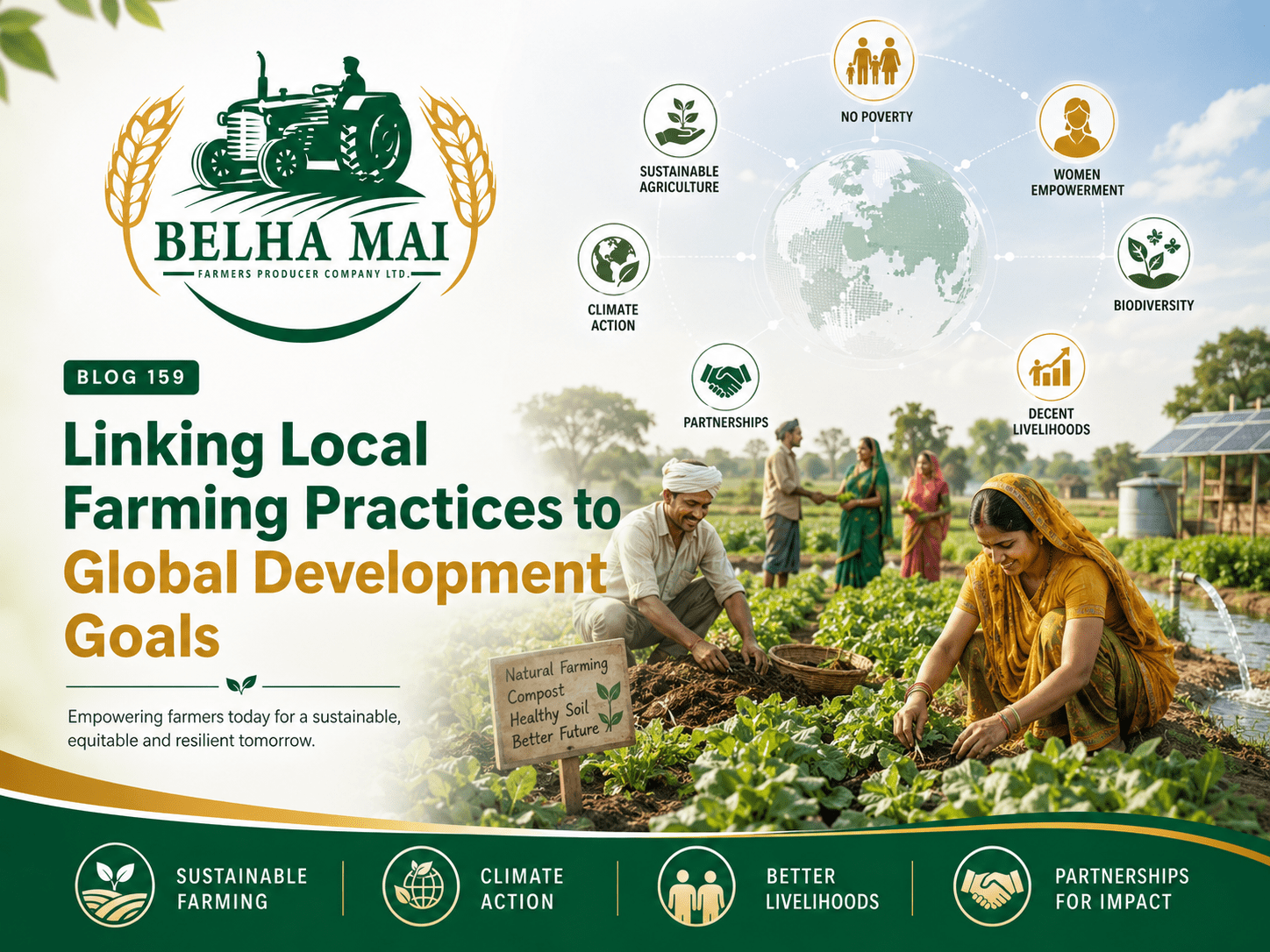
Linking Local Farming Practices to Global Development Goals is an important way to understand the connection between village-level agriculture and worldwide sustainability priorities. Farming may look like a local activity, but its impact reaches far beyond a single field or village. Soil health, water use, biodiversity, food security, farmer income, women’s participation, and climate resilience are all connected with global development.
The Sustainable Development Goals provide a global framework for poverty reduction, food security, gender equality, decent work, responsible production, climate action, life on land, and partnerships. Local farming practices can directly support these goals when farmers adopt sustainable, inclusive, and income-oriented approaches.
Farmer Producer Organizations, also known as FPOs, can play a major role in linking local farming practices to global development goals. They help farmers work collectively, access knowledge, adopt better practices, reduce costs, build market linkages, create value addition, and participate in sustainable rural development.
Linking Local Farming Practices to Global Development Goals Through Sustainable Agriculture
Linking Local Farming Practices to Global Development Goals begins with sustainable agriculture. Sustainable agriculture means farming in a way that protects natural resources, improves farmer income, supports food security, and keeps land productive for future generations.
Local practices such as composting, crop rotation, mixed cropping, mulching, organic input use, natural farming, water conservation, and soil testing can support long-term sustainability. These practices may appear simple, but they directly connect with global goals related to food security, climate action, responsible production, and life on land.
When farmers adopt sustainable agriculture, they are not only improving their own fields. They are also contributing to a larger global mission of protecting food systems, reducing environmental damage, and building resilient rural communities.
Linking Local Farming Practices to Global Development Goals Through Soil Health
Soil health is one of the strongest links between local farming and global development. Healthy soil supports better crops, higher productivity, lower input dependency, better water retention, biodiversity, and long-term food security.
Local farming practices such as adding farmyard manure, compost, crop residue, green manure, bio-inputs, and organic matter can improve soil fertility. Soil testing and balanced fertilizer use can also help farmers avoid unnecessary input costs and protect soil from degradation.
When soil health improves, farmer income becomes more stable and agricultural systems become more resilient. This directly supports global development goals related to poverty reduction, food security, sustainable agriculture, and environmental protection.
Linking Local Farming Practices to Global Development Goals Through Water Conservation
Water is a critical resource for agriculture. Many farming regions face irregular rainfall, groundwater depletion, poor irrigation efficiency, and climate-related water stress. Local water conservation practices can make agriculture more sustainable and resilient.
Farmers can conserve water through mulching, farm ponds, drip irrigation, sprinkler systems, efficient irrigation scheduling, crop selection, direct seeded rice, and better field-level water management. These practices reduce pressure on water resources and improve crop survival.
Water conservation supports global development goals related to climate action, sustainable agriculture, poverty reduction, and responsible resource use. When local farmers save water, they contribute to a more sustainable future.
Linking Local Farming Practices to Global Development Goals Through Natural Farming
Natural farming and low-input farming practices can reduce input costs and improve ecological balance when implemented properly. Farmers can use locally available resources such as cow dung, cow urine, compost, biomass, crop residue, bio-inputs, and natural pest management methods.
Natural farming can help reduce dependency on expensive external inputs. This is important for small and marginal farmers who often struggle with rising production costs. Lower input cost can improve net income and reduce financial stress.
By promoting natural farming practices, local agriculture can support global development goals related to sustainable production, climate action, soil restoration, biodiversity, and rural livelihoods.
Linking Local Farming Practices to Global Development Goals Through Biodiversity
Biodiversity is essential for sustainable agriculture. Pollinators, beneficial insects, trees, soil microbes, birds, native plants, and crop diversity all support healthy farming systems. When biodiversity declines, farming becomes more vulnerable to pests, diseases, and climate shocks.
Local practices such as mixed cropping, agroforestry, tree plantation, reduced chemical misuse, pollinator protection, and maintaining field biodiversity can protect the natural ecosystem around farms.
Biodiversity-friendly farming supports global development goals related to life on land, climate resilience, food security, and sustainable agriculture. It also helps farmers build more stable and resilient production systems.
Linking Local Farming Practices to Global Development Goals Through Climate Action
Climate change is already affecting farmers through heat stress, irregular rainfall, drought, floods, pest outbreaks, and changing crop cycles. Local farming practices can help reduce climate risk and improve farmer resilience.
Climate-friendly practices may include crop diversification, water conservation, soil organic matter improvement, agroforestry, residue management, natural farming, efficient machinery use, and better weather-based crop planning.
These actions may happen at the village level, but they directly contribute to global climate goals. Linking Local Farming Practices to Global Development Goals helps show that farmers are not only victims of climate change; they can also become part of the solution.
Linking Local Farming Practices to Global Development Goals Through Farmer Income
Sustainable development is incomplete without farmer income. If farmers do not earn properly, they cannot invest in better practices, education, health, nutrition, or farm improvement. Therefore, local farming practices must also support income growth.
FPOs can help farmers improve income by reducing input costs, improving productivity, aggregating produce, creating market linkages, reducing distress selling, and supporting value addition. Local farming becomes more powerful when it is connected with better business systems.
Farmer income is directly connected with global development goals such as no poverty, decent work, economic growth, food security, and reduced inequalities. Better income allows rural families to build a more stable future.
Linking Local Farming Practices to Global Development Goals Through Women Empowerment
Women play a major role in agriculture. They participate in sowing, weeding, harvesting, seed preservation, livestock care, cleaning, grading, processing, and household-level farm management. However, their contribution is often under-recognized.
Local farming practices can support women empowerment when women are included in training, decision-making, FPO membership, value addition, processing, packaging, leadership, and income-generating activities.
Women empowerment supports global development goals related to gender equality, poverty reduction, decent work, nutrition, and community development. When women farmers become active participants in local farming systems, the whole rural economy becomes stronger.
Linking Local Farming Practices to Global Development Goals Through Rural Employment
Local farming practices can create employment when agriculture is connected with services, processing, storage, packaging, machinery, marketing, and value addition. Farming should not be seen only as crop production. It can become the foundation of rural enterprise.
FPOs can create employment through input supply centers, farm machinery banks, aggregation centers, processing units, packaging units, storage facilities, field services, digital outreach, and market linkage operations.
Rural employment supports global development goals related to decent work, poverty reduction, sustainable communities, and economic growth. When employment is created locally, migration pressure reduces and rural families become more stable.
Linking Local Farming Practices to Global Development Goals Through Value Addition
Value addition is one of the strongest ways to connect local farming with sustainable development. When farmers sell only raw produce, their income remains limited. When produce is cleaned, graded, processed, packaged, branded, and marketed, farmers can capture more value.
Local value addition can include flour milling, honey processing, fruit processing, dehydration, pulping, millet products, spice processing, amla products, mango products, and other food-based enterprises.
Value addition supports global development goals by improving income, reducing wastage, creating jobs, supporting women, strengthening local enterprises, and making rural economies more resilient.
Linking Local Farming Practices to Global Development Goals Through Responsible Production
Responsible production means producing food in a way that protects resources, reduces waste, improves quality, and respects environmental limits. Local farming practices can support this by reducing unnecessary chemical use, improving post-harvest handling, conserving water, and reducing losses.
FPOs can guide farmers toward better production planning, quality standards, safe handling, traceability, packaging, storage, and responsible supply chains. These systems are important for institutional buyers, CSR partners, food companies, and export-oriented markets.
Responsible production connects local farming with global goals related to sustainability, food safety, resource conservation, and responsible consumption.
Linking Local Farming Practices to Global Development Goals Through Partnerships
Local farming practices become more impactful when they are supported by strong partnerships. Farmers and FPOs need support from government departments, CSR organizations, NGOs, banks, research institutions, universities, technology providers, processors, exporters, and buyers.
Partnerships can bring finance, infrastructure, training, technology, quality systems, market access, and long-term development support. They help scale local solutions into larger development impact.
Global development goals cannot be achieved by one institution alone. Partnerships are essential. FPOs can become the bridge between local farming communities and wider development ecosystems.
Linking Local Farming Practices to Global Development Goals Through FPOs
FPOs are one of the most practical institutions for linking local farming practices to global development goals. They work directly with farmers and understand village-level challenges. At the same time, they can connect farmers with formal markets, government schemes, CSR programs, grants, buyers, and development partners.
Through FPOs, local practices can become organized, documented, scalable, and market-linked. This is important because development agencies and CSR organizations often need credible grassroots institutions to implement rural projects.
An FPO can help convert individual farmer efforts into collective rural transformation. This makes FPOs important for SDG-based agriculture and rural development.
Linking Local Farming Practices to Global Development Goals and SDG 1
SDG 1 focuses on poverty reduction. Local farming practices can support poverty reduction when they increase farmer income, reduce input costs, create employment, and improve livelihood security.
FPOs can strengthen this process by helping farmers access inputs, markets, value addition, finance, machinery, and partnerships. When farmers earn better income from local farming, poverty reduction becomes more practical.
This shows that a small improvement in village-level agriculture can directly contribute to a global development goal.
Linking Local Farming Practices to Global Development Goals and SDG 5
SDG 5 focuses on gender equality. Local farming systems can support gender equality when women are included in training, leadership, farm decisions, FPO membership, processing, packaging, and income-generating activities.
Women’s participation strengthens the rural economy. It also improves household welfare, children’s education, nutrition, health, and savings.
When women farmers are recognized and empowered, local farming practices become more inclusive and aligned with global development goals.
Linking Local Farming Practices to Global Development Goals and SDG 8
SDG 8 focuses on decent work and economic growth. Local farming practices can support this goal when agriculture creates regular livelihoods, rural enterprises, processing units, service activities, and market-linked businesses.
FPO-led models can create work in input services, machinery services, aggregation, storage, processing, branding, sales, logistics, and digital operations.
This helps rural areas move from subsistence farming toward enterprise-based rural development.
Linking Local Farming Practices to Global Development Goals and SDG 13
SDG 13 focuses on climate action. Local farming practices can support climate action through soil health improvement, water conservation, agroforestry, natural farming, crop diversification, and climate-resilient agriculture.
FPOs can spread these practices among farmers through training, demonstrations, advisory services, and partnerships. Climate action becomes stronger when farmers work collectively.
This proves that climate solutions are not only found in global conferences. They also exist in fields, villages, and farmer institutions.
Linking Local Farming Practices to Global Development Goals and SDG 15
SDG 15 focuses on life on land. Local farming practices can support this goal by protecting soil, biodiversity, trees, pollinators, and natural ecosystems.
Agroforestry, mixed cropping, tree plantation, reduced chemical misuse, organic matter improvement, and biodiversity-friendly farming can strengthen land-based livelihoods.
When farmers protect land, they protect the future of agriculture. This makes local farming practices central to SDG 15.
Linking Local Farming Practices to Global Development Goals and SDG 17
SDG 17 focuses on partnerships. Local farming practices need institutional support to scale. Farmers need partnerships for finance, technology, training, infrastructure, markets, and policy support.
FPOs can act as grassroots partners for CSR organizations, NGOs, government departments, research institutions, buyers, and development agencies.
Strong partnerships can help local farming practices become part of national and global sustainability efforts.
Belha Mai FPO and Local Farming Practices
Belha Mai Farmers Producer Company Ltd. is working to support farmers through collective strength, farmer services, market linkage, farm machinery, value addition, women participation, digital outreach, and sustainable agriculture.
The organization’s approach connects local farming realities with larger development goals. By supporting farmers at the grassroots level, Belha Mai FPO can contribute to poverty reduction, women empowerment, decent work, climate action, biodiversity protection, and partnerships.
For Belha Mai FPO, local farming is not only about production. It is about building a sustainable rural economy where farmers, women, youth, communities, and natural resources grow together.
Why Linking Local Farming Practices to Global Development Goals Matters
Linking Local Farming Practices to Global Development Goals matters because it gives recognition to grassroots action. It shows that sustainable development does not happen only through large policies or international programs. It also happens through farmers improving soil, saving water, planting trees, reducing waste, supporting women, and building local enterprises.
This connection is also important for CSR organizations, NGOs, grant agencies, and development partners. They need credible rural institutions that can implement sustainability projects at the ground level. FPOs can provide this platform.
When local practices are linked with global goals, farmer institutions gain stronger visibility, better partnership opportunities, and greater development relevance.
Conclusion
Linking Local Farming Practices to Global Development Goals is a powerful way to understand the future of rural development. Local farming practices can support poverty reduction, food security, gender equality, decent work, climate action, biodiversity, responsible production, and partnerships.
FPOs can make this connection stronger by organizing farmers, improving knowledge, reducing costs, building market linkages, supporting value addition, empowering women, and creating development partnerships.
For India, the path to sustainable development passes through its villages and farms. For Belha Mai Farmers Producer Company Ltd., this vision represents a farmer-led model where local action contributes to global change.
FAQ
What does Linking Local Farming Practices to Global Development Goals mean?
Linking Local Farming Practices to Global Development Goals means connecting village-level agriculture practices such as soil health, water conservation, natural farming, biodiversity, women participation, and farmer income with global sustainability goals.
How do local farming practices support global development goals?
Local farming practices support global development goals by reducing poverty, improving food security, conserving water, protecting soil, supporting women farmers, creating rural employment, reducing climate risk, and protecting biodiversity.
Why are FPOs important in linking local farming with global goals?
FPOs are important because they organize farmers, provide training, improve market access, support value addition, promote sustainable agriculture, connect farmers with partners, and scale local solutions through collective action.
Which Sustainable Development Goals are connected with local farming?
Local farming is strongly connected with SDG 1 No Poverty, SDG 2 Zero Hunger, SDG 5 Gender Equality, SDG 8 Decent Work, SDG 12 Responsible Production, SDG 13 Climate Action, SDG 15 Life on Land, and SDG 17 Partnerships.
How can local farming support climate action?
Local farming can support climate action through soil health improvement, water conservation, crop diversification, agroforestry, natural farming, residue management, and climate-resilient agriculture.
Why should CSR organizations support local farming practices?
CSR organizations should support local farming practices because they create direct grassroots impact in poverty reduction, women empowerment, sustainable agriculture, climate resilience, rural employment, and community development.
Internal Links Section
👉 SDG Goals — https://belhamaifpo.com/sdg-goals/
👉 Farmer Producer Organizations Complete Guide — https://belhamaifpo.com/farmer-producer-organisation/farmer-producer-organizations-fpos/
👉 How Farmer Producer Organizations Contribute to Sustainable Development Goals — https://belhamaifpo.com/sdg-goals/how-farmer-producer-organizations-contribute-to-sustainable-development-goals/
👉 Why FPOs are Key to Sustainable Agriculture — https://belhamaifpo.com/sdg-goals/why-fpos-are-key-to-sustainable-agriculture/
👉 How FPOs Reduce Poverty in Rural India —https://belhamaifpo.com/sdg-goals/how-fpos-reduce-poverty-in-rural-india/
👉 Belha Mai FPO — https://belhamaifpo.com/
External Authority Links
👉 United Nations Sustainable Development Goals — https://sdgs.un.org/goals
👉 NITI Aayog SDG India Index —https://www.niti.gov.in/sdg-india-index
👉 Ministry of Agriculture and Farmers Welfare — https://agriwelfare.gov.in/
👉 Small Farmers’ Agribusiness Consortium — https://sfacindia.com/
👉 National Bank for Agriculture and Rural Development — https://www.nabard.org/
Follow Belha Mai FPO for More Updates
Website: https://belhamaifpo.com/
Facebook: https://www.facebook.com/profile.php?id=61561043486818
YouTube: https://www.youtube.com/channel/UC9ZvojoTMCa7mU1-Q_Bh60A
LinkedIn: https://www.linkedin.com/in/abhay-singh-ab5568280/
Instagram: https://instagram.com/belhamaifpo
Belha Mai Farmers Producer Company Ltd. supports farmers through better information, technology, market linkage, value addition, FPO awareness, rural development, and sustainable agriculture.