Introduction
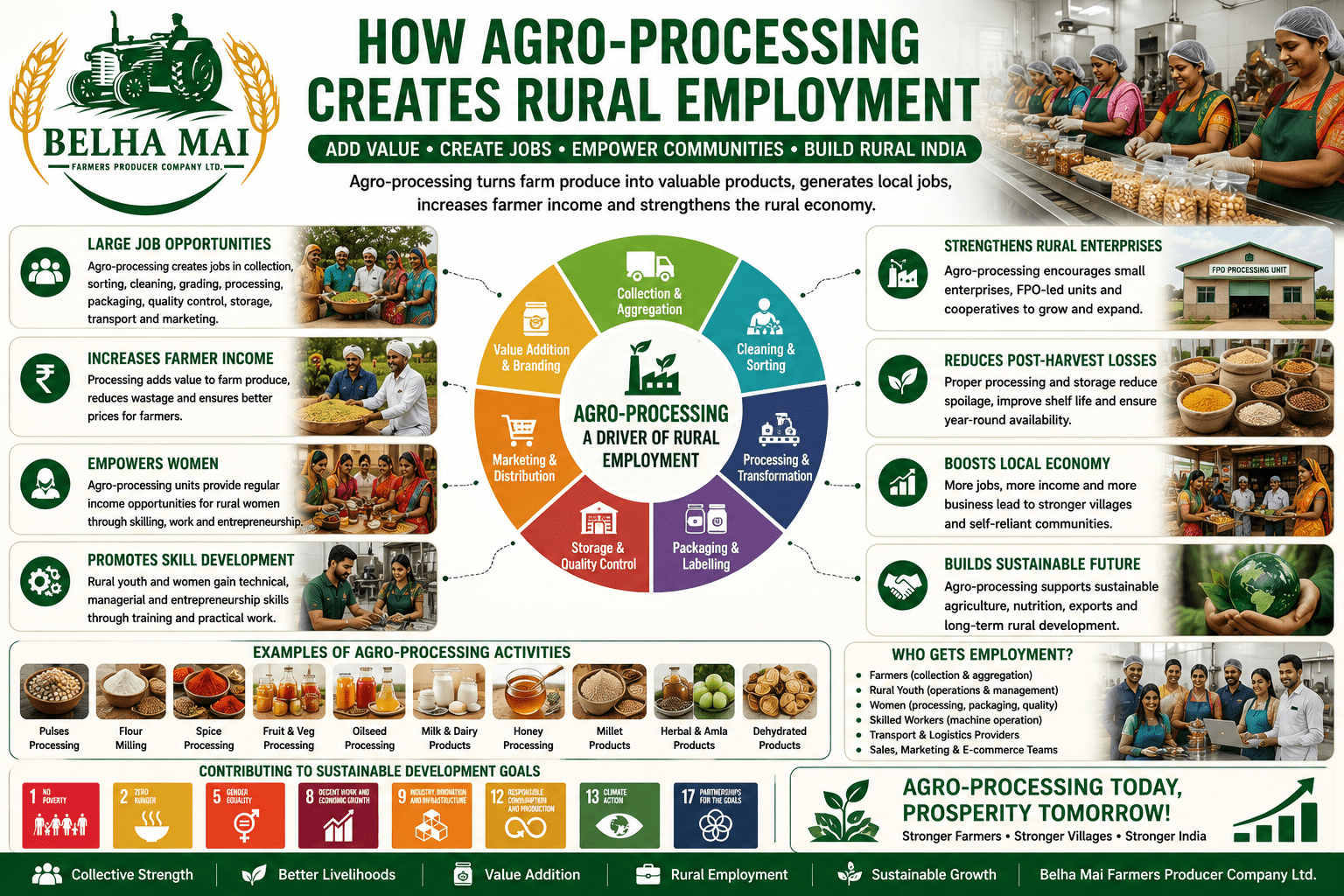
How Agro-Processing Creates Rural Employment is an important subject for rural development, farmer income, women empowerment, food security, and sustainable economic growth. Agriculture produces raw materials, but agro-processing converts those raw materials into valuable products. This process creates jobs, reduces wastage, increases farmer income, and strengthens the rural economy.
In many villages, farmers sell raw produce immediately after harvest because they do not have storage, processing, packaging, branding, or market access. As a result, most of the value is captured outside the village by traders, processors, wholesalers, and brands. Agro-processing can change this situation by creating value close to the production area.
Farmer Producer Organizations, also known as FPOs, can play a major role in building agro-processing-based rural employment. Through aggregation, processing units, packaging centers, storage, branding, quality control, and market linkage, FPOs can convert agriculture into a stronger rural enterprise model.
How Agro-Processing Creates Rural Employment Through Value Addition
How Agro-Processing Creates Rural Employment begins with value addition. When raw farm produce is processed, cleaned, graded, packed, branded, or converted into finished products, its value increases. This process creates work at every stage.
Value addition can include flour milling, pulse processing, spice grinding, fruit pulping, dehydration, honey processing, oilseed processing, millet products, amla products, mango products, herbal products, dairy products, and packaged foods. Each activity requires people, machines, skills, quality systems, and market support.
When value addition happens in rural areas, more income remains within the village economy. Farmers benefit through better prices, while local workers benefit through employment. This makes agro-processing one of the strongest tools for rural development.
How Agro-Processing Creates Rural Employment Through Collection and Aggregation
Before processing can begin, farm produce must be collected and aggregated. This creates local employment in produce collection, weighing, loading, unloading, record keeping, sorting, and transport coordination.
FPOs can organize collection centers where farmers bring their produce. These centers require staff for farmer coordination, quality checking, documentation, storage management, and buyer communication.
Aggregation also helps farmers sell in larger quantities. Larger volume makes processing more practical and market linkage stronger. This creates employment while also improving farmer bargaining power.
How Agro-Processing Creates Rural Employment Through Cleaning and Sorting
Cleaning and sorting are basic but important stages of agro-processing. Before any produce is processed or packed, it must be cleaned, sorted, and separated according to quality.
This creates jobs for rural workers, especially women and youth. Activities may include removing dust, stones, damaged produce, immature produce, foreign matter, and low-quality material. Sorting improves product quality and market value.
Clean and sorted produce receives better acceptance from buyers, processors, retailers, and institutional customers. Therefore, even simple processing steps can create employment and improve income.
How Agro-Processing Creates Rural Employment Through Grading
Grading means separating produce according to size, quality, maturity, moisture, shape, or market requirement. It is important for fruits, vegetables, grains, pulses, spices, honey, and processed products.
Grading creates employment for trained workers who understand product standards. It also helps farmers receive better prices because higher-quality produce can be sold separately instead of being mixed with lower-grade produce.
FPO-led grading centers can help rural communities build better market credibility. When buyers trust the quality, repeat business becomes possible. This supports long-term rural employment.
How Agro-Processing Creates Rural Employment Through Processing Units
Processing units are the main employment centers in agro-processing. These units require workers for machine operation, raw material handling, processing, cleaning, monitoring, maintenance, packaging, labeling, storage, and dispatch.
A small rural processing unit can create employment for operators, supervisors, helpers, quality staff, packing workers, cleaners, transport workers, sales staff, and accountants. Larger units can create even more jobs.
Processing units also support indirect employment. Mechanics, electricians, packaging suppliers, transporters, traders, digital marketers, and service providers all benefit from agro-processing activity.
How Agro-Processing Creates Rural Employment Through Packaging
Packaging is a major job-creating activity in agro-processing. Once a product is processed, it must be packed properly to maintain quality, shelf life, safety, branding, and market appeal.
Packaging creates employment in pouch filling, bottle filling, sealing, labeling, weighing, batch coding, carton packing, quality checking, and inventory management. Women workers can play a strong role in this segment.
Good packaging also helps rural brands enter better markets. When products look professional and trustworthy, they can be sold to retailers, institutions, online customers, and larger buyers.
How Agro-Processing Creates Rural Employment Through Quality Control
Quality control is essential for food processing and institutional supply. Products must be safe, clean, properly processed, and consistent. This creates demand for trained rural workers who can handle quality checks.
Quality control may include moisture checking, hygiene monitoring, grading standards, batch records, packaging checks, storage conditions, food safety compliance, and basic documentation.
As FPOs move toward branded products, institutional markets, and export readiness, quality control becomes even more important. This creates skilled employment and improves the credibility of rural enterprises.
How Agro-Processing Creates Rural Employment Through Storage and Warehousing
Storage is an important part of agro-processing. Raw material and finished goods need proper storage to avoid spoilage, pest damage, moisture issues, and quality loss.
Rural storage facilities create jobs in warehouse management, stock records, loading, unloading, cleaning, pest monitoring, inventory control, and dispatch planning. Cold storage and controlled storage facilities can create even more skilled employment.
Better storage also helps farmers avoid distress selling. When produce can be stored, processed, and sold later, farmers and rural enterprises gain more control over prices and supply timing.
How Agro-Processing Creates Rural Employment Through Logistics
Agro-processing depends on movement of goods. Raw produce must move from farms to processing units, and finished products must move from processing units to markets.
This creates employment for drivers, loaders, transport coordinators, delivery workers, warehouse staff, route planners, and logistics service providers. Rural youth can participate strongly in this segment.
Logistics also connects villages with towns, cities, institutions, wholesalers, retailers, and export supply chains. Strong logistics support makes agro-processing commercially viable.
How Agro-Processing Creates Rural Employment Through Marketing and Sales
Processed products need marketing and sales. This creates employment in product promotion, customer handling, retailer connection, institutional sales, digital marketing, e-commerce, social media, exhibitions, buyer meetings, and order management.
Rural youth with basic education and digital skills can participate in marketing and sales roles. FPOs can train youth to handle product catalogs, WhatsApp marketing, online orders, customer communication, and business development.
Marketing is important because processing alone does not guarantee income. Products must reach buyers. This creates new employment beyond the farm and factory.
How Agro-Processing Creates Rural Employment for Women
Women can benefit greatly from agro-processing. Many processing activities such as cleaning, grading, sorting, cutting, drying, packaging, labeling, quality checking, and record keeping are suitable for women’s participation.
Agro-processing can provide women with local income opportunities near their homes. This is important in rural areas where women may face mobility restrictions or family responsibilities.
Women’s income improves household welfare. It supports children’s education, nutrition, health, savings, and family stability. Therefore, agro-processing is not only an employment tool; it is also a women empowerment strategy.
How Agro-Processing Creates Rural Employment for Youth
Rural youth often migrate to cities because they do not see enough opportunities in villages. Agro-processing can create skilled and semi-skilled jobs that make rural areas more economically attractive.
Youth can work in machine operation, digital marketing, packaging design, quality control, logistics, accounting, e-commerce, data management, procurement, sales, and field coordination.
When youth participate in agro-processing, agriculture becomes more modern and enterprise-oriented. This helps build the next generation of rural entrepreneurs and agri-business professionals.
How Agro-Processing Creates Rural Employment Through Skill Development
Agro-processing requires skills. Workers need training in hygiene, machine operation, packaging, quality control, inventory, safety, food handling, documentation, and basic business practices.
Skill development creates better employment quality. Trained workers can earn better wages and handle more responsible roles. It also improves the performance of processing units.
FPOs, NGOs, CSR organizations, government agencies, and training institutions can collaborate to build rural skills in agro-processing. This makes employment more sustainable and professional.
How Agro-Processing Creates Rural Employment Through Small Rural Enterprises
Agro-processing encourages rural entrepreneurship. Small enterprises can be created around flour milling, spice processing, honey packaging, fruit dehydration, millet snacks, amla products, mango products, oil extraction, dairy products, and local food brands.
These enterprises create employment for owners, workers, suppliers, transporters, packaging providers, and marketing teams. They also help keep economic value within rural areas.
FPOs can support small enterprises by providing raw material, training, branding, compliance support, and market linkage. This creates a strong rural enterprise ecosystem.
How Agro-Processing Creates Rural Employment Through FPOs
FPOs are very important for agro-processing because they already work with farmers and understand local production. They can aggregate raw material, identify processing opportunities, set up units, train workers, and connect products with markets.
FPO-led agro-processing can benefit both farmers and workers. Farmers get better value for produce, while local people get employment in processing and related activities.
An FPO can also ensure that agro-processing remains farmer-centric. Instead of value moving away from villages, the value can remain with farmer-owned institutions and rural communities.
How Agro-Processing Creates Rural Employment Through Reduced Wastage
Post-harvest wastage is a major problem in agriculture, especially for fruits, vegetables, honey, grains, pulses, and perishable products. When produce is wasted, farmers lose income and rural communities lose economic value.
Agro-processing reduces wastage by converting surplus or perishable produce into shelf-stable products. For example, fruits can be converted into pulp, juice, dehydrated slices, candy, jam, or powder. Grains can be milled and packaged. Honey can be processed and bottled.
Reducing wastage creates employment and improves farmer income. It also supports responsible production and sustainable food systems.
How Agro-Processing Creates Rural Employment Through Better Farmer Income
Agro-processing improves farmer income by increasing the value of farm produce. When raw produce is processed into a market-ready product, the farmer or FPO can earn more than selling raw material alone.
Better farmer income creates more local spending. Farmers invest in education, health, farm inputs, machinery, housing, and local services. This creates further employment in the rural economy.
Therefore, agro-processing has a multiplier effect. It improves income at the farmer level and creates jobs across the local value chain.
How Agro-Processing Creates Rural Employment Through Branding
Branding helps rural products reach better markets. A branded product can communicate quality, origin, farmer ownership, sustainability, and trust. This creates employment in packaging design, labeling, content writing, photography, marketing, sales, and customer service.
FPO brands can become powerful tools for farmer-led development. Products such as honey, flour, amla products, mango products, millet products, spices, and processed foods can be sold under a rural brand identity.
Branding also improves market recognition. A strong brand helps rural enterprises compete with larger market players.
How Agro-Processing Creates Rural Employment Through Institutional Supply
Agro-processing can help rural enterprises supply to institutions such as schools, hospitals, hotels, government programs, corporate canteens, retailers, wholesalers, and food companies.
Institutional supply requires regular production, quality control, packaging, documentation, logistics, and customer management. This creates stable employment.
FPOs can use institutional supply as a route to scale agro-processing. When demand is stable, rural employment becomes more regular and reliable.
How Agro-Processing Creates Rural Employment Through Export Readiness
Some agro-processed products can become export-ready if they meet quality, packaging, food safety, and documentation standards. Export readiness creates higher-value opportunities and skilled jobs.
Export-oriented processing requires quality systems, testing, grading, compliance, packaging, storage, logistics, and buyer communication. Rural youth and trained staff can participate in these roles.
For FPOs, export readiness can increase income potential and strengthen institutional credibility. It also creates opportunities for partnerships with buyers, processors, and government export promotion agencies.
How Agro-Processing Creates Rural Employment and SDGs
Agro-processing is closely connected with Sustainable Development Goals. It supports SDG 1 through poverty reduction, SDG 2 through food security, SDG 5 through women empowerment, SDG 8 through decent work, SDG 9 through rural industry, SDG 12 through responsible production, and SDG 17 through partnerships.
When agro-processing is developed through FPOs, it becomes more inclusive. Farmers, women, youth, workers, and rural entrepreneurs can all benefit from the value chain.
This makes agro-processing a strong tool for sustainable rural transformation.
Belha Mai FPO and Agro-Processing
Belha Mai Farmers Producer Company Ltd. is working to strengthen farmers through collective action, input services, farm machinery, market linkage, value addition, women participation, digital outreach, and sustainable agriculture.
Agro-processing fits strongly into this vision because it can convert local farm produce into higher-value products and create rural jobs. Products related to grains, honey, amla, mango, millets, and other agricultural produce can support both farmer income and local employment.
For Belha Mai FPO, agro-processing is not only a business activity. It is a rural development strategy that can create livelihoods, empower women, reduce wastage, improve farmer income, and build a stronger village economy.
Why Agro-Processing Matters for India’s Rural Future
India’s rural future depends on creating employment beyond traditional crop farming. Farming alone may not provide year-round income for every rural household. Agro-processing can fill this gap by creating jobs throughout the year.
It can also reduce migration pressure, build rural enterprises, improve food supply chains, create local brands, and support sustainable agriculture. When processing happens near production areas, villages become stronger economic centers.
For India, agro-processing can help transform agriculture from a raw produce economy into a value-added rural enterprise economy.
Conclusion
How Agro-Processing Creates Rural Employment can be understood through one simple idea: when farm produce is processed locally, jobs are created locally. Agro-processing generates employment in collection, cleaning, grading, processing, packaging, storage, quality control, logistics, marketing, and enterprise development.
It supports farmers through better prices and supports rural families through local jobs. It creates opportunities for women, youth, workers, entrepreneurs, and FPOs.
For Belha Mai Farmers Producer Company Ltd., agro-processing represents a strong path toward farmer income, rural employment, value addition, women empowerment, and sustainable development.
FAQ
How Agro-Processing Creates Rural Employment?
Agro-processing creates rural employment by generating jobs in produce collection, cleaning, grading, processing, packaging, storage, quality control, logistics, marketing, and value-added product development.
Why is agro-processing important for rural development?
Agro-processing is important for rural development because it increases farmer income, reduces wastage, creates local jobs, supports women and youth, strengthens rural enterprises, and keeps more value within the village economy.
How does agro-processing help farmers?
Agro-processing helps farmers by increasing the value of raw produce, reducing post-harvest losses, improving market access, creating demand for quality produce, and supporting better price realization.
Can agro-processing create employment for women?
Yes. Agro-processing can create strong employment opportunities for women in cleaning, grading, sorting, packaging, labeling, quality checking, food processing, and value-added product preparation.
How do FPOs support agro-processing?
FPOs support agro-processing by aggregating farmer produce, setting up processing units, organizing workers, maintaining quality, branding products, creating market linkages, and building rural enterprise models.
Why should CSR organizations support agro-processing?
CSR organizations should support agro-processing because it creates rural jobs, empowers women, improves farmer income, reduces wastage, promotes local enterprises, and supports sustainable development goals.
Internal Links Section
👉 SDG Goals — https://belhamaifpo.com/sdg-goals/
👉 Farmer Producer Organizations Complete Guide — https://belhamaifpo.com/farmer-producer-organisation/farmer-producer-organizations-fpos/
👉 How Farmer Producer Organizations Contribute to Sustainable Development Goals — https://belhamaifpo.com/sdg-goals/how-farmer-producer-organizations-contribute-to-sustainable-development-goals/
👉 Role of FPOs in Achieving Rural Development in India — https://belhamaifpo.com/sdg-goals/role-of-fpos-in-achieving-rural-development-in-india/
👉 How FPOs Reduce Poverty in Rural India — https://belhamaifpo.com/sdg-goals/how-fpos-reduce-poverty-in-rural-india/
👉 Why FPOs are Key to Sustainable Agriculture — https://belhamaifpo.com/sdg-goals/why-fpos-are-key-to-sustainable-agriculture/
👉 Linking Local Farming Practices to Global Development Goals —https://belhamaifpo.com/sdg-goals/linking-local-farming-practices-to-global-development-goals/
👉 How Grassroots Institutions Drive Sustainable Change — https://belhamaifpo.com/sdg-goals/how-grassroots-institutions-drive-sustainable-change/
👉 How Agriculture Can Reduce Rural Poverty in India — https://belhamaifpo.com/sdg-goals/how-agriculture-can-reduce-rural-poverty-in-india/
👉 Role of Collective Farming in Increasing Farmer Income —https://belhamaifpo.com/sdg-goals/role-of-collective-farming-in-increasing-farmer-income/
👉 Rajvi Bhog Food Products: Complete Guide — https://belhamaifpo.com/agriculture/rajvi-bhog-food-products-quality-export-guide/
👉 Honey Processing in India: Complete Guide —https://belhamaifpo.com/agriculture/honey-processing-in-india-complete-guide/
👉 Belha Mai FPO — https://belhamaifpo.com/
External Authority Links
👉 United Nations Sustainable Development Goals — https://sdgs.un.org/goals
👉 Ministry of Food Processing Industries — https://www.mofpi.gov.in/
👉 Ministry of Agriculture and Farmers Welfare — https://agriwelfare.gov.in/
👉 Small Farmers’ Agribusiness Consortium — https://sfacindia.com/
👉 National Bank for Agriculture and Rural Development — https://www.nabard.org/
👉 NITI Aayog SDG India Index — https://www.niti.gov.in/sdg-india-index
Follow Belha Mai FPO for More Updates
Website: https://belhamaifpo.com/
Facebook: https://www.facebook.com/profile.php?id=61561043486818
YouTube: https://www.youtube.com/channel/UC9ZvojoTMCa7mU1-Q_Bh60A
LinkedIn:https://www.linkedin.com/in/abhay-singh-ab5568280/
Instagram: https://instagram.com/belhamaifpo
Belha Mai Farmers Producer Company Ltd. supports farmers through better information, technology, market linkage, value addition, FPO awareness, rural development, and sustainable agriculture.