Introduction
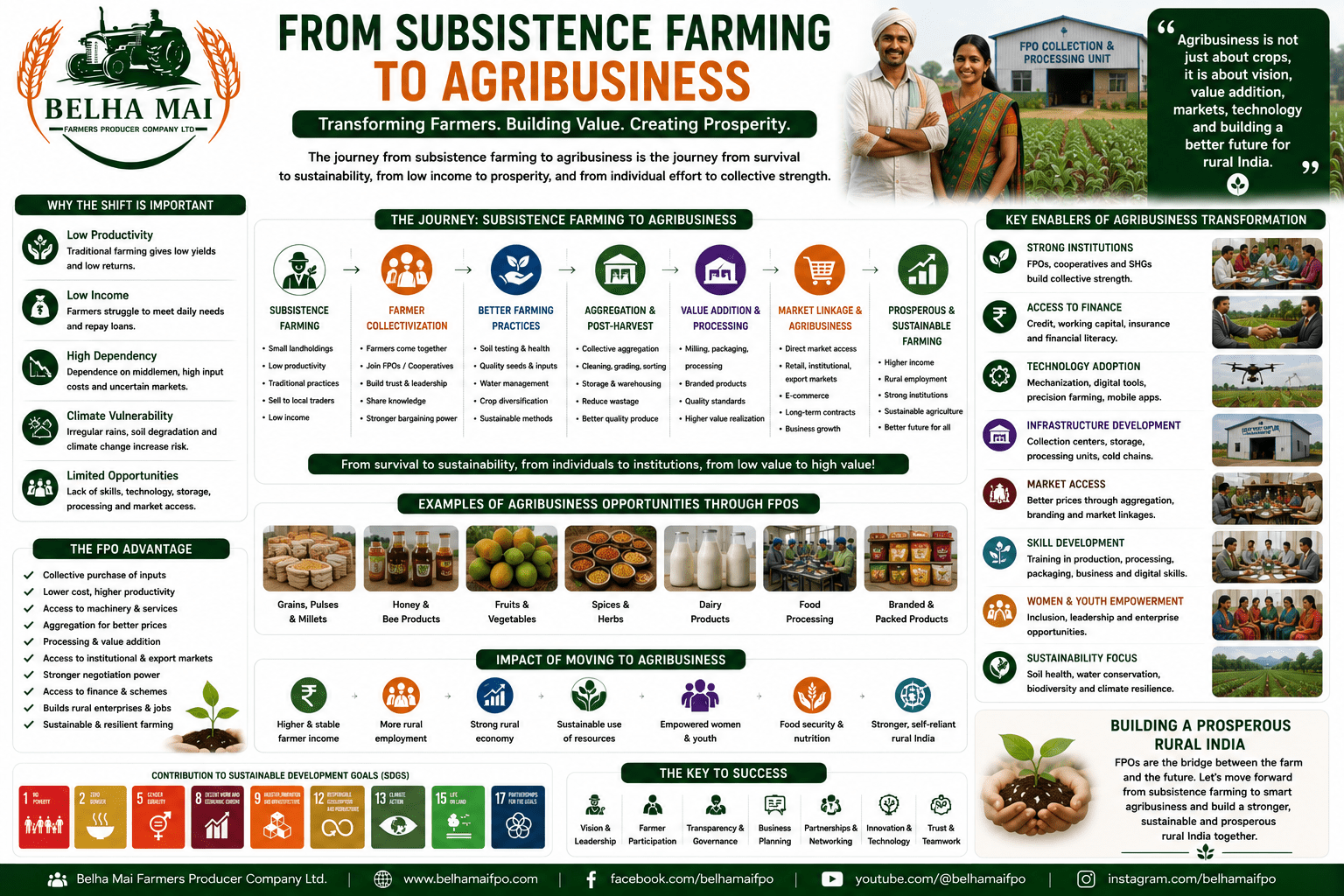
From Subsistence Farming to Agribusiness is one of the most important transitions needed for rural India. Subsistence farming means farming mainly for survival, household food needs, and small seasonal income. In this system, farmers often have limited land, limited capital, weak market access, low productivity, and high dependence on local traders.
Agribusiness means treating agriculture as an organized economic activity. It includes production, input planning, soil health, technology, aggregation, storage, processing, packaging, branding, finance, logistics, and market linkage. Agribusiness does not mean that farmers lose their identity. It means farmers become stronger economic participants in the value chain.
Farmer Producer Organizations can play a major role in helping small farmers move from subsistence farming to agribusiness. Through collective strength, FPOs can help farmers reduce costs, improve productivity, access machinery, create value addition, connect with buyers, and build rural enterprises.
From Subsistence Farming to Agribusiness and Why It Matters
From Subsistence Farming to Agribusiness matters because many small farmers continue to work hard but earn limited income. They grow crops, sell raw produce, and often depend on middlemen. Most of the value is captured outside the village through processing, packaging, branding, and retailing.
When farmers move toward agribusiness, they begin to think beyond production. They start focusing on quality, cost, market demand, processing, storage, branding, and buyer relationships. This helps improve income and reduce vulnerability.
This transition is important for rural development because it can create local employment, women-led enterprises, youth opportunities, better farmer income, and stronger village economies.
What Is Subsistence Farming?
Subsistence farming is a farming system where farmers mainly produce for household consumption and basic survival. Surplus produce, if any, is sold in local markets or to nearby traders.
In subsistence farming, farmers often have low bargaining power, limited technology, weak access to finance, poor storage, and little control over prices. Income is usually seasonal and uncertain.
Subsistence farming may provide food security for the family, but it often does not provide enough income for education, health, farm investment, or long-term prosperity.
What Is Agribusiness?
Agribusiness includes all business activities related to agriculture. It covers input supply, production planning, mechanisation, aggregation, storage, processing, packaging, branding, transport, finance, digital tools, and marketing.
Agribusiness helps farmers treat agriculture as a value chain. Instead of selling only raw produce, farmers can participate in higher-value activities such as grading, processing, packaging, and direct marketing.
For small farmers, agribusiness becomes practical when they work collectively through FPOs, cooperatives, SHGs, or producer groups.
From Subsistence Farming to Agribusiness Through FPOs
FPOs are one of the strongest pathways for moving from subsistence farming to agribusiness. Individual farmers may not have the scale, finance, or confidence to enter bigger markets. But an FPO can bring farmers together and create collective strength.
FPOs can support input purchase, advisory services, farm machinery, aggregation, storage, processing, branding, market linkage, finance, and partnerships. These services help farmers move from scattered production to organized enterprise.
Connect with our previous blog:
👉 Can FPOs Transform Rural India? —https://belhamaifpo.com/sdg-goals/can-fpos-transform-rural-india/
From Subsistence Farming to Agribusiness Through Collective Strength
Small farmers often struggle because they work alone. They buy inputs individually, sell small quantities, and have limited bargaining power. Collective strength changes this situation.
When farmers come together through an FPO, they can purchase inputs in bulk, access services, aggregate produce, negotiate with buyers, and participate in larger markets.
Collective strength is the first step in transforming farming from survival-based activity into business-oriented agriculture.
From Subsistence Farming to Agribusiness Through Better Input Planning
Agribusiness begins before sowing. Farmers need quality seeds, balanced nutrition, soil testing, pest management, irrigation planning, and crop advisory. Without proper input planning, productivity and profit remain low.
FPOs can help farmers access quality inputs at reasonable prices. They can also guide farmers on responsible input use, organic inputs, bio-inputs, and crop-specific recommendations.
Better input planning reduces waste and improves profitability. It helps farmers move from guess-based farming to knowledge-based farming.
From Subsistence Farming to Agribusiness Through Soil Health
Soil health is the foundation of agribusiness. If soil is weak, farmers spend more on inputs and receive lower productivity. Sustainable agribusiness needs healthy soil.
Farmers need soil testing, organic matter, composting, balanced fertilization, crop rotation, natural farming practices, and responsible fertilizer use. Soil health improves productivity and reduces long-term risk.
Connect with our soil health blogs:
👉 Soil Health Challenges in Indian Agriculture —https://belhamaifpo.com/sdg-goals/soil-health-challenges-in-indian-agriculture/
👉 Importance of Organic Farming in Soil Restoration — https://belhamaifpo.com/sdg-goals/importance-of-organic-farming-in-soil-restoration/
👉 How Chemical Fertilizers Affect Soil Health — https://belhamaifpo.com/sdg-goals/how-chemical-fertilizers-affect-soil-health/
From Subsistence Farming to Agribusiness Through Farm Mechanisation
Farm mechanisation helps farmers save time, reduce labour burden, improve productivity, and complete farm operations at the right time. Mechanisation is essential for business-oriented farming.
Small farmers may not be able to buy machines individually, but they can access machinery through FPO-led Farm Machinery Banks or custom hiring centers.
Connect with:
👉 Impact of Mechanisation on Farmer Livelihoods — https://belhamaifpo.com/sdg-goals/impact-of-mechanisation-on-farmer-livelihoods/
👉 Farm Machinery Bank — https://belhamaifpo.com/farm-machinery-bank/
From Subsistence Farming to Agribusiness Through Crop Planning
In subsistence farming, crop decisions are often based on tradition or habit. In agribusiness, crop planning is based on soil, water, climate, market demand, processing potential, and income opportunity.
FPOs can help farmers plan crops according to buyer demand and value chain opportunities. They can also support crop diversification to reduce risk.
Crop planning helps farmers move from random production to demand-based production.
From Subsistence Farming to Agribusiness Through Crop Diversification
Dependence on one or two crops creates risk. Price fall, pest attack, weather damage, or market failure can seriously affect farmer income.
Agribusiness encourages diversification into pulses, millets, oilseeds, vegetables, horticulture, beekeeping, dairy, goatery, poultry, nursery, bio-inputs, and agroforestry.
Diversification creates multiple income sources and makes farming more resilient.
From Subsistence Farming to Agribusiness Through Aggregation
Aggregation is a key step in agribusiness. Large buyers need quantity, quality, and consistency. Individual farmers may not be able to provide this, but an FPO can aggregate produce from many farmers.
Aggregation improves bargaining power and makes direct market linkage possible. It also supports grading, sorting, storage, and processing.
When farmers aggregate produce collectively, they become stronger market participants.
From Subsistence Farming to Agribusiness Through Post-Harvest Management
Many farmers lose income after harvest because of poor drying, cleaning, grading, storage, and transport. Post-harvest losses reduce profit and quality.
Agribusiness focuses on post-harvest management through cleaning, grading, sorting, moisture control, storage, packaging, and quality checking.
Better post-harvest management improves price realization and reduces wastage. FPOs can create common facilities for this purpose.
From Subsistence Farming to Agribusiness Through Storage
Storage allows farmers to avoid distress selling immediately after harvest. Without storage, farmers often sell at low prices when market supply is high.
FPOs can support warehouses, collection centers, packhouses, cold rooms, and inventory systems. Storage helps farmers sell at better times and supply buyers more consistently.
Storage is a major step from survival farming to organized agribusiness.
From Subsistence Farming to Agribusiness Through Processing
Processing transforms raw produce into higher-value products. Grains can become flour, fruits can become pulp or dehydrated products, honey can be processed and bottled, and millets can become packaged foods.
Processing creates rural employment and helps farmers retain more value locally. It also improves shelf life and market reach.
Connect with:
👉 How Agro-Processing Creates Rural Employment — https://belhamaifpo.com/sdg-goals/how-agro-processing-creates-rural-employment/
From Subsistence Farming to Agribusiness Through Value Addition
Value addition is at the heart of agribusiness. It includes cleaning, grading, sorting, milling, processing, packaging, branding, labeling, quality testing, and marketing.
Raw produce often earns low margins, but value-added products can earn better returns. Value addition also creates jobs for women, youth, machine operators, packaging workers, and marketing teams.
FPO-led value addition can help rural communities capture value that usually moves outside the village.
From Subsistence Farming to Agribusiness Through Branding
Branding helps farmers move from commodity selling to identity-based selling. A brand can communicate quality, origin, farmer ownership, sustainability, and trust.
FPOs can build brands for grains, honey, amla products, mango products, millets, pulses, spices, and processed foods. Branding creates market recognition and better customer connection.
Belha Mai FPO can use its brands such as Rajvi Bhog and Belha Bees to build farmer-led agribusiness opportunities.
From Subsistence Farming to Agribusiness Through Market Linkage
Market linkage is essential for agribusiness. Production alone does not create income unless farmers have access to buyers, fair prices, and reliable demand.
FPOs can connect farmers with wholesalers, processors, retailers, exporters, institutional buyers, hotels, hospitals, corporate canteens, e-commerce platforms, and direct consumers.
Market linkage helps farmers move from local trader dependency to planned business relationships.
From Subsistence Farming to Agribusiness Through Finance
Agribusiness needs finance. Farmers and FPOs need working capital, crop finance, machinery loans, processing investment, storage finance, packaging support, and marketing funds.
FPOs can help farmers connect with banks, government schemes, CSR programs, NABARD, SFAC, and financial institutions. Finance must be linked with business planning and market demand.
Without finance, farmers remain stuck in low-investment farming. With responsible finance, they can grow enterprises.
From Subsistence Farming to Agribusiness Through Technology
Technology can support agribusiness through weather advisory, market prices, soil testing, digital payments, e-commerce, farm monitoring, drones, mobile apps, traceability, and inventory systems.
However, technology must be practical and affordable for small farmers. FPOs can act as a bridge between farmers and technology providers.
Digital tools can help farmers become more informed, connected, and market-ready.
From Subsistence Farming to Agribusiness Through Digital Marketing
Digital marketing helps FPOs and farmer brands reach customers beyond local markets. Websites, social media, WhatsApp catalogs, e-commerce platforms, and online buyer networks can support sales.
Digital marketing is useful for value-added products, branded produce, honey, grains, amla products, mango products, millets, and processed foods.
Rural youth can play an important role in digital marketing and customer communication.
From Subsistence Farming to Agribusiness Through Rural Enterprises
Agribusiness creates rural enterprises around input services, farm machinery, processing, packaging, storage, logistics, retail, digital services, and marketing.
These enterprises create employment beyond farm labour. They provide income opportunities for women, youth, workers, and local entrepreneurs.
Rural enterprise development is a major step toward village-level prosperity.
From Subsistence Farming to Agribusiness Through Women Empowerment
Women play an important role in farming, livestock, post-harvest handling, processing, food preparation, nutrition, and rural enterprise. Agribusiness must include women as workers, entrepreneurs, leaders, and decision-makers.
Women can lead processing units, packaging centers, SHG enterprises, seed banks, natural farming groups, dairy, beekeeping, nursery work, and value-added product businesses.
Connect with:
👉 Role of Women in Indian Agriculture — https://belhamaifpo.com/sdg-goals/role-of-women-in-indian-agriculture/
👉 How FPOs Empower Women Farmers —https://belhamaifpo.com/sdg-goals/how-fpos-empower-women-farmers/
👉 Women-led Farming Models in India —https://belhamaifpo.com/sdg-goals/women-led-farming-models-in-india/
From Subsistence Farming to Agribusiness Through Youth Participation
Rural youth can help modernize agriculture. They can work in digital services, machinery operations, logistics, processing, packaging, marketing, accounts, e-commerce, and agri-business management.
If youth see agriculture as a business opportunity, they are more likely to stay connected with villages. This reduces migration and builds rural entrepreneurship.
FPOs can create roles for youth in modern agribusiness systems.
From Subsistence Farming to Agribusiness Through Sustainable Agriculture
Agribusiness must be sustainable. If farming damages soil, water, biodiversity, and climate resilience, future income will suffer. Sustainable agribusiness protects both profit and natural resources.
Farmers need soil health, organic matter, water conservation, biodiversity, natural farming, responsible fertilizer use, agroforestry, and climate-smart practices.
Connect with:
👉 Future of Sustainable Agriculture in India — https://belhamaifpo.com/sdg-goals/future-of-sustainable-agriculture-in-india/
👉 Natural Farming Practices in India — https://belhamaifpo.com/sdg-goals/natural-farming-practices-in-india/
👉 Biodiversity Loss in Agriculture and Solutions — https://belhamaifpo.com/sdg-goals/biodiversity-loss-in-agriculture-and-solutions/
From Subsistence Farming to Agribusiness Through Partnerships
Farmers and FPOs need partnerships to scale agribusiness. Government, CSR organizations, NGOs, corporates, banks, research institutions, technology providers, and buyers all have important roles.
Partnerships can bring finance, infrastructure, training, market linkage, technology, machinery, processing units, and professional guidance.
Connect with:
👉 Why Partnerships Are Important in Rural Development —https://belhamaifpo.com/sdg-goals/why-partnerships-are-important-in-rural-development/
👉 Role of Corporates in Agriculture Development —https://belhamaifpo.com/sdg-goals/role-of-corporates-in-agriculture-development/
👉 How CSR Can Support FPOs — https://belhamaifpo.com/sdg-goals/how-csr-can-support-fpos/
👉 Public-Private Partnerships in Agriculture — https://belhamaifpo.com/sdg-goals/public-private-partnerships-in-agriculture/
👉 How NGOs Contribute to Rural Transformation — https://belhamaifpo.com/sdg-goals/how-ngos-contribute-to-rural-transformation/
From Subsistence Farming to Agribusiness Through Export Readiness
Agribusiness can open export opportunities when farmers and FPOs meet quality, packaging, testing, traceability, and compliance requirements.
Export readiness requires professional systems. FPOs need training, documentation, quality control, food safety, buyer communication, and logistics support.
Not every FPO will export immediately, but export-oriented thinking improves quality and market discipline.
From Subsistence Farming to Agribusiness Through Institutional Supply
Institutional supply can create stable demand for farmer products. FPOs can supply to schools, hospitals, hotels, retailers, food processors, corporate canteens, and government-linked programs.
Regular orders help farmers and FPOs plan production, processing, storage, and cash flow.
Institutional supply is a practical pathway from local farming to organized agribusiness.
From Subsistence Farming to Agribusiness and SDGs
The shift from subsistence farming to agribusiness supports many Sustainable Development Goals. It supports SDG 1 No Poverty, SDG 2 Zero Hunger, SDG 5 Gender Equality, SDG 8 Decent Work, SDG 9 Industry and Innovation, SDG 12 Responsible Production, SDG 13 Climate Action, SDG 15 Life on Land, and SDG 17 Partnerships.
Agribusiness can reduce poverty, create employment, empower women, support food systems, and build sustainable rural economies.
When agribusiness is farmer-owned and FPO-led, it becomes inclusive and development-oriented.
Belha Mai FPO and the Agribusiness Transition
Belha Mai Farmers Producer Company Ltd. is working to support farmers through input services, farm machinery, market linkage, value addition, digital outreach, women participation, soil health, sustainable agriculture, and rural development.
The journey from subsistence farming to agribusiness is closely aligned with Belha Mai FPO’s vision. Farmers need to move from selling raw produce at low prices to creating value-added, branded, market-linked products.
For Belha Mai FPO, agribusiness means stronger farmers, stronger women, stronger youth, better markets, rural employment, sustainable farming, and long-term village prosperity.
Challenges in Moving From Subsistence Farming to Agribusiness
The transition is not easy. Farmers may face lack of finance, low confidence, poor infrastructure, weak market access, limited training, small production volumes, and fear of risk.
FPOs may struggle with governance, working capital, professional staff, market relationships, and compliance. Processing and branding also require investment and discipline.
These challenges can be solved through capacity building, partnerships, finance, infrastructure, training, and market-led planning.
Roadmap for Moving From Subsistence Farming to Agribusiness
The roadmap begins with farmer mobilization and FPO strengthening. The next step is better input planning, soil health, productivity improvement, aggregation, storage, and market linkage.
After that, FPOs can move toward processing, packaging, branding, institutional supply, e-commerce, and export readiness. Women and youth should be included at every stage.
Agribusiness transformation should be gradual, practical, and based on local resources and market demand.
Why Agribusiness Matters for Rural India’s Future
Rural India needs more than farming for survival. It needs farming for prosperity. Agribusiness can create better farmer income, rural jobs, local enterprises, stronger markets, women empowerment, youth participation, and sustainable agriculture.
Farmer-led agribusiness through FPOs can ensure that value remains closer to villages and farmers.
This is why the movement from subsistence farming to agribusiness is essential for the future of rural India.
Conclusion
From Subsistence Farming to Agribusiness is the journey from survival to opportunity. It helps farmers move from low-income, scattered, and seasonal farming toward organized, value-added, market-linked, and sustainable rural enterprise.
FPOs are central to this journey because they provide collective strength, market access, processing opportunities, finance linkage, technology support, and institutional structure.
For Belha Mai Farmers Producer Company Ltd., this transition represents a practical path toward stronger farmers, rural employment, women empowerment, sustainable agriculture, and prosperous villages.
FAQ
What does From Subsistence Farming to Agribusiness mean?
From subsistence farming to agribusiness means moving from survival-based farming to organized, income-oriented agriculture that includes production planning, aggregation, storage, processing, value addition, branding, finance, technology, and market linkage.
Why is agribusiness important for farmers?
Agribusiness is important because it helps farmers earn more through better productivity, reduced costs, market access, value addition, processing, branding, and stronger buyer relationships.
How can FPOs help farmers move toward agribusiness?
FPOs help farmers by providing collective strength, input services, farm machinery, aggregation, storage, processing, finance linkage, training, branding, and market access.
How does value addition support agribusiness?
Value addition supports agribusiness by converting raw produce into higher-value products through cleaning, grading, processing, packaging, branding, and marketing.
Can small farmers become part of agribusiness?
Yes. Small farmers can become part of agribusiness through FPOs, cooperatives, SHGs, producer groups, shared infrastructure, market linkages, and value-added rural enterprises.
How can Belha Mai FPO support agribusiness development?
Belha Mai FPO can support agribusiness development through farmer services, farm machinery, market linkage, value addition, agro-processing, branding, digital outreach, women empowerment, youth participation, and sustainable agriculture.
Internal Links Section
👉 SDG Goals — https://belhamaifpo.com/sdg-goals/
👉 Farmer Producer Organizations Complete Guide — https://belhamaifpo.com/farmer-producer-organisation/farmer-producer-organizations-fpos/
👉 Can FPOs Transform Rural India? — https://belhamaifpo.com/sdg-goals/can-fpos-transform-rural-india/
👉 Future of Sustainable Agriculture in India — https://belhamaifpo.com/sdg-goals/future-of-sustainable-agriculture-in-india/
👉 How Agro-Processing Creates Rural Employment —https://belhamaifpo.com/sdg-goals/how-agro-processing-creates-rural-employment/
👉 How FPOs Create Year-Round Income for Farmers —https://belhamaifpo.com/sdg-goals/how-fpos-create-year-round-income-for-farmers/
👉 Role of Collective Farming in Increasing Farmer Income —https://belhamaifpo.com/sdg-goals/role-of-collective-farming-in-increasing-farmer-income/
👉 Impact of Mechanisation on Farmer Livelihoods — https://belhamaifpo.com/sdg-goals/impact-of-mechanisation-on-farmer-livelihoods/
👉 Soil Health Challenges in Indian Agriculture — https://belhamaifpo.com/sdg-goals/soil-health-challenges-in-indian-agriculture/
👉 Natural Farming Practices in India —https://belhamaifpo.com/sdg-goals/natural-farming-practices-in-india/
👉 Biodiversity Loss in Agriculture and Solutions — https://belhamaifpo.com/sdg-goals/biodiversity-loss-in-agriculture-and-solutions/
👉 Role of Women in Indian Agriculture — https://belhamaifpo.com/sdg-goals/role-of-women-in-indian-agriculture/
👉 How FPOs Empower Women Farmers — https://belhamaifpo.com/sdg-goals/how-fpos-empower-women-farmers/
👉 Why Partnerships Are Important in Rural Development — https://belhamaifpo.com/sdg-goals/why-partnerships-are-important-in-rural-development/
👉 Role of Corporates in Agriculture Development — https://belhamaifpo.com/sdg-goals/role-of-corporates-in-agriculture-development/
👉 How CSR Can Support FPOs —https://belhamaifpo.com/sdg-goals/how-csr-can-support-fpos/
👉 Public-Private Partnerships in Agriculture —https://belhamaifpo.com/sdg-goals/public-private-partnerships-in-agriculture/
👉 How NGOs Contribute to Rural Transformation —https://belhamaifpo.com/sdg-goals/how-ngos-contribute-to-rural-transformation/
👉 Farm Machinery Bank —https://belhamaifpo.com/farm-machinery-bank/
👉 Rajvi Bhog Food Products: Complete Guide — https://belhamaifpo.com/agriculture/rajvi-bhog-food-products-quality-export-guide/
👉 Honey Processing in India: Complete Guide —https://belhamaifpo.com/agriculture/honey-processing-in-india-complete-guide/
👉 Belha Mai FPO — https://belhamaifpo.com/
External Authority Links
👉 United Nations Sustainable Development Goals — https://sdgs.un.org/goals
👉 SDG 8: Decent Work and Economic Growth — https://sdgs.un.org/goals/goal8
👉 Ministry of Agriculture and Farmers Welfare — https://agriwelfare.gov.in/
👉 Small Farmers’ Agribusiness Consortium — https://sfacindia.com/
👉 National Bank for Agriculture and Rural Development — https://www.nabard.org/
👉 Ministry of Food Processing Industries — https://www.mofpi.gov.in/
👉 Ministry of Rural Development — https://rural.gov.in/
👉 NITI Aayog SDG India Index — https://www.niti.gov.in/sdg-india-index
Follow Belha Mai FPO for More Updates
Website: https://belhamaifpo.com/
Facebook:https://www.facebook.com/profile.php?id=61561043486818
YouTube: https://www.youtube.com/channel/UC9ZvojoTMCa7mU1-Q_Bh60A
LinkedIn: https://www.linkedin.com/in/abhay-singh-ab5568280/
Instagram: https://instagram.com/belhamaifpo
Belha Mai Farmers Producer Company Ltd. supports farmers through better information, technology, market linkage, value addition, FPO awareness, rural development, women empowerment, soil health, agribusiness development, and sustainable agriculture.