Introduction
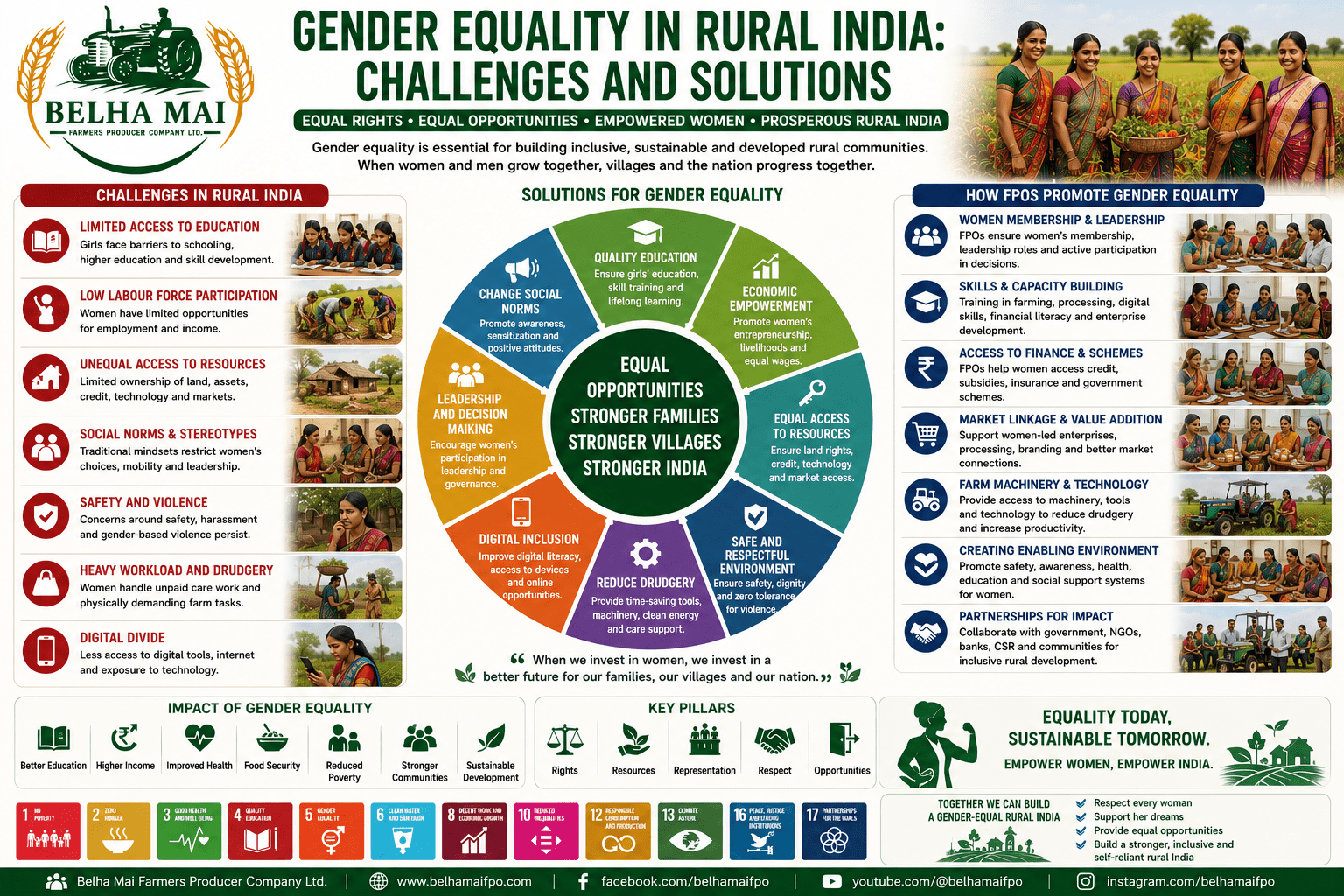
Gender Equality in Rural India is one of the most important foundations for sustainable development, poverty reduction, food security, rural employment, and inclusive growth. Rural women contribute significantly to agriculture, livestock, household management, food systems, post-harvest work, family welfare, and community life. Yet, their contribution is often not fully recognized in economic, social, and institutional systems.
In many villages, women work hard in farming, livestock care, processing, household nutrition, and family responsibilities, but they may have limited access to land ownership, education, finance, technology, training, markets, and leadership positions. This creates a gap between women’s contribution and women’s recognition.
Gender equality in rural India is not only a women’s issue. It is a rural development issue. When women receive equal opportunities, families become stronger, agriculture becomes more productive, children benefit, and villages become more resilient. Farmer Producer Organizations, Self-Help Groups, CSR programs, NGOs, government departments, and community institutions can all play a major role in creating this change.
Gender Equality in Rural India and Why It Matters
Gender Equality in Rural India matters because rural development cannot be complete if half of the population remains under-recognized or under-supported. Women are central to agriculture, household welfare, nutrition, education, livestock, and community stability.
When women have access to education, income, finance, technology, markets, and leadership, they can make stronger decisions for their families and communities. Women’s empowerment often improves children’s education, health, nutrition, savings, and household stability.
Rural India becomes stronger when women and men grow together. Gender equality helps create inclusive growth, better livelihoods, stronger institutions, and more sustainable development.
Gender Equality in Rural India and Agriculture
Agriculture is one of the biggest areas where women contribute deeply. Women participate in sowing, transplanting, weeding, harvesting, cleaning, grading, drying, seed preservation, livestock care, and post-harvest handling.
However, many women are still not formally recognized as farmers. They may work in the field every day, but land records, bank accounts, scheme benefits, and decision-making power may remain mostly with men.
Gender equality in agriculture means recognizing women as farmers, workers, entrepreneurs, leaders, and decision-makers. This recognition is necessary for improving rural livelihoods and sustainable agriculture.
Challenge of Limited Access to Education
One of the major challenges for gender equality in rural India is limited access to education. Many girls and women face barriers in continuing education due to household responsibilities, distance from schools, financial pressure, safety concerns, or social norms.
Education is essential for confidence, awareness, decision-making, digital literacy, financial literacy, health, and livelihood opportunities. Without education, women may struggle to access schemes, understand markets, use technology, or participate in institutions.
The solution is to strengthen girls’ education, adult literacy, digital learning, skill training, and community awareness. Education creates the foundation for long-term gender equality.
Challenge of Limited Access to Land and Property
Land ownership is a major issue for rural women. Many women work in agriculture but do not own land or have their names in land records. This affects their access to credit, insurance, government schemes, and formal recognition as farmers.
Without land ownership or property rights, women may have limited decision-making power in farming and household investment. This keeps them dependent even when they contribute heavily to agriculture.
Solutions include legal awareness, joint land titles, inheritance awareness, women’s documentation support, and recognition of women as agricultural workers and entrepreneurs. Stronger property rights can improve women’s confidence and economic security.
Challenge of Limited Access to Finance
Access to finance is another major barrier. Many rural women do not have collateral, credit history, formal income records, or direct banking experience. This makes it difficult for them to take loans for farming, livestock, processing, or enterprise.
Financial exclusion limits women’s ability to grow economically. Even when women have business ideas, lack of finance prevents them from starting or expanding activities.
Solutions include Self-Help Groups, FPO membership, bank linkage, microcredit, financial literacy, digital payments, insurance awareness, and government scheme access. Finance gives women the power to invest in productive activities.
Challenge of Heavy Workload and Unpaid Labour
Rural women often carry a double burden. They work in farms and also manage household responsibilities such as cooking, cleaning, water collection, childcare, elderly care, livestock care, and food preparation.
Much of this work remains unpaid and invisible. Because it is not counted as formal economic work, women’s contribution is undervalued.
Solutions include recognizing unpaid labour, reducing drudgery through tools and machines, improving water and energy access, sharing household responsibilities, and creating paid opportunities in agriculture and rural enterprises.
Challenge of Low Participation in Decision-Making
Women may participate in agriculture, but they may not always participate in major decisions related to crop selection, input purchase, finance, market sale, machinery use, land leasing, or enterprise investment.
Low decision-making power reduces women’s control over income and resources. It also limits their confidence and leadership development.
Solutions include women’s participation in FPOs, SHGs, village committees, producer groups, training programs, and leadership roles. Women must be included not only as workers but also as decision-makers.
Challenge of Limited Access to Technology
Technology can improve agriculture, finance, education, markets, and communication. But many rural women have limited access to smartphones, internet, digital payments, online training, market information, and farm technology.
The digital divide creates another layer of inequality. Women may depend on others for information and transactions, reducing their independence.
Solutions include digital literacy training, mobile-based advisory, women-friendly digital platforms, smartphone access, online marketing support, and training in digital payments. Digital inclusion can open new doors for rural women.
Challenge of Limited Access to Farm Machinery
Farm work can be physically demanding, especially for women. Many women spend long hours in activities such as weeding, harvesting, carrying loads, cleaning, drying, and post-harvest handling.
Limited access to machinery increases drudgery and affects health, time, and productivity. Women may also not receive training to operate or manage machines.
Solutions include women-friendly tools, shared machinery services, Farm Machinery Banks, FPO-led custom hiring centers, and training women in machine operation and management. Reducing drudgery is an important step toward gender equality.
Challenge of Market Barriers
Many rural women produce, process, or support farm products, but they may not directly access markets. Men or traders may control selling, pricing, negotiation, and buyer relationships.
Market barriers reduce women’s income and business confidence. Without market exposure, women may remain limited to low-value roles.
Solutions include FPO-led market linkage, exhibitions, women-led producer groups, packaging support, branding, direct buyer connections, e-commerce, and institutional supply. Women must be connected with markets to convert their work into income.
Challenge of Social Norms and Stereotypes
Social norms often restrict women’s mobility, leadership, ownership, education, and economic participation. Traditional thinking may limit women to household roles even when they are capable of leading enterprises and institutions.
These norms can reduce women’s confidence and opportunity. Social change takes time, but it is possible through awareness, education, role models, and community support.
Solutions include sensitization programs, women leadership examples, family awareness, male engagement, community dialogue, and institutional inclusion. Gender equality grows when society begins to respect women’s contribution.
Challenge of Safety and Mobility
Safety concerns can restrict women’s movement for education, markets, training, employment, and leadership activities. If women cannot travel safely, they may miss important opportunities.
Mobility restrictions also reduce their ability to attend FPO meetings, government offices, banks, exhibitions, and training centers.
Solutions include safe transport, local training centers, women-friendly meeting timings, community support systems, safer public spaces, and institutional planning that respects women’s needs.
Challenge of Low Representation in Institutions
Women are often underrepresented in farmer institutions, cooperatives, FPO boards, market committees, village leadership bodies, and rural business platforms. Low representation means women’s concerns may not be included in planning.
Institutional representation is essential for gender equality. Women must be present where decisions are made.
Solutions include women membership in FPOs, women directors, women committees, leadership training, mentorship, and active participation in governance. Representation converts women’s voice into action.
Gender Equality in Rural India Through Education
Education is one of the strongest solutions for gender equality in rural India. Education improves confidence, awareness, health, financial decision-making, digital ability, and livelihood choices.
Girls’ education should be protected, and adult women should also receive literacy, digital, financial, and skill-based learning opportunities.
Educated women can participate more actively in agriculture, enterprise, community leadership, and family decision-making. Education creates long-term empowerment.
Gender Equality in Rural India Through Skill Development
Skill development helps women move from unpaid or low-paid work to higher-value roles. Women need training in farming, livestock, food processing, packaging, quality control, digital tools, bookkeeping, marketing, finance, and enterprise management.
Skill training should be practical, local, and linked with income opportunities. Training should not remain only theoretical.
When women gain skills, they can become workers, entrepreneurs, trainers, supervisors, and leaders. This strengthens the rural economy.
Gender Equality in Rural India Through Economic Empowerment
Economic empowerment means women have access to income, assets, finance, markets, skills, and enterprise opportunities. Without economic empowerment, gender equality remains incomplete.
Women can earn through agriculture, livestock, food processing, beekeeping, nursery activities, handicrafts, dairy, poultry, value addition, packaging, and digital services.
Economic empowerment increases women’s confidence and household status. It also supports family welfare and rural poverty reduction.
Gender Equality in Rural India Through FPOs
Farmer Producer Organizations can play a strong role in gender equality. FPOs can include women as members, shareholders, directors, workers, entrepreneurs, trainers, and leaders.
FPOs can support women through input services, training, market linkage, finance access, farm machinery, value addition, processing, packaging, and digital information.
When women participate in FPOs, they move from informal contribution to formal economic participation. This is one of the most practical pathways for gender equality in rural agriculture.
Gender Equality in Rural India Through Self-Help Groups
Self-Help Groups have already helped many rural women build savings, confidence, credit access, and collective strength. SHGs can become stronger when linked with agriculture, processing, FPOs, and markets.
SHGs can support women-led enterprises such as food processing, dairy, poultry, goatery, beekeeping, nursery work, composting, packaging, and local retail.
The connection between SHGs and FPOs can create powerful women-led rural development models.
Gender Equality in Rural India Through Finance Access
Finance access is essential for women to start or grow income activities. Women need support for bank accounts, credit, insurance, digital payments, savings, working capital, and government schemes.
FPOs and SHGs can help women prepare documents, understand schemes, connect with banks, and manage repayments responsibly.
Financial inclusion gives women independence and economic power. It helps them invest in farming, livestock, processing, education, and enterprise.
Gender Equality in Rural India Through Market Linkages
Market linkage is a practical solution for women’s income growth. Women’s products and services need buyers, branding, packaging, quality standards, and fair pricing.
FPOs can connect women with local markets, institutions, retailers, exhibitions, e-commerce platforms, processors, and direct consumers.
When women access markets, their work becomes visible and valuable. Market linkage is therefore central to gender equality in rural enterprise.
Gender Equality in Rural India Through Value Addition
Value addition creates strong income opportunities for rural women. Women can participate in cleaning, grading, sorting, processing, packaging, labeling, quality checking, and product preparation.
Products such as honey, amla products, mango products, millet products, grains, pulses, spices, pickles, dairy products, and local foods can be developed through women-led groups and FPOs.
Value addition creates local employment and year-round income. It also helps women become active participants in rural business.
Gender Equality in Rural India Through Leadership
Women’s leadership is essential for real equality. Women should not only participate in programs but also help design, manage, and lead them.
Leadership opportunities can be created in FPO boards, SHG federations, processing units, producer groups, village committees, market committees, and rural enterprises.
Women leaders bring practical experience and community insight. Their leadership can improve planning, inclusion, and trust.
Gender Equality in Rural India Through Digital Inclusion
Digital inclusion can open new opportunities for women. Mobile phones, internet access, digital payments, online training, market price updates, e-commerce, and government portals can help women connect with wider systems.
Digital training should be simple and practical. Women should learn how to use phones for communication, payments, market information, business promotion, and learning.
Digital inclusion reduces dependency and improves participation. It is an important solution for modern rural gender equality.
Gender Equality in Rural India Through Farm Mechanisation
Farm mechanisation can support gender equality by reducing manual drudgery and saving time. Women-friendly tools and shared machinery can reduce physical strain and improve productivity.
FPO-led Farm Machinery Banks can make machinery available at affordable rates. Women can also be trained as machine operators, coordinators, or service managers.
Mechanisation should be inclusive, not male-dominated. Women must be included in training and access.
Gender Equality in Rural India Through Rural Enterprises
Rural enterprises can help women become financially independent. These enterprises can be based on agriculture, livestock, food processing, beekeeping, nurseries, compost, bio-inputs, local retail, handicrafts, or digital services.
FPOs, SHGs, CSR organizations, NGOs, and government programs can support rural women enterprises through training, finance, infrastructure, branding, and market linkage.
Women-led enterprises create income, jobs, confidence, and community respect.
Gender Equality in Rural India Through Partnerships
Partnerships are necessary to create large-scale impact. Government departments, CSR organizations, NGOs, banks, NABARD, SFAC, training institutions, universities, and buyers can support women-focused rural development.
Partnerships can bring finance, skills, machinery, processing units, digital tools, market access, safety awareness, and leadership programs.
FPOs can act as grassroots platforms for implementing women empowerment projects because they already work with farmers and rural communities.
Gender Equality in Rural India and Sustainable Development Goals
Gender equality is directly connected with SDG 5, but it also supports many other Sustainable Development Goals. It helps reduce poverty, improve food security, create decent work, promote responsible production, support climate action, and build partnerships.
When rural women are empowered, development becomes more inclusive and sustainable. Women’s participation strengthens agriculture, families, communities, and rural institutions.
Gender equality is not separate from rural development. It is one of its strongest pillars.
Belha Mai FPO and Gender Equality
Belha Mai Farmers Producer Company Ltd. recognizes the importance of women in agriculture, value addition, rural employment, family welfare, and sustainable development.
Through FPO-led activities such as farmer services, training, market linkage, processing, value addition, digital outreach, farm machinery, and sustainable agriculture, women can receive stronger opportunities and recognition.
For Belha Mai FPO, gender equality means creating a rural system where women farmers are respected, included, trained, empowered, and connected with income opportunities.
Why Gender Equality Matters for Rural India’s Future
Rural India cannot become prosperous if women remain behind. Women are already contributing to farming, livestock, post-harvest work, food systems, family care, and rural livelihoods. The future depends on recognizing and strengthening this contribution.
When rural women are empowered, families become healthier, children study better, farmers become stronger, and communities become more resilient.
Gender equality in rural India is therefore not only about fairness. It is about building a stronger, more sustainable, and more prosperous India.
Conclusion
Gender Equality in Rural India requires both recognition and action. Rural women need equal access to education, finance, land, technology, markets, training, leadership, safety, and enterprise opportunities.
The challenges are real, but the solutions are practical. FPOs, SHGs, government programs, CSR organizations, NGOs, banks, and community institutions can work together to create change.
For Belha Mai Farmers Producer Company Ltd., gender equality is a key part of sustainable rural development. When women grow, agriculture grows. When agriculture grows, rural India grows.
FAQ
What is Gender Equality in Rural India?
Gender equality in rural India means giving women and men equal access to education, finance, land, training, technology, markets, leadership, income opportunities, safety, and decision-making in rural life and agriculture.
What are the main challenges to Gender Equality in Rural India?
The main challenges include limited education, low land ownership, lack of finance, unpaid labour, low decision-making power, technology gaps, market barriers, social norms, safety concerns, and low representation in institutions.
How can FPOs support Gender Equality in Rural India?
FPOs can support gender equality by including women as members, shareholders, leaders, workers, entrepreneurs, and decision-makers while providing training, finance access, machinery, market linkage, and value addition opportunities.
Why is women’s economic empowerment important?
Women’s economic empowerment is important because it improves household income, children’s education, nutrition, health, savings, decision-making, and community development.
How does gender equality support rural development?
Gender equality supports rural development by improving productivity, income, family welfare, women leadership, food security, social inclusion, and sustainable community growth.
Why should CSR organizations support gender equality in rural India?
CSR organizations should support gender equality in rural India because it creates measurable impact in poverty reduction, women empowerment, rural employment, education, sustainable agriculture, and inclusive development.
Internal Links Section
👉 SDG Goals — https://belhamaifpo.com/sdg-goals/
👉 Farmer Producer Organizations Complete Guide —https://belhamaifpo.com/farmer-producer-organisation/farmer-producer-organizations-fpos/
👉 Role of Women in Indian Agriculture —https://belhamaifpo.com/sdg-goals/role-of-women-in-indian-agriculture/
👉 How FPOs Empower Women Farmers — https://belhamaifpo.com/sdg-goals/how-fpos-empower-women-farmers/
👉 How FPOs Create Year-Round Income for Farmers — https://belhamaifpo.com/sdg-goals/how-fpos-create-year-round-income-for-farmers/
👉 How Agro-Processing Creates Rural Employment —https://belhamaifpo.com/sdg-goals/how-agro-processing-creates-rural-employment/
👉 Role of Collective Farming in Increasing Farmer Income —https://belhamaifpo.com/sdg-goals/role-of-collective-farming-in-increasing-farmer-income/
👉 How Agriculture Can Reduce Rural Poverty in India —https://belhamaifpo.com/sdg-goals/how-agriculture-can-reduce-rural-poverty-in-india/
👉 Why FPOs are Key to Sustainable Agriculture — https://belhamaifpo.com/sdg-goals/why-fpos-are-key-to-sustainable-agriculture/
👉 Belha Mai FPO — https://belhamaifpo.com/
External Authority Links
👉 United Nations Sustainable Development Goals — https://sdgs.un.org/goals
👉 UN Women — https://www.unwomen.org/
👉 Ministry of Women and Child Development — https://wcd.nic.in/
👉 National Rural Livelihood Mission — https://nrlm.gov.in/
👉 Ministry of Agriculture and Farmers Welfare — https://agriwelfare.gov.in/
👉 Small Farmers’ Agribusiness Consortium — https://sfacindia.com/
👉 National Bank for Agriculture and Rural Development — https://www.nabard.org/
👉 NITI Aayog SDG India Index — https://www.niti.gov.in/sdg-india-index
Follow Belha Mai FPO for More Updates
Website: https://belhamaifpo.com/
Facebook: https://www.facebook.com/profile.php?id=61561043486818
YouTube: https://www.youtube.com/channel/UC9ZvojoTMCa7mU1-Q_Bh60A
LinkedIn: https://www.linkedin.com/in/abhay-singh-ab5568280/
Instagram:https://instagram.com/belhamaifpo
Belha Mai Farmers Producer Company Ltd. supports farmers through better information, technology, market linkage, value addition, FPO awareness, rural development, women empowerment, and sustainable agriculture.