एग्रोफॉरेस्ट्री क्या है और इसके लाभ
Introduction
Agroforestry is an important sustainable farming system where trees are grown together with crops, livestock or both on the same land. In simple words, agroforestry means combining agriculture and trees in a planned way so that farmers can get food, fodder, fuel, timber, fruits, shade, soil protection and additional income from the same farm. Agroforestry and its benefits are very important for India because most farmers have small landholdings and need farming systems that provide regular income, long-term security and climate resilience.
एग्रोफॉरेस्ट्री एक महत्वपूर्ण टिकाऊ कृषि प्रणाली है, जिसमें पेड़ों को फसलों, पशुपालन या दोनों के साथ एक ही भूमि पर उगाया जाता है। सरल भाषा में, एग्रोफॉरेस्ट्री का अर्थ है कृषि और पेड़ों को योजनाबद्ध तरीके से जोड़ना ताकि किसान उसी खेत से भोजन, चारा, ईंधन, लकड़ी, फल, छाया, मिट्टी संरक्षण और अतिरिक्त आय प्राप्त कर सकें। भारत के लिए एग्रोफॉरेस्ट्री और इसके लाभ बहुत महत्वपूर्ण हैं क्योंकि अधिकांश किसानों के पास छोटी जोत है और उन्हें ऐसी खेती प्रणालियों की आवश्यकता है जो नियमित आय, दीर्घकालिक सुरक्षा और जलवायु सहनशीलता प्रदान करें।
Meaning of Agroforestry
Agroforestry is a land-use system where trees, crops and sometimes livestock are managed together to create ecological and economic benefits. It is not just random tree planting. It is a planned farming model where suitable trees are selected according to soil, climate, crop pattern, market demand and farmer needs. Agroforestry and its benefits become stronger when trees are planted in proper spacing, managed scientifically and linked with income opportunities.
एग्रोफॉरेस्ट्री एक भूमि उपयोग प्रणाली है, जिसमें पेड़ों, फसलों और कभी-कभी पशुपालन को साथ में प्रबंधित किया जाता है ताकि पर्यावरणीय और आर्थिक लाभ मिल सकें। यह केवल कहीं भी पेड़ लगाने का कार्य नहीं है। यह एक योजनाबद्ध खेती मॉडल है, जिसमें मिट्टी, जलवायु, फसल पैटर्न, बाजार मांग और किसान की जरूरत के अनुसार उपयुक्त पेड़ों का चयन किया जाता है। जब पेड़ सही दूरी पर लगाए जाते हैं, वैज्ञानिक तरीके से प्रबंधित होते हैं और आय अवसरों से जुड़ते हैं, तब एग्रोफॉरेस्ट्री और इसके लाभ अधिक मजबूत होते हैं।
Why Agroforestry is Important for Farmers
Agroforestry is important for farmers because it helps diversify income and reduce dependence on one crop. In traditional farming, farmers may depend only on seasonal crops, and if crop prices fall or weather damages the crop, income becomes uncertain. Agroforestry gives farmers additional sources of income from timber, fruits, fodder, fuelwood, bamboo, medicinal plants, leaves, flowers and other tree-based products. This makes farming more stable and resilient.
एग्रोफॉरेस्ट्री किसानों के लिए महत्वपूर्ण है क्योंकि यह आय को विविध बनाती है और एक ही फसल पर निर्भरता कम करती है। पारंपरिक खेती में किसान केवल मौसमी फसलों पर निर्भर हो सकते हैं, और यदि फसल मूल्य गिर जाए या मौसम से फसल खराब हो जाए, तो आय अनिश्चित हो जाती है। एग्रोफॉरेस्ट्री किसानों को लकड़ी, फल, चारा, ईंधन लकड़ी, बांस, औषधीय पौधे, पत्ते, फूल और अन्य वृक्ष आधारित उत्पादों से अतिरिक्त आय देती है। इससे खेती अधिक स्थिर और सहनशील बनती है।
Main Components of Agroforestry
The main components of agroforestry are trees, crops, livestock, soil, water and farmer management. Trees may provide timber, fruit, fodder, fuelwood, shade or ecological benefits. Crops provide seasonal income and food security. Livestock can use fodder and shade from the system. Soil and water are protected by tree roots, leaf litter and better land cover. Farmer management decides whether the system becomes productive or creates competition between trees and crops.
एग्रोफॉरेस्ट्री के मुख्य घटक पेड़, फसलें, पशुधन, मिट्टी, पानी और किसान प्रबंधन हैं। पेड़ लकड़ी, फल, चारा, ईंधन लकड़ी, छाया या पर्यावरणीय लाभ दे सकते हैं। फसलें मौसमी आय और खाद्य सुरक्षा देती हैं। पशुधन इस प्रणाली से चारा और छाया प्राप्त कर सकता है। पेड़ों की जड़ें, पत्तियों का गिरना और बेहतर भूमि आवरण मिट्टी और पानी की रक्षा करते हैं। किसान प्रबंधन तय करता है कि प्रणाली उत्पादक बनेगी या पेड़ों और फसलों के बीच प्रतिस्पर्धा पैदा होगी।
Types of Agroforestry Systems
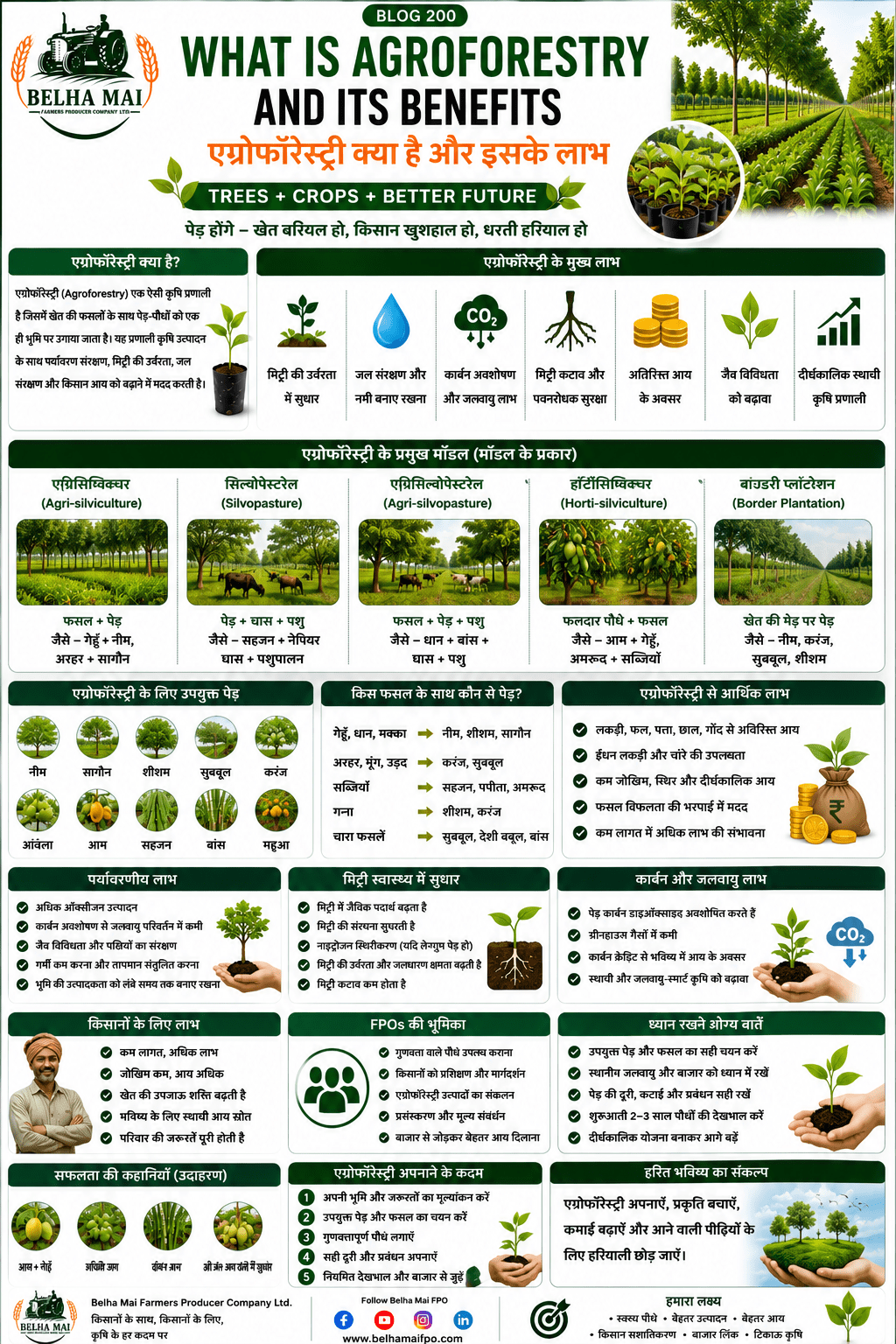
Agroforestry has different models such as agri-silviculture, silvopasture, agri-silvopasture, horti-silviculture, boundary plantation, windbreaks, shelterbelts and homegarden systems. In agri-silviculture, trees are grown with agricultural crops. In silvopasture, trees are combined with pasture and livestock. In horti-silviculture, fruit trees are grown with crops or other useful trees. The best model depends on land size, local climate, crop type, farmer objective and market demand.
एग्रोफॉरेस्ट्री के अलग-अलग मॉडल होते हैं, जैसे एग्री-सिल्वीकल्चर, सिल्वोपास्चर, एग्री-सिल्वोपास्चर, हॉर्टी-सिल्वीकल्चर, बाउंड्री प्लांटेशन, विंडब्रेक, शेल्टरबेल्ट और होमगार्डन सिस्टम। एग्री-सिल्वीकल्चर में पेड़ों को कृषि फसलों के साथ उगाया जाता है। सिल्वोपास्चर में पेड़ों को चरागाह और पशुपालन के साथ जोड़ा जाता है। हॉर्टी-सिल्वीकल्चर में फलदार पेड़ों को फसलों या अन्य उपयोगी पेड़ों के साथ उगाया जाता है। सबसे अच्छा मॉडल भूमि आकार, स्थानीय जलवायु, फसल प्रकार, किसान उद्देश्य और बाजार मांग पर निर्भर करता है।
Agri-Silviculture Model
Agri-silviculture is a common agroforestry model where trees are grown along with agricultural crops. Farmers may plant trees on boundaries, rows or selected parts of the field while continuing seasonal crops like wheat, pulses, oilseeds, vegetables or fodder. This model helps farmers get short-term income from crops and long-term income from trees. Proper spacing is very important so that trees do not create too much shade or competition for crops.
एग्री-सिल्वीकल्चर एक सामान्य एग्रोफॉरेस्ट्री मॉडल है, जिसमें पेड़ों को कृषि फसलों के साथ उगाया जाता है। किसान खेत की मेड़, पंक्तियों या चुने हुए हिस्सों में पेड़ लगा सकते हैं और साथ में गेहूं, दलहन, तिलहन, सब्जियां या चारा जैसी मौसमी फसलें लेते रह सकते हैं। यह मॉडल किसानों को फसलों से अल्पकालिक आय और पेड़ों से दीर्घकालिक आय देता है। सही दूरी बहुत महत्वपूर्ण है ताकि पेड़ फसलों पर अधिक छाया या प्रतिस्पर्धा न पैदा करें।
Horti-Silviculture Model
Horti-silviculture is a useful agroforestry model where fruit trees are grown with other trees or crops. Farmers may grow mango, amla, guava, lemon, papaya, drumstick or other fruit crops along with suitable intercrops during the early years. This model is useful because fruit trees take time to start full production, and intercrops can provide income during the waiting period. It is highly suitable for farmers who want horticulture-based long-term income.
हॉर्टी-सिल्वीकल्चर एक उपयोगी एग्रोफॉरेस्ट्री मॉडल है, जिसमें फलदार पेड़ों को अन्य पेड़ों या फसलों के साथ उगाया जाता है। किसान आम, आंवला, अमरूद, नींबू, पपीता, सहजन या अन्य फलदार फसलों को शुरुआती वर्षों में उपयुक्त अंतर फसलों के साथ उगा सकते हैं। यह मॉडल उपयोगी है क्योंकि फलदार पेड़ों को पूर्ण उत्पादन शुरू करने में समय लगता है और अंतर फसलें प्रतीक्षा अवधि में आय दे सकती हैं। यह उन किसानों के लिए बहुत उपयुक्त है जो बागवानी आधारित दीर्घकालिक आय चाहते हैं।
Silvopasture Model
Silvopasture is an agroforestry system where trees are combined with grasses, fodder crops and livestock. This model provides shade for animals, fodder for livestock and tree-based income for farmers. It is useful in areas where farmers keep cattle, goats, sheep or buffalo. Silvopasture can improve land use efficiency and support dairy, goatery and livestock-based rural livelihoods. Proper grazing management is necessary to protect young trees.
सिल्वोपास्चर एक एग्रोफॉरेस्ट्री प्रणाली है, जिसमें पेड़ों को घास, चारा फसलों और पशुपालन के साथ जोड़ा जाता है। यह मॉडल पशुओं को छाया, पशुधन को चारा और किसानों को पेड़ आधारित आय देता है। यह उन क्षेत्रों में उपयोगी है जहां किसान गाय, बकरी, भेड़ या भैंस पालते हैं। सिल्वोपास्चर भूमि उपयोग दक्षता सुधार सकता है और डेयरी, बकरीपालन तथा पशुधन आधारित ग्रामीण आजीविका को समर्थन दे सकता है। युवा पेड़ों की सुरक्षा के लिए सही चराई प्रबंधन आवश्यक है।
Boundary Plantation
Boundary plantation is one of the simplest agroforestry practices where trees are planted on farm boundaries. Farmers can grow trees like teak, shisham, bamboo, neem, mahua, drumstick, subabul or other suitable species along field borders. This model does not disturb the main crop area much and can provide long-term income, wind protection, shade and biodiversity benefits. Boundary plantation is practical for small farmers when species selection and spacing are properly planned.
बाउंड्री प्लांटेशन सबसे सरल एग्रोफॉरेस्ट्री पद्धतियों में से एक है, जिसमें खेत की मेड़ या सीमा पर पेड़ लगाए जाते हैं। किसान खेत की सीमाओं पर सागौन, शीशम, बांस, नीम, महुआ, सहजन, सुबबूल या अन्य उपयुक्त प्रजातियां लगा सकते हैं। यह मॉडल मुख्य फसल क्षेत्र को अधिक प्रभावित नहीं करता और दीर्घकालिक आय, हवा से सुरक्षा, छाया और जैव विविधता लाभ दे सकता है। सही प्रजाति चयन और दूरी के साथ बाउंड्री प्लांटेशन छोटे किसानों के लिए व्यावहारिक है।
Suitable Trees for Agroforestry
The selection of trees is very important in agroforestry. Suitable trees depend on local climate, soil, rainfall, irrigation, crop pattern and market demand. Common tree species may include neem, bamboo, mahua, teak, shisham, subabul, drumstick, amla, mango, guava, jamun, karonda and other locally suitable species. Farmers should select trees that provide income, improve the farm environment and do not create harmful competition with crops.
एग्रोफॉरेस्ट्री में पेड़ों का चयन बहुत महत्वपूर्ण है। उपयुक्त पेड़ स्थानीय जलवायु, मिट्टी, वर्षा, सिंचाई, फसल पैटर्न और बाजार मांग पर निर्भर करते हैं। सामान्य पेड़ प्रजातियों में नीम, बांस, महुआ, सागौन, शीशम, सुबबूल, सहजन, आंवला, आम, अमरूद, जामुन, करौंदा और अन्य स्थानीय उपयुक्त प्रजातियां शामिल हो सकती हैं। किसानों को ऐसे पेड़ चुनने चाहिए जो आय दें, खेत के वातावरण को सुधारें और फसलों के साथ हानिकारक प्रतिस्पर्धा न करें।
Benefits of Agroforestry for Soil Health
One of the major benefits of agroforestry is improvement in soil health. Tree roots help bind the soil and reduce erosion. Fallen leaves add organic matter to the soil and support soil microorganisms. Trees also improve soil structure and can help recycle nutrients from deeper soil layers. Over time, agroforestry can improve soil fertility, moisture retention and biological activity, which supports better crop growth.
एग्रोफॉरेस्ट्री का एक बड़ा लाभ मिट्टी की सेहत में सुधार है। पेड़ों की जड़ें मिट्टी को बांधने में मदद करती हैं और कटाव कम करती हैं। गिरे हुए पत्ते मिट्टी में जैविक पदार्थ जोड़ते हैं और मिट्टी के सूक्ष्मजीवों को समर्थन देते हैं। पेड़ मिट्टी की संरचना सुधारते हैं और गहरी परतों से पोषक तत्वों को ऊपर लाने में मदद कर सकते हैं। समय के साथ एग्रोफॉरेस्ट्री मिट्टी की उर्वरता, नमी संरक्षण और जैविक गतिविधि सुधार सकती है, जिससे बेहतर फसल वृद्धि को समर्थन मिलता है।
Benefits of Agroforestry for Water Conservation
Agroforestry and its benefits include better water conservation. Trees reduce surface runoff, improve water infiltration and help maintain soil moisture. Shade from trees can reduce evaporation and protect crops from extreme heat. In dry areas, properly designed agroforestry systems can help farmers use rainfall more effectively. However, farmers must choose suitable tree species and spacing so that trees do not create excessive water competition with crops.
एग्रोफॉरेस्ट्री और इसके लाभों में बेहतर जल संरक्षण भी शामिल है। पेड़ सतही बहाव कम करते हैं, पानी के मिट्टी में प्रवेश को बढ़ाते हैं और मिट्टी की नमी बनाए रखने में मदद करते हैं। पेड़ों की छाया वाष्पीकरण कम कर सकती है और फसलों को अत्यधिक गर्मी से बचा सकती है। सूखे क्षेत्रों में सही डिजाइन वाली एग्रोफॉरेस्ट्री प्रणाली किसानों को वर्षा जल का अधिक प्रभावी उपयोग करने में मदद कर सकती है। हालांकि किसानों को उपयुक्त पेड़ प्रजाति और दूरी चुननी चाहिए ताकि पेड़ फसलों के साथ अत्यधिक पानी प्रतिस्पर्धा न करें।
Climate Resilience Benefits
Agroforestry supports climate resilience by reducing heat stress, improving soil moisture, increasing farm biodiversity and storing carbon in trees and soil. Climate change is creating problems like irregular rainfall, heat waves and pest pressure. Tree-based farming systems can make farms more stable and resilient. Agroforestry cannot remove all climate risks, but it can reduce vulnerability and help farmers build long-term adaptation strategies.
एग्रोफॉरेस्ट्री गर्मी तनाव कम करके, मिट्टी की नमी सुधारकर, खेत की जैव विविधता बढ़ाकर और पेड़ों तथा मिट्टी में कार्बन संग्रह करके जलवायु सहनशीलता को समर्थन देती है। जलवायु परिवर्तन अनियमित वर्षा, लू और कीट दबाव जैसी समस्याएं पैदा कर रहा है। वृक्ष आधारित खेती प्रणालियां खेतों को अधिक स्थिर और सहनशील बना सकती हैं। एग्रोफॉरेस्ट्री सभी जलवायु जोखिमों को समाप्त नहीं कर सकती, लेकिन यह संवेदनशीलता कम कर सकती है और किसानों को दीर्घकालिक अनुकूलन रणनीति बनाने में मदद कर सकती है।
Carbon and Environmental Benefits
Agroforestry and its benefits include carbon sequestration and environmental protection. Trees absorb carbon dioxide from the atmosphere and store carbon in biomass and soil. Agroforestry also supports biodiversity by creating habitats for birds, insects, pollinators and soil organisms. It helps reduce soil erosion, improves microclimate and supports ecological balance. For sustainable agriculture, agroforestry is one of the most practical nature-based solutions.
एग्रोफॉरेस्ट्री और इसके लाभों में कार्बन अवशोषण और पर्यावरण संरक्षण शामिल हैं। पेड़ वातावरण से कार्बन डाइऑक्साइड अवशोषित करते हैं और बायोमास तथा मिट्टी में कार्बन संग्रह करते हैं। एग्रोफॉरेस्ट्री पक्षियों, कीटों, परागणकर्ताओं और मिट्टी के जीवों के लिए आवास बनाकर जैव विविधता को भी समर्थन देती है। यह मिट्टी कटाव कम करती है, सूक्ष्म जलवायु सुधारती है और पर्यावरणीय संतुलन को समर्थन देती है। टिकाऊ कृषि के लिए एग्रोफॉरेस्ट्री सबसे व्यावहारिक प्रकृति-आधारित समाधानों में से एक है।
Income Benefits for Farmers
Agroforestry can improve farmer income by creating multiple income sources from the same land. Farmers can earn from crops in the short term and from trees in the medium or long term. Fruit trees can provide seasonal income, timber trees can provide future income, bamboo can provide industrial and craft value, and fodder trees can support livestock. This reduces risk and makes farming more economically stable.
एग्रोफॉरेस्ट्री एक ही भूमि से कई आय स्रोत बनाकर किसान आय सुधार सकती है। किसान अल्पकाल में फसलों से और मध्यम या दीर्घकाल में पेड़ों से आय प्राप्त कर सकते हैं। फलदार पेड़ मौसमी आय दे सकते हैं, लकड़ी वाले पेड़ भविष्य की आय दे सकते हैं, बांस औद्योगिक और हस्तशिल्प मूल्य दे सकता है, और चारा पेड़ पशुपालन को समर्थन दे सकते हैं। इससे जोखिम कम होता है और खेती आर्थिक रूप से अधिक स्थिर बनती है।
Risk Reduction in Farming
Agroforestry and its benefits are important for reducing farming risk. If one crop fails due to price fall, pest attack or weather problem, farmers may still get income from trees, fruits, fodder or livestock. Diversification is a key strength of agroforestry. Instead of depending on a single crop, farmers build a mixed system that can provide income and resources across different seasons and years.
एग्रोफॉरेस्ट्री और इसके लाभ खेती का जोखिम कम करने के लिए महत्वपूर्ण हैं। यदि कोई फसल मूल्य गिरने, कीट आक्रमण या मौसम समस्या के कारण खराब हो जाती है, तो किसान फिर भी पेड़ों, फलों, चारे या पशुपालन से आय प्राप्त कर सकते हैं। विविधीकरण एग्रोफॉरेस्ट्री की प्रमुख ताकत है। एक ही फसल पर निर्भर रहने के बजाय किसान मिश्रित प्रणाली बनाते हैं, जो अलग-अलग मौसमों और वर्षों में आय तथा संसाधन दे सकती है।
Benefits for Livestock Farmers
Agroforestry can support livestock farmers by providing fodder, shade and better farm microclimate. Trees like subabul, drumstick and other fodder species can support animal feed needs when managed properly. Shade from trees can reduce heat stress for animals. Silvopasture models can combine trees, grasses and livestock in a planned way. This helps farmers integrate crop farming and animal husbandry more effectively.
एग्रोफॉरेस्ट्री पशुपालक किसानों को चारा, छाया और बेहतर खेत सूक्ष्म जलवायु देकर समर्थन दे सकती है। सुबबूल, सहजन और अन्य चारा प्रजातियां सही प्रबंधन के साथ पशु चारा जरूरतों को पूरा करने में मदद कर सकती हैं। पेड़ों की छाया पशुओं में गर्मी तनाव कम कर सकती है। सिल्वोपास्चर मॉडल पेड़ों, घास और पशुपालन को योजनाबद्ध तरीके से जोड़ सकता है। इससे किसान फसल खेती और पशुपालन को अधिक प्रभावी ढंग से जोड़ सकते हैं।
Agroforestry and Biodiversity
Agroforestry improves biodiversity by creating a more diverse farm ecosystem. A farm with trees, crops, grasses and flowering plants attracts birds, bees, beneficial insects and soil organisms. This can improve pollination, natural pest control and ecological balance. Biodiversity also makes the farm more resilient because different plants support different functions in the system. A diverse farm is usually healthier than a single-crop system.
एग्रोफॉरेस्ट्री अधिक विविध खेत पारिस्थितिकी तंत्र बनाकर जैव विविधता को सुधारती है। पेड़ों, फसलों, घास और फूलदार पौधों वाला खेत पक्षियों, मधुमक्खियों, लाभकारी कीटों और मिट्टी के जीवों को आकर्षित करता है। इससे परागण, प्राकृतिक कीट नियंत्रण और पर्यावरणीय संतुलन में सुधार हो सकता है। जैव विविधता खेत को अधिक सहनशील भी बनाती है क्योंकि अलग-अलग पौधे प्रणाली में अलग-अलग कार्यों को समर्थन देते हैं। विविध खेत सामान्यतः एकल फसल प्रणाली की तुलना में अधिक स्वस्थ होता है।
Agroforestry for Small Farmers
Agroforestry and its benefits are especially useful for small farmers when designed carefully. Small farmers can use field boundaries, bunds, unused corners and intercropping spaces for suitable trees. Fruit trees, drumstick, bamboo, neem, mahua and other useful species can create additional income without completely replacing crops. However, planning is essential so that trees do not shade crops too much or compete for water and nutrients.
एग्रोफॉरेस्ट्री और इसके लाभ छोटे किसानों के लिए विशेष रूप से उपयोगी हो सकते हैं, यदि इसकी सावधानीपूर्वक योजना बनाई जाए। छोटे किसान खेत की मेड़, सीमाएं, खाली कोने और अंतर फसल क्षेत्रों में उपयुक्त पेड़ लगा सकते हैं। फलदार पेड़, सहजन, बांस, नीम, महुआ और अन्य उपयोगी प्रजातियां फसलों को पूरी तरह बदले बिना अतिरिक्त आय दे सकती हैं। हालांकि योजना आवश्यक है ताकि पेड़ फसलों पर अत्यधिक छाया न करें या पानी और पोषक तत्वों के लिए अधिक प्रतिस्पर्धा न करें।
Challenges in Agroforestry
Agroforestry also has some challenges. Farmers may face issues like wrong species selection, delayed income from trees, lack of market linkage, competition between trees and crops, unclear rules for tree harvesting and lack of technical guidance. These challenges can be reduced through proper planning, expert advice, suitable spacing, market research and FPO support. Agroforestry should be designed according to the local area, not copied blindly from another region.
एग्रोफॉरेस्ट्री की कुछ चुनौतियां भी हैं। किसानों को गलत प्रजाति चयन, पेड़ों से देर से आय, बाजार लिंक की कमी, पेड़ों और फसलों के बीच प्रतिस्पर्धा, पेड़ कटाई नियमों की अस्पष्टता और तकनीकी मार्गदर्शन की कमी जैसी समस्याएं आ सकती हैं। सही योजना, विशेषज्ञ सलाह, उपयुक्त दूरी, बाजार अध्ययन और FPO सहायता से इन चुनौतियों को कम किया जा सकता है। एग्रोफॉरेस्ट्री को स्थानीय क्षेत्र के अनुसार डिजाइन करना चाहिए, किसी दूसरे क्षेत्र से आंख बंद करके कॉपी नहीं करना चाहिए।
How Farmers Can Start Agroforestry
Farmers can start agroforestry by first studying their land, soil, water availability, existing crops and market opportunities. They should select suitable tree species and decide whether to plant on boundaries, rows, blocks or mixed systems. Farmers should maintain proper spacing, protect young trees, use quality planting material and follow pruning or management practices. Starting small and expanding gradually is a practical approach for many farmers.
किसान एग्रोफॉरेस्ट्री की शुरुआत अपनी भूमि, मिट्टी, पानी उपलब्धता, मौजूदा फसलों और बाजार अवसरों का अध्ययन करके कर सकते हैं। उन्हें उपयुक्त पेड़ प्रजाति चुननी चाहिए और तय करना चाहिए कि पेड़ मेड़ पर, पंक्तियों में, ब्लॉक में या मिश्रित प्रणाली में लगाए जाएंगे। किसानों को सही दूरी रखनी चाहिए, छोटे पेड़ों की सुरक्षा करनी चाहिए, गुणवत्तापूर्ण पौध सामग्री उपयोग करनी चाहिए और छंटाई या प्रबंधन पद्धतियां अपनानी चाहिए। कई किसानों के लिए छोटी शुरुआत करके धीरे-धीरे विस्तार करना व्यावहारिक तरीका है।
Role of Nurseries in Agroforestry
Quality nurseries are very important for agroforestry success because strong tree seedlings improve survival and growth. Poor-quality tree plants may die, grow slowly or fail to provide expected benefits. High-tech nurseries and FPO-led nurseries can produce healthy plants of bamboo, neem, mahua, drumstick, amla, mango, guava, teak, shisham and other suitable species. Good planting material is the foundation of successful agroforestry.
एग्रोफॉरेस्ट्री की सफलता के लिए गुणवत्तापूर्ण नर्सरियां बहुत महत्वपूर्ण हैं क्योंकि मजबूत वृक्ष पौधे जीवित रहने और वृद्धि को सुधारते हैं। खराब गुणवत्ता वाले पेड़ पौधे मर सकते हैं, धीरे बढ़ सकते हैं या अपेक्षित लाभ देने में असफल हो सकते हैं। हाई-टेक नर्सरियां और FPO आधारित नर्सरियां बांस, नीम, महुआ, सहजन, आंवला, आम, अमरूद, सागौन, शीशम और अन्य उपयुक्त प्रजातियों के स्वस्थ पौधे तैयार कर सकती हैं। अच्छी पौध सामग्री सफल एग्रोफॉरेस्ट्री की नींव है।
Role of FPOs in Agroforestry
FPOs can play a strong role in promoting agroforestry by helping farmers select suitable tree species, access quality planting material, receive training and connect with markets. An FPO can aggregate demand for tree plants, develop nurseries, support plantation drives and create links for timber, fruit, bamboo, medicinal plants and value-added products. FPOs can also help farmers understand government schemes and long-term income models.
FPOs किसानों को उपयुक्त पेड़ प्रजाति चुनने, गुणवत्तापूर्ण पौध सामग्री प्राप्त करने, प्रशिक्षण लेने और बाजार से जुड़ने में मदद करके एग्रोफॉरेस्ट्री को बढ़ावा देने में मजबूत भूमिका निभा सकते हैं। एक FPO वृक्ष पौधों की मांग एकत्र कर सकता है, नर्सरी विकसित कर सकता है, plantation drives को समर्थन दे सकता है और लकड़ी, फल, बांस, औषधीय पौधों तथा मूल्य संवर्धित उत्पादों के लिए लिंक बना सकता है। FPOs किसानों को सरकारी योजनाओं और दीर्घकालिक आय मॉडल समझने में भी मदद कर सकते हैं।
Agroforestry and Value Chain Development
Agroforestry and its benefits become stronger when connected with value chain development. Trees can provide fruits, timber, bamboo, leaves, flowers, gums, seeds and medicinal raw materials. These products can be aggregated, processed, branded and marketed through FPOs and rural enterprises. Without market linkage, farmers may not receive full benefit from agroforestry. Therefore, planting trees should be connected with future harvesting, processing and selling plans.
एग्रोफॉरेस्ट्री और इसके लाभ तब अधिक मजबूत होते हैं जब इन्हें वैल्यू चेन विकास से जोड़ा जाता है। पेड़ फल, लकड़ी, बांस, पत्ते, फूल, गोंद, बीज और औषधीय कच्चा माल दे सकते हैं। इन उत्पादों को FPOs और ग्रामीण उद्यमों के माध्यम से एग्रीगेट, प्रोसेस, ब्रांड और मार्केट किया जा सकता है। बाजार लिंक के बिना किसानों को एग्रोफॉरेस्ट्री का पूरा लाभ नहीं मिल सकता। इसलिए पेड़ लगाने को भविष्य की कटाई, प्रोसेसिंग और बिक्री योजना से जोड़ना चाहिए।
Belha Mai FPO Vision
Belha Mai Farmers Producer Company Ltd. believes that agroforestry can support farmer income, climate resilience, soil health and rural development. Trees like neem, mahua, bamboo, drumstick, mango, amla and other locally suitable species can become part of a long-term farmer prosperity model. Through quality nursery development, farmer training, plantation planning and market linkage, Belha Mai FPO aims to promote agroforestry as a practical and sustainable farming solution.
Belha Mai Farmers Producer Company Ltd. का मानना है कि एग्रोफॉरेस्ट्री किसान आय, जलवायु सहनशीलता, मिट्टी स्वास्थ्य और ग्रामीण विकास को समर्थन दे सकती है। नीम, महुआ, बांस, सहजन, आम, आंवला और अन्य स्थानीय उपयुक्त प्रजातियां दीर्घकालिक किसान समृद्धि मॉडल का हिस्सा बन सकती हैं। गुणवत्तापूर्ण नर्सरी विकास, किसान प्रशिक्षण, plantation planning और बाजार लिंक के माध्यम से Belha Mai FPO एग्रोफॉरेस्ट्री को एक व्यावहारिक और टिकाऊ खेती समाधान के रूप में बढ़ावा देना चाहता है।
Conclusion
Agroforestry is a sustainable farming system that combines trees, crops and sometimes livestock on the same land. Agroforestry and its benefits include additional income, soil improvement, water conservation, biodiversity, climate resilience, carbon storage and long-term farming security. For small farmers, FPOs and rural enterprises, agroforestry can create a practical model of sustainable agriculture when planned with quality planting material, suitable species, proper spacing, technical guidance and market linkage.
एग्रोफॉरेस्ट्री एक टिकाऊ खेती प्रणाली है, जिसमें पेड़ों, फसलों और कभी-कभी पशुपालन को एक ही भूमि पर जोड़ा जाता है। एग्रोफॉरेस्ट्री और इसके लाभों में अतिरिक्त आय, मिट्टी सुधार, जल संरक्षण, जैव विविधता, जलवायु सहनशीलता, कार्बन संग्रह और दीर्घकालिक खेती सुरक्षा शामिल हैं। छोटे किसानों, FPOs और ग्रामीण उद्यमों के लिए एग्रोफॉरेस्ट्री टिकाऊ कृषि का व्यावहारिक मॉडल बन सकती है, यदि इसे गुणवत्तापूर्ण पौध सामग्री, उपयुक्त प्रजाति, सही दूरी, तकनीकी मार्गदर्शन और बाजार लिंक के साथ योजना बनाकर अपनाया जाए।
FAQ
What is agroforestry?
Agroforestry is a farming system where trees are grown together with crops, livestock or both on the same land in a planned way.
एग्रोफॉरेस्ट्री एक खेती प्रणाली है, जिसमें पेड़ों को फसलों, पशुपालन या दोनों के साथ एक ही भूमि पर योजनाबद्ध तरीके से उगाया जाता है।
What are the main benefits of agroforestry?
The main benefits of agroforestry include additional income, soil conservation, water conservation, biodiversity, climate resilience, carbon storage and reduced farming risk.
एग्रोफॉरेस्ट्री के मुख्य लाभों में अतिरिक्त आय, मिट्टी संरक्षण, जल संरक्षण, जैव विविधता, जलवायु सहनशीलता, कार्बन संग्रह और खेती जोखिम में कमी शामिल हैं।
Which trees are suitable for agroforestry?
Suitable trees depend on local climate and market demand, but common options include neem, bamboo, mahua, teak, shisham, drumstick, amla, mango, guava and subabul.
उपयुक्त पेड़ स्थानीय जलवायु और बाजार मांग पर निर्भर करते हैं, लेकिन सामान्य विकल्पों में नीम, बांस, महुआ, सागौन, शीशम, सहजन, आंवला, आम, अमरूद और सुबबूल शामिल हैं।
Can small farmers adopt agroforestry?
Yes, small farmers can adopt agroforestry by using field boundaries, bunds, unused corners and suitable spacing for trees along with crops.
हां, छोटे किसान खेत की मेड़, सीमाएं, खाली कोने और फसलों के साथ उपयुक्त दूरी पर पेड़ लगाकर एग्रोफॉरेस्ट्री अपना सकते हैं।
How can FPOs support agroforestry?
FPOs can support agroforestry by supplying quality plants, training farmers, developing nurseries, aggregating tree-based products and linking farmers with markets.
FPOs गुणवत्तापूर्ण पौधे उपलब्ध कराकर, किसानों को प्रशिक्षण देकर, नर्सरी विकसित करके, वृक्ष आधारित उत्पादों को एग्रीगेट करके और किसानों को बाजार से जोड़कर एग्रोफॉरेस्ट्री को समर्थन दे सकते हैं।
Internal Links Section
👉 High-Tech Nursery in India: Complete Guide —https://belhamaifpo.com/agriculture/high-tech-nursery-in-india-complete-guide/
👉 What is a High-Tech Nursery in Agriculture? —https://belhamaifpo.com/agriculture/what-is-a-high-tech-nursery-in-agriculture/
👉 How Quality Planting Material Increases Yield —https://belhamaifpo.com/agriculture/how-quality-planting-material-increases-yield/
👉 Nursery Management Practices for Fruit Plants —https://belhamaifpo.com/agriculture/nursery-management-practices-for-fruit-plants/
👉 Protected Cultivation and Nursery Development —https://belhamaifpo.com/agriculture/protected-cultivation-and-nursery-development/
👉 Why small farmers struggle in India — https://belhamaifpo.com/agriculture/why-small-farmers-struggle-in-india/
👉 Belha Mai FPO Website — https://belhamaifpo.com/
External Authority Links
👉 National Agroforestry Policy — https://agriwelfare.gov.in/
👉 Ministry of Agriculture & Farmers Welfare — https://agriwelfare.gov.in/
👉 ICAR — https://icar.org.in/
👉 National Horticulture Board — https://nhb.gov.in/
👉 MIDH — https://midh.gov.in/
Follow Belha Mai FPO for More Updates
Website: https://belhamaifpo.com/
Facebook: https://www.facebook.com/profile.php?id=61561043486818
YouTube: https://www.youtube.com/channel/UC9ZvojoTMCa7mU1-Q_Bh60A
LinkedIn: https://www.linkedin.com/in/abhay-singh-ab5568280/
Instagram: https://instagram.com/belhamaifpo
Belha Mai FPO is working to support farmers through better information, technology, market linkage, value addition, FPO awareness and rural development.