आम टिशू कल्चर पौधे: अवसर और चुनौतियां
Introduction
Mango tissue culture plants are an important emerging topic in modern horticulture because mango is one of India’s most valuable fruit crops. Farmers need healthy, uniform and true-to-type mango planting material for successful orchards. Traditionally, mango plants are propagated mainly through grafting, but with the growth of high-tech nurseries and plant biotechnology, interest in mango tissue culture plants is increasing. However, mango tissue culture is more complex than crops like banana, so farmers and FPOs must understand both the opportunities and challenges before depending on this technology.
आम टिशू कल्चर पौधे आधुनिक बागवानी का एक महत्वपूर्ण उभरता हुआ विषय हैं क्योंकि आम भारत की सबसे मूल्यवान फल फसलों में से एक है। सफल बागानों के लिए किसानों को स्वस्थ, समान और सही किस्म वाले आम के पौधों की आवश्यकता होती है। पारंपरिक रूप से आम के पौधे मुख्य रूप से ग्राफ्टिंग के माध्यम से तैयार किए जाते हैं, लेकिन हाई-टेक नर्सरी और प्लांट बायोटेक्नोलॉजी के विकास के साथ आम टिशू कल्चर पौधों में रुचि बढ़ रही है। हालांकि आम का टिशू कल्चर केला जैसी फसलों की तुलना में अधिक जटिल है, इसलिए किसानों और FPOs को इस तकनीक पर निर्भर होने से पहले इसके अवसरों और चुनौतियों दोनों को समझना चाहिए।
What are Mango Tissue Culture Plants?
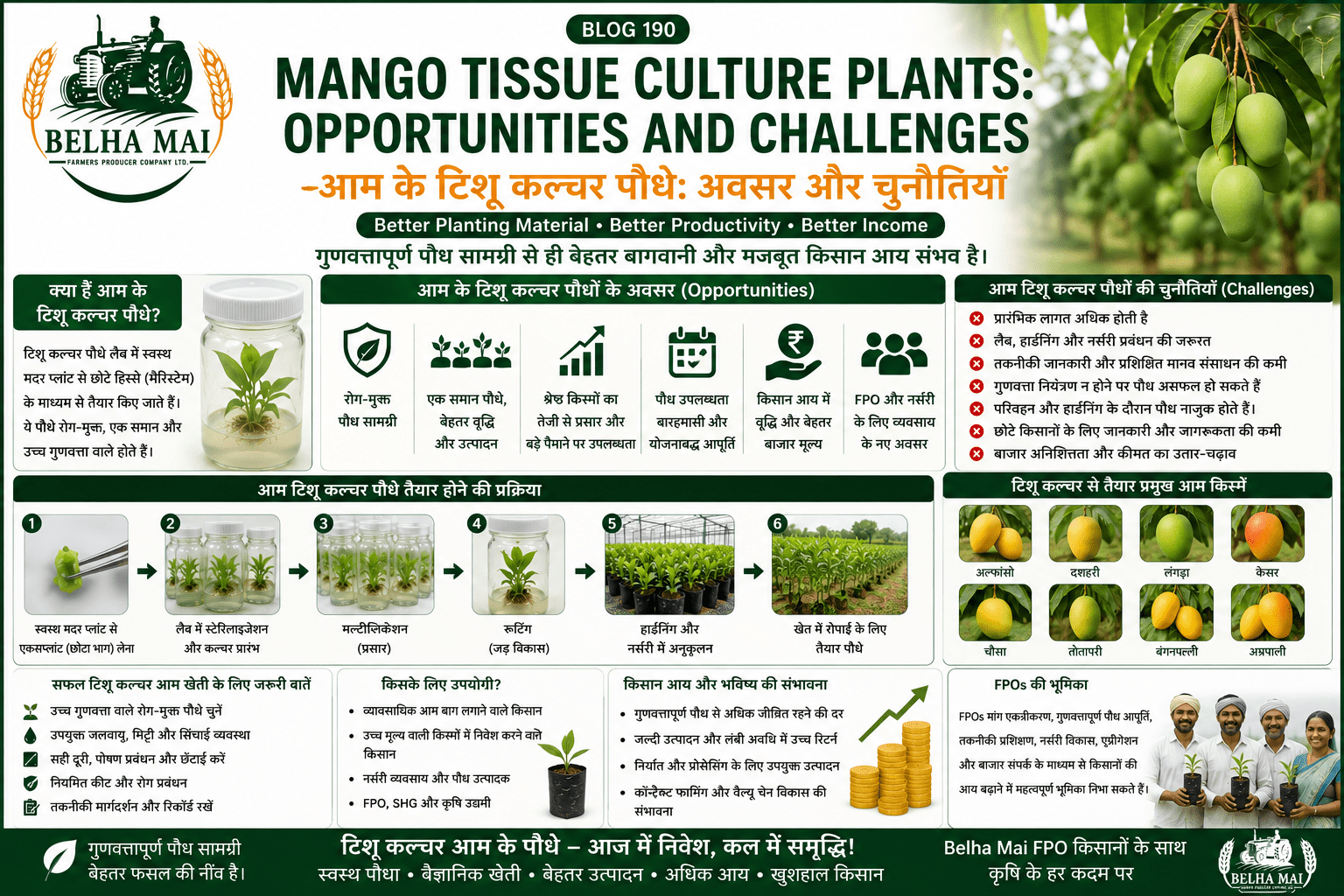
Mango tissue culture plants are plants produced through laboratory-based plant propagation using selected plant tissues from healthy mother plants. In this method, small plant parts are grown under sterile conditions on a nutrient medium and multiplied into plantlets. The purpose is to produce quality mango planting material with better uniformity and possible disease-free status. However, mango tissue culture is still technically challenging, and commercial success depends on strong research, skilled labs, correct protocols and proper nursery hardening.
आम टिशू कल्चर पौधे ऐसे पौधे होते हैं जिन्हें स्वस्थ मदर प्लांट से चुने गए पौध ऊतक का उपयोग करके प्रयोगशाला आधारित पौध प्रसार से तैयार किया जाता है। इस विधि में पौधे के छोटे भागों को स्वच्छ वातावरण में पोषक माध्यम पर उगाया जाता है और छोटे पौधों में बढ़ाया जाता है। इसका उद्देश्य बेहतर समानता और संभावित रोग-मुक्त स्थिति के साथ गुणवत्तापूर्ण आम पौध सामग्री तैयार करना है। हालांकि आम टिशू कल्चर अभी भी तकनीकी रूप से चुनौतीपूर्ण है, और व्यावसायिक सफलता मजबूत शोध, कुशल लैब, सही प्रोटोकॉल और उचित नर्सरी हार्डनिंग पर निर्भर करती है।
Why Mango Planting Material Matters
Mango is a long-duration fruit crop, and a farmer’s decision at the time of planting affects the orchard for many years. If a farmer plants poor-quality, weak or wrong-variety mango plants, the mistake may cause long-term loss. Mango tissue culture plants can create opportunities for better planting material in the future, but farmers must be careful because mango orchards require trust, variety purity and strong field performance. In mango farming, the quality of the plant is the foundation of future productivity and income.
आम एक लंबी अवधि वाली फल फसल है, और रोपाई के समय किसान का निर्णय कई वर्षों तक बागान को प्रभावित करता है। यदि किसान खराब गुणवत्ता, कमजोर या गलत किस्म के आम पौधे लगाता है, तो यह गलती लंबे समय तक नुकसान कर सकती है। आम टिशू कल्चर पौधे भविष्य में बेहतर पौध सामग्री के अवसर बना सकते हैं, लेकिन किसानों को सावधान रहना चाहिए क्योंकि आम बागानों में भरोसा, किस्म की शुद्धता और मजबूत खेत प्रदर्शन बहुत जरूरी होता है। आम खेती में पौधे की गुणवत्ता भविष्य की उत्पादकता और आय की नींव है।
Current Status of Mango Tissue Culture
Mango tissue culture plants are not as widely commercialized as banana tissue culture plants. Banana tissue culture has already become popular among farmers, but mango tissue culture still faces technical and commercial limitations. Mango is considered difficult because of problems such as contamination, slow multiplication, rooting difficulty, genetic stability concerns and hardening challenges. This does not mean mango tissue culture has no future. It means the technology needs careful research, reliable protocols and quality control before large-scale farmer adoption.
आम टिशू कल्चर पौधे केले के टिशू कल्चर पौधों की तरह व्यापक रूप से व्यावसायिक नहीं हुए हैं। केले का टिशू कल्चर किसानों में लोकप्रिय हो चुका है, लेकिन आम टिशू कल्चर अभी भी तकनीकी और व्यावसायिक सीमाओं का सामना कर रहा है। आम को कठिन माना जाता है क्योंकि इसमें संक्रमण, धीमा मल्टीप्लिकेशन, जड़ विकसित करने की कठिनाई, जेनेटिक स्थिरता की चिंता और हार्डनिंग की चुनौतियां होती हैं। इसका अर्थ यह नहीं है कि आम टिशू कल्चर का भविष्य नहीं है। इसका अर्थ है कि बड़े पैमाने पर किसान अपनाने से पहले इस तकनीक को सावधानीपूर्वक शोध, विश्वसनीय प्रोटोकॉल और गुणवत्ता नियंत्रण की आवश्यकता है।
Opportunities in Mango Tissue Culture Plants
Mango tissue culture plants can create strong opportunities for high-quality planting material, especially if reliable protocols are developed for important mango varieties. India has many popular mango varieties such as Dasheri, Langra, Chausa, Alphonso, Kesar, Totapuri and Amrapali. If tissue culture technology becomes commercially stable, nurseries and FPOs can multiply elite mango varieties faster and supply better plants to farmers. This can support mango orchard expansion, export-oriented farming and organized mango value chain development.
आम टिशू कल्चर पौधे उच्च गुणवत्ता वाली पौध सामग्री के लिए मजबूत अवसर बना सकते हैं, विशेष रूप से यदि महत्वपूर्ण आम किस्मों के लिए विश्वसनीय प्रोटोकॉल विकसित हो जाएं। भारत में दशहरी, लंगड़ा, चौसा, अल्फांसो, केसर, तोतापुरी और आम्रपाली जैसी कई लोकप्रिय आम किस्में हैं। यदि टिशू कल्चर तकनीक व्यावसायिक रूप से स्थिर हो जाती है, तो नर्सरियां और FPOs श्रेष्ठ आम किस्मों को तेजी से बढ़ाकर किसानों को बेहतर पौधे दे सकते हैं। इससे आम बागान विस्तार, निर्यात-उन्मुख खेती और संगठित आम वैल्यू चेन विकास को सहायता मिल सकती है।
Opportunity for Disease-Free Planting Material
One of the biggest opportunities in mango tissue culture plants is the possibility of producing cleaner and healthier planting material. In traditional nursery systems, diseases and pests can sometimes move through infected plant material or poor nursery hygiene. Tissue culture, when properly developed and monitored, can reduce such risks. However, for mango, disease-free production must be supported by mother plant testing, clean lab practices, nursery hygiene and traceable plant supply systems.
आम टिशू कल्चर पौधों में सबसे बड़ा अवसर स्वच्छ और स्वस्थ पौध सामग्री तैयार करने की संभावना है। पारंपरिक नर्सरी प्रणाली में बीमारी और कीट कई बार संक्रमित पौध सामग्री या खराब नर्सरी स्वच्छता के माध्यम से फैल सकते हैं। टिशू कल्चर, यदि सही तरीके से विकसित और निगरानी किया जाए, तो ऐसे जोखिमों को कम कर सकता है। हालांकि आम के लिए रोग-मुक्त उत्पादन को मदर प्लांट परीक्षण, स्वच्छ लैब प्रक्रिया, नर्सरी स्वच्छता और ट्रेसएबल पौध आपूर्ति प्रणाली से समर्थन देना जरूरी है।
Opportunity for Uniform Mango Orchards
Mango tissue culture plants may help in developing more uniform orchards in the future. Uniform plants can help farmers manage irrigation, nutrition, pruning, plant protection and orchard planning more effectively. In commercial mango farming, uniformity is useful because it supports better orchard management and market planning. However, mango is a perennial fruit crop, so field performance must be tested properly before farmers invest in large plantations using tissue culture plants.
आम टिशू कल्चर पौधे भविष्य में अधिक समान बागान विकसित करने में मदद कर सकते हैं। समान पौधे किसानों को सिंचाई, पोषण, प्रूनिंग, पौध सुरक्षा और बागान योजना को बेहतर तरीके से प्रबंधित करने में सहायता कर सकते हैं। व्यावसायिक आम खेती में समानता उपयोगी होती है क्योंकि इससे बागान प्रबंधन और बाजार योजना बेहतर होती है। हालांकि आम एक बहुवर्षीय फल फसल है, इसलिए टिशू कल्चर पौधों से बड़े बागान लगाने से पहले खेत प्रदर्शन का उचित परीक्षण जरूरी है।
Opportunity for High-Tech Nursery Business
Mango tissue culture plants can create new opportunities for high-tech nursery businesses, especially when tissue culture labs are connected with hardening units, polyhouses, shade net houses and mother plant blocks. A high-tech nursery can supply quality mango planting material, provide technical guidance and support farmers with orchard planning. For FPOs, this can become a future business model if the technology becomes reliable and commercially viable.
आम टिशू कल्चर पौधे हाई-टेक नर्सरी व्यवसाय के लिए नए अवसर बना सकते हैं, विशेष रूप से जब टिशू कल्चर लैब को हार्डनिंग यूनिट, पॉलीहाउस, शेडनेट हाउस और मदर प्लांट ब्लॉक से जोड़ा जाए। एक हाई-टेक नर्सरी गुणवत्तापूर्ण आम पौध सामग्री की आपूर्ति कर सकती है, तकनीकी मार्गदर्शन दे सकती है और किसानों को बागान योजना में सहायता कर सकती है। FPOs के लिए यह भविष्य का व्यवसाय मॉडल बन सकता है, यदि तकनीक विश्वसनीय और व्यावसायिक रूप से व्यवहार्य हो जाती है।
Opportunity for FPOs
FPOs can play an important role in the future of mango tissue culture plants because they are directly connected with farmers and local horticulture demand. An FPO can identify farmer demand, connect with reliable labs, develop nursery hardening infrastructure and supply quality plants to members. FPOs can also provide training on mango orchard establishment, irrigation, nutrition, pruning, pest control and market linkage. This can make mango tissue culture plants more practical and farmer-friendly.
आम टिशू कल्चर पौधों के भविष्य में FPOs महत्वपूर्ण भूमिका निभा सकते हैं क्योंकि वे सीधे किसानों और स्थानीय बागवानी मांग से जुड़े होते हैं। एक FPO किसान मांग की पहचान कर सकता है, विश्वसनीय लैब से जुड़ सकता है, नर्सरी हार्डनिंग इंफ्रास्ट्रक्चर विकसित कर सकता है और सदस्यों को गुणवत्तापूर्ण पौधे दे सकता है। FPOs आम बागान स्थापना, सिंचाई, पोषण, प्रूनिंग, कीट नियंत्रण और बाजार लिंक पर प्रशिक्षण भी दे सकते हैं। इससे आम टिशू कल्चर पौधे अधिक व्यावहारिक और किसान-हितैषी बन सकते हैं।
Opportunity for Mango Value Chain Development
Mango tissue culture plants can support mango value chain development if they help farmers establish better orchards. Better planting material can lead to better production, better production supports aggregation, and aggregation supports grading, ripening, processing, branding and export. Mango has strong demand in fresh fruit markets as well as processed products such as mango pulp, dried mango slices, aamchur and value-added products. Quality planting material is the first step in building a strong mango value chain.
यदि आम टिशू कल्चर पौधे किसानों को बेहतर बागान स्थापित करने में मदद करते हैं, तो वे आम वैल्यू चेन विकास को समर्थन दे सकते हैं। बेहतर पौध सामग्री बेहतर उत्पादन देती है, बेहतर उत्पादन एग्रीगेशन को मजबूत करता है, और एग्रीगेशन ग्रेडिंग, रिपनिंग, प्रोसेसिंग, ब्रांडिंग और निर्यात को आधार देता है। आम की ताजा फल बाजारों के साथ-साथ मैंगो पल्प, डिहाइड्रेटेड मैंगो स्लाइस, आमचूर और मूल्य संवर्धित उत्पादों में भी मजबूत मांग है। गुणवत्तापूर्ण पौध सामग्री मजबूत आम वैल्यू चेन बनाने का पहला कदम है।
Major Challenge: Technical Difficulty
The biggest challenge in mango tissue culture plants is technical difficulty. Mango is not as easy to multiply through tissue culture as banana. Problems may arise during culture initiation, contamination control, multiplication, rooting and hardening. Some mango varieties may respond differently in the laboratory. This makes commercial production difficult and costly. Therefore, mango tissue culture requires skilled scientists, strong protocols, careful testing and continuous quality monitoring.
आम टिशू कल्चर पौधों की सबसे बड़ी चुनौती तकनीकी कठिनाई है। आम को केले की तरह टिशू कल्चर से आसानी से बढ़ाना संभव नहीं है। कल्चर इनिशिएशन, संक्रमण नियंत्रण, मल्टीप्लिकेशन, रूटिंग और हार्डनिंग के दौरान समस्याएं आ सकती हैं। कुछ आम किस्में प्रयोगशाला में अलग-अलग प्रतिक्रिया दे सकती हैं। इससे व्यावसायिक उत्पादन कठिन और महंगा हो जाता है। इसलिए आम टिशू कल्चर के लिए कुशल वैज्ञानिक, मजबूत प्रोटोकॉल, सावधानीपूर्वक परीक्षण और लगातार गुणवत्ता निगरानी आवश्यक है।
Major Challenge: Rooting and Hardening
Rooting and hardening are major challenges in mango tissue culture plants. Laboratory plantlets are delicate and must develop strong roots before they can survive in nursery and field conditions. If rooting is weak or hardening is poor, plants may die after transfer. Mango being a long-term fruit crop requires strong planting material at the time of field establishment. Therefore, nursery hardening is as important as laboratory multiplication.
आम टिशू कल्चर पौधों में रूटिंग और हार्डनिंग बड़ी चुनौतियां हैं। प्रयोगशाला में तैयार छोटे पौधे नाजुक होते हैं और नर्सरी तथा खेत की परिस्थितियों में जीवित रहने से पहले मजबूत जड़ विकसित करनी होती है। यदि रूटिंग कमजोर है या हार्डनिंग खराब है, तो पौधे ट्रांसफर के बाद मर सकते हैं। आम एक लंबी अवधि वाली फल फसल है, इसलिए खेत स्थापना के समय मजबूत पौध सामग्री की आवश्यकता होती है। इसलिए नर्सरी हार्डनिंग प्रयोगशाला मल्टीप्लिकेशन जितनी ही महत्वपूर्ण है।
Major Challenge: True-to-Type Plants
For mango tissue culture plants, true-to-type quality is very important. Farmers must receive the same variety they paid for, with proper genetic stability and expected field performance. Any variation can create serious loss because mango orchards remain productive for many years. This is why testing, certification, mother plant selection and traceability are essential. Without strong quality assurance, farmers may hesitate to trust mango tissue culture plants.
आम टिशू कल्चर पौधों में सही किस्म और true-to-type गुणवत्ता बहुत महत्वपूर्ण है। किसान को वही किस्म मिलनी चाहिए जिसके लिए उसने भुगतान किया है, और पौधे में जेनेटिक स्थिरता तथा अपेक्षित खेत प्रदर्शन होना चाहिए। किसी भी प्रकार की भिन्नता गंभीर नुकसान कर सकती है क्योंकि आम के बागान कई वर्षों तक उत्पादन देते हैं। इसलिए परीक्षण, प्रमाणन, मदर प्लांट चयन और ट्रेसबिलिटी आवश्यक हैं। मजबूत गुणवत्ता आश्वासन के बिना किसान आम टिशू कल्चर पौधों पर भरोसा करने में हिचक सकते हैं।
Major Challenge: Higher Cost
Mango tissue culture plants may be more expensive than traditional grafted mango plants because the process requires laboratory infrastructure, trained manpower, research, sterile conditions, hardening units and quality control. Since mango tissue culture is technically difficult, production costs may remain high unless protocols become commercially efficient. Farmers will adopt mango tissue culture plants only when they see clear value in plant quality, survival, productivity and long-term income.
आम टिशू कल्चर पौधे पारंपरिक ग्राफ्टेड आम पौधों की तुलना में महंगे हो सकते हैं क्योंकि इस प्रक्रिया में प्रयोगशाला इंफ्रास्ट्रक्चर, प्रशिक्षित मानव संसाधन, शोध, स्वच्छ वातावरण, हार्डनिंग यूनिट और गुणवत्ता नियंत्रण की आवश्यकता होती है। चूंकि आम टिशू कल्चर तकनीकी रूप से कठिन है, इसलिए जब तक प्रोटोकॉल व्यावसायिक रूप से प्रभावी नहीं होते, उत्पादन लागत अधिक रह सकती है। किसान आम टिशू कल्चर पौधे तभी अपनाएंगे जब उन्हें पौध गुणवत्ता, जीवित रहने की क्षमता, उत्पादकता और दीर्घकालिक आय में स्पष्ट लाभ दिखाई देगा।
Comparison with Grafted Mango Plants
Traditional grafted mango plants are currently the most common and practical planting material for mango orchards. Grafting is well-known, widely available and accepted by farmers. Mango tissue culture plants may offer future opportunities, but they must prove reliability, field performance and economic viability. For now, farmers should not reject grafted plants. Instead, they should choose healthy, true-to-type, well-grown grafted plants from trusted nurseries while keeping an eye on future tissue culture developments.
वर्तमान में पारंपरिक ग्राफ्टेड आम पौधे आम बागानों के लिए सबसे सामान्य और व्यावहारिक पौध सामग्री हैं। ग्राफ्टिंग प्रसिद्ध, व्यापक रूप से उपलब्ध और किसानों द्वारा स्वीकार की गई विधि है। आम टिशू कल्चर पौधे भविष्य के अवसर दे सकते हैं, लेकिन उन्हें विश्वसनीयता, खेत प्रदर्शन और आर्थिक व्यवहार्यता साबित करनी होगी। फिलहाल किसानों को ग्राफ्टेड पौधों को नकारना नहीं चाहिए। इसके बजाय उन्हें भरोसेमंद नर्सरियों से स्वस्थ, सही किस्म और अच्छी तरह विकसित ग्राफ्टेड पौधे लेने चाहिए और भविष्य की टिशू कल्चर प्रगति पर नजर रखनी चाहिए।
Precautions for Farmers
Farmers should be careful before buying mango tissue culture plants. They should ask for variety details, source of mother plant, lab reliability, hardening quality, plant age, root development and field performance records. Farmers should avoid unknown suppliers making unrealistic promises. Since mango orchards are long-term investments, plant selection should never be done only on low price or big claims. Reliable source, technical support and traceability are essential.
किसानों को आम टिशू कल्चर पौधे खरीदने से पहले सावधानी रखनी चाहिए। उन्हें किस्म की जानकारी, मदर प्लांट का स्रोत, लैब की विश्वसनीयता, हार्डनिंग गुणवत्ता, पौधे की उम्र, जड़ विकास और खेत प्रदर्शन रिकॉर्ड के बारे में पूछना चाहिए। किसानों को ऐसे अज्ञात आपूर्तिकर्ताओं से बचना चाहिए जो अवास्तविक दावे करते हैं। चूंकि आम बागान लंबे समय का निवेश है, इसलिए पौध चयन केवल कम कीमत या बड़े दावों के आधार पर नहीं करना चाहिए। विश्वसनीय स्रोत, तकनीकी सहायता और ट्रेसबिलिटी आवश्यक हैं।
Future Scope in India
The future scope of mango tissue culture plants in India is promising but depends on research, commercial validation and farmer trust. India has huge mango diversity and strong domestic and export demand. If tissue culture protocols become reliable for important varieties, it can help produce quality planting material at scale. This can support new orchards, high-density planting systems, certified nurseries and FPO-led mango clusters. The future is strong, but the technology must be handled scientifically.
भारत में आम टिशू कल्चर पौधों का भविष्य संभावनाशील है, लेकिन यह शोध, व्यावसायिक सत्यापन और किसान विश्वास पर निर्भर करता है। भारत में आम की विशाल विविधता और घरेलू तथा निर्यात बाजार में मजबूत मांग है। यदि महत्वपूर्ण किस्मों के लिए टिशू कल्चर प्रोटोकॉल विश्वसनीय बनते हैं, तो बड़े पैमाने पर गुणवत्तापूर्ण पौध सामग्री तैयार की जा सकती है। इससे नए बागान, हाई-डेंसिटी प्लांटिंग सिस्टम, प्रमाणित नर्सरियां और FPO आधारित आम क्लस्टर मजबूत हो सकते हैं। भविष्य मजबूत है, लेकिन तकनीक को वैज्ञानिक तरीके से संभालना होगा।
Role of Belha Mai FPO
Belha Mai Farmers Producer Company Ltd. is working with a vision to strengthen horticulture, high-tech nursery development and mango value chains. For mango-producing regions, quality planting material is the foundation of long-term farmer income. Belha Mai FPO believes that technologies like tissue culture should be promoted carefully, with research support, nursery infrastructure, farmer training and market linkage. The focus should be on practical adoption, not only on technology promotion.
Belha Mai Farmers Producer Company Ltd. बागवानी, हाई-टेक नर्सरी विकास और आम वैल्यू चेन को मजबूत करने के विजन के साथ काम कर रहा है। आम उत्पादक क्षेत्रों के लिए गुणवत्तापूर्ण पौध सामग्री दीर्घकालिक किसान आय की नींव है। Belha Mai FPO का मानना है कि टिशू कल्चर जैसी तकनीकों को शोध समर्थन, नर्सरी इंफ्रास्ट्रक्चर, किसान प्रशिक्षण और बाजार लिंक के साथ सावधानीपूर्वक बढ़ावा देना चाहिए। ध्यान केवल तकनीक के प्रचार पर नहीं, बल्कि व्यावहारिक अपनाने पर होना चाहिए।
Conclusion
Mango tissue culture plants offer important opportunities for quality planting material, uniform orchards, disease-free plants, high-tech nursery development and mango value chain growth. At the same time, they face challenges such as technical difficulty, rooting problems, hardening issues, higher cost and field performance concerns. For farmers and FPOs, the correct approach is balanced: understand the technology, verify plant quality, trust reliable sources and use expert guidance. Mango tissue culture plants may become an important part of future horticulture, but careful adoption is essential.
आम टिशू कल्चर पौधे गुणवत्तापूर्ण पौध सामग्री, समान बागान, रोग-मुक्त पौधे, हाई-टेक नर्सरी विकास और आम वैल्यू चेन वृद्धि के महत्वपूर्ण अवसर प्रदान करते हैं। साथ ही इन्हें तकनीकी कठिनाई, रूटिंग समस्या, हार्डनिंग चुनौती, अधिक लागत और खेत प्रदर्शन की चिंता जैसी चुनौतियों का सामना करना पड़ता है। किसानों और FPOs के लिए सही दृष्टिकोण संतुलित होना चाहिए: तकनीक को समझना, पौध गुणवत्ता की जांच करना, विश्वसनीय स्रोत पर भरोसा करना और विशेषज्ञ मार्गदर्शन लेना। आम टिशू कल्चर पौधे भविष्य की बागवानी का महत्वपूर्ण हिस्सा बन सकते हैं, लेकिन सावधानीपूर्वक अपनाना आवश्यक है।
FAQ
What are mango tissue culture plants?
Mango tissue culture plants are mango plants produced through laboratory-based propagation using selected plant tissues from healthy mother plants.
आम टिशू कल्चर पौधे ऐसे आम पौधे होते हैं जिन्हें स्वस्थ मदर प्लांट से चुने गए पौध ऊतक का उपयोग करके प्रयोगशाला आधारित प्रसार से तैयार किया जाता है।
Are mango tissue culture plants common in India?
Mango tissue culture plants are not as common as banana tissue culture plants because mango tissue culture is technically more difficult and still needs strong commercial validation.
आम टिशू कल्चर पौधे केले के टिशू कल्चर पौधों की तरह सामान्य नहीं हैं क्योंकि आम टिशू कल्चर तकनीकी रूप से अधिक कठिन है और अभी मजबूत व्यावसायिक सत्यापन की आवश्यकता है।
What are the opportunities of mango tissue culture plants?
The main opportunities include quality planting material, uniform orchards, disease-free plants, faster multiplication of elite varieties and high-tech nursery business development.
मुख्य अवसरों में गुणवत्तापूर्ण पौध सामग्री, समान बागान, रोग-मुक्त पौधे, श्रेष्ठ किस्मों का तेज प्रसार और हाई-टेक नर्सरी व्यवसाय विकास शामिल हैं।
What are the challenges of mango tissue culture plants?
The main challenges include contamination, slow multiplication, rooting difficulty, hardening problems, higher cost and field performance concerns.
मुख्य चुनौतियों में संक्रमण, धीमा मल्टीप्लिकेशन, रूटिंग कठिनाई, हार्डनिंग समस्या, अधिक लागत और खेत प्रदर्शन की चिंता शामिल हैं।
Should farmers buy mango tissue culture plants?
Farmers should buy mango tissue culture plants only from reliable and technically strong sources after checking variety details, hardening quality, root development and field performance records.
किसानों को आम टिशू कल्चर पौधे केवल विश्वसनीय और तकनीकी रूप से मजबूत स्रोतों से ही खरीदने चाहिए, वह भी किस्म की जानकारी, हार्डनिंग गुणवत्ता, जड़ विकास और खेत प्रदर्शन रिकॉर्ड जांचने के बाद।
Internal Links Section
👉 High-Tech Nursery in India: Complete Guide —https://belhamaifpo.com/agriculture/high-tech-nursery-in-india-complete-guide/
👉 Mango Farming in India: Complete Guide —https://belhamaifpo.com/agriculture/mango-farming-in-india/
👉 What is Plant Tissue Culture in Agriculture? —https://belhamaifpo.com/agriculture/what-is-plant-tissue-culture-in-agriculture/
👉 Benefits of Tissue Culture Plants for Farmers —https://belhamaifpo.com/agriculture/benefits-of-tissue-culture-plants-for-farmers/
👉 Tissue Culture vs Traditional Plant Propagation —https://belhamaifpo.com/agriculture/tissue-culture-vs-traditional-plant-propagation/
👉 Belha Mai FPO Website — https://belhamaifpo.com/
External Authority Links
👉 National Horticulture Board — https://nhb.gov.in/
👉 Ministry of Agriculture & Farmers Welfare — https://agriwelfare.gov.in/
👉 Department of Biotechnology, Government of India — https://dbtindia.gov.in/
👉 ICAR — https://icar.org.in/
👉 APEDA — https://apeda.gov.in/
Follow Belha Mai FPO for More Updates
Website: https://belhamaifpo.com/
Facebook:https://www.facebook.com/profile.php?id=61561043486818
YouTube: https://www.youtube.com/channel/UC9ZvojoTMCa7mU1-Q_Bh60A
LinkedIn:https://www.linkedin.com/in/abhay-singh-ab5568280/
Instagram:https://instagram.com/belhamaifpo
Belha Mai FPO is working to support farmers through better information, technology, market linkage, value addition, FPO awareness and rural development.