भारत से डिहाइड्रेटेड फलों और सब्जियों का निर्यात
Introduction
Export of dehydrated fruits and vegetables from India is an important opportunity for farmers, FPOs, food processors and rural entrepreneurs. India produces a wide variety of fruits and vegetables, but a large share of fresh produce is seasonal and perishable. When fresh produce is dehydrated scientifically, it becomes lighter, more stable, easier to transport and suitable for longer storage. This makes dehydrated products useful for domestic markets as well as international buyers.
भारत से डिहाइड्रेटेड फलों और सब्जियों का निर्यात किसानों, FPOs, फूड प्रोसेसरों और ग्रामीण उद्यमियों के लिए एक महत्वपूर्ण अवसर है। भारत में फलों और सब्जियों की बड़ी विविधता पैदा होती है, लेकिन ताजा उत्पादन का बड़ा हिस्सा मौसमी और जल्दी खराब होने वाला होता है। जब ताजे उत्पादन को वैज्ञानिक तरीके से डिहाइड्रेट किया जाता है, तो वह हल्का, अधिक स्थिर, परिवहन में आसान और लंबे भंडारण के लिए उपयुक्त बन जाता है। इसलिए डिहाइड्रेटेड उत्पाद घरेलू बाजारों के साथ-साथ अंतरराष्ट्रीय खरीदारों के लिए भी उपयोगी होते हैं।
Meaning of Dehydrated Fruits and Vegetables
Dehydrated fruits and vegetables are products from which moisture is removed through drying methods such as solar drying, hot air drying, tray drying, cabinet drying, freeze drying or other approved technologies. Moisture reduction helps increase shelf life and reduce spoilage. Export of dehydrated fruits and vegetables becomes possible only when the product is clean, properly dried, safely packed and made according to buyer and country-specific requirements.
डिहाइड्रेटेड फल और सब्जियां वे उत्पाद हैं जिनसे solar drying, hot air drying, tray drying, cabinet drying, freeze drying या अन्य approved technologies के माध्यम से नमी हटाई जाती है। नमी कम करने से shelf life बढ़ती है और खराबी कम होती है। डिहाइड्रेटेड फलों और सब्जियों का निर्यात तभी संभव होता है जब product clean, properly dried, safely packed और buyer तथा country-specific requirements के अनुसार तैयार हो।
Why Export Opportunity is Growing
Export of dehydrated fruits and vegetables is growing because global consumers, food companies, hotels, restaurants and ready-to-eat food brands need stable ingredients throughout the year. Dehydrated products are useful in snacks, bakery, instant foods, soups, sauces, spice mixes, breakfast cereals, health foods and institutional kitchens. India has a strong advantage because it has diverse crops, skilled processors, competitive production and many traditional food products that can be converted into export-ready dehydrated products.
डिहाइड्रेटेड फलों और सब्जियों का export opportunity इसलिए बढ़ रहा है क्योंकि global consumers, food companies, hotels, restaurants और ready-to-eat food brands को पूरे वर्ष stable ingredients की आवश्यकता होती है। Dehydrated products snacks, bakery, instant foods, soups, sauces, spice mixes, breakfast cereals, health foods और institutional kitchens में उपयोगी हैं। भारत को मजबूत advantage है क्योंकि यहां diverse crops, skilled processors, competitive production और कई traditional food products हैं जिन्हें export-ready dehydrated products में बदला जा सकता है।
Benefits for Indian Farmers
Export of dehydrated fruits and vegetables can benefit Indian farmers by creating better demand for processed and value-added products. During peak season, fresh produce prices often fall because supply is high. Dehydration helps convert surplus produce into shelf-stable products. If FPOs and processors connect with export markets, farmers can receive better value, reduced wastage and more stable demand for crops like mango, amla, onion, garlic, tomato, chilli and vegetables.
डिहाइड्रेटेड फलों और सब्जियों का निर्यात भारतीय किसानों को processed और value-added products की बेहतर demand बनाकर लाभ दे सकता है। Peak season में fresh produce की prices अक्सर गिर जाती हैं क्योंकि supply अधिक होती है। Dehydration surplus produce को shelf-stable products में बदलने में मदद करता है। यदि FPOs और processors export markets से जुड़ते हैं, तो किसानों को mango, amla, onion, garlic, tomato, chilli और vegetables जैसी crops से बेहतर value, कम wastage और अधिक stable demand मिल सकती है।
Benefits for FPOs
Export of dehydrated fruits and vegetables can become a strong business opportunity for FPOs. An FPO can aggregate raw material from member farmers, ensure sorting and grading, process produce through dehydration, pack under a brand and connect with domestic or international buyers. FPOs may not export immediately on their own, but they can begin by supplying export-quality raw material or semi-processed products to processors and exporters.
डिहाइड्रेटेड फलों और सब्जियों का निर्यात FPOs के लिए मजबूत business opportunity बन सकता है। एक FPO member farmers से raw material aggregate कर सकता है, sorting और grading सुनिश्चित कर सकता है, dehydration के माध्यम से produce process कर सकता है, brand के अंतर्गत pack कर सकता है और domestic या international buyers से जुड़ सकता है। FPOs तुरंत अपने दम पर export न भी करें, तो वे processors और exporters को export-quality raw material या semi-processed products supply करके शुरुआत कर सकते हैं।
Suitable Dehydrated Fruits for Export
Many Indian fruits are suitable for dehydration and export, including mango, amla, banana, papaya, pineapple, apple, guava, jackfruit, fig, dates, grapes and berries. Mango slices, dried mango, aamchur, amla powder, dried amla, banana chips and fruit powders can have market potential when processed hygienically. The product should match buyer specifications for colour, taste, moisture, size, texture, packaging and food safety.
भारत के कई फल dehydration और export के लिए उपयुक्त हैं, जैसे mango, amla, banana, papaya, pineapple, apple, guava, jackfruit, fig, dates, grapes और berries। Mango slices, dried mango, aamchur, amla powder, dried amla, banana chips और fruit powders में market potential हो सकता है, यदि उन्हें hygienically process किया जाए। Product को colour, taste, moisture, size, texture, packaging और food safety के buyer specifications से match करना चाहिए।
Suitable Dehydrated Vegetables for Export
Dehydrated vegetables also have strong export potential. Onion flakes, garlic flakes, tomato powder, dried tomato slices, chilli flakes, dried spinach, carrot flakes, beetroot powder, okra slices, curry leaves, fenugreek leaves and mixed dehydrated vegetables can be used by food companies and institutional buyers. Dehydrated vegetables are especially useful for ready-to-cook, ready-to-eat and industrial food applications.
Dehydrated vegetables में भी strong export potential है। Onion flakes, garlic flakes, tomato powder, dried tomato slices, chilli flakes, dried spinach, carrot flakes, beetroot powder, okra slices, curry leaves, fenugreek leaves और mixed dehydrated vegetables food companies और institutional buyers द्वारा उपयोग किए जा सकते हैं। Dehydrated vegetables ready-to-cook, ready-to-eat और industrial food applications के लिए विशेष रूप से उपयोगी हैं।
Amla Export Opportunity
Amla is a strong product for export-oriented value addition because it is known for nutrition, traditional wellness and food processing uses. Amla can be processed into dried amla, amla powder, amla candy, amla flakes and other value-added products. For Pratapgarh and nearby amla-growing regions, export of dehydrated amla products can create new opportunities for farmers and FPOs if quality, food safety, packaging and buyer linkage are developed properly.
Amla export-oriented value addition के लिए strong product है क्योंकि यह nutrition, traditional wellness और food processing uses के लिए जाना जाता है। Amla को dried amla, amla powder, amla candy, amla flakes और अन्य value-added products में process किया जा सकता है। Pratapgarh और nearby amla-growing regions के लिए dehydrated amla products का export farmers और FPOs के लिए नए अवसर बना सकता है, यदि quality, food safety, packaging और buyer linkage सही तरीके से विकसित किए जाएं।
Mango Export Opportunity
Mango is another important product for export of dehydrated fruits and vegetables from India. Fresh mango has seasonal demand, but dried mango slices, mango powder and aamchur can extend mango value beyond the fresh season. Properly dehydrated mango products can be used in snacks, confectionery, bakery, food ingredients and retail packs. FPOs working with mango farmers can use dehydration to reduce wastage during peak season and create export-ready products.
भारत से डिहाइड्रेटेड फलों और सब्जियों के निर्यात में mango भी एक महत्वपूर्ण product है। Fresh mango की seasonal demand होती है, लेकिन dried mango slices, mango powder और aamchur mango value को fresh season से आगे बढ़ा सकते हैं। Properly dehydrated mango products snacks, confectionery, bakery, food ingredients और retail packs में उपयोग हो सकते हैं। Mango farmers के साथ काम करने वाले FPOs dehydration के माध्यम से peak season में wastage कम करके export-ready products बना सकते हैं।
Dehydration Process for Export Products
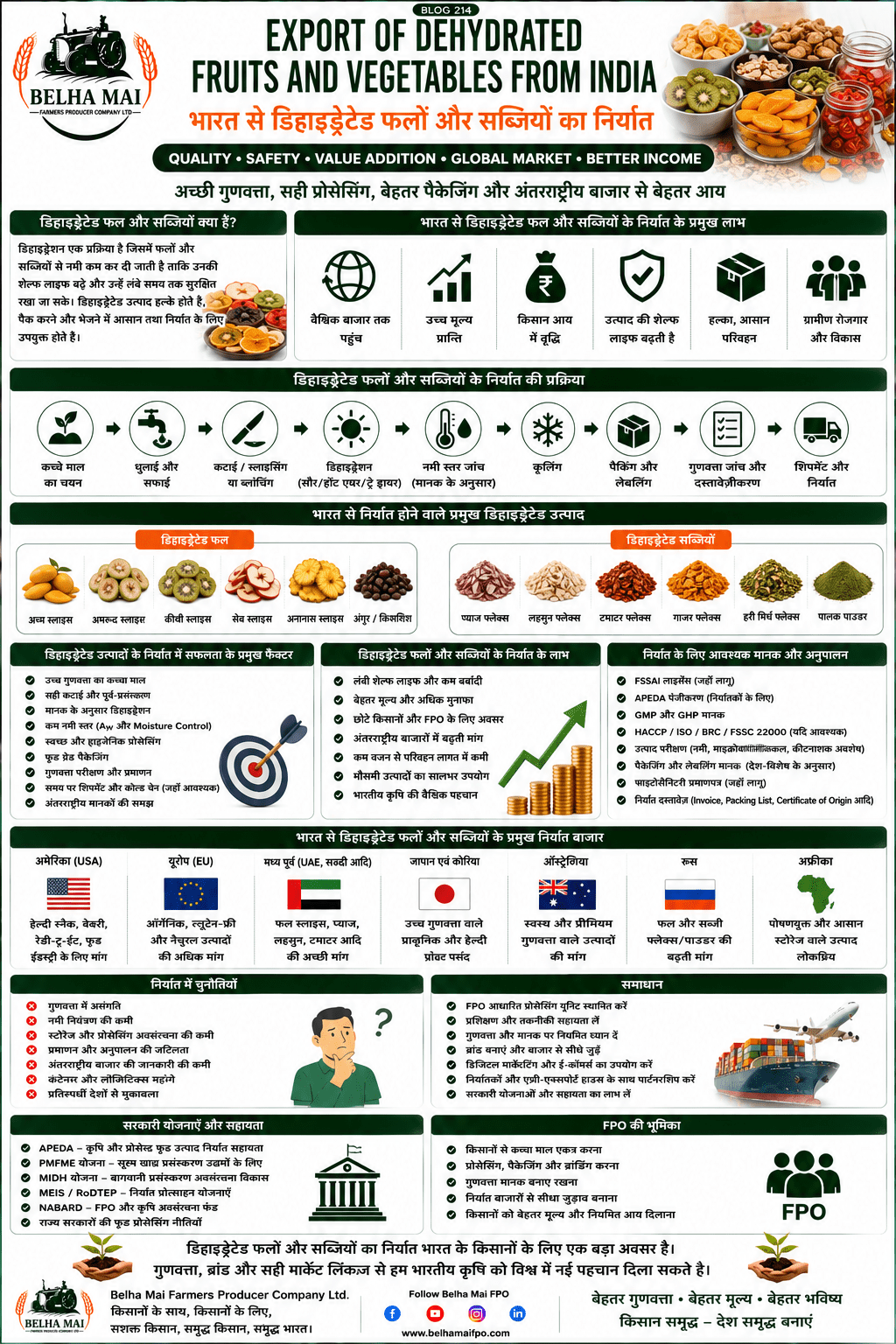
Export of dehydrated fruits and vegetables requires a controlled process. The process begins with selection of good raw material, followed by washing, cleaning, sorting, grading, cutting or slicing, pre-treatment if needed, drying, moisture checking, cooling, packing, labelling, storage and shipment. Each step must be managed hygienically because export buyers are strict about product quality, food safety and consistency.
डिहाइड्रेटेड फलों और सब्जियों के export products के लिए controlled process की आवश्यकता होती है। Process good raw material selection से शुरू होता है, जिसके बाद washing, cleaning, sorting, grading, cutting या slicing, जरूरत होने पर pre-treatment, drying, moisture checking, cooling, packing, labelling, storage और shipment होता है। हर step को hygienically manage करना जरूरी है क्योंकि export buyers product quality, food safety और consistency को लेकर strict होते हैं।
Importance of Raw Material Quality
Export quality begins with raw material quality. Damaged, diseased, overripe or immature fruits and vegetables cannot produce good dehydrated products. Raw material should be fresh, clean, properly matured and suitable for processing. Farmers and FPOs should follow proper harvesting, handling and sorting practices. If the raw material is poor, no processing technology can fully correct the quality.
Export quality raw material quality से शुरू होती है। Damaged, diseased, overripe या immature fruits and vegetables अच्छे dehydrated products नहीं बना सकते। Raw material fresh, clean, properly matured और processing के लिए suitable होना चाहिए। Farmers और FPOs को proper harvesting, handling और sorting practices अपनानी चाहिए। यदि raw material poor है, तो कोई भी processing technology quality को पूरी तरह correct नहीं कर सकती।
Sorting and Grading for Export
Sorting and grading are essential for export of dehydrated fruits and vegetables. Produce must be sorted to remove defective items and graded for size, maturity and quality. Uniform raw material gives uniform drying and better final product. Grading also helps match different products with different buyer needs. Export buyers usually prefer consistency, so sorting and grading must be part of the standard process.
डिहाइड्रेटेड फलों और सब्जियों के export के लिए sorting और grading essential हैं। Produce को defective items हटाने के लिए sorted और size, maturity तथा quality के अनुसार graded करना चाहिए। Uniform raw material uniform drying और बेहतर final product देता है। Grading अलग-अलग products को अलग-अलग buyer needs से match करने में भी मदद करती है। Export buyers सामान्यतः consistency पसंद करते हैं, इसलिए sorting और grading standard process का हिस्सा होना चाहिए।
Moisture Control
Moisture control is very important in export of dehydrated fruits and vegetables. If moisture is too high, the product may spoil, develop fungus or fail buyer standards. If moisture is too low, the product may lose texture, taste or appearance. The correct moisture level depends on product type and buyer specification. Processors should use proper testing methods and maintain batch records.
Moisture control डिहाइड्रेटेड फलों और सब्जियों के export में बहुत महत्वपूर्ण है। यदि moisture बहुत अधिक है, तो product spoil हो सकता है, fungus develop हो सकता है या buyer standards fail कर सकता है। यदि moisture बहुत कम है, तो product texture, taste या appearance खो सकता है। Correct moisture level product type और buyer specification पर निर्भर करता है। Processors को proper testing methods use करने चाहिए और batch records maintain करने चाहिए।
Food Safety and Hygiene
Food safety is one of the most important requirements in export of dehydrated fruits and vegetables. Processing areas should be clean, workers should follow hygiene practices, water should be safe, equipment should be sanitized and packaging should be food-grade. Foreign matter, contamination, insects, dust and unsafe handling can lead to rejection. Export-oriented processing needs strong quality discipline from farm to factory.
Food safety डिहाइड्रेटेड फलों और सब्जियों के export की सबसे महत्वपूर्ण requirements में से एक है। Processing areas clean होने चाहिए, workers को hygiene practices follow करनी चाहिए, water safe होना चाहिए, equipment sanitized होना चाहिए और packaging food-grade होनी चाहिए। Foreign matter, contamination, insects, dust और unsafe handling rejection का कारण बन सकते हैं। Export-oriented processing को farm से factory तक strong quality discipline की जरूरत होती है।
Packaging for Export
Packaging is critical for export of dehydrated fruits and vegetables because products must remain safe during storage, transport and international shipment. Packaging should protect products from moisture, oxygen, insects, breakage and contamination. Depending on product and buyer requirement, packaging may include laminated pouches, vacuum packs, nitrogen-flushed packs, cartons, bulk bags or food-grade drums. Labelling should follow buyer and destination country requirements.
Packaging डिहाइड्रेटेड फलों और सब्जियों के export के लिए critical है क्योंकि products को storage, transport और international shipment के दौरान safe रहना चाहिए। Packaging products को moisture, oxygen, insects, breakage और contamination से protect करनी चाहिए। Product और buyer requirement के अनुसार packaging में laminated pouches, vacuum packs, nitrogen-flushed packs, cartons, bulk bags या food-grade drums शामिल हो सकते हैं। Labelling buyer और destination country requirements के अनुसार होनी चाहिए।
Labelling and Documentation
Export of dehydrated fruits and vegetables requires proper labelling and documentation. Labels may need product name, ingredients, net weight, batch number, manufacturing date, best-before date, country of origin, nutritional information and exporter details depending on market requirement. Export documents may include invoice, packing list, certificate of origin, testing reports, shipping documents and buyer-specific documents. Proper documentation reduces shipment delays and rejection risk.
डिहाइड्रेटेड फलों और सब्जियों के export के लिए proper labelling और documentation आवश्यक है। Labels में market requirement के अनुसार product name, ingredients, net weight, batch number, manufacturing date, best-before date, country of origin, nutritional information और exporter details शामिल हो सकते हैं। Export documents में invoice, packing list, certificate of origin, testing reports, shipping documents और buyer-specific documents शामिल हो सकते हैं। Proper documentation shipment delays और rejection risk कम करता है।
Compliance Requirements
Export of dehydrated fruits and vegetables may require compliance with FSSAI, APEDA registration where applicable, GST, IEC, food safety standards, buyer specifications and destination country regulations. Some buyers may ask for HACCP, ISO 22000, BRC, organic certification, residue testing or microbiological testing depending on product and market. Since requirements can change, exporters and FPOs should verify updated rules before shipment.
डिहाइड्रेटेड फलों और सब्जियों के export के लिए FSSAI, जहां लागू हो APEDA registration, GST, IEC, food safety standards, buyer specifications और destination country regulations का compliance आवश्यक हो सकता है। Product और market के अनुसार कुछ buyers HACCP, ISO 22000, BRC, organic certification, residue testing या microbiological testing मांग सकते हैं। चूंकि requirements बदल सकती हैं, exporters और FPOs को shipment से पहले updated rules verify करने चाहिए।
Role of APEDA and Export Support
APEDA plays an important role in agricultural and processed food export promotion from India. Exporters dealing with eligible products may need registration and may get access to information, trade promotion support and export-related guidance. FPOs and food processing units interested in export should study APEDA requirements carefully and connect with experienced export consultants, buyers and logistics partners before starting.
APEDA भारत से agricultural और processed food export promotion में महत्वपूर्ण भूमिका निभाता है। Eligible products के साथ काम करने वाले exporters को registration की आवश्यकता हो सकती है और उन्हें information, trade promotion support और export-related guidance मिल सकती है। Export में रुचि रखने वाले FPOs और food processing units को APEDA requirements carefully study करनी चाहिए और शुरुआत से पहले experienced export consultants, buyers और logistics partners से जुड़ना चाहिए।
Export Markets for Dehydrated Products
Export markets for dehydrated fruits and vegetables may include the Middle East, Europe, USA, Japan, South Korea, Australia, Africa and other regions depending on product and buyer demand. Different markets have different quality, packaging, documentation and compliance expectations. For example, premium markets may demand strict testing and high-quality packaging, while bulk buyers may focus on consistent supply and competitive pricing.
Dehydrated fruits and vegetables के export markets में product और buyer demand के अनुसार Middle East, Europe, USA, Japan, South Korea, Australia, Africa और अन्य regions शामिल हो सकते हैं। अलग-अलग markets की quality, packaging, documentation और compliance expectations अलग होती हैं। उदाहरण के लिए, premium markets strict testing और high-quality packaging मांग सकते हैं, जबकि bulk buyers consistent supply और competitive pricing पर focus कर सकते हैं।
Middle East Market Opportunity
The Middle East can be an attractive market for dehydrated fruits and vegetables because of strong demand for food imports, Indian food products and ready-to-use ingredients. Dried mango, dried fruits, amla products, onion, garlic, spices and dehydrated vegetables may find opportunities when quality and packaging are good. Indian FPOs and processors can explore this market through exporters, distributors and food trade networks.
Middle East डिहाइड्रेटेड फलों और सब्जियों के लिए attractive market हो सकता है क्योंकि वहां food imports, Indian food products और ready-to-use ingredients की strong demand है। Dried mango, dried fruits, amla products, onion, garlic, spices और dehydrated vegetables को quality और packaging अच्छी होने पर opportunities मिल सकती हैं। Indian FPOs और processors exporters, distributors और food trade networks के माध्यम से इस market को explore कर सकते हैं।
Europe and USA Market Opportunity
Europe and USA are quality-sensitive markets where food safety, traceability, labelling and compliance are very important. Export of dehydrated fruits and vegetables to these markets requires strong processing standards, proper testing, reliable documentation and professional packaging. Although entry may be challenging, these markets can offer good value for high-quality and specialty products.
Europe और USA quality-sensitive markets हैं, जहां food safety, traceability, labelling और compliance बहुत महत्वपूर्ण हैं। इन markets में डिहाइड्रेटेड फलों और सब्जियों का export strong processing standards, proper testing, reliable documentation और professional packaging मांगता है। Entry challenging हो सकती है, लेकिन high-quality और specialty products के लिए ये markets good value दे सकते हैं।
Japan, Korea and Premium Markets
Japan, Korea and other premium markets usually have strict quality expectations and strong attention to food safety, appearance, packaging and consistency. Dehydrated products for these markets must be prepared with high discipline. FPOs may not directly enter such markets immediately, but they can build capacity step by step by supplying quality raw material or processed products to experienced exporters.
Japan, Korea और अन्य premium markets में सामान्यतः strict quality expectations और food safety, appearance, packaging तथा consistency पर strong attention होता है। इन markets के लिए dehydrated products high discipline के साथ तैयार होने चाहिए। FPOs तुरंत सीधे ऐसे markets में प्रवेश न भी करें, तो वे experienced exporters को quality raw material या processed products supply करके step by step capacity build कर सकते हैं।
Domestic Market First, Export Later
For many FPOs and new processors, it is practical to build domestic markets first and then move towards export. Domestic sales help test product quality, packaging, customer response, shelf life and pricing. Once quality systems become strong, the business can approach exporters or international buyers. Export of dehydrated fruits and vegetables should be treated as a serious business requiring consistency, compliance and patience.
कई FPOs और new processors के लिए पहले domestic markets बनाना और फिर export की ओर बढ़ना practical है। Domestic sales product quality, packaging, customer response, shelf life और pricing test करने में मदद करती है। जब quality systems मजबूत हो जाएं, तब business exporters या international buyers तक पहुंच सकता है। डिहाइड्रेटेड फलों और सब्जियों का export consistency, compliance और patience मांगने वाला serious business माना जाना चाहिए।
Role of FPOs in Export Value Chain
FPOs can play many roles in the export value chain. They can supply quality raw material, manage farmer training, ensure residue-safe production, operate collection centres, manage sorting and grading, process products, pack products and connect with exporters. Even if the FPO does not export directly, it can become an important export supply partner by maintaining quality and traceability.
FPOs export value chain में कई roles निभा सकते हैं। वे quality raw material supply कर सकते हैं, farmer training manage कर सकते हैं, residue-safe production सुनिश्चित कर सकते हैं, collection centres operate कर सकते हैं, sorting और grading manage कर सकते हैं, products process कर सकते हैं, products pack कर सकते हैं और exporters से जुड़ सकते हैं। यदि FPO सीधे export न भी करे, तो quality और traceability maintain करके important export supply partner बन सकता है।
Traceability in Export
Traceability is very important in export of dehydrated fruits and vegetables. Buyers want to know where the raw material came from, how it was processed, what batch it belongs to and whether quality checks were done. FPOs can maintain farmer records, harvest records, processing records, batch numbers and dispatch records. Traceability improves buyer confidence and helps manage quality issues.
Traceability डिहाइड्रेटेड फलों और सब्जियों के export में बहुत महत्वपूर्ण है। Buyers जानना चाहते हैं कि raw material कहां से आया, कैसे process हुआ, किस batch से संबंधित है और quality checks हुए या नहीं। FPOs farmer records, harvest records, processing records, batch numbers और dispatch records maintain कर सकते हैं। Traceability buyer confidence सुधारती है और quality issues manage करने में मदद करती है।
Residue and Contamination Control
Export markets often check pesticide residues, heavy metals, microbial load and foreign matter depending on product and destination country. Farmers and FPOs should follow good agricultural practices, safe input use, proper washing, hygienic processing and clean packaging. Residue and contamination control must begin at the farm level because export quality cannot be created only at the final packaging stage.
Export markets product और destination country के अनुसार pesticide residues, heavy metals, microbial load और foreign matter check कर सकते हैं। Farmers और FPOs को good agricultural practices, safe input use, proper washing, hygienic processing और clean packaging अपनानी चाहिए। Residue और contamination control farm level से शुरू होना चाहिए क्योंकि export quality केवल final packaging stage पर नहीं बनाई जा सकती।
Branding for Export
Branding can improve export of dehydrated fruits and vegetables when the product has quality, packaging and a clear story. A strong brand can highlight Indian origin, farmer-owned supply chain, quality processing, natural ingredients and value addition. However, export branding should be professional and compliant with buyer requirements. FPO brands like Rajvi Bhog can gradually build identity in domestic and export-oriented markets.
Branding डिहाइड्रेटेड फलों और सब्जियों के export को improve कर सकती है, जब product में quality, packaging और clear story हो। Strong brand Indian origin, farmer-owned supply chain, quality processing, natural ingredients और value addition को highlight कर सकता है। हालांकि export branding professional और buyer requirements के अनुसार compliant होनी चाहिए। Rajvi Bhog जैसे FPO brands धीरे-धीरे domestic और export-oriented markets में identity build कर सकते हैं।
Logistics and Shipment
Export of dehydrated fruits and vegetables requires proper logistics and shipment planning. Products must be stored in dry and clean conditions before dispatch. Depending on buyer requirement and product sensitivity, shipment may be through sea, air or land routes. Packaging must protect the product during long transit. Exporters should also plan container loading, documentation, insurance and delivery timelines carefully.
डिहाइड्रेटेड फलों और सब्जियों के export के लिए proper logistics और shipment planning की जरूरत होती है। Dispatch से पहले products को dry और clean conditions में store करना चाहिए। Buyer requirement और product sensitivity के अनुसार shipment sea, air या land routes से हो सकता है। Packaging को long transit के दौरान product की रक्षा करनी चाहिए। Exporters को container loading, documentation, insurance और delivery timelines carefully plan करने चाहिए।
Pricing and Costing
Export pricing for dehydrated fruits and vegetables must include raw material cost, processing cost, drying loss, labour, packaging, testing, certification, storage, transport, documentation, exporter margin and buyer requirements. Farmers and FPOs must understand that dehydration reduces weight because moisture is removed, so costing should be calculated carefully. Wrong costing can lead to losses even when the product sells well.
Dehydrated fruits and vegetables की export pricing में raw material cost, processing cost, drying loss, labour, packaging, testing, certification, storage, transport, documentation, exporter margin और buyer requirements शामिल होने चाहिए। Farmers और FPOs को समझना चाहिए कि dehydration से weight कम होता है क्योंकि moisture हटती है, इसलिए costing carefully calculate करनी चाहिए। Wrong costing से product अच्छा बिकने पर भी losses हो सकते हैं।
Common Challenges in Export
Export of dehydrated fruits and vegetables has challenges such as strict quality requirements, food safety compliance, documentation, packaging cost, buyer trust, working capital, delayed payments, price competition and logistics risks. New exporters may face rejection if quality is inconsistent. FPOs should begin with training, domestic market experience, small export-linked orders and partnerships with experienced exporters.
डिहाइड्रेटेड फलों और सब्जियों के export में strict quality requirements, food safety compliance, documentation, packaging cost, buyer trust, working capital, delayed payments, price competition और logistics risks जैसी challenges होती हैं। New exporters को quality inconsistent होने पर rejection का सामना करना पड़ सकता है। FPOs को training, domestic market experience, small export-linked orders और experienced exporters के साथ partnerships से शुरुआत करनी चाहिए।
How FPOs Can Start Export Preparation
FPOs can start export preparation by selecting suitable products, training farmers, improving raw material quality, setting up sorting and grading, developing hygienic processing, using food-grade packaging and maintaining records. They should first build domestic buyer confidence, then connect with merchant exporters, APEDA networks, trade fairs and institutional buyers. Export readiness is a step-by-step journey.
FPOs suitable products select करके, farmers को train करके, raw material quality improve करके, sorting और grading set up करके, hygienic processing develop करके, food-grade packaging use करके और records maintain करके export preparation शुरू कर सकते हैं। उन्हें पहले domestic buyer confidence build करना चाहिए, फिर merchant exporters, APEDA networks, trade fairs और institutional buyers से जुड़ना चाहिए। Export readiness step-by-step journey है।
Government Schemes and Support
Export of dehydrated fruits and vegetables may receive support through food processing, PMFME, APEDA, MSME, FPO, cold chain, packaging, quality certification and export promotion schemes depending on eligibility and project design. Farmers and FPOs should check updated information from official sources before investment. Scheme rules and export requirements may change, so updated verification is necessary.
डिहाइड्रेटेड फलों और सब्जियों के export को eligibility और project design के अनुसार food processing, PMFME, APEDA, MSME, FPO, cold chain, packaging, quality certification और export promotion schemes से support मिल सकता है। Farmers और FPOs को investment से पहले official sources से updated information check करनी चाहिए। Scheme rules और export requirements बदल सकते हैं, इसलिए updated verification आवश्यक है।
Belha Mai FPO Vision
Belha Mai Farmers Producer Company Ltd. believes that export of dehydrated fruits and vegetables from India can create strong opportunities for farmers when quality, processing, packaging and market linkage are managed properly. For crops like mango, amla and vegetables, dehydration can reduce wastage and create export-ready value-added products. Through aggregation, sorting, grading, dehydration, branding and buyer linkage, Belha Mai FPO aims to build stronger rural export value chains.
Belha Mai Farmers Producer Company Ltd. का मानना है कि भारत से डिहाइड्रेटेड फलों और सब्जियों का export किसानों के लिए strong opportunities बना सकता है, यदि quality, processing, packaging और market linkage सही तरीके से manage किए जाएं। Mango, amla और vegetables जैसी crops के लिए dehydration wastage कम कर सकता है और export-ready value-added products बना सकता है। Aggregation, sorting, grading, dehydration, branding और buyer linkage के माध्यम से Belha Mai FPO stronger rural export value chains बनाना चाहता है।
Conclusion
Export of dehydrated fruits and vegetables from India is a promising opportunity, but it requires discipline, quality and compliance. Dehydrated products can reduce post-harvest losses, increase shelf life, improve farmer income and help Indian agriculture reach global markets. For FPOs, export readiness should begin with strong raw material, hygienic processing, proper packaging, traceability, domestic market experience and partnerships with reliable exporters. With the right approach, dehydrated fruits and vegetables can become a powerful value-added export category for rural India.
भारत से डिहाइड्रेटेड फलों और सब्जियों का export promising opportunity है, लेकिन इसके लिए discipline, quality और compliance की जरूरत होती है। Dehydrated products post-harvest losses कम कर सकते हैं, shelf life बढ़ा सकते हैं, farmer income सुधार सकते हैं और Indian agriculture को global markets तक पहुंचा सकते हैं। FPOs के लिए export readiness की शुरुआत strong raw material, hygienic processing, proper packaging, traceability, domestic market experience और reliable exporters के साथ partnerships से होनी चाहिए। सही approach के साथ dehydrated fruits and vegetables rural India के लिए powerful value-added export category बन सकते हैं।
FAQ
What is export of dehydrated fruits and vegetables?
Export of dehydrated fruits and vegetables means selling dried fruit and vegetable products from India to international markets after proper processing, packaging, testing and documentation.
डिहाइड्रेटेड फलों और सब्जियों का export का अर्थ है proper processing, packaging, testing और documentation के बाद dried fruit और vegetable products को भारत से international markets में बेचना।
Which dehydrated fruits can be exported from India?
Mango, amla, banana, papaya, pineapple, guava, apple, fig, dates and fruit powders can be exported depending on quality, buyer demand and compliance.
Mango, amla, banana, papaya, pineapple, guava, apple, fig, dates और fruit powders quality, buyer demand और compliance के अनुसार export किए जा सकते हैं।
Which dehydrated vegetables have export potential?
Onion flakes, garlic flakes, tomato powder, dried tomato, chilli flakes, carrot flakes, beetroot powder, spinach powder and mixed dehydrated vegetables have export potential.
Onion flakes, garlic flakes, tomato powder, dried tomato, chilli flakes, carrot flakes, beetroot powder, spinach powder और mixed dehydrated vegetables में export potential हो सकता है।
Can FPOs export dehydrated fruits and vegetables?
Yes, FPOs can export directly after fulfilling requirements, or they can begin by supplying export-quality raw material or processed products to experienced exporters.
हां, FPOs requirements पूरा करके direct export कर सकते हैं, या शुरुआत में experienced exporters को export-quality raw material या processed products supply कर सकते हैं।
What is needed for export readiness?
Export readiness needs quality raw material, hygienic processing, moisture control, food-grade packaging, testing, traceability, documentation, buyer linkage and compliance with applicable rules.
Export readiness के लिए quality raw material, hygienic processing, moisture control, food-grade packaging, testing, traceability, documentation, buyer linkage और applicable rules का compliance चाहिए।
Internal Links Section
👉 High-Tech Nursery in India: Complete Guide — https://belhamaifpo.com/agriculture/high-tech-nursery-in-india-complete-guide/
👉 Dehydration of Fruits and Vegetables: Complete Guide — https://belhamaifpo.com/agriculture/dehydration-of-fruits-and-vegetables-complete-guide/
👉 Benefits of Food Processing for Farmers —https://belhamaifpo.com/agriculture/benefits-of-food-processing-for-farmers/
👉 Importance of Branding in Agriculture Products —https://belhamaifpo.com/agriculture/importance-of-branding-in-agriculture-products/
👉 How Agri Supply Chains Work in India —https://belhamaifpo.com/agriculture/how-agri-supply-chains-work-in-india/
👉 Reducing Post-Harvest Losses Through Infrastructure —https://belhamaifpo.com/agriculture/reducing-post-harvest-losses-through-infrastructure/
👉 Sorting and Grading in Agriculture Explained —https://belhamaifpo.com/agriculture/sorting-and-grading-in-agriculture-explained/
👉 Importance of Cold Storage in Agriculture —https://belhamaifpo.com/agriculture/importance-of-cold-storage-in-agriculture/
👉 What is a Ripening Chamber and How It Works —https://belhamaifpo.com/agriculture/what-is-a-ripening-chamber-and-how-it-works/
👉 Mango Farming in India: Complete Guide —https://belhamaifpo.com/agriculture/mango-farming-in-india/
👉 Amla Farming in India: Complete Guide —https://belhamaifpo.com/agriculture/amla-farming-in-india/
👉 Rajvi Bhog Food Products: Complete Guide — https://belhamaifpo.com/agriculture/rajvi-bhog-food-products-quality-export-guide/
👉 Honey Processing in India: Complete Guide —https://belhamaifpo.com/agriculture/honey-processing-in-india-complete-guide/
👉 How Quality Planting Material Increases Yield — https://belhamaifpo.com/agriculture/how-quality-planting-material-increases-yield/
👉 Best Agroforestry Models in India — https://belhamaifpo.com/agriculture/best-agroforestry-models-in-india/
👉 Economic Benefits of Tree-Based Farming —https://belhamaifpo.com/agriculture/economic-benefits-of-tree-based-farming/
👉 Why small farmers struggle in India — https://belhamaifpo.com/agriculture/why-small-farmers-struggle-in-india/
👉 Belha Mai FPO Website — https://belhamaifpo.com/
External Authority Links
👉 APEDA — https://apeda.gov.in/
👉 Ministry of Food Processing Industries — https://mofpi.gov.in/
👉 PMFME Scheme — https://pmfme.mofpi.gov.in/
👉 FSSAI — https://fssai.gov.in/
👉 Directorate General of Foreign Trade — https://dgft.gov.in/
👉 Ministry of Agriculture & Farmers Welfare — https://agriwelfare.gov.in/
👉 National Horticulture Board — https://nhb.gov.in/
👉 MSME — https://msme.gov.in/
👉 NABARD — https://nabard.org/
Follow Belha Mai FPO for More Updates
Website: https://belhamaifpo.com/
Facebook: https://www.facebook.com/profile.php?id=61561043486818
YouTube: https://www.youtube.com/channel/UC9ZvojoTMCa7mU1-Q_Bh60A
LinkedIn: https://www.linkedin.com/in/abhay-singh-ab5568280/
Instagram: https://instagram.com/belhamaifpo
Belha Mai FPO is working to support farmers through better information, technology, market linkage, value addition, FPO awareness and rural development.