Introduction
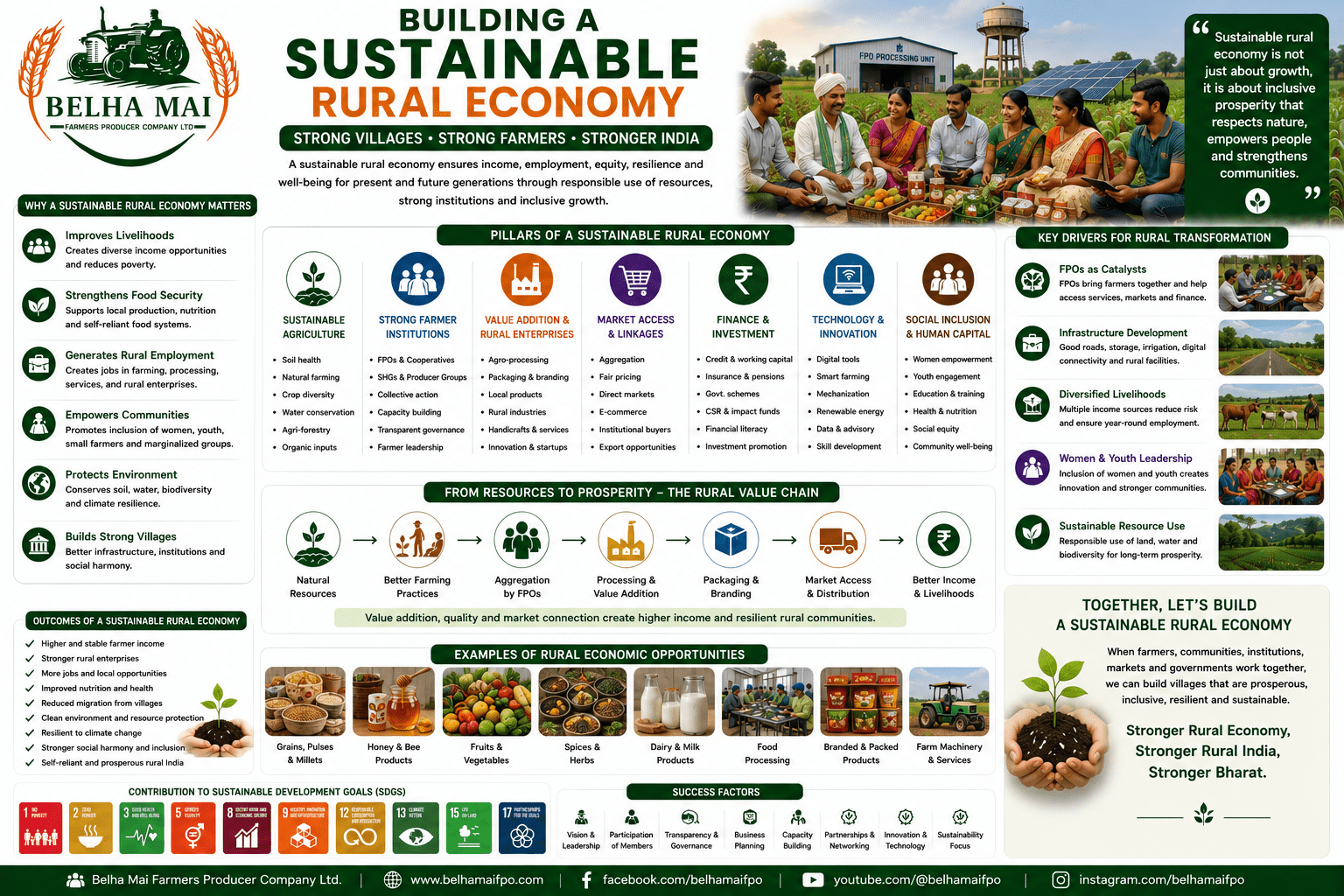
Building a Sustainable Rural Economy is one of the most important goals for rural India. A rural economy becomes sustainable when farmers, women, youth, workers, entrepreneurs, local institutions, and natural resources grow together in a balanced way. It is not only about increasing production; it is about creating stable income, local employment, social inclusion, environmental protection, and long-term village prosperity.
A sustainable rural economy should reduce poverty, strengthen farmer income, create rural enterprises, support women-led livelihoods, involve youth, protect soil and water, improve market access, and build strong grassroots institutions. This kind of economy does not depend only on seasonal crop income. It creates multiple income streams through agriculture, allied activities, processing, services, digital tools, value addition, and partnerships.
Farmer Producer Organizations can play a major role in building a sustainable rural economy. FPOs bring farmers together, reduce costs, improve market linkages, create value addition, support rural employment, promote sustainable agriculture, and connect villages with government, CSR, banks, NGOs, corporates, and buyers.
Building a Sustainable Rural Economy and Why It Matters
Building a Sustainable Rural Economy matters because rural India cannot depend only on raw crop production and seasonal income. Farmers need stable livelihoods, better markets, infrastructure, finance, technology, and enterprise opportunities.
A rural economy becomes weak when farmers sell raw produce at low prices, youth migrate due to lack of jobs, women remain underpaid, natural resources decline, and villages depend heavily on outside markets. A sustainable rural economy solves these gaps by creating local value chains.
When villages produce, process, package, brand, and market their own products, more value remains within the local economy. This creates stronger farmers, stronger families, and stronger rural communities.
Building a Sustainable Rural Economy Through FPOs
FPOs are one of the strongest institutions for building a sustainable rural economy. Individual farmers often lack scale, bargaining power, finance, storage, processing capacity, and direct market access. An FPO helps farmers work collectively.
FPOs can support input services, farm machinery, aggregation, storage, processing, packaging, branding, market linkage, finance access, digital advisory, and value addition. These services help farmers move from scattered farming to organized rural enterprise.
This connects with our previous blog:
👉 Can FPOs Transform Rural India? —https://belhamaifpo.com/sdg-goals/can-fpos-transform-rural-india/
Building a Sustainable Rural Economy Through Farmer Income
Farmer income is the foundation of the rural economy. When farmers earn better income, they spend more on education, health, farm improvement, household needs, local services, and village businesses.
Farmer income improves when production costs reduce, productivity improves, produce is aggregated, markets are stronger, value addition is created, and wastage is reduced. FPOs can support all these areas.
A sustainable rural economy must focus on net income, not only production. Farmers should earn more after reducing cost and improving market realization.
Building a Sustainable Rural Economy Through Value Addition
Value addition is one of the most powerful tools for rural economic growth. Raw produce usually gives limited income, but processed, cleaned, graded, packed, branded, and market-ready products can create higher value.
Value addition can happen in grains, pulses, millets, fruits, vegetables, honey, amla, mango, spices, oilseeds, dairy, and local foods. It creates jobs in processing, packaging, quality control, storage, logistics, marketing, and sales.
This connects with our previous blog:
👉 From Subsistence Farming to Agribusiness —https://belhamaifpo.com/sdg-goals/from-subsistence-farming-to-agribusiness/
Building a Sustainable Rural Economy Through Agro-Processing
Agro-processing helps villages retain more value from farm produce. Instead of sending raw material outside and buying back expensive processed goods, rural communities can create processing units closer to production areas.
Processing units create employment for women, youth, machine operators, packers, quality workers, transporters, and marketing teams. They also reduce post-harvest losses and improve shelf life.
This connects strongly with:
👉 How Agro-Processing Creates Rural Employment — https://belhamaifpo.com/sdg-goals/how-agro-processing-creates-rural-employment/
Building a Sustainable Rural Economy Through Rural Enterprises
A sustainable rural economy needs rural enterprises. These enterprises can include input centers, farm machinery services, nurseries, bio-input units, food processing units, honey processing, amla processing, mango products, millet products, dairy units, poultry, goatery, digital service centers, and rural retail.
Rural enterprises create local jobs and reduce dependence on cities. They help youth and women earn within villages and nearby markets.
FPOs can become platforms for creating and supporting rural enterprises because they already work with farmers and local communities.
Building a Sustainable Rural Economy Through Year-Round Income
Seasonal income is one of the biggest problems in rural areas. Farming families have expenses throughout the year, but crop income often comes only once or twice a year.
A sustainable rural economy creates year-round income through allied activities, processing, storage, machinery services, value addition, livestock, beekeeping, nursery work, bio-inputs, digital services, and market operations.
This connects with:
👉 How FPOs Create Year-Round Income for Farmers —https://belhamaifpo.com/sdg-goals/how-fpos-create-year-round-income-for-farmers/
Building a Sustainable Rural Economy Through Market Linkages
Market linkage is essential for rural prosperity. Farmers and rural enterprises need buyers, fair prices, quality standards, packaging, branding, logistics, and long-term demand.
FPOs can connect farmers with wholesalers, processors, retailers, exporters, institutional buyers, e-commerce platforms, hotels, hospitals, corporate canteens, and direct consumers.
Without market linkage, production and processing cannot create sustainable income. Market access converts rural effort into real economic value.
Building a Sustainable Rural Economy Through Aggregation
Aggregation helps small farmers participate in larger markets. One farmer may have a small quantity, but many farmers together can supply bulk quantities to buyers.
FPOs can aggregate produce, maintain quality, arrange storage, and negotiate better prices. This improves bargaining power and reduces dependence on local traders.
Aggregation is a basic but powerful step in building a sustainable rural economy.
Building a Sustainable Rural Economy Through Storage and Warehousing
Storage helps farmers avoid distress selling immediately after harvest. It also allows FPOs to supply buyers more consistently and manage inventory better.
Warehouses, collection centers, packhouses, cold rooms, and rural storage points can create jobs and reduce wastage. Storage is also important for processing and institutional supply.
A rural economy becomes stronger when it has the infrastructure to hold, manage, and sell produce at the right time.
Building a Sustainable Rural Economy Through Farm Mechanisation
Farm mechanisation improves productivity, reduces labour burden, saves time, and supports timely farming operations. Small farmers often cannot buy expensive machines individually, but FPO-led Farm Machinery Banks can make machines accessible.
Farm machinery services can also create rural jobs for machine operators, mechanics, booking coordinators, and service managers.
This connects with:
👉 Impact of Mechanisation on Farmer Livelihoods —https://belhamaifpo.com/sdg-goals/impact-of-mechanisation-on-farmer-livelihoods/
👉 Farm Machinery Bank —https://belhamaifpo.com/farm-machinery-bank/
Building a Sustainable Rural Economy Through Sustainable Agriculture
A rural economy cannot be sustainable if soil, water, biodiversity, and climate resilience are ignored. Short-term income cannot come at the cost of long-term natural resource damage.
Sustainable agriculture includes soil health, balanced nutrition, water conservation, crop diversification, organic matter, natural farming, agroforestry, biodiversity protection, and responsible input use.
This connects with:
👉 Future of Sustainable Agriculture in India — https://belhamaifpo.com/sdg-goals/future-of-sustainable-agriculture-in-india/
👉 Why FPOs are Key to Sustainable Agriculture — https://belhamaifpo.com/sdg-goals/why-fpos-are-key-to-sustainable-agriculture/
Building a Sustainable Rural Economy Through Soil Health
Healthy soil is the base of a sustainable rural economy. If soil health declines, farmers face lower productivity, higher costs, water stress, and more crop risk.
Soil testing, organic matter improvement, composting, balanced fertilizer use, crop rotation, green manuring, and natural farming practices can restore soil health.
This connects with our soil health blogs:
👉 Soil Health Challenges in Indian Agriculture — https://belhamaifpo.com/sdg-goals/soil-health-challenges-in-indian-agriculture/
👉 Importance of Organic Farming in Soil Restoration —https://belhamaifpo.com/sdg-goals/importance-of-organic-farming-in-soil-restoration/
👉 How Chemical Fertilizers Affect Soil Health — https://belhamaifpo.com/sdg-goals/how-chemical-fertilizers-affect-soil-health/
Building a Sustainable Rural Economy Through Water Conservation
Water conservation is essential for farming, livestock, processing, health, and village life. A rural economy cannot remain sustainable if water resources decline.
Farm ponds, rainwater harvesting, micro-irrigation, mulching, watershed development, drainage improvement, and water-use efficiency can strengthen rural resilience.
FPOs, CSR organizations, NGOs, government departments, and local communities can work together to build water-secure villages.
Building a Sustainable Rural Economy Through Biodiversity Protection
Biodiversity supports soil health, pollination, pest control, nutrition, climate resilience, and ecological balance. A rural economy becomes stronger when farms are diverse and nature-friendly.
Crop diversity, native seeds, agroforestry, pollinator protection, beekeeping, mixed farming, and natural farming can protect biodiversity while supporting livelihoods.
This connects with:
👉 Biodiversity Loss in Agriculture and Solutions —https://belhamaifpo.com/sdg-goals/biodiversity-loss-in-agriculture-and-solutions/
Building a Sustainable Rural Economy Through Natural Farming
Natural farming can support soil biology, reduce input dependency, improve biodiversity, and strengthen farmer self-reliance. It can be especially useful when adopted with proper training, demonstrations, and market linkage.
FPOs can help farmers prepare natural inputs, form farmer groups, create demonstration plots, and connect naturally grown produce with buyers.
This connects with:
👉 Natural Farming Practices in India — https://belhamaifpo.com/sdg-goals/natural-farming-practices-in-india/
Building a Sustainable Rural Economy Through Women Empowerment
Women are central to rural life and agriculture. They contribute to farming, livestock, post-harvest work, food processing, nutrition, household management, and rural livelihoods.
A sustainable rural economy must include women as farmers, workers, entrepreneurs, leaders, and decision-makers. Women-led processing, SHG enterprises, packaging units, dairy, beekeeping, nursery activities, and value addition can create strong local income.
This connects with our women-focused blogs:
👉 Role of Women in Indian Agriculture — https://belhamaifpo.com/sdg-goals/role-of-women-in-indian-agriculture/
👉 How FPOs Empower Women Farmers — https://belhamaifpo.com/sdg-goals/how-fpos-empower-women-farmers/
👉 Gender Equality in Rural India: Challenges and Solutions — https://belhamaifpo.com/sdg-goals/gender-equality-in-rural-india-challenges-and-solutions/
👉 Women-led Farming Models in India — https://belhamaifpo.com/sdg-goals/women-led-farming-models-in-india/
Building a Sustainable Rural Economy Through Youth Participation
Rural youth are essential for the future of villages. They can bring energy, technology, innovation, digital skills, marketing ability, and enterprise thinking.
Youth can work in farm machinery services, digital platforms, e-commerce, logistics, processing units, packaging, branding, quality control, social media, accounting, and agri-business management.
A sustainable rural economy must create opportunities for youth so that migration becomes a choice, not a compulsion.
Building a Sustainable Rural Economy Through Digital Tools
Digital tools can help rural communities access weather updates, market prices, crop advisory, digital payments, e-commerce, government schemes, buyer information, and online training.
FPOs can use digital tools for farmer databases, member communication, order management, inventory records, financial tracking, and market promotion.
Digital inclusion makes rural economies more connected, transparent, and market-ready.
Building a Sustainable Rural Economy Through Finance
Finance is necessary for farming, processing, machinery, storage, packaging, irrigation, livestock, and enterprise development. Without finance, rural economic growth remains slow.
Banks, NABARD, government schemes, CSR programs, microfinance institutions, and FPOs can support rural finance. Financial literacy is also important so farmers and entrepreneurs use credit responsibly.
A sustainable rural economy needs both access to finance and the ability to manage finance properly.
Building a Sustainable Rural Economy Through Local Brands
Local brands help rural products receive identity and value. A farmer-owned brand can communicate quality, origin, sustainability, farmer ownership, and rural impact.
FPOs can build brands for grains, honey, amla products, mango products, millets, pulses, spices, and processed foods. Branding creates value beyond raw commodity selling.
Belha Mai FPO can strengthen rural economic sustainability through brands such as Rajvi Bhog and Belha Bees.
Building a Sustainable Rural Economy Through Institutional Supply
Institutional supply creates regular demand. FPOs and rural enterprises can supply to schools, hospitals, hotels, hostels, corporate canteens, food processors, retailers, and government-linked programs.
Regular orders help farmers and FPOs plan production, processing, packaging, and logistics. This creates stable income and rural jobs.
Institutional supply is one of the practical routes to building rural enterprise systems.
Building a Sustainable Rural Economy Through Export Readiness
Export readiness can create higher-value opportunities for some FPOs and rural enterprises. It requires quality standards, testing, packaging, documentation, traceability, food safety, and consistent supply.
Not every rural enterprise will export immediately, but export-oriented thinking improves quality, discipline, and market readiness.
FPOs can gradually build export readiness through partnerships, training, and proper infrastructure.
Building a Sustainable Rural Economy Through Renewable Energy
Renewable energy can reduce costs and support rural enterprises. Solar pumps, solar dryers, solar cold rooms, renewable-powered processing units, and clean energy systems can improve sustainability.
Renewable energy can also support irrigation, storage, drying, and processing in villages where power supply is unreliable.
Clean energy links rural development with climate action and enterprise growth.
Building a Sustainable Rural Economy Through Education and Skill Development
Education and skill development are essential for long-term rural transformation. Farmers, women, youth, workers, and FPO staff need skills in agriculture, processing, packaging, finance, digital tools, machinery, marketing, and enterprise management.
Skill development should be practical and market-linked. Training must create income opportunities.
A skilled rural population can build stronger businesses, better farms, and more resilient communities.
Building a Sustainable Rural Economy Through Health and Nutrition
A rural economy cannot be sustainable if communities are unhealthy. Health, nutrition, safe drinking water, sanitation, and food diversity are important for productivity and quality of life.
Agriculture can support nutrition through pulses, millets, vegetables, fruits, dairy, poultry, honey, kitchen gardens, and diversified farming.
Women-led nutrition gardens and local food systems can improve both health and livelihoods.
Building a Sustainable Rural Economy Through Partnerships
Partnerships are necessary because rural development needs many strengths. Government brings schemes, CSR brings resources, NGOs bring community mobilization, banks bring finance, corporates bring markets, research institutions bring knowledge, and FPOs bring farmer participation.
This connects with our partnership blogs:
👉 Why Partnerships Are Important in Rural Development —https://belhamaifpo.com/sdg-goals/why-partnerships-are-important-in-rural-development/
👉 Role of Corporates in Agriculture Development — https://belhamaifpo.com/sdg-goals/role-of-corporates-in-agriculture-development/
👉 How CSR Can Support FPOs — https://belhamaifpo.com/sdg-goals/how-csr-can-support-fpos/
👉 Public-Private Partnerships in Agriculture — https://belhamaifpo.com/sdg-goals/public-private-partnerships-in-agriculture/
👉 How NGOs Contribute to Rural Transformation —https://belhamaifpo.com/sdg-goals/how-ngos-contribute-to-rural-transformation/
Building a Sustainable Rural Economy Through Social Inclusion
A sustainable rural economy must include small farmers, marginal farmers, landless workers, women, youth, elderly people, and vulnerable communities. Development must not benefit only a few.
FPOs, SHGs, cooperatives, NGOs, and community institutions can help ensure participation and inclusion. Women and youth must be given leadership roles and income opportunities.
Inclusive growth creates stronger communities and reduces social inequality.
Building a Sustainable Rural Economy Through Strong Governance
Strong governance is essential for FPOs, SHGs, cooperatives, and rural enterprises. Transparent records, regular meetings, audits, member communication, financial discipline, and accountability build trust.
Without governance, rural institutions may become weak or inactive. With good governance, they can manage finance, projects, buyers, and member services more effectively.
Good governance is the backbone of sustainable rural development.
Building a Sustainable Rural Economy and SDGs
Building a sustainable rural economy supports many Sustainable Development Goals. It supports SDG 1 No Poverty, SDG 2 Zero Hunger, SDG 3 Good Health, SDG 5 Gender Equality, SDG 6 Clean Water, SDG 8 Decent Work, SDG 9 Industry and Innovation, SDG 12 Responsible Production, SDG 13 Climate Action, SDG 15 Life on Land, and SDG 17 Partnerships.
A sustainable rural economy connects income, environment, equality, food security, health, employment, and partnerships.
This makes rural economic development central to India’s SDG journey.
Belha Mai FPO and Sustainable Rural Economy
Belha Mai Farmers Producer Company Ltd. is working to support farmers through input services, farm machinery, market linkage, value addition, digital outreach, women participation, soil health, sustainable agriculture, and rural development.
Belha Mai FPO can contribute to building a sustainable rural economy by helping farmers move from raw produce selling to value-added products, from seasonal income to year-round income, and from individual struggle to collective enterprise.
For Belha Mai FPO, a sustainable rural economy means stronger farmers, empowered women, skilled youth, rural enterprises, healthy soil, better markets, and long-term village prosperity.
Challenges in Building a Sustainable Rural Economy
Building a sustainable rural economy is not easy. Challenges include weak infrastructure, lack of finance, low market access, climate risk, poor storage, limited processing, low digital literacy, weak institutions, and migration of rural youth.
Farmers may also face rising input costs, soil degradation, water scarcity, and uncertain prices. FPOs may struggle with working capital and professional management.
These challenges require long-term planning, partnerships, capacity building, infrastructure, finance, and market-led rural enterprise development.
Roadmap for Building a Sustainable Rural Economy
The roadmap begins with strong farmer institutions. FPOs, SHGs, cooperatives, and producer groups must be strengthened through governance, training, finance, and member participation.
The next step is sustainable agriculture, aggregation, storage, processing, value addition, branding, and market linkage. Women and youth must be included in every stage.
Finally, partnerships with government, CSR, NGOs, banks, corporates, buyers, and research institutions must be developed to scale impact and create long-term sustainability.
Why a Sustainable Rural Economy Matters for India
India’s future depends on strong villages. If rural areas remain weak, migration, poverty, food insecurity, and social stress will increase. If rural economies become strong, the entire country benefits.
A sustainable rural economy creates local jobs, improves farmer income, protects natural resources, empowers women, engages youth, and strengthens national food systems.
Building sustainable rural economies is not only a rural agenda. It is a national development priority.
Conclusion
Building a Sustainable Rural Economy means creating villages where farmers earn better, women lead enterprises, youth find opportunities, natural resources are protected, and local institutions become strong. It requires sustainable agriculture, value addition, rural enterprises, finance, technology, market linkage, social inclusion, and partnerships.
FPOs can become powerful platforms for this transformation because they connect farmers with services, markets, infrastructure, and collective strength.
For Belha Mai Farmers Producer Company Ltd., building a sustainable rural economy represents a practical path toward stronger farmers, stronger villages, sustainable agriculture, and a prosperous rural India.
FAQ
What does Building a Sustainable Rural Economy mean?
Building a sustainable rural economy means creating a rural system that improves farmer income, creates local jobs, supports rural enterprises, empowers women and youth, protects natural resources, and builds long-term village prosperity.
Why is a sustainable rural economy important?
A sustainable rural economy is important because it reduces poverty, improves livelihoods, creates employment, protects soil and water, reduces migration, strengthens food security, and supports inclusive rural development.
How can FPOs build a sustainable rural economy?
FPOs can build a sustainable rural economy through input services, aggregation, storage, processing, value addition, farm machinery, market linkage, finance access, women empowerment, youth participation, and sustainable agriculture.
How does value addition support rural economy?
Value addition supports the rural economy by converting raw produce into higher-value products through processing, packaging, branding, quality control, and marketing, which creates more income and local employment.
What role do women play in a sustainable rural economy?
Women play a major role through farming, livestock, food processing, packaging, SHG enterprises, value addition, nutrition, leadership, and rural entrepreneurship.
How can Belha Mai FPO support a sustainable rural economy?
Belha Mai FPO can support a sustainable rural economy through farmer services, farm machinery, market linkage, value addition, agro-processing, women empowerment, youth engagement, soil health, sustainable agriculture, and partnerships.
Internal Links Section
👉 SDG Goals — https://belhamaifpo.com/sdg-goals/
👉 Farmer Producer Organizations Complete Guide — https://belhamaifpo.com/farmer-producer-organisation/farmer-producer-organizations-fpos/
👉 From Subsistence Farming to Agribusiness — https://belhamaifpo.com/sdg-goals/from-subsistence-farming-to-agribusiness/
👉 Can FPOs Transform Rural India? — https://belhamaifpo.com/sdg-goals/can-fpos-transform-rural-india/
👉 Future of Sustainable Agriculture in India — https://belhamaifpo.com/sdg-goals/future-of-sustainable-agriculture-in-india/
👉 How FPOs Create Year-Round Income for Farmers —https://belhamaifpo.com/sdg-goals/how-fpos-create-year-round-income-for-farmers/
👉 How Agro-Processing Creates Rural Employment — https://belhamaifpo.com/sdg-goals/how-agro-processing-creates-rural-employment/
👉 Impact of Mechanisation on Farmer Livelihoods —https://belhamaifpo.com/sdg-goals/impact-of-mechanisation-on-farmer-livelihoods/
👉 Role of Collective Farming in Increasing Farmer Income — https://belhamaifpo.com/sdg-goals/role-of-collective-farming-in-increasing-farmer-income/
👉 Soil Health Challenges in Indian Agriculture —https://belhamaifpo.com/sdg-goals/soil-health-challenges-in-indian-agriculture/
👉 Natural Farming Practices in India — https://belhamaifpo.com/sdg-goals/natural-farming-practices-in-india/
👉 Biodiversity Loss in Agriculture and Solutions —https://belhamaifpo.com/sdg-goals/biodiversity-loss-in-agriculture-and-solutions/
👉 Role of Women in Indian Agriculture —https://belhamaifpo.com/sdg-goals/role-of-women-in-indian-agriculture/
👉 Public-Private Partnerships in Agriculture — https://belhamaifpo.com/sdg-goals/public-private-partnerships-in-agriculture/
👉 How NGOs Contribute to Rural Transformation —https://belhamaifpo.com/sdg-goals/how-ngos-contribute-to-rural-transformation/
👉 Farm Machinery Bank —https://belhamaifpo.com/farm-machinery-bank/
👉 Rajvi Bhog Food Products: Complete Guide —https://belhamaifpo.com/agriculture/rajvi-bhog-food-products-quality-export-guide/
👉 Honey Processing in India: Complete Guide — https://belhamaifpo.com/agriculture/honey-processing-in-india-complete-guide/
👉 Belha Mai FPO — https://belhamaifpo.com/
External Authority Links
👉 United Nations Sustainable Development Goals — https://sdgs.un.org/goals
👉 SDG 8: Decent Work and Economic Growth — https://sdgs.un.org/goals/goal8
👉 SDG 12: Responsible Consumption and Production — https://sdgs.un.org/goals/goal12
👉 Ministry of Rural Development — https://rural.gov.in/
👉 Ministry of Agriculture and Farmers Welfare — https://agriwelfare.gov.in/
👉 Small Farmers’ Agribusiness Consortium — https://sfacindia.com/
👉 National Bank for Agriculture and Rural Development — https://www.nabard.org/
👉 Ministry of Food Processing Industries — https://www.mofpi.gov.in/
👉 NITI Aayog SDG India Index —https://www.niti.gov.in/sdg-india-index
Follow Belha Mai FPO for More Updates
Website: https://belhamaifpo.com/
Facebook:https://www.facebook.com/profile.php?id=61561043486818
YouTube: https://www.youtube.com/channel/UC9ZvojoTMCa7mU1-Q_Bh60A
LinkedIn: https://www.linkedin.com/in/abhay-singh-ab5568280/
Instagram:https://instagram.com/belhamaifpo
Belha Mai Farmers Producer Company Ltd. supports farmers through better information, technology, market linkage, value addition, FPO awareness, rural development, women empowerment, soil health, rural enterprise development, and sustainable agriculture.