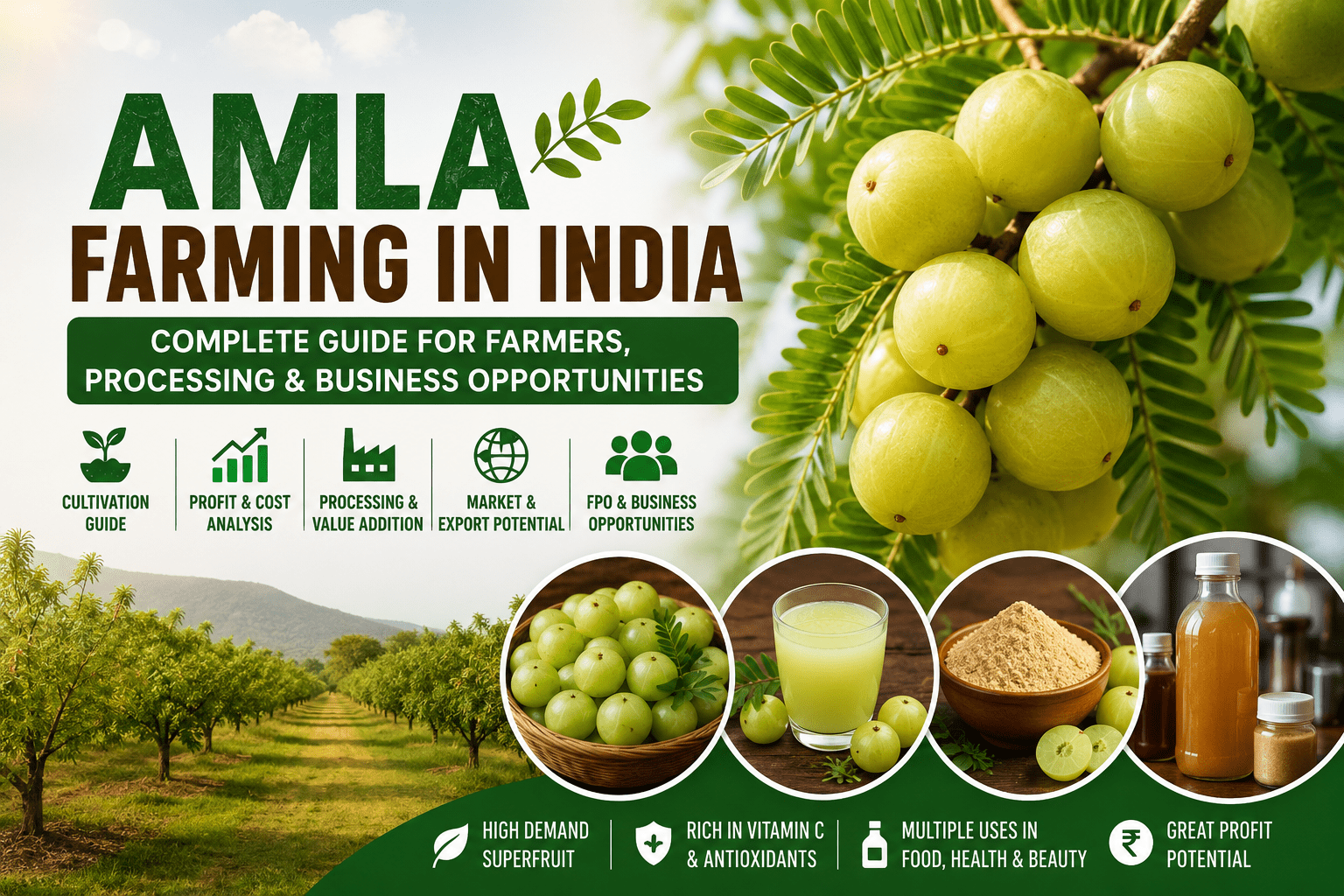

Introduction
Amla farming in India has become one of the most promising opportunities for farmers, Farmer Producer Organizations, and agribusiness entrepreneurs. Amla, also known as Indian gooseberry, is a highly valuable fruit crop because of its nutritional, medicinal, and commercial importance. It has been used in traditional Indian health systems for centuries and continues to remain popular in modern food, wellness, and herbal product industries.
The demand for amla is increasing because it is used in many products such as amla juice, amla powder, candy, murabba, pickle, chyawanprash, herbal supplements, hair oils, and cosmetic products. This makes amla not only a farming crop but also a strong business opportunity. Farmers who grow amla can earn from fresh fruit sales, while entrepreneurs and FPOs can generate additional income through processing, branding, packaging, and direct marketing.
Amla is especially useful for Indian farmers because it is a hardy crop. It can tolerate dry conditions better than many other fruit crops and can be grown in different agro-climatic regions. Once established, an amla orchard can remain productive for many years, making it suitable for long-term income generation. For farmers in semi-arid and rainfed regions, amla cultivation can become a sustainable and profitable option when proper orchard management is followed.
Another major advantage of amla farming is its strong connection with value addition. Unlike some crops that must be sold immediately after harvest, amla can be processed into multiple products with longer shelf life and higher market value. This opens opportunities for small processing units, women-led enterprises, rural startups, and Farmer Producer Organizations.
Government focus on horticulture development also supports crops like amla through schemes related to plantation, post-harvest management, processing, and market infrastructure. The Mission for Integrated Development of Horticulture supports holistic growth of horticulture crops, including fruits, through area expansion, post-harvest management, and capacity building.
In this complete guide, we will understand amla farming in India from farm to market. We will cover climate, soil, varieties, plantation cost, profit potential, harvesting, storage, processing, value-added products, market demand, export opportunities, government support, and the role of FPOs in building a strong amla value chain.
What is Amla?
Amla is a small greenish-yellow fruit known for its sour and astringent taste. It is commonly called Indian gooseberry and is botanically known as Phyllanthus emblica. The fruit is valued for its high antioxidant content and its wide use in food, herbal, wellness, and cosmetic industries. Research literature also identifies amla as a fruit rich in bioactive compounds, which is one reason behind its popularity in nutraceutical and functional food products.
In India, amla is consumed in different forms. Some people consume it fresh, while many prefer processed products such as juice, powder, candy, chutney, pickle, and murabba. It is also an important ingredient in many Ayurvedic formulations. Because of this wide usage, amla has demand across both rural and urban markets.
For farmers, amla is important because it is not limited to one type of buyer. Fresh fruit traders, processing units, Ayurvedic companies, herbal product manufacturers, juice makers, and exporters can all become potential buyers. This creates multiple market channels and reduces dependence on only one selling option.
From a business point of view, amla is a strong crop because it supports both raw fruit marketing and value addition. A farmer may sell fresh amla directly in the local market, while an FPO may collect produce from multiple farmers, grade it, process it, and sell branded products at a higher price. This is where amla farming becomes more than agriculture—it becomes an agribusiness opportunity.
Importance of Amla Farming in India
Amla farming in India is important because it connects agriculture, health, processing, and rural business development. In recent years, people have become more aware of immunity, natural health products, and chemical-free food options. This has increased interest in fruits like amla that are traditionally associated with wellness.
For farmers, amla offers a long-term orchard-based income model. Unlike seasonal vegetables or short-duration crops, amla trees can continue producing fruits for many years after establishment. This makes it suitable for farmers who want a stable horticulture crop with growing market demand.
Amla also supports rural employment. Activities such as nursery raising, plantation, pruning, harvesting, grading, sorting, processing, packaging, and marketing create work opportunities at different stages of the value chain. This is especially useful for rural youth, women’s groups, and Farmer Producer Organizations.
Another important factor is processing potential. Amla can be converted into several value-added products. When farmers sell raw amla, they receive only the market price of fresh fruit. But when the same amla is processed into juice, powder, candy, or herbal products, its value increases. This helps improve profitability and reduces wastage.
Amla farming also fits well with FPO-based models. An individual farmer may not have enough quantity to supply large buyers or processors. But when an FPO aggregates amla from multiple farmers, it can negotiate better prices, invest in processing units, create a brand, and enter larger markets.
This is why amla farming should not be seen only as fruit cultivation. It should be seen as a complete value chain opportunity involving production, post-harvest handling, processing, branding, and market linkages.
Scope of Amla Farming and Business Opportunities
The scope of amla farming in India is expanding because demand is coming from different sectors. Fresh fruit markets require amla for direct consumption and household use. Food processing units require it for juice, candy, pickle, and murabba. Ayurvedic and herbal companies require amla for formulations. Cosmetic and personal care industries use amla in hair oils, shampoos, and skincare products.
This wide demand creates several business opportunities. A farmer can start with cultivation. An entrepreneur can start a small amla processing unit. An FPO can build a complete value chain from aggregation to branding. A rural startup can sell packaged amla products online. Exporters can explore international demand for fresh and processed amla products through proper compliance and quality standards.
Export opportunities are also linked with institutions such as APEDA, which works for agricultural and processed food exports from India. APEDA’s trade platform supports agri-business connections and export information for agricultural products.
However, success in amla farming and business depends on planning. Farmers must select suitable varieties, manage orchards properly, harvest at the right stage, and reduce post-harvest losses. Businesses must focus on quality, food safety, packaging, branding, and market linkages. FPOs must ensure aggregation, grading, farmer training, and transparent systems.
The biggest opportunity in amla lies in value addition. Selling raw fruit gives limited margins, but branded products can create better income. For example, amla juice, amla powder, amla candy, and amla-based health products can reach urban consumers, health-conscious buyers, and online markets.
This makes amla one of the most promising crops for farmers who want to move from basic cultivation to agribusiness.
Why Amla is Suitable for Farmers and FPOs
Amla is suitable for farmers because it is a hardy fruit crop with long-term productivity. It can tolerate difficult conditions better than many sensitive fruit crops, and once the orchard is established, it can provide regular harvests for many years. This makes it attractive for farmers looking for a durable horticulture option.
For FPOs, amla is even more powerful because it offers collective business possibilities. An FPO can organize farmers, promote quality planting material, provide technical guidance, aggregate produce, and connect with buyers. It can also enter processing and branding, which is where real growth begins.
For example, if members of an FPO grow amla, the organization can create a focused business model around amla products instead of randomly trading unrelated crops. It can produce branded amla juice, powder, candy, or murabba under its own label. This gives the FPO identity and helps build customer trust.
Amla also reduces the risk of dependency on one market. If fresh fruit prices are low, the produce can be diverted toward processing. If processing capacity is available, the FPO can store value in product form rather than selling immediately at low rates. This improves bargaining power and helps farmers receive better value.
The future of amla farming will belong to those farmers and FPOs who think beyond cultivation. The real opportunity is in building a complete system: quality production, aggregation, processing, branding, and direct market access.
Climate & Soil Requirements for Amla Cultivation
Amla is considered one of the most adaptable fruit crops in India because it can survive and perform well under different climatic conditions. This is one of the major reasons why amla farming is becoming popular among farmers in semi-arid and rainfed regions. Compared to many sensitive fruit crops, amla trees are hardy in nature and can tolerate drought conditions after proper establishment. However, for obtaining good fruit quality and higher yield, selecting the right climate and soil conditions remains extremely important.
India provides highly suitable conditions for amla cultivation, especially in states such as Uttar Pradesh, Madhya Pradesh, Rajasthan, Gujarat, Maharashtra, Chhattisgarh, Bihar, and parts of South India. The crop is widely cultivated in both traditional orchards and modern horticulture plantations because of its low maintenance requirements and long productive life.
Amla performs best in tropical and subtropical climatic regions. The ideal temperature range for healthy growth and fruit development is generally between 20°C to 38°C. Mature amla trees can tolerate high temperatures during summer, while young plants require some protection during extreme weather conditions. In many parts of India, the crop survives temperatures above 45°C once fully established. This makes it suitable for dryland horticulture systems.
Rainfall also plays an important role in amla cultivation. Moderate rainfall is considered beneficial for healthy orchard development. However, waterlogging is harmful to amla plants and can damage root systems. Farmers must ensure proper drainage in orchards, especially during the monsoon season. In rainfed areas, supplementary irrigation during initial years improves plant establishment and growth.
One of the major advantages of amla farming is that it can be cultivated in relatively poor soils where other commercial fruit crops may struggle. Still, for commercial production and better profitability, selecting proper soil conditions is necessary. Amla grows best in light to medium loamy soils with good drainage and adequate organic matter. Sandy loam soils are also considered suitable when irrigation facilities are available.
The ideal soil pH for amla cultivation ranges between 6.5 and 8.0. Interestingly, amla can tolerate slightly alkaline soils better than many fruit crops, which makes it useful for farmers in regions with moderate soil limitations. However, highly saline or waterlogged soils should be avoided because they negatively affect root growth and fruit productivity.
Before establishing an amla orchard, soil testing should always be conducted. Soil testing helps farmers understand nutrient status, pH level, organic carbon content, and micronutrient availability. This allows proper fertilizer planning and helps avoid long-term productivity issues. Farmer Producer Organizations can play an important role here by organizing collective soil testing services for member farmers.
Land preparation is another important factor for successful amla farming. The field should be cleaned properly before plantation. Deep ploughing and leveling improve root penetration and water management. In areas with poor drainage, raised beds or proper drainage channels should be created to prevent water stagnation during heavy rainfall.
Amla plants also require adequate sunlight for proper flowering and fruiting. Orchards should therefore be established in open areas with sufficient sunlight exposure. Shaded areas reduce productivity and may affect fruit quality over time.
For farmers interested in organic or low-input farming systems, amla can become a suitable crop because it generally requires fewer chemical interventions compared to some highly sensitive horticulture crops. Proper farmyard manure application, mulching, organic nutrient management, and water conservation practices can improve long-term orchard health and sustainability.
Climate resilience is another important reason why amla farming is gaining attention in India. With increasing uncertainty in rainfall patterns and rising temperatures due to climate change, many farmers are looking for crops that can survive under stress conditions. Amla’s drought tolerance and adaptability make it a comparatively stable option for long-term horticulture planning.
In recent years, many government horticulture programs have also encouraged fruit crop diversification, including amla plantation, under various horticulture missions. These programs support orchard development, irrigation infrastructure, and post-harvest management, helping farmers shift toward high-value horticulture crops.
Selecting the right climate and soil conditions at the beginning is one of the most critical decisions in amla farming. A well-planned orchard established under suitable agro-climatic conditions can remain productive for decades and become a stable source of income through fresh fruit sales, processing, and value-added business opportunities.
Popular Varieties of Amla in India
Selection of the right variety is one of the most important decisions in amla farming because it directly affects yield, fruit quality, processing suitability, disease tolerance, and market demand. Different varieties of amla are cultivated across India depending on climatic conditions, soil type, processing requirements, and commercial objectives. Some varieties are preferred for fresh consumption, while others are ideal for juice, candy, powder, pickle, murabba, and Ayurvedic processing industries.
Farmers should always select varieties based on local climate, market demand, and business purpose. For example, if the objective is supplying processing industries, varieties with high pulp content and larger fruit size may provide better returns. On the other hand, if farmers are targeting fresh fruit markets, appearance, taste, and shelf life become more important.
India has developed several improved amla varieties through agricultural research institutions and horticulture programs. These varieties offer better yield, improved fruit quality, and adaptability under different agro-climatic conditions. Proper variety selection can significantly improve orchard productivity and long-term profitability.
One of the most popular commercial varieties is NA-7. This variety is widely cultivated because of its large fruit size, good pulp content, and high productivity. NA-7 fruits are suitable for processing industries and are commonly used for juice, candy, murabba, and powder manufacturing. Farmers prefer this variety because it produces comparatively uniform fruits with strong commercial value.
Another important variety is NA-6, which is known for regular bearing and good fruit quality. It is suitable for both fresh consumption and processing. The fruits are medium to large in size and contain a good amount of Vitamin C. Many farmers cultivate NA-6 in commercial orchards because of its balanced productivity and market acceptability.
Chakaiya is one of the traditional and highly popular amla varieties in India. It is widely cultivated because of its excellent keeping quality and high processing suitability. The fruits are comparatively smaller but highly fibrous and rich in Vitamin C. Chakaiya variety is extensively used in processing industries for making candy, murabba, powder, and Ayurvedic products. This variety is also known for its regular bearing habit and comparatively stable yield.
Banarasi is another famous variety of amla. It produces large-sized fruits and is often preferred for table purposes and processing. However, Banarasi may show irregular bearing in some conditions, which is why proper orchard management becomes important. The fruit quality is considered good, and the variety is valued for its commercial appearance.
Krishna variety is known for producing medium-sized fruits with good quality and high Vitamin C content. It performs well under suitable climatic conditions and is preferred by many farmers for commercial cultivation. The fruits are suitable for both processing and fresh markets.
Kanchan is another important variety developed for improved productivity and better fruit quality. It produces attractive fruits with comparatively lower fiber content, making it suitable for processing applications. The variety is gaining popularity among farmers interested in commercial horticulture.
Apart from these major varieties, several local and regional varieties are also cultivated in different parts of India depending on traditional practices and local adaptability. Some farmers continue cultivating local selections because they are well adapted to specific agro-climatic conditions and may require lower management inputs.
For Farmer Producer Organizations and agribusiness entrepreneurs, selecting the right variety is even more important because it influences processing quality and branding opportunities. For example, varieties with higher pulp recovery and lower fiber content are more suitable for juice manufacturing. Similarly, varieties with strong shelf life and attractive appearance are preferred for fresh fruit marketing.
Variety selection also affects harvest timing. Some varieties mature earlier, while others mature later. By planting multiple varieties with slightly different harvesting periods, farmers and FPOs can extend market availability and reduce sudden supply pressure.
Disease resistance and climate adaptability should also be considered during variety selection. In regions with water stress or harsh climatic conditions, farmers should prefer hardy and locally adapted varieties to reduce production risk.
Quality planting material is equally important. Farmers should always purchase grafted plants from reliable nurseries, horticulture departments, or certified institutions. Poor-quality planting material can affect orchard productivity for many years because amla is a long-duration crop. Farmer Producer Organizations can support member farmers by collectively arranging certified planting material and technical guidance.
Modern amla farming is no longer limited to traditional orchard practices. Today, variety selection is directly linked with business strategy. Farmers growing amla for fresh markets may choose different varieties compared to entrepreneurs targeting processing industries. Similarly, exporters may prefer varieties suitable for grading, storage, and transportation.
As demand for amla-based products continues to grow in India and international markets, selecting commercially suitable varieties will become even more important for long-term profitability and value chain development.
Amla Plantation Cost & Profit Analysis
Amla farming is increasingly being considered a long-term horticulture investment because of its comparatively low maintenance cost, long productive life, and strong market demand. Unlike short-duration crops that require cultivation every season, an amla orchard can continue producing fruits for several decades when managed properly. This makes amla farming suitable for farmers looking for stable and sustainable income opportunities.
Before starting commercial amla cultivation, farmers must understand plantation costs, recurring expenses, expected yield, and profit potential. Proper financial planning is extremely important because orchard-based farming requires patience during the initial establishment years. However, once production stabilizes, the orchard can generate consistent returns through fresh fruit sales and value-added processing opportunities.
The initial plantation cost in amla farming depends on several factors such as land preparation, planting material, irrigation system, labor charges, fencing, nutrient management, and plant density. Farmers using high-quality grafted plants and modern irrigation systems may have slightly higher establishment costs initially, but these investments generally improve survival rate, productivity, and long-term profitability.
One of the major expenses in amla plantation is land preparation. Proper field cleaning, deep ploughing, leveling, and pit digging are essential for healthy root establishment. Pits are usually prepared with a mixture of soil, farmyard manure, and organic inputs to improve initial plant growth.
The cost of planting material also plays an important role. Farmers should always prefer grafted plants from certified nurseries because high-quality planting material improves orchard performance and fruit quality. Cheap or unverified plants may reduce productivity and create long-term problems.
Irrigation infrastructure is another important investment. Although mature amla trees are drought tolerant, young plants require regular irrigation during initial years. Many farmers now prefer drip irrigation systems because they improve water efficiency and reduce labor requirements. Drip systems also support fertigation, which helps in efficient nutrient application.
Labor costs include plantation activities, irrigation management, pruning, weeding, fertilizer application, pest management, harvesting, and post-harvest handling. During early years, labor expenses are comparatively moderate, but proper orchard care remains necessary for healthy tree development.
The cost structure of amla farming varies across regions and farming systems. Farmers using organic farming methods may have different input costs compared to conventional farming systems. Similarly, orchards established with integrated farming models may generate additional income through intercrops during the early non-bearing years.
One of the biggest advantages of amla farming is that intercropping can be practiced during the initial years before the trees attain full canopy growth. Farmers often cultivate vegetables, pulses, medicinal plants, or short-duration crops between plant rows. This helps generate additional income and reduces financial pressure during orchard establishment years.
Amla trees generally start commercial fruiting after a few years depending on the variety, management practices, and planting material quality. Yield gradually increases as the orchard matures. Well-managed orchards can produce substantial quantities of fruit per acre, especially when proper irrigation, nutrient management, pruning, and pest management practices are followed.
Profitability in amla farming depends not only on yield but also on market strategy. Farmers selling fresh fruit in local mandis may receive lower margins compared to those connected with processors, FPOs, herbal companies, or direct buyers. This is why aggregation and market linkages become important.
The real income potential of amla farming increases significantly when value addition is introduced. Fresh amla can be processed into juice, powder, candy, pickle, murabba, and herbal products with much higher market value. Farmer Producer Organizations can play a major role here by collectively establishing small processing units and developing local brands.
Market demand for amla products is growing because consumers are increasingly interested in natural and immunity-supporting food products. This creates opportunities not only for farmers but also for processors, packaging units, rural entrepreneurs, and export-oriented businesses.
Another important factor in profitability is orchard longevity. Unlike seasonal crops that require repeated investment every year, an amla orchard remains productive for many years once properly established. This reduces repeated plantation expenses and supports long-term income generation.
Government support schemes for horticulture development may also reduce the financial burden during orchard establishment. Various horticulture missions and subsidy programs support plantation, irrigation systems, post-harvest infrastructure, and processing activities for fruit crops. Farmers and FPOs should actively explore these schemes to reduce investment risk.
For small farmers, amla farming becomes even more beneficial when integrated with Farmer Producer Organizations. FPOs can support farmers through collective procurement of planting material, technical training, aggregation, grading, processing, branding, and market linkage development. This helps improve bargaining power and reduces dependency on middlemen.
From an agribusiness perspective, amla farming should not be viewed only as fruit production. It should be considered a complete value chain opportunity involving cultivation, processing, packaging, branding, and direct market access. Farmers who combine production with value addition generally achieve better profitability compared to those selling only raw fruits.
As awareness about health, herbal products, and natural nutrition continues to increase, the commercial importance of amla is expected to grow further. This makes amla farming a promising long-term opportunity for farmers, entrepreneurs, and Farmer Producer Organizations across India.
Amla Cultivation & Farm Management Practices
Successful amla farming depends not only on selecting suitable varieties and climate conditions but also on adopting proper cultivation and orchard management practices. Scientific farm management helps improve plant growth, fruit quality, productivity, and orchard longevity. Since amla is a long-duration fruit crop, farmers must focus on establishing a healthy orchard during the early years to ensure stable production in the future.
Proper planning before plantation is extremely important. Farmers should first select suitable land with good drainage and adequate sunlight exposure. Amla orchards perform best in open fields where plants receive sufficient sunlight throughout the day. Poor drainage and waterlogging should always be avoided because they damage the root system and affect overall orchard health.
Land Preparation and Pit Digging
The field should be cleaned thoroughly before plantation. Deep ploughing improves soil aeration and helps root penetration. After leveling, pits are prepared for planting grafted amla saplings. Farmers usually fill these pits with a mixture of topsoil, farmyard manure, compost, and organic nutrients to improve soil fertility during initial growth stages.
Proper pit preparation plays an important role in plant establishment because it supports healthy root development and moisture retention. In areas with poor soil quality, adding organic matter improves long-term orchard sustainability.
Planting and Spacing
Amla is generally planted using grafted plants because they provide better fruit quality and earlier production compared to seed-grown plants. Farmers should always purchase healthy planting material from certified nurseries or horticulture departments.
Spacing depends on variety, soil fertility, and management system. Proper spacing is important because overcrowding reduces sunlight penetration and air circulation, which can affect productivity and increase disease risk. Wider spacing also helps in orchard operations such as irrigation, pruning, harvesting, and intercultural activities.
Many commercial orchards follow systematic row planting to support mechanization and efficient orchard management. Farmer Producer Organizations can help member farmers adopt scientific planting systems and improve orchard productivity.
Irrigation Management
Although mature amla trees are comparatively drought tolerant, young plants require regular irrigation during establishment years. Proper irrigation management is essential for healthy vegetative growth, flowering, fruit development, and yield stability.
Drip irrigation is increasingly preferred in commercial amla orchards because it improves water-use efficiency and reduces wastage. Drip systems also help in fertigation, where nutrients are supplied directly through irrigation water. This improves nutrient absorption and reduces labor costs.
During summer months and dry periods, irrigation should be managed carefully to avoid moisture stress. However, excessive irrigation and waterlogging should be avoided because they negatively affect root health.
Mulching around plants helps conserve soil moisture, suppress weeds, and improve soil health. Organic mulching materials such as straw, dry leaves, and farm residues are commonly used in sustainable orchard systems.
Nutrient Management
Balanced nutrient management is extremely important for long-term orchard productivity. Farmers should regularly apply organic manure and recommended fertilizers based on soil testing results. Farmyard manure improves soil structure, microbial activity, and moisture retention capacity.
Micronutrient management is also important because deficiencies can affect fruit development and overall tree health. Soil testing helps farmers understand nutrient deficiencies and apply corrective measures accordingly.
Many farmers are now adopting integrated nutrient management systems that combine organic inputs, biofertilizers, compost, and limited chemical fertilizers. This improves soil sustainability and reduces long-term dependency on synthetic inputs.
Farmer Producer Organizations can support farmers through collective soil testing programs, fertilizer planning, and awareness training related to nutrient management.
Weed Management
Weed control is necessary during the early years of orchard establishment because weeds compete for nutrients, moisture, and sunlight. Regular weeding and intercultural operations help maintain healthy orchard conditions.
Mulching and cover cropping are increasingly used as sustainable weed management practices. In some regions, farmers also grow intercrops between plant rows during the initial years to utilize vacant space and generate additional income.
Pruning and Canopy Management
Pruning is another important practice in amla cultivation. Proper pruning helps maintain tree shape, improves sunlight penetration, and promotes healthy branching. Removal of dead, diseased, or overcrowded branches improves air circulation and reduces disease incidence.
Scientific canopy management also improves fruit quality and harvesting efficiency. Farmers should regularly monitor tree growth and remove unwanted shoots during orchard development stages.
Pest and Disease Management
Compared to many fruit crops, amla is considered relatively hardy. However, pest and disease management still remains important for maintaining commercial productivity. Common issues may include insect pests, bark damage, fruit infections, and fungal diseases under certain climatic conditions.
Integrated Pest Management (IPM) practices are increasingly recommended for sustainable amla farming. These practices include orchard sanitation, monitoring, biological control methods, neem-based products, and limited use of recommended pesticides only when necessary.
Excessive chemical use should be avoided because growing consumer demand now favors safer and residue-free horticulture products. Organic and low-residue farming practices can also improve market opportunities for premium buyers and export markets.
Intercropping Opportunities
One of the major advantages of amla orchards is the possibility of intercropping during the early years before full canopy development. Farmers often cultivate vegetables, pulses, medicinal plants, or short-duration crops between rows to generate additional income.
Intercropping improves land utilization and helps farmers manage financial pressure during the non-bearing period of the orchard. However, crop selection should be done carefully to avoid competition for nutrients and moisture.
Importance of Scientific Orchard Management
Modern amla farming requires more than traditional cultivation methods. Farmers who adopt scientific orchard management practices generally achieve better productivity, improved fruit quality, and higher profitability. Regular field monitoring, irrigation planning, nutrient management, pruning, and market-oriented production strategies are essential for commercial success.
Farmer Producer Organizations can significantly improve cultivation standards by organizing farmer training programs, technical demonstrations, and collective input procurement systems. FPOs can also help farmers adopt modern irrigation systems, integrated pest management, and quality production practices required for processing and export markets.
As market demand for fresh and processed amla products continues to increase, scientific farm management will become even more important for maintaining competitiveness and profitability in the amla value chain.
Harvesting & Post-Harvest Management
Harvesting and post-harvest management are extremely important stages in amla farming because they directly affect fruit quality, shelf life, market value, and processing suitability. Even if farmers achieve good production in the orchard, improper harvesting and handling can lead to heavy losses during transportation, storage, and marketing. This is why scientific post-harvest practices are becoming increasingly important in commercial amla cultivation.
Amla fruits are generally harvested when they attain full maturity, proper size, and characteristic color. The exact harvesting period may vary depending on the variety, climatic conditions, and region. In many parts of India, harvesting usually takes place during the winter season when fruits become fully developed and suitable for fresh markets as well as processing industries.
Maturity Indicators in Amla
Identifying the correct maturity stage is important because immature fruits may have poor quality and lower market acceptance, while overripe fruits may become more susceptible to damage during handling and transportation.
Farmers generally observe:
- fruit size,
- color development,
- firmness,
- and overall appearance
before harvesting. Mature amla fruits typically become light greenish-yellow with proper firmness and pulp development. Fruits harvested at the right stage are more suitable for juice extraction, candy making, powder production, and long-distance transportation.
Harvesting Methods
Harvesting should always be done carefully to avoid bruising and physical damage to fruits. Rough handling reduces shelf life and lowers market quality. In traditional orchards, harvesting is often done manually using bamboo sticks or by handpicking fruits. However, excessive force should be avoided because it can damage both fruits and tree branches.
Modern orchards increasingly prefer careful manual harvesting methods where fruits are collected in baskets or crates to reduce mechanical injury. Farmers should avoid dropping fruits directly on the ground because this increases the chances of contamination and spoilage.
Harvesting during cooler parts of the day, such as early morning or late afternoon, helps maintain fruit freshness and reduces heat stress during handling.
Cleaning, Grading, and Sorting
After harvesting, fruits should be cleaned properly to remove dust, leaves, and damaged material. Sorting and grading are extremely important because buyers and processing industries prefer uniform fruit quality.
Fruits are generally separated based on:
- size,
- color,
- appearance,
- and processing suitability.
Damaged, diseased, cracked, or overripe fruits should be removed during sorting. Proper grading improves market value and helps farmers receive better prices.
Farmer Producer Organizations can play an important role here by establishing collective grading and sorting centers. Individual farmers often face difficulties in maintaining standardized quality, but collective systems improve consistency and market confidence.
Storage and Shelf Life Management
Fresh amla fruits have limited shelf life under normal conditions. Improper storage may lead to moisture loss, spoilage, and quality deterioration. This is why proper post-harvest storage becomes important, especially for farmers supplying distant markets or processing industries.
Amla should be stored in cool, dry, and well-ventilated conditions. Excessive heat and humidity accelerate spoilage and fungal growth. Proper packaging and handling reduce physical injury and improve storage life.
Cold storage facilities can further improve shelf life and market flexibility. Farmer Producer Organizations and agribusiness entrepreneurs can invest in shared storage infrastructure to reduce post-harvest losses and improve price realization.
One of the major advantages of amla is its processing potential. Even if fresh fruit marketing becomes difficult, the produce can be converted into juice, powder, candy, pickle, murabba, and other products with longer shelf life. This reduces wastage and improves profitability.
Packaging and Transportation
Packaging is another critical component of post-harvest management. Fruits should be packed in suitable containers that protect them from crushing and moisture damage during transportation. Traditional packaging methods often result in losses because of poor ventilation and rough handling.
Modern packaging systems using crates, corrugated boxes, and food-grade containers improve fruit safety and market appearance. Attractive packaging also becomes important when targeting urban retail markets or branded product businesses.
Transportation should be fast and efficient to maintain freshness. Delays during transportation increase spoilage risk and reduce fruit quality. Farmers and FPOs connected with organized buyers and processing units generally experience better post-harvest management outcomes because supply chain systems are more structured.
Role of FPOs in Post-Harvest Management
Farmer Producer Organizations can significantly improve post-harvest efficiency in amla value chains. Many small farmers individually lack access to grading centers, storage infrastructure, transportation facilities, and processing units. Through collective action, FPOs can establish:
- aggregation centers,
- sorting units,
- cold storage systems,
- and processing facilities.
This reduces losses and increases bargaining power in the market.
FPOs can also help standardize quality, improve traceability, and build branded products. Instead of selling raw fruits at lower prices, organized groups can create value-added products with better market margins.
Importance of Scientific Post-Harvest Management
Post-harvest management should not be treated as a secondary activity in amla farming. In reality, it is one of the most important stages influencing profitability. A significant portion of horticulture losses in India occurs after harvesting because of poor handling, inadequate storage, and weak transportation systems.
Farmers who adopt proper harvesting, grading, storage, and packaging practices generally achieve better prices and stronger market relationships. For commercial orchards, processing businesses, and export-oriented operations, maintaining post-harvest quality becomes even more critical.
As demand for fresh and processed amla products continues to grow in domestic and international markets, efficient post-harvest management systems will play a major role in increasing farmer income and strengthening the overall amla value chain.
Amla Processing & Value Addition Opportunities
One of the biggest strengths of amla farming is its enormous processing and value addition potential. Unlike many fruits that are sold mainly for fresh consumption, amla can be converted into a wide range of products with higher market value and longer shelf life. This makes amla not only a horticulture crop but also a strong agribusiness opportunity for farmers, Farmer Producer Organizations, rural entrepreneurs, and food processing companies.
In India, the demand for processed amla products has increased significantly because of growing awareness regarding health, immunity, Ayurveda, herbal products, and natural nutrition. Consumers are increasingly preferring traditional and immunity-supporting products, especially after the rapid growth of wellness and nutraceutical industries. This has created strong market opportunities for value-added amla products in domestic as well as international markets.
Why Processing is Important in Amla Farming
Fresh amla has a limited shelf life and is highly seasonal. During peak harvesting periods, market prices may decline because of oversupply. Farmers selling only raw fruits often face lower margins and price fluctuations.
Processing solves this problem by:
- increasing shelf life,
- reducing wastage,
- improving product value,
- and expanding market opportunities.
Instead of selling raw fruits immediately after harvest, farmers and FPOs can process the produce into products that can be stored, transported, branded, and sold throughout the year.
This is where the real economic potential of amla farming begins.
Amla Juice Manufacturing
Amla juice is one of the most popular processed products in the market. It is widely consumed because of its perceived health and immunity benefits. The juice industry has grown rapidly in recent years due to increasing consumer preference for natural beverages and herbal wellness products.
The manufacturing process generally includes:
- washing,
- grading,
- deseeding,
- pulp extraction,
- filtration,
- pasteurization,
- and bottling.
Proper hygiene and food safety standards are extremely important during processing. Packaging quality also influences shelf life and consumer trust.
For Farmer Producer Organizations, amla juice manufacturing can become a strong business model because it creates direct value addition from member produce. Instead of selling fresh fruits at lower prices, FPOs can develop their own branded juice products and target local retail markets, online platforms, and wellness stores.
Amla Powder Production
Amla powder is another highly demanded value-added product. It is commonly used in Ayurveda, herbal supplements, health foods, cosmetics, and personal care products.
The production process generally involves:
- slicing,
- drying,
- grinding,
- and packaging.
Proper drying methods are extremely important because excessive heat may reduce nutritional quality. Hygienic processing and moisture control help maintain shelf life and product quality.
Amla powder has strong market potential because it is lightweight, easy to transport, and suitable for online and retail packaging businesses.
Amla Candy, Murabba & Pickle
Traditional processed products such as amla candy, murabba, and pickle continue to have strong consumer demand in India. These products are popular among households, local markets, sweet shops, and Ayurvedic product stores.
Amla candy manufacturing is especially attractive for small processing units because it requires moderate investment and has good retail demand. Different flavors and packaging styles can further improve product appeal.
Murabba remains one of the most traditional value-added products in India and continues to have demand in both rural and urban markets. Similarly, amla pickle and chutney are widely consumed in many regions.
These products create opportunities for:
- women self-help groups,
- rural entrepreneurs,
- micro food processing units,
- and FPO-based enterprises.
Herbal & Nutraceutical Industry Opportunities
One of the fastest-growing sectors connected with amla is the herbal and nutraceutical industry. Amla is widely used in Ayurvedic formulations, immunity products, herbal supplements, chyawanprash, and wellness products.
Growing global interest in natural and plant-based products has increased demand for herbal ingredients, including amla extracts and powders. This creates opportunities for large-scale processing and export-oriented businesses.
Many companies now source amla directly from organized farmer groups and processing units. FPOs that maintain quality standards and traceability systems can benefit from such institutional market linkages.
Importance of Packaging & Branding
Processing alone is not enough for achieving higher profitability. Branding and packaging play an equally important role in value addition. Consumers today are influenced by:
- packaging quality,
- hygiene standards,
- labeling,
- and brand trust.
Simple raw products often receive lower market value compared to branded and professionally packaged products.
This is why FPOs and rural enterprises should focus on:
- attractive packaging,
- proper labeling,
- food safety compliance,
- and brand development.
Building a recognizable local brand can significantly improve profitability and customer loyalty.
Small Processing Units & Rural Entrepreneurship
Amla processing creates excellent opportunities for rural entrepreneurship because many value-added products can be manufactured at small and medium scales. Small processing units can be established with moderate investment and gradually expanded depending on market response.
These enterprises generate rural employment in:
- grading,
- processing,
- packaging,
- transportation,
- marketing,
- and sales.
Women-led enterprises and Farmer Producer Organizations can particularly benefit from value-added amla businesses because collective processing improves economies of scale and market access.
Role of FPOs in Amla Processing
Farmer Producer Organizations can play a transformational role in the amla value chain. Individual farmers often lack:
- processing infrastructure,
- branding capacity,
- market access,
- and technical expertise.
By working collectively, FPOs can:
- aggregate produce,
- establish processing units,
- develop brands,
- negotiate with buyers,
- and access government support schemes.
Instead of depending entirely on middlemen, FPOs can create direct farm-to-market systems with higher profit margins.
One of the biggest opportunities for FPOs lies in building specialized amla-based brands focused on:
- juice,
- herbal products,
- processed foods,
- and wellness products.
Government Support for Processing Activities
The Government of India is promoting food processing and horticulture value chains through various schemes related to:
- micro food processing,
- cold storage,
- packaging,
- processing infrastructure,
- and FPO development.
Programs supporting food processing and horticulture diversification create opportunities for farmers and rural enterprises interested in amla-based businesses.
Future Potential of Amla Processing Industry
The future of amla processing in India appears highly promising because consumer demand for healthy, natural, and immunity-supporting products is continuously increasing. Urban consumers are increasingly shifting toward herbal beverages, nutraceutical products, and chemical-free food items.
Export opportunities are also expanding for processed amla products, especially in markets interested in Ayurveda and plant-based nutrition.
Farmers and FPOs who focus only on raw fruit sales may face limited growth in the future. However, those who move toward processing, branding, and value addition can build sustainable and profitable agribusiness models.
The real power of amla farming lies not only in cultivation but in transforming raw fruits into high-value market-ready products.
Packaging, Branding & Supply Chain
Packaging, branding, and supply chain management play a critical role in the success of amla farming and processing businesses. Producing good-quality amla or processed products alone is not enough in today’s competitive market. The real commercial success comes when products are properly packaged, branded, transported, and marketed to consumers in a professional manner.
As consumer awareness and competition continue to increase, buyers now expect products that are hygienic, attractive, safe, and professionally presented. Whether the product is fresh amla, juice, powder, candy, pickle, or herbal supplements, packaging and branding directly influence customer trust and market value.
For farmers and Farmer Producer Organizations, improving packaging and branding can significantly increase profitability by helping them move from bulk commodity sales toward premium market positioning.
Importance of Packaging in Amla Products
Packaging is much more than simply covering a product. It protects the product from physical damage, contamination, moisture, spoilage, and transportation losses. Proper packaging also improves shelf life and enhances market appearance.
In fresh fruit marketing, strong and ventilated packaging materials help reduce bruising and post-harvest damage during transportation. Traditional packaging methods often lead to higher losses because fruits are crushed, exposed to moisture, or handled roughly.
Modern packaging solutions such as:
- plastic crates,
- corrugated fiber boxes,
- food-grade containers,
- and moisture-resistant pouches
are increasingly being used in commercial supply chains.
For processed products like amla juice, powder, candy, and pickle, packaging becomes even more important because consumers directly associate packaging quality with product quality and safety.
Packaging for Fresh Amla
Fresh amla fruits require packaging systems that:
- provide ventilation,
- reduce physical injury,
- maintain freshness,
- and support transportation.
Plastic crates are commonly preferred because they improve airflow and reduce crushing losses compared to traditional sacks or loosely packed containers.
Proper grading before packaging also improves market value because buyers prefer uniform fruit size and quality.
Packaging for Processed Products
Processed amla products require specialized packaging depending on the product type.
For example:
- juice requires food-grade bottles,
- powder requires moisture-proof pouches,
- candy requires sealed retail packaging,
- and pickles require leak-proof containers.
Proper labeling is equally important. Labels should clearly mention:
- product name,
- ingredients,
- manufacturing details,
- expiry date,
- nutritional information,
- and brand identity.
Professional packaging improves customer confidence and supports retail marketing opportunities.
Importance of Branding
Branding is one of the most powerful tools for increasing profitability in the amla value chain. Raw agricultural products often face price competition, but branded products can create customer loyalty and premium pricing opportunities.
Today, consumers increasingly prefer:
- trusted brands,
- hygienically packed products,
- natural ingredients,
- and authentic farm-based products.
This creates excellent opportunities for FPOs and rural enterprises to develop local brands around amla products.
A strong brand helps:
- differentiate products,
- build customer trust,
- improve repeat purchases,
- and expand market reach.
For example, instead of selling loose amla powder in bulk markets, an FPO can sell professionally packaged branded amla powder directly to consumers through retail stores or online platforms.
Branding Opportunities for FPOs
Farmer Producer Organizations have a unique advantage in branding because they represent collective farmer identity and traceable agricultural production systems.
An FPO can build its brand around:
- natural farming,
- farmer-direct products,
- regional identity,
- organic cultivation,
- or traditional processing methods.
Consumers increasingly value transparency and authenticity in food products. This creates strong opportunities for farmer-led brands.
For example, an amla-based FPO can market products emphasizing:
- direct sourcing from farmers,
- chemical-free cultivation,
- traditional processing,
- and rural empowerment.
Such storytelling improves brand value and customer connection.
Supply Chain Management in Amla Business
Supply chain management refers to the movement of products from farm to consumer. In amla farming, the supply chain includes:
- harvesting,
- aggregation,
- grading,
- storage,
- transportation,
- processing,
- packaging,
- and retail distribution.
Weak supply chains often result in:
- high post-harvest losses,
- poor product quality,
- delayed deliveries,
- and reduced profitability.
Efficient supply chain systems improve market access and customer satisfaction.
Role of Aggregation Centers
Aggregation centers are extremely important for Farmer Producer Organizations. Small farmers individually produce limited quantities, which makes it difficult to negotiate with large buyers or processors.
Through aggregation centers, FPOs can:
- collect produce from farmers,
- standardize quality,
- perform grading and sorting,
- and supply larger quantities to organized buyers.
This improves bargaining power and reduces transportation inefficiencies.
Transportation & Logistics
Transportation is another major component of the supply chain. Fresh amla and processed products must be transported carefully to maintain quality and reduce losses.
Poor roads, delayed transportation, rough handling, and lack of cold chain systems can negatively affect product quality.
Modern logistics systems and better packaging reduce these risks. Organized transportation networks also help farmers and FPOs access distant urban markets with higher price potential.
Retail & Online Market Opportunities
The growth of e-commerce and health-conscious consumers has created new opportunities for amla products. Today, many consumers prefer purchasing:
- herbal products,
- immunity boosters,
- natural juices,
- and traditional foods
through online platforms and organized retail channels.
This creates opportunities for:
- direct-to-consumer brands,
- FPO-owned labels,
- and rural food enterprises.
Social media marketing and digital branding are also becoming important for promoting value-added amla products.
Food Safety & Quality Standards
As businesses expand into organized retail and exports, maintaining food safety and quality standards becomes essential. Proper hygiene, packaging standards, labeling compliance, and processing quality help build customer trust and support long-term market growth.
FPOs entering processing businesses should focus on:
- hygienic production,
- traceability,
- standardization,
- and regulatory compliance.
These factors become especially important for export-oriented businesses.
Future of Branding & Supply Chains in Amla Industry
The future of the amla industry will increasingly depend on value chains rather than raw fruit sales alone. Farmers and FPOs who invest in:
- branding,
- packaging,
- processing,
- and organized supply chains
will be in a stronger position compared to those selling unprocessed produce in traditional markets.
Consumers today are not only buying products—they are buying trust, quality, and brand identity.
This is why packaging, branding, and supply chain management are becoming as important as cultivation itself in modern amla agribusiness.
Amla Market Demand & Export Potential
The market demand for amla in India has increased significantly over the last decade because of growing awareness about health, immunity, herbal products, and natural nutrition. Once considered mainly a traditional medicinal fruit, amla has now become an important commercial crop connected with food processing, Ayurveda, nutraceuticals, cosmetics, and wellness industries.
Today, amla is used in multiple sectors including:
- fresh fruit markets,
- juice manufacturing,
- herbal supplements,
- nutraceutical products,
- cosmetics,
- food processing industries,
- and export-oriented businesses.
This wide industrial usage creates strong and diversified demand for amla across domestic as well as international markets.
Domestic Demand for Amla in India
India remains the largest market for amla products because of its deep connection with Ayurveda and traditional food systems. Amla is consumed in various forms including:
- fresh fruits,
- juice,
- candy,
- pickle,
- murabba,
- powder,
- chyawanprash,
- herbal medicines,
- and wellness products.
Urban consumers are increasingly purchasing packaged amla products because of rising interest in immunity-boosting foods and natural health supplements. The shift toward preventive healthcare and herbal nutrition has further increased demand for amla-based products.
The Ayurvedic industry is one of the largest consumers of amla in India. Amla is used in many traditional formulations because of its nutritional and medicinal properties. Herbal wellness companies continuously require quality raw material for manufacturing products.
The food processing sector has also become a major market driver. Processed products such as:
- amla juice,
- candy,
- powder,
- squash,
- and ready-to-consume health drinks
have gained popularity among consumers looking for healthier alternatives.
This increasing domestic demand creates strong opportunities for farmers, Farmer Producer Organizations, and rural entrepreneurs.
Market Price Trends in Amla Farming
Amla prices vary depending on:
- season,
- variety,
- fruit quality,
- market demand,
- processing demand,
- and region.
During peak harvesting season, prices may decline because of excess supply in local markets. Farmers who depend only on raw fruit sales may face price fluctuations and limited bargaining power.
This is why value addition and organized marketing are becoming increasingly important in the amla value chain.
Farmers connected with:
- processing units,
- FPOs,
- direct buyers,
- and organized supply chains
generally receive better and more stable prices compared to those selling through unorganized local markets.
Proper grading, sorting, packaging, and aggregation also improve price realization because organized buyers prefer standardized quality.
Growing Demand from Processing Industry
The processing industry is one of the strongest growth drivers for amla farming in India. Companies manufacturing:
- juices,
- herbal supplements,
- powders,
- nutraceutical products,
- cosmetics,
- and Ayurvedic medicines
require large quantities of quality amla every year.
This industrial demand creates opportunities for:
- contract farming,
- FPO-based aggregation,
- processing units,
- and long-term supply agreements.
Farmer Producer Organizations can play a major role by organizing collective production systems and ensuring regular supply to processing industries.
Nutraceutical & Wellness Market Potential
The nutraceutical and wellness sector is expanding rapidly worldwide, and amla has become an important ingredient in this industry. Consumers are increasingly preferring natural and plant-based products instead of synthetic alternatives.
Amla is widely marketed as:
- an immunity-supporting fruit,
- a natural antioxidant source,
- and a wellness ingredient.
Because of this, demand for:
- amla extracts,
- powders,
- juices,
- capsules,
- and herbal formulations
continues to increase.
The wellness industry offers higher value opportunities compared to traditional raw fruit markets because branded health products generally have stronger profit margins.
Export Potential of Amla from India
India has significant export potential for both fresh and processed amla products. Global interest in Ayurveda, herbal wellness, and plant-based nutrition is increasing steadily, especially in countries with health-conscious consumers.
Processed products such as:
- amla powder,
- juice,
- herbal extracts,
- candy,
- and nutraceutical ingredients
have strong international demand.
Export opportunities are especially visible in:
- Middle Eastern markets,
- Southeast Asia,
- Europe,
- and countries with large Indian diaspora populations.
However, export businesses require:
- quality control,
- food safety compliance,
- standardized processing,
- proper packaging,
- and traceability systems.
This is where organized Farmer Producer Organizations and professional processing units gain advantage.
Role of APEDA & Export Promotion
Agricultural export promotion agencies and food export institutions support agri-businesses interested in international trade opportunities. Export-oriented amla businesses can benefit from:
- export awareness programs,
- buyer-seller connections,
- quality guidance,
- and international trade support.
Farmer Producer Organizations can also explore export-oriented aggregation models if proper quality standards and processing systems are maintained.
Importance of Branding in Market Expansion
Branding is becoming increasingly important in the amla industry because consumers now prefer:
- trusted products,
- hygienic packaging,
- traceable sourcing,
- and quality assurance.
Loose and unorganized products often face strong price competition, while branded products achieve better customer trust and profitability.
This creates strong opportunities for:
- regional brands,
- farmer-owned brands,
- FPO-led brands,
- and wellness-focused product lines.
For example, a branded amla juice marketed around:
- immunity,
- natural farming,
- and farmer-direct sourcing
can attract premium customers in urban markets.
Future Growth Potential of Amla Industry
The future of the amla industry in India appears highly promising because multiple growth sectors are connected with it simultaneously.
These sectors include:
- horticulture,
- food processing,
- Ayurveda,
- nutraceuticals,
- wellness products,
- organic farming,
- and exports.
Growing consumer preference for natural products and preventive healthcare will likely increase long-term demand for amla products both in India and abroad.
At the same time, government support for horticulture diversification, food processing, and FPO development is creating a favorable environment for expansion.
For farmers, the biggest opportunity lies not only in cultivation but in participating in the complete value chain:
- production,
- aggregation,
- processing,
- branding,
- and direct market access.
Farmer Producer Organizations that focus on organized value chains can significantly improve farmer income through collective marketing and processing systems.
Why Market Linkages Matter
One of the biggest challenges in agriculture is not production—it is market access. Farmers producing good-quality amla still require:
- stable buyers,
- processing linkages,
- transportation systems,
- and market information.
This is why market linkages are becoming increasingly important in horticulture businesses.
FPOs, processing companies, agri-startups, and organized buyers can help farmers reduce dependency on middlemen and improve price realization through direct procurement systems.
The future of amla farming in India will depend on how effectively farmers and agribusinesses connect production with organized markets, processing industries, and value-added business opportunities.
Role of FPOs in Amla Value Chain
Farmer Producer Organizations (FPOs) can play a transformational role in the amla value chain by helping small and marginal farmers move beyond traditional farming and enter organized agribusiness systems. In India, many farmers cultivating amla face common challenges such as low bargaining power, lack of market access, price fluctuations, poor post-harvest infrastructure, and limited processing facilities. Individually, farmers often struggle to compete in organized markets, but collectively through FPOs, they can build stronger and more profitable business models.
The amla value chain includes:
- cultivation,
- harvesting,
- aggregation,
- grading,
- storage,
- processing,
- packaging,
- branding,
- and marketing.
FPOs can participate at each stage of this chain and help farmers capture greater value from their produce.
Why FPOs are Important in Amla Farming
Amla farming is highly suitable for collective business models because the crop has strong processing and value addition potential. When farmers sell fresh amla individually in local markets, they often receive lower prices and remain dependent on traders and middlemen.
FPOs solve this problem by organizing farmers and creating economies of scale. Through collective aggregation and marketing, FPOs can negotiate better prices, reduce transportation costs, and access larger buyers.
This is especially important for small farmers who may not individually produce enough quantity to attract processors, exporters, or organized retail buyers.
Aggregation & Collective Marketing
Aggregation is one of the most important functions of FPOs in the amla sector. Through aggregation centers, FPOs can collect produce from multiple member farmers and create larger marketable quantities.
This provides several advantages:
- better bargaining power,
- reduced transportation cost,
- uniform quality management,
- and direct access to organized buyers.
Large processing companies and institutional buyers generally prefer purchasing from organized groups rather than dealing with hundreds of individual farmers. FPOs therefore become an important bridge between farmers and markets.
Collective marketing also improves price transparency and reduces dependency on local commission agents.
Quality Standardization & Grading
Quality consistency is extremely important in fresh fruit marketing and processing industries. FPOs can establish:
- grading centers,
- sorting units,
- and quality control systems
to improve market confidence.
Standardized produce receives better prices because buyers prefer uniform fruit size, appearance, and quality.
For export-oriented businesses and organized retail chains, maintaining quality standards becomes even more important.
Role in Processing & Value Addition
One of the biggest opportunities for FPOs lies in processing and value addition. Instead of selling only raw fruits, FPOs can establish small and medium processing units for products such as:
- amla juice,
- powder,
- candy,
- pickle,
- murabba,
- and herbal products.
Processing significantly increases profitability because value-added products generally have higher margins compared to raw fruits.
For example, fresh amla sold immediately after harvest may provide limited returns, but when the same produce is converted into branded processed products, its market value increases substantially.
FPO-led processing also creates:
- local employment,
- rural entrepreneurship,
- and business diversification opportunities.
Branding Opportunities for FPOs
Branding is another area where FPOs can create long-term value. Consumers increasingly prefer:
- farmer-direct products,
- traceable food systems,
- natural farming products,
- and locally sourced goods.
An FPO can build its own identity around:
- regional produce,
- traditional processing,
- organic farming,
- or farmer welfare.
Branded amla products can be sold through:
- local retail stores,
- supermarkets,
- online platforms,
- exhibitions,
- and institutional buyers.
A strong brand not only improves profitability but also creates customer trust and long-term market presence.
Access to Government Schemes & Institutional Support
FPOs also help farmers access government schemes and institutional support more effectively. Individual farmers often face difficulties in accessing:
- subsidies,
- technical training,
- processing support,
- storage infrastructure,
- and financial assistance.
Through collective organization, FPOs can apply for:
- processing units,
- cold storage,
- grading infrastructure,
- packaging systems,
- and market linkage programs.
Many government programs now specifically promote FPO-based value chains in horticulture and food processing sectors.
Role in Reducing Middlemen Dependency
One of the biggest advantages of FPOs is their ability to reduce dependence on middlemen. Traditionally, many farmers sell produce immediately after harvest because of financial pressure and lack of storage facilities.
This often leads to distress sales and lower prices.
By organizing aggregation, storage, processing, and direct marketing systems, FPOs improve farmer bargaining power and allow better price realization.
Direct market connections with:
- processors,
- retailers,
- exporters,
- and online buyers
can significantly improve farmer income.
Technology & Digital Platforms in FPO Operations
Modern FPOs are increasingly using digital platforms for:
- farmer registration,
- inventory management,
- order tracking,
- digital payments,
- and market communication.
Technology helps improve transparency, operational efficiency, and supply chain management.
Digital platforms also support traceability and data management, which become important for organized retail and export markets.
Employment & Rural Development Impact
FPO-based amla value chains create employment opportunities beyond farming itself. Activities such as:
- grading,
- packaging,
- processing,
- transportation,
- branding,
- and sales
generate additional income opportunities for rural youth and women’s groups.
This makes amla value chains important not only for agriculture but also for rural economic development.
Challenges Faced by FPOs in Amla Sector
Although opportunities are strong, FPOs also face challenges such as:
- limited working capital,
- lack of technical expertise,
- weak management systems,
- and market competition.
Many FPOs require professional support in:
- business planning,
- branding,
- processing technology,
- and financial management.
Capacity building and long-term handholding support therefore remain essential.
Future of FPOs in Amla Industry
The future of FPOs in the amla sector appears highly promising because consumer demand for natural and value-added products is continuously increasing. Farmers who remain limited only to raw fruit sales may struggle with price fluctuations and limited margins.
However, FPOs that focus on:
- aggregation,
- processing,
- branding,
- and organized marketing
can create sustainable agribusiness models with long-term profitability.
The real opportunity in amla farming lies not only in cultivation but in building complete farmer-owned value chains. FPOs have the potential to transform amla from a traditional fruit crop into a modern rural enterprise ecosystem that benefits farmers, consumers, and rural communities alike.
Government Support & Subsidies for Amla Farming
The Government of India is actively promoting horticulture crops such as amla through various schemes related to plantation development, irrigation, post-harvest management, food processing, and Farmer Producer Organizations. These schemes are designed to help farmers diversify toward high-value crops and improve rural income opportunities.
One of the major programs supporting horticulture crops is the Mission for Integrated Development of Horticulture (MIDH). Under this mission, farmers can receive assistance for orchard establishment, nursery development, micro-irrigation, and post-harvest infrastructure. Amla cultivation is included under horticulture development initiatives in several states.
Micro-irrigation support is also available under government schemes promoting water-use efficiency. Farmers adopting drip irrigation systems in amla orchards may receive subsidies depending on state policies and eligibility conditions. Drip irrigation helps conserve water and improves nutrient management in orchards.
For processing and value addition activities, the government also supports small food processing enterprises through various programs connected with rural entrepreneurship and agro-processing development. Farmer Producer Organizations, self-help groups, and rural enterprises involved in amla processing can benefit from support related to:
- processing equipment,
- packaging,
- branding,
- and infrastructure development.
FPOs receive special policy attention because they help organize small farmers into collective business systems. Several programs support FPO capacity building, market linkages, infrastructure, and business development activities.
Government agencies, horticulture departments, agricultural universities, and Krishi Vigyan Kendras also provide technical guidance and farmer training related to orchard management, pest control, post-harvest handling, and processing opportunities.
However, farmers should understand that subsidy availability and implementation may vary across states. Before starting commercial amla farming or processing projects, farmers and FPOs should contact local horticulture departments or agricultural offices for updated scheme details and eligibility criteria.
Government support can significantly reduce the financial burden during the early stages of orchard establishment and help farmers move toward organized horticulture and value-added agribusiness models.
How to Start an Amla-Based Business
Amla farming offers much more than fruit cultivation. With rising demand for natural health products, herbal foods, and value-added agricultural products, amla has become a strong business opportunity for farmers, rural entrepreneurs, Farmer Producer Organizations, and food processing startups. Today, businesses based on amla products are growing rapidly because consumers are increasingly interested in immunity-supporting and plant-based products.
Starting an amla-based business does not always require large-scale investment. Many successful enterprises begin at a small level with simple processing and gradually expand based on market demand. However, proper planning, quality control, branding, and market understanding are essential for building a sustainable business.
Choosing the Right Business Model
The first step is deciding which type of amla business to start. Some entrepreneurs focus on:
- fresh fruit trading,
- processing,
- packaging,
- herbal products,
- or branded retail products.
Popular amla-based business ideas include:
- amla juice manufacturing,
- candy production,
- powder processing,
- pickle and murabba production,
- herbal supplement products,
- and packaged wellness foods.
The business model should depend on:
- local market demand,
- raw material availability,
- investment capacity,
- and technical knowledge.
Raw Material & Supply Planning
A stable supply of quality raw material is critical for any processing business. Entrepreneurs can source fresh amla directly from farmers or collaborate with Farmer Producer Organizations for consistent supply.
FPO partnerships are especially useful because they improve:
- aggregation,
- quality consistency,
- and supply chain efficiency.
Businesses connected directly with farmer groups often achieve better traceability and long-term procurement stability.
Processing Infrastructure
The scale of infrastructure depends on the business model. Small enterprises may begin with:
- washing,
- slicing,
- drying,
- grinding,
- or bottling equipment.
Larger processing units may require advanced machinery, food safety systems, storage infrastructure, and packaging facilities.
Hygiene and quality control are extremely important because consumers increasingly prefer safe and professionally processed food products.
Branding & Packaging
Branding is one of the most important success factors in amla-based businesses. Selling loose products often results in lower margins, while branded products can attract premium customers.
Good packaging improves:
- product appearance,
- shelf life,
- customer trust,
- and retail acceptance.
Amla products can be marketed around:
- immunity,
- wellness,
- natural farming,
- traditional health systems,
- or farmer-direct sourcing.
Digital marketing and social media promotion also create new opportunities for small rural brands.
Market Opportunities
Amla-based products can be sold through:
- local markets,
- retail shops,
- supermarkets,
- Ayurvedic stores,
- online platforms,
- and wholesale buyers.
The wellness and nutraceutical industries are also creating strong demand for processed amla products.
Entrepreneurs who focus on quality, branding, and market positioning generally achieve better long-term profitability.
Role of FPOs in Amla Businesses
Farmer Producer Organizations can become powerful business platforms in the amla sector. Instead of selling raw fruits only, FPOs can:
- establish processing units,
- create local brands,
- aggregate produce,
- and enter direct marketing systems.
This improves farmer income and supports rural employment generation.
Future Opportunities
The future of amla-based businesses in India appears highly promising because consumer preference for herbal, immunity-supporting, and natural food products continues to increase.
Farmers and entrepreneurs who combine:
- cultivation,
- processing,
- branding,
- and organized marketing
can build sustainable and profitable businesses around the growing amla value chain.
Conclusion
Amla farming in India is emerging as one of the most promising opportunities in horticulture, food processing, and rural agribusiness. The crop offers multiple advantages including climate adaptability, long productive life, strong market demand, and enormous value addition potential. From fresh fruit markets to processing industries and export opportunities, amla has created a complete value chain capable of generating sustainable income for farmers and rural enterprises.
One of the biggest strengths of amla farming is its connection with processing and wellness industries. Products such as juice, powder, candy, murabba, herbal supplements, and nutraceutical products continue to witness growing demand among health-conscious consumers. This creates long-term opportunities not only for cultivation but also for branding, packaging, and organized business development.
Farmer Producer Organizations can play a transformational role in this sector by helping farmers aggregate produce, improve quality standards, establish processing units, and access organized markets. Through collective action, FPOs can help small farmers move from traditional raw fruit sales toward higher-value agribusiness systems.
Government support for horticulture, food processing, irrigation, and FPO development further strengthens the future potential of the amla industry in India.
The future of amla farming will belong to those farmers, entrepreneurs, and organizations that focus not only on production but also on value addition, processing, branding, and direct market linkages. With proper planning and scientific management, amla can become a powerful driver of rural income generation, agribusiness growth, and sustainable agricultural development in India.
Hear are some usefull Links:-
👍 https://www.nabard.org/EngDefault.aspx
👍 https://www.nafed-india.com/
🌱 Amla Farming & Cultivation
Amla farming is becoming one of the most profitable horticulture opportunities in India because of increasing demand in:
- wellness industries,
- nutraceuticals,
- herbal products,
- and food processing sectors.
Scientific orchard management, climate suitability, improved varieties, and sustainable farming practices are extremely important for improving productivity and long-term farmer profitability.
Amla Farming Profit Per Acre in India
Understand the profitability potential of amla orchards including yield expectations, market opportunities, long-term income generation, and factors affecting farmer returns. ║ 👉 https://belhamaifpo.com/agriculture/amla-farming-profit-per-acre-in-india-cost-income-complete-business-guide/
Best Climate and Soil for Amla Cultivation
Learn about the ideal climatic conditions, temperature range, rainfall requirements, and soil suitability for successful amla cultivation in India. ║ 👉 https://belhamaifpo.com/agriculture/best-climate-for-amla-cultivation-in-india/
Popular Varieties of Amla in India
Explore the major commercial varieties of amla grown across India including their productivity, fruit quality, and processing suitability. ║ 👉 https://belhamaifpo.com/agriculture/popular-varieties-of-amla-in-india/
Amla Plantation Cost and Returns Analysis
A detailed overview of orchard establishment costs, irrigation expenses, maintenance investment, and long-term profitability analysis in amla farming. ║ 👉 https://belhamaifpo.com/agriculture/amla-plantation-cost-and-returns-analysis-in-india-complete-profit-guide/
Amla Harvesting Techniques and Best Practices
Learn scientific harvesting methods, maturity indicators, and best practices to reduce fruit damage and improve post-harvest quality. ║ 👉 https://belhamaifpo.com/farmer-producer-organisation/amla-harvesting-techniques-and-best-practices/
Organic Amla Farming: Opportunities and Challenges
Understand the growing opportunities in organic amla farming along with certification challenges, organic inputs, market linkage, and sustainable agriculture systems. ║ 👉 https://belhamaifpo.com/agriculture/organic-amla-farming/
Challenges in Amla Farming and Solutions
Explore the major production, climate, infrastructure, market, and post-harvest challenges faced by amla farmers along with practical solutions. ║ 👉https://belhamaifpo.com/uncategorized/amla-farming-challenges-solutions/
Government Subsidies for Amla Farming
Learn about major government schemes supporting amla cultivation including MIDH, NHB, irrigation subsidies, infrastructure support, and FPO assistance. ║ 👉 https://belhamaifpo.com/uncategorized/government-subsidies-for-amla-farming/
📦 Processing & Value Addition
Value addition is becoming the future of the amla industry. Processing helps improve:
- shelf life,
- farmer income,
- branding,
- export potential,
- and nutraceutical opportunities.
Growing consumer demand for immunity products and herbal wellness is creating major opportunities in amla processing businesses.
Amla Processing Business in India
A complete guide to the amla processing industry including infrastructure, investment opportunities, value-added products, and future market potential. ║ 👉 https://belhamaifpo.com/agriculture/amla-processing-business-in-india/
Amla Juice Manufacturing Process
Understand the complete process of amla juice manufacturing including washing, pulping, filtration, preservation, bottling, and packaging systems. ║ 👉 https://belhamaifpo.com/agriculture/amla-juice-manufacturing-process/
Health Benefits of Amla Juice for Immunity
Learn how amla juice supports immunity, digestion, antioxidant activity, and overall wellness through its rich nutritional profile. ║ 👉 https://belhamaifpo.com/agriculture/health-benefits-of-amla-juice-for-immunity/
Amla Powder Benefits and Uses
Explore the growing demand for amla powder in nutraceuticals, herbal medicine, wellness products, and functional food industries. ║ 👉 https://belhamaifpo.com/agriculture/amla-powder-benefits-and-uses/
Value-Added Products from Amla
Discover the wide range of value-added products made from amla including powder, candy, juice, kombucha, capsules, nutraceuticals, and wellness beverages. ║ 👉 https://belhamaifpo.com/agriculture/value-added-products-from-amla/
Packaging Solutions for Amla Products
Learn about scientific packaging methods for juice, powder, dehydrated products, and export-oriented wellness products. ║ 👉 https://belhamaifpo.com/agriculture/packaging-solutions-for-amla-products5/
How to Start an Amla-Based Business
A practical guide for entrepreneurs interested in processing, branding, packaging, value addition, and export-oriented amla businesses. ║ 👉 https://belhamaifpo.com/agriculture/how-to-start-an-amla-based-business/
📈 Market, Demand & Export Opportunities
Domestic and global demand for amla products is increasing rapidly because of growing awareness regarding:
- immunity,
- preventive healthcare,
- herbal medicine,
- and wellness nutrition.
Scientific processing and branding can significantly improve India’s export competitiveness.
Amla Market Price Trends in India
Understand seasonal price fluctuations, mandi systems, trader dynamics, and factors influencing amla pricing across India. ║ 👉 https://belhamaifpo.com/agriculture/amla-market-price-trends-in-india/
Amla Demand in Domestic vs International Markets
Explore the changing consumption trends and growing demand for amla products in domestic wellness industries and international nutraceutical markets. ║ 👉 https://belhamaifpo.com/agriculture/amla-demand-in-domestic-vs-international-marketss/
Export Potential of Amla from India
Learn about export opportunities for amla products including powder, juice, nutraceuticals, and herbal wellness products. ║ 👉 https://belhamaifpo.com/agriculture/export-potential-of-amla-from-india/
Amla Supply Chain in India Explained
Understand the complete supply chain system from orchards and traders to processors, retailers, exporters, and final consumers. ║ 👉 https://belhamaifpo.com/uncategorized/amla-supply-chain-india-explained/
🏭 Infrastructure & Post-Harvest Management
Modern post-harvest infrastructure plays a critical role in reducing:
- storage losses,
- distress selling,
- quality deterioration,
- and transportation damage.
https://belhamaifpo.com/farmer-producer-organisation/post-harvest-management-of-amla/Cold storage, pack houses, dehydration systems, grading lines, and sorting infrastructure are becoming increasingly important in the amla sector.
Post-Harvest Management of Amla
Learn scientific post-harvest handling methods including transportation, cleaning, storage, and quality management systems. ║ 👉 https://belhamaifpo.com/farmer-producer-organisation/post-harvest-management-of-amla/
Amla Storage and Shelf Life Management
Understand the importance of cold storage, preservation systems, dehydration, and scientific storage management for extending shelf life. ║ 👉 https://belhamaifpo.com/agriculture/amla-storage-and-shelf-life-management/
Amla Grading and Sorting Process
Explore modern grading, sorting, pack house systems, and infrastructure solutions for improving market quality and export readiness. ║ 👉 https://belhamaifpo.com/agriculture/amla-grading-and-sorting-process-2/
🚜 FPOs & Farmer Development
Farmer Producer Organizations (FPOs) are becoming increasingly important in:
- aggregation,
- infrastructure development,
- value addition,
- and farmer-owned processing systems.
FPO-led development can significantly strengthen farmer bargaining power and rural entrepreneurship ecosystems.
Role of FPOs in Amla Value Chain
Learn how FPOs can improve aggregation, infrastructure access, processing, branding, and direct market linkage in the amla sector. ║ 👉 https://belhamaifpo.com/agriculture/role-of-fpos-in-amla-value-chain/
Case Study: Successful Amla-Based FPO in India
Explore the work being undertaken by Belha Mai Farmer Producer Company in horticulture infrastructure, tissue culture, processing, agroforestry, and farmer-led value-chain development. ║ 👉 https://belhamaifpo.com/agriculture/case-study-successful-amla-based-fpo-in-india/