

Introduction (Amla Plantation Cost and Returns Analysis Per Acre)
Amla plantation cost and returns analysis is one of the most searched topics among farmers planning to start commercial Indian gooseberry farming in India. With rising demand from Ayurveda, food processing, herbal, and nutraceutical industries, amla cultivation is becoming a profitable long-term horticulture investment.
Amla is considered a low-maintenance and drought-tolerant fruit crop capable of generating stable income for decades. Once established properly, an amla orchard can continue commercial production for 40–50 years or even longer.
Amla plantation cost and returns analysis in India is becoming increasingly important However, before starting an orchard, farmers must clearly understand:
- plantation cost,
- yearly maintenance expenses,
- yield potential,
- market risks,
- and expected returns.
In this blog, we will analyze the complete economics of amla plantation in India including establishment cost, annual expenses, returns, profitability, and the growing role of FPOs in improving farmer income.
👉 Lear more about Amla farming in India: complete guide for Farmers, Processing & Business Opportunities http://Amla farming in India: complete guide for Farmers, Processing & Business Opportunities
Why Amla Farming Is Becoming Popular
Major Reasons Behind Rising Popularity
- Growing demand for immunity-boosting products
- Expanding Ayurveda and herbal industry
- Increasing use in processing industries
- Long productive lifespan
- Lower maintenance compared to many fruit crops
- Suitable for marginal lands
- Good export potential
Amla is widely used for:
- Murabba
- Candy
- Juice
- Pickle
- Chyawanprash
- Hair oil
- Herbal supplements
- Ayurvedic medicines
Modern infrastructure such as cold storage, pack houses, and dehydration units can strengthen the business potential discussed in amla plantation cost and returns analysis in India.
Best Regions for Amla Plantation
Pratapgarh is considered one of the original and most famous amla-growing regions in India. The district has developed a strong identity because of its large traditional orchards and processing-based amla economy.
Other major amla-producing states include:
- Uttar Pradesh
- Madhya Pradesh
- Rajasthan
- Gujarat
- Punjab
- Haryana
- Chhattisgarh
- Uttarakhand
Scientific orchard management can significantly improve profitability in amla plantation cost and returns analysis in India through better productivity and reduced post-harvest losses.
Land Preparation Cost
Proper land preparation is critical for establishing a healthy and long-lasting orchard.
Land Preparation Includes
- Field cleaning
- Deep ploughing
- Leveling
- Pit marking
- Pit digging
- Organic manure application
Estimated Cost Per Acre
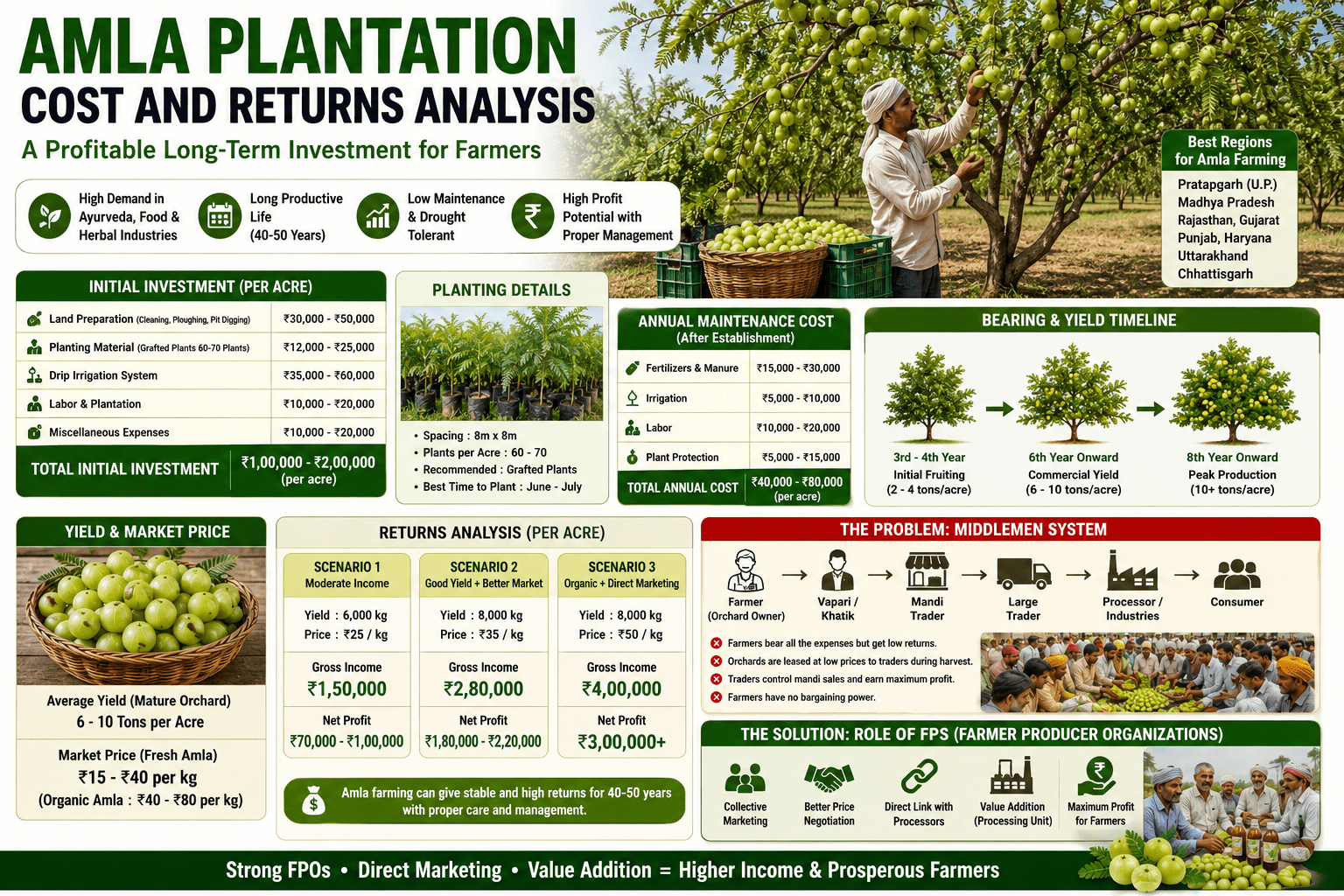
| Activity | Approximate Cost |
|---|---|
| Field preparation | ₹5,000 – ₹10,000 |
| Pit digging and filling | ₹15,000 – ₹25,000 |
| Farmyard manure | ₹8,000 – ₹15,000 |
👉 Total land preparation cost: ₹30,000 – ₹50,000
Planting Material Cost


Choosing quality grafted plants is extremely important for:
- early bearing,
- better yield,
- disease resistance,
- and superior fruit quality.
Recommended Planting Density
- Spacing: 8m × 8m
- Approximate plants per acre: 60–70
Sapling Cost
| Item | Approximate Cost |
|---|---|
| Grafted plants | ₹150 – ₹350 per plant |
👉 Total planting material cost: ₹12,000 – ₹25,000
Irrigation Setup Cost
Drip irrigation is highly recommended for commercial amla farming because it:
- saves water,
- improves fruit quality,
- reduces labor,
- and enhances fertilizer efficiency.
Estimated Drip Irrigation Cost
| System | Approximate Cost |
|---|---|
| Drip irrigation setup | ₹35,000 – ₹60,000 |
Government subsidies may significantly reduce this expense under horticulture schemes.
Labor and Plantation Cost
Plantation Activities
- Pit filling
- Planting saplings
- Irrigation setup
- Mulching
- Initial support and protection
Estimated Labor Cost
👉 ₹10,000 – ₹20,000 per acre
Total Initial Investment Per Acre
Estimated Establishment Cost
| Expense | Approximate Cost |
|---|---|
| Land preparation | ₹30,000 – ₹50,000 |
| Planting material | ₹12,000 – ₹25,000 |
| Drip irrigation | ₹35,000 – ₹60,000 |
| Labor and plantation | ₹10,000 – ₹20,000 |
| Miscellaneous expenses | ₹10,000 – ₹20,000 |
Total Initial Investment
👉 ₹1 lakh to ₹2 lakh per acre
The actual cost depends on:
- irrigation system,
- labor charges,
- soil condition,
- and orchard management practices.
Annual Maintenance Cost
Once the orchard is established, yearly maintenance becomes comparatively lower.
Major Annual Expenses
- Fertilizers and manure
- Irrigation
- Weeding
- Pruning
- Plant protection
- Labor
Estimated Annual Cost
| Expense | Approximate Cost |
|---|---|
| Fertilizers and manure | ₹15,000 – ₹30,000 |
| Irrigation | ₹5,000 – ₹10,000 |
| Labor | ₹10,000 – ₹20,000 |
| Plant protection | ₹5,000 – ₹15,000 |
👉 Annual maintenance cost: ₹40,000 – ₹80,000 per acre
👉 Learn about Amla farming profit per acre in India
Gestation Period of Amla Orchard
Amla is a long-term investment crop.
Bearing Timeline
- Initial fruiting: 3rd–4th year
- Commercial yield: 6th year onward
- Peak production: 8th year onward
One of the biggest advantages highlighted in amla plantation cost and returns analysis in India is the long productive life of amla orchards.
Yield Analysis Per Acre
Yield depends on:
- variety,
- irrigation,
- nutrition,
- pruning,
- climate,
- and orchard management.
Average Yield
| Orchard Stage | Yield |
|---|---|
| Young orchard | 2–4 tons/acre |
| Mature orchard | 6–10 tons/acre |
Well-managed orchards can produce even higher yields.
Market Price of Amla
Average Price Range
| Product | Market Price |
|---|---|
| Fresh amla | ₹15 – ₹40/kg |
| Organic amla | ₹40 – ₹80/kg |
Prices fluctuate based on:
- season,
- quality,
- market demand,
- and processing industry requirements.
Returns Analysis Per Acre
Scenario 1 – Moderate Income
- Yield: 6,000 kg
- Selling price: ₹25/kg
Gross Income
👉 ₹1,50,000 annually
Estimated Net Profit
👉 ₹70,000 – ₹1,00,000 annually
Scenario 2 – Good Yield + Better Market
- Yield: 8,000 kg
- Selling price: ₹35/kg
Gross Income
👉 ₹2,80,000 annually
Estimated Net Profit
👉 ₹1.8 lakh – ₹2.2 lakh annually
Scenario 3 – Organic + Direct Marketing
- Yield: 8,000 kg
- Selling price: ₹50/kg
Gross Income
👉 ₹4,00,000 annually
Estimated Net Profit
👉 ₹3 lakh+ annually
This is some what Amla Plantation Cost and Returns Analysis in India
The Hidden Problem in Amla Marketing
Although amla farming appears profitable on paper, many orchard owners face severe economic pressure due to the current post-harvest marketing structure.
In many regions of:
- Uttar Pradesh
- Punjab
- Haryana
- Uttarakhand
- Chhattisgarh
farmers are often forced to lease their orchards to Vapari or Khatik traders during harvest season.
How Middlemen Capture the Profits


The system usually works like this:
Farmer → Vapari/Khatik → Mandi Trader → Large Trader → Processor → Consumer
What Happens
- Farmers bear yearly expenses
- Traders lease orchards at low prices
- Traders control harvesting and mandi sales
- Farmers lose pricing power
- Large profits go to intermediaries
Meanwhile, processors and brands convert amla into:
- Murabba
- Candy
- Juice
- Powder
- Ayurvedic products
which sell at much higher margins.
Many orchard owners remain financially distressed despite years of investment and hard work.
How FPOs Can Improve Farmer Returns


Farmer Producer Organizations (FPOs) can dramatically improve the economics of amla farming.
Benefits of FPOs
Collective Marketing
Farmers can sell in bulk directly to processors.
Better Price Negotiation
FPOs increase bargaining power.
Elimination of Middlemen
Direct procurement reduces trader exploitation.
Processing and Value Addition
FPOs can produce:
- Murabba
- Candy
- Juice
- Pickles
- Herbal products
Higher Farmer Share
The maximum share of profits stays with farming communities.
Conclusion
Proper understanding of amla plantation cost and returns analysis in India can help farmers shift toward profitable horticulture-based farming systems and long-term value addition opportunities. Amla plantation is one of the most profitable long-term horticulture investments in India. With proper orchard management, quality planting material, irrigation, and market linkage, farmers can generate stable income for decades.
Regions like Pratapgarh continue to lead India’s amla economy because of their ideal climate, traditional orchards, and strong processing demand.
However, the biggest challenge today is not production — it is the exploitative marketing system dominated by Vapari, mandi traders, and intermediaries who capture a major portion of the profits.
Farmer Producer Organizations (FPOs) can become the real solution by enabling collective marketing, direct processor linkage, value addition, and fair price realization.
A strong FPO system can protect orchard owners, strengthen rural economies, and ensure that the real profits of amla farming finally reach the farmers themselves.
👉 Learn all About Popular varieties of amla in India : https://belhamaifpo.com/agriculture/popular-varieties-of-amla-in-india/
Some helpful Links :