

Introduction
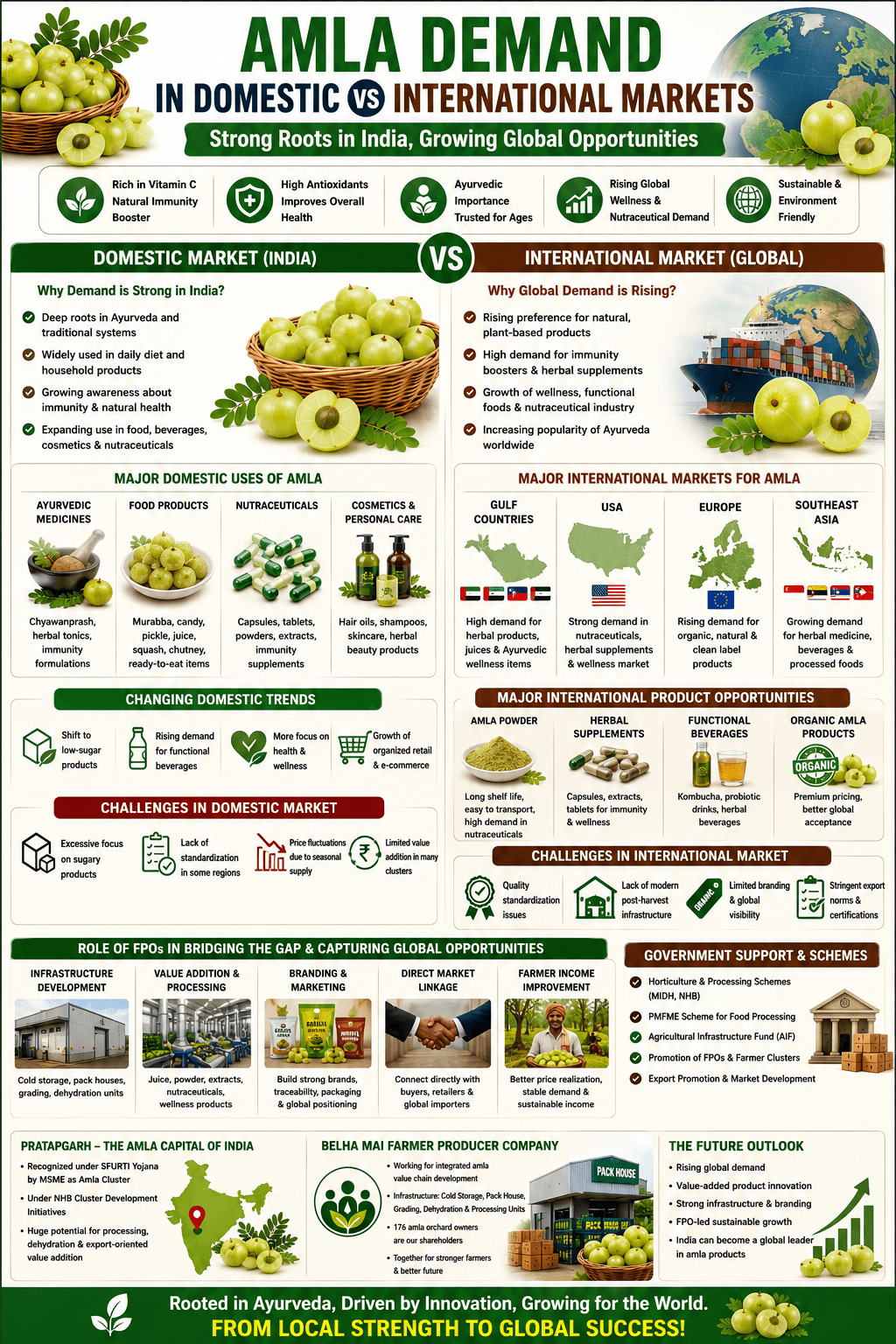
Amla demand in domestic vs international markets is increasing rapidly as consumers across the world shift toward:
- natural wellness products,
- immunity boosters,
- herbal supplements,
- nutraceuticals,
- and functional foods.
Amla (Indian Gooseberry) is one of India’s most valuable medicinal and horticultural crops because of its:
- exceptionally high Vitamin C content,
- antioxidant properties,
- Ayurvedic importance,
- and growing use in wellness industries.
In India, amla has traditionally been consumed through:
- murabba,
- pickles,
- juices,
- powders,
- chyawanprash,
- and Ayurvedic medicines.
However, international markets are now increasingly demanding:
- low-sugar wellness products,
- nutraceuticals,
- herbal beverages,
- probiotic products,
- and natural immunity boosters.
This is creating major opportunities for India’s amla value chain.
In this blog, we will understand:
- amla demand in domestic vs international markets,
- changing consumer trends,
- processing opportunities,
- export potential,
- market challenges,
- and the role of FPOs in strengthening global competitiveness.
🔗 To Learn more on Export potential of amla from India : https://belhamaifpo.com/agriculture/export-potential-of-amla-from-india/
Why Amla Demand in Domestic vs International Markets Is Increasing
One of the biggest reasons behind growing amla demand in domestic vs international markets is rising awareness about:
- immunity,
- preventive healthcare,
- natural nutrition,
- and herbal wellness products.
The COVID-19 period significantly accelerated consumer interest in:
- Ayurvedic products,
- herbal supplements,
- and immunity-enhancing foods.
Domestic Demand for Amla in India
India remains one of the largest consumers of amla products because of:
- Ayurveda,
- traditional food habits,
- and herbal medicine systems.
Amla demand is strong across:
- food industries,
- herbal medicine,
- nutraceuticals,
- wellness brands,
- and household consumption.
Major Domestic Uses of Amla
1. Ayurvedic Medicines
Amla is widely used in:
- chyawanprash,
- herbal tonics,
- immunity formulations,
- digestive medicines,
- and hair care products.
2. Food Processing Industry
Amla is processed into:
- murabba,
- candy,
- juice,
- powder,
- pickles,
- and dehydrated products.
🔗 To Learn more on Value-added products from amla : https://belhamaifpo.com/agriculture/value-added-products-from-amla/
3. Nutraceutical Industry
Demand for:
- amla capsules,
- herbal extracts,
- immunity products,
- and wellness supplements
is increasing rapidly.
4. Hair and Cosmetic Industry
Amla is also used extensively in:
- hair oils,
- shampoos,
- herbal cosmetics,
- and beauty products.
Changing Domestic Consumer Trends
Indian consumers are increasingly shifting toward:
- low-sugar products,
- natural wellness beverages,
- functional foods,
- and chemical-free nutrition.
This creates opportunities for:
- probiotic beverages,
- kombucha,
- herbal juices,
- and nutraceutical products.
Problem With Current Domestic Market Structure
Despite huge production, much of the amla industry still focuses mainly on:
- sugary murabba,
- sweet candy,
- and traditional products.
India has one of the world’s largest diabetic populations, yet healthier value-added products remain underdeveloped.
This limits amla’s positioning as a modern global superfood.
International Demand for Amla
International demand for amla products is increasing because global consumers increasingly prefer:
- plant-based nutrition,
- natural supplements,
- immunity boosters,
- and herbal wellness products.
Major International Markets for Amla
1. Gulf Countries
Strong demand exists for:
- herbal products,
- juices,
- and Ayurvedic wellness products.
2. USA
Demand is increasing in:
- nutraceutical industries,
- wellness markets,
- herbal supplements,
- and organic food sectors.
3. Europe
European consumers increasingly demand:
- organic products,
- functional foods,
- and traceable herbal products.
4. Southeast Asia
Demand exists for:
- herbal medicine,
- processed food products,
- and wellness beverages.
Major International Product Opportunities
Amla Powder
One of the most export-friendly products because of:
- longer shelf life,
- lower transportation cost,
- and high nutraceutical demand.
Herbal Supplements
Capsules and extracts are increasingly popular globally.
Functional Beverages
Opportunities are growing in:
- kombucha,
- probiotic drinks,
- herbal wellness beverages,
- and immunity products.
Organic Amla Products
Organic products receive:
- premium pricing,
- stronger global acceptance,
- and better export positioning.
Major Challenges in International Markets
1. Lack of Standardization
Many small-scale processors lack:
- quality consistency,
- export-grade packaging,
- and scientific processing systems.
2. Weak Post-Harvest Infrastructure
Most amla-growing clusters still lack:
- cold storage,
- grading systems,
- pack houses,
- dehydration units,
- and scientific handling systems.
🔗 To Learn more on Post-harvest management of amla : https://belhamaifpo.com/farmer-producer-organisation/post-harvest-management-of-amla/
3. Limited Branding
Many Indian amla products are sold:
- in bulk,
- without branding,
- or through intermediaries.
This limits global brand recognition.
4. Excessive Focus on Sugary Products
Global wellness markets increasingly prefer:
- low-sugar,
- functional,
- and nutraceutical products.
However, many processors still focus mainly on sugary products.
🔗 To Learn more on Export potential of amla from India : https://belhamaifpo.com/agriculture/export-potential-of-amla-from-india/
Why Modern Infrastructure Is Critical
Scientific infrastructure is essential for improving:
- export competitiveness,
- product quality,
- shelf life,
- and traceability.
Important infrastructure includes:
- cold storage,
- pack houses,
- grading systems,
- dehydration units,
- and processing facilities.
Importance of Dehydration and Powder Processing
Dry amla powder has huge global demand because it:
- stores easily,
- transports efficiently,
- and fits wellness markets perfectly.
However, dehydration facilities are still absent in many major amla-growing clusters.
This is a major missed opportunity.
🔗 To Learn more on Amla powder benefits and uses : https://belhamaifpo.com/agriculture/amla-powder-benefits-and-uses/
Role of FPOs in Strengthening Amla Demand in Domestic vs International Markets
Farmer Producer Organizations (FPOs) can play a transformational role in improving market access and value addition.
Infrastructure Development
FPOs can establish:
- pack houses,
- cold storage,
- dehydration units,
- grading systems,
- and processing facilities.
🔗 To Learn more on Amla farming in India: complete guide for Farmers, Processing & Business Opportunities : https://belhamaifpo.com/farmer-producer-organisation/amla-farming-in-india/
Farmer-Owned Value Addition
FPOs can move farmers into:
- powder manufacturing,
- juice processing,
- nutraceuticals,
- herbal wellness products,
- and export-oriented businesses.
Branding and Direct Marketing
FPOs can develop:
- regional brands,
- traceable products,
- and direct-to-consumer businesses.
This improves:
- farmer income,
- brand value,
- and export competitiveness.
Government Support and Export Opportunities
Government schemes supporting:
- food processing,
- horticulture,
- FPOs,
- exports,
- and infrastructure development
can significantly strengthen India’s amla value chain.
Pratapgarh’s Emerging Role in Amla Value Chain Development
Pratapgarh is widely recognized as one of India’s most important amla-growing regions and is often called the traditional Amla Capital of India.
The district is recognized:
- under SFURTI Yojana by MSME as an Amla Cluster,
- and under NHB cluster development initiatives.
This creates huge opportunities for:
- processing,
- dehydration,
- export-oriented value addition,
- and nutraceutical industries.
Belha Mai Farmer Producer Company’s Initiative
Belha Mai Farmer Producer Company is actively working toward:
- cold storage,
- pack houses,
- grading systems,
- dehydration units,
- and integrated value-chain infrastructure.
The organization currently has:
- 176 amla orchard owners as shareholders.
This initiative has the potential to significantly improve:
- market linkage,
- value addition,
- and export competitiveness.
Conclusion
Amla demand in domestic vs international markets is expected to grow significantly due to rising awareness about:
- immunity,
- wellness,
- nutraceuticals,
- and sustainable nutrition.
While domestic markets remain strong because of Ayurveda and traditional consumption, international demand is increasingly driven by:
- herbal wellness,
- functional foods,
- low-sugar products,
- and nutraceutical industries.
However, major challenges still exist related to:
- infrastructure,
- branding,
- post-harvest management,
- and value addition.
FPO-led infrastructure development, dehydration systems, scientific processing, and export-oriented branding can significantly strengthen India’s position in the global amla market.
The work being undertaken in Pratapgarh by Belha Mai Farmer Producer Company represents an important step toward building a modern and farmer-led amla value chain ecosystem in India.
Some helpful Links:-
👉 https://nhb.gov.in/schemes.aspx