Organic Amla Farming

Introduction
Organic amla farming: opportunities and challenges is becoming an increasingly important topic as global consumers shift toward:
- chemical-free food,
- natural wellness products,
- nutraceuticals,
- and sustainable agriculture.
Amla (Indian Gooseberry) is one of India’s most valuable medicinal and horticultural crops because of its:
- high Vitamin C content,
- medicinal importance,
- antioxidant properties,
- and growing demand in wellness industries.
Today, consumers across the world are increasingly demanding:
- organic foods,
- herbal wellness products,
- low-chemical agriculture,
- and traceable supply chains.
This creates major opportunities for organic amla farming in India.
However, organic farming also faces several challenges related to:
- certification,
- pest management,
- market linkage,
- yield transition,
- and infrastructure limitations.
In this blog, we will understand:
- opportunities in organic amla farming,
- major challenges,
- certification systems,
- organic inputs,
- market trends,
- and the role of FPOs in building sustainable organic value chains.
👉 To Learn More on Challenges in amla farming and solutions : https://belhamaifpo.com/uncategorized/amla-farming-challenges-solutions/
Why Organic Amla Farming: Opportunities and Challenges Is Important
One of the biggest reasons for discussing organic amla farming: opportunities and challenges is the growing global demand for:
- chemical-free wellness products,
- herbal medicines,
- organic nutraceuticals,
- and sustainable agriculture systems.
Organic agriculture is increasingly linked with:
- soil health,
- biodiversity,
- climate resilience,
- and long-term sustainability.
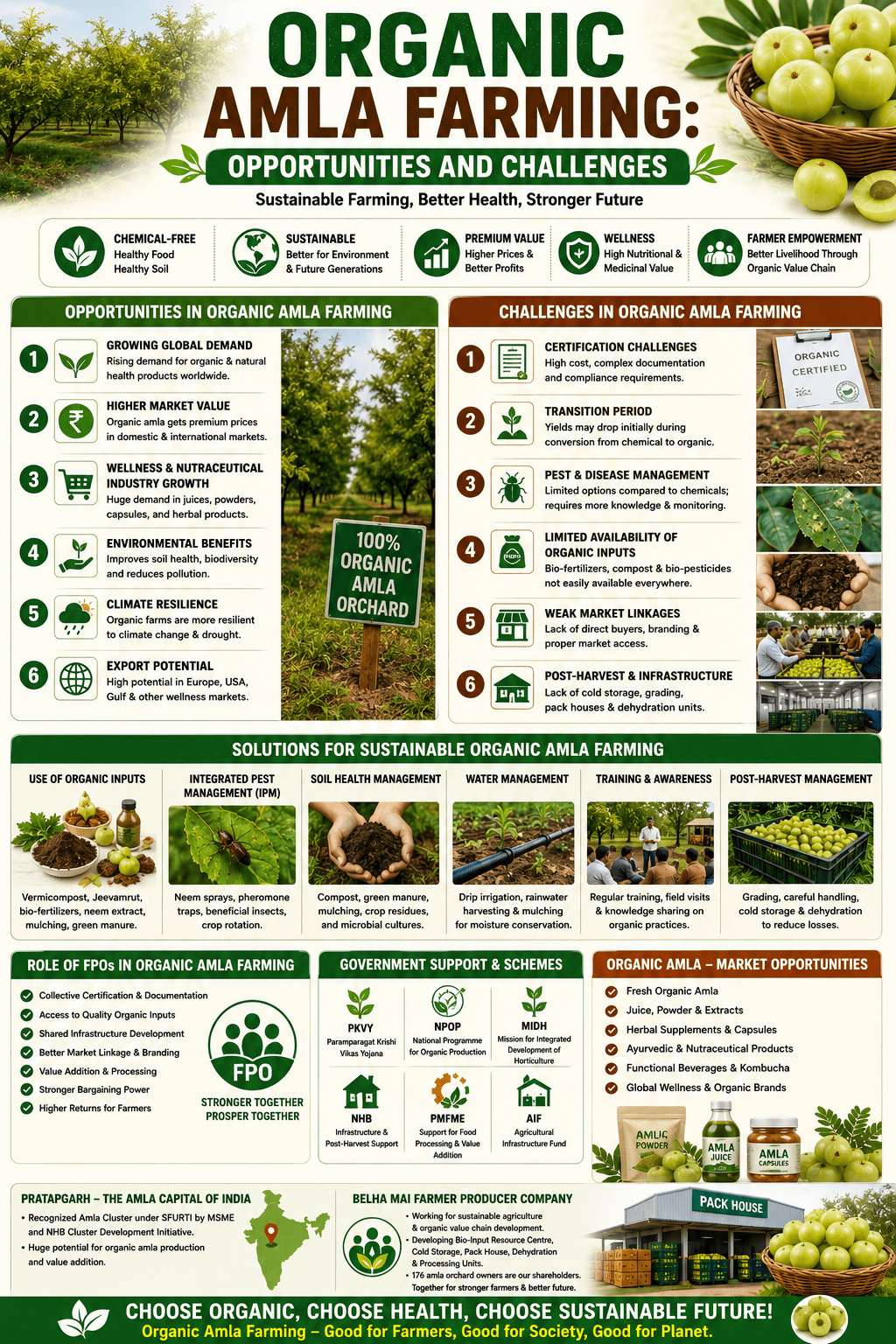
Major Opportunities in Organic Amla Farming
1. Growing Global Demand for Organic Products
Global consumers increasingly prefer:
- natural foods,
- herbal supplements,
- and organic wellness products.
Amla is already widely known in:
- Ayurveda,
- herbal medicine,
- and nutraceutical industries.
Organic certification can significantly increase export opportunities.
2. Higher Market Value
Organic products generally receive:
- premium prices,
- stronger consumer trust,
- and better export potential.
This can significantly improve farmer profitability.
👉 To Learn More on Amla market price trends in India : https://belhamaifpo.com/agriculture/amla-market-price-trends-in-india/
3. Rising Demand in Wellness Industries
The wellness industry is rapidly expanding globally.
Organic amla is increasingly used in:
- juices,
- powders,
- capsules,
- herbal supplements,
- nutraceuticals,
- and functional beverages.
4. Environmental Sustainability
Organic farming helps improve:
- soil health,
- biodiversity,
- water conservation,
- and ecological balance.
It also reduces dependency on:
- chemical fertilizers,
- pesticides,
- and synthetic growth promoters.
5. Climate-Resilient Agriculture
Organic farming systems often improve:
- soil organic matter,
- moisture retention,
- and resilience against climate variability.
This is becoming increasingly important due to:
- drought,
- heat stress,
- and irregular rainfall.
6. Export Opportunities
International markets increasingly demand:
- certified organic products,
- traceability,
- and residue-free produce.
Organic amla products have growing potential in:
- Europe,
- Gulf countries,
- USA,
- and wellness-focused markets.
- 👉 To Learn More on Export potential of amla from India : https://belhamaifpo.com/agriculture/export-potential-of-amla-from-india/
Major Challenges in Organic Amla Farming
1. Certification Challenges
One of the biggest organic amla farming: opportunities and challenges issues is certification.
Organic certification often involves:
- documentation,
- inspection,
- conversion periods,
- and compliance costs.
Small farmers may struggle with:
- paperwork,
- awareness,
- and technical guidance.
Solution
FPO-led collective certification systems can significantly reduce:
- cost,
- complexity,
- and compliance burden.
2. Transition Period Challenges
During conversion from chemical to organic farming:
- yields may temporarily decline,
- pest pressure may increase,
- and nutrient balance may fluctuate.
This transition phase is often difficult for farmers.
Solution
Farmers should gradually adopt:
- organic nutrient management,
- composting,
- bio-inputs,
- and integrated farming practices.
Training and extension support are extremely important.
3. Pest and Disease Management
Organic farming restricts synthetic pesticide use.
Farmers may face:
- pest outbreaks,
- fungal diseases,
- and orchard management challenges.
Solution
Integrated Pest Management (IPM) and biological control methods are essential.
Farmers should focus on:
- neem-based sprays,
- biological pesticides,
- orchard sanitation,
- and biodiversity enhancement.
4. Limited Availability of Organic Inputs
Many regions still lack:
- certified organic inputs,
- bio-fertilizers,
- composting systems,
- and biological pest control products.
Solution
Bio-Input Resource Centres (BIRCs) can play an important role by producing:
- vermicompost,
- bio-fertilizers,
- natural pesticides,
- and microbial formulations locally.
5. Weak Market Linkages
Many organic farmers still struggle with:
- buyer access,
- branding,
- certification-based marketing,
- and export linkage.
As a result:
- products are often sold at conventional prices,
- despite higher production effort.
Solution
Direct market linkage, branding, and traceability systems are essential.
FPOs can help farmers connect directly with:
- organic retailers,
- exporters,
- nutraceutical companies,
- and wellness brands.
6. Post-Harvest Infrastructure Problems
Organic value chains require:
- hygienic handling,
- scientific storage,
- traceability,
- and contamination-free systems.
However, many regions still lack:
- cold storage,
- grading systems,
- pack houses,
- and dehydration units.
👉 To Learn More on Post-harvest management of amla : https://belhamaifpo.com/farmer-producer-organisation/post-harvest-management-of-amla/
Solution
Investment in:
- cold storage,
- pack houses,
- grading systems,
- and dehydration infrastructure
is essential for strengthening organic value chains.
Importance of Bio-Input Resource Centres (BIRC)
Bio-Input Resource Centres are becoming increasingly important in organic agriculture.
These centres can produce:
- bio-fertilizers,
- vermicompost,
- natural pesticides,
- microbial cultures,
- and organic growth promoters.
BIRCs help:
- reduce chemical dependency,
- lower farming costs,
- and strengthen sustainable agriculture systems.
Organic Amla Farming and Nutraceutical Opportunities
Organic amla has huge potential in:
- nutraceuticals,
- herbal medicine,
- immunity products,
- probiotics,
- and wellness beverages.
Global consumers increasingly prefer:
- low-sugar products,
- functional foods,
- and chemical-free wellness systems.
This creates major opportunities for:
- organic amla juice,
- powder,
- capsules,
- kombucha,
- and herbal beverages.
Role of FPOs in Organic Amla Farming
Farmer Producer Organizations (FPOs) can play a transformational role in solving major organic farming challenges.
Collective Certification
FPOs can help farmers:
- reduce certification costs,
- improve documentation,
- and simplify compliance systems.
Infrastructure Development
FPOs can establish:
- pack houses,
- grading systems,
- dehydration units,
- cold storage,
- and organic processing facilities.
👉 To Learn all about Amla farming in India: complete guide for Farmers, Processing & Business Opportunities : https://belhamaifpo.com/farmer-producer-organisation/amla-farming-in-india/
Branding and Marketing
FPOs can develop:
- organic brands,
- farmer-owned products,
- and direct-to-consumer businesses.
Farmer-Owned Value Addition
FPOs can move farmers into:
- organic juice processing,
- powder manufacturing,
- herbal wellness products,
- and nutraceutical industries.
This significantly improves value realization.
Government Support for Organic Farming
Government programs increasingly support:
- organic farming,
- natural farming,
- horticulture,
- and sustainable agriculture systems.
Support may include:
- certification assistance,
- training,
- infrastructure,
- and organic input development.
👉 To Learn all about Government subsidies for amla farming https://belhamaifpo.com/uncategorized/government-subsidies-for-amla-farming/
Pratapgarh’s Emerging Role in Organic Amla Farming
Pratapgarh is widely recognized as one of India’s major amla-growing regions and is often called the traditional Amla Capital of India.
The district has huge potential for:
- organic amla farming,
- value addition,
- dehydration,
- nutraceuticals,
- and export-oriented wellness products.
Belha Mai Farmer Producer Company’s Initiative
Belha Mai Farmer Producer Company is actively working toward:
- sustainable agriculture,
- post-harvest infrastructure,
- Bio-Input Resource Centre development,
- cold storage,
- dehydration,
- and farmer-led value addition systems.
The organization currently has:
- 176 amla orchard owners as shareholders.
This initiative has the potential to significantly improve:
- sustainable farming,
- farmer income,
- and organic value-chain development.
Conclusion
Organic amla farming: opportunities and challenges represent one of the most important future directions in sustainable horticulture and wellness agriculture.
Growing global demand for:
- chemical-free food,
- herbal wellness products,
- nutraceuticals,
- and sustainable agriculture
creates major opportunities for Indian farmers.
However, farmers still face major challenges related to:
- certification,
- pest management,
- market linkage,
- and infrastructure limitations.
FPO-led collective systems, Bio-Input Resource Centres, scientific infrastructure, and farmer-owned value addition can significantly strengthen organic amla farming ecosystems and improve long-term farmer profitability.
The work being undertaken in Pratapgarh by Belha Mai Farmer Producer Company represents an important step toward building a sustainable and farmer-led organic amla ecosystem in India.
Some useful limks:-
👉 https://www.uphorticulture.in/