

Introduction
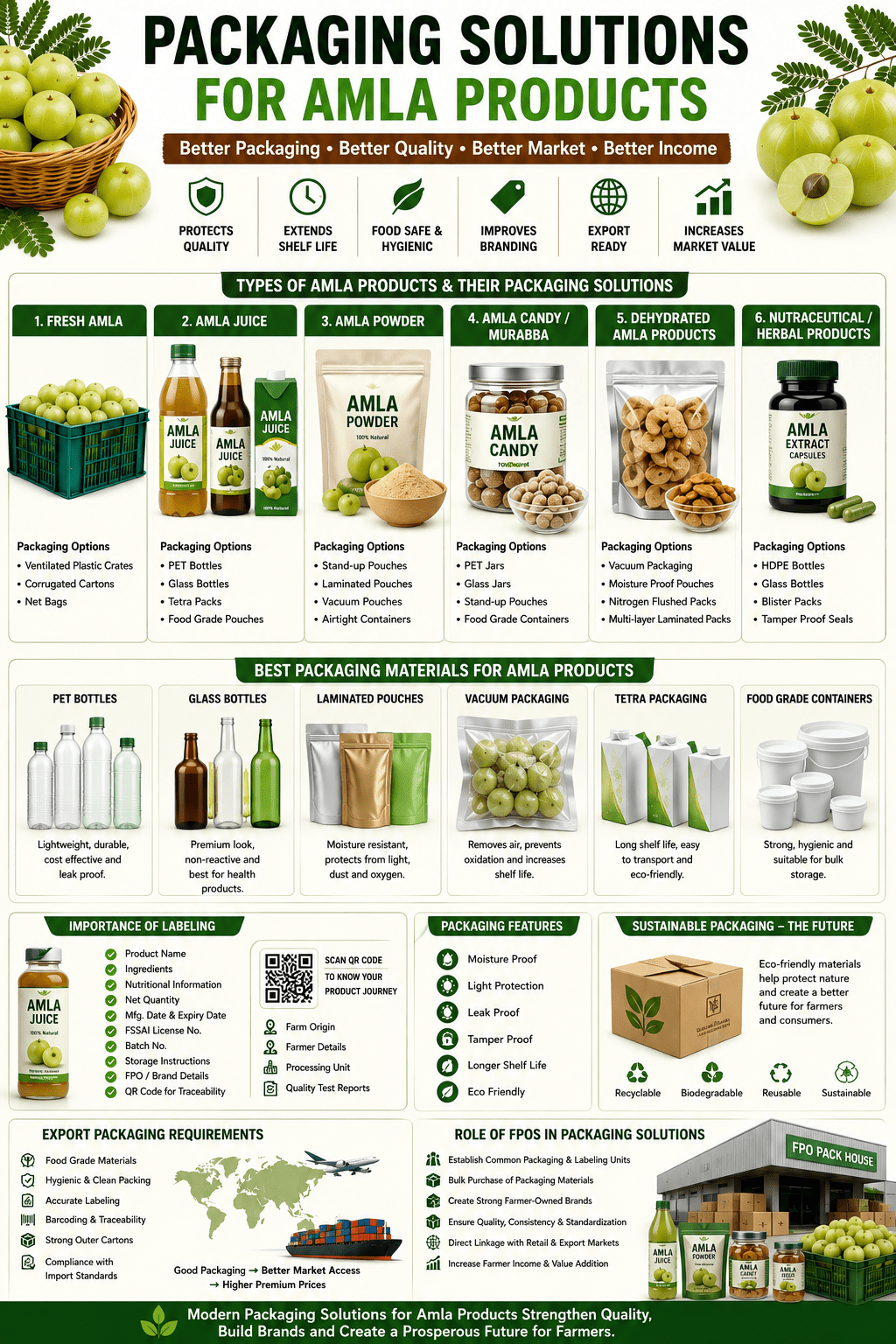
Packaging solutions for amla products play a crucial role in improving:
- shelf life,
- product quality,
- export readiness,
- branding,
- and market value.
In today’s competitive wellness and food industry, packaging is no longer just about storing products. Modern packaging helps:
- protect product quality,
- maintain hygiene,
- reduce spoilage,
- improve transportation,
- attract consumers,
- and strengthen brand identity.
As the demand for:
- amla juice,
- powder,
- candy,
- murabba,
- dehydrated products,
- nutraceuticals,
- and herbal wellness products
continues to increase, scientific packaging systems are becoming extremely important.
Unfortunately, in many parts of India, small-scale processing units still use:
- poor-quality packaging,
- non-standard labeling,
- and outdated storage systems.
As a result:
- shelf life reduces,
- export opportunities weaken,
- and product quality deteriorates.
In this blog, we will understand:
- packaging solutions for amla products,
- types of packaging materials,
- export packaging,
- vacuum packaging,
- labeling standards,
- storage considerations,
- and the role of FPOs in building modern packaging infrastructure.
👉 Learn About Amla farming in India: complete guide for Farmers, Processing & Business Opportunities: https://belhamaifpo.com/farmer-producer-organisation/amla-farming-in-india/
Why Packaging Solutions for Amla Products Are Important
One of the biggest advantages of modern packaging solutions for amla products is that they help:
- increase shelf life,
- improve consumer trust,
- reduce contamination,
- and improve branding.
Good packaging also improves:
- transportation safety,
- export quality,
- and retail presentation.
👉 Read our blog on Amla grading and sorting process: https://belhamaifpo.com/agriculture/amla-grading-and-sorting-process-2/
Major Objectives of Packaging
1. Product Protection
Packaging protects amla products from:
- moisture,
- dust,
- sunlight,
- contamination,
- and physical damage.
2. Longer Shelf Life
Scientific packaging helps reduce:
- oxidation,
- microbial growth,
- and moisture absorption.
This improves storage stability significantly.
3. Better Branding
Modern packaging improves:
- product appearance,
- customer trust,
- and market acceptance.
Attractive packaging increases consumer confidence.
4. Export Readiness
International markets demand:
- hygienic packaging,
- traceability,
- labeling standards,
- and food-safe materials.
Scientific packaging is essential for exports.
👉 Learn more about Export potential of amla from India: https://belhamaifpo.com/agriculture/export-potential-of-amla-from-india/
Types of Amla Products Requiring Packaging
Fresh Amla
Requires:
- ventilated crates,
- food-grade cartons,
- and transport-safe containers.
Amla Juice
Requires:
- PET bottles,
- glass bottles,
- tetra packs,
- or food-grade pouches.
Leak-proof packaging is extremely important.
Amla Powder
Requires:
- moisture-resistant pouches,
- vacuum packaging,
- laminated pouches,
- or airtight containers.
Powder products are highly sensitive to moisture.
Amla Candy and Murabba
Requires:
- sealed food-grade containers,
- jars,
- stand-up pouches,
- and hygienic retail packaging.
Dehydrated Amla Products
Require:
- vacuum packaging,
- nitrogen flushing,
- and moisture-proof storage systems.
Nutraceutical and Herbal Products
Capsules, extracts, and wellness products require:
- pharmaceutical-grade packaging,
- airtight containers,
- and proper labeling.
Best Packaging Materials for Amla Products
1. PET Bottles
Widely used for:
- juice,
- beverages,
- and liquid wellness products.
Advantages
- lightweight,
- durable,
- and cost-effective.
2. Glass Bottles
Used for:
- premium juices,
- herbal extracts,
- and wellness products.
Advantages
- premium appearance,
- non-reactive,
- and eco-friendly.
3. Laminated Pouches
Used for:
- powder,
- dehydrated products,
- and candy.
Advantages
- moisture resistance,
- lightweight,
- and longer shelf life.
4. Vacuum Packaging
One of the best packaging solutions for amla products because it:
- removes air,
- reduces oxidation,
- and increases shelf life.
Vacuum packaging is highly useful for:
- dry amla powder,
- dehydrated slices,
- and export-oriented products.
5. Tetra Packaging
Used in:
- beverages,
- health drinks,
- and export-oriented liquid products.
Advantages
- long shelf life,
- easy transportation,
- and reduced refrigeration dependency.
Importance of Labeling in Packaging Solutions for Amla Products
Proper labeling improves:
- transparency,
- compliance,
- and brand trust.
Labels should include:
- product name,
- ingredients,
- manufacturing date,
- expiry date,
- FSSAI details,
- nutritional information,
- and storage instructions.
Role of QR Codes and Traceability
Modern consumers increasingly demand:
- transparency,
- authenticity,
- and traceability.
QR code systems can help consumers track:
- farm origin,
- FPO details,
- processing information,
- and quality certifications.
This is becoming highly important in export markets.
👉 Leard about Value-added products from amla : https://belhamaifpo.com/agriculture/value-added-products-from-amla/
Packaging Challenges in India’s Amla Industry
Many small-scale processing units still face:
- poor-quality packaging,
- limited machinery,
- weak branding,
- and lack of modern storage systems.
As a result:
- products lose shelf life,
- transportation damage increases,
- and export competitiveness weakens.
Importance of Cold Storage and Pack Houses
Modern packaging systems work best with:
- cold storage,
- grading systems,
- pack houses,
- and scientific post-harvest handling.
Without proper infrastructure:
- product quality deteriorates quickly,
- and losses increase.
Why Packaging Is Important for Export Markets
International buyers prefer:
- attractive packaging,
- standardized labeling,
- food-safe materials,
- and hygienic handling.
Good packaging improves:
- shelf appeal,
- product trust,
- and international competitiveness.
Future of Sustainable Packaging
Global markets are increasingly shifting toward:
- eco-friendly packaging,
- biodegradable materials,
- and recyclable systems.
Sustainable packaging can help improve:
- environmental image,
- export acceptance,
- and premium branding.
Role of FPOs in Packaging Solutions for Amla Products
Farmer Producer Organizations (FPOs) can play a transformational role in modern packaging infrastructure development.
Infrastructure Development
FPOs can establish:
- packaging units,
- labeling systems,
- vacuum packaging facilities,
- and integrated pack houses.
Branding and Farmer-Owned Products
FPOs can develop:
- regional brands,
- farmer-owned wellness products,
- and direct-to-consumer businesses.
This helps farmers participate in:
- branding,
- packaging,
- and value addition profits.
Direct Market Linkage
FPOs can directly connect with:
- retailers,
- exporters,
- nutraceutical companies,
- and wellness brands.
This reduces:
- middlemen dependency,
- and improves farmer price realization.
Pratapgarh’s Emerging Role in Amla Value Addition
Pratapgarh is widely recognized as one of India’s most important amla-growing regions and is known as the traditional Amla Capital of India.
The district is recognized:
- under SFURTI Yojana by MSME as an Amla Cluster,
- and under NHB cluster development initiatives.
This creates huge opportunities for:
- packaging infrastructure,
- processing,
- dehydration,
- and export-oriented value addition.
Belha Mai Farmer Producer Company’s Initiative
Belha Mai Farmer Producer Company is actively working toward:
- modern pack houses,
- grading and sorting systems,
- cold storage,
- dehydration units,
- and integrated value-chain infrastructure.
The organization currently has:
- 176 amla orchard owners as shareholders.
This initiative has the potential to significantly improve:
- product quality,
- export readiness,
- and farmer income.
Conclusion
Packaging solutions for amla products are becoming increasingly important in modern agriculture, food processing, nutraceuticals, and export-oriented value addition.
Scientific packaging helps:
- improve shelf life,
- reduce spoilage,
- strengthen branding,
- improve export competitiveness,
- and increase farmer income.
However, India’s amla industry still faces major challenges related to:
- weak packaging infrastructure,
- poor branding,
- and limited scientific post-harvest systems.
FPO-led infrastructure development, modern packaging technology, vacuum packaging, QR-based traceability, and export-oriented branding can completely transform India’s amla value chain.
The work being undertaken in Pratapgarh by Belha Mai Farmer Producer Company represents an important step toward building a modern and farmer-led amla processing ecosystem in India.
Some Useful Links:-