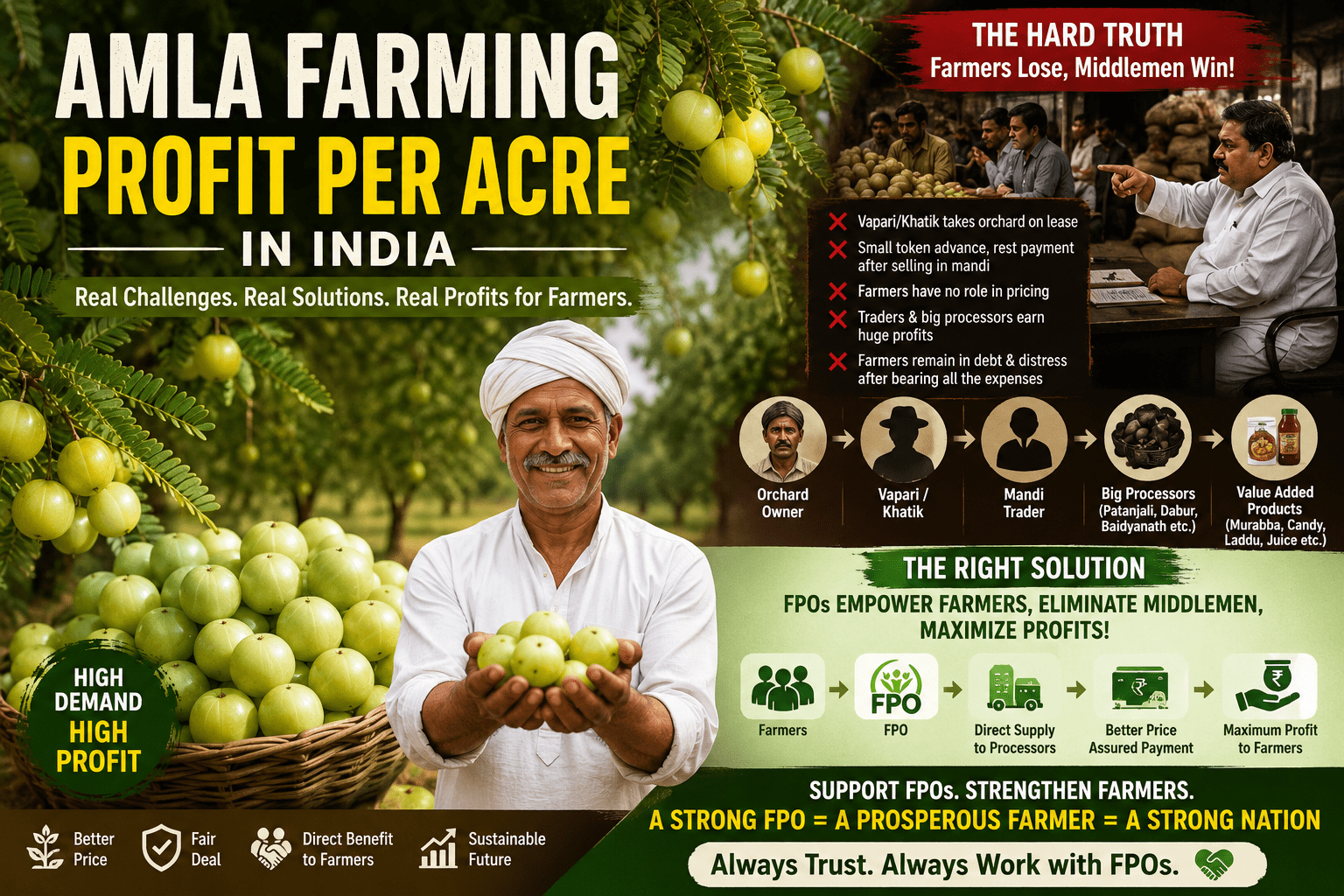
Amla Farming Profit Per Acre in India
Introduction
Amla cultivation is rapidly becoming one of the most profitable horticulture businesses in India. Also known as Indian Gooseberry, amla is widely used in Ayurveda, herbal medicines, juices, candies, pickles, cosmetics, and health supplements. Due to its high Vitamin C content and growing demand in the nutraceutical industry, farmers are now shifting toward commercial amla farming for long-term income and sustainable returns.
Unlike seasonal crops, amla orchards can produce income for decades with comparatively lower maintenance costs after establishment. With proper planning, quality planting material, irrigation, and market linkage, farmers can earn attractive profits per acre from amla cultivation.
In this blog, we will understand the complete economics of amla farming per acre in India including:
- Initial investment
- Planting density
- Yield potential
- Annual maintenance cost
- Income generation
- Net profit per acre
- Market opportunities
- Value addition potential
- Factors affecting profitability
Why Amla Farming Is Becoming Popular in India
The demand for amla has increased significantly in recent years because consumers are becoming more health conscious. Amla is considered a superfood in Ayurveda and modern nutrition due to its antioxidant and immunity-boosting properties.
Today, amla is used in:
- Ayurvedic medicines
- Chyawanprash
- Herbal supplements
- Juice industries
- Hair oils and cosmetics
- Candy and murabba production
- Pickles and processed foods
- Nutraceutical products
Because of this rising demand, farmers are receiving better market prices and opportunities for contract farming, processing, and export.
Major amla-producing states in India include:
- Uttar Pradesh
- Rajasthan
- Madhya Pradesh
- Gujarat
- Maharashtra
- Tamil Nadu
- Andhra Pradesh
- Chhattisgarh
Climate and Soil Requirement for Amla Farming
Amla is a hardy fruit crop that can tolerate drought and adverse climatic conditions better than many fruit crops.
Ideal Climate
- Tropical and subtropical climate
- Temperature range: 20°C to 38°C
- Tolerates high temperatures and mild frost
- Requires moderate rainfall
Suitable Soil
- Well-drained sandy loam soil is ideal
- pH range: 6.5 to 8.5
- Can tolerate slightly alkaline soil
- Avoid waterlogged fields
One major advantage of amla cultivation is that it can be successfully grown even on marginal lands where many other crops fail.
Best Amla Varieties for Commercial Farming
Selecting the right variety is very important for achieving higher yields and better market value.
Popular Commercial Varieties
NA-7
- High yielding variety
- Large fruit size
- Good for processing
- Popular among commercial growers
Krishna
- Attractive fruits
- Good pulp content
- Suitable for fresh market and processing
Chakaiya
- Heavy bearing variety
- Excellent for pickle and processing industries
Banarasi
- Large fruit size
- Premium market demand
- Suitable for fresh consumption
Kanchan
- Regular bearing
- Good disease tolerance
Farmers should always purchase grafted and certified plants from reliable nurseries.
Planting Density Per Acre
Plant spacing directly affects productivity and management.
Recommended Spacing
- Standard spacing: 8m × 8m
- Approximate plants per acre: 60 to 70 plants
Some farmers adopt high-density planting initially and later thin the orchard as trees mature.
Initial Investment in Amla Farming Per Acre
The initial establishment cost in amla farming is higher during the first year because of land preparation, pit digging, irrigation setup, and plant purchase.
Estimated Initial Cost Per Acre
| Expense | Approximate Cost |
| Land preparation | ₹8,000 – ₹15,000 |
| Pit digging and filling | ₹15,000 – ₹25,000 |
| Grafted plants | ₹12,000 – ₹25,000 |
| Drip irrigation setup | ₹35,000 – ₹60,000 |
| Organic manure and fertilizers | ₹10,000 – ₹20,000 |
| Labor cost | ₹10,000 – ₹18,000 |
| Plant protection | ₹5,000 – ₹10,000 |
| Miscellaneous expenses | ₹5,000 – ₹10,000 |
Total Initial Investment
👉 Estimated total investment per acre: ₹1 lakh to ₹2 lakh
The investment can vary depending on irrigation system, planting density, land condition, and labor availability.
Gestation Period in Amla Farming
Amla farming is a long-term investment crop.
- Plants start bearing fruits from 3rd to 4th year
- Commercial production begins from 6th year onward
- Peak production generally starts after 8 years
- Orchard lifespan can exceed 40 to 50 years
This makes amla cultivation highly profitable in the long run.
Yield Per Acre in Amla Farming
Yield depends on variety, orchard management, irrigation, nutrition, pruning, and climate.
Average Yield Per Tree
- Young trees: 15 to 30 kg/tree
- Mature trees: 70 to 150 kg/tree
Average Yield Per Acre
- Early bearing stage: 2 to 4 tons per acre
- Mature orchard: 6 to 10 tons per acre
Under scientific management and good irrigation facilities, some farmers achieve even higher yields.
Amla Market Price in India
Amla prices fluctuate based on season, quality, size, and market demand.
Average Farm Gate Price
| Product Type | Price Range |
| Fresh amla | ₹15 – ₹40 per kg |
| Organic amla | ₹40 – ₹80 per kg |
| Processed products | Higher value realization |
Prices generally increase during off-season periods and in processing markets.
Amla Farming Income Per Acre
Let us calculate approximate income from a mature amla orchard.
Example Calculation
Scenario 1: Moderate Yield
- Yield: 6,000 kg per acre
- Selling price: ₹25/kg
Gross Income
₹1,50,000 per acre annually
Scenario 2: Good Yield and Better Market Price
- Yield: 8,000 kg per acre
- Selling price: ₹35/kg
Gross Income
₹2,80,000 per acre annually
Scenario 3: Organic or Value-Added Marketing
- Yield: 8,000 kg per acre
- Selling price: ₹50/kg
Gross Income
₹4,00,000 per acre annually
Annual Maintenance Cost in Amla Orchard
After establishment, maintenance costs become comparatively lower.
Annual Expenses
| Expense | Approximate Annual Cost |
| Fertilizers and manure | ₹15,000 – ₹30,000 |
| Irrigation | ₹5,000 – ₹12,000 |
| Labor | ₹10,000 – ₹25,000 |
| Plant protection | ₹5,000 – ₹15,000 |
| Pruning and orchard management | ₹5,000 – ₹10,000 |
Total Annual Maintenance Cost
Approximately ₹40,000 to ₹90,000 per acre annually
Net Profit Per Acre in Amla Farming
Estimated Net Profit
| Farming Model | Approximate Net Profit |
| Conventional farming | ₹80,000 – ₹1.8 lakh/year |
| Scientific orchard management | ₹2 lakh+/year |
| Organic and processed product model | ₹3 lakh+/year |
Profitability increases significantly when farmers adopt value addition and direct marketing.
Value Addition Opportunities in Amla Farming
One of the biggest advantages of amla farming is the huge scope for processing and value addition.
Popular Value-Added Products
- Amla juice
- Amla candy
- Murabba
- Pickle
- Dried amla powder
- Herbal supplements
- Hair oil
- Ayurvedic formulations
Value-added products can increase farmer income by multiple times compared to selling raw fruits.
Government Support and Subsidies
Farmers can avail various government schemes for horticulture development.
Available Support
- Subsidy on drip irrigation
- Horticulture plantation subsidy
- Support under National Horticulture Mission (NHM)
- Cold storage assistance
- FPO support programs
- Food processing subsidies
Farmers should contact their local horticulture department for state-specific schemes.
The Harsh Reality of Amla Marketing: Why Farmers Are Under Pressure
Although amla farming has huge profit potential, the ground reality for orchard owners in many parts of India is very different. Farmers across Uttar Pradesh, Uttarakhand, Punjab, Haryana, and Chhattisgarh are facing tremendous financial pressure because of an unhealthy and exploitative post-harvest marketing system.
In most regions, orchard owners do not directly sell their produce in the mandi or to processing companies. Instead, a middleman system dominates the entire trade chain.
How the Current System Works
During harvesting season, local traders commonly known as “Vapari” or “Khatik” visit orchards and take the orchard on lease for the entire season. They usually pay a small token amount initially and promise to pay the remaining money later after selling the fruits in the mandi.
Once the orchard is leased:
- The Vapari controls harvesting
- The Vapari handles transportation
- The Vapari sells fruits in wholesale markets
- Farmers lose control over pricing
- Farmers have no role in market negotiation
The mandi system itself is often controlled by large traders and commission agents who further supply the produce to:
- Large processing companies
- Ayurvedic industries
- Juice manufacturers
- Herbal product brands
- Candy and murabba processors
Many large processors and brands purchase huge quantities of amla through these trader networks instead of buying directly from farmers.
At the local level, small processors in districts like Pratapgarh also use amla for making:
- Murabba
- Candy
- Laddu
- Pickle
- Juice
- Powder
- Ayurvedic products
However, despite being the original producers, farmers receive the smallest share of the final value chain.
Why Orchard Owners Are Suffering
The biggest problem is that the farmer bears almost all expenses throughout the year while traders capture the majority of the profits within just one or two months of trading.
Expenses Borne by Farmers
Farmers invest continuously in:
- Land preparation
- Irrigation
- Fertilizers and manure
- Pest and disease management
- Orchard maintenance
- Labor wages
- Pruning and management
- Protection from climatic damage
After waiting for years for the orchard to mature, many farmers are ultimately forced to sell their orchards at throwaway prices because they lack:
- Storage facilities
- Market access
- Transportation networks
- Direct buyers
- Processing units
- Working capital
- Collective bargaining power
Financial distress forces many orchard owners to accept whatever price is offered by the Vapari.
In many cases:
- Farmers remain in debt
- Traders earn high seasonal profits
- Large processors secure cheap raw material
- Farmers lose pricing power completely
This imbalance has become one of the biggest challenges in the amla industry today.
How Traders and Middlemen Dominate the Value Chain
The current post-harvest structure allows multiple layers of intermediaries to profit from the farmer’s produce.
Existing Supply Chain
Farmer → Vapari/Khatik → Mandi Trader → Large Trader → Processor/Brand → Consumer
At every stage, margins are added, but the actual producer receives only a small fraction of the final consumer price.
For example:
- A farmer may sell raw amla at ₹15–₹20 per kg
- Processed products may ultimately sell at ₹150–₹500 per kg equivalent value
The real economic value of amla is captured mostly by traders, processors, branding companies, and retailers.
The Role of FPOs in Changing the Amla Economy
Farmer Producer Organizations (FPOs) can completely transform the amla value chain if managed professionally and honestly.
An FPO can eliminate unnecessary intermediaries by aggregating produce directly from farmers there shreholders and connecting them with processors, exporters, retail chains, and consumers.
How FPOs Help Farmers
1. Collective Marketing
FPOs combine produce from multiple farmers, creating bulk quantities that attract direct buyers.
2. Better Price Negotiation
When farmers sell collectively through an FPO, traders cannot easily manipulate prices.
3. Direct Linkage With Processors
FPOs can directly collaborate with:
- Ayurvedic companies
- Juice manufacturers
- Herbal industries
- Exporters
- Food processing companies
This reduces the role of middlemen and ensures better price realization for farmers.
4. Post-Harvest Infrastructure
FPOs can establish:
- Collection centers
- Grading units
- Storage facilities
- Processing units
- Packaging systems
- Transportation networks
5. Value Addition at Farmer Level
Instead of selling raw fruits, FPOs can produce:
- Amla candy
- Murabba
- Juice
- Powder
- Pickles
- Herbal products
This allows the maximum share of profits to remain with farming communities.
Why Processors Should Work Directly With FPOs
Large processors and brands must understand that sustainable agriculture cannot survive if orchard owners remain financially distressed.
When processors buy directly from FPOs:
- Farmers receive fair prices
- Quality improves
- Traceability becomes stronger
- Supply chains become transparent
- Exploitation by intermediaries reduces
- Rural employment increases
- Local economies strengthen
If processors increasingly collaborate with FPOs instead of depending entirely on traders and commission agents, the excessive dominance of Vaparis and mandi middlemen can gradually disappear.
This can create a more balanced and farmer-centric agricultural economy.
A Request to Consumers and Buyers
Consumers, processors, institutions, and government agencies should actively support and trust genuine Farmer Producer Organizations.
When buyers work directly with FPOs:
- Farmers receive a larger share of profits
- Rural communities become economically stronger
- Small orchard owners survive
- Exploitative middlemen systems weaken
- Agriculture becomes more sustainable
Supporting FPOs is not only an economic decision but also a social and ethical responsibility toward India’s farming communities.
Challenges in Amla Farming
Although amla farming is profitable, farmers may face certain challenges.
Common Problems
- Long waiting period before full production
- Market price fluctuations
- Lack of processing facilities
- Fruit cracking issues
- Pest and disease attacks
- Poor post-harvest handling
Proper planning and scientific orchard management can reduce these risks.
Tips to Increase Profit in Amla Farming
1. Use Grafted Plants
Certified grafted plants provide early bearing and better yields.
2. Install Drip Irrigation
Drip irrigation improves water efficiency and fruit quality.
3. Focus on Organic Farming
Organic amla receives premium prices in the market.
4. Join an FPO or Cooperative
Farmer Producer Organizations help in bulk marketing and better price realization.
5. Start Small Processing Units
Processing increases shelf life and overall profitability.
6. Build Direct Market Linkages
Direct sales to consumers, herbal companies, and processors increase margins.
Future Scope of Amla Farming in India
The future of amla farming in India looks highly promising because of growing demand in:
- Ayurveda industry
- Health supplement sector
- Herbal cosmetics
- Nutraceutical products
- Export markets
- Organic food industry
With increasing awareness about immunity and natural health products, the demand for amla-based products is expected to rise steadily in the coming years.
Conclusion
Amla farming is one of the most profitable long-term horticulture investments in India. Although the crop requires patience during the initial years, mature orchards can generate stable and attractive annual income for decades.
With proper orchard management, quality planting material, irrigation, and market linkage, farmers can earn ₹1 lakh to ₹3 lakh or even more per acre annually from amla cultivation.
Farmers who combine cultivation with processing, branding, and direct marketing can significantly increase their profitability and create sustainable agribusiness opportunities.
As the demand for herbal and immunity-boosting products continues to rise, amla farming offers excellent future potential for Indian farmers, FPOs, and agripreneurs.
👉 To lean more about Amla farming in India: complete guide for Farmers, Processing & Business Opportunities (PLEASE CLICK THIS LINK) https://belhamaifpo.com/farmer-producer-organisation/amla-farming-in-india/
Some useful links
👉 https://nhb.gov.in/schemes.aspx