Introduction
Amla, also known as Indian Gooseberry, is one of India’s most valuable horticultural crops. Revered in Ayurveda for centuries, amla is widely used in herbal medicines, juices, candies, murabba, powders, cosmetics, and nutraceutical products. Due to rising health awareness and increasing demand for immunity-boosting products, commercial amla cultivation is rapidly expanding across India.
However, when discussing amla cultivation, one district stands above all others — Pratapgarh. Popularly known as the “Amla Capital of India,” Pratapgarh has built a unique identity through its traditional orchards, superior fruit quality, and massive contribution to the Indian amla economy.
In this blog, we will understand:
- Best climate for amla cultivation
- Ideal soil conditions
- Why Pratapgarh is famous for amla
- Major amla-producing states
- Challenges faced by orchard owners
- Exploitation by traders and middlemen
- How FPOs can transform the amla economy
Why Pratapgarh Is Known as the Amla Hub of India


6
Pratapgarh has historically been one of the largest and most recognized amla-producing regions in India. The district’s favorable climate, fertile land, and generations of farming experience have made it a center of excellence for amla cultivation.
The famous varieties grown in Pratapgarh are highly preferred for:
- Murabba production
- Candy making
- Ayurvedic medicines
- Juice processing
- Herbal supplements
The region has thousands of hectares under amla cultivation, and a large portion of India’s processing-grade amla originates from this belt.
Pratapgarh’s traditional orchards are not just farms — they represent the livelihood, culture, and economic backbone of thousands of farming families.
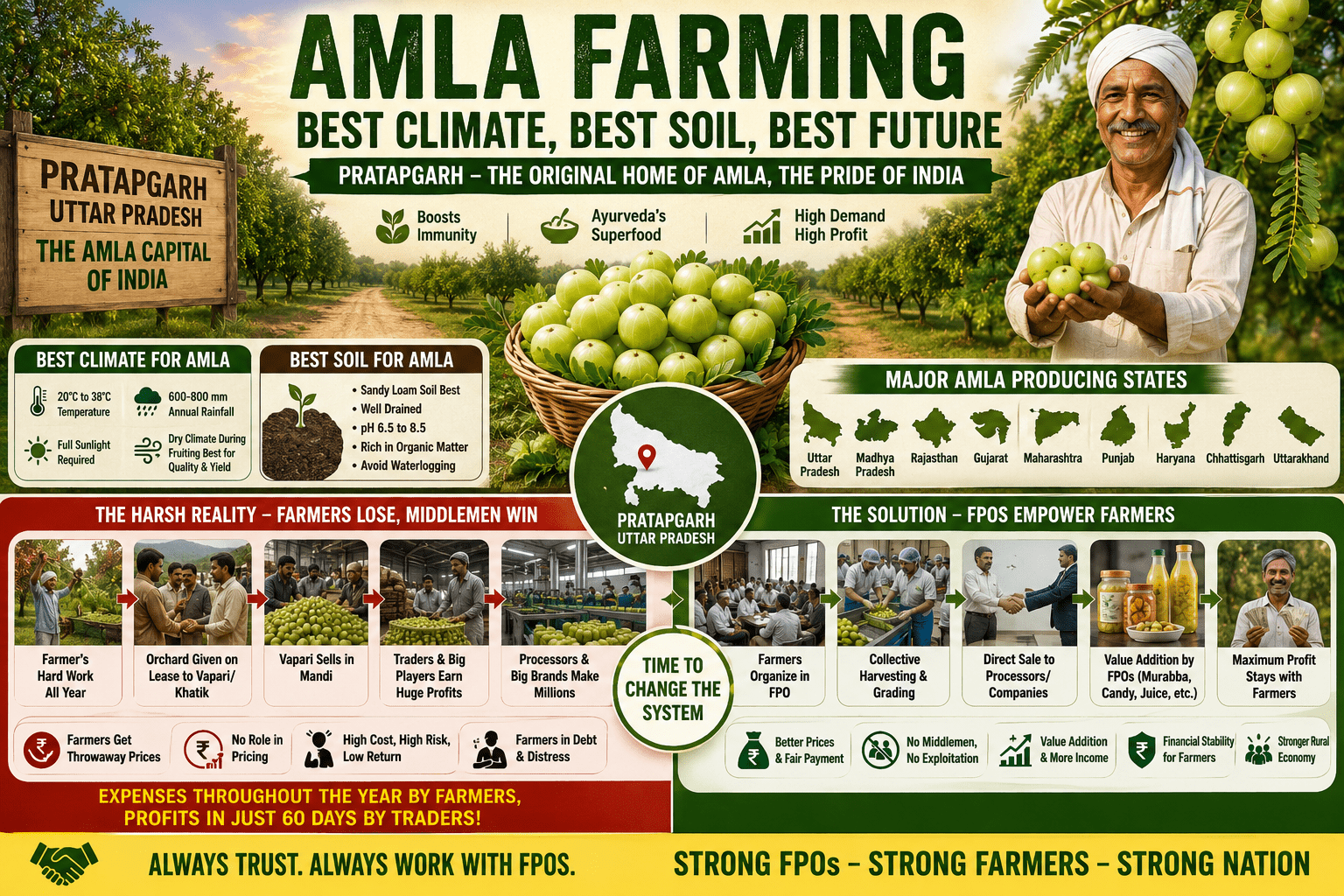
Best Climate for Amla Cultivation


6
Amla is considered a hardy fruit crop and can tolerate drought conditions better than many other fruit trees. However, proper climatic conditions are essential for achieving high yields and superior fruit quality.
Ideal Climate Conditions
Temperature
- Best temperature range: 20°C to 38°C
- Can tolerate high summer temperatures
- Mature trees can survive mild frost
Rainfall
- Moderate rainfall is ideal
- Annual rainfall requirement: 600–800 mm
- Excessive waterlogging damages roots
Sunlight
Amla requires full sunlight for better flowering, fruiting, and fruit development.
Dry Climate During Fruiting
Dry weather during maturity improves:
- Fruit quality
- Shelf life
- Vitamin C content
- Processing quality
This is one of the major reasons why regions like Pratapgarh perform exceptionally well.
Best Soil for Amla Cultivation


5
Amla can grow in a wide range of soils, which makes it suitable for many parts of India.
Ideal Soil Type
Sandy Loam Soil
Best suited for commercial cultivation because it provides:
- Good drainage
- Better root development
- Healthy tree growth
pH Range
- Ideal soil pH: 6.5 to 8.5
- Tolerates slightly alkaline soils
Drainage
Waterlogging is extremely harmful for amla orchards. Poor drainage can lead to:
- Root rot
- Fungal diseases
- Reduced fruiting
Organic Matter
Adding organic manure improves:
- Soil fertility
- Moisture retention
- Microbial activity
- Fruit quality
Major Amla Producing States in India
Apart from Pratapgarh, commercial amla cultivation is expanding in many states.
Leading States
- Uttar Pradesh
- Madhya Pradesh
- Rajasthan
- Gujarat
- Maharashtra
- Punjab
- Haryana
- Chhattisgarh
- Uttarakhand
Despite this expansion, Pratapgarh still remains one of the strongest identities associated with amla cultivation in India.
The Hidden Crisis in the Amla Industry
While consumers see amla as a profitable superfood crop, the reality faced by orchard owners is often painful and financially stressful.
Across regions like:
- Uttar Pradesh
- Uttarakhand
- Punjab
- Haryana
- Chhattisgarh
many orchard owners are trapped in an exploitative post-harvest marketing system dominated by Vapari, Khatik, traders, and mandi intermediaries.
How Vapari and Middlemen Control the Amla Market


6
During harvest season, many farmers are forced to lease their orchards to local traders known as Vapari or Khatik.
The system usually works like this:
- The trader gives a small token amount to the orchard owner.
- The trader takes complete control of harvesting.
- Fruits are sold in the mandi by the trader.
- Payments are delayed or manipulated.
- Farmers lose all pricing power.
The worst part is that farmers bear all the yearly expenses such as:
- Irrigation
- Fertilizers
- Labor
- Orchard maintenance
- Pest management
- Pruning
- Land management
But the majority of profits are captured by:
- Vapari
- Commission agents
- Mandi traders
- Large wholesalers
- Processing companies
within just a few weeks of trading.
The Broken Amla Supply Chain
Current Structure
Farmer → Vapari/Khatik → Mandi Trader → Big Trader → Processor → Retail Market
Large processing companies often procure amla through trader networks rather than directly from farmers.
Amla from orchards is eventually converted into:
- Murabba
- Candy
- Juice
- Pickles
- Herbal supplements
- Ayurvedic medicines
- Hair oil
- Powders
Yet orchard owners receive only a tiny fraction of the final market value.
This imbalance is pushing many traditional orchard owners into financial distress.
Why Many Orchard Owners Are Losing Interest
The present system is discouraging long-term orchard development because:
- Farmers are not receiving fair prices
- Market access is controlled by middlemen
- Payments are uncertain
- Input costs are increasing every year
- Small orchard owners lack bargaining power
As a result:
- Some orchards are neglected
- Some are being cut down
- Younger generations are losing interest in horticulture
If this trend continues, India risks losing traditional amla belts that took decades to develop.
👉 To learn more on Amla farming in India: complete guide for Farmers, Processing & Business Opportunities. https://belhamaifpo.com/farmer-producer-organisation/amla-farming-in-india/
How FPOs Can Transform the Amla Economy


8
Farmer Producer Organizations (FPOs) can play a revolutionary role in protecting orchard owners and rebuilding the amla value chain.
How FPOs Help Farmers
Collective Selling
FPOs aggregate produce from multiple farmers, allowing direct bulk sales.
Elimination of Middlemen
When processors buy directly from FPOs, the role of exploitative intermediaries reduces significantly.
Better Price Discovery
FPOs improve transparency and help farmers negotiate better prices.
Processing and Value Addition
FPOs can establish:
- Collection centers
- Grading units
- Storage facilities
- Processing plants
- Packaging units
This allows farmers themselves to produce:
- Amla candy
- Murabba
- Juice
- Pickles
- Herbal products
instead of selling raw fruits cheaply.
Stronger Farmer Income
The maximum share of profits stays with farming communities rather than traders.
👉 To know more about Amla farming profit per acre in India : https://belhamaifpo.com/agriculture/amla-farming-profit-per-acre-in-india-cost-income-complete-business-guide/
Why Processors Should Directly Work With FPOs
Processors and Ayurvedic companies must increasingly collaborate with farmer groups and FPOs instead of relying entirely on mandi trader networks.
Direct procurement from FPOs ensures:
- Fair pricing
- Better traceability
- Higher quality
- Sustainable sourcing
- Stronger rural economies
A healthy agricultural economy is only possible when the actual producer receives a fair share of the value chain.
Conclusion
Amla cultivation has enormous potential in India due to rising demand from Ayurvedic, nutraceutical, and food processing industries. Regions like Pratapgarh continue to lead the country because of their ideal climate, suitable soils, and generations of horticultural expertise.
However, behind the success story lies a harsh reality. Thousands of orchard owners are under tremendous pressure from an exploitative post-harvest system dominated by Vapari, mandi traders, and middlemen. Farmers bear all production costs throughout the year, yet the largest profits are captured elsewhere in the supply chain.
This system cannot sustain Indian horticulture in the long run.
Farmer Producer Organizations (FPOs) can become the real solution by connecting farmers directly with processors, exporters, retailers, and consumers. If buyers, processors, and government institutions begin trusting and working directly with FPOs, the role of unnecessary intermediaries will gradually decline, and a much larger share of profits will finally reach the orchard owners themselves.
Supporting FPOs means supporting farmers, protecting traditional orchards, strengthening rural economies, and building a more sustainable agricultural future for India.
Some useful Links:
👉 https://www.nabard.org/EngDefault.aspx
👉 https://www.uphorticulture.in/
👉 https://nhb.gov.in/schemes.aspx