Amla Processing Business in India

Introduction
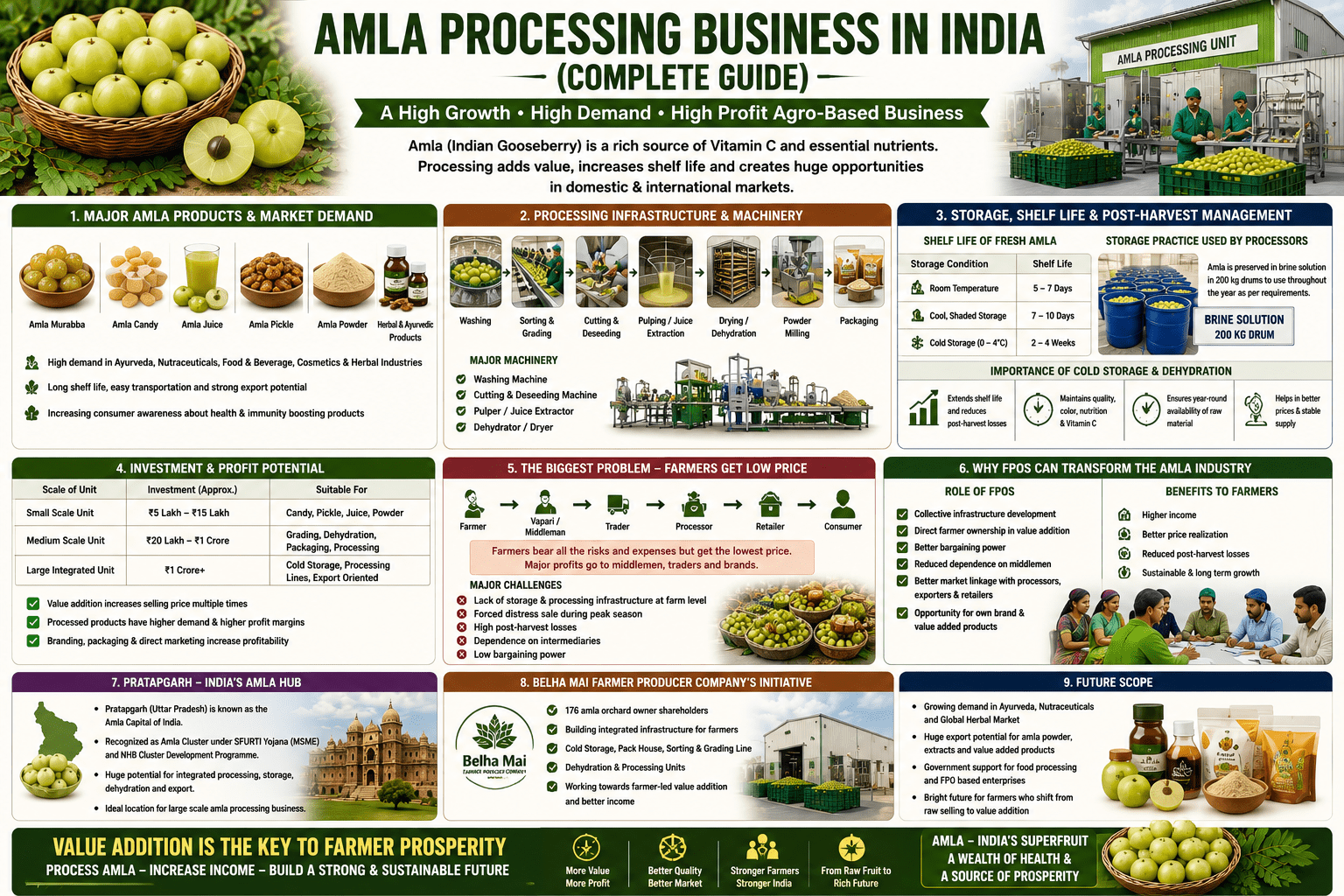
Amla processing business in India is rapidly emerging as one of the most profitable agro-based industries due to rising demand for herbal, Ayurvedic, nutraceutical, and immunity-boosting products. Amla (Indian Gooseberry) is widely recognized for its exceptionally high Vitamin C content and medicinal value, making it one of the most important raw materials in India’s herbal economy.
Today, amla is processed into:
- Murabba
- Candy
- Juice
- Pickles
- Dry powder
- Chyawanprash
- Herbal supplements
- Hair oils
- Nutraceutical ingredients
With increasing awareness about natural health products, the market for processed amla products is growing rapidly across:
- domestic retail,
- Ayurveda industries,
- food processing sectors,
- and export markets.
However, despite this growing demand, most orchard owners still receive low prices because the processing sector is dominated by traders and intermediaries instead of farmers.
In this blog, we will understand:
- amla processing business opportunities,
- investment requirements,
- processing methods,
- machinery,
- market demand,
- profit potential,
- major challenges,
- and the role of FPOs in transforming the amla value chain.
👉 To Learn More on Amla farming in India: complete guide for Farmers, Processing & Business Opportunities https://belhamaifpo.com/farmer-producer-organisation/amla-farming-in-india/
Why Amla Processing Business Is Growing in India
India is one of the world’s largest producers of amla, and demand for processed products continues to rise due to increasing focus on:
- immunity,
- Ayurveda,
- herbal wellness,
- and preventive healthcare.
Major Growth Drivers
Rising Health Awareness
Consumers are shifting toward natural and herbal products.
Expansion of Ayurveda Industry
Ayurvedic companies use large quantities of amla.
Nutraceutical Demand
Amla powder and extracts are increasingly used in supplements.
Export Opportunities
Demand for herbal ingredients is growing internationally.
Longer Shelf Life
Processed products are easier to store and transport compared to fresh fruits.
👉 To Learn More on Amla storage and shelf life management https://belhamaifpo.com/agriculture/amla-storage-and-shelf-life-management/
Major Amla Products in India

1. Amla Murabba
One of the most traditional and popular products.
Demand
- Household consumption
- Ayurvedic use
- Retail markets
2. Amla Candy
Popular among health-conscious consumers and children.
Types
- Sweet candy
- Spicy candy
- Honey-coated candy
3. Amla Juice
Widely consumed as a health drink.
Growing Market
- Wellness stores
- Ayurveda outlets
- Online health brands
4. Dry Amla Powder
Dry amla powder is becoming one of the fastest-growing products because of:
- long shelf life,
- easier transportation,
- export demand,
- and nutraceutical applications.
In many cases, dry powder now has more future potential than:
- Murabba
- Laddu
- Traditional sweets
5. Amla Pickle
Strong demand in Indian households and food markets.
6. Herbal and Ayurvedic Products
Amla is extensively used in:
- Chyawanprash
- Herbal tablets
- Capsules
- Hair oils
- Wellness products
Raw Material Availability
Pratapgarh is considered one of India’s most important amla-growing regions and is widely recognized as the traditional Amla Capital of India.
Major amla-producing states include:
- Uttar Pradesh
- Madhya Pradesh
- Rajasthan
- Punjab
- Haryana
- Chhattisgarh
- Uttarakhand
Easy access to raw material is one of the biggest advantages of starting an amla processing business in these regions.
👉 To Learn More on Post-harvest management of amla : https://belhamaifpo.com/farmer-producer-organisation/post-harvest-management-of-amla/
Machinery Required for Amla Processing Business
Basic Machinery
Washing Unit
Used for cleaning fruits.
Cutting and Deseeding Machine
Improves efficiency and reduces labor cost.
Pulper Machine
Used for juice and pulp extraction.
Dryer or Dehydration Unit
Critical for powder production.
Grading and Sorting Line
Improves quality and uniformity.
Packaging Machine
Required for retail-ready products.
Cold Storage Facility
Helps maintain raw material quality.
Importance of Cold Storage and Dehydration


One of the biggest problems in India’s amla sector is the lack of:
- cold storage,
- dehydration facilities,
- and integrated post-harvest infrastructure.
Currently, many processors preserve amla in:
- brine solution,
- salt preservation systems,
- or chemical tanks
inside large 200 kg drums for year-round usage.
However, ordinary orchard owners and farmers usually have no storage facility at all.
This results in:
- heavy post-harvest losses,
- distress sales,
- and trader domination.
Modern infrastructure can:
- extend shelf life,
- reduce wastage,
- improve quality,
- and stabilize prices.
Investment Required for Amla Processing Business
Small-Scale Unit
👉 ₹5 lakh – ₹15 lakh
Suitable for:
- candy,
- pickle,
- powder,
- and juice production.
Medium-Scale Processing Unit
👉 ₹20 lakh – ₹1 crore
Includes:
- grading line,
- dehydration,
- packaging,
- and semi-automatic processing.
Large Integrated Unit
👉 ₹1 crore+
Includes:
- cold storage,
- pack house,
- modern processing lines,
- and export-oriented systems.
Profit Potential in Amla Processing Business
Why Processing Is More Profitable
Raw fruits have lower margins compared to processed products.
For example:
- Fresh amla may sell at ₹20–₹40/kg
- Processed products can generate several times higher value
Value addition significantly increases:
- shelf life,
- branding opportunities,
- and profitability.
The Biggest Problem: Farmers Have No Role in Processing Profits
Despite producing the raw material, orchard owners often receive the smallest share of the value chain.
In many regions:
- farmers lease orchards to Vapari or traders,
- traders control mandi sales,
- processors procure through intermediaries,
- and farmers lose pricing power.
The current supply chain often works like this:
Farmer → Vapari → Trader → Processor → Retailer → Consumer
Meanwhile:
- farmers bear yearly orchard expenses,
- but major profits go to intermediaries and branding companies.
👉 To Learn more on Amla farming profit per acre in India : https://belhamaifpo.com/agriculture/amla-farming-profit-per-acre-in-india-cost-income-complete-business-guide/
Why FPOs Can Transform the Amla Processing Industry
Farmer Producer Organizations (FPOs) can completely transform the amla processing ecosystem.
Role of FPOs
Direct Farmer Ownership
Farmers themselves become stakeholders in value addition.
Collective Processing Infrastructure
FPOs can establish:
- dehydration units,
- pack houses,
- grading systems,
- and processing facilities.
Better Market Linkage
FPOs can directly supply:
- retailers,
- exporters,
- herbal industries,
- and nutraceutical companies.
Reduction of Middlemen
Direct marketing improves farmer margins.
Branding Opportunities
FPOs can build regional brands around:
- organic products,
- cluster identity,
- and farmer-led processing.
Pratapgarh’s Emerging Role in Amla Processing
Pratapgarh is increasingly emerging as a major center for integrated amla value chain development.
The district is recognized:
- under SFURTI Yojana by MSME as an Amla Cluster,
- and under NHB cluster development initiatives.
This creates huge opportunities for:
- processing infrastructure,
- cold storage,
- dehydration,
- branding,
- and export-oriented development.
Belha Mai Farmer Producer Company’s Initiative
Belha Mai Farmer Producer Company is playing a critical role in strengthening the amla ecosystem in Pratapgarh.
The organization currently has:
- 176 amla orchard owners as shareholders
and is actively working toward developing:
- cold storage,
- pack houses,
- sorting and grading lines,
- dehydration systems,
- and integrated farmer-led infrastructure.
This initiative has the potential to make Pratapgarh a pioneering model for FPO-led amla processing and post-harvest management in India.
Future Scope of Amla Processing Business
India’s herbal and wellness economy is growing rapidly.
Demand for:
- herbal products,
- dry amla powder,
- nutraceutical ingredients,
- immunity boosters,
- and natural Vitamin C
is expected to rise strongly in coming years.
This creates huge opportunities for:
- value addition,
- FPO-led processing,
- export business,
- and farmer-owned brands.
Conclusion
Amla processing business in India has enormous growth potential because of rising demand from Ayurveda, nutraceutical, food processing, and herbal wellness industries.
However, the biggest challenge today is that orchard owners still remain disconnected from value addition profits due to trader-controlled supply chains and weak post-harvest infrastructure.
Scientific cold storage, dehydration systems, grading lines, pack houses, and FPO-led processing infrastructure can completely transform the amla economy by:
- reducing losses,
- increasing shelf life,
- improving farmer bargaining power,
- and ensuring better price realization.
The work being undertaken in Pratapgarh by Belha Mai Farmer Producer Company represents an important step toward building a farmer-led integrated amla processing ecosystem in India.
With proper infrastructure, policy support, and direct market linkage, Pratapgarh can emerge as one of India’s leading centers for scientific amla processing and value-added agriculture.
Some useful links
👉 https://www.uphorticulture.in/