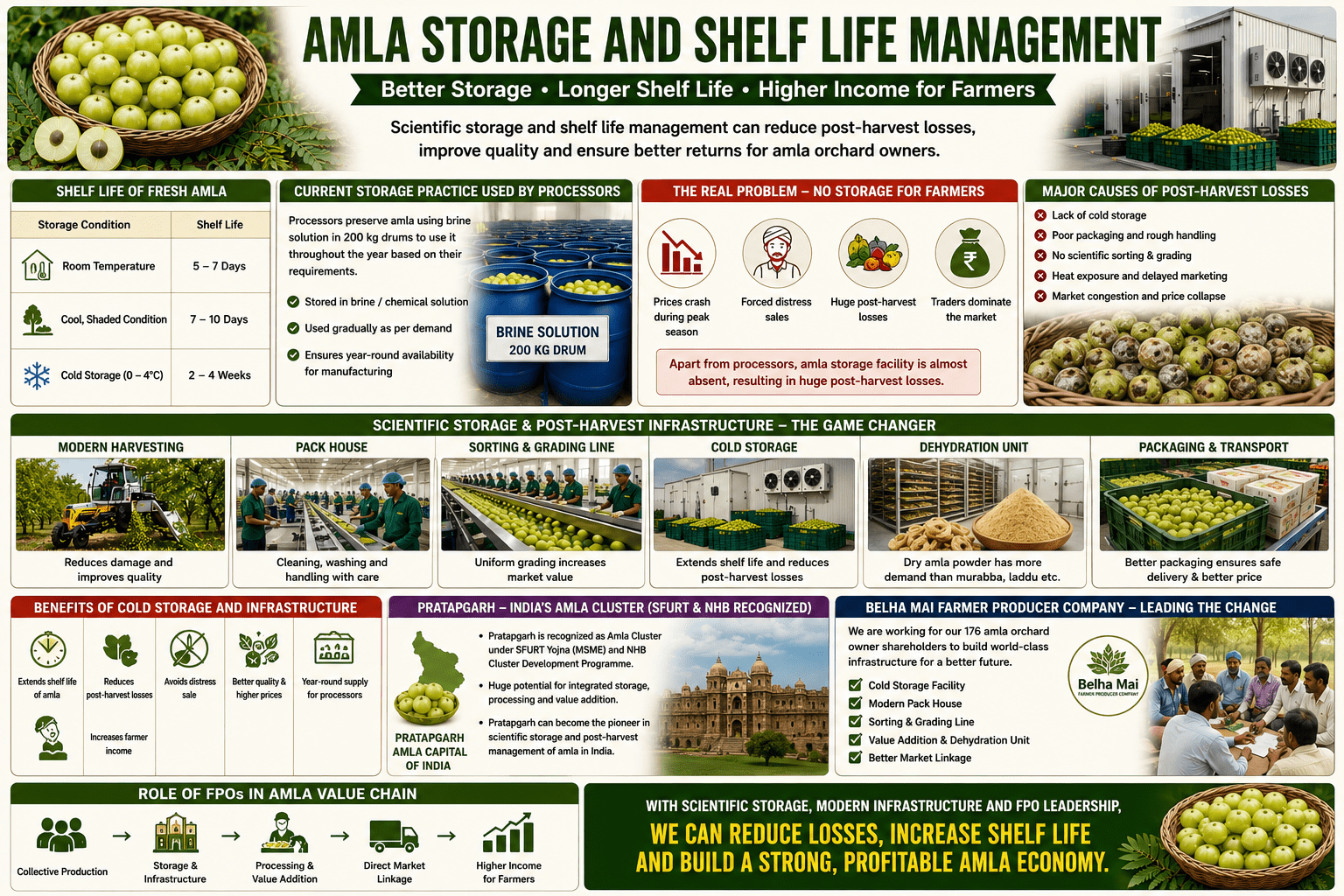
Amla Storage and Shelf Life Management

Introduction
Amla storage and shelf life management is becoming one of the most important challenges in India’s horticulture sector. Although India is one of the largest producers of amla (Indian Gooseberry), proper scientific storage infrastructure is still missing in almost all major amla-growing clusters.
As a result:
- huge quantities of fruits are wasted,
- prices crash during peak harvesting season,
- farmers are forced into distress sales,
- and traders dominate the market.
Fresh amla has a short shelf life if not managed scientifically. Without proper storage:
- fruits lose moisture,
- fungal infection increases,
- Vitamin C quality declines,
- and market value drops rapidly.
Today, most storage systems are available only with large processors while ordinary orchard owners and farming communities have almost no access to scientific storage infrastructure.
In this blog, we will understand:
- shelf life of amla,
- current processor storage practices,
- post-harvest losses,
- cold storage importance,
- dehydration opportunities,
- and how FPO-led infrastructure can transform the amla economy.
👉 Learn about Post-harvest management of amla : https://belhamaifpo.com/farmer-producer-organisation/post-harvest-management-of-amla/
Why Amla Storage and Shelf Life Management Is Important
Scientific amla storage and shelf life management helps:
- reduce post-harvest losses,
- improve quality,
- extend shelf life,
- stabilize prices,
- and increase farmer income.
Amla is widely used in:
- Murabba
- Candy
- Juice
- Chyawanprash
- Herbal supplements
- Ayurvedic medicines
- Dry amla powder
Modern processing industries require:
- clean fruits,
- uniform grading,
- scientific handling,
- and year-round supply.
Without storage systems, farmers lose bargaining power completely.
Shelf Life of Fresh Amla
Under Normal Conditions
| Storage Condition | Shelf Life |
|---|---|
| Room temperature | 5–7 days |
| Cool shaded storage | 7–10 days |
| Cold storage | 2–4 weeks |
This short shelf life is one of the biggest reasons behind distress sales during harvesting season.
Current Storage Practice Used by Processors


Currently, many processors preserve amla using:
- brine solution,
- salt preservation systems,
- or chemical preservation tanks
inside large 200 kg drums.
These preserved fruits are then gradually used throughout the year based on manufacturing requirements.
This system helps processors manufacture:
- Murabba
- Candy
- Juice
- Herbal products
- Ayurvedic medicines
even after the harvesting season is over.
However, this type of scientific storage system is generally available only with processors and traders — not with farmers.
👉 Learn about Amla farming in India: complete guide for Farmers, Processing & Business Opportunities : https://belhamaifpo.com/farmer-producer-organisation/amla-farming-in-india/
The Real Problem: Storage Infrastructure for Farmers Is Almost Absent
The harsh reality is that apart from processors, proper amla storage facilities are almost absent in most growing clusters of India.
Because of this:
- prices collapse during peak arrivals,
- fruits spoil rapidly,
- traders exploit farmers,
- and post-harvest losses increase massively.
In most regions:
- Uttar Pradesh
- Punjab
- Haryana
- Uttarakhand
- Chhattisgarh
farmers are forced to sell quickly because they have no storage options.
Major Causes of Post-Harvest Losses
1. Lack of Cold Storage
Fresh fruits deteriorate quickly.
2. Poor Packaging
Rough transportation damages fruits.
3. No Scientific Grading
Mixed-quality produce reduces market value.
4. Delayed Processing
Processing delays increase spoilage.
5. Heat Exposure
Direct exposure reduces freshness and quality.
Why Cold Storage Will Transform the Amla Industry


Cold storage infrastructure can completely reshape the amla economy.
Benefits of Cold Storage
Extends Shelf Life
Fruits remain fresh longer.
Reduces Distress Sale
Farmers can wait for better prices.
Improves Processing Planning
Processors receive stable supply.
Reduces Wastage
Post-harvest losses decrease significantly.
Improves Farmer Bargaining Power
Farmers gain control over selling decisions.
Dehydration: A Huge Untapped Opportunity
One of the most neglected sectors in India’s amla industry is dehydration and dry powder processing.
Why Dry Amla Powder Has Huge Future Demand
Dry amla powder today has:
- higher demand,
- longer shelf life,
- easier transportation,
- and growing export opportunities.
Demand is rapidly increasing in:
- Ayurveda,
- nutraceutical industries,
- herbal supplements,
- and health products.
In many cases, dry amla powder has more demand than:
- Murabba
- Laddu
- Candy
Yet dehydration infrastructure is almost absent in most amla-growing clusters.
This is a major missed opportunity for farmers and FPOs.
👉 Learn about Amla farming profit per acre in India : https://belhamaifpo.com/agriculture/amla-farming-profit-per-acre-in-india-cost-income-complete-business-guide/
Pratapgarh: India’s Emerging Amla Infrastructure Hub
Pratapgarh has historically been recognized as one of India’s most important amla-growing regions.
The district has now gained even greater importance because:
- SFURTI Yojana under MSME recognizes Pratapgarh as an Amla Cluster,
- and NHB cluster development programs also recognize the region.
This creates huge opportunities for:
- integrated cold storage,
- pack houses,
- grading systems,
- dehydration units,
- and scientific post-harvest management.
Belha Mai Farmer Producer Company’s Pioneering Initiative


Belha Mai Farmer Producer Company is playing a critical role in transforming the amla ecosystem of Pratapgarh.
The organization currently has:
- 176 amla orchard owners as shareholders
and is actively working toward developing:
- cold storage facilities,
- modern pack houses,
- sorting and grading lines,
- dehydration infrastructure,
- and integrated post-harvest systems.
This project is highly significant because such infrastructure is still absent in almost all amla-growing states of India.
Pratapgarh has the potential to become:
- India’s first scientifically integrated amla storage cluster,
- a national model for FPO-led infrastructure,
- and a pioneer in farmer-led horticulture value chain development.
Role of FPOs in Amla Storage and Shelf Life Management
Farmer Producer Organizations (FPOs) can completely transform the current amla value chain.
Role of FPOs
Collective Infrastructure Development
FPOs can establish:
- cold stores,
- grading systems,
- dehydration units,
- pack houses,
- and transportation systems.
Better Market Timing
Farmers can avoid distress selling.
Value Addition
FPOs can manufacture:
- dry amla powder,
- juice,
- candy,
- herbal products,
- and nutraceutical ingredients.
Direct Market Linkage
FPOs can directly connect with:
- processors,
- exporters,
- retailers,
- and herbal industries.
Higher Farmer Share
The maximum value remains with farming communities instead of middlemen.
Conclusion
Amla storage and shelf life management is becoming one of the most important pillars of the future amla economy in India.
At present, scientific storage infrastructure is almost absent for ordinary orchard owners, resulting in:
- huge post-harvest losses,
- distress sales,
- trader domination,
- and low farmer income.
Modern cold storage systems, grading lines, dehydration units, and integrated pack houses can completely transform the industry by:
- reducing losses,
- increasing shelf life,
- improving quality,
- and strengthening farmer bargaining power.
The pioneering infrastructure work being undertaken in Pratapgarh by Belha Mai Farmer Producer Company represents a major step toward building India’s first integrated farmer-led amla post-harvest ecosystem.
With proper support, Pratapgarh can emerge as a national leader in scientific amla storage and value chain management.
Some useful links:
🔗 https://nduat.org/ , https://ayush.gov.in/
🔗 https://www.uphorticulture.in/