Farmer Producer Organizations (FPOs) in India भारत में किसान उत्पादक संगठन (एफपीओ)
Introduction / परिचय
Farmer Producer Organizations (FPOs) are becoming one of the most important farmer-owned institutions in India because they help small and marginal farmers work collectively, reduce input costs, improve bargaining power, access better markets, and build sustainable rural businesses.
Hindi below it:
किसान उत्पादक संगठन (एफपीओ) भारत में किसानों की सबसे महत्वपूर्ण सामूहिक संस्थाओं में से एक बन रहे हैं क्योंकि ये छोटे और सीमांत किसानों को मिलकर काम करने, लागत कम करने, सौदेबाजी शक्ति बढ़ाने, बेहतर बाजार तक पहुंच बनाने और टिकाऊ ग्रामीण व्यवसाय विकसित करने में मदद करते हैं।
An FPO helps farmers work as a collective business enterprise. Instead of selling individually with limited bargaining power, farmers can come together, aggregate produce, purchase inputs in bulk, connect with buyers, access government schemes, and build long-term business opportunities.
एफपीओ किसानों को सामूहिक व्यवसायिक संस्था के रूप में काम करने में मदद करता है। अकेले बेचने के बजाय किसान मिलकर उपज का एकत्रीकरण कर सकते हैं, थोक में इनपुट खरीद सकते हैं, खरीदारों से जुड़ सकते हैं, सरकारी योजनाओं का लाभ ले सकते हैं और लंबे समय के व्यवसायिक अवसर बना सकते हैं।
However, FPO registration should not be treated only as a legal process. It requires proper planning, active farmer members, correct legal structure, complete documentation, professional guidance, and a clear business model.
लेकिन एफपीओ पंजीकरण को केवल कानूनी प्रक्रिया नहीं समझना चाहिए। इसके लिए सही योजना, सक्रिय किसान सदस्य, सही कानूनी संरचना, पूर्ण दस्तावेज, पेशेवर मार्गदर्शन और स्पष्ट व्यवसाय मॉडल की आवश्यकता होती है।
Farmer Producer Organizations (FPOs) in India / भारत में किसान उत्पादक संगठन (एफपीओ)
Before understanding the registration process, it is important to understand what an FPO is. An FPO is a legally registered organization formed by farmers to collectively undertake agricultural and related business activities.
पंजीकरण प्रक्रिया को समझने से पहले यह जानना जरूरी है कि एफपीओ क्या होता है। एफपीओ किसानों द्वारा बनाई गई एक कानूनी रूप से पंजीकृत संस्था होती है, जो कृषि और उससे जुड़ी व्यवसायिक गतिविधियों को सामूहिक रूप से संचालित करती है।
Through an FPO, farmers can purchase seeds, fertilizers, pesticides, organic inputs, and machinery services at better rates. They can also sell produce collectively, reduce dependence on middlemen, enter into direct market linkages, and develop value-added products.
एफपीओ के माध्यम से किसान बीज, खाद, कीटनाशक, जैविक इनपुट और कृषि मशीनरी सेवाएं बेहतर दरों पर प्राप्त कर सकते हैं। वे अपनी उपज को सामूहिक रूप से बेच सकते हैं, बिचौलियों पर निर्भरता कम कर सकते हैं, सीधे बाजार से जुड़ सकते हैं और मूल्य संवर्धित उत्पाद बना सकते हैं।
👉 https://belhamaifpo.com/agriculture/what-is-fpo-in-india/
Eligibility Criteria for FPO Registration / एफपीओ पंजीकरण के लिए पात्रता
To register an FPO in India, farmers must fulfill some basic eligibility conditions. The most common structure for FPO registration is the Producer Company model, where a minimum group of producer members is required.
भारत में एफपीओ पंजीकरण के लिए किसानों को कुछ मूल पात्रता शर्तें पूरी करनी होती हैं। एफपीओ पंजीकरण के लिए सबसे सामान्य संरचना Producer Company model है, जिसमें उत्पादक सदस्यों का न्यूनतम समूह आवश्यक होता है।
Generally, an FPO requires a minimum of 10 individual farmers or 2 producer institutions. Members must be engaged in agriculture or allied activities such as horticulture, dairy, beekeeping, fisheries, forestry, food processing, or other primary production activities.
सामान्यतः एफपीओ के लिए न्यूनतम 10 व्यक्तिगत किसान या 2 उत्पादक संस्थाएं आवश्यक होती हैं। सदस्य कृषि या उससे जुड़ी गतिविधियों जैसे बागवानी, डेयरी, मधुमक्खी पालन, मत्स्य पालन, वानिकी, खाद्य प्रसंस्करण या अन्य प्राथमिक उत्पादन गतिविधियों से जुड़े होने चाहिए।
The members should have a common objective of improving income, reducing costs, increasing bargaining power, and building a collective business organization.
सदस्यों का साझा उद्देश्य आय बढ़ाना, लागत कम करना, सौदेबाजी शक्ति बढ़ाना और सामूहिक व्यवसायिक संस्था बनाना होना चाहिए।
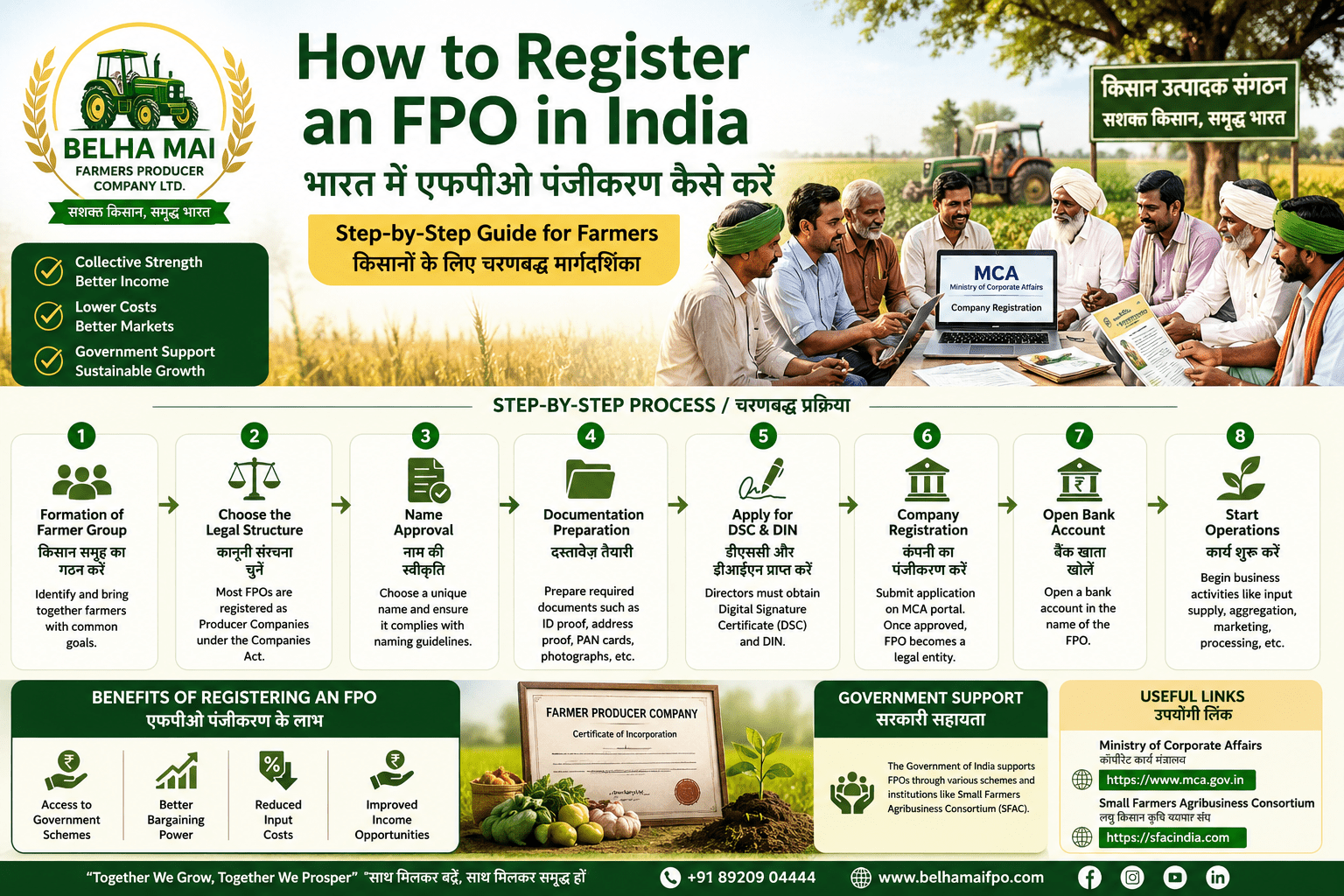
Formation of Farmer Group / किसान समूह का गठन
The first step in FPO registration is to form a group of farmers with common interests. These farmers may belong to the same village, block, crop cluster, or agricultural activity.
एफपीओ पंजीकरण का पहला कदम समान रुचि वाले किसानों का समूह बनाना है। ये किसान एक ही गांव, ब्लॉक, फसल क्लस्टर या कृषि गतिविधि से जुड़े हो सकते हैं।
This group becomes the foundation of the FPO. Therefore, members should be active, serious, and willing to participate in collective business activities. Farmers should avoid adding inactive members only to complete the minimum registration requirement.
यही समूह एफपीओ की नींव बनता है। इसलिए सदस्य सक्रिय, गंभीर और सामूहिक व्यवसायिक गतिविधियों में भाग लेने के इच्छुक होने चाहिए। केवल न्यूनतम पंजीकरण आवश्यकता पूरी करने के लिए निष्क्रिय सदस्यों को जोड़ने से बचना चाहिए।
At this stage, farmers should discuss the purpose of the FPO. The objective may be input supply, produce aggregation, processing, marketing, machinery services, branding, or direct buyer linkage.
इस चरण में किसानों को एफपीओ का उद्देश्य तय करना चाहिए। उद्देश्य input supply, produce aggregation, processing, marketing, machinery services, branding या direct buyer linkage हो सकता है।
Farmer Producer Organizations (FPOs) Choose the Legal Structure / कानूनी संरचना चुनें
After forming the farmer group, the next step is to choose the correct legal structure. Most FPOs in India are registered as Producer Companies under the Companies Act because this structure supports farmer ownership, professional management, business operations, and growth.
किसान समूह बनने के बाद अगला कदम सही कानूनी संरचना चुनना है। भारत में अधिकांश एफपीओ Companies Act के अंतर्गत Producer Company के रूप में पंजीकृत होते हैं क्योंकि यह संरचना किसान स्वामित्व, पेशेवर प्रबंधन, व्यवसायिक संचालन और विकास को समर्थन देती है।
A Producer Company combines the benefits of a company and the values of a cooperative. It gives the FPO a formal legal identity while keeping farmers at the center of ownership and decision-making.
Producer Company कंपनी के लाभ और सहकारी संस्था के मूल्यों को जोड़ती है। इससे एफपीओ को औपचारिक कानूनी पहचान मिलती है और स्वामित्व व निर्णय प्रक्रिया में किसान केंद्र में रहते हैं।
Choosing the wrong legal structure may create problems in compliance, funding, business expansion, and governance. Therefore, this decision should be taken carefully.
गलत कानूनी संरचना चुनने से अनुपालन, फंडिंग, व्यवसाय विस्तार और governance में समस्या हो सकती है। इसलिए यह निर्णय सावधानी से लेना चाहिए।
Farmer Producer Organizations (FPOs) Name Approval / नाम की स्वीकृति
After choosing the legal structure, the proposed FPO must select a suitable and unique name. The name should be simple, professional, meaningful, and suitable for long-term identity.
कानूनी संरचना चुनने के बाद प्रस्तावित एफपीओ को एक उपयुक्त और unique name चुनना चाहिए। नाम सरल, professional, अर्थपूर्ण और लंबे समय की पहचान के लिए उपयुक्त होना चाहिए।
The name should not be identical or too similar to any existing company name or registered trademark. A good name helps build credibility among farmers, banks, buyers, government departments, and business partners.
नाम किसी existing company या registered trademark से समान या बहुत मिलता-जुलता नहीं होना चाहिए। अच्छा नाम किसानों, बैंकों, खरीदारों, सरकारी विभागों और business partners के बीच credibility बनाता है।
Once the name is approved, the registration process can move forward.
नाम स्वीकृत होने के बाद पंजीकरण प्रक्रिया आगे बढ़ सकती है।
Documentation Preparation / दस्तावेजों की तैयारी
Documentation is one of the most important parts of FPO registration. Many applications get delayed because documents are incomplete, outdated, unclear, or mismatched.
दस्तावेजों की तैयारी एफपीओ पंजीकरण का सबसे महत्वपूर्ण हिस्सा है। कई आवेदन इसलिए देरी का सामना करते हैं क्योंकि documents अधूरे, पुराने, अस्पष्ट या mismatch होते हैं।
Important documents generally include identity proof, address proof, PAN card, passport-size photographs, registered office proof, Digital Signature Certificate, Director Identification Number, Memorandum of Association, Articles of Association, and other legal papers.
महत्वपूर्ण दस्तावेजों में सामान्यतः identity proof, address proof, PAN card, passport-size photographs, registered office proof, Digital Signature Certificate, Director Identification Number, Memorandum of Association, Articles of Association और अन्य legal papers शामिल होते हैं।
Farmers should verify every document before submission. Names, addresses, PAN details, mobile numbers, and signatures should match correctly.
किसानों को submission से पहले हर दस्तावेज की जांच करनी चाहिए। नाम, पता, PAN details, mobile number और signatures सही तरीके से मेल खाने चाहिए।
Apply for DSC and DIN / DSC और DIN के लिए आवेदन करें
For online company registration, proposed directors must obtain a Digital Signature Certificate, commonly called DSC. DSC is used to digitally sign electronic forms submitted through the Ministry of Corporate Affairs system.
Online company registration के लिए proposed directors को Digital Signature Certificate यानी DSC प्राप्त करना होता है। DSC का उपयोग Ministry of Corporate Affairs system में electronic forms पर digital signature करने के लिए होता है।
Directors also require a Director Identification Number, known as DIN. DIN is a unique identification number for directors and is important for company governance and compliance.
Directors को Director Identification Number यानी DIN की भी आवश्यकता होती है। DIN directors के लिए unique identification number होता है और company governance व compliance के लिए महत्वपूर्ण होता है।
Without DSC and DIN, FPO registration cannot be completed properly. Therefore, this step should be completed carefully with proper guidance.
DSC और DIN के बिना एफपीओ पंजीकरण सही तरीके से पूरा नहीं हो सकता। इसलिए यह चरण सही मार्गदर्शन के साथ सावधानी से पूरा करना चाहिए।
Company Registration / कंपनी पंजीकरण
After completing the documents, DSC, DIN, and name approval, the incorporation application is submitted through the Ministry of Corporate Affairs portal. This is the official legal registration stage.
Documents, DSC, DIN और name approval पूरा होने के बाद incorporation application Ministry of Corporate Affairs portal के माध्यम से submit किया जाता है। यही official legal registration stage है।
The application includes company forms, member details, director details, registered office details, MOA, AOA, and other supporting documents. If all documents are correct, the Registrar of Companies approves the incorporation.
Application में company forms, member details, director details, registered office details, MOA, AOA और अन्य supporting documents शामिल होते हैं। यदि सभी दस्तावेज सही होते हैं, तो Registrar of Companies incorporation approve करता है।
After approval, the FPO receives a Certificate of Incorporation. From this stage, the FPO becomes a legal entity and can operate formally.
Approval के बाद एफपीओ को Certificate of Incorporation प्राप्त होता है। इस चरण से एफपीओ legal entity बन जाता है और औपचारिक रूप से काम कर सकता है।
Open Bank Account / बैंक खाता खोलना
After registration, the FPO should open a bank account in its own name. This account is necessary for member share capital, business income, payments, loans, grants, and government support.
पंजीकरण के बाद एफपीओ को अपने नाम से bank account खोलना चाहिए। यह account member share capital, business income, payments, loans, grants और government support के लिए आवश्यक होता है।
The bank may ask for documents such as Certificate of Incorporation, PAN, board resolution, address proof, KYC documents of directors, and other compliance papers.
बैंक Certificate of Incorporation, PAN, board resolution, address proof, directors के KYC documents और अन्य compliance papers मांग सकता है।
A separate FPO bank account improves transparency, accounting, and financial discipline from the beginning.
अलग एफपीओ bank account शुरुआत से transparency, accounting और financial discipline को मजबूत बनाता है।
Start Operations / संचालन शुरू करें
After registration and bank account opening, the FPO can start its business operations. But operations should begin with a clear plan and not randomly.
पंजीकरण और bank account opening के बाद एफपीओ अपना business operations शुरू कर सकता है। लेकिन संचालन स्पष्ट योजना के साथ शुरू होना चाहिए, random तरीके से नहीं।
The FPO can begin activities such as input supply, seed distribution, fertilizer supply, pesticide supply, farm machinery services, aggregation, grading, sorting, processing, packaging, branding, and marketing.
एफपीओ input supply, seed distribution, fertilizer supply, pesticide supply, farm machinery services, aggregation, grading, sorting, processing, packaging, branding और marketing जैसी गतिविधियां शुरू कर सकता है।
A good FPO should maintain proper records from day one, including purchase register, sales register, stock register, cash book, bank book, invoices, member register, board meeting records, and compliance files.
एक अच्छे एफपीओ को पहले दिन से सही records रखने चाहिए, जैसे purchase register, sales register, stock register, cash book, bank book, invoices, member register, board meeting records और compliance files।
Benefits of Registering an FPO / एफपीओ पंजीकरण के लाभ
Registering an FPO gives farmers a legal platform to work collectively. It helps farmers improve bargaining power, reduce input costs, access better markets, and build a farmer-owned business institution.
एफपीओ पंजीकरण किसानों को सामूहिक रूप से काम करने का कानूनी मंच देता है। इससे किसान bargaining power बढ़ा सकते हैं, input costs कम कर सकते हैं, बेहतर बाजार तक पहुंच सकते हैं और किसान-स्वामित्व वाली व्यवसायिक संस्था बना सकते हैं।
An FPO can help farmers purchase inputs in bulk, sell produce collectively, access institutional buyers, use government schemes, apply for loans, and develop value-added products.
एफपीओ किसानों को थोक में inputs खरीदने, सामूहिक रूप से उपज बेचने, institutional buyers तक पहुंचने, government schemes का लाभ लेने, loans के लिए आवेदन करने और value-added products बनाने में मदद कर सकता है।
Benefits of joining an FPO → https://belhamaifpo.com/agriculture/top-benefits-of-joining-an-fpo-for-small-farmers-in-india/
Common Mistakes to Avoid / सामान्य गलतियाँ जिनसे बचना चाहिए
While registering an FPO, farmers should avoid common mistakes such as lack of planning, poor documentation, weak member participation, wrong legal structure, and no clear business model.
एफपीओ पंजीकरण के दौरान किसानों को योजना की कमी, खराब दस्तावेज, कमजोर सदस्य भागीदारी, गलत कानूनी संरचना और clear business model की कमी जैसी गलतियों से बचना चाहिए।
An FPO should not be formed only to receive grants or subsidies. It should be created as a real farmer-owned business institution with long-term economic activity.
एफपीओ केवल grants या subsidies लेने के लिए नहीं बनाना चाहिए। इसे वास्तविक किसान-स्वामित्व वाली व्यवसायिक संस्था के रूप में बनाना चाहिए, जिसमें दीर्घकालिक आर्थिक गतिविधि हो।
If planning is weak at the beginning, the FPO may become inactive after registration. Therefore, farmers should prepare properly before starting the process.
यदि शुरुआत में planning कमजोर होती है, तो एफपीओ पंजीकरण के बाद inactive हो सकता है। इसलिए किसानों को प्रक्रिया शुरू करने से पहले सही तैयारी करनी चाहिए।
Government Support for FPOs / एफपीओ के लिए सरकारी सहायता
The Government of India actively promotes FPOs through different schemes, institutions, and support systems. Organizations such as Small Farmers Agribusiness Consortium provide support for FPO development.
भारत सरकार विभिन्न schemes, institutions और support systems के माध्यम से एफपीओ को बढ़ावा देती है। Small Farmers Agribusiness Consortium जैसी संस्थाएं एफपीओ विकास में सहयोग करती हैं।
Government support may include capacity building, training, equity grant, credit guarantee, market linkage support, infrastructure assistance, and technical guidance.
सरकारी सहायता में capacity building, training, equity grant, credit guarantee, market linkage support, infrastructure assistance और technical guidance शामिल हो सकते हैं।
However, farmers should remember that long-term success depends not only on government support but also on strong governance, active members, financial discipline, professional management, and market linkage.
लेकिन किसानों को याद रखना चाहिए कि लंबे समय की सफलता केवल सरकारी सहायता पर निर्भर नहीं होती, बल्कि strong governance, active members, financial discipline, professional management और market linkage पर निर्भर करती है।
Conclusion / निष्कर्ष
Knowing Farmer Producer Organizations (FPOs) is the first step toward building a strong farmer-led organization. With proper planning, documentation, active members, correct legal structure, and collective effort, farmers can create a sustainable and profitable business model.
भारत में किसान उत्पादक संगठन (एफपीओ), यह जानना एक मजबूत किसान-नेतृत्व वाली संस्था बनाने की दिशा में पहला कदम है। सही planning, documentation, active members, correct legal structure और collective effort के साथ किसान एक sustainable और profitable business model बना सकते हैं।
A registered FPO can help farmers reduce input costs, improve market access, increase bargaining power, access government schemes, create rural employment, and build value-added agricultural products.
Registered FPO किसानों को input costs कम करने, market access सुधारने, bargaining power बढ़ाने, government schemes तक पहुंच बनाने, rural employment पैदा करने और value-added agricultural products बनाने में मदद कर सकता है।
Registration is only the beginning. The real success of an FPO depends on how well it is managed after registration.
पंजीकरण केवल शुरुआत है। एफपीओ की वास्तविक सफलता इस बात पर निर्भर करती है कि registration के बाद उसका संचालन कितनी अच्छी तरह किया जाता है।
Some usefull Links:-
👉 https://www.nabard.org/EngDefault.aspx
👉 https://www.nafed-india.com/
1️⃣ Understanding FPOs & Basics
👉 Learn the complete concept, structure, and role of Farmer Producer Organizations in India. What is a Farmer Producer Organization (FPO) in India? https://belhamaifpo.com/agriculture/what-is-fpo-in-india/
👉 Discover the major benefits small farmers receive by joining an FPO, including better pricing and market access. Benefits of joining an FPO for small farmers? https://belhamaifpo.com/agriculture/top-benefits-of-joining-an-fpo-for-small-farmers-in-india/
👉 Understand how FPOs are creating employment, improving income, and transforming rural communities across India. How FPOs are transforming rural India? https://belhamaifpo.com/agriculture/how-farmer-producer-organizations-fpos-are-transforming-rural-india/
👉 Learn the key differences between FPOs, Cooperatives, and Self-Help Groups in terms of structure and operations. Difference between FPO, Cooperative, and SHG? https://belhamaifpo.com/agriculture/difference-between-fpo-cooperative-and-shg/
👉 Explore why FPOs are important for small and marginal farmers in improving bargaining power and sustainability. Importance of FPOs for small and marginal farmers? https://belhamaifpo.com/uncategorized/importance-fpos-for-small-farmers/
👉 Discover the wide diversity of farming systems practiced across different regions of India. Diversity of Farming in India? https://belhamaifpo.com/agriculture/diversity-of-farming-in-india/
👉 Understand the major structural challenges affecting Indian agriculture and farmer productivity. Structural Challenges in Indian Farming? https://belhamaifpo.com/agriculture/structural-challenges-in-indian-farming/
👉 Learn about the key water and irrigation challenges faced by Indian farmers and their impact on agriculture. Water & Irrigation Challenges? https://belhamaifpo.com/agriculture/irrigation-challenges-in-indian-agriculture/
🏛️ Registration & Legal Setup
👉 Learn the complete step-by-step process of registering a Farmer Producer Organization in India. How to register an FPO in India | Step-by-step guide. https://belhamaifpo.com/uncategorized/how-to-register-an-fpo-in-india-step-by-step-guide/
👉 Discover the important documents required for successful FPO registration and compliance. Documents required for FPO registration. https://belhamaifpo.com/farmer-producer-organisation/documents-required-for-fpo-registration-in-india/
👉 Understand the minimum member requirements needed to legally establish an FPO in India. Minimum members required to start an FPO. https://belhamaifpo.com/uncategorized/minimum-members-required-for-fpo/
👉 Learn about the legal framework, company structure, and governance model of FPOs. Legal structure of an FPO explained. https://belhamaifpo.com/uncategorized/legal-structure-of-fpo-in-india/
👉 Avoid common registration mistakes that can delay or weaken the formation of an FPO. Common mistakes during FPO registration. https://belhamaifpo.com/uncategorized/10-common-mistakes-during-fpo-registration/
💰 Business Models & Revenue Generation
👉 Understand how Farmer Producer Organizations operate as sustainable business enterprises and generate income through multiple revenue streams. FPO business model explained. https://belhamaifpo.com/uncategorized/fpo-business-model-explained/
👉 Learn how FPOs earn money through input supply, aggregation, output trading, branding, and value addition. How FPOs earn money | Revenue streams explained, https://belhamaifpo.com/agriculture/how-fpos-earn-money/
👉 Explore profitable agriculture and rural business opportunities that FPOs can successfully adopt in India. Profitable business ideas for FPOs in India. https://belhamaifpo.com/agriculture/profitable-business-ideas-for-fpos/
👉 Discover how agro-processing units can help FPOs increase farmer income and create value-added products. How FPOs can start agro-processing units. https://belhamaifpo.com/uncategorized/how-fpos-can-start-agro-processing-units/
👉 Learn how aggregation helps FPOs improve bargaining power and increase profits for farmers. Role of aggregation in increasing farmer profits. https://belhamaifpo.com/uncategorized/role-of-aggregation-in-farmer-profits/
👉 Understand how FPOs help farmers eliminate middlemen and gain direct access to better markets. How to eliminate middlemen through FPOs. https://belhamaifpo.com/agriculture/how-to-eliminate-middlemen-through-fpos/
👉 Explore a real-world example of a successful Farmer Producer Organization business model in India. Case study | Successful FPO business model in India. https://belhamaifpo.com/uncategorized/successful-fpo-business-model-in-india/
⚠️ Challenges Faced by FPOs
👉 Explore the major operational, financial, and structural challenges faced by Farmer Producer Organizations in India. Challenges faced by Indian FPOs.https://belhamaifpo.com/agriculture/financial-challenges-in-running-an-fpo-abhay-singh-0024/
👉 Understand the key reasons why many FPOs struggle to survive and fail to achieve long-term sustainability. Why many FPOs fail in India. https://belhamaifpo.com/agriculture/why-many-fpos-fail-in-india/
👉 Learn about the financial difficulties faced by FPOs, including working capital and funding challenges. Financial challenges in running an FPO. https://belhamaifpo.com/agriculture/financial-challenges-in-running-an-fpo-abhay-singh-0024/
👉 Discover the common governance and management issues that affect the performance of FPOs. Governance issues in FPOs explained. https://belhamaifpo.com/uncategorized/governance-issues-in-fpos/
👉 Understand the market linkage problems faced by FPOs and how they impact farmer income and growth. Market linkage problems faced by FPOs https://belhamaifpo.com/uncategorized/market-linkage-problems-faced-by-fpos/
👉 Learn how the lack of business and management skills creates operational challenges for FPOs. Lack of business skills in FPO management. https://belhamaifpo.com/farmer-producer-organisation/lack-of-business-skills-in-fpo-management/
🚀 Growth, Technology & Future Opportunities
👉 Learn how Farmer Producer Organizations can expand their activities and scale operations for long-term growth. How FPOs can scale their operations. https://belhamaifpo.com/agriculture/how-fpos-can-scale-their-operations/
👉 Discover effective strategies FPOs can use to build strong market linkages and connect directly with buyers. How to build market linkages for FPOs. https://belhamaifpo.com/farmer-producer-organisation/how-to-build-market-linkages-for-fpos/
👉 Explore the role of digital platforms and technology in improving FPO management, communication, and business efficiency. Role of digital platforms in FPO growth. https://belhamaifpo.com/farmer-producer-organisation/role-of-digital-platforms-in-fpo-growth/
👉 Understand how corporates and private companies can collaborate with FPOs to build sustainable agricultural value chains. How corporates can partner with FPOs https://belhamaifpo.com/farmer-producer-organisation/how-corporates-can-partner-with-fpos/
👉 Discover the future opportunities and growth potential of FPOs in transforming Indian agriculture and rural economies. Future of FPO opportunity & growth. https://belhamaifpo.com/farmer-producer-organisation/future-of-fpo-opportunity-growth/
👉 Learn about the various government schemes, subsidies, and institutional support available for FPOs in India. Government support for FPOs in India | 2026 guide. https://belhamaifpo.com/farmer-producer-organisation/government-support-for-fpos-in-india/
👉 Understand the important role played by SFAC in promoting, supporting, and strengthening Farmer Producer Organizations. Role of Small Farmers Agribusiness Consortium in promoting FPOs. https://belhamaifpo.com/farmer-producer-organisation/role-of-small-farmers-agribusiness-consortium-in-promoting-fpos/