Introduction
The role of aggregation in increasing farmer profits is one of the most powerful yet simple concepts in modern agriculture. In India, the majority of farmers are small and marginal, which means they produce limited quantities and often struggle to get fair prices in the market. When farmers sell individually, they have very little bargaining power and are forced to accept whatever price is offered by traders or middlemen.
Aggregation changes this situation completely. By bringing farmers together through Farmer Producer Organizations (FPOs), produce can be combined and sold in bulk. This not only improves pricing but also reduces costs and opens access to better markets. Understanding how aggregation works is essential for any FPO that wants to increase farmer income and build a sustainable business model.
👉 ( what is a FPO: https://belhamaifpo.com/uncategorized/farmer-producer-organizations-fpos/)
📘 What is Aggregation in Agriculture?
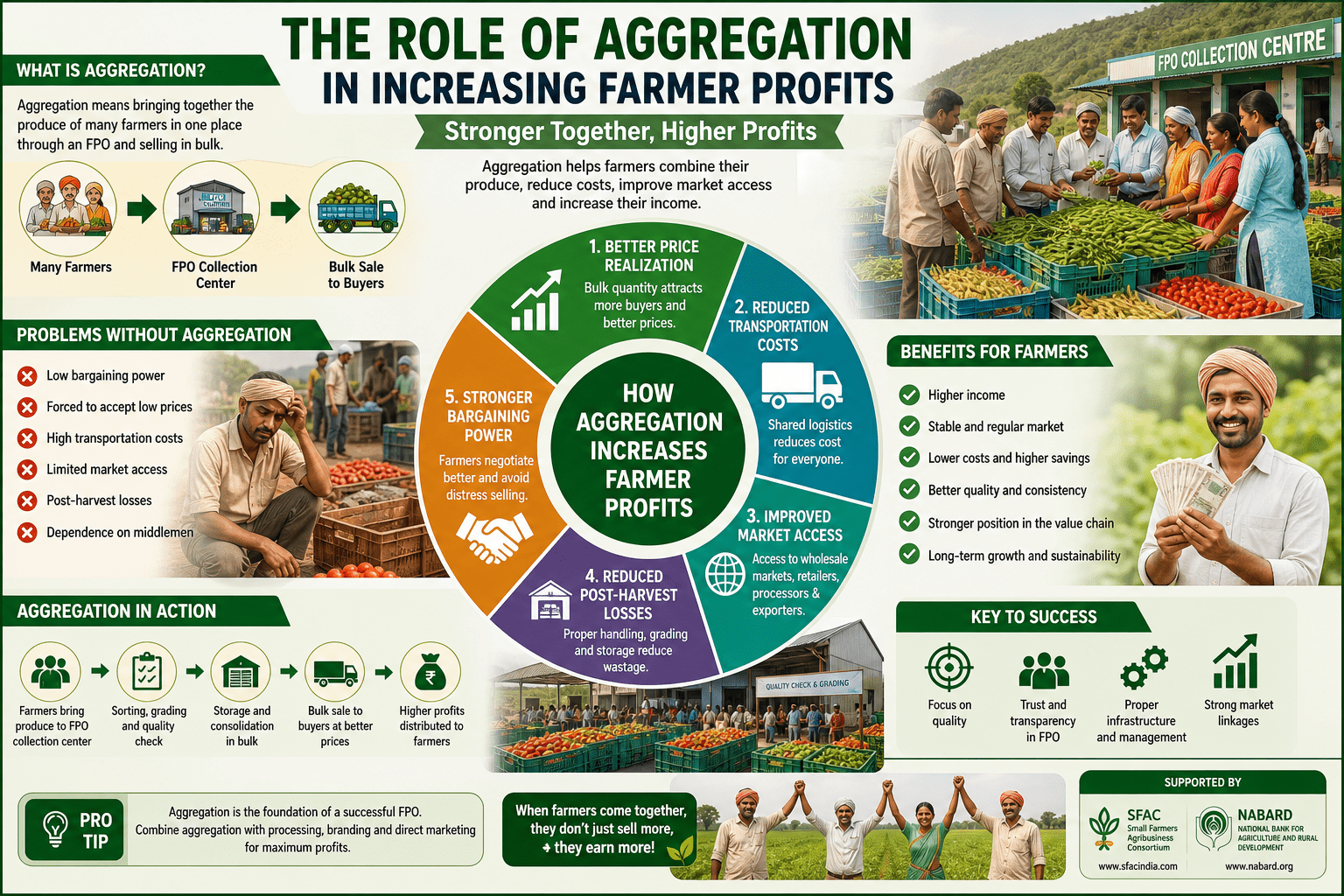
Aggregation in agriculture simply means collecting produce from multiple farmers and combining it into a larger quantity for sale. Instead of each farmer going to the market separately, the FPO acts as a central point where produce is collected, sorted, and sold collectively.
This system creates scale, and in business, scale always leads to better opportunities. When buyers see large quantities of consistent quality produce, they are willing to pay higher prices and engage in long-term partnerships.
👉 ( FPO business model explained → https://belhamaifpo.com/uncategorized/fpo-business-model-explained/)
🚜 Problems Faced by Farmers Without Aggregation
Before understanding the benefits, it is important to look at the challenges farmers face when aggregation is not practiced. Individual farmers often deal with low production volumes, which limits their ability to negotiate prices. Transportation becomes expensive because small quantities do not justify the cost of hiring vehicles.
Farmers also lack direct access to large markets such as wholesale mandis, processors, or exporters. As a result, they depend heavily on local traders who often exploit this situation by offering lower prices. Additionally, the absence of proper storage facilities leads to distress selling, where farmers are forced to sell quickly at low rates to avoid losses.
💰 How Aggregation Increases Farmer Profits
Aggregation plays a direct role in improving farmer income in multiple ways. One of the biggest advantages is better price realization. When produce is sold in bulk, buyers are more interested and willing to pay competitive prices. This is because bulk supply reduces their procurement cost and ensures continuity.
Another important benefit is cost reduction. Transportation costs are shared among all members of the FPO, making it much more affordable. Instead of multiple small trips, a single large shipment is sent to the market, saving both time and money.
Aggregation also improves market access. FPOs can connect with large buyers such as supermarkets, food processing companies, and exporters. These buyers are not interested in dealing with individual farmers but prefer bulk suppliers. By aggregating produce, FPOs bridge this gap.
Post-harvest losses are also reduced. When produce is collected at one place, it can be properly stored, graded, and handled. This reduces wastage and ensures that farmers get better value for their produce.
Most importantly, aggregation strengthens bargaining power. When farmers act as a group, they are no longer price takers. They can negotiate terms, decide when to sell, and choose the best buyer.
📊 Practical Example of Aggregation
Consider a group of 150 farmers growing tomatoes. Individually, each farmer produces a small quantity and sells to local traders at a low price. However, when these farmers come together under an FPO and aggregate their produce, they are able to supply large volumes to wholesale buyers or food processing units.
As a result, they receive better prices, reduce transportation costs, and avoid middlemen. Over time, this leads to a significant increase in income and stability.
🔗 Link Between Aggregation and Other FPO Activities
Aggregation is not just a standalone activity. It forms the foundation for other business operations of an FPO. Input supply becomes easier because the organization knows the requirements of its members. Output marketing becomes more efficient because bulk quantities are available.
Aggregation also supports agro-processing. Without sufficient raw material, it is not possible to run processing units effectively. Therefore, aggregation acts as the first step toward value addition and brand building.
⚠️ Challenges in Aggregation
While aggregation has many benefits, it also comes with challenges. Coordination among farmers can sometimes be difficult, especially when there is a lack of trust or awareness. Maintaining consistent quality across produce from different farmers is another challenge.
Infrastructure such as storage, transportation, and grading facilities is also required for effective aggregation. Without proper planning and management, these challenges can reduce efficiency. However, with proper training and leadership, these issues can be managed successfully.
👉 ( Challenges faced by FPOs → https://belhamaifpo.com/uncategorized/challenges-faced-by-fpos-in-india/)
🧠 Pro Tip
Aggregation should not be seen as the final goal. It is only the beginning. To achieve real growth, FPOs must combine aggregation with processing, branding, and direct market linkages. This is what transforms a basic farmer group into a successful agribusiness enterprise.
(How FPOs earn money → https://belhamaifpo.com/agriculture/how-fpos-earn-money/
📈 Conclusion
The role of aggregation in increasing farmer profits is fundamental to the success of any Farmer Producer Organization. By bringing farmers together, aggregation creates scale, improves pricing, reduces costs, and opens access to better markets.
For small and marginal farmers, aggregation is the first step toward financial stability and growth. When combined with value addition and branding, it has the potential to completely transform rural livelihoods. FPOs that focus on strong aggregation systems will always have a competitive advantage and a stronger position in the agricultural market.

SOME USEFULL LINKS: