Introduction
Understanding a successful FPO business model in India becomes much clearer when we look at practical, real-world examples. Many Farmer Producer Organizations are formed with the objective of improving farmer income, but only a few manage to grow into sustainable and profitable enterprises. The difference lies in how they structure their activities, maintain focus, and gradually move from basic trading to value addition and branding.
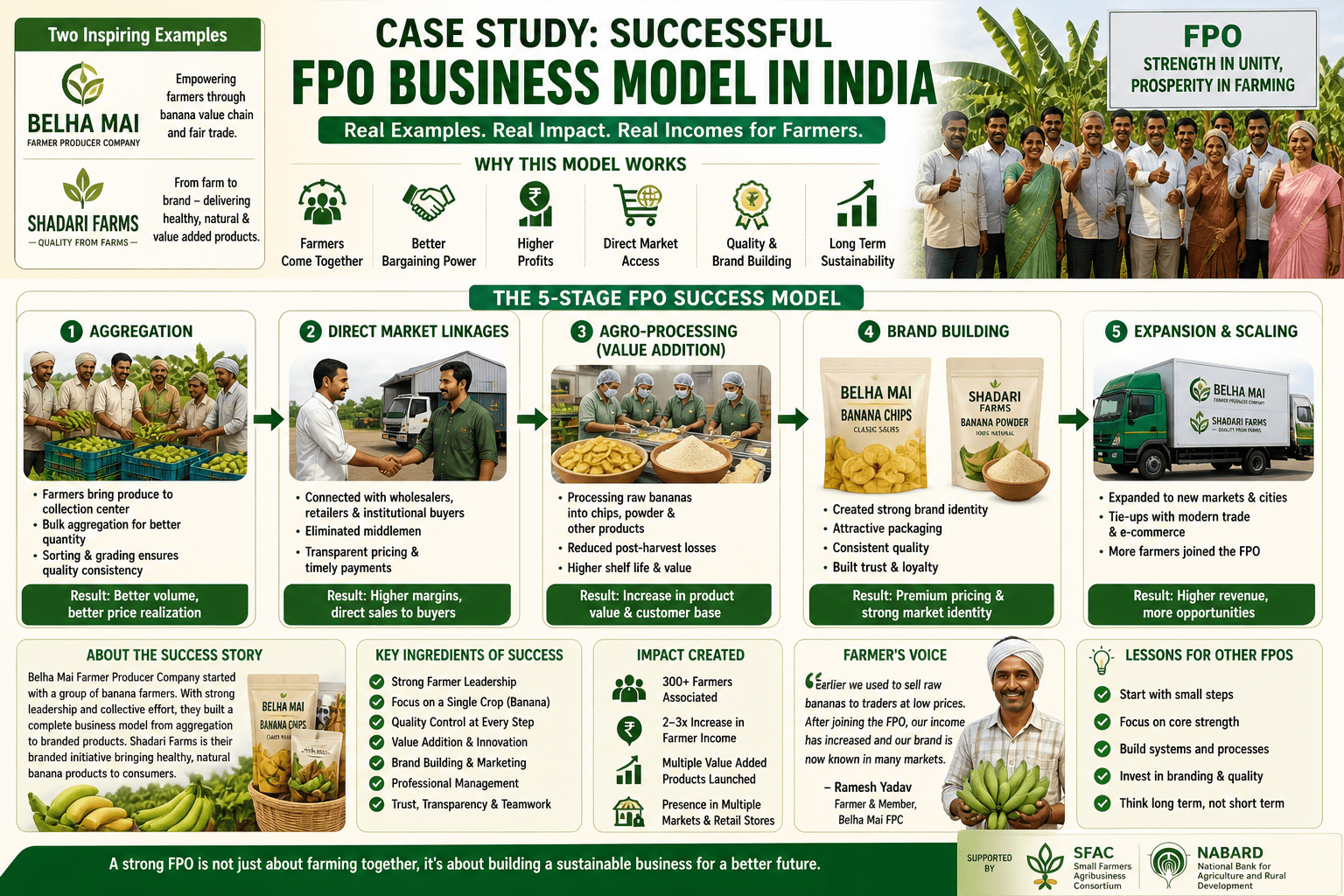
Organizations like Belha Mai Farmer Producer Company and emerging brands such as Shadari Farms reflect how a well-planned approach can transform a group of small farmers into a strong agribusiness entity. Their journey highlights the importance of aggregation, direct market access, processing, and most importantly, building a brand around core agricultural produce.
To know more about farmer producer organisation just click the link: 👉https://belhamaifpo.com/uncategorized/farmer-producer-organizations-fpos/
Background of the Model
In many parts of India, farmers operate on a small scale and depend heavily on local traders to sell their produce. This results in low price realization, limited market exposure, and minimal profits. Before forming structured organizations, farmers often lacked coordination and had no access to larger markets or better pricing mechanisms.
With the formation of Farmer Producer Organizations like Belha Mai Farmer Producer Company, farmers began to organize themselves into a collective system. This allowed them to pool their resources, share risks, and work together toward a common goal of improving income and reducing dependency on intermediaries.
To know about the challanges face by the farmer producer organisation just click the link: 👉https://belhamaifpo.com/uncategorized/challenges-faced-by-fpos-in-india/
Stage 1: Aggregation as the Foundation
The first and most important step in building a successful FPO business model is aggregation. Farmers started bringing their produce to a common collection point where it could be combined into larger quantities. This process created scale, which is essential in any business.
By aggregating produce, the FPO was able to attract bulk buyers who were previously not interested in dealing with individual farmers. This resulted in better price realization and reduced exploitation by middlemen. Aggregation also made it easier to manage logistics such as transportation and storage, further improving efficiency.
To know How FPOs are transforming rural India just click this link: 👉https://belhamaifpo.com/agriculture/how-farmer-producer-organizations-fpos-are-transforming-rural-india/
Stage 2: Direct Market Linkages
Once aggregation was established, the next step was to build direct connections with buyers. Instead of relying on intermediaries, the FPO started linking directly with wholesalers, retailers, and institutional buyers.
This shift significantly improved transparency in pricing and allowed farmers to receive a larger share of the final value of their produce. Direct market linkages also helped the FPO understand market demand, quality requirements, and pricing trends, enabling better planning and decision-making.
To know How to eliminate middlemen through FPOs click this link:-👉
https://belhamaifpo.com/agriculture/how-to-eliminate-middlemen-through-fpos/
Stage 3: Moving into Agro-Processing
While aggregation and direct selling improved income, the FPO realized that selling raw produce had limitations. To increase profitability, they decided to enter agro-processing.
By converting raw agricultural produce into value-added products, the FPO was able to increase the market value of its offerings. Processing also extended the shelf life of products, reducing post-harvest losses and opening up new market opportunities.
This stage marked a shift from basic trading to a more structured business approach, where the focus was not just on selling produce but on creating higher-value products.
To know How FPOs can start agro-processing units just click this link:- 👉https://belhamaifpo.com/uncategorized/how-fpos-can-start-agro-processing-units/
Stage 4: Brand Building as a Growth Driver
The most critical stage in the success of any FPO is brand building. Instead of selling products in bulk without identity, the FPO started focusing on creating a unique brand.
This involved developing a brand name, designing attractive packaging, and ensuring consistent quality. Over time, this approach helped build trust among customers and allowed the FPO to differentiate its products in the market.
Brands like Shadari Farms represent this evolution, where agricultural produce is not just sold as a commodity but as a recognized product with value and identity. This transition from a farmer group to a brand is what creates long-term growth and sustainability.
Importance of Focus and Specialization
One of the key reasons behind the success of models like Belha Mai Farmer Producer Company is their ability to maintain focus. Instead of trying to trade multiple unrelated products, successful FPOs concentrate on crops that are widely grown by their members.
This specialization helps in maintaining quality, building expertise, and creating a strong market presence. On the other hand, FPOs that try to diversify too early often struggle with consistency and fail to build a clear identity.
Stage 5: Expansion and Scaling
After establishing a strong foundation, the FPO gradually expanded its operations. This included increasing production capacity, exploring new markets, and strengthening distribution channels.
With a recognized brand and consistent quality, the FPO was able to enter larger markets and attract more buyers. This not only increased revenue but also encouraged more farmers to join the organization, further strengthening its base.
Challenges Faced Along the Way
The journey toward building a successful FPO business model is not without challenges. In the initial stages, lack of funding and infrastructure can slow down progress. Limited technical knowledge and experience in business management can also create difficulties.
Market competition is another major challenge, especially when entering value-added product segments. However, with proper planning, training, and institutional support, these challenges can be overcome over time.
Pro Tip
A successful FPO does not try to do everything at once. It follows a clear path—starting with aggregation, moving into direct marketing, then processing, and finally brand building. This step-by-step approach ensures stability and sustainable growth.
Conclusion
A successful FPO business model in India is built on strong fundamentals and a clear long-term vision. The journey from aggregation to branding is what transforms a simple farmer group into a powerful agribusiness enterprise.
Examples like Belha Mai Farmer Producer Company and evolving brands such as Shadari Farms demonstrate how collective effort, strategic planning, and focus can significantly improve farmer income and create sustainable opportunities in rural areas.
FPOs that remain committed to quality, consistency, and innovation will continue to grow and play a vital role in shaping the future of Indian agriculture.
if one wish to know more about the FPOs can click on this link: 👉https://belhamaifpo.com/uncategorized/farmer-producer-organizations-fpos/
To know more about some governemnt agencies working with the FPO are:-
👉 https://www.nabard.org/EngDefault.aspx