Introduction
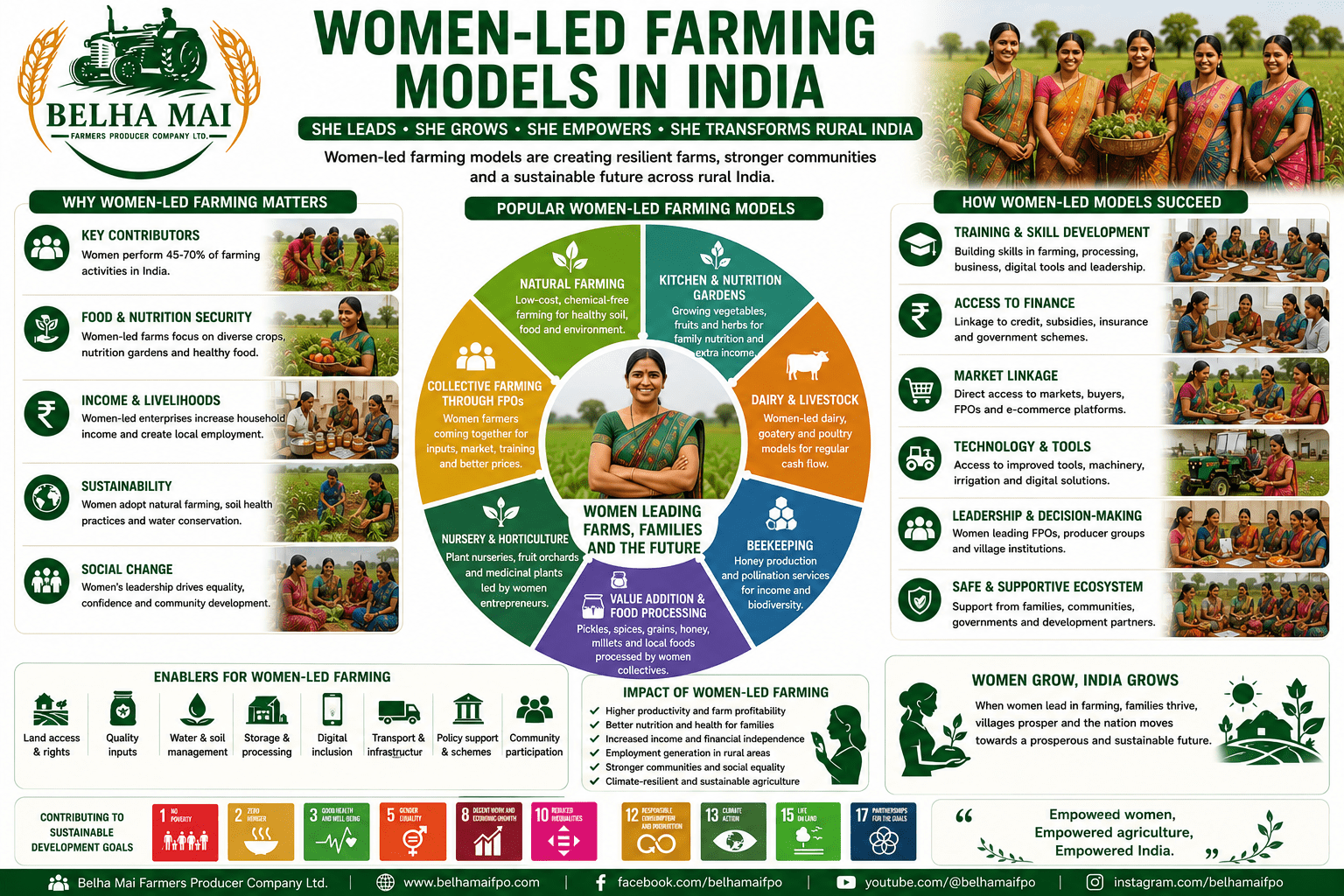
Women-led Farming Models in India are becoming increasingly important for rural development, gender equality, food security, sustainable agriculture, and local enterprise creation. Women already contribute significantly to Indian agriculture through crop production, livestock care, seed preservation, post-harvest handling, food processing, family nutrition, and rural livelihoods. The next step is to recognize women not only as workers, but also as farmers, entrepreneurs, leaders, and decision-makers.
In many rural communities, women-led models are emerging through Farmer Producer Organizations, Self-Help Groups, producer groups, dairy groups, beekeeping groups, natural farming collectives, food processing units, nursery enterprises, and local value addition activities. These models help women earn income, build confidence, access finance, receive training, and connect with markets.
Women-led farming models in India are important because they create inclusive rural development. When women lead farming and enterprise activities, families become stronger, children benefit, rural income improves, and communities become more resilient.
Women-led Farming Models in India and Their Importance
Women-led Farming Models in India are important because they bring women into the center of agricultural decision-making and rural enterprise development. Traditionally, women have worked in agriculture, but their contribution has often remained invisible or unpaid.
A women-led farming model gives women a stronger role in planning, production, processing, marketing, and income management. It helps them participate in the agricultural value chain beyond field labour.
These models also support sustainable development. Women-led agriculture can improve food security, nutrition, family welfare, soil health, local employment, and community-level cooperation.
Women-led Farming Models in India Through FPOs
Farmer Producer Organizations can become strong platforms for women-led farming models. Women can participate as members, shareholders, directors, group leaders, workers, processors, marketers, and entrepreneurs.
Women-led or women-inclusive FPOs can support input supply, training, market linkage, processing, packaging, branding, finance access, and leadership development. Through FPOs, women can move from informal farm labour to formal economic participation.
FPOs also provide collective strength. A woman farmer alone may face barriers in accessing markets, technology, finance, and buyers. But through an FPO, women can work together and build stronger enterprises.
Women-led Farming Models in India Through Self-Help Groups
Self-Help Groups have played a major role in rural women’s empowerment. SHGs help women save money, access credit, build confidence, and start income-generating activities.
When SHGs are connected with agriculture, they can create powerful women-led farming models. Women can work together in kitchen gardens, livestock, food processing, mushroom cultivation, beekeeping, nursery activities, composting, seed preservation, and local marketing.
The connection between SHGs and FPOs can make these models even stronger. SHGs can mobilize women, while FPOs can provide market linkage, business support, aggregation, and institutional connections.
Women-led Farming Models in India Through Natural Farming
Natural farming is one of the most suitable areas for women-led farming models. Women are often closely connected with livestock, composting, kitchen gardens, biomass use, seed preservation, and household-level resource management.
Women can lead natural farming activities such as compost preparation, bio-input production, seed treatment, mulching, mixed cropping, kitchen nutrition gardens, and natural pest management. These practices reduce input costs and support soil health.
FPOs and development partners can support women-led natural farming through training, demonstration plots, input preparation units, and market linkage for naturally grown produce.
Women-led Farming Models in India Through Kitchen and Nutrition Gardens
Kitchen gardens and nutrition gardens are practical women-led farming models. They help families grow vegetables, fruits, herbs, leafy greens, and nutritious crops near the household.
These gardens improve family nutrition, reduce household food expenses, and create small income opportunities when surplus produce is sold locally. Women often manage these gardens with strong attention to household food needs.
Nutrition gardens are also connected with food security and health. They can help improve diets for children, women, and elderly family members, especially in rural households.
Women-led Farming Models in India Through Dairy
Dairy is one of the strongest women-led livelihood models in rural India. Women often take care of cattle, buffaloes, fodder, feeding, milking, cleaning, and household-level dairy management.
Dairy provides regular cash flow, which is important because crop income is seasonal. Women-led dairy groups can improve income, nutrition, manure availability, and financial security.
FPOs, cooperatives, SHGs, and dairy institutions can support women through veterinary services, feed supply, milk collection, chilling facilities, credit, training, and market linkage.
Women-led Farming Models in India Through Goatery and Poultry
Goatery and poultry are important women-led farming models because they require relatively smaller investment and can provide regular income. Many rural women already manage goats and poultry at household level.
With proper training, vaccination, feed management, breed improvement, and market linkage, these activities can become profitable enterprises. They are especially useful for small and marginal households.
Women-led goatery and poultry models can support income diversification, nutrition, savings, and emergency cash needs. FPOs and SHGs can help organize these activities at scale.
Women-led Farming Models in India Through Beekeeping
Beekeeping is a promising women-led farming model. It supports honey production, pollination, biodiversity, and additional income. Women can participate in honey extraction, filtering, bottling, labeling, packaging, quality checking, and marketing.
Beekeeping can also be connected with horticulture, mustard, pulses, and other crops where pollination improves productivity. It can create income beyond traditional crop farming.
FPOs can support women beekeepers through training, equipment access, honey processing units, branding, certification, and market linkage.
Women-led Farming Models in India Through Horticulture
Horticulture creates strong opportunities for women-led farming models. Women can participate in vegetable cultivation, fruit production, flower cultivation, medicinal plants, kitchen gardens, nursery work, grading, packaging, and local marketing.
Horticulture can provide income across different seasons. It can also improve family nutrition and create opportunities for value addition.
Women-led horticulture models can be strengthened through FPOs, cold storage, packhouses, processing units, farmer training, and buyer linkages.
Women-led Farming Models in India Through Nursery Development
Nursery development is a suitable women-led rural enterprise. Women can participate in seedling production, grafting support, pot filling, watering, plant care, shade net management, plant grading, and sales.
Nurseries can produce fruit plants, vegetable seedlings, medicinal plants, ornamental plants, agroforestry plants, and climate-resilient planting material. This can create regular income and skilled employment.
Women-led nursery models can support climate action, agroforestry, horticulture expansion, and rural entrepreneurship.
Women-led Farming Models in India Through Food Processing
Food processing is one of the strongest women-led farming models in India. Women have traditional knowledge of food preparation, preservation, drying, pickling, grinding, and household processing.
With proper training and infrastructure, this knowledge can become a formal rural enterprise. Women can produce pickles, spices, flour, millet products, honey products, amla products, mango products, snacks, pulses, jams, powders, and other local foods.
Food processing creates year-round employment and higher income. It also helps reduce post-harvest wastage and adds value to local produce.
Women-led Farming Models in India Through Value Addition
Value addition helps women move beyond raw produce and participate in higher-value activities. It includes cleaning, grading, sorting, processing, packaging, branding, labeling, quality checking, and marketing.
Women-led value addition units can create income for women and better returns for farmers. These units can be operated through FPOs, SHGs, cooperatives, or rural enterprises.
Value addition also creates local jobs and strengthens village-level economic activity. It is an important model for women-led rural transformation.
Women-led Farming Models in India Through Millet-Based Enterprises
Millets are gaining importance for nutrition, climate resilience, and sustainable agriculture. Women-led millet enterprises can create strong income opportunities.
Women can participate in millet cleaning, grading, flour milling, snack preparation, packaging, branding, and local marketing. Millet-based products can be sold to households, schools, institutions, retailers, and health-conscious consumers.
Women-led millet models support nutrition, climate-resilient agriculture, and rural enterprise development.
Women-led Farming Models in India Through Amla and Fruit Processing
Fruit processing is another strong women-led model. Amla, mango, guava, papaya, and other fruits can be converted into value-added products such as candy, murabba, pulp, juice, dehydrated slices, powder, jam, and pickles.
Women can participate in cleaning, cutting, drying, processing, packaging, labeling, and quality control. This creates local employment and reduces wastage.
FPOs can support women-led fruit processing with common facilities, food safety training, packaging, branding, and market linkage.
Women-led Farming Models in India Through Bio-Input Production
Bio-input production can become a women-led sustainable agriculture enterprise. Women can prepare compost, vermicompost, biofertilizers, biopesticides, natural farming inputs, and soil health products.
These inputs can reduce farming costs and support sustainable agriculture. Women-led bio-input units can supply local farmers and FPO members.
This model supports soil health, climate resilience, income generation, and natural resource conservation.
Women-led Farming Models in India Through Seed Banks
Women have traditionally played an important role in seed preservation. Women-led seed banks can help conserve local seeds, improve seed access, and strengthen community resilience.
Seed banks can store traditional crop varieties, pulses, millets, vegetables, and climate-resilient seeds. Women can manage seed selection, cleaning, drying, storage, records, and distribution.
FPOs and development partners can support women-led seed banks with training, storage infrastructure, documentation, and seed quality practices.
Women-led Farming Models in India Through Collective Farming
Collective farming helps women work together, share resources, access training, reduce input costs, and reach markets more effectively. A group of women farmers can manage crops, livestock, processing, or enterprise activities collectively.
Collective farming builds confidence and reduces isolation. It also helps women negotiate better with buyers, suppliers, banks, and institutions.
Women-led collective farming can be strengthened through FPOs, SHGs, producer groups, and community-based organizations.
Women-led Farming Models in India Through Digital Platforms
Digital platforms can help women farmers access information, markets, payments, training, and customer networks. However, digital literacy gaps must be addressed.
Women-led digital farming models may include WhatsApp-based marketing, digital payments, online training, farmer apps, e-commerce, social media promotion, and digital record keeping.
Digital inclusion helps women become more independent and market-connected. It also creates opportunities for rural youth and women in digital service roles.
Women-led Farming Models in India Through Farm Mechanisation
Farm mechanisation can reduce drudgery and improve productivity for women farmers. Women-friendly tools and shared machinery can reduce physical strain in weeding, harvesting, threshing, processing, and transport.
FPO-led Farm Machinery Banks can make machinery affordable for women farmers. Training women in machine operation and service coordination can also create new employment.
Mechanisation must be inclusive so that women can benefit equally from modern agricultural technology.
Women-led Farming Models in India Through Market Linkages
Women-led farming models need strong market linkages to succeed. Production alone is not enough. Women need buyers, fair prices, packaging, branding, logistics, quality standards, and customer relationships.
FPOs can connect women-led groups with local markets, exhibitions, retail shops, institutional buyers, food processors, online platforms, and direct consumers.
Market linkage converts women’s labour and enterprise into real income. Without market access, women-led models cannot grow sustainably.
Women-led Farming Models in India Through Finance Access
Finance is essential for women-led farming models. Women need capital for seeds, livestock, equipment, processing, packaging, storage, machinery, and working capital.
SHGs, banks, FPOs, government schemes, CSR programs, and microfinance institutions can support women with credit and financial literacy.
Finance access helps women start and scale enterprises. It also gives them confidence and economic independence.
Women-led Farming Models in India Through Leadership
Women-led farming models require women leaders. Leadership helps women take decisions, manage groups, negotiate with institutions, build enterprises, and guide other farmers.
Leadership can emerge through FPO boards, SHG federations, producer groups, processing units, village committees, and market groups.
When women lead, rural development becomes more inclusive and practical. Women leaders also inspire other women to participate.
Women-led Farming Models in India Through Partnerships
Women-led farming models need partnerships to scale. Government departments, CSR organizations, NGOs, banks, NABARD, SFAC, training institutions, universities, technology providers, and buyers can support women-led initiatives.
Partnerships can provide finance, training, infrastructure, machinery, processing units, digital tools, packaging, branding, and market access.
FPOs can act as strong grassroots platforms for implementing women-focused agriculture and livelihood projects.
Women-led Farming Models in India and Sustainable Development Goals
Women-led farming models are directly connected with Sustainable Development Goals. They support SDG 1 No Poverty, SDG 2 Zero Hunger, SDG 3 Good Health, SDG 5 Gender Equality, SDG 8 Decent Work, SDG 12 Responsible Production, SDG 13 Climate Action, SDG 15 Life on Land, and SDG 17 Partnerships.
When women lead in agriculture, rural development becomes more balanced. Income improves, nutrition improves, communities become stronger, and sustainable farming practices spread more effectively.
This makes women-led farming central to sustainable rural transformation.
Belha Mai FPO and Women-led Farming Models
Belha Mai Farmers Producer Company Ltd. recognizes that women are essential to agriculture, value addition, rural employment, food security, and sustainable development.
Through FPO-led farmer services, training, market linkage, agro-processing, farm machinery, digital outreach, value addition, and sustainable agriculture, women can take stronger roles in rural enterprise and farming systems.
For Belha Mai FPO, women-led farming models represent a practical pathway toward stronger families, stronger farmer institutions, stronger rural enterprises, and a more inclusive rural economy.
Why Women-led Farming Models Matter for India’s Future
India’s rural future depends on inclusive agriculture. Women are already doing a large share of agricultural and household food work. If they are given equal access to training, finance, technology, markets, and leadership, agriculture can become more productive and sustainable.
Women-led farming models create income, reduce poverty, improve nutrition, empower families, and strengthen rural communities.
When women lead in agriculture, villages become stronger and more resilient. This is why women-led farming models matter for India’s future.
Conclusion
Women-led Farming Models in India show that women are not only participants in agriculture; they are leaders of rural transformation. Through FPOs, SHGs, natural farming, dairy, beekeeping, nursery activities, food processing, value addition, digital platforms, and rural enterprises, women can create powerful livelihood models.
These models improve income, nutrition, sustainability, leadership, and community development. They also support gender equality and sustainable development.
For Belha Mai Farmers Producer Company Ltd., promoting women-led farming models means building a future where women farmers are recognized, empowered, market-connected, and respected as leaders of rural prosperity.
FAQ
What are Women-led Farming Models in India?
Women-led farming models in India are agriculture and rural enterprise models where women lead or actively manage farming, livestock, food processing, natural farming, beekeeping, nursery activities, value addition, and market-linked enterprises.
Why are women-led farming models important?
Women-led farming models are important because they improve women’s income, strengthen family welfare, support nutrition, create rural employment, promote sustainable agriculture, and build inclusive rural development.
How can FPOs support women-led farming models?
FPOs can support women-led farming models through training, finance access, input services, farm machinery, processing units, packaging, branding, market linkage, leadership opportunities, and rural enterprise development.
Which farming activities are suitable for women-led models?
Suitable activities include natural farming, kitchen gardens, dairy, goatery, poultry, beekeeping, nursery development, food processing, fruit processing, millet products, bio-input production, seed banks, and value addition.
How do women-led farming models support gender equality?
Women-led farming models support gender equality by giving women access to income, leadership, decision-making, finance, markets, skills, technology, and formal recognition in agriculture.
Why should CSR organizations support women-led farming models?
CSR organizations should support women-led farming models because they create impact in women empowerment, rural livelihoods, poverty reduction, food security, sustainable agriculture, and community development.
Internal Links Section
👉 SDG Goals — https://belhamaifpo.com/sdg-goals/
👉 Farmer Producer Organizations Complete Guide —https://belhamaifpo.com/farmer-producer-organisation/farmer-producer-organizations-fpos/
👉 Gender Equality in Rural India: Challenges and Solutions — https://belhamaifpo.com/sdg-goals/gender-equality-in-rural-india-challenges-and-solutions/
👉 How FPOs Empower Women Farmers — https://belhamaifpo.com/sdg-goals/how-fpos-empower-women-farmers/
👉 Role of Women in Indian Agriculture —https://belhamaifpo.com/sdg-goals/role-of-women-in-indian-agriculture/
👉 How FPOs Create Year-Round Income for Farmers —https://belhamaifpo.com/sdg-goals/how-fpos-create-year-round-income-for-farmers/
👉 How Agro-Processing Creates Rural Employment — https://belhamaifpo.com/sdg-goals/how-agro-processing-creates-rural-employment/
👉 Role of Collective Farming in Increasing Farmer Income — https://belhamaifpo.com/sdg-goals/role-of-collective-farming-in-increasing-farmer-income/
👉 How Agriculture Can Reduce Rural Poverty in India — https://belhamaifpo.com/sdg-goals/how-agriculture-can-reduce-rural-poverty-in-india/
👉 Honey Processing in India: Complete Guide — https://belhamaifpo.com/agriculture/honey-processing-in-india-complete-guide/
👉 Rajvi Bhog Food Products: Complete Guide — https://belhamaifpo.com/agriculture/rajvi-bhog-food-products-quality-export-guide/
👉 Belha Mai FPO — https://belhamaifpo.com/
External Authority Links
👉 United Nations Sustainable Development Goals — https://sdgs.un.org/goals
👉 UN Women — https://www.unwomen.org/
👉 Ministry of Women and Child Development —https://wcd.nic.in/
👉 National Rural Livelihood Mission — https://nrlm.gov.in/
👉 Ministry of Agriculture and Farmers Welfare — https://agriwelfare.gov.in/
👉 Small Farmers’ Agribusiness Consortium — https://sfacindia.com/
👉 National Bank for Agriculture and Rural Development — https://www.nabard.org/
👉 NITI Aayog SDG India Index — https://www.niti.gov.in/sdg-india-index
Follow Belha Mai FPO for More Updates
Website: https://belhamaifpo.com/
Facebook: https://www.facebook.com/profile.php?id=61561043486818
YouTube: https://www.youtube.com/channel/UC9ZvojoTMCa7mU1-Q_Bh60A
LinkedIn: https://www.linkedin.com/in/abhay-singh-ab5568280/
Instagram: https://instagram.com/belhamaifpo
Belha Mai Farmers Producer Company Ltd. supports farmers through better information, technology, market linkage, value addition, FPO awareness, rural development, women empowerment, and sustainable agriculture.