कृषि में सतत आपूर्ति शृंखलाएँ
Introduction
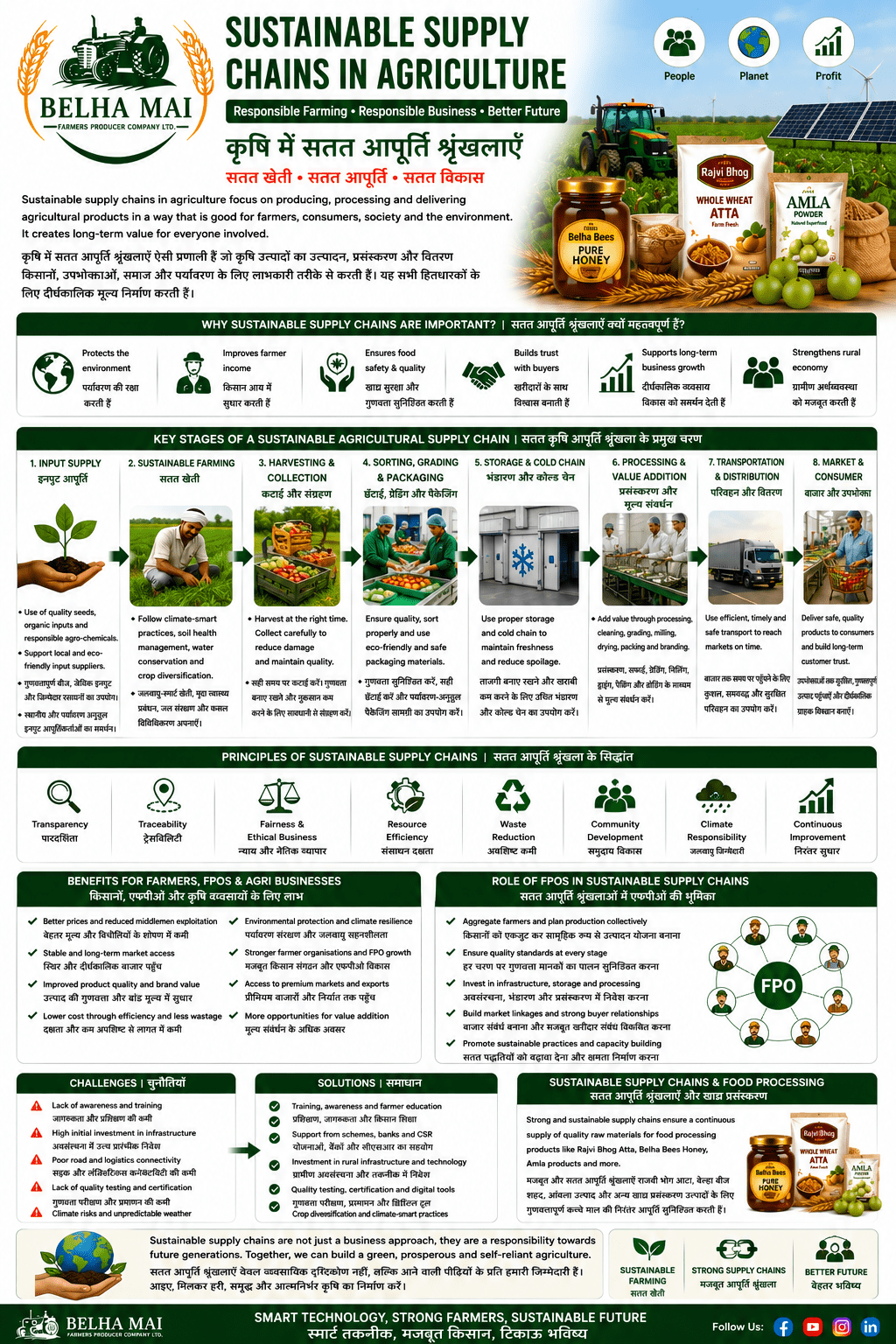
Sustainable Supply Chains in Agriculture are important because agricultural products pass through many stages before reaching consumers. These stages include input supply, farming, harvesting, collection, sorting, grading, storage, processing, packaging, transport, marketing and final consumption.
कृषि में सतत आपूर्ति शृंखलाएँ इसलिए महत्वपूर्ण हैं क्योंकि कृषि उत्पाद उपभोक्ताओं तक पहुँचने से पहले कई चरणों से गुजरते हैं। इन चरणों में input supply, farming, harvesting, collection, sorting, grading, storage, processing, packaging, transport, marketing और final consumption शामिल होते हैं।
A supply chain becomes sustainable when every stage is managed in a way that protects farmers, consumers, the environment and business value. It is not only about moving products from farm to market; it is about doing it responsibly.
आपूर्ति शृंखला तब सतत बनती है जब प्रत्येक चरण का प्रबंधन इस प्रकार किया जाए कि किसानों, उपभोक्ताओं, पर्यावरण और व्यावसायिक मूल्य की रक्षा हो। यह केवल उत्पादों को खेत से बाजार तक पहुँचाने का कार्य नहीं है; यह जिम्मेदारी के साथ ऐसा करने की प्रक्रिया है।
For FPOs, Sustainable Supply Chains in Agriculture can create better farmer income, reduce wastage, improve product quality, support food processing, build buyer trust and prepare farmer-led brands for premium markets.
FPOs के लिए कृषि में सतत आपूर्ति शृंखलाएँ बेहतर किसान आय बना सकती हैं, बर्बादी कम कर सकती हैं, उत्पाद गुणवत्ता सुधार सकती हैं, खाद्य प्रसंस्करण को support कर सकती हैं, खरीदार का विश्वास बना सकती हैं और किसान-नेतृत्व वाले brands को premium markets के लिए तैयार कर सकती हैं।
What Is a Sustainable Agricultural Supply Chain
A sustainable agricultural supply chain is a system where agricultural products are produced, collected, processed, stored, transported and sold in a responsible, efficient and transparent way.
सतत कृषि आपूर्ति शृंखला ऐसी व्यवस्था है जिसमें कृषि उत्पादों का उत्पादन, संग्रह, प्रसंस्करण, भंडारण, परिवहन और बिक्री जिम्मेदार, कुशल और पारदर्शी तरीके से की जाती है।
It focuses on three important goals: people, planet and profit. This means the system should benefit farmers and workers, protect the environment and remain financially viable.
यह तीन महत्वपूर्ण लक्ष्यों पर ध्यान देती है: लोग, पृथ्वी और लाभ। इसका अर्थ है कि व्यवस्था किसानों और श्रमिकों को लाभ दे, पर्यावरण की रक्षा करे और आर्थिक रूप से व्यवहार्य बनी रहे।
A sustainable supply chain reduces unnecessary losses, improves quality, uses resources efficiently and builds long-term relationships between farmers, FPOs, buyers and consumers.
सतत आपूर्ति शृंखला अनावश्यक नुकसान कम करती है, गुणवत्ता सुधारती है, संसाधनों का कुशल उपयोग करती है और farmers, FPOs, buyers तथा consumers के बीच दीर्घकालिक संबंध बनाती है।
Why Sustainable Supply Chains Are Important
Sustainable Supply Chains in Agriculture are important because the traditional agriculture supply chain often faces problems such as high wastage, poor storage, weak grading, delayed payments, low farmer share and lack of traceability.
कृषि में सतत आपूर्ति शृंखलाएँ इसलिए महत्वपूर्ण हैं क्योंकि पारंपरिक कृषि आपूर्ति शृंखला में अक्सर high wastage, poor storage, weak grading, delayed payments, low farmer share और traceability की कमी जैसी समस्याएँ होती हैं।
When the supply chain is weak, farmers lose value and consumers may not get consistent quality. Middlemen may capture more benefit while producers remain underpaid.
जब आपूर्ति शृंखला कमजोर होती है, तो किसान मूल्य खो देते हैं और उपभोक्ताओं को consistent quality नहीं मिलती। कई बार अधिक लाभ middlemen ले जाते हैं जबकि producers को उचित भुगतान नहीं मिलता।
A sustainable supply chain helps improve fairness, quality, transparency, resource efficiency and market confidence.
सतत आपूर्ति शृंखला fairness, quality, transparency, resource efficiency और market confidence को बेहतर बनाने में मदद करती है।
Responsible Input Supply
A sustainable supply chain begins with responsible input supply. Seeds, fertilisers, bio-inputs, pesticides, irrigation systems and farm machinery should be selected carefully.
सतत आपूर्ति शृंखला जिम्मेदार input supply से शुरू होती है। Seeds, fertilisers, bio-inputs, pesticides, irrigation systems और farm machinery का चयन सावधानीपूर्वक होना चाहिए।
Poor quality inputs can reduce crop yield, increase cost and damage soil health. Responsible input supply ensures that farmers receive genuine, suitable and timely inputs.
खराब गुणवत्ता वाले inputs crop yield कम कर सकते हैं, लागत बढ़ा सकते हैं और soil health को नुकसान पहुँचा सकते हैं। जिम्मेदार input supply यह सुनिश्चित करती है कि किसानों को genuine, suitable और timely inputs मिलें।
FPOs can support sustainable input supply by providing trusted inputs, advisory services, soil testing, training and proper usage guidance.
FPOs trusted inputs, advisory services, soil testing, training और proper usage guidance देकर sustainable input supply को support कर सकते हैं।
Sustainable Farming Practices
Sustainable farming practices are the foundation of a sustainable supply chain. These practices protect soil, water, biodiversity and long-term farm productivity.
सतत खेती की पद्धतियाँ सतत आपूर्ति शृंखला की नींव हैं। ये पद्धतियाँ मिट्टी, पानी, जैव विविधता और दीर्घकालिक farm productivity की रक्षा करती हैं।
Examples include soil health management, balanced fertiliser use, organic matter addition, water conservation, integrated pest management, crop rotation, agroforestry and climate-smart farming.
Examples में soil health management, balanced fertiliser use, organic matter addition, water conservation, integrated pest management, crop rotation, agroforestry और climate-smart farming शामिल हैं।
When farmers follow sustainable practices, the supply chain becomes stronger because the raw material is healthier, safer and more reliable.
जब किसान sustainable practices अपनाते हैं, तो supply chain मजबूत बनती है क्योंकि raw material अधिक स्वस्थ, सुरक्षित और विश्वसनीय होता है।
Harvesting at the Right Time
Harvesting at the right time is very important for quality and shelf life. Early or late harvesting can reduce product value and increase losses.
सही समय पर harvesting quality और shelf life के लिए बहुत महत्वपूर्ण है। बहुत जल्दी या बहुत देर से harvesting करने पर product value कम हो सकती है और losses बढ़ सकते हैं।
For fruits and vegetables, harvesting stage affects colour, taste, firmness, shelf life and transport suitability. For grains, moisture level at harvest affects storage quality and processing performance.
Fruits और vegetables में harvesting stage colour, taste, firmness, shelf life और transport suitability को प्रभावित करता है। Grains में harvest के समय moisture level storage quality और processing performance को प्रभावित करता है।
FPOs can train farmers on harvesting standards and create collection schedules to maintain quality consistency.
FPOs farmers को harvesting standards पर training दे सकते हैं और quality consistency बनाए रखने के लिए collection schedules बना सकते हैं।
Collection and Aggregation
Collection and aggregation are important steps in agriculture supply chains. Individual farmers may produce small quantities, but FPOs can aggregate produce from many farmers and create larger marketable volumes.
Collection और aggregation agriculture supply chains के महत्वपूर्ण steps हैं। Individual farmers छोटी quantities produce कर सकते हैं, लेकिन FPOs कई farmers से produce aggregate करके larger marketable volumes बना सकते हैं।
Aggregation helps improve bargaining power, reduce transport cost and create consistent supply for buyers, processors and institutions.
Aggregation bargaining power बढ़ाने, transport cost कम करने और buyers, processors तथा institutions के लिए consistent supply बनाने में मदद करता है।
However, aggregation should be organised with proper farmer records, quality checks, weighing, grading and payment systems.
हालाँकि aggregation proper farmer records, quality checks, weighing, grading और payment systems के साथ organised होना चाहिए।
Sorting and Grading
Sorting and grading are essential for creating quality in the supply chain. They separate products according to size, quality, colour, maturity, cleanliness and market requirement.
Sorting और grading supply chain में quality बनाने के लिए आवश्यक हैं। ये products को size, quality, colour, maturity, cleanliness और market requirement के अनुसार अलग करते हैं।
Without sorting and grading, good quality produce may be mixed with poor quality produce, reducing the overall value of the lot.
Sorting और grading के बिना अच्छी quality का produce खराब quality के produce के साथ mix हो सकता है, जिससे पूरे lot की value कम हो जाती है।
FPOs can improve farmer income by creating grade-wise pricing and supplying better quality produce to premium buyers.
FPOs grade-wise pricing बनाकर और premium buyers को better quality produce supply करके farmer income सुधार सकते हैं।
Sustainable Packaging
Sustainable packaging protects products while reducing environmental impact. Good packaging should protect the product from moisture, contamination, breakage, pests and quality loss.
सतत packaging products की रक्षा करती है और पर्यावरणीय प्रभाव को कम करती है। अच्छी packaging product को moisture, contamination, breakage, pests और quality loss से बचानी चाहिए।
For food products, packaging should be safe, clean, suitable for storage and aligned with labelling requirements.
Food products के लिए packaging safe, clean, storage के लिए suitable और labelling requirements के अनुसार होनी चाहिए।
FPOs should choose packaging according to product type, shelf life, transport distance, buyer requirement and sustainability goals.
FPOs को product type, shelf life, transport distance, buyer requirement और sustainability goals के अनुसार packaging चुननी चाहिए।
Storage and Cold Chain
Storage is a critical part of sustainable agricultural supply chains. Poor storage can damage grains, fruits, vegetables, honey, powders and processed foods.
Storage सतत कृषि आपूर्ति शृंखलाओं का critical हिस्सा है। Poor storage grains, fruits, vegetables, honey, powders और processed foods को नुकसान पहुँचा सकता है।
Proper storage protects quality, reduces distress selling and gives farmers better market timing. Cold chain is especially important for perishable products.
Proper storage quality की रक्षा करता है, distress selling कम करता है और farmers को better market timing देता है। Perishable products के लिए cold chain विशेष रूप से महत्वपूर्ण है।
FPOs can reduce losses by investing in warehouses, cold rooms, packhouses, moisture control, pest control and stock management systems.
FPOs warehouses, cold rooms, packhouses, moisture control, pest control और stock management systems में investment करके losses कम कर सकते हैं।
Processing and Value Addition
Processing and value addition make agriculture supply chains more sustainable by reducing wastage and increasing product value. Raw produce can be converted into stable and higher-value products.
Processing और value addition wastage कम करके और product value बढ़ाकर agriculture supply chains को अधिक sustainable बनाते हैं। Raw produce को stable और higher-value products में बदला जा सकता है।
For example, wheat can become atta, suji and dalia. Amla can become powder, candy and murabba. Mango can become pulp, slices and dehydrated products. Honey can be processed, tested and packed under a trusted brand.
उदाहरण के लिए, wheat को atta, suji और dalia में बदला जा सकता है। Amla को powder, candy और murabba में बदला जा सकता है। Mango को pulp, slices और dehydrated products में बदला जा सकता है। Honey को process, test और trusted brand के तहत pack किया जा सकता है।
Value addition helps FPOs move beyond raw produce selling and build stronger farmer-led brands.
Value addition FPOs को raw produce selling से आगे बढ़ाकर मजबूत farmer-led brands बनाने में मदद करता है।
Sustainable Transport and Distribution
Transport and distribution should be efficient, timely and cost-effective. Delays, poor handling and unsuitable vehicles can damage agricultural products.
Transport और distribution efficient, timely और cost-effective होना चाहिए। Delays, poor handling और unsuitable vehicles agricultural products को नुकसान पहुँचा सकते हैं।
Sustainable transport reduces fuel waste, product loss and unnecessary cost. Proper route planning, load planning and delivery scheduling are important.
Sustainable transport fuel waste, product loss और unnecessary cost को कम करता है। Proper route planning, load planning और delivery scheduling महत्वपूर्ण हैं।
FPOs can improve distribution by coordinating transport, aggregating loads and building direct buyer linkages.
FPOs transport coordinate करके, loads aggregate करके और direct buyer linkages बनाकर distribution सुधार सकते हैं।
Market Linkage and Buyer Trust
Market linkage is the final bridge between production and income. A sustainable supply chain must connect farmers with reliable buyers who value quality, consistency and transparency.
Market linkage production और income के बीच अंतिम bridge है। सतत supply chain farmers को ऐसे reliable buyers से जोड़ती है जो quality, consistency और transparency को value देते हैं।
Buyer trust is built through timely delivery, correct quantity, quality assurance, proper documentation and honest communication.
Buyer trust timely delivery, correct quantity, quality assurance, proper documentation और honest communication से बनता है।
FPOs can build long-term market linkages with wholesalers, retailers, institutions, processors, exporters and digital platforms.
FPOs wholesalers, retailers, institutions, processors, exporters और digital platforms के साथ long-term market linkages बना सकते हैं।
Traceability in Sustainable Supply Chains
Traceability means tracking the product from farm to consumer. It helps show where the product came from, how it was produced, how it was processed and how it reached the buyer.
Traceability का अर्थ product को farm से consumer तक track करना है। यह दिखाने में मदद करती है कि product कहाँ से आया, कैसे produce हुआ, कैसे process हुआ और buyer तक कैसे पहुँचा।
Traceability builds trust in food safety, quality, origin and responsible sourcing. It is especially important for premium markets, institutional supply and export readiness.
Traceability food safety, quality, origin और responsible sourcing में trust बनाती है। यह premium markets, institutional supply और export readiness के लिए विशेष रूप से महत्वपूर्ण है।
FPOs can use digital records, QR codes, farmer data and batch tracking to improve traceability.
FPOs digital records, QR codes, farmer data और batch tracking का उपयोग करके traceability सुधार सकते हैं।
Reducing Post-Harvest Losses
Post-harvest losses reduce farmer income and waste valuable resources. Losses may happen during harvesting, handling, transport, storage, grading, processing and market returns.
Post-harvest losses farmer income को कम करते हैं और valuable resources को waste करते हैं। Losses harvesting, handling, transport, storage, grading, processing और market returns के दौरान हो सकते हैं।
A sustainable supply chain focuses on reducing these losses through better handling, proper storage, timely transport, processing and packaging.
सतत supply chain better handling, proper storage, timely transport, processing और packaging के माध्यम से इन losses को कम करने पर ध्यान देती है।
Reducing post-harvest losses is one of the fastest ways to increase farmer income without increasing cultivated area.
Post-harvest losses को कम करना cultivated area बढ़ाए बिना farmer income बढ़ाने के सबसे तेज तरीकों में से एक है।
Fairness and Ethical Business
A sustainable supply chain should be fair to farmers, workers, buyers and consumers. Farmers should receive timely and transparent payments.
सतत supply chain farmers, workers, buyers और consumers के प्रति fair होनी चाहिए। किसानों को timely और transparent payments मिलने चाहिए।
Ethical business means correct weighing, honest grading, clear pricing, proper contracts and no exploitation of small farmers.
Ethical business का अर्थ correct weighing, honest grading, clear pricing, proper contracts और small farmers का exploitation न करना है।
FPOs can promote fairness by maintaining records, creating transparent procurement systems and sharing price information with members.
FPOs records maintain करके, transparent procurement systems बनाकर और members के साथ price information share करके fairness को बढ़ावा दे सकते हैं।
Environmental Responsibility
Environmental responsibility is a key part of Sustainable Supply Chains in Agriculture. Farming and supply chain activities should reduce harm to soil, water, air and biodiversity.
Environmental responsibility कृषि में सतत आपूर्ति शृंखलाओं का key हिस्सा है। Farming और supply chain activities को soil, water, air और biodiversity को होने वाले नुकसान को कम करना चाहिए।
This includes responsible input use, water conservation, residue management, renewable energy, reduced waste and climate-smart farming practices.
इसमें responsible input use, water conservation, residue management, renewable energy, reduced waste और climate-smart farming practices शामिल हैं।
FPOs can encourage sustainable practices through training, demonstrations, advisory services and farmer awareness programmes.
FPOs training, demonstrations, advisory services और farmer awareness programmes के माध्यम से sustainable practices को बढ़ावा दे सकते हैं।
Role of FPOs in Sustainable Supply Chains
FPOs are central to building sustainable supply chains because they connect farmers with inputs, advisory, aggregation, processing, finance, markets and institutions.
FPOs sustainable supply chains बनाने में central role निभाते हैं क्योंकि वे farmers को inputs, advisory, aggregation, processing, finance, markets और institutions से जोड़ते हैं।
An FPO can improve quality, reduce wastage, create traceability, provide market linkage and build farmer-owned brands.
FPO quality सुधार सकता है, wastage कम कर सकता है, traceability बना सकता है, market linkage दे सकता है और farmer-owned brands बना सकता है।
When FPOs become professionally managed, they can turn fragmented agriculture into organised rural enterprise.
जब FPOs professionally managed होते हैं, तो वे fragmented agriculture को organised rural enterprise में बदल सकते हैं।
Sustainable Supply Chains and Food Processing
Food processing depends on a reliable supply of quality raw material. Sustainable supply chains ensure that processing units receive the right product at the right time and in the right condition.
Food processing quality raw material की reliable supply पर निर्भर करता है। Sustainable supply chains यह सुनिश्चित करती हैं कि processing units को सही product, सही समय पर और सही condition में मिले।
For Rajvi Bhog atta, Belha Bees honey, amla powder, mango pulp and dehydrated products, supply chain quality directly affects final product quality.
Rajvi Bhog atta, Belha Bees honey, amla powder, mango pulp और dehydrated products जैसे products के लिए supply chain quality directly final product quality को प्रभावित करती है।
A strong supply chain improves shelf life, brand trust, buyer satisfaction and export readiness.
मजबूत supply chain shelf life, brand trust, buyer satisfaction और export readiness को सुधारती है।
Sustainable Supply Chains and Export Readiness
Export markets demand consistent quality, food safety, traceability, documentation and timely delivery. Sustainable supply chains help FPOs prepare for these requirements.
Export markets consistent quality, food safety, traceability, documentation और timely delivery की मांग करते हैं। Sustainable supply chains FPOs को इन requirements के लिए तैयार करने में मदद करती हैं।
If the supply chain is weak, export orders may face quality rejection, delay, documentation problems or buyer complaints.
यदि supply chain कमजोर है, तो export orders को quality rejection, delay, documentation problems या buyer complaints का सामना करना पड़ सकता है।
FPOs aiming for export should strengthen grading, packaging, storage, documentation, traceability and buyer communication.
Export के लिए तैयार होने वाले FPOs को grading, packaging, storage, documentation, traceability और buyer communication को मजबूत करना चाहिए।
Digital Tools for Sustainable Supply Chains
Digital tools can make supply chains more transparent and efficient. They can support farmer records, procurement tracking, stock management, quality records, transport tracking and buyer communication.
Digital tools supply chains को अधिक transparent और efficient बना सकते हैं। वे farmer records, procurement tracking, stock management, quality records, transport tracking और buyer communication को support कर सकते हैं।
QR codes, mobile applications, inventory software and digital payment systems can improve trust and reduce confusion.
QR codes, mobile applications, inventory software और digital payment systems trust सुधार सकते हैं और confusion कम कर सकते हैं।
For FPOs, digital supply chain systems can support better management, audits, funding applications and partnerships.
FPOs के लिए digital supply chain systems better management, audits, funding applications और partnerships को support कर सकते हैं।
Challenges in Building Sustainable Supply Chains
Building sustainable supply chains is not easy. Challenges include lack of awareness, weak infrastructure, poor storage, high logistics cost, low farmer training, limited finance and lack of quality testing.
Sustainable supply chains बनाना आसान नहीं है। Challenges में awareness की कमी, weak infrastructure, poor storage, high logistics cost, low farmer training, limited finance और quality testing की कमी शामिल हैं।
Small farmers may not have the capacity to solve these challenges individually. This is why collective institutions like FPOs are important.
Small farmers individually इन challenges को solve करने की क्षमता नहीं रखते। इसी कारण FPOs जैसी collective institutions महत्वपूर्ण हैं।
With proper planning, funding, training and partnerships, FPOs can gradually build stronger and more sustainable supply chains.
Proper planning, funding, training और partnerships के साथ FPOs धीरे-धीरे stronger और अधिक sustainable supply chains बना सकते हैं।
Steps to Build a Sustainable Supply Chain
The first step is to understand the product and its supply chain stages. Every product has different needs for harvesting, grading, storage, processing, transport and marketing.
पहला कदम product और उसके supply chain stages को समझना है। हर product की harvesting, grading, storage, processing, transport और marketing की अलग-अलग जरूरतें होती हैं।
The second step is to identify where losses, delays, quality problems and unnecessary costs are happening.
दूसरा कदम यह पहचानना है कि losses, delays, quality problems और unnecessary costs कहाँ हो रहे हैं।
The third step is to improve systems through farmer training, better infrastructure, quality control, digital records, market linkage and financial planning.
तीसरा कदम farmer training, better infrastructure, quality control, digital records, market linkage और financial planning के माध्यम से systems को सुधारना है।
Belha Mai FPO Vision for Sustainable Supply Chains
Belha Mai Farmers Producer Company Ltd. understands that sustainable supply chains can create long-term value for farmers, consumers and rural businesses.
Belha Mai Farmers Producer Company Ltd. समझता है कि sustainable supply chains farmers, consumers और rural businesses के लिए long-term value बना सकती हैं।
For Belha Mai FPO, sustainable supply chains can support Rajvi Bhog food products, Belha Bees honey, amla value addition, mango value addition, high-tech nursery, food processing, traceability and export readiness.
Belha Mai FPO के लिए sustainable supply chains Rajvi Bhog food products, Belha Bees honey, amla value addition, mango value addition, high-tech nursery, food processing, traceability और export readiness को support कर सकती हैं।
The aim should be to build a responsible farmer-led supply chain that improves farmer income, protects the environment, reduces waste and builds buyer trust.
लक्ष्य ऐसी responsible farmer-led supply chain बनाना होना चाहिए जो farmer income सुधारती हो, environment की रक्षा करती हो, waste कम करती हो और buyer trust बनाती हो।
Conclusion
Sustainable Supply Chains in Agriculture are essential for building a stronger, fairer and more responsible agriculture economy. They connect farmers with better systems, better quality, better markets and better income opportunities.
कृषि में सतत आपूर्ति शृंखलाएँ मजबूत, निष्पक्ष और अधिक जिम्मेदार agriculture economy बनाने के लिए आवश्यक हैं। वे farmers को बेहतर systems, better quality, better markets और बेहतर income opportunities से जोड़ती हैं।
A sustainable supply chain includes responsible input supply, sustainable farming, proper harvesting, aggregation, grading, storage, processing, packaging, transport, traceability and market linkage.
Sustainable supply chain में responsible input supply, sustainable farming, proper harvesting, aggregation, grading, storage, processing, packaging, transport, traceability और market linkage शामिल होते हैं।
In the future of the Food Processing Industry in India, FPOs that build sustainable supply chains will be better prepared for value addition, branding, export readiness and long-term rural development.
Food Processing Industry in India के भविष्य में वे FPOs value addition, branding, export readiness और long-term rural development के लिए बेहतर तैयार होंगे जो sustainable supply chains बनाएँगे।
FAQ
What are Sustainable Supply Chains in Agriculture?
Sustainable Supply Chains in Agriculture are systems that manage agricultural products from farm to consumer in a responsible, efficient, transparent and environment-friendly way.
कृषि में सतत आपूर्ति शृंखलाएँ ऐसी व्यवस्थाएँ हैं जो agricultural products को farm से consumer तक जिम्मेदार, कुशल, पारदर्शी और environment-friendly तरीके से manage करती हैं।
Why are sustainable supply chains important for farmers?
Sustainable supply chains are important because they reduce wastage, improve quality, increase farmer income, build buyer trust and create long-term market access.
Sustainable supply chains महत्वपूर्ण हैं क्योंकि वे wastage कम करती हैं, quality सुधारती हैं, farmer income बढ़ाती हैं, buyer trust बनाती हैं और long-term market access तैयार करती हैं।
How can FPOs build sustainable supply chains?
FPOs can build sustainable supply chains through farmer aggregation, quality control, grading, storage, processing, packaging, traceability, digital records and market linkage.
FPOs farmer aggregation, quality control, grading, storage, processing, packaging, traceability, digital records और market linkage के माध्यम से sustainable supply chains बना सकते हैं।
What is the role of traceability in sustainable supply chains?
Traceability helps track products from farm to consumer and builds trust in food safety, quality, origin and responsible sourcing.
Traceability products को farm से consumer तक track करने में मदद करती है और food safety, quality, origin तथा responsible sourcing में trust बनाती है।
How do sustainable supply chains reduce post-harvest losses?
They reduce post-harvest losses through better harvesting, handling, grading, storage, transport, processing and packaging.
वे better harvesting, handling, grading, storage, transport, processing और packaging के माध्यम से post-harvest losses कम करती हैं।
Why are sustainable supply chains important for food processing?
They are important because food processing depends on consistent, safe and good-quality raw material delivered at the right time.
वे महत्वपूर्ण हैं क्योंकि food processing सही समय पर मिलने वाले consistent, safe और good-quality raw material पर निर्भर करता है।
Internal Links Section
👉 Food Processing Industry in India: Complete Guide
👉 Carbon Credit Opportunities for Farmers
👉 Digital Platforms for Farmers in India
👉 Traceability in Agriculture: Farm to Fork Explained
👉 QR Code Tracking in Food Supply Chain
👉 Quality Control in Food Processing Industry
👉 Reducing Post-Harvest Losses Through Infrastructure
External Authority Links
👉 Ministry of Agriculture & Farmers Welfare
👉 Ministry of Food Processing Industries
👉 FAO Sustainable Food Value Chains
Follow Belha Mai FPO for More Updates
Stay connected with Belha Mai Farmers Producer Company Ltd. for more updates on agriculture, food processing, farmer development, FPO awareness, market linkage, value addition, rural entrepreneurship and sustainable farming.
कृषि, खाद्य प्रसंस्करण, किसान विकास, FPO जागरूकता, बाजार संपर्क, मूल्य संवर्धन, ग्रामीण उद्यमिता और सतत खेती से जुड़ी जानकारी के लिए Belha Mai Farmers Producer Company Ltd. से जुड़े रहें।
👉 Website
👉 YouTube
Belha Mai FPO is committed to supporting farmers through better information, technology, market linkage, value addition, FPO awareness and rural development.
Belha Mai FPO बेहतर जानकारी, तकनीक, बाजार संपर्क, मूल्य संवर्धन, FPO जागरूकता और ग्रामीण विकास के माध्यम से किसानों को सहयोग देने के लिए प्रतिबद्ध है।