खेती में जल संरक्षण तकनीकें
Introduction
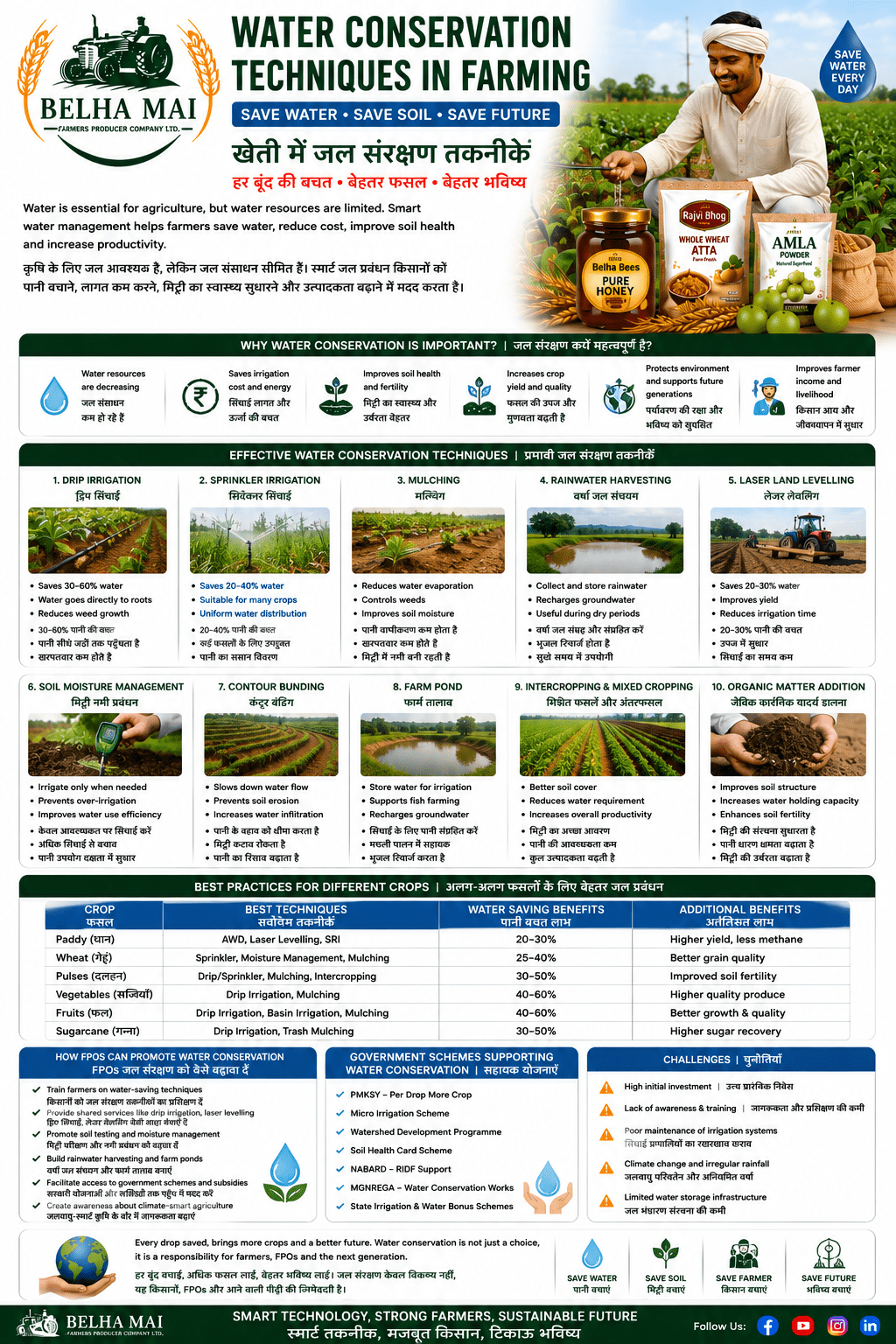
Water Conservation Techniques in Farming are becoming very important because agriculture depends heavily on water, while water resources are becoming limited in many regions. Farmers need water for crop growth, soil moisture, irrigation, livestock, nurseries and post-harvest activities.
खेती में जल संरक्षण तकनीकें बहुत महत्वपूर्ण होती जा रही हैं, क्योंकि कृषि पानी पर बहुत अधिक निर्भर करती है, जबकि कई क्षेत्रों में जल संसाधन सीमित होते जा रहे हैं। किसानों को फसल वृद्धि, मिट्टी की नमी, सिंचाई, पशुपालन, नर्सरी और कटाई के बाद की गतिविधियों के लिए पानी की आवश्यकता होती है।
In many farming areas, groundwater levels are falling, rainfall is becoming irregular and irrigation cost is increasing. This makes water conservation not only an environmental need but also an economic need for farmers.
कई कृषि क्षेत्रों में भूजल स्तर घट रहा है, वर्षा अनियमित हो रही है और सिंचाई की लागत बढ़ रही है। इससे जल संरक्षण केवल पर्यावरण की आवश्यकता नहीं, बल्कि किसानों के लिए आर्थिक आवश्यकता भी बन गया है।
For FPOs, water conservation can support sustainable farming, better crop planning, lower production cost, improved productivity and long-term farmer income.
FPOs के लिए जल संरक्षण सतत खेती, बेहतर फसल योजना, कम उत्पादन लागत, बेहतर उत्पादकता और दीर्घकालिक किसान आय को सहारा दे सकता है।
Why Water Conservation Is Important in Farming
Water conservation is important in farming because water is one of the most critical inputs in agriculture. Without proper water management, crop yield, crop quality and farmer income can be affected.
खेती में जल संरक्षण इसलिए महत्वपूर्ण है क्योंकि पानी कृषि के सबसे महत्वपूर्ण संसाधनों में से एक है। सही जल प्रबंधन के बिना फसल उत्पादन, फसल गुणवत्ता और किसान आय प्रभावित हो सकती है।
Poor water management can lead to over-irrigation, waterlogging, soil erosion, nutrient loss, higher electricity cost and reduced soil health.
खराब जल प्रबंधन से अधिक सिंचाई, जलभराव, मिट्टी कटाव, पोषक तत्वों की हानि, अधिक बिजली लागत और मिट्टी की सेहत में गिरावट हो सकती है।
Good water conservation helps farmers use every drop more efficiently. It also supports climate-resilient agriculture and protects future generations.
अच्छा जल संरक्षण किसानों को हर बूंद का अधिक कुशल उपयोग करने में मदद करता है। यह जलवायु-सहिष्णु कृषि को भी सहारा देता है और आने वाली पीढ़ियों की रक्षा करता है।
Drip Irrigation
Drip irrigation is one of the most effective water conservation techniques in farming. In this method, water is supplied slowly and directly near the root zone of plants through pipes and emitters.
ड्रिप सिंचाई खेती में जल संरक्षण की सबसे प्रभावी तकनीकों में से एक है। इस पद्धति में pipes और emitters के माध्यम से पानी धीरे-धीरे और सीधे पौधों की जड़ों के पास पहुँचाया जाता है।
Drip irrigation reduces water wastage because water does not spread unnecessarily across the field. It is especially useful for vegetables, fruits, orchards, nurseries and high-value crops.
ड्रिप सिंचाई पानी की बर्बादी कम करती है, क्योंकि पानी पूरे खेत में अनावश्यक रूप से नहीं फैलता। यह सब्जियों, फलों, बागों, नर्सरी और अधिक मूल्य वाली फसलों के लिए विशेष रूप से उपयोगी है।
For FPOs working in horticulture, mango, amla, vegetable cultivation and high-tech nursery projects, drip irrigation can improve water efficiency and crop quality.
हॉर्टिकल्चर, आम, आँवला, सब्जी खेती और high-tech nursery projects पर काम करने वाले FPOs के लिए drip irrigation जल दक्षता और फसल गुणवत्ता को सुधार सकती है।
Sprinkler Irrigation
Sprinkler irrigation applies water in the form of artificial rainfall. Water is sprayed over the crop through sprinkler nozzles and pipes.
Sprinkler irrigation में पानी को कृत्रिम वर्षा के रूप में दिया जाता है। Sprinkler nozzles और pipes के माध्यम से पानी फसल पर छिड़का जाता है।
This method is useful for crops where uniform water distribution is needed. It can reduce water loss compared to flood irrigation and can be used in uneven land conditions.
यह पद्धति उन फसलों के लिए उपयोगी है जहाँ समान जल वितरण की आवश्यकता होती है। यह flood irrigation की तुलना में पानी की हानि कम कर सकती है और असमान भूमि पर भी उपयोगी हो सकती है।
Sprinkler irrigation can help farmers save water, reduce labour and improve irrigation efficiency when used properly.
सही तरीके से उपयोग करने पर sprinkler irrigation किसानों को पानी बचाने, श्रम कम करने और सिंचाई दक्षता सुधारने में मदद कर सकती है।
Mulching
Mulching is a simple and effective water conservation technique. It means covering the soil surface with organic material, crop residue, plastic mulch or other suitable material.
Mulching एक सरल और प्रभावी जल संरक्षण तकनीक है। इसका अर्थ है मिट्टी की सतह को जैविक पदार्थ, फसल अवशेष, plastic mulch या अन्य उपयुक्त सामग्री से ढकना।
Mulching reduces water evaporation from the soil. It also helps control weeds, regulate soil temperature, reduce erosion and improve soil moisture.
Mulching मिट्टी से पानी के वाष्पीकरण को कम करती है। यह खरपतवार नियंत्रण, मिट्टी के तापमान को संतुलित करने, कटाव कम करने और मिट्टी की नमी सुधारने में भी मदद करती है।
Organic mulching can also add organic matter to the soil over time and support better soil health.
जैविक mulching समय के साथ मिट्टी में जैविक पदार्थ भी बढ़ा सकती है और मिट्टी की सेहत को बेहतर बना सकती है।
Rainwater Harvesting
Rainwater harvesting means collecting and storing rainwater for later use. This can be done through farm ponds, tanks, recharge pits, check dams, rooftop harvesting and field bunds.
वर्षा जल संचयन का अर्थ है वर्षा के पानी को एकत्र करके भविष्य के उपयोग के लिए सुरक्षित रखना। यह farm ponds, tanks, recharge pits, check dams, rooftop harvesting और field bunds के माध्यम से किया जा सकता है।
Rainwater harvesting helps reduce dependence on groundwater and improves water availability during dry periods.
वर्षा जल संचयन भूजल पर निर्भरता कम करता है और सूखे समय में पानी की उपलब्धता सुधारता है।
For FPOs, community-level rainwater harvesting structures can support many farmers together and improve climate resilience in villages.
FPOs के लिए सामुदायिक स्तर पर वर्षा जल संचयन संरचनाएँ कई किसानों को एक साथ लाभ दे सकती हैं और गाँवों में जलवायु सहनशीलता को मजबूत कर सकती हैं।
Farm Ponds
Farm ponds are small water storage structures made on farms to collect rainwater or runoff water. They can be used for irrigation, livestock and emergency water support.
Farm ponds खेतों में बनाई जाने वाली छोटी जल संग्रहण संरचनाएँ हैं, जिनमें वर्षा जल या बहाव का पानी एकत्र किया जाता है। इनका उपयोग सिंचाई, पशुपालन और आपातकालीन जल सहायता के लिए किया जा सकता है।
Farm ponds are especially useful in rainfed areas where farmers face water shortage during dry periods.
Farm ponds उन rainfed क्षेत्रों में विशेष रूप से उपयोगी हैं जहाँ किसानों को सूखे समय में पानी की कमी का सामना करना पड़ता है।
When combined with drip or sprinkler irrigation, farm ponds can improve water use efficiency and crop security.
Drip या sprinkler irrigation के साथ मिलाकर farm ponds जल उपयोग दक्षता और फसल सुरक्षा को बेहतर बना सकते हैं।
Laser Land Levelling
Laser land levelling is a modern technique used to make the field surface more even. A level field allows water to spread uniformly during irrigation.
Laser land levelling एक आधुनिक तकनीक है, जिसका उपयोग खेत की सतह को अधिक समतल बनाने के लिए किया जाता है। समतल खेत में सिंचाई के दौरान पानी समान रूप से फैलता है।
Uneven fields waste water because some areas receive too much water while others receive too little. Laser levelling reduces this problem.
असमतल खेतों में पानी की बर्बादी होती है, क्योंकि कुछ क्षेत्रों में बहुत अधिक पानी पहुँचता है और कुछ क्षेत्रों में कम। Laser levelling इस समस्या को कम करती है।
For FPOs running farm machinery services, laser land levelling can become an important water-saving service for member farmers.
Farm machinery services चलाने वाले FPOs के लिए laser land levelling सदस्य किसानों के लिए एक महत्वपूर्ण जल-बचत सेवा बन सकती है।
Soil Moisture Management
Soil moisture management means maintaining the right level of moisture in the soil according to crop requirement. Too much or too little water can both harm crops.
Soil moisture management का अर्थ है crop requirement के अनुसार मिट्टी में सही नमी स्तर बनाए रखना। बहुत अधिक या बहुत कम पानी दोनों फसलों को नुकसान पहुँचा सकते हैं।
Farmers can manage soil moisture through mulching, organic matter addition, timely irrigation, soil testing, moisture sensors and proper drainage.
किसान mulching, organic matter addition, timely irrigation, soil testing, moisture sensors और proper drainage के माध्यम से मिट्टी की नमी का प्रबंधन कर सकते हैं।
Better soil moisture management improves crop growth, reduces water stress and saves irrigation cost.
बेहतर soil moisture management फसल वृद्धि सुधारता है, water stress कम करता है और irrigation cost बचाता है।
Contour Bunding
Contour bunding is a water conservation technique used on sloping lands. Bunds are constructed along the contour lines to slow down water flow and reduce soil erosion.
Contour bunding ढलान वाली जमीन पर उपयोग की जाने वाली जल संरक्षण तकनीक है। इसमें contour lines के साथ bunds बनाए जाते हैं ताकि पानी का बहाव धीमा हो और मिट्टी कटाव कम हो।
This technique helps rainwater stay longer in the field and increases water infiltration into the soil.
यह तकनीक rainwater को खेत में अधिक समय तक रोकने में मदद करती है और मिट्टी में water infiltration बढ़ाती है।
Contour bunding is useful in rainfed farming areas where soil erosion and runoff are major problems.
Contour bunding उन rainfed farming areas में उपयोगी है जहाँ soil erosion और runoff बड़ी समस्याएँ हैं।
Check Dams and Water Recharge Structures
Check dams and recharge structures help slow down flowing water and recharge groundwater. They are useful in areas where rainwater quickly flows away.
Check dams और recharge structures बहते हुए पानी को धीमा करने और groundwater recharge करने में मदद करते हैं। ये उन क्षेत्रों में उपयोगी हैं जहाँ rainwater तेजी से बहकर निकल जाता है।
These structures can improve water availability for wells, borewells and nearby fields.
ये संरचनाएँ wells, borewells और nearby fields के लिए water availability सुधार सकती हैं।
FPOs and village institutions can promote community-level water recharge projects through collective planning and government schemes.
FPOs और village institutions collective planning तथा government schemes के माध्यम से community-level water recharge projects को बढ़ावा दे सकते हैं।
Organic Matter Addition
Adding organic matter to soil is an important water conservation practice. Organic matter improves soil structure and increases the soil’s ability to hold water.
मिट्टी में जैविक पदार्थ मिलाना एक महत्वपूर्ण जल संरक्षण पद्धति है। जैविक पदार्थ मिट्टी की संरचना सुधारता है और मिट्टी की पानी धारण करने की क्षमता बढ़ाता है।
Farmers can add compost, farmyard manure, green manure, crop residues and bio-inputs to improve soil health.
किसान soil health सुधारने के लिए compost, गोबर खाद, हरी खाद, crop residues और bio-inputs का उपयोग कर सकते हैं।
Healthy soil with good organic matter needs less frequent irrigation and supports better crop growth.
अच्छे जैविक पदार्थ वाली स्वस्थ मिट्टी को बार-बार सिंचाई की कम आवश्यकता होती है और वह बेहतर फसल वृद्धि को support करती है।
Crop Rotation and Intercropping
Crop rotation and intercropping can support water conservation by improving soil cover, reducing erosion and making better use of available moisture.
Crop rotation और intercropping soil cover सुधारकर, erosion कम करके और available moisture का बेहतर उपयोग करके जल संरक्षण को support कर सकते हैं।
Different crops have different root systems and water needs. A planned crop system can reduce pressure on water resources.
अलग-अलग फसलों की जड़ प्रणाली और पानी की आवश्यकता अलग होती है। एक planned crop system जल संसाधनों पर दबाव कम कर सकता है।
Intercropping can also improve biodiversity, reduce risk and increase overall farm productivity.
Intercropping biodiversity सुधार सकती है, risk कम कर सकती है और overall farm productivity बढ़ा सकती है।
Alternate Wetting and Drying in Paddy
Alternate Wetting and Drying is a water-saving technique used in paddy cultivation. In this method, the field is not kept continuously flooded.
Alternate Wetting and Drying धान की खेती में उपयोग की जाने वाली जल-बचत तकनीक है। इस पद्धति में खेत को लगातार पानी से भरा नहीं रखा जाता।
The field is irrigated after the water level goes down to a certain level, depending on soil and crop condition.
मिट्टी और फसल की स्थिति के अनुसार जब पानी का स्तर एक निश्चित सीमा तक घटता है, तब खेत में सिंचाई की जाती है।
This technique can save water and may also help reduce methane emissions when applied correctly under suitable conditions.
उपयुक्त परिस्थितियों में सही तरीके से अपनाने पर यह तकनीक पानी बचा सकती है और methane emissions को कम करने में भी मदद कर सकती है।
Direct Seeded Rice
Direct Seeded Rice is a technique where rice seeds are sown directly in the field instead of transplanting seedlings from a nursery. It can reduce water use, labour requirement and transplanting cost.
Direct Seeded Rice एक तकनीक है जिसमें धान के बीजों को नर्सरी से रोपाई करने के बजाय सीधे खेत में बोया जाता है। यह water use, labour requirement और transplanting cost को कम कर सकती है।
This method requires proper field preparation, weed management, seed quality and timely irrigation.
इस पद्धति के लिए proper field preparation, weed management, seed quality और timely irrigation आवश्यक है।
For FPOs, Direct Seeded Rice can be promoted through machinery services, farmer training and field demonstrations.
FPOs Direct Seeded Rice को machinery services, farmer training और field demonstrations के माध्यम से बढ़ावा दे सकते हैं।
Water Conservation in Wheat
Water conservation in wheat can be improved through timely irrigation, laser land levelling, sprinkler irrigation, soil moisture management and mulching.
Wheat में जल संरक्षण timely irrigation, laser land levelling, sprinkler irrigation, soil moisture management और mulching के माध्यम से सुधारा जा सकता है।
Wheat needs irrigation at critical stages, and unnecessary irrigation can increase cost without improving yield.
Wheat को critical stages पर irrigation की आवश्यकता होती है, और unnecessary irrigation yield सुधारे बिना cost बढ़ा सकती है।
Better irrigation scheduling can help farmers save water and improve grain quality.
Better irrigation scheduling किसानों को पानी बचाने और grain quality सुधारने में मदद कर सकती है।
Water Conservation in Horticulture
Horticulture crops such as mango, amla, guava, banana and vegetables can benefit greatly from water conservation techniques.
Mango, amla, guava, banana और vegetables जैसी horticulture crops जल संरक्षण तकनीकों से बहुत लाभ प्राप्त कर सकती हैं।
Drip irrigation, mulching, basin management, rainwater harvesting and soil moisture monitoring can improve plant growth and fruit quality.
Drip irrigation, mulching, basin management, rainwater harvesting और soil moisture monitoring plant growth और fruit quality को सुधार सकते हैं।
For FPOs working in amla and mango value addition, water conservation can improve raw material quality and long-term orchard productivity.
Amla और mango value addition पर काम करने वाले FPOs के लिए water conservation raw material quality और long-term orchard productivity को सुधार सकता है।
Water Conservation and Food Processing
Water conservation is also important for food processing because processing units need reliable water for cleaning, washing, processing, hygiene and utilities.
Water conservation food processing के लिए भी महत्वपूर्ण है, क्योंकि processing units को cleaning, washing, processing, hygiene और utilities के लिए reliable water की आवश्यकता होती है।
If farms use water efficiently, raw material production becomes more stable. This supports processing units that depend on regular supply.
यदि खेतों में पानी का कुशल उपयोग होता है, तो raw material production अधिक स्थिर बनता है। यह उन processing units को support करता है जो नियमित supply पर निर्भर करती हैं।
For products such as Rajvi Bhog atta, Belha Bees honey, amla powder, mango pulp and dehydrated products, water-secure farming supports a stronger value chain.
Rajvi Bhog atta, Belha Bees honey, amla powder, mango pulp और dehydrated products जैसे उत्पादों के लिए water-secure farming मजबूत value chain को support करती है।
Water Conservation and Climate Resilience
Water conservation helps farmers prepare for climate change. Irregular rainfall, drought and heat stress are becoming common challenges in agriculture.
Water conservation किसानों को climate change के लिए तैयार करने में मदद करता है। Irregular rainfall, drought और heat stress agriculture में common challenges बनते जा रहे हैं।
When farmers conserve water, improve soil moisture and harvest rainwater, they become more resilient to dry spells and weather uncertainty.
जब किसान पानी बचाते हैं, मिट्टी की नमी सुधारते हैं और rainwater harvest करते हैं, तो वे dry spells और weather uncertainty के प्रति अधिक resilient बनते हैं।
FPOs can promote water conservation as part of climate-smart agriculture and risk management.
FPOs water conservation को climate-smart agriculture और risk management के हिस्से के रूप में promote कर सकते हैं।
Government Support for Water Conservation
Government schemes and departments often support water conservation through micro-irrigation, watershed development, farm ponds, soil health programmes and irrigation infrastructure.
Government schemes और departments micro-irrigation, watershed development, farm ponds, soil health programmes और irrigation infrastructure के माध्यम से water conservation को support करते हैं।
Farmers should check suitable schemes through agriculture departments, horticulture departments, irrigation departments and official portals.
Farmers को agriculture departments, horticulture departments, irrigation departments और official portals के माध्यम से suitable schemes check करनी चाहिए।
FPOs can help farmers understand eligibility, prepare documents and access water conservation schemes.
FPOs farmers को eligibility समझने, documents तैयार करने और water conservation schemes access करने में मदद कर सकते हैं।
Role of FPOs in Water Conservation
FPOs can play an important role in water conservation by creating awareness, organising training, promoting micro-irrigation and providing machinery services.
FPOs awareness बनाकर, training organise करके, micro-irrigation को promote करके और machinery services उपलब्ध कराकर water conservation में महत्वपूर्ण भूमिका निभा सकते हैं।
They can also support soil testing, moisture monitoring, farm pond planning, rainwater harvesting and collective watershed projects.
वे soil testing, moisture monitoring, farm pond planning, rainwater harvesting और collective watershed projects को भी support कर सकते हैं।
When FPOs promote water conservation collectively, small farmers can access knowledge, technology and schemes more easily.
जब FPOs water conservation को सामूहिक रूप से promote करते हैं, तो small farmers knowledge, technology और schemes को अधिक आसानी से access कर सकते हैं।
Challenges in Water Conservation
The biggest challenge in water conservation is lack of awareness. Many farmers may not know how much water is wasted through traditional irrigation methods.
Water conservation की सबसे बड़ी चुनौती awareness की कमी है। कई किसानों को यह पता नहीं होता कि traditional irrigation methods से कितना पानी बर्बाद होता है।
Another challenge is the initial cost of micro-irrigation systems, farm ponds, sensors and land levelling.
दूसरी चुनौती micro-irrigation systems, farm ponds, sensors और land levelling की initial cost है।
Poor maintenance, limited technical support, irregular rainfall and fragmented landholdings can also make water conservation difficult.
Poor maintenance, limited technical support, irregular rainfall और fragmented landholdings भी water conservation को कठिन बना सकते हैं।
Steps Farmers Can Take
Farmers can start with simple steps such as checking soil moisture before irrigation, repairing field channels, using mulching and avoiding unnecessary flooding.
Farmers soil moisture check करके, field channels repair करके, mulching अपनाकर और unnecessary flooding से बचकर सरल steps से शुरुआत कर सकते हैं।
They can gradually adopt drip irrigation, sprinkler irrigation, rainwater harvesting, farm ponds, laser land levelling and soil organic matter improvement.
वे धीरे-धीरे drip irrigation, sprinkler irrigation, rainwater harvesting, farm ponds, laser land levelling और soil organic matter improvement को अपना सकते हैं।
Small changes in water management can create big savings over time.
Water management में छोटे बदलाव समय के साथ बड़ी बचत पैदा कर सकते हैं।
Belha Mai FPO Vision for Water Conservation
Belha Mai Farmers Producer Company Ltd. understands that water conservation is essential for sustainable farming, farmer income and climate resilience.
Belha Mai Farmers Producer Company Ltd. समझता है कि water conservation sustainable farming, farmer income और climate resilience के लिए आवश्यक है।
For Belha Mai FPO, water conservation can support paddy, wheat, mango, amla, high-tech nursery, food processing, farm machinery services and long-term rural development.
Belha Mai FPO के लिए water conservation paddy, wheat, mango, amla, high-tech nursery, food processing, farm machinery services और long-term rural development को support कर सकता है।
The aim should be to help farmers save water, reduce cost, improve productivity and protect natural resources for future generations.
लक्ष्य किसानों को पानी बचाने, cost कम करने, productivity सुधारने और future generations के लिए natural resources की रक्षा करने में मदद करना होना चाहिए।
Conclusion
Water Conservation Techniques in Farming are essential for the future of agriculture. Farmers need to use water carefully because water resources are limited and climate uncertainty is increasing.
खेती में जल संरक्षण तकनीकें agriculture के भविष्य के लिए आवश्यक हैं। किसानों को पानी का सावधानी से उपयोग करना होगा, क्योंकि water resources सीमित हैं और climate uncertainty बढ़ रही है।
Techniques such as drip irrigation, sprinkler irrigation, mulching, rainwater harvesting, farm ponds, laser land levelling, soil moisture management and organic matter addition can save water and improve productivity.
Drip irrigation, sprinkler irrigation, mulching, rainwater harvesting, farm ponds, laser land levelling, soil moisture management और organic matter addition जैसी तकनीकें पानी बचा सकती हैं और productivity सुधार सकती हैं।
In the future of the Food Processing Industry in India, FPOs that promote water conservation will be better prepared for sustainable production, value addition, climate resilience and farmer income growth.
Food Processing Industry in India के भविष्य में वे FPOs sustainable production, value addition, climate resilience और farmer income growth के लिए बेहतर तैयार होंगे जो water conservation को promote करेंगे।
FAQ
What are Water Conservation Techniques in Farming?
Water Conservation Techniques in Farming are methods that help farmers save water, improve irrigation efficiency, maintain soil moisture and reduce water wastage.
खेती में जल संरक्षण तकनीकें वे पद्धतियाँ हैं जो किसानों को पानी बचाने, सिंचाई दक्षता सुधारने, मिट्टी की नमी बनाए रखने और पानी की बर्बादी कम करने में मदद करती हैं।
Which irrigation method saves the most water?
Drip irrigation is one of the most efficient irrigation methods because it supplies water directly near the root zone of plants.
Drip irrigation सबसे efficient irrigation methods में से एक है क्योंकि यह पौधों की जड़ों के पास सीधे पानी पहुँचाता है।
How does mulching save water?
Mulching saves water by reducing evaporation from the soil surface and helping maintain soil moisture.
Mulching मिट्टी की सतह से evaporation कम करके और soil moisture बनाए रखकर पानी बचाती है।
Why is rainwater harvesting important for farmers?
Rainwater harvesting is important because it stores rainwater for later use and reduces dependence on groundwater.
Rainwater harvesting महत्वपूर्ण है क्योंकि यह rainwater को future use के लिए store करता है और groundwater पर dependence कम करता है।
How can FPOs promote water conservation?
FPOs can promote water conservation through farmer training, micro-irrigation support, farm machinery services, rainwater harvesting projects, soil testing and government scheme linkage.
FPOs farmer training, micro-irrigation support, farm machinery services, rainwater harvesting projects, soil testing और government scheme linkage के माध्यम से water conservation को promote कर सकते हैं।
Why is water conservation important for food processing?
Water conservation is important for food processing because stable farm production and reliable raw material supply depend on proper water management.
Water conservation food processing के लिए महत्वपूर्ण है क्योंकि stable farm production और reliable raw material supply सही water management पर निर्भर करती है।
Internal Links Section
👉 Food Processing Industry in India: Complete Guide
👉 Sustainable Supply Chains in Agriculture
👉 Carbon Credit Opportunities for Farmers
👉 Precision Agriculture Explained
👉 IoT in Farming: Applications and Benefits
👉 Risk Management in Agriculture Business
👉 Smart Farming Technologies in India
External Authority Links
👉 Ministry of Agriculture & Farmers Welfare
👉 Pradhan Mantri Krishi Sinchayee Yojana
👉 Agriculture Infrastructure Fund
👉 ICAR – Indian Council of Agricultural Research
Follow Belha Mai FPO for More Updates
Stay connected with Belha Mai Farmers Producer Company Ltd. for more updates on agriculture, food processing, farmer development, FPO awareness, market linkage, value addition, rural entrepreneurship and sustainable farming.
कृषि, खाद्य प्रसंस्करण, किसान विकास, FPO जागरूकता, बाजार संपर्क, मूल्य संवर्धन, ग्रामीण उद्यमिता और सतत खेती से जुड़ी जानकारी के लिए Belha Mai Farmers Producer Company Ltd. से जुड़े रहें।
👉 Website
👉 YouTube
Belha Mai FPO is committed to supporting farmers through better information, technology, market linkage, value addition, FPO awareness and rural development.
Belha Mai FPO बेहतर जानकारी, तकनीक, बाजार संपर्क, मूल्य संवर्धन, FPO जागरूकता और ग्रामीण विकास के माध्यम से किसानों को सहयोग देने के लिए प्रतिबद्ध है।