भारत में पुनर्योजी कृषि
Introduction
Regenerative Agriculture in India is becoming important because farmers are facing soil degradation, rising input costs, water scarcity, climate uncertainty and declining biodiversity. This farming approach focuses on restoring the health of soil, water, crops, animals and the entire farm ecosystem.
भारत में पुनर्योजी कृषि इसलिए महत्वपूर्ण होती जा रही है क्योंकि किसान मिट्टी की गिरती गुणवत्ता, बढ़ती लागत, पानी की कमी, जलवायु अनिश्चितता और जैव विविधता में कमी जैसी चुनौतियों का सामना कर रहे हैं। यह खेती की पद्धति मिट्टी, पानी, फसल, पशु और पूरे खेत की पारिस्थितिकी व्यवस्था को पुनर्जीवित करने पर ध्यान देती है।
Regenerative agriculture is not only about reducing damage. It is about improving the natural strength of the farm so that agriculture becomes more productive, resilient and sustainable over time.
पुनर्योजी कृषि केवल नुकसान कम करने के बारे में नहीं है। यह खेत की प्राकृतिक शक्ति को बढ़ाने के बारे में है ताकि समय के साथ कृषि अधिक उत्पादक, मजबूत और टिकाऊ बन सके।
For farmers and FPOs, regenerative agriculture can support better soil health, lower input dependency, improved water retention, higher biodiversity, climate resilience and long-term income stability.
किसानों और FPOs के लिए पुनर्योजी कृषि बेहतर मिट्टी स्वास्थ्य, कम input dependency, बेहतर जल धारण क्षमता, अधिक जैव विविधता, जलवायु सहनशीलता और दीर्घकालिक आय स्थिरता को सहारा दे सकती है।
What Is Regenerative Agriculture
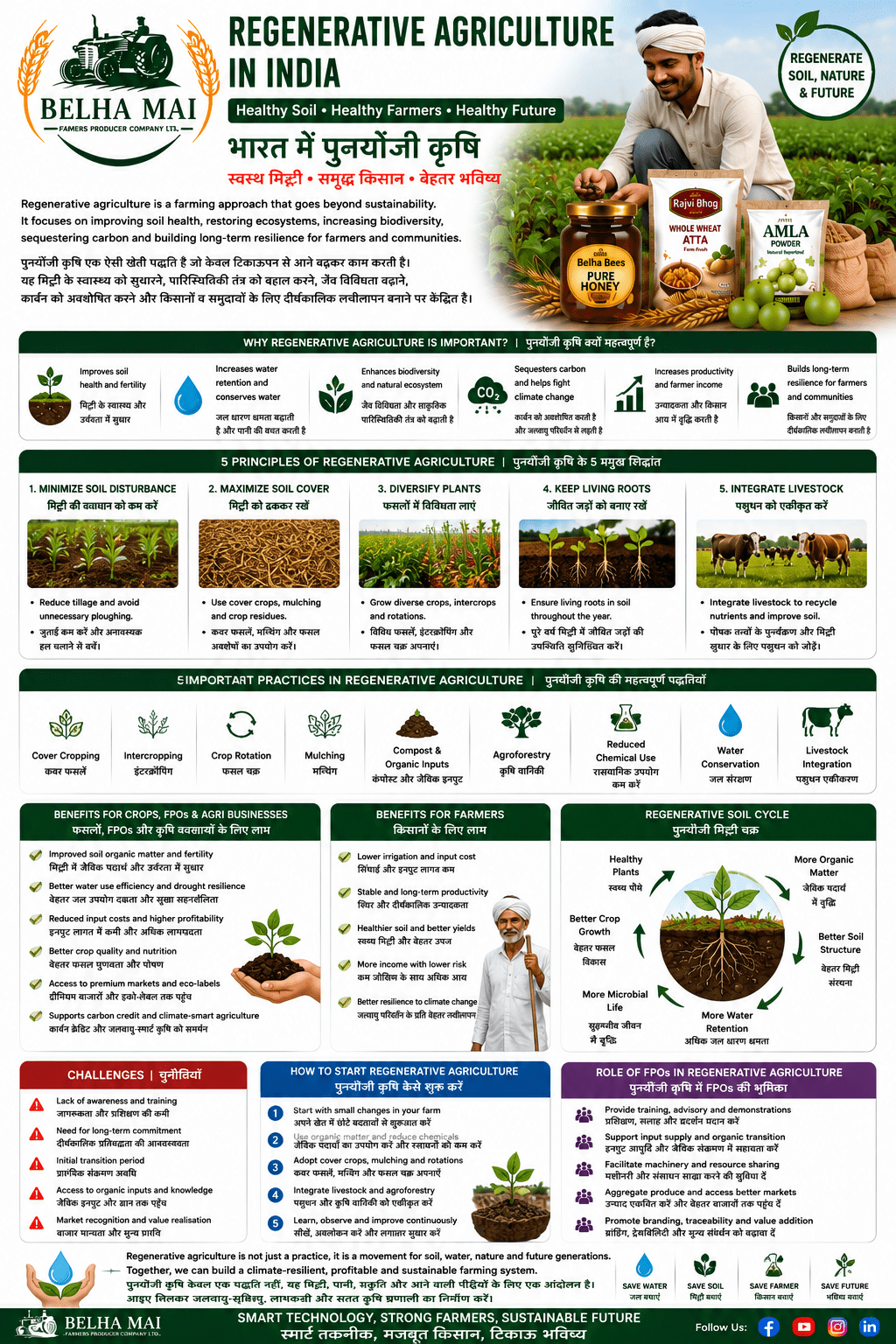
Regenerative agriculture is a farming approach that aims to restore and improve natural resources instead of only extracting production from the land. It focuses on rebuilding soil organic matter, improving biodiversity, conserving water and strengthening ecological balance.
पुनर्योजी कृषि खेती की ऐसी पद्धति है जिसका उद्देश्य भूमि से केवल उत्पादन लेना नहीं, बल्कि प्राकृतिक संसाधनों को पुनर्स्थापित और बेहतर बनाना है। यह मिट्टी में जैविक पदार्थ बढ़ाने, जैव विविधता सुधारने, पानी बचाने और पारिस्थितिक संतुलन मजबूत करने पर ध्यान देती है।
This approach includes practices such as cover cropping, crop rotation, composting, reduced tillage, agroforestry, mulching, integrated livestock, water conservation and reduced chemical dependency.
इस पद्धति में cover cropping, crop rotation, composting, reduced tillage, agroforestry, mulching, integrated livestock, water conservation और chemical dependency कम करने जैसी practices शामिल हैं।
The main idea is simple: healthier soil creates healthier crops, healthier farms and healthier rural communities.
इसका मुख्य विचार सरल है: स्वस्थ मिट्टी स्वस्थ फसल, स्वस्थ खेत और स्वस्थ ग्रामीण समुदाय बनाती है।
Why Regenerative Agriculture Is Important in India
Regenerative Agriculture in India is important because a large number of farmers depend on small and marginal landholdings. When soil health declines and input costs rise, small farmers are affected the most.
भारत में पुनर्योजी कृषि इसलिए महत्वपूर्ण है क्योंकि बड़ी संख्या में किसान छोटे और सीमांत जोतों पर निर्भर हैं। जब मिट्टी की सेहत घटती है और input costs बढ़ती हैं, तो छोटे किसान सबसे अधिक प्रभावित होते हैं।
Indian agriculture also faces challenges such as groundwater decline, erratic rainfall, crop residue burning, excessive chemical use, soil erosion and climate-related crop losses.
भारतीय कृषि को भूजल में गिरावट, अनियमित वर्षा, फसल अवशेष जलाने, रसायनों के अधिक उपयोग, मिट्टी कटाव और जलवायु से जुड़ी फसल हानि जैसी चुनौतियों का भी सामना करना पड़ता है।
Regenerative farming can help address these challenges by improving soil structure, increasing water holding capacity, reducing erosion and making farming more climate-resilient.
पुनर्योजी खेती मिट्टी की संरचना सुधारकर, पानी धारण क्षमता बढ़ाकर, कटाव कम करके और खेती को अधिक जलवायु-सहिष्णु बनाकर इन चुनौतियों को हल करने में मदद कर सकती है।
Soil Health as the Foundation
Soil health is the foundation of regenerative agriculture. If soil is healthy, crops can grow better, water can be retained for longer and nutrients can become more available to plants.
मिट्टी का स्वास्थ्य पुनर्योजी कृषि की नींव है। यदि मिट्टी स्वस्थ है, तो फसल बेहतर बढ़ सकती है, पानी लंबे समय तक रुक सकता है और पोषक तत्व पौधों को अधिक उपलब्ध हो सकते हैं।
Healthy soil contains organic matter, useful microorganisms, earthworms, good structure and balanced nutrients. Such soil supports strong roots and better crop performance.
स्वस्थ मिट्टी में जैविक पदार्थ, उपयोगी सूक्ष्मजीव, केंचुए, अच्छी संरचना और संतुलित पोषक तत्व होते हैं। ऐसी मिट्टी मजबूत जड़ों और बेहतर फसल प्रदर्शन को सहारा देती है।
Farmers can improve soil health through compost, farmyard manure, green manure, crop residues, cover crops, reduced tillage and balanced nutrient management.
किसान compost, गोबर खाद, हरी खाद, फसल अवशेष, cover crops, reduced tillage और balanced nutrient management के माध्यम से मिट्टी की सेहत सुधार सकते हैं।
Organic Matter Addition
Organic matter addition is one of the most important practices in regenerative agriculture. Organic matter improves soil structure, water holding capacity, nutrient availability and microbial life.
जैविक पदार्थ जोड़ना पुनर्योजी कृषि की सबसे महत्वपूर्ण practices में से एक है। जैविक पदार्थ मिट्टी की संरचना, जल धारण क्षमता, पोषक तत्वों की उपलब्धता और सूक्ष्मजीव जीवन को सुधारता है।
Farmers can add organic matter through compost, farmyard manure, green manure, crop residue incorporation, leaf litter and bio-inputs.
किसान compost, गोबर खाद, हरी खाद, फसल अवशेषों को मिट्टी में मिलाकर, पत्तियों के कचरे और जैविक inputs के माध्यम से जैविक पदार्थ बढ़ा सकते हैं।
When organic matter increases, soil becomes more resilient to drought, erosion and nutrient loss.
जब जैविक पदार्थ बढ़ता है, तो मिट्टी सूखे, कटाव और पोषक तत्वों की हानि के प्रति अधिक सहनशील बनती है।
Cover Cropping
Cover cropping means growing crops mainly to protect and improve the soil rather than for direct harvest. Cover crops keep the soil covered and reduce erosion.
Cover cropping का अर्थ ऐसी फसलें उगाना है जिनका मुख्य उद्देश्य सीधे उत्पादन लेना नहीं, बल्कि मिट्टी की रक्षा और सुधार करना होता है। Cover crops मिट्टी को ढका रखती हैं और कटाव कम करती हैं।
Cover crops can improve soil organic matter, suppress weeds, support beneficial insects and improve soil moisture.
Cover crops मिट्टी में जैविक पदार्थ बढ़ा सकती हैं, खरपतवार कम कर सकती हैं, लाभकारी कीटों को सहारा दे सकती हैं और मिट्टी की नमी सुधार सकती हैं।
For Indian farmers, cover crops can be selected according to season, soil type, rainfall and main crop system.
भारतीय किसानों के लिए cover crops का चयन मौसम, मिट्टी के प्रकार, वर्षा और मुख्य फसल प्रणाली के अनुसार किया जा सकता है।
Crop Rotation
Crop rotation means growing different crops in a planned sequence on the same field. It helps break pest cycles, improve soil nutrients and reduce dependence on one crop.
Crop rotation का अर्थ एक ही खेत में योजनाबद्ध क्रम से अलग-अलग फसलें उगाना है। यह कीट चक्र को तोड़ने, मिट्टी के पोषक तत्व सुधारने और एक ही फसल पर निर्भरता कम करने में मदद करता है।
For example, cereal crops can be rotated with pulses, oilseeds or green manure crops. This improves soil fertility and reduces production risk.
उदाहरण के लिए, cereal crops को pulses, oilseeds या green manure crops के साथ rotate किया जा सकता है। इससे मिट्टी की उर्वरता सुधरती है और production risk कम होता है।
FPOs can promote crop rotation through farmer training, seed availability, market linkage and crop planning support.
FPOs farmer training, seed availability, market linkage और crop planning support के माध्यम से crop rotation को बढ़ावा दे सकते हैं।
Reduced Tillage
Reduced tillage means disturbing the soil as little as possible. Excessive tillage can damage soil structure, reduce organic matter and increase erosion.
Reduced tillage का अर्थ मिट्टी को जितना संभव हो उतना कम disturb करना है। अधिक जुताई मिट्टी की संरचना को नुकसान पहुँचा सकती है, जैविक पदार्थ घटा सकती है और कटाव बढ़ा सकती है।
When soil is disturbed less, microorganisms, earthworms and root channels can work better. This supports healthier soil and better water movement.
जब मिट्टी को कम disturb किया जाता है, तो सूक्ष्मजीव, केंचुए और जड़ों के रास्ते बेहतर तरीके से काम कर सकते हैं। इससे स्वस्थ मिट्टी और बेहतर जल प्रवाह को support मिलता है।
Reduced tillage can also reduce fuel cost and labour requirement when suitable machinery and proper crop planning are available.
जब suitable machinery और proper crop planning उपलब्ध हो, तो reduced tillage fuel cost और labour requirement को भी कम कर सकती है।
Mulching
Mulching is the practice of covering soil with crop residues, leaves, straw, organic material or suitable mulch sheets. It protects soil from direct sunlight, wind and rain impact.
Mulching मिट्टी को फसल अवशेष, पत्तियों, भूसा, जैविक पदार्थ या उपयुक्त mulch sheets से ढकने की पद्धति है। यह मिट्टी को सीधी धूप, हवा और वर्षा के प्रभाव से बचाती है।
Mulching reduces water evaporation, controls weeds, improves soil moisture and adds organic matter when organic mulch is used.
Mulching पानी के वाष्पीकरण को कम करती है, खरपतवार नियंत्रित करती है, मिट्टी की नमी सुधारती है और जैविक mulch उपयोग करने पर मिट्टी में जैविक पदार्थ बढ़ाती है।
This practice is especially useful in horticulture crops, vegetables, nurseries and dry areas.
यह पद्धति horticulture crops, vegetables, nurseries और dry areas में विशेष रूप से उपयोगी है।
Agroforestry
Agroforestry is an important part of regenerative agriculture. It means integrating trees with crops, livestock or farm boundaries.
Agroforestry पुनर्योजी कृषि का महत्वपूर्ण हिस्सा है। इसका अर्थ पेड़ों को crops, livestock या खेत की boundaries के साथ जोड़ना है।
Trees improve biodiversity, store carbon, protect soil, provide shade, reduce wind erosion and create additional income sources.
पेड़ जैव विविधता बढ़ाते हैं, कार्बन संग्रहित करते हैं, मिट्टी की रक्षा करते हैं, छाया देते हैं, wind erosion कम करते हैं और अतिरिक्त आय के स्रोत बनाते हैं।
For FPOs, agroforestry can connect with nursery development, carbon credit opportunities, fruit production, timber value and long-term climate resilience.
FPOs के लिए agroforestry nursery development, carbon credit opportunities, fruit production, timber value और long-term climate resilience से जुड़ सकती है।
Water Conservation
Water conservation is essential in regenerative agriculture. Healthy soil can hold more water, but farmers also need practical water-saving techniques.
Water conservation पुनर्योजी कृषि में आवश्यक है। स्वस्थ मिट्टी अधिक पानी रोक सकती है, लेकिन किसानों को व्यावहारिक जल-बचत तकनीकों की भी आवश्यकता होती है।
Drip irrigation, sprinkler irrigation, rainwater harvesting, farm ponds, contour bunding, mulching and soil moisture management can help save water.
Drip irrigation, sprinkler irrigation, rainwater harvesting, farm ponds, contour bunding, mulching और soil moisture management पानी बचाने में मदद कर सकते हैं।
Water conservation reduces irrigation cost and protects farmers from drought and irregular rainfall.
Water conservation irrigation cost कम करता है और किसानों को सूखे तथा अनियमित वर्षा से बचाने में मदद करता है।
Biodiversity on Farms
Biodiversity is an important principle of regenerative agriculture. A farm with many types of crops, trees, insects, birds and soil organisms is more balanced and resilient.
जैव विविधता पुनर्योजी कृषि का महत्वपूर्ण सिद्धांत है। जिस खेत में कई प्रकार की फसलें, पेड़, कीट, पक्षी और मिट्टी के जीव होते हैं, वह अधिक संतुलित और सहनशील होता है।
Biodiversity can reduce pest pressure, improve pollination, support soil life and reduce dependence on external inputs.
जैव विविधता कीट दबाव कम कर सकती है, pollination सुधार सकती है, मिट्टी के जीवन को support कर सकती है और बाहरी inputs पर निर्भरता घटा सकती है।
Farmers can improve biodiversity through mixed cropping, intercropping, flowering plants, agroforestry and reduced chemical use.
किसान mixed cropping, intercropping, flowering plants, agroforestry और chemical use कम करके biodiversity सुधार सकते हैं।
Integrated Livestock
Livestock can play an important role in regenerative agriculture when managed properly. Animals provide manure, support nutrient cycling and create additional income for farmers.
सही तरीके से प्रबंधन करने पर livestock पुनर्योजी कृषि में महत्वपूर्ण भूमिका निभा सकता है। पशु manure देते हैं, nutrient cycling को support करते हैं और किसानों के लिए अतिरिक्त आय बनाते हैं।
Farmers can use farmyard manure, composted dung and livestock integration to improve soil organic matter.
किसान soil organic matter सुधारने के लिए farmyard manure, composted dung और livestock integration का उपयोग कर सकते हैं।
However, livestock must be managed responsibly so that grazing pressure, waste and disease risks remain controlled.
हालाँकि livestock को जिम्मेदारी से manage करना चाहिए ताकि grazing pressure, waste और disease risks नियंत्रित रहें।
Reducing Chemical Dependency
Regenerative agriculture does not always mean stopping all external inputs immediately. It means reducing unnecessary dependency and using inputs more wisely.
पुनर्योजी कृषि का अर्थ हमेशा सभी external inputs को तुरंत बंद करना नहीं है। इसका अर्थ अनावश्यक निर्भरता कम करना और inputs का अधिक समझदारी से उपयोग करना है।
Farmers can reduce chemical dependency through soil testing, integrated nutrient management, biological pest control, composting and balanced fertiliser use.
किसान soil testing, integrated nutrient management, biological pest control, composting और balanced fertiliser use के माध्यम से chemical dependency कम कर सकते हैं।
This approach lowers input cost, protects soil health and supports safer food production.
यह पद्धति input cost कम करती है, soil health की रक्षा करती है और safer food production को support करती है।
Regenerative Agriculture and Carbon Credits
Regenerative agriculture is closely linked with carbon credit opportunities because many regenerative practices increase soil carbon or reduce emissions.
पुनर्योजी कृषि carbon credit opportunities से closely linked है क्योंकि कई regenerative practices soil carbon बढ़ाती हैं या emissions कम करती हैं।
Practices such as agroforestry, reduced tillage, cover cropping, composting, residue management and water-saving practices may support carbon projects when properly measured and verified.
Agroforestry, reduced tillage, cover cropping, composting, residue management और water-saving practices जैसी पद्धतियाँ सही measurement और verification होने पर carbon projects को support कर सकती हैं।
FPOs can help farmers participate in carbon projects by aggregating farmers, maintaining records and connecting with credible project partners.
FPOs farmers को aggregate करके, records maintain करके और credible project partners से जोड़कर carbon projects में किसानों की भागीदारी में मदद कर सकते हैं।
Regenerative Agriculture and Food Processing
Regenerative agriculture can support food processing by improving raw material quality. Healthy soil and responsible farming can produce better crops for processing.
पुनर्योजी कृषि raw material quality सुधारकर food processing को support कर सकती है। स्वस्थ मिट्टी और जिम्मेदार खेती processing के लिए बेहतर crops पैदा कर सकती हैं।
For products such as Rajvi Bhog atta, Belha Bees honey, amla powder, mango pulp and dehydrated products, better farming practices can improve brand trust and product consistency.
Rajvi Bhog atta, Belha Bees honey, amla powder, mango pulp और dehydrated products जैसे products के लिए better farming practices brand trust और product consistency को सुधार सकती हैं।
A regenerative supply chain can connect soil health, farmer income, food safety, traceability and consumer trust.
Regenerative supply chain soil health, farmer income, food safety, traceability और consumer trust को जोड़ सकती है।
Regenerative Agriculture and Export Readiness
Export markets increasingly value quality, safety, traceability and responsible sourcing. Regenerative agriculture can support these requirements when properly documented.
Export markets quality, safety, traceability और responsible sourcing को तेजी से value दे रहे हैं। Proper documentation होने पर regenerative agriculture इन requirements को support कर सकती है।
Farm records, soil health practices, reduced chemical use, water conservation and traceability can strengthen buyer confidence.
Farm records, soil health practices, reduced chemical use, water conservation और traceability buyer confidence को मजबूत कर सकते हैं।
For FPOs, regenerative agriculture can become part of a stronger export story for farmer-led brands.
FPOs के लिए regenerative agriculture farmer-led brands की stronger export story का हिस्सा बन सकती है।
Role of FPOs in Regenerative Agriculture
FPOs can play a major role in promoting regenerative agriculture because they work with many farmers collectively.
FPOs regenerative agriculture को बढ़ावा देने में बड़ी भूमिका निभा सकते हैं क्योंकि वे कई किसानों के साथ सामूहिक रूप से काम करते हैं।
An FPO can provide training, organise demonstrations, arrange bio-inputs, support soil testing, promote water conservation and build market linkage for regenerative products.
FPO training दे सकता है, demonstrations organise कर सकता है, bio-inputs arrange कर सकता है, soil testing support कर सकता है, water conservation promote कर सकता है और regenerative products के लिए market linkage बना सकता है।
FPOs can also help farmers access government schemes, CSR support, climate finance and carbon credit opportunities.
FPOs farmers को government schemes, CSR support, climate finance और carbon credit opportunities तक पहुँचाने में भी मदद कर सकते हैं।
Benefits for Farmers
Regenerative agriculture can help farmers reduce input cost, improve soil fertility, save water, reduce crop risk and improve long-term productivity.
Regenerative agriculture किसानों को input cost कम करने, soil fertility सुधारने, पानी बचाने, crop risk कम करने और long-term productivity सुधारने में मदद कर सकती है।
It can also create additional income through diversified crops, livestock integration, agroforestry, value addition and carbon-linked opportunities.
यह diversified crops, livestock integration, agroforestry, value addition और carbon-linked opportunities के माध्यम से additional income भी बना सकती है।
The biggest benefit is that the farm becomes stronger and less dependent on expensive external inputs over time.
सबसे बड़ा लाभ यह है कि समय के साथ खेत अधिक मजबूत बनता है और महंगे external inputs पर निर्भरता कम होती है।
Challenges in Regenerative Agriculture
Regenerative agriculture takes time. Soil health does not improve overnight, and farmers may need patience, training and continuous support.
Regenerative agriculture में समय लगता है। Soil health एक रात में नहीं सुधरती, और किसानों को धैर्य, training और continuous support की आवश्यकता हो सकती है।
Another challenge is the transition period. Farmers may worry about yield, cost, labour and market acceptance during the shift.
दूसरी चुनौती transition period है। बदलाव के दौरान किसानों को yield, cost, labour और market acceptance की चिंता हो सकती है।
FPOs can reduce these challenges by starting with pilot farms, demonstrations, farmer field schools and gradual adoption.
FPOs pilot farms, demonstrations, farmer field schools और gradual adoption के माध्यम से इन challenges को कम कर सकते हैं।
Steps to Start Regenerative Agriculture
Farmers can start regenerative agriculture with simple steps such as adding organic matter, reducing unnecessary tillage, using crop residues, improving water conservation and diversifying crops.
Farmers organic matter जोड़कर, unnecessary tillage कम करके, crop residues का उपयोग करके, water conservation सुधारकर और crops diversify करके regenerative agriculture की शुरुआत कर सकते हैं।
They should also test soil, maintain farm records, observe crop performance and learn from successful local examples.
उन्हें soil test भी कराना चाहिए, farm records maintain करने चाहिए, crop performance observe करनी चाहिए और सफल local examples से सीखना चाहिए।
The best approach is gradual adoption because every farm has different soil, water, crop and market conditions.
सबसे अच्छा तरीका gradual adoption है क्योंकि हर farm की soil, water, crop और market conditions अलग होती हैं।
Belha Mai FPO Vision for Regenerative Agriculture
Belha Mai Farmers Producer Company Ltd. understands that regenerative agriculture can help farmers build healthier soil, stronger farms and more sustainable rural livelihoods.
Belha Mai Farmers Producer Company Ltd. समझता है कि regenerative agriculture farmers को healthier soil, stronger farms और more sustainable rural livelihoods बनाने में मदद कर सकती है।
For Belha Mai FPO, regenerative agriculture can support soil health improvement, water conservation, agroforestry, carbon credit opportunities, high-tech nursery, food processing and sustainable supply chains.
Belha Mai FPO के लिए regenerative agriculture soil health improvement, water conservation, agroforestry, carbon credit opportunities, high-tech nursery, food processing और sustainable supply chains को support कर सकती है।
The aim should be to create a farmer-led model where productivity, environment, income and rural development grow together.
लक्ष्य ऐसा farmer-led model बनाना होना चाहिए जहाँ productivity, environment, income और rural development साथ-साथ बढ़ें।
Conclusion
Regenerative Agriculture in India is a practical pathway for improving soil health, saving water, increasing biodiversity, reducing input dependency and building climate-resilient farming systems.
भारत में regenerative agriculture soil health सुधारने, पानी बचाने, biodiversity बढ़ाने, input dependency कम करने और climate-resilient farming systems बनाने का practical pathway है।
It is not only an environmental approach; it is also an economic opportunity for farmers and FPOs when linked with value addition, traceability, carbon opportunities and better markets.
यह केवल environmental approach नहीं है; जब इसे value addition, traceability, carbon opportunities और better markets से जोड़ा जाता है, तो यह farmers और FPOs के लिए economic opportunity भी बन जाती है।
In the future of the Food Processing Industry in India, FPOs that promote regenerative agriculture can build stronger farmer-led brands, sustainable supply chains and long-term rural prosperity.
Food Processing Industry in India के भविष्य में वे FPOs stronger farmer-led brands, sustainable supply chains और long-term rural prosperity बना सकते हैं जो regenerative agriculture को promote करेंगे।
FAQ
What is Regenerative Agriculture in India?
Regenerative Agriculture in India is a farming approach that restores soil health, improves biodiversity, saves water, reduces chemical dependency and builds climate-resilient farming systems.
भारत में regenerative agriculture ऐसी farming approach है जो soil health restore करती है, biodiversity सुधारती है, पानी बचाती है, chemical dependency कम करती है और climate-resilient farming systems बनाती है।
How is regenerative agriculture different from normal farming?
Regenerative agriculture focuses not only on production but also on improving soil, water, biodiversity and farm ecosystem health for long-term sustainability.
Regenerative agriculture केवल production पर नहीं, बल्कि long-term sustainability के लिए soil, water, biodiversity और farm ecosystem health सुधारने पर ध्यान देती है।
Which practices are used in regenerative agriculture?
Practices include composting, cover cropping, crop rotation, reduced tillage, mulching, agroforestry, water conservation, biodiversity improvement and integrated livestock.
Practices में composting, cover cropping, crop rotation, reduced tillage, mulching, agroforestry, water conservation, biodiversity improvement और integrated livestock शामिल हैं।
Can regenerative agriculture increase farmer income?
Regenerative agriculture can support farmer income by reducing input cost, improving soil fertility, increasing resilience, creating diversified income and supporting value-added markets.
Regenerative agriculture input cost कम करके, soil fertility सुधारकर, resilience बढ़ाकर, diversified income बनाकर और value-added markets को support करके farmer income में मदद कर सकती है।
How can FPOs promote regenerative agriculture?
FPOs can promote regenerative agriculture through training, demonstrations, soil testing, bio-input support, water conservation, agroforestry, market linkage and carbon credit opportunities.
FPOs training, demonstrations, soil testing, bio-input support, water conservation, agroforestry, market linkage और carbon credit opportunities के माध्यम से regenerative agriculture को promote कर सकते हैं।
Is regenerative agriculture linked with carbon credits?
Regenerative agriculture can be linked with carbon credits when practices such as agroforestry, cover cropping, reduced tillage and soil carbon improvement are properly measured and verified.
Regenerative agriculture carbon credits से जुड़ सकती है जब agroforestry, cover cropping, reduced tillage और soil carbon improvement जैसी practices को proper measurement और verification के साथ लागू किया जाए।
Internal Links Section
👉 Food Processing Industry in India: Complete Guide
👉 Water Conservation Techniques in Farming
👉 Sustainable Supply Chains in Agriculture
👉 Carbon Credit Opportunities for Farmers
👉 Precision Agriculture Explained
👉 Risk Management in Agriculture Business
👉 Smart Farming Technologies in India
External Authority Links
👉 Ministry of Agriculture & Farmers Welfare
👉 FAO Climate-Smart Agriculture
👉 FAO Sustainable Food Value Chains
👉 ICAR – Indian Council of Agricultural Research
👉 United Nations Climate Change
Follow Belha Mai FPO for More Updates
Stay connected with Belha Mai Farmers Producer Company Ltd. for more updates on agriculture, food processing, farmer development, FPO awareness, market linkage, value addition, rural entrepreneurship and sustainable farming.
कृषि, खाद्य प्रसंस्करण, किसान विकास, FPO जागरूकता, बाजार संपर्क, मूल्य संवर्धन, ग्रामीण उद्यमिता और सतत खेती से जुड़ी जानकारी के लिए Belha Mai Farmers Producer Company Ltd. से जुड़े रहें।
👉 Website
👉 YouTube
Belha Mai FPO is committed to supporting farmers through better information, technology, market linkage, value addition, FPO awareness and rural development.
Belha Mai FPO बेहतर जानकारी, तकनीक, बाजार संपर्क, मूल्य संवर्धन, FPO जागरूकता और ग्रामीण विकास के माध्यम से किसानों को सहयोग देने के लिए प्रतिबद्ध है।