नेट-जीरो खेती: अवधारणा और चुनौतियाँ
Introduction
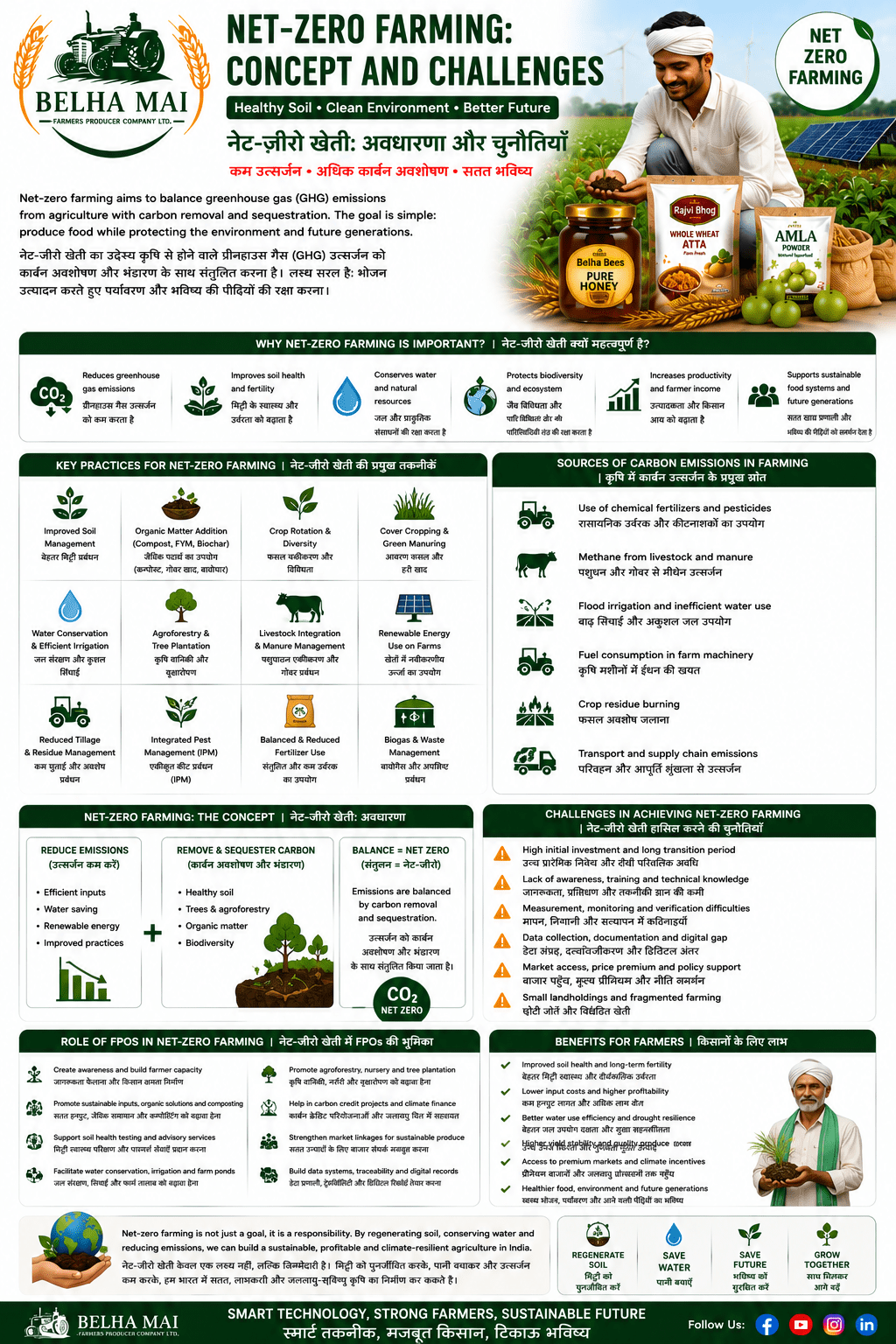
Net-Zero Farming is a modern climate-smart agriculture concept that aims to balance greenhouse gas emissions from farming with carbon removal and carbon storage. The goal is to produce food while reducing environmental damage and protecting future generations.
नेट-जीरो खेती एक आधुनिक जलवायु-स्मार्ट कृषि अवधारणा है, जिसका उद्देश्य खेती से होने वाले ग्रीनहाउस गैस उत्सर्जन को कार्बन हटाने और कार्बन संग्रहण के साथ संतुलित करना है। इसका लक्ष्य भोजन उत्पादन करना है, साथ ही पर्यावरणीय नुकसान को कम करना और आने वाली पीढ़ियों की रक्षा करना है।
Agriculture is both affected by climate change and connected with climate solutions. Farmers face irregular rainfall, heat stress, water scarcity and crop losses, but they can also help reduce emissions through better soil, water, crop and energy management.
कृषि जलवायु परिवर्तन से प्रभावित भी होती है और जलवायु समाधान से जुड़ी भी है। किसान अनियमित वर्षा, गर्मी के तनाव, पानी की कमी और फसल हानि का सामना करते हैं, लेकिन वे बेहतर मिट्टी, पानी, फसल और ऊर्जा प्रबंधन के माध्यम से उत्सर्जन कम करने में भी मदद कर सकते हैं।
For farmers and FPOs, Net-Zero Farming is not only an environmental goal. It can also become a pathway for lower input cost, better soil health, improved water use, stronger supply chains, carbon opportunities and sustainable rural businesses.
किसानों और FPOs के लिए नेट-जीरो खेती केवल पर्यावरणीय लक्ष्य नहीं है। यह कम लागत, बेहतर मिट्टी स्वास्थ्य, बेहतर जल उपयोग, मजबूत आपूर्ति शृंखला, कार्बन अवसर और सतत ग्रामीण व्यवसायों का मार्ग भी बन सकती है।
What Is Net-Zero Farming
Net-Zero Farming means reducing emissions from farming activities as much as possible and balancing the remaining emissions through carbon removal or carbon storage. This can be done through soil carbon improvement, agroforestry, renewable energy, better manure management and efficient use of inputs.
नेट-जीरो खेती का अर्थ है खेती से होने वाले उत्सर्जन को जितना संभव हो कम करना और शेष उत्सर्जन को कार्बन हटाने या कार्बन संग्रहण के माध्यम से संतुलित करना। यह मिट्टी में कार्बन सुधार, कृषि वानिकी, नवीकरणीय ऊर्जा, बेहतर गोबर प्रबंधन और inputs के कुशल उपयोग से किया जा सकता है।
In simple words, net-zero farming tries to reduce what farming releases into the atmosphere and increase what farming stores in soil, plants and trees.
सरल शब्दों में, नेट-जीरो खेती यह प्रयास करती है कि खेती वातावरण में जो उत्सर्जन करती है उसे कम किया जाए और जो कार्बन मिट्टी, पौधों और पेड़ों में संग्रहित हो सकता है उसे बढ़ाया जाए।
This approach does not mean stopping farming. It means making farming cleaner, more efficient, more resilient and more responsible.
इस पद्धति का अर्थ खेती बंद करना नहीं है। इसका अर्थ खेती को अधिक स्वच्छ, अधिक कुशल, अधिक सहनशील और अधिक जिम्मेदार बनाना है।
Why Net-Zero Farming Is Important
Net-Zero Farming is important because agriculture produces emissions through fertiliser use, livestock, paddy cultivation, fuel use, residue burning, irrigation and supply chain activities.
नेट-जीरो खेती इसलिए महत्वपूर्ण है क्योंकि कृषि में उर्वरक उपयोग, पशुपालन, धान की खेती, ईंधन उपयोग, फसल अवशेष जलाने, सिंचाई और आपूर्ति शृंखला गतिविधियों से उत्सर्जन होता है।
At the same time, agriculture can store carbon in soil, trees, roots and farm biomass. This makes farming an important part of climate action.
साथ ही कृषि मिट्टी, पेड़ों, जड़ों और खेत के जैविक पदार्थ में कार्बन संग्रहित कर सकती है। इससे खेती जलवायु कार्रवाई का महत्वपूर्ण हिस्सा बनती है।
For India, Net-Zero Farming is important because millions of farmers depend on agriculture, and climate change directly affects rural livelihoods.
भारत के लिए नेट-जीरो खेती महत्वपूर्ण है क्योंकि करोड़ों किसान कृषि पर निर्भर हैं और जलवायु परिवर्तन सीधे ग्रामीण आजीविका को प्रभावित करता है।
Sources of Emissions in Farming
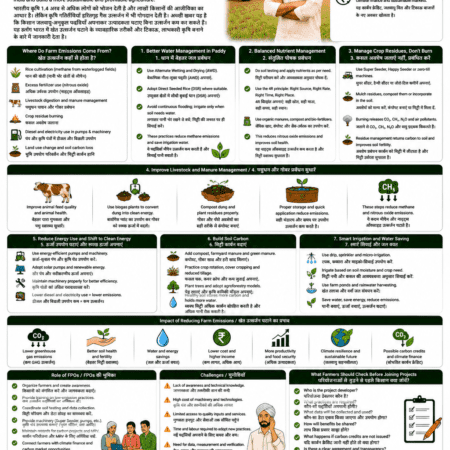
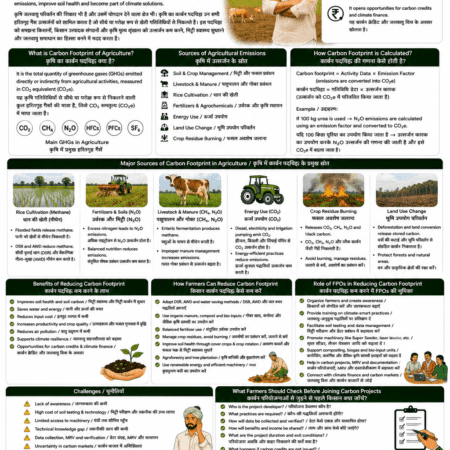
Farming emissions can come from different sources. Chemical fertilisers can release nitrous oxide, livestock can release methane, and flooded paddy fields can also produce methane under certain conditions.
खेती में उत्सर्जन कई स्रोतों से हो सकता है। रासायनिक उर्वरक nitrous oxide छोड़ सकते हैं, पशुधन methane छोड़ सकता है और लगातार पानी भरे धान के खेत भी कुछ परिस्थितियों में methane बना सकते हैं।
Farm machinery, diesel pumps, transport vehicles and processing activities can produce carbon dioxide when fossil fuels are used.
जब जीवाश्म ईंधन का उपयोग होता है, तो farm machinery, diesel pumps, transport vehicles और processing activities carbon dioxide पैदा कर सकती हैं।
Crop residue burning, poor manure handling, inefficient irrigation and post-harvest losses also add to the climate impact of agriculture.
फसल अवशेष जलाना, खराब गोबर प्रबंधन, अकुशल सिंचाई और कटाई के बाद होने वाले नुकसान भी कृषि के जलवायु प्रभाव को बढ़ाते हैं।
Reducing Emissions in Farming
The first step in Net-Zero Farming is reducing emissions wherever possible. Farmers can reduce emissions by using fertilisers efficiently, saving water, avoiding residue burning and reducing unnecessary fuel use.
नेट-जीरो खेती का पहला कदम जहाँ संभव हो वहाँ उत्सर्जन कम करना है। किसान उर्वरकों का कुशल उपयोग करके, पानी बचाकर, फसल अवशेष जलाने से बचकर और अनावश्यक ईंधन उपयोग कम करके उत्सर्जन घटा सकते हैं।
Efficient farming does not mean reducing productivity. It means producing more carefully with fewer losses and better resource use.
कुशल खेती का अर्थ उत्पादकता कम करना नहीं है। इसका अर्थ कम नुकसान और बेहतर संसाधन उपयोग के साथ अधिक सावधानी से उत्पादन करना है।
FPOs can support emission reduction through farmer training, shared machinery, soil testing, crop advisory, water conservation and sustainable input supply.
FPOs किसान प्रशिक्षण, shared machinery, soil testing, crop advisory, water conservation और sustainable input supply के माध्यम से उत्सर्जन घटाने में सहायता कर सकते हैं।
Carbon Removal and Carbon Storage
Carbon removal means taking carbon dioxide out of the atmosphere and storing it in soil, trees or biomass. Agriculture can support this through regenerative practices and agroforestry.
Carbon removal का अर्थ वातावरण से carbon dioxide को हटाकर मिट्टी, पेड़ों या जैविक पदार्थ में संग्रहित करना है। कृषि regenerative practices और agroforestry के माध्यम से इसमें सहायता कर सकती है।
Healthy soil with good organic matter can store more carbon. Trees planted on farms can also absorb carbon and store it for many years.
अच्छे जैविक पदार्थ वाली स्वस्थ मिट्टी अधिक कार्बन संग्रहित कर सकती है। खेतों में लगाए गए पेड़ भी carbon को अवशोषित करके कई वर्षों तक संग्रहित कर सकते हैं।
For farmers, carbon storage practices can also improve soil fertility, water retention and long-term productivity.
किसानों के लिए carbon storage practices मिट्टी की उर्वरता, जल धारण क्षमता और दीर्घकालिक उत्पादकता को भी सुधार सकती हैं।
Soil Health and Net-Zero Farming
Soil health is at the centre of Net-Zero Farming. Healthy soil can store carbon, hold water, support microorganisms and improve crop productivity.
Soil health नेट-जीरो खेती के केंद्र में है। स्वस्थ मिट्टी कार्बन संग्रहित कर सकती है, पानी रोक सकती है, सूक्ष्मजीवों को सहारा दे सकती है और फसल उत्पादकता सुधार सकती है।
Farmers can improve soil health through compost, farmyard manure, green manure, crop residues, cover crops, crop rotation and reduced tillage.
किसान compost, गोबर खाद, हरी खाद, फसल अवशेष, cover crops, crop rotation और reduced tillage के माध्यम से मिट्टी का स्वास्थ्य सुधार सकते हैं।
When soil becomes healthier, the farm becomes more resilient to drought, heavy rain and nutrient loss.
जब मिट्टी अधिक स्वस्थ होती है, तो खेत सूखे, भारी वर्षा और पोषक तत्वों की हानि के प्रति अधिक सहनशील बनता है।
Agroforestry and Tree Plantation
Agroforestry is one of the strongest practices for Net-Zero Farming. It integrates trees with crops, livestock or farm boundaries.
Agroforestry नेट-जीरो खेती की सबसे मजबूत practices में से एक है। इसमें पेड़ों को फसलों, पशुधन या खेत की सीमाओं के साथ जोड़ा जाता है।
Trees absorb carbon dioxide, protect soil, improve biodiversity, provide shade and create additional income sources.
पेड़ carbon dioxide को अवशोषित करते हैं, मिट्टी की रक्षा करते हैं, जैव विविधता बढ़ाते हैं, छाया देते हैं और अतिरिक्त आय के स्रोत बनाते हैं।
FPOs can support agroforestry through nursery development, farmer training, tree plantation records and market linkage for tree-based products.
FPOs nursery development, farmer training, tree plantation records और tree-based products के लिए market linkage के माध्यम से agroforestry को support कर सकते हैं।
Organic Matter Addition
Organic matter addition helps build soil carbon and improve soil fertility. It is one of the practical steps farmers can take toward Net-Zero Farming.
जैविक पदार्थ जोड़ना मिट्टी में कार्बन बनाने और soil fertility सुधारने में मदद करता है। यह Net-Zero Farming की दिशा में किसानों द्वारा अपनाया जा सकने वाला एक practical कदम है।
Compost, farmyard manure, crop residues, green manure and bio-inputs can increase organic matter in the soil.
Compost, गोबर खाद, फसल अवशेष, हरी खाद और जैविक inputs मिट्टी में जैविक पदार्थ बढ़ा सकते हैं।
This improves soil structure, water holding capacity, nutrient availability and crop resilience.
इससे मिट्टी की संरचना, जल धारण क्षमता, पोषक तत्वों की उपलब्धता और फसल की सहनशीलता सुधरती है।
Water Conservation and Efficient Irrigation
Water conservation is important for Net-Zero Farming because inefficient irrigation wastes water, energy and money. Better water management reduces pressure on groundwater and lowers emissions linked with pumping.
जल संरक्षण Net-Zero Farming के लिए महत्वपूर्ण है क्योंकि अकुशल सिंचाई पानी, ऊर्जा और धन की बर्बादी करती है। बेहतर जल प्रबंधन भूजल पर दबाव कम करता है और pumping से जुड़े उत्सर्जन को घटाता है।
Drip irrigation, sprinkler irrigation, rainwater harvesting, farm ponds, mulching and soil moisture monitoring can improve water efficiency.
Drip irrigation, sprinkler irrigation, rainwater harvesting, farm ponds, mulching और soil moisture monitoring जल दक्षता को सुधार सकते हैं।
For paddy cultivation, suitable water-saving practices can help reduce water use and may also reduce methane emissions under proper conditions.
धान की खेती में उपयुक्त जल-बचत practices पानी के उपयोग को कम कर सकती हैं और सही परिस्थितियों में methane emissions को भी घटा सकती हैं।
Renewable Energy on Farms
Renewable energy can reduce emissions from farming and rural processing. Solar pumps, solar dryers, solar cold rooms and renewable-powered processing units can make agriculture cleaner.
नवीकरणीय ऊर्जा खेती और ग्रामीण processing से होने वाले उत्सर्जन को कम कर सकती है। Solar pumps, solar dryers, solar cold rooms और renewable-powered processing units कृषि को अधिक स्वच्छ बना सकते हैं।
Diesel pumps and fossil fuel-based systems increase operating costs and emissions. Renewable energy can reduce dependence on such sources over time.
Diesel pumps और fossil fuel-based systems operating costs और emissions बढ़ाते हैं। Renewable energy समय के साथ ऐसे स्रोतों पर निर्भरता कम कर सकती है।
For FPOs, renewable energy can support irrigation, storage, food processing, cold chain and rural enterprise development.
FPOs के लिए renewable energy irrigation, storage, food processing, cold chain और rural enterprise development को support कर सकती है।
Reduced Tillage and Crop Residue Management
Reduced tillage means disturbing the soil less. This helps protect soil structure, reduce erosion and support carbon storage.
Reduced tillage का अर्थ मिट्टी को कम disturb करना है। इससे मिट्टी की संरचना सुरक्षित रहती है, कटाव कम होता है और carbon storage को support मिलता है।
Crop residue management prevents burning and returns organic matter to the soil. Residues can be used as mulch, compost, biochar or biomass raw material.
Crop residue management जलाने से बचाता है और जैविक पदार्थ को मिट्टी में वापस लाता है। अवशेषों का उपयोग mulch, compost, biochar या biomass raw material के रूप में किया जा सकता है।
FPOs can promote these practices through machinery services, farmer demonstrations and awareness campaigns.
FPOs machinery services, farmer demonstrations और awareness campaigns के माध्यम से इन practices को promote कर सकते हैं।
Balanced Fertiliser Use
Balanced fertiliser use is important for reducing emissions and improving soil health. Excess fertiliser use can increase cost and create environmental problems.
संतुलित उर्वरक उपयोग emissions कम करने और soil health सुधारने के लिए महत्वपूर्ण है। अधिक उर्वरक उपयोग cost बढ़ा सकता है और पर्यावरणीय समस्याएँ पैदा कर सकता है।
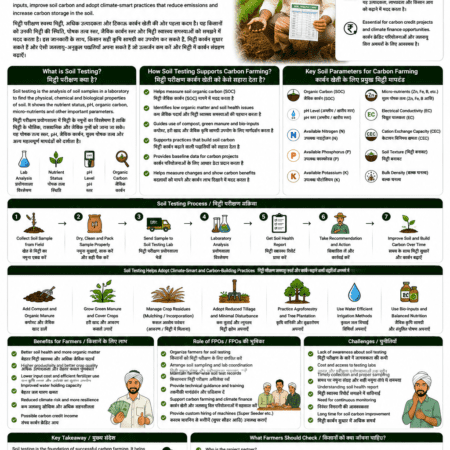
Soil testing can help farmers apply nutrients according to actual crop and soil requirements.
Soil testing किसानों को वास्तविक crop और soil requirements के अनुसार nutrients apply करने में मदद कर सकती है।
Integrated nutrient management, compost, bio-inputs and proper fertiliser timing can improve efficiency and reduce wastage.
Integrated nutrient management, compost, जैविक inputs और सही fertiliser timing दक्षता सुधार सकते हैं और wastage कम कर सकते हैं।
Integrated Pest Management
Integrated Pest Management helps reduce unnecessary pesticide use. It combines monitoring, prevention, biological methods, cultural practices and need-based chemical control.
Integrated Pest Management अनावश्यक pesticide use को कम करने में मदद करता है। यह monitoring, prevention, biological methods, cultural practices और need-based chemical control को जोड़ता है।
This approach protects crop health while reducing cost and environmental pressure.
यह approach crop health की रक्षा करता है, साथ ही cost और environmental pressure को कम करता है।
FPOs can promote Integrated Pest Management through training, pest advisory, bio-input supply and farmer field demonstrations.
FPOs training, pest advisory, bio-input supply और farmer field demonstrations के माध्यम से Integrated Pest Management को promote कर सकते हैं।
Livestock and Manure Management
Livestock is an important part of rural agriculture, but poor manure management can create emissions and hygiene problems.
Livestock ग्रामीण कृषि का महत्वपूर्ण हिस्सा है, लेकिन खराब गोबर प्रबंधन emissions और hygiene problems पैदा कर सकता है।
Proper composting, biogas units, manure storage and nutrient recycling can reduce emissions and improve soil fertility.
Proper composting, biogas units, manure storage और nutrient recycling emissions कम कर सकते हैं और soil fertility सुधार सकते हैं।
When livestock is integrated responsibly with farming, it can support both income and soil health.
जब livestock को farming के साथ जिम्मेदारी से integrate किया जाता है, तो यह income और soil health दोनों को support कर सकता है।
Net-Zero Farming and Carbon Credits
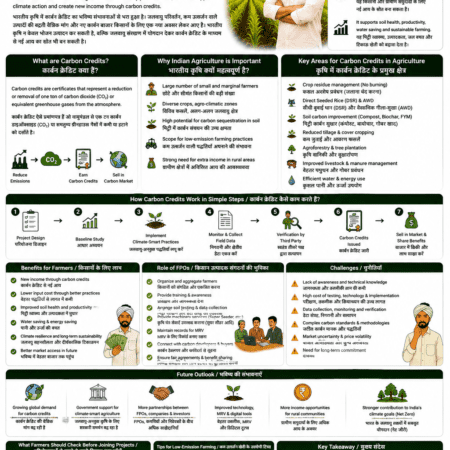
Net-Zero Farming is linked with carbon credit opportunities because many practices reduce emissions or store carbon. These practices can become part of verified carbon projects.
Net-Zero Farming carbon credit opportunities से जुड़ी है क्योंकि कई practices emissions कम करती हैं या carbon store करती हैं। ये practices verified carbon projects का हिस्सा बन सकती हैं।
Agroforestry, soil carbon improvement, residue management, water-saving practices and renewable energy can support carbon project development when properly measured.
Agroforestry, soil carbon improvement, residue management, water-saving practices और renewable energy सही measurement होने पर carbon project development को support कर सकते हैं।
FPOs can help farmers participate in carbon opportunities by aggregating members, maintaining records and working with credible partners.
FPOs members को aggregate करके, records maintain करके और credible partners के साथ काम करके farmers को carbon opportunities में भाग लेने में मदद कर सकते हैं।
Net-Zero Farming and Food Processing
Net-Zero Farming can support sustainable food processing by improving raw material quality and reducing the environmental footprint of the supply chain.
Net-Zero Farming raw material quality सुधारकर और supply chain के environmental footprint को कम करके sustainable food processing को support कर सकती है।
If products are produced through responsible farming practices, they can build stronger trust among consumers, institutions and export buyers.
यदि products responsible farming practices के माध्यम से produce होते हैं, तो वे consumers, institutions और export buyers के बीच stronger trust बना सकते हैं।
For Rajvi Bhog, Belha Bees, amla products and mango products, net-zero principles can strengthen brand value and sustainability positioning.
Rajvi Bhog, Belha Bees, amla products और mango products के लिए net-zero principles brand value और sustainability positioning को मजबूत कर सकते हैं।
Net-Zero Farming and Supply Chains
Net-Zero Farming is not limited to the field. Transport, storage, packaging, processing and distribution also affect the climate footprint of agriculture.
Net-Zero Farming केवल खेत तक सीमित नहीं है। Transport, storage, packaging, processing और distribution भी agriculture के climate footprint को प्रभावित करते हैं।
A sustainable supply chain should reduce wastage, improve energy efficiency, use better packaging and reduce unnecessary transport emissions.
Sustainable supply chain को wastage कम करना चाहिए, energy efficiency सुधारनी चाहिए, बेहतर packaging का उपयोग करना चाहिए और unnecessary transport emissions कम करने चाहिए।
FPOs can build cleaner supply chains by improving aggregation, storage, processing, transport planning and traceability.
FPOs aggregation, storage, processing, transport planning और traceability सुधारकर cleaner supply chains बना सकते हैं।
Role of Digital Tools
Digital tools are important for Net-Zero Farming because measurement and records are essential. Without data, it is difficult to show emission reduction or carbon storage.
Digital tools Net-Zero Farming के लिए महत्वपूर्ण हैं क्योंकि measurement और records आवश्यक होते हैं। Data के बिना emission reduction या carbon storage दिखाना कठिन होता है।
Mobile apps, satellite images, IoT sensors, QR codes, farm records and digital dashboards can support monitoring and reporting.
Mobile apps, satellite images, IoT sensors, QR codes, farm records और digital dashboards monitoring और reporting को support कर सकते हैं।
For FPOs, digital tools can help manage farmer data, crop practices, carbon records, traceability and project reporting.
FPOs के लिए digital tools farmer data, crop practices, carbon records, traceability और project reporting को manage करने में मदद कर सकते हैं।
Benefits for Farmers
Net-Zero Farming can benefit farmers by improving soil health, reducing input cost, saving water and building resilience against climate risks.
Net-Zero Farming किसानों को soil health सुधारकर, input cost घटाकर, पानी बचाकर और climate risks के खिलाफ resilience बनाकर लाभ दे सकती है।
It can also create future opportunities through carbon credits, premium markets, sustainable brands and institutional partnerships.
यह carbon credits, premium markets, sustainable brands और institutional partnerships के माध्यम से भविष्य के अवसर भी बना सकती है।
The biggest long-term benefit is that the farm becomes healthier, more productive and less vulnerable to climate shocks.
सबसे बड़ा दीर्घकालिक लाभ यह है कि खेत अधिक स्वस्थ, अधिक उत्पादक और climate shocks के प्रति कम कमजोर बनता है।
Benefits for FPOs
For FPOs, Net-Zero Farming can create new opportunities in farmer services, climate finance, carbon projects, sustainable supply chains and value-added brands.
FPOs के लिए Net-Zero Farming farmer services, climate finance, carbon projects, sustainable supply chains और value-added brands में नए अवसर बना सकती है।
An FPO can aggregate farmers, provide training, collect data, organise sustainable inputs and connect with carbon or climate finance partners.
FPO farmers को aggregate कर सकता है, training दे सकता है, data collect कर सकता है, sustainable inputs organise कर सकता है और carbon या climate finance partners से जुड़ सकता है।
This can improve the FPO’s credibility with buyers, banks, government departments, CSR partners and development agencies.
यह buyers, banks, government departments, CSR partners और development agencies के साथ FPO की credibility सुधार सकता है।
Challenges in Net-Zero Farming
The biggest challenge in Net-Zero Farming is awareness. Many farmers may not clearly understand emissions, carbon storage, carbon credits or net-zero concepts.
Net-Zero Farming की सबसे बड़ी चुनौती awareness है। कई farmers emissions, carbon storage, carbon credits या net-zero concepts को स्पष्ट रूप से नहीं समझते।
Another challenge is measurement. Carbon reduction and carbon storage need proper data, monitoring, verification and technical support.
दूसरी चुनौती measurement है। Carbon reduction और carbon storage के लिए proper data, monitoring, verification और technical support की आवश्यकता होती है।
Small landholdings, limited finance, lack of digital records, transition costs and uncertain carbon markets can also make Net-Zero Farming difficult.
Small landholdings, limited finance, digital records की कमी, transition costs और uncertain carbon markets भी Net-Zero Farming को कठिन बना सकते हैं।
Transition Period
Net-Zero Farming requires a transition period. Farmers may need time to change practices, improve soil, plant trees, reduce chemical dependency and adopt water-saving systems.
Net-Zero Farming में transition period की आवश्यकता होती है। Farmers को practices बदलने, soil सुधारने, trees लगाने, chemical dependency कम करने और water-saving systems अपनाने में समय लग सकता है।
During this period, farmers may worry about yield, income, labour and cost. This is why gradual adoption is better than sudden change.
इस अवधि में farmers yield, income, labour और cost को लेकर चिंतित हो सकते हैं। इसी कारण sudden change के बजाय gradual adoption बेहतर होता है।
FPOs can support the transition through demonstrations, training, technical guidance and market linkage.
FPOs demonstrations, training, technical guidance और market linkage के माध्यम से transition को support कर सकते हैं।
Measurement and Verification Challenges
Measurement and verification are necessary for proving climate impact. However, they can be costly and technically complex.
Climate impact को साबित करने के लिए measurement और verification आवश्यक हैं। हालाँकि ये महंगे और तकनीकी रूप से जटिल हो सकते हैं।
Carbon projects may require soil testing, satellite monitoring, farm records, farmer declarations, third-party verification and long-term data.
Carbon projects में soil testing, satellite monitoring, farm records, farmer declarations, third-party verification और long-term data की आवश्यकता हो सकती है।
FPOs can reduce this challenge by aggregating farmers and working with credible technical agencies.
FPOs farmers को aggregate करके और credible technical agencies के साथ काम करके इस challenge को कम कर सकते हैं।
Market and Policy Challenges
Net-Zero Farming needs supportive markets and policies. Farmers must receive fair value for adopting sustainable practices.
Net-Zero Farming को supportive markets और policies की आवश्यकता है। Farmers को sustainable practices अपनाने के लिए fair value मिलनी चाहिए।
If buyers do not pay better prices or if carbon income is uncertain, farmers may not feel motivated to continue.
यदि buyers बेहतर prices नहीं देते या carbon income uncertain रहती है, तो farmers continue करने के लिए motivated महसूस नहीं कर सकते।
Government schemes, CSR projects, carbon markets, sustainable brands and institutional buyers can help create stronger incentives.
Government schemes, CSR projects, carbon markets, sustainable brands और institutional buyers stronger incentives बनाने में मदद कर सकते हैं।
Role of FPOs in Net-Zero Farming
FPOs can play a central role in Net-Zero Farming because they can organise small farmers collectively. Individual farmers may not be able to manage climate projects alone.
FPOs Net-Zero Farming में central role निभा सकते हैं क्योंकि वे small farmers को collectively organise कर सकते हैं। Individual farmers climate projects को अकेले manage नहीं कर सकते।
FPOs can provide training, promote soil health, support water conservation, facilitate tree plantation, collect data and build market linkages.
FPOs training दे सकते हैं, soil health promote कर सकते हैं, water conservation support कर सकते हैं, tree plantation facilitate कर सकते हैं, data collect कर सकते हैं और market linkages बना सकते हैं।
A strong FPO can protect farmer interests and ensure that climate opportunities become practical and fair for small farmers.
मजबूत FPO farmer interests की रक्षा कर सकता है और यह सुनिश्चित कर सकता है कि climate opportunities small farmers के लिए practical और fair बनें।
Steps Farmers Can Take
Farmers can begin Net-Zero Farming with simple and practical steps. They can improve soil organic matter, reduce residue burning, save water, use fertilisers carefully and plant trees.
Farmers simple और practical steps से Net-Zero Farming शुरू कर सकते हैं। वे soil organic matter सुधार सकते हैं, residue burning कम कर सकते हैं, पानी बचा सकते हैं, fertilisers का सावधानी से उपयोग कर सकते हैं और trees लगा सकते हैं।
They can also maintain farm records, adopt crop rotation, use compost, reduce unnecessary tillage and explore renewable energy where possible.
वे farm records maintain कर सकते हैं, crop rotation अपना सकते हैं, compost का उपयोग कर सकते हैं, unnecessary tillage कम कर सकते हैं और जहाँ संभव हो renewable energy explore कर सकते हैं।
Small steps taken consistently can create strong long-term climate and income benefits.
लगातार उठाए गए छोटे कदम मजबूत long-term climate और income benefits बना सकते हैं।
Steps FPOs Can Take
FPOs should start by creating awareness among members about climate-smart and net-zero practices. Training and field demonstrations are very important.
FPOs को members के बीच climate-smart और net-zero practices के बारे में awareness बनाकर शुरुआत करनी चाहिए। Training और field demonstrations बहुत महत्वपूर्ण हैं।
They should identify suitable practices for local crops, soil, water and farmer capacity. Not every practice is suitable for every area.
उन्हें local crops, soil, water और farmer capacity के अनुसार suitable practices identify करनी चाहिए। हर practice हर क्षेत्र के लिए suitable नहीं होती।
FPOs should build partnerships with government departments, research institutions, carbon project developers, CSR partners and buyers.
FPOs को government departments, research institutions, carbon project developers, CSR partners और buyers के साथ partnerships बनानी चाहिए।
Belha Mai FPO Vision for Net-Zero Farming
Belha Mai Farmers Producer Company Ltd. understands that Net-Zero Farming can help farmers build climate-resilient, sustainable and profitable agriculture systems.
Belha Mai Farmers Producer Company Ltd. समझता है कि Net-Zero Farming किसानों को climate-resilient, sustainable और profitable agriculture systems बनाने में मदद कर सकती है।
For Belha Mai FPO, Net-Zero Farming can be connected with water conservation, regenerative agriculture, agroforestry, carbon credit opportunities, high-tech nursery, food processing and sustainable supply chains.
Belha Mai FPO के लिए Net-Zero Farming को water conservation, regenerative agriculture, agroforestry, carbon credit opportunities, high-tech nursery, food processing और sustainable supply chains से जोड़ा जा सकता है।
The aim should be to create a farmer-led climate-smart model that protects soil, saves water, reduces emissions and improves farmer income.
लक्ष्य ऐसा farmer-led climate-smart model बनाना होना चाहिए जो soil की रक्षा करे, पानी बचाए, emissions कम करे और farmer income सुधारे।
Conclusion
Net-Zero Farming is a future-ready agriculture concept that balances emission reduction with carbon removal and carbon storage. It can help farmers protect the environment while improving long-term farm resilience.
Net-Zero Farming एक future-ready agriculture concept है जो emission reduction को carbon removal और carbon storage के साथ balance करता है। यह किसानों को environment की रक्षा करते हुए long-term farm resilience सुधारने में मदद कर सकता है।
The concept includes soil health improvement, agroforestry, water conservation, renewable energy, residue management, balanced fertiliser use, digital records and sustainable supply chains.
इस concept में soil health improvement, agroforestry, water conservation, renewable energy, residue management, balanced fertiliser use, digital records और sustainable supply chains शामिल हैं।
In the future of the Food Processing Industry in India, FPOs that promote Net-Zero Farming can build stronger farmer-led brands, climate-smart supply chains and sustainable rural businesses.
Food Processing Industry in India के भविष्य में वे FPOs stronger farmer-led brands, climate-smart supply chains और sustainable rural businesses बना सकते हैं जो Net-Zero Farming को promote करेंगे।
FAQ
What is Net-Zero Farming?
Net-Zero Farming is an agriculture approach that reduces greenhouse gas emissions from farming and balances remaining emissions through carbon removal and carbon storage.
Net-Zero Farming एक agriculture approach है जो farming से होने वाले greenhouse gas emissions को कम करती है और remaining emissions को carbon removal तथा carbon storage के माध्यम से balance करती है।
Why is Net-Zero Farming important?
Net-Zero Farming is important because it helps reduce climate impact, improve soil health, save water, protect biodiversity and build resilient farming systems.
Net-Zero Farming महत्वपूर्ण है क्योंकि यह climate impact कम करने, soil health सुधारने, पानी बचाने, biodiversity की रक्षा करने और resilient farming systems बनाने में मदद करती है।
Which practices support Net-Zero Farming?
Practices such as agroforestry, soil carbon improvement, composting, water conservation, renewable energy, residue management, reduced tillage and balanced fertiliser use support Net-Zero Farming.
Agroforestry, soil carbon improvement, composting, water conservation, renewable energy, residue management, reduced tillage और balanced fertiliser use जैसी practices Net-Zero Farming को support करती हैं।
Can small farmers adopt Net-Zero Farming?
Small farmers can adopt Net-Zero Farming gradually through simple practices such as compost use, crop rotation, water saving, residue management and tree plantation.
Small farmers compost use, crop rotation, water saving, residue management और tree plantation जैसी simple practices के माध्यम से धीरे-धीरे Net-Zero Farming अपना सकते हैं।
How can FPOs help in Net-Zero Farming?
FPOs can help by training farmers, aggregating members, collecting data, promoting sustainable practices, supporting carbon projects and building market linkages.
FPOs farmers को training देकर, members को aggregate करके, data collect करके, sustainable practices को promote करके, carbon projects को support करके और market linkages बनाकर मदद कर सकते हैं।
Is Net-Zero Farming linked with carbon credits?
Net-Zero Farming can be linked with carbon credits when emission reduction or carbon storage practices are properly measured, verified and connected with carbon markets.
Net-Zero Farming carbon credits से जुड़ सकती है जब emission reduction या carbon storage practices को properly measured, verified और carbon markets से connected किया जाए।
Internal Links Section
👉 Food Processing Industry in India: Complete Guide
👉 Regenerative Agriculture in India
👉 Water Conservation Techniques in Farming
👉 Carbon Credit Opportunities for Farmers
👉 Sustainable Supply Chains in Agriculture
👉 Precision Agriculture Explained
👉 Risk Management in Agriculture Business
External Authority Links
👉 Ministry of Environment, Forest and Climate Change
👉 Ministry of Agriculture & Farmers Welfare
👉 United Nations Climate Change
👉 FAO Climate-Smart Agriculture
👉 ICAR – Indian Council of Agricultural Research
👉 Bureau of Energy Efficiency – Carbon Market
Follow Belha Mai FPO for More Updates
Stay connected with Belha Mai Farmers Producer Company Ltd. for more updates on agriculture, food processing, farmer development, FPO awareness, market linkage, value addition, rural entrepreneurship and sustainable farming.
कृषि, खाद्य प्रसंस्करण, किसान विकास, FPO जागरूकता, बाजार संपर्क, मूल्य संवर्धन, ग्रामीण उद्यमिता और सतत खेती से जुड़ी जानकारी के लिए Belha Mai Farmers Producer Company Ltd. से जुड़े रहें।
👉 Website
👉 YouTube
Belha Mai FPO is committed to supporting farmers through better information, technology, market linkage, value addition, FPO awareness and rural development.
Belha Mai FPO बेहतर जानकारी, तकनीक, बाजार संपर्क, मूल्य संवर्धन, FPO जागरूकता और ग्रामीण विकास के माध्यम से किसानों को सहयोग देने के लिए प्रतिबद्ध है।