बागवानी विकास में टिशू कल्चर की भूमिका
Introduction
The role of tissue culture in horticulture is becoming very important because modern fruit and vegetable farming depends heavily on quality planting material. Horticulture crops such as banana, papaya, strawberry, bamboo, ornamental plants and many fruit crops require healthy, uniform and disease-free plants for better productivity. Tissue culture helps produce plants under controlled laboratory conditions and supports farmers with better crop establishment, improved survival and more scientific farming. For India, where horticulture can increase farmer income, tissue culture can become a strong tool for future agricultural development.
बागवानी में टिशू कल्चर की भूमिका बहुत महत्वपूर्ण होती जा रही है क्योंकि आधुनिक फल और सब्जी खेती काफी हद तक गुणवत्तापूर्ण पौध सामग्री पर निर्भर करती है। केला, पपीता, स्ट्रॉबेरी, बांस, सजावटी पौधे और कई फलदार फसलों जैसी बागवानी फसलों के लिए स्वस्थ, समान और रोग-मुक्त पौधों की आवश्यकता होती है। टिशू कल्चर नियंत्रित प्रयोगशाला वातावरण में पौधे तैयार करने में मदद करता है और किसानों को बेहतर फसल स्थापना, अधिक जीवित रहने की क्षमता और वैज्ञानिक खेती में सहायता देता है। भारत में, जहां बागवानी किसान आय बढ़ाने का माध्यम बन सकती है, टिशू कल्चर भविष्य के कृषि विकास का मजबूत साधन बन सकता है।
Meaning of Tissue Culture in Horticulture
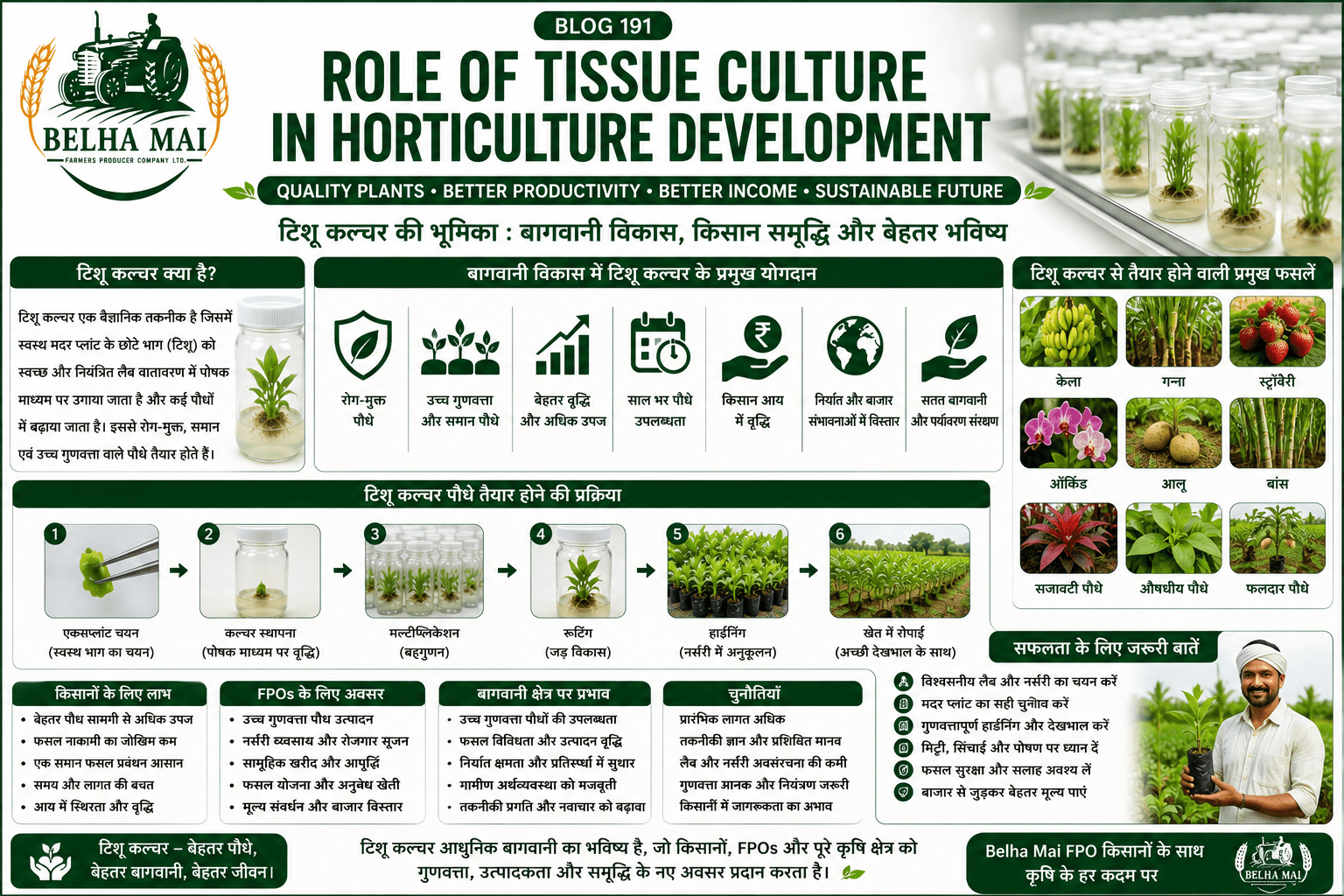
The role of tissue culture in horticulture begins with the production of plants from a small part of a healthy mother plant. This small plant part is grown in a sterile laboratory environment on a nutrient medium and multiplied into many plantlets. These plantlets are later rooted, hardened in nursery conditions and supplied to farmers for cultivation. In horticulture, this method is especially useful because many fruit crops and high-value crops need reliable planting material to perform well in the field.
बागवानी में टिशू कल्चर की भूमिका स्वस्थ मदर प्लांट के छोटे भाग से पौधे तैयार करने से शुरू होती है। इस छोटे पौध भाग को स्वच्छ प्रयोगशाला वातावरण में पोषक माध्यम पर उगाया जाता है और कई छोटे पौधों में बढ़ाया जाता है। बाद में इन पौधों में जड़ें विकसित की जाती हैं, नर्सरी में हार्डनिंग की जाती है और फिर किसानों को खेती के लिए उपलब्ध कराया जाता है। बागवानी में यह विधि विशेष रूप से उपयोगी है क्योंकि कई फलदार और उच्च मूल्य वाली फसलों को खेत में अच्छा प्रदर्शन करने के लिए विश्वसनीय पौध सामग्री की आवश्यकता होती है।
Importance of Quality Planting Material
The role of tissue culture in horticulture is directly connected with the importance of quality planting material. In horticulture crops, a farmer’s success starts from the quality of the plant. If the plant is weak, infected or not true-to-type, the farmer may suffer for many years, especially in fruit crops that remain in the field for a long time. Tissue culture can help produce healthy and uniform plants, which gives farmers a better foundation for productivity, quality and income.
बागवानी में टिशू कल्चर की भूमिका सीधे गुणवत्तापूर्ण पौध सामग्री के महत्व से जुड़ी है। बागवानी फसलों में किसान की सफलता पौधे की गुणवत्ता से शुरू होती है। यदि पौधा कमजोर, संक्रमित या सही किस्म का नहीं है, तो किसान को कई वर्षों तक नुकसान हो सकता है, विशेष रूप से उन फलदार फसलों में जो लंबे समय तक खेत में रहती हैं। टिशू कल्चर स्वस्थ और समान पौधे तैयार करने में मदद कर सकता है, जिससे किसानों को उत्पादकता, गुणवत्ता और आय के लिए बेहतर आधार मिलता है।
Disease-Free Plant Production
One of the most important roles of tissue culture in horticulture is disease-free plant production. Many diseases enter the field through infected planting material, and once disease spreads in a fruit crop or plantation crop, it becomes difficult and costly to manage. Tissue culture, when supported by proper mother plant selection and laboratory hygiene, can reduce the risk of disease transmission. This is useful for crops where planting material quality strongly affects long-term productivity.
बागवानी में टिशू कल्चर की सबसे महत्वपूर्ण भूमिकाओं में से एक रोग-मुक्त पौध उत्पादन है। कई बीमारियां संक्रमित पौध सामग्री के माध्यम से खेत में प्रवेश करती हैं, और जब एक बार बीमारी फलदार या प्लांटेशन फसल में फैल जाती है, तो उसका प्रबंधन कठिन और महंगा हो जाता है। सही मदर प्लांट चयन और प्रयोगशाला स्वच्छता के साथ टिशू कल्चर बीमारी फैलने के जोखिम को कम कर सकता है। यह उन फसलों के लिए उपयोगी है जहां पौध सामग्री की गुणवत्ता दीर्घकालिक उत्पादन को बहुत प्रभावित करती है।
Uniform Growth and Better Crop Management
The role of tissue culture in horticulture is also seen in uniform crop growth. Tissue culture plants are usually more uniform because they are produced from selected mother plants under controlled conditions. Uniform plants help farmers manage irrigation, nutrition, pruning, pest control and harvesting more efficiently. In commercial horticulture, uniformity is very important because it supports better crop planning, grading, aggregation and marketing.
बागवानी में टिशू कल्चर की भूमिका समान फसल वृद्धि में भी दिखाई देती है। टिशू कल्चर पौधे सामान्यतः अधिक समान होते हैं क्योंकि वे नियंत्रित परिस्थितियों में चुने हुए मदर प्लांट से तैयार किए जाते हैं। समान पौधे किसानों को सिंचाई, पोषण, प्रूनिंग, कीट नियंत्रण और कटाई को अधिक प्रभावी ढंग से प्रबंधित करने में मदद करते हैं। व्यावसायिक बागवानी में समानता बहुत महत्वपूर्ण है क्योंकि यह बेहतर फसल योजना, ग्रेडिंग, एग्रीगेशन और विपणन को समर्थन देती है।
Rapid Multiplication of Elite Varieties
Another major role of tissue culture in horticulture is the rapid multiplication of elite varieties. Traditional propagation can be slow, seasonal and limited by availability of planting material. Tissue culture can multiply selected varieties in large numbers under laboratory conditions. This is useful when farmers, nurseries or FPOs need large quantities of quality plants for crop expansion. Rapid multiplication helps horticulture development programs reach more farmers in less time.
बागवानी में टिशू कल्चर की एक और बड़ी भूमिका श्रेष्ठ किस्मों का तेज प्रसार है। पारंपरिक पौध प्रसार धीमा, मौसमी और पौध सामग्री की उपलब्धता से सीमित हो सकता है। टिशू कल्चर नियंत्रित प्रयोगशाला परिस्थितियों में चुनी हुई किस्मों को बड़ी संख्या में बढ़ा सकता है। यह तब उपयोगी होता है जब किसानों, नर्सरियों या FPOs को फसल विस्तार के लिए बड़ी मात्रा में गुणवत्तापूर्ण पौधों की आवश्यकता होती है। तेज प्रसार बागवानी विकास कार्यक्रमों को कम समय में अधिक किसानों तक पहुंचाने में मदद करता है।
Role in Banana and Other Horticulture Crops
The role of tissue culture in horticulture is clearly visible in banana farming, where tissue culture plants have become widely accepted by commercial farmers. Banana tissue culture plants support uniform growth, better crop management and planned harvesting. Apart from banana, tissue culture is also useful in crops like potato, strawberry, bamboo, orchids, medicinal plants and some ornamental plants. In the future, improved protocols can also increase opportunities in crops like mango, amla, guava, papaya, fig and jamun.
बागवानी में टिशू कल्चर की भूमिका केले की खेती में स्पष्ट दिखाई देती है, जहां टिशू कल्चर पौधे व्यावसायिक किसानों द्वारा व्यापक रूप से अपनाए गए हैं। केला टिशू कल्चर पौधे समान वृद्धि, बेहतर फसल प्रबंधन और योजनाबद्ध कटाई में मदद करते हैं। केले के अलावा टिशू कल्चर आलू, स्ट्रॉबेरी, बांस, ऑर्किड, औषधीय पौधों और कुछ सजावटी पौधों में भी उपयोगी है। भविष्य में बेहतर प्रोटोकॉल के साथ आम, आंवला, अमरूद, पपीता, अंजीर और जामुन जैसी फसलों में भी अवसर बढ़ सकते हैं।
Support for High-Tech Nursery Development
The role of tissue culture in horticulture becomes stronger when it is connected with high-tech nursery development. A tissue culture lab produces plantlets, but the nursery prepares these plantlets for real field conditions. Hardening, acclimatization, grading, disease monitoring and plant care are essential before supplying plants to farmers. Therefore, tissue culture and high-tech nursery systems should work together to provide field-ready quality plants.
बागवानी में टिशू कल्चर की भूमिका तब और मजबूत हो जाती है जब इसे हाई-टेक नर्सरी विकास से जोड़ा जाता है। टिशू कल्चर लैब छोटे पौधे तैयार करती है, लेकिन नर्सरी इन पौधों को वास्तविक खेत परिस्थितियों के लिए तैयार करती है। किसानों को पौधे देने से पहले हार्डनिंग, वातावरण अनुकूलन, ग्रेडिंग, रोग निगरानी और पौध देखभाल आवश्यक है। इसलिए खेत-तैयार गुणवत्तापूर्ण पौधे उपलब्ध कराने के लिए टिशू कल्चर और हाई-टेक नर्सरी प्रणाली को साथ मिलकर काम करना चाहिए।
Importance for Fruit Crop Expansion
The role of tissue culture in horticulture is important for fruit crop expansion because fruit crops require long-term investment from farmers. When farmers establish orchards, they invest land, labour, water, time and money for many years. Quality planting material reduces the risk of poor orchard performance. Tissue culture can support fruit crop expansion by providing healthier and more uniform plants, especially where traditional plant supply is limited or inconsistent.
बागवानी में टिशू कल्चर की भूमिका फल फसल विस्तार के लिए महत्वपूर्ण है क्योंकि फलदार फसलों में किसानों का दीर्घकालिक निवेश लगता है। जब किसान बागान स्थापित करते हैं, तो वे कई वर्षों के लिए भूमि, श्रम, पानी, समय और धन लगाते हैं। गुणवत्तापूर्ण पौध सामग्री खराब बागान प्रदर्शन के जोखिम को कम करती है। टिशू कल्चर स्वस्थ और अधिक समान पौधे देकर फल फसल विस्तार में सहायता कर सकता है, विशेष रूप से जहां पारंपरिक पौध आपूर्ति सीमित या असमान होती है।
Reducing Post-Planting Risk
The role of tissue culture in horticulture is also linked to reducing post-planting risk. Farmers often face plant mortality, uneven growth and disease problems after planting poor-quality plants. Tissue culture plants, when properly hardened and managed, can reduce some of these risks. However, farmers must remember that tissue culture is not a replacement for good farming practices. Proper soil preparation, irrigation, nutrition and pest management are still necessary.
बागवानी में टिशू कल्चर की भूमिका रोपाई के बाद जोखिम कम करने से भी जुड़ी है। किसान खराब गुणवत्ता वाले पौधे लगाने के बाद पौध मृत्यु, असमान वृद्धि और बीमारी की समस्याओं का सामना करते हैं। सही हार्डनिंग और प्रबंधन वाले टिशू कल्चर पौधे इन जोखिमों को कुछ हद तक कम कर सकते हैं। हालांकि किसानों को याद रखना चाहिए कि टिशू कल्चर अच्छी खेती पद्धतियों का विकल्प नहीं है। सही मिट्टी तैयारी, सिंचाई, पोषण और कीट प्रबंधन अभी भी जरूरी हैं।
Role in Climate Resilient Horticulture
The role of tissue culture in horticulture can also support climate-resilient farming when combined with suitable varieties and scientific nursery systems. Climate change is increasing stress from heat, irregular rainfall, pests and diseases. Healthy and vigorous planting material can help farmers start with stronger plants. When tissue culture is combined with proper variety selection, protected nursery systems, irrigation planning and farmer training, horticulture becomes more resilient and productive.
बागवानी में टिशू कल्चर की भूमिका जलवायु-सहनीय खेती को भी समर्थन दे सकती है, जब इसे उपयुक्त किस्मों और वैज्ञानिक नर्सरी प्रणालियों के साथ जोड़ा जाए। जलवायु परिवर्तन के कारण गर्मी, अनियमित वर्षा, कीट और बीमारियों का दबाव बढ़ रहा है। स्वस्थ और मजबूत पौध सामग्री किसानों को मजबूत पौधों के साथ शुरुआत करने में मदद करती है। जब टिशू कल्चर को सही किस्म चयन, संरक्षित नर्सरी प्रणाली, सिंचाई योजना और किसान प्रशिक्षण के साथ जोड़ा जाता है, तो बागवानी अधिक सहनशील और उत्पादक बनती है।
Role in Farmer Income Growth
The role of tissue culture in horticulture is closely connected with farmer income growth. Better plants can lead to better crop establishment, improved yield potential and better quality produce. When farmers get uniform produce, it becomes easier to grade, aggregate and market. This creates better opportunities for FPOs, institutional buyers, processors and exporters. Tissue culture can contribute to income growth when quality planting material is linked with good crop management and strong market access.
बागवानी में टिशू कल्चर की भूमिका किसान आय वृद्धि से गहराई से जुड़ी है। बेहतर पौधे बेहतर फसल स्थापना, बेहतर उत्पादन क्षमता और बेहतर गुणवत्ता वाले उत्पादन में मदद कर सकते हैं। जब किसानों को समान उत्पादन मिलता है, तो ग्रेडिंग, एग्रीगेशन और विपणन आसान होता है। इससे FPOs, संस्थागत खरीदारों, प्रोसेसरों और निर्यातकों के लिए बेहतर अवसर बनते हैं। टिशू कल्चर किसान आय वृद्धि में योगदान कर सकता है, जब गुणवत्तापूर्ण पौध सामग्री को अच्छी फसल प्रबंधन और मजबूत बाजार पहुंच से जोड़ा जाए।
Role of FPOs in Horticulture Development
FPOs can strengthen the role of tissue culture in horticulture by connecting farmers with reliable labs, nurseries and technical experts. Many small farmers cannot directly judge plant quality or negotiate with large nurseries. FPOs can aggregate demand, arrange quality plants, provide training and support market linkage. This makes tissue culture more accessible and practical for small and marginal farmers. FPO-led nursery models can also create rural employment and local enterprise opportunities.
FPOs किसानों को विश्वसनीय लैब, नर्सरियों और तकनीकी विशेषज्ञों से जोड़कर बागवानी में टिशू कल्चर की भूमिका को मजबूत कर सकते हैं। कई छोटे किसान सीधे पौध गुणवत्ता नहीं जांच पाते और बड़ी नर्सरियों से बातचीत नहीं कर पाते। FPOs मांग एकत्र कर सकते हैं, गुणवत्तापूर्ण पौधे उपलब्ध करा सकते हैं, प्रशिक्षण दे सकते हैं और बाजार लिंक में सहायता कर सकते हैं। इससे टिशू कल्चर छोटे और सीमांत किसानों के लिए अधिक सुलभ और व्यावहारिक बनता है। FPO आधारित नर्सरी मॉडल ग्रामीण रोजगार और स्थानीय उद्यमिता के अवसर भी बना सकता है।
Link with Horticulture Value Chain
The role of tissue culture in horticulture does not stop at plant production. It is the first step in the horticulture value chain. Quality plants lead to better production, better production supports aggregation, aggregation supports processing, and processing supports branding and marketing. For crops like mango, amla, banana and guava, a strong value chain begins with reliable planting material. Tissue culture can therefore become the foundation of a complete farm-to-market model.
बागवानी में टिशू कल्चर की भूमिका पौध उत्पादन पर समाप्त नहीं होती। यह बागवानी वैल्यू चेन का पहला कदम है। गुणवत्तापूर्ण पौधे बेहतर उत्पादन देते हैं, बेहतर उत्पादन एग्रीगेशन को मजबूत करता है, एग्रीगेशन प्रोसेसिंग को आधार देता है और प्रोसेसिंग ब्रांडिंग तथा मार्केटिंग को समर्थन देती है। आम, आंवला, केला और अमरूद जैसी फसलों के लिए मजबूत वैल्यू चेन विश्वसनीय पौध सामग्री से शुरू होती है। इसलिए टिशू कल्चर पूर्ण खेत से बाजार मॉडल की नींव बन सकता है।
Challenges in Using Tissue Culture for Horticulture
The role of tissue culture in horticulture is strong, but there are challenges also. Tissue culture requires skilled manpower, laboratory infrastructure, sterile conditions, electricity, quality control and proper nursery hardening. Some crops are easier to multiply, while others are technically difficult. Farmers may also face higher plant costs. Therefore, tissue culture should be promoted with proper training, reliable labs, certification, traceability and field-level support.
बागवानी में टिशू कल्चर की भूमिका मजबूत है, लेकिन इसमें चुनौतियां भी हैं। टिशू कल्चर के लिए प्रशिक्षित मानव संसाधन, प्रयोगशाला इंफ्रास्ट्रक्चर, स्वच्छ वातावरण, बिजली, गुणवत्ता नियंत्रण और सही नर्सरी हार्डनिंग की आवश्यकता होती है। कुछ फसलों को बढ़ाना आसान होता है, जबकि कुछ तकनीकी रूप से कठिन होती हैं। किसानों को पौध लागत अधिक भी लग सकती है। इसलिए टिशू कल्चर को सही प्रशिक्षण, विश्वसनीय लैब, प्रमाणन, ट्रेसबिलिटी और खेत-स्तर सहायता के साथ बढ़ावा देना चाहिए।
Belha Mai FPO Vision
Belha Mai Farmers Producer Company Ltd. believes that the role of tissue culture in horticulture can become very important for future farmer prosperity. Quality planting material, high-tech nursery systems, farmer training and market linkage are essential for strong horticulture development. Belha Mai FPO aims to support farmers through better information, modern technology, value chain infrastructure and organized market access so that horticulture becomes a practical income opportunity for rural families.
Belha Mai Farmers Producer Company Ltd. का मानना है कि बागवानी में टिशू कल्चर की भूमिका भविष्य की किसान समृद्धि के लिए बहुत महत्वपूर्ण हो सकती है। मजबूत बागवानी विकास के लिए गुणवत्तापूर्ण पौध सामग्री, हाई-टेक नर्सरी सिस्टम, किसान प्रशिक्षण और बाजार लिंक आवश्यक हैं। Belha Mai FPO बेहतर जानकारी, आधुनिक तकनीक, वैल्यू चेन इंफ्रास्ट्रक्चर और संगठित बाजार पहुंच के माध्यम से किसानों को समर्थन देना चाहता है, ताकि बागवानी ग्रामीण परिवारों के लिए व्यावहारिक आय अवसर बन सके।
Conclusion
The role of tissue culture in horticulture development is very important because it supports quality planting material, disease-free plants, uniform growth, rapid multiplication and better farmer income opportunities. It can strengthen fruit crop expansion, high-tech nursery development and FPO-led horticulture value chains. However, tissue culture must be supported by proper lab practices, nursery hardening, farmer training and reliable market linkage. For modern Indian agriculture, tissue culture can become a foundation for productive and profitable horticulture.
बागवानी विकास में टिशू कल्चर की भूमिका बहुत महत्वपूर्ण है क्योंकि यह गुणवत्तापूर्ण पौध सामग्री, रोग-मुक्त पौधे, समान वृद्धि, तेज प्रसार और बेहतर किसान आय अवसरों को समर्थन देता है। यह फल फसल विस्तार, हाई-टेक नर्सरी विकास और FPO आधारित बागवानी वैल्यू चेन को मजबूत कर सकता है। हालांकि टिशू कल्चर को सही लैब प्रक्रिया, नर्सरी हार्डनिंग, किसान प्रशिक्षण और विश्वसनीय बाजार लिंक से समर्थन मिलना चाहिए। आधुनिक भारतीय कृषि के लिए टिशू कल्चर उत्पादक और लाभकारी बागवानी की नींव बन सकता है।
FAQ
What is the role of tissue culture in horticulture?
The role of tissue culture in horticulture is to produce healthy, uniform and disease-free plants for better crop growth, productivity and farmer income.
बागवानी में टिशू कल्चर की भूमिका बेहतर फसल वृद्धि, उत्पादकता और किसान आय के लिए स्वस्थ, समान और रोग-मुक्त पौधे तैयार करना है।
Why is tissue culture important for horticulture crops?
Tissue culture is important for horticulture crops because many fruit and high-value crops need quality planting material for long-term productivity.
टिशू कल्चर बागवानी फसलों के लिए महत्वपूर्ण है क्योंकि कई फलदार और उच्च मूल्य वाली फसलों को दीर्घकालिक उत्पादकता के लिए गुणवत्तापूर्ण पौध सामग्री की आवश्यकता होती है।
Which horticulture crops use tissue culture?
Banana, strawberry, potato, bamboo, orchids, medicinal plants and some ornamental crops commonly use tissue culture.
केला, स्ट्रॉबेरी, आलू, बांस, ऑर्किड, औषधीय पौधे और कुछ सजावटी फसलें सामान्य रूप से टिशू कल्चर का उपयोग करती हैं।
Can tissue culture increase farmer income?
Tissue culture can support farmer income by providing better planting material, improving crop uniformity and supporting better production and marketing.
टिशू कल्चर बेहतर पौध सामग्री, फसल समानता और बेहतर उत्पादन तथा विपणन को समर्थन देकर किसान आय बढ़ाने में मदद कर सकता है।
How can FPOs use tissue culture in horticulture?
FPOs can use tissue culture by aggregating farmer demand, sourcing quality plants, developing nursery units, training farmers and linking produce with markets.
FPOs किसान मांग एकत्र करके, गुणवत्तापूर्ण पौधे उपलब्ध कराकर, नर्सरी यूनिट विकसित करके, किसानों को प्रशिक्षण देकर और उत्पादन को बाजार से जोड़कर टिशू कल्चर का उपयोग कर सकते हैं।
Internal Links Section
👉 High-Tech Nursery in India: Complete Guide —https://belhamaifpo.com/agriculture/high-tech-nursery-in-india-complete-guide/
👉 What is Plant Tissue Culture in Agriculture? —https://belhamaifpo.com/agriculture/what-is-plant-tissue-culture-in-agriculture/
👉 Benefits of Tissue Culture Plants for Farmers —https://belhamaifpo.com/agriculture/benefits-of-tissue-culture-plants-for-farmers/
👉 Tissue Culture vs Traditional Plant Propagation — https://belhamaifpo.com/agriculture/tissue-culture-vs-traditional-plant-propagation/
👉 Banana Tissue Culture Farming in India —https://belhamaifpo.com/agriculture/banana-tissue-culture-farming-in-india/
👉 Mango Farming in India: Complete Guide —https://belhamaifpo.com/agriculture/mango-farming-in-india/
👉 Belha Mai FPO Website — https://belhamaifpo.com/
External Authority Links
👉 National Horticulture Board — https://nhb.gov.in/
👉 Ministry of Agriculture & Farmers Welfare — https://agriwelfare.gov.in/
👉 Department of Biotechnology, Government of India — https://dbtindia.gov.in/
👉 ICAR — https://icar.org.in/
👉 APEDA — https://apeda.gov.in/
Follow Belha Mai FPO for More Updates
Website: https://belhamaifpo.com/
Facebook: https://www.facebook.com/profile.php?id=61561043486818
YouTube: https://www.youtube.com/channel/UC9ZvojoTMCa7mU1-Q_Bh60A
LinkedIn:https://www.linkedin.com/in/abhay-singh-ab5568280/
Instagram: https://instagram.com/belhamaifpo
Belha Mai FPO is working to support farmers through better information, technology, market linkage, value addition, FPO awareness and rural development.