Introduction
Biodiversity Loss in Agriculture and Solutions is an important subject for sustainable farming, food security, climate resilience, farmer income, and rural development. Agriculture depends on biodiversity. Crops, trees, insects, pollinators, birds, livestock, soil microbes, earthworms, native seeds, and natural ecosystems all play a role in keeping farming systems healthy and productive.
In many farming systems, biodiversity is declining because of monocropping, excessive chemical use, habitat destruction, loss of native seeds, soil degradation, water stress, and climate change. When biodiversity declines, farms become more vulnerable to pests, diseases, crop failure, soil damage, and climate shocks.
Biodiversity loss in agriculture affects farmers directly. It can reduce productivity, increase input costs, weaken soil health, reduce pollination, reduce crop resilience, and lower nutritional diversity. Farmer Producer Organizations can play an important role in promoting biodiversity-friendly farming through awareness, training, crop diversification, agroforestry, natural farming, soil health programs, and market linkage.
Biodiversity Loss in Agriculture and Solutions: Why It Matters
Biodiversity Loss in Agriculture and Solutions matters because farming is not only about one crop in one field. A farm is part of a living ecosystem. Soil organisms, insects, birds, trees, crops, animals, water bodies, and local plant species all influence productivity and resilience.
When biodiversity is healthy, farms can better manage pests, retain soil fertility, support pollination, conserve water, and resist climate stress. When biodiversity declines, farming becomes more dependent on external inputs and more vulnerable to failure.
Protecting biodiversity is therefore not only an environmental responsibility. It is a practical farming strategy for stronger yields, lower risk, better income, and sustainable rural livelihoods.
What Is Biodiversity in Agriculture?
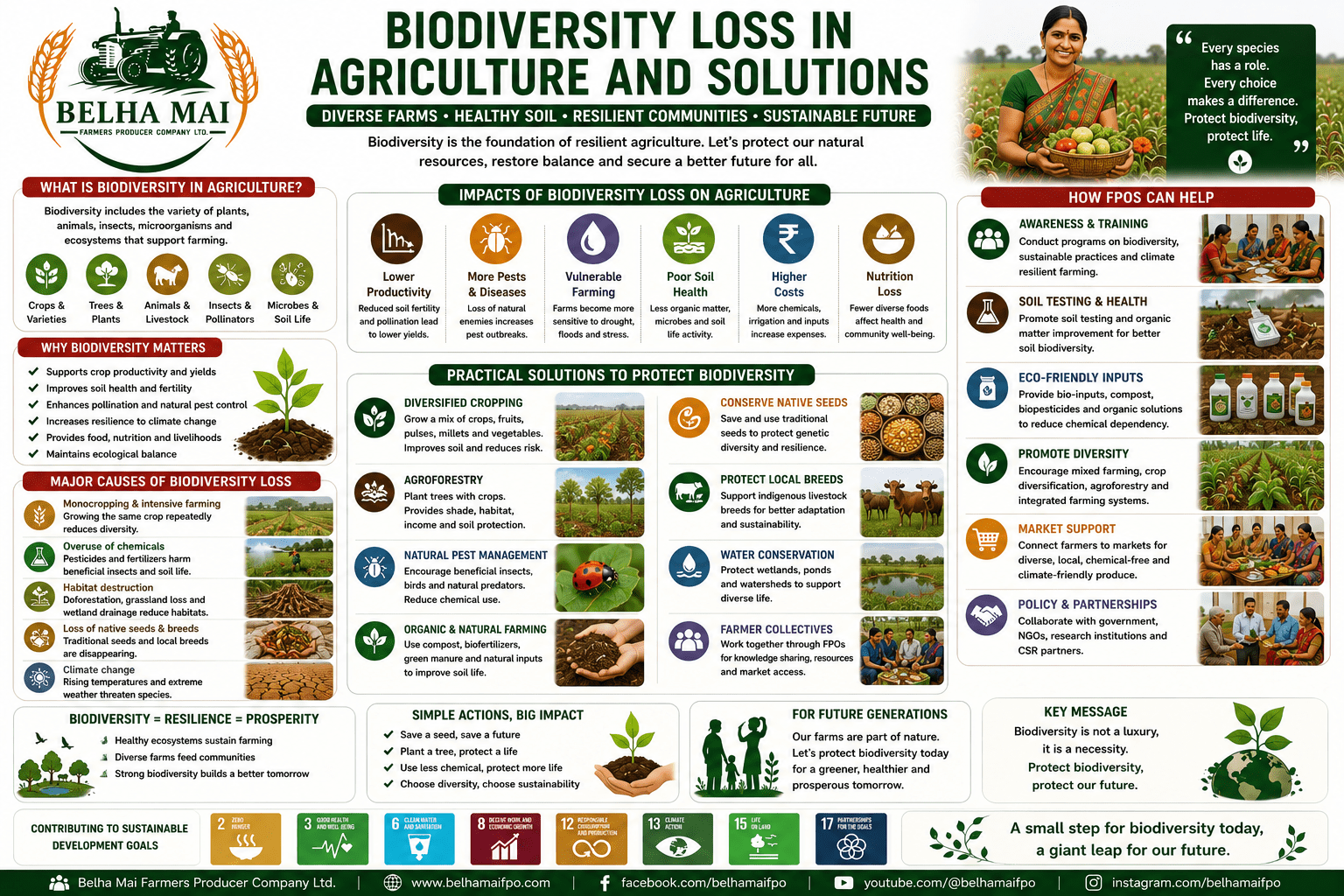
Biodiversity in agriculture means the variety of life that supports farming systems. It includes crop diversity, seed diversity, livestock diversity, trees, insects, pollinators, birds, soil microbes, earthworms, grasses, local plants, water organisms, and beneficial organisms.
Agricultural biodiversity helps maintain soil fertility, pollination, pest control, nutrition, climate resilience, and ecological balance. It also gives farmers more options for income and risk management.
A biodiverse farm is usually more resilient than a farm dependent on a single crop and heavy external inputs. Diversity creates balance, and balance creates stability.
Causes of Biodiversity Loss in Agriculture
Biodiversity loss in agriculture happens due to several reasons. Monocropping is one of the major causes because growing the same crop repeatedly reduces crop diversity and weakens ecological balance.
Excessive chemical fertilizers and pesticides can harm soil life, beneficial insects, pollinators, and natural pest control systems. Habitat destruction, removal of trees, loss of field bund vegetation, water body degradation, and overuse of natural resources also reduce biodiversity.
Climate change, soil degradation, water scarcity, and loss of native seeds further increase the problem. These causes are interconnected and must be addressed through practical and collective solutions.
Monocropping and Biodiversity Loss
Monocropping means growing the same crop repeatedly over a large area. While it may look simple and commercially convenient, it can reduce biodiversity and increase farming risk.
When only one crop dominates, soil nutrients become imbalanced, pest and disease pressure increases, and beneficial biodiversity declines. Farmers may then depend more on fertilizers and pesticides to maintain production.
Crop diversification, mixed cropping, intercropping, pulses, millets, vegetables, oilseeds, horticulture, and agroforestry can help reduce the negative effects of monocropping.
Chemical Overuse and Biodiversity Loss
Excessive use of chemical pesticides and fertilizers can harm biodiversity. Pesticides may kill not only harmful pests but also beneficial insects, pollinators, natural predators, and soil organisms.
Unbalanced fertilizer use can disturb soil microbial life and reduce soil organic matter. Over time, this weakens the natural fertility of the soil and reduces ecological balance.
The solution is not careless rejection of all inputs, but responsible and balanced use. Integrated pest management, bio-inputs, organic matter, soil testing, and natural pest control can help protect biodiversity.
Loss of Native Seeds and Local Varieties
Native seeds and local crop varieties are important parts of agricultural biodiversity. They often carry traits such as drought tolerance, local adaptation, pest resistance, taste, nutrition, and cultural value.
When farmers shift completely to a few commercial varieties, local seed diversity may disappear. This reduces resilience because farming systems become dependent on fewer genetic options.
Seed conservation, community seed banks, local variety documentation, and farmer-led seed systems can help protect native seeds. FPOs can support this by organizing farmers and creating awareness.
Soil Degradation and Biodiversity Loss
Soil is one of the most important biodiversity zones in agriculture. Healthy soil contains microorganisms, fungi, bacteria, earthworms, insects, roots, and organic matter. These living organisms help nutrient cycling and soil fertility.
When soil is degraded due to erosion, compaction, chemical imbalance, low organic matter, or water stress, soil biodiversity declines. This directly affects crop productivity.
Compost, organic matter, crop residue management, reduced erosion, green manuring, vermicompost, biofertilizers, and crop rotation can help restore soil biodiversity.
Loss of Pollinators in Agriculture
Pollinators such as bees, butterflies, insects, and other organisms are essential for many crops. They support fruit setting, seed formation, and productivity in several agricultural and horticultural crops.
Pollinator loss can happen due to pesticide misuse, habitat destruction, lack of flowering plants, pollution, and climate change. When pollinators decline, crop yield and quality may suffer.
Farmers can protect pollinators by reducing harmful pesticide use, planting flowering plants, maintaining field biodiversity, supporting beekeeping, and protecting natural habitats.
Habitat Destruction Around Farms
Farm biodiversity depends not only on crop fields but also on nearby habitats. Trees, hedges, field bunds, water bodies, grasses, wetlands, and natural vegetation provide shelter for birds, insects, pollinators, and beneficial organisms.
When these habitats are removed, biodiversity declines. Farms become more exposed to pests, soil erosion, heat, and ecological imbalance.
Agroforestry, boundary plantation, grass strips, water body protection, and maintaining natural vegetation can help restore farm habitats.
Climate Change and Biodiversity Loss
Climate change affects biodiversity through heat stress, irregular rainfall, droughts, floods, pest outbreaks, and changing crop patterns. Many species cannot adapt quickly to changing conditions.
Farmers also suffer because climate stress reduces crop stability and increases risk. Biodiversity can help farmers adapt by creating more resilient farming systems.
Crop diversity, agroforestry, soil health restoration, water conservation, native seeds, and mixed farming can help reduce climate risk and protect biodiversity.
Impact of Biodiversity Loss on Farmer Income
Biodiversity loss affects farmer income in several ways. It can increase pest attacks, reduce pollination, weaken soil fertility, increase input costs, and reduce crop resilience.
When farms become less diverse, farmers become more vulnerable to price shocks, crop failure, and climate stress. Dependence on one crop also increases income risk.
Biodiversity-friendly farming can improve income stability by creating multiple sources of production, reducing input dependency, and improving long-term farm resilience.
Impact of Biodiversity Loss on Soil Health
Biodiversity is essential for soil health. Soil organisms help decompose organic matter, improve nutrient cycling, build soil structure, and support plant growth.
When biodiversity declines, soil becomes less active and less fertile. Farmers may need more external inputs to maintain productivity.
Improving soil biodiversity through compost, organic matter, crop rotation, green manuring, mulching, and reduced chemical pressure is essential for sustainable agriculture.
Impact of Biodiversity Loss on Food and Nutrition
Biodiversity loss can reduce food diversity. If farming systems depend only on a few crops, rural diets may become less diverse and less nutritious.
Diverse farming systems can provide cereals, pulses, millets, vegetables, fruits, dairy, honey, livestock products, and local foods. This supports better nutrition and food security.
Protecting biodiversity is therefore also important for community health, family nutrition, and local food systems.
Impact of Biodiversity Loss on Climate Resilience
Biodiverse farming systems are more resilient to climate shocks. If one crop fails, another crop or activity may support the farmer. Trees, healthy soil, water bodies, and crop diversity also reduce climate stress.
When biodiversity declines, farms become more fragile. Drought, flood, pest attack, or price crash can create serious livelihood problems.
Biodiversity protection is therefore a climate adaptation strategy for Indian agriculture.
Solution: Diversified Cropping
Diversified cropping is one of the most practical solutions to biodiversity loss. Farmers can grow multiple crops such as cereals, pulses, millets, oilseeds, vegetables, fruits, fodder, and medicinal plants.
Diverse crops improve soil balance, reduce pest risk, support nutrition, and create multiple income sources. They also reduce dependence on one crop and one market.
FPOs can help farmers diversify crops based on soil, water, climate, and market demand. Diversification must be both ecological and economically practical.
Solution: Mixed Cropping and Intercropping
Mixed cropping and intercropping help protect biodiversity by growing more than one crop in the same field. These systems can reduce pest spread, improve soil fertility, and support better resource use.
For example, legumes can support nitrogen availability, while different crop structures can reduce pest pressure and improve field biodiversity.
Farmers need proper guidance on crop combinations, spacing, timing, and market planning. FPOs can support this through training and demonstrations.
Solution: Agroforestry
Agroforestry combines trees with crops, livestock, or farming systems. It helps protect biodiversity by providing habitat, shade, biomass, roots, leaf litter, and ecological balance.
Trees can reduce soil erosion, improve microclimate, support birds and insects, and provide additional income through fruits, timber, fodder, fuelwood, or other products.
Agroforestry is important for biodiversity, climate resilience, soil health, and long-term farmer income.
Solution: Natural Farming
Natural farming can help protect biodiversity by reducing chemical dependency and promoting local resources, organic matter, soil biology, mixed cropping, and ecological pest management.
Natural farming practices can support beneficial insects, soil microbes, earthworms, and farm-level biodiversity. They can also reduce input costs when adopted properly.
FPOs can support natural farming through farmer training, demonstration plots, bio-input preparation, and market linkage.
Solution: Organic Farming
Organic farming supports biodiversity by improving soil organic matter, reducing harmful chemical pressure, supporting microbes, protecting pollinators, and encouraging ecological balance.
Organic methods such as composting, green manuring, crop rotation, biofertilizers, biopesticides, and mulching can improve biodiversity in soil and fields.
Organic farming should be supported with training, certification where required, aggregation, and market access so that farmers receive economic benefit.
Solution: Pollinator Protection
Pollinator protection is essential for biodiversity-friendly agriculture. Farmers can support pollinators by planting flowering plants, reducing pesticide misuse, maintaining field margins, and encouraging beekeeping.
Beekeeping is especially useful because it supports both pollination and income. Honey production can also create value addition and rural employment.
FPOs can promote beekeeping and pollinator-friendly farming as part of sustainable agriculture programs.
Solution: Native Seed Conservation
Native seeds and local varieties should be protected because they carry valuable traits for resilience, taste, nutrition, and local adaptation.
Farmers can conserve native seeds through seed banks, seed exchange, local variety documentation, and community-led seed systems.
FPOs can help organize native seed conservation and connect it with sustainable farming and niche markets.
Solution: Protecting Local Breeds
Local livestock breeds are also part of agricultural biodiversity. Indigenous cattle, goats, poultry, and other animals may be better adapted to local climate, disease conditions, and low-input systems.
Protecting local breeds supports resilience and rural livelihoods. It also maintains genetic diversity for the future.
FPOs, SHGs, and rural institutions can promote local breed awareness, livestock health, and market linkage for animal-based livelihoods.
Solution: Soil Health Restoration
Soil health restoration is central to biodiversity protection. Healthy soil supports microbial life, earthworms, roots, water retention, and nutrient cycling.
Farmers can restore soil health through compost, farmyard manure, vermicompost, green manure, crop residue, reduced erosion, balanced nutrition, soil testing, and crop rotation.
FPOs can organize soil health campaigns and help farmers adopt practical solutions.
Solution: Water Conservation
Water bodies, farm ponds, wetlands, drainage channels, and irrigation systems support biodiversity. Poor water management can damage soil and reduce ecological balance.
Water conservation practices include farm ponds, rainwater harvesting, micro-irrigation, mulching, drainage improvement, and protecting local water bodies.
Water conservation supports both biodiversity and farmer livelihoods.
Solution: Integrated Pest Management
Integrated pest management helps reduce harmful pesticide use and protect beneficial organisms. It includes pest monitoring, biological control, botanical extracts, trap crops, pheromone traps, resistant varieties, and need-based pesticide use.
This approach protects pollinators, natural predators, soil organisms, and farm biodiversity.
FPOs can train farmers in integrated pest management through demonstrations and expert guidance.
Solution: Reducing Crop Residue Burning
Crop residue burning harms soil organisms, reduces organic matter, creates pollution, and damages biodiversity. Residue can instead be used for composting, mulching, incorporation, or soil cover.
Machines such as Super Seeders, Happy Seeders, mulchers, and residue management tools can help farmers avoid burning.
FPO-led Farm Machinery Banks can make these machines accessible to small farmers and support biodiversity-friendly farming.
Solution: Community Awareness
Biodiversity protection requires awareness. Farmers need to understand that birds, insects, trees, microbes, pollinators, and local seeds are not separate from agriculture. They are part of farming success.
Awareness programs can help farmers see the economic value of biodiversity. Training should connect biodiversity with yield, income, soil health, water, pest control, and climate resilience.
FPOs can become local awareness platforms for biodiversity-friendly agriculture.
Role of FPOs in Protecting Biodiversity
FPOs can play a major role in protecting biodiversity because they work directly with farmers. They can promote crop diversification, agroforestry, soil health, natural farming, organic inputs, native seeds, pollinator protection, and sustainable market linkages.
FPOs can also create farmer groups for biodiversity-friendly farming and connect them with CSR organizations, NGOs, government departments, research institutions, and buyers.
When biodiversity protection is organized through FPOs, it becomes practical, scalable, and market-linked.
FPO-Led Market Support for Biodiversity-Friendly Produce
Farmers are more likely to adopt biodiversity-friendly practices when they receive market benefits. FPOs can help create markets for diverse, local, organic, natural, residue-free, and sustainably produced crops.
This may include local markets, retail buyers, institutional buyers, health-conscious consumers, online platforms, and value-added products.
Market support helps biodiversity protection become economically attractive for farmers.
Biodiversity Loss in Agriculture and Sustainable Development Goals
Biodiversity protection is connected with Sustainable Development Goals. It supports SDG 1 No Poverty, SDG 2 Zero Hunger, SDG 3 Good Health, SDG 6 Clean Water, SDG 8 Decent Work, SDG 12 Responsible Production, SDG 13 Climate Action, SDG 15 Life on Land, and SDG 17 Partnerships.
When biodiversity is protected, agriculture becomes more resilient, nutritious, sustainable, and farmer-friendly.
This makes biodiversity protection a major priority for rural development and climate action.
Belha Mai FPO and Biodiversity-Friendly Agriculture
Belha Mai Farmers Producer Company Ltd. recognizes the importance of sustainable agriculture, soil health, farmer income, value addition, climate resilience, and rural development.
Biodiversity-friendly agriculture fits strongly into this vision because it protects natural resources while supporting farmer livelihoods. Through farmer awareness, soil health education, sustainable input support, crop diversification, agroforestry, and partnerships, FPOs can help farmers protect biodiversity.
For Belha Mai FPO, biodiversity is not only an environmental topic. It is connected with stronger farms, stronger farmers, better income, and a sustainable rural future.
Why Biodiversity Protection Matters for India’s Future
India’s agriculture must feed people, support farmers, protect natural resources, and adapt to climate change. Biodiversity is essential for all these goals.
If biodiversity continues to decline, farming systems may become more fragile, costly, and risky. But if biodiversity is protected, farms can become more resilient and sustainable.
Protecting biodiversity is an investment in the future of agriculture, food security, and rural prosperity.
Conclusion
Biodiversity Loss in Agriculture and Solutions can be understood through one clear message: agriculture survives because nature supports it. Crops, trees, pollinators, livestock, soil microbes, native seeds, water bodies, and beneficial organisms all contribute to farming success.
The solutions include diversified cropping, agroforestry, natural farming, organic farming, pollinator protection, native seed conservation, soil health restoration, water conservation, integrated pest management, and FPO-led farmer awareness.
For Belha Mai Farmers Producer Company Ltd., protecting biodiversity means protecting farmers, protecting soil, protecting food systems, and protecting the future of rural India.
FAQ
What is Biodiversity Loss in Agriculture and Solutions?
Biodiversity loss in agriculture means the decline of crop diversity, native seeds, pollinators, soil microbes, trees, livestock breeds, beneficial insects, and farm ecosystems. Solutions include diversified farming, agroforestry, natural farming, organic inputs, pollinator protection, soil health restoration, and FPO-led awareness.
Why is biodiversity important in agriculture?
Biodiversity is important because it supports soil health, pollination, natural pest control, crop resilience, nutrition, climate adaptation, and long-term farm productivity.
What causes biodiversity loss in agriculture?
Major causes include monocropping, excessive chemical use, habitat destruction, loss of native seeds, soil degradation, water stress, climate change, and removal of trees and natural vegetation.
How can farmers protect biodiversity?
Farmers can protect biodiversity by growing diverse crops, planting trees, conserving native seeds, reducing chemical misuse, protecting pollinators, improving soil health, using organic matter, and adopting natural farming practices.
How do FPOs help protect biodiversity?
FPOs help protect biodiversity by training farmers, promoting crop diversification, supporting organic and bio-inputs, encouraging agroforestry, organizing soil health programs, supporting native seeds, and creating market linkages for sustainable produce.
Why should CSR organizations support biodiversity-friendly agriculture?
CSR organizations should support biodiversity-friendly agriculture because it improves soil health, farmer income, food security, climate resilience, water conservation, pollinator protection, and sustainable rural development.
Internal Links Section
👉 SDG Goals — https://belhamaifpo.com/sdg-goals/
👉 Farmer Producer Organizations Complete Guide —https://belhamaifpo.com/farmer-producer-organisation/farmer-producer-organizations-fpos/
👉 Soil Health Challenges in Indian Agriculture —https://belhamaifpo.com/sdg-goals/soil-health-challenges-in-indian-agriculture/
👉 Importance of Organic Farming in Soil Restoration —https://belhamaifpo.com/sdg-goals/importance-of-organic-farming-in-soil-restoration/
👉 How Chemical Fertilizers Affect Soil Health — https://belhamaifpo.com/sdg-goals/how-chemical-fertilizers-affect-soil-health/
👉 Why FPOs are Key to Sustainable Agriculture — https://belhamaifpo.com/sdg-goals/why-fpos-are-key-to-sustainable-agriculture/
👉 Linking Local Farming Practices to Global Development Goals —https://belhamaifpo.com/sdg-goals/linking-local-farming-practices-to-global-development-goals/
👉 How Agriculture Can Reduce Rural Poverty in India — https://belhamaifpo.com/sdg-goals/how-agriculture-can-reduce-rural-poverty-in-india/
👉 Impact of Mechanisation on Farmer Livelihoods — https://belhamaifpo.com/sdg-goals/impact-of-mechanisation-on-farmer-livelihoods/
👉 Farm Machinery Bank — https://belhamaifpo.com/farm-machinery-bank/
👉 Honey Processing in India: Complete Guide — https://belhamaifpo.com/agriculture/honey-processing-in-india-complete-guide/
👉 Belha Mai FPO — https://belhamaifpo.com/
External Authority Links
👉 United Nations Sustainable Development Goals — https://sdgs.un.org/goals
👉 Convention on Biological Diversity — https://www.cbd.int/
👉 Ministry of Environment, Forest and Climate Change — https://moef.gov.in/
👉 Ministry of Agriculture and Farmers Welfare — https://agriwelfare.gov.in/
👉 Indian Council of Agricultural Research — https://icar.org.in/
👉 National Biodiversity Authority — https://nbaindia.org/
👉 Soil Health Card Scheme — https://soilhealth.dac.gov.in/
👉 National Bank for Agriculture and Rural Development — https://www.nabard.org/
Follow Belha Mai FPO for More Updates
Website: https://belhamaifpo.com/
Facebook: https://www.facebook.com/profile.php?id=61561043486818
YouTube: https://www.youtube.com/channel/UC9ZvojoTMCa7mU1-Q_Bh60A
LinkedIn: https://www.linkedin.com/in/abhay-singh-ab5568280/
Instagram: https://instagram.com/belhamaifpo
Belha Mai Farmers Producer Company Ltd. supports farmers through better information, technology, market linkage, value addition, FPO awareness, rural development, women empowerment, soil health, biodiversity protection, and sustainable agriculture.