Introduction
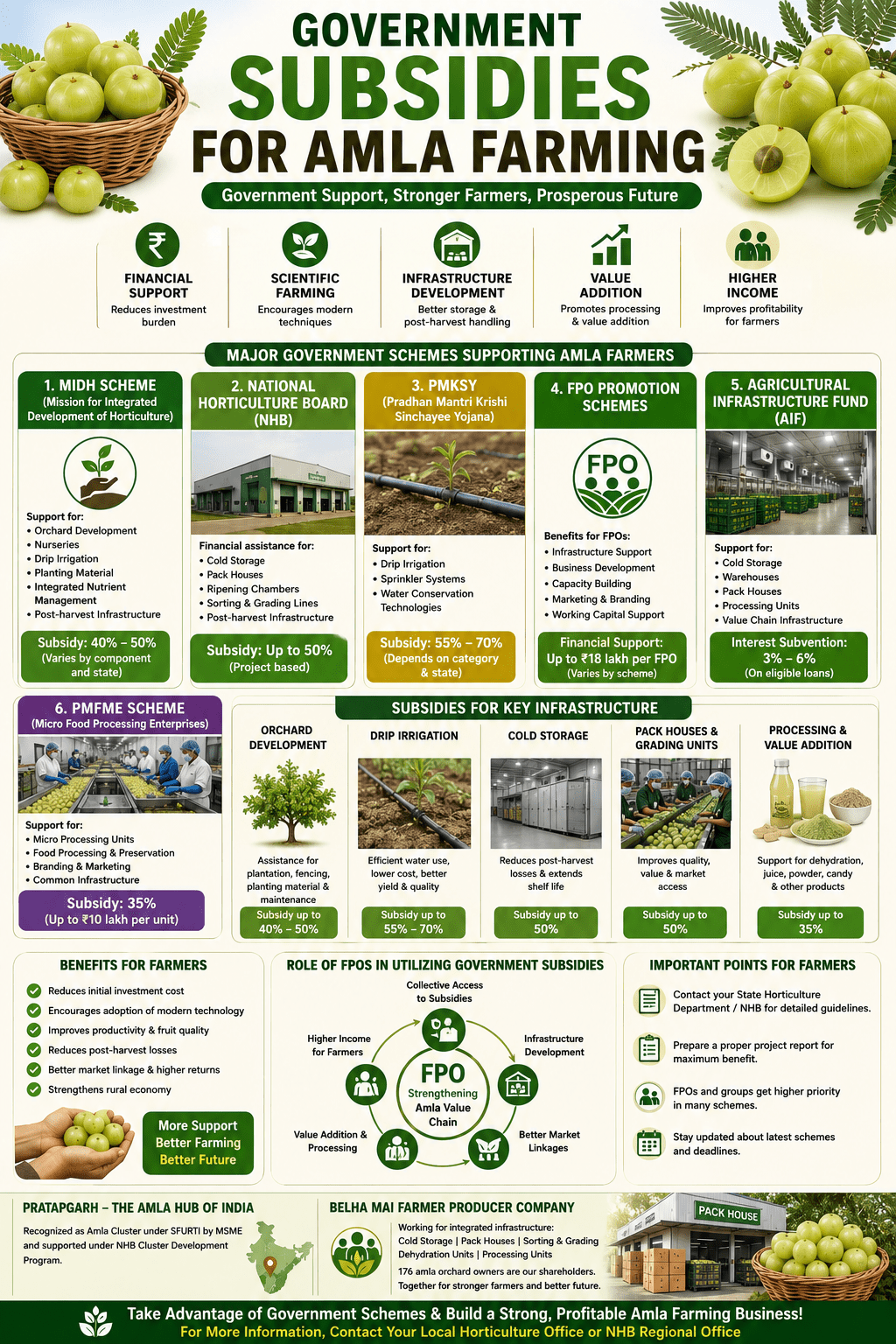
Government subsidies for amla farming are helping farmers reduce investment costs and improve profitability through infrastructure and horticulture support schemes. Government subsidies for amla farming are playing an increasingly important role in promoting horticulture development, orchard expansion, post-harvest infrastructure, and farmer income growth in India. Amla (Indian Gooseberry) is one of India’s most important medicinal and horticultural crops because of its:
- high nutritional value,
- medicinal importance,
- processing potential,
- and export opportunities.
To encourage horticulture-based farming systems, the Government of India and various state governments provide financial assistance for:
- orchard establishment,
- drip irrigation,
- nurseries,
- cold storage,
- pack houses,
- processing units,
- and Farmer Producer Organizations (FPOs).
These subsidies help farmers:
- reduce investment burden,
- adopt scientific farming,
- improve post-harvest management,
- and strengthen market linkage opportunities.
In this blog, we will understand:
- government subsidies for amla farming,
- major schemes,
- subsidy structure,
- post-harvest support,
- FPO assistance,
- and opportunities for amla growers in India.
👉 Learn in detail about Amla farming in India: complete guide for Farmers, Processing & Business Opportunities : https://belhamaifpo.com/farmer-producer-organisation/amla-farming-in-india/
Why Government Subsidies for Amla Farming Are Important
One of the biggest challenges in amla cultivation is the high initial investment required for:
- orchard establishment,
- irrigation systems,
- fencing,
- post-harvest infrastructure,
- and processing facilities.
Government subsidies help:
- reduce financial pressure,
- encourage long-term horticulture investment,
- and improve farmer profitability,
👉 Learn in detail about Amla farming profit per acre in India: https://belhamaifpo.com/agriculture/amla-farming-profit-per-acre-in-india-cost-income-complete-business-guide/
Major Government Schemes Supporting Amla Farming
1. MIDH Scheme (Mission for Integrated Development of Horticulture)
The demand for government subsidies for amla farming is increasing because farmers are shifting toward horticulture and value-added agriculture. MIDH is one of the most important schemes supporting horticulture crops including amla.
The scheme provides assistance for:
- orchard establishment,
- nurseries,
- drip irrigation,
- protected cultivation,
- and post-harvest infrastructure.
Benefits Under MIDH
- subsidy for plantation development,
- assistance for high-quality planting material,
- support for integrated nutrient management,
- and infrastructure development.
2. National Horticulture Board (NHB)
The National Horticulture Board provides support for:
- commercial horticulture projects,
- cold storage,
- pack houses,
- ripening chambers,
- and post-harvest infrastructure.
NHB assistance is highly important for:
- large orchard development,
- scientific infrastructure,
- and integrated value-chain projects.
3. PMKSY (Pradhan Mantri Krishi Sinchayee Yojana)
Water management is extremely important in horticulture farming.
PMKSY provides subsidies for:
- drip irrigation,
- sprinkler systems,
- and water conservation technologies.
Benefits
- efficient water use,
- lower irrigation cost,
- improved productivity,
- and better orchard health.
FPO-led projects can better utilize government subsidies for amla farming for cold storage, pack houses, and processing infrastructure.
👉 Learn About Water & Irrigation Challenges : https://belhamaifpo.com/agriculture/irrigation-challenges-in-indian-agriculture/
4. FPO Promotion Schemes
Government programs supporting FPOs are highly important for the amla sector.
Under various schemes:
- FPOs receive financial support,
- business development assistance,
- and infrastructure funding.
This helps FPOs establish:
- pack houses,
- grading systems,
- cold storage,
- and processing units.
👉 Learn about FARMER PRODUCER COMPANY COMPLITE GUIDE : https://belhamaifpo.com/uncategorized/farmer-producer-organizations-fpos/
5. Agricultural Infrastructure Fund (AIF)
Modern infrastructure support under government subsidies for amla farming can help reduce post-harvest losses and improve farmer income. The Agricultural Infrastructure Fund supports:
- post-harvest management,
- storage infrastructure,
- processing facilities,
- and value-chain development.
Projects eligible under AIF include:
- cold storage,
- warehouses,
- pack houses,
- and food processing infrastructure.
6. PM Formalization of Micro Food Processing Enterprises (PMFME)
PMFME supports:
- micro food processing units,
- value addition,
- branding,
- and processing infrastructure.
This scheme is highly useful for:
- amla candy,
- murabba,
- powder,
- juice,
- and dehydration businesses.
Subsidies for Orchard Development
Government subsidies for orchard establishment generally include support for:
- land preparation,
- planting material,
- irrigation systems,
- and maintenance assistance.
Scientific orchards help improve:
- productivity,
- fruit quality,
- and long-term profitability.
👉 Learn about Amla plantation cost and returns analysis : https://belhamaifpo.com/agriculture/amla-plantation-cost-and-returns-analysis-in-india-complete-profit-guide/
Subsidies for Drip Irrigation
Drip irrigation is highly beneficial in amla farming because it:
- saves water,
- improves fertilizer efficiency,
- and reduces irrigation cost.
Government assistance significantly reduces:
- installation expenses,
- and technology adoption barriers.
Subsidies for Cold Storage and Pack Houses
One of the biggest challenges in India’s amla industry is weak post-harvest infrastructure.
Most growing regions still lack:
- cold storage,
- grading systems,
- sorting lines,
- and scientific pack houses.
Government subsidies for:
- cold storage,
- integrated pack houses,
- and grading systems
can significantly reduce post-harvest losses.
Importance of Post-Harvest Infrastructure
Fresh amla has limited shelf life.
Without scientific storage:
- farmers are forced into distress selling,
- prices collapse during peak season,
- and wastage increases.
Infrastructure support helps:
- stabilize prices,
- improve market linkage,
- and increase farmer bargaining power.
Processing Subsidies for Value Addition
Government support is also available for:
- dehydration units,
- juice processing,
- powder manufacturing,
- packaging systems,
- and food processing machinery.
This is highly important because value-added products generate:
- better margins,
- export opportunities,
- and longer shelf life.
Why Value Addition Is the Future
Global wellness markets are increasingly shifting toward:
- low-sugar products,
- nutraceuticals,
- probiotics,
- functional beverages,
- and herbal wellness products.
However, many small-scale processors still focus mainly on:
- sugary murabba,
- sweet candy,
- and sugar-based products.
Modern value addition can help position amla as a global superfood.
👉 Learn about Value-added products from amla : https://belhamaifpo.com/agriculture/value-added-products-from-amla/
👉 Also Learn about Packaging solutions for amla products : https://belhamaifpo.com/agriculture/packaging-solutions-for-amla-products5/
Role of FPOs in Government Subsidy Utilization
Farmer Producer Organizations (FPOs) can play a transformational role in utilizing government schemes effectively.
Infrastructure Development
FPOs can establish:
- cold storage,
- pack houses,
- grading systems,
- dehydration units,
- and processing facilities.
Collective Benefits
FPOs help farmers:
- access subsidies collectively,
- reduce costs,
- and improve market linkage.
Direct Market Linkage
FPOs can directly connect with:
- processors,
- exporters,
- nutraceutical companies,
- and wellness brands.
This reduces dependency on:
- middlemen,
- traders,
- and Vapari systems.
The Middlemen Problem in Amla Sector
In many regions:
- orchard owners bear yearly cultivation expenses,
- but traders and intermediaries capture major profits.
Because of weak infrastructure:
- farmers often lease orchards during harvest season,
- and lose bargaining power.
FPO-led infrastructure can help reduce:
- distress selling,
- trader dependency,
- and post-harvest losses.
Pratapgarh’s Emerging Role in Amla Infrastructure Development
Pratapgarh is widely recognized as one of India’s most important amla-growing regions and is often called the traditional Amla Capital of India.
The district is recognized:
- under SFURTI Yojana by MSME as an Amla Cluster,
- and under NHB cluster development initiatives.
This creates huge opportunities for:
- horticulture infrastructure,
- processing,
- cold storage,
- dehydration,
- and export-oriented value addition.
Belha Mai Farmer Producer Company’s Initiative
Belha Mai Farmer Producer Company is actively working toward:
- cold storage,
- pack houses,
- sorting and grading systems,
- dehydration units,
- and integrated post-harvest infrastructure.
The organization currently has:
- 176 amla orchard owners as shareholders.
This initiative has the potential to significantly improve:
- farmer income,
- value addition,
- and market linkage opportunities.
Conclusion
Proper awareness about government subsidies for amla farming can help orchard owners adopt scientific cultivation and build long-term profitable horticulture systems. Government subsidies for amla farming are extremely important for developing:
- scientific orchards,
- irrigation systems,
- post-harvest infrastructure,
- and value-added processing.
Government support can help farmers:
- reduce investment burden,
- adopt modern technology,
- improve productivity,
- and strengthen market competitiveness.
However, to fully transform the amla sector, investments must focus on:
- cold storage,
- pack houses,
- grading systems,
- dehydration infrastructure,
- and farmer-owned value addition.
FPO-led infrastructure and direct market linkage can help ensure that a larger share of profits reaches farmers instead of intermediaries.
The work being undertaken in Pratapgarh by Belha Mai Farmer Producer Company represents an important step toward building a modern and farmer-led amla ecosystem in India.
Some Useful Links :
👉 https://www.uphorticulture.in