Introduction
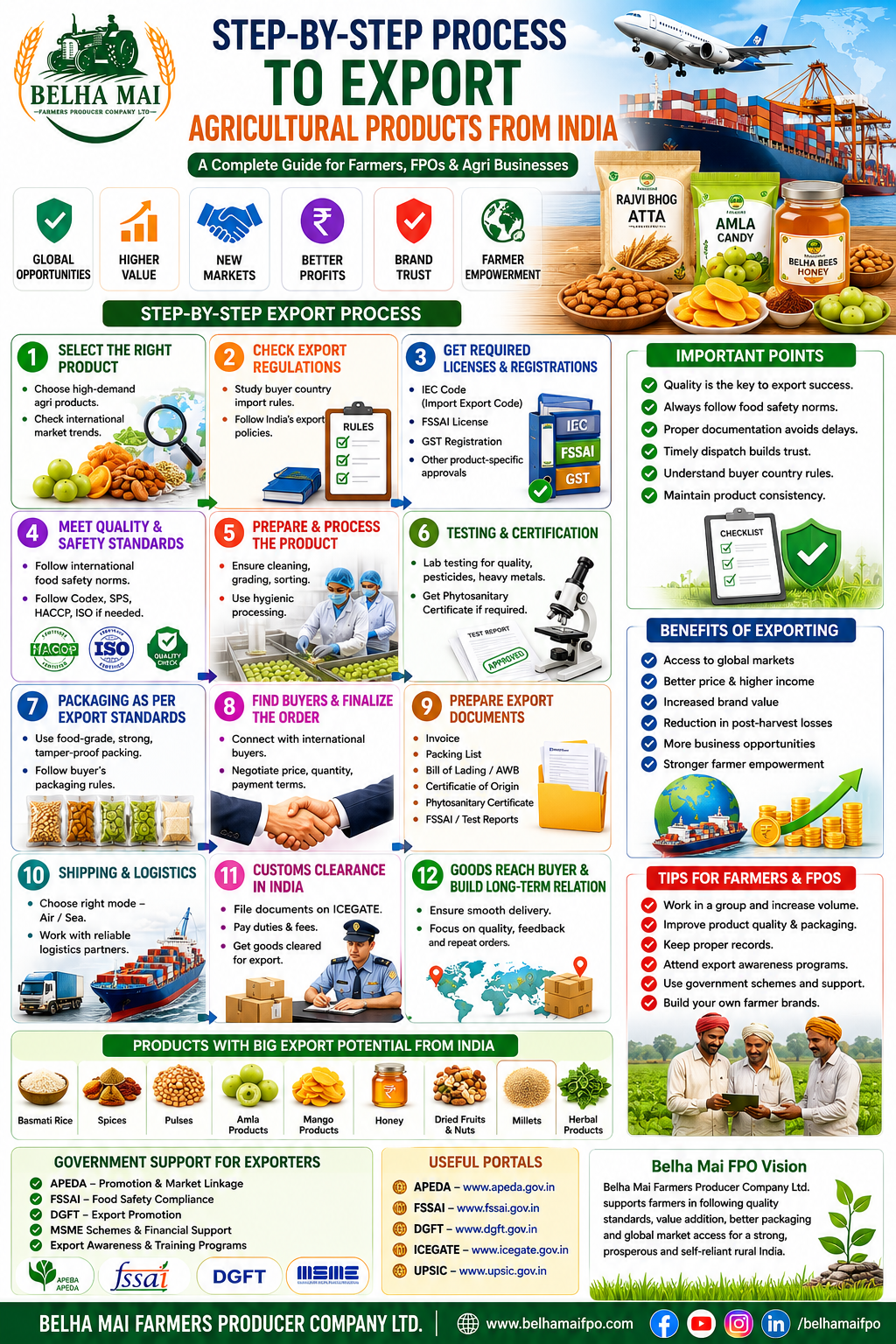
Export Agricultural Products from India is a major opportunity for farmers, Farmer Producer Organisations, food processors and agri businesses. India produces a wide range of agricultural products such as rice, wheat, pulses, fruits, vegetables, mango, amla, honey, spices, millets, processed foods and dehydrated products. With proper quality, packaging and documentation, these products can reach international markets.
Export Agricultural Products from India किसानों, किसान उत्पादक संगठनों, food processors और agri businesses के लिए एक बड़ा अवसर है। भारत rice, wheat, pulses, fruits, vegetables, mango, amla, honey, spices, millets, processed foods और dehydrated products जैसे कई agricultural products का उत्पादन करता है। Proper quality, packaging और documentation के साथ ये products international markets तक पहुंच सकते हैं।
For FPOs, export is not only about sending goods outside India. It is about building a complete professional system that includes farmer aggregation, quality control, food safety, traceability, packaging, buyer communication, pricing, logistics and payment security. Without this system, export becomes risky.
FPOs के लिए export केवल भारत से बाहर goods भेजने का काम नहीं है। यह एक complete professional system बनाने का काम है, जिसमें farmer aggregation, quality control, food safety, traceability, packaging, buyer communication, pricing, logistics और payment security शामिल हैं। इस system के बिना export risky हो सकता है।
Why Agricultural Export Matters for Farmers and FPOs
Agricultural export can help farmers and FPOs reach better markets and better price opportunities. Many Indian products have demand in global markets due to taste, variety, traditional value and availability. Products like mango pulp, dehydrated mango, amla powder, honey, rice, millets, spices and processed foods can create strong business potential.
Agricultural export किसानों और FPOs को better markets और better price opportunities तक पहुंचाने में मदद कर सकता है। कई Indian products की global markets में demand है क्योंकि उनका taste, variety, traditional value और availability मजबूत है। Mango pulp, dehydrated mango, amla powder, honey, rice, millets, spices और processed foods जैसे products strong business potential बना सकते हैं।
For FPOs, export can improve brand value and create long-term buyer relationships. However, export requires discipline. International buyers expect consistent quality, correct documents, timely shipment, safe packaging and clear communication. Therefore, FPOs must prepare step by step.
FPOs के लिए export brand value improve कर सकता है और long-term buyer relationships बना सकता है। लेकिन export discipline मांगता है। International buyers consistent quality, correct documents, timely shipment, safe packaging और clear communication की अपेक्षा करते हैं। इसलिए FPOs को step by step तैयारी करनी चाहिए।
Step One: Select the Right Product
The first step to Export Agricultural Products from India is choosing the right product. The product should have demand in international markets and should be available in sufficient quantity and consistent quality. FPOs should start with crops and products where they already have strength.
Export Agricultural Products from India की पहली step सही product चुनना है। Product की international markets में demand होनी चाहिए और वह sufficient quantity तथा consistent quality में available होना चाहिए। FPOs को उन crops और products से शुरुआत करनी चाहिए जिनमें उनकी पहले से strength है।
For example, an FPO in a mango belt can explore fresh mango, mango pulp, aamchur or dehydrated mango slices. An amla-producing FPO can explore amla powder, dry amla, candy or nutraceutical ingredients. A honey-producing FPO can explore processed honey and institutional packs.
उदाहरण के लिए mango belt में स्थित FPO fresh mango, mango pulp, aamchur या dehydrated mango slices explore कर सकता है। Amla-producing FPO amla powder, dry amla, candy या nutraceutical ingredients explore कर सकता है। Honey-producing FPO processed honey और institutional packs explore कर सकता है।
Step Two: Study Export Demand and Target Market
Before exporting, FPOs should study which countries import the selected product. They should check buyer preferences, product form, packaging size, quality requirements, price range, competition and seasonality. Export should not start only because a product is available locally.
Export करने से पहले FPOs को यह study करना चाहिए कि selected product कौन से countries import करते हैं। उन्हें buyer preferences, product form, packaging size, quality requirements, price range, competition और seasonality check करनी चाहिए। Export केवल इसलिए शुरू नहीं करना चाहिए कि product locally available है।
Target market selection is very important. Gulf countries, Europe, Southeast Asia, Africa and North America may have different standards, packaging preferences and documentation requirements. The product and market must match each other.
Target market selection बहुत महत्वपूर्ण है। Gulf countries, Europe, Southeast Asia, Africa और North America के standards, packaging preferences और documentation requirements अलग हो सकते हैं। Product और market का एक-दूसरे से match होना जरूरी है।
Step Three: Obtain IEC from DGFT
IEC means Importer Exporter Code. It is issued by the Directorate General of Foreign Trade and is required for import-export business from India. For any FPO or agri business planning export, obtaining IEC is one of the first formal steps.
IEC का अर्थ है Importer Exporter Code। यह Directorate General of Foreign Trade द्वारा जारी किया जाता है और भारत से import-export business के लिए आवश्यक होता है। Export plan करने वाले किसी भी FPO या agri business के लिए IEC लेना शुरुआती formal steps में से एक है।
FPOs should ensure that their PAN, bank details, address, authorised person details and business documents are correct before applying. IEC details should also be updated whenever required so that export transactions do not face portal or compliance issues.
FPOs को apply करने से पहले अपना PAN, bank details, address, authorised person details और business documents सही रखने चाहिए। IEC details को आवश्यकता पड़ने पर update भी करना चाहिए ताकि export transactions में portal या compliance issues न आएं।
Step Four: Apply for APEDA RCMC Where Applicable
For many agricultural and processed food products, APEDA registration is important. APEDA stands for Agricultural and Processed Food Products Export Development Authority. Exporters dealing with APEDA scheduled products generally apply for Registration-cum-Membership Certificate, also called RCMC.
कई agricultural और processed food products के लिए APEDA registration महत्वपूर्ण है। APEDA का अर्थ है Agricultural and Processed Food Products Export Development Authority। APEDA scheduled products से जुड़े exporters सामान्यतः Registration-cum-Membership Certificate, जिसे RCMC कहते हैं, के लिए apply करते हैं।
APEDA has stated that exporters can apply for e-RCMC through the DGFT portal after obtaining IEC for APEDA scheduled products. Therefore, FPOs should first complete IEC and then check APEDA RCMC requirement for their product category.
APEDA ने बताया है कि exporters APEDA scheduled products के लिए IEC लेने के बाद DGFT portal के माध्यम से e-RCMC के लिए apply कर सकते हैं। इसलिए FPOs को पहले IEC complete करना चाहिए और फिर अपनी product category के लिए APEDA RCMC requirement check करनी चाहिए।
Step Five: Ensure FSSAI and Food Safety Compliance
If the product is a food product, FSSAI compliance is important. Processed food, packaged food, honey, flour, amla products, mango products, dehydrated foods and other food items need proper food safety systems, hygiene, packaging and labelling.
यदि product food product है, तो FSSAI compliance महत्वपूर्ण है। Processed food, packaged food, honey, flour, amla products, mango products, dehydrated foods और अन्य food items को proper food safety systems, hygiene, packaging और labelling की आवश्यकता होती है।
International buyers are strict about food safety. FPOs should maintain cleaning records, batch records, testing reports, supplier records, processing records and traceability. Strong food safety systems reduce rejection risk and improve buyer confidence.
International buyers food safety को लेकर strict होते हैं। FPOs को cleaning records, batch records, testing reports, supplier records, processing records और traceability maintain करनी चाहिए। Strong food safety systems rejection risk कम करते हैं और buyer confidence बढ़ाते हैं।
Step Six: Understand Product Standards and Testing Requirements
Every export product has specific quality requirements. These may include moisture level, pesticide residue, microbial load, heavy metals, aflatoxin, purity, size, grade, colour, taste, texture and packaging strength. FPOs must understand these requirements before shipment.
हर export product की specific quality requirements होती हैं। इनमें moisture level, pesticide residue, microbial load, heavy metals, aflatoxin, purity, size, grade, colour, taste, texture और packaging strength शामिल हो सकते हैं। FPOs को shipment से पहले इन requirements को समझना चाहिए।
Lab testing is very important for export. The buyer may ask for a certificate of analysis, pesticide residue report, microbiological test report or other product-specific reports. Testing should be done from recognised laboratories as per buyer and destination country requirements.
Export के लिए lab testing बहुत महत्वपूर्ण है। Buyer certificate of analysis, pesticide residue report, microbiological test report या अन्य product-specific reports मांग सकता है। Testing buyer और destination country requirements के अनुसार recognised laboratories से करानी चाहिए।
Step Seven: Prepare Export-Quality Packaging and Labelling
Packaging must protect the product during long transport, handling, storage and climate changes. Export packaging should be strong, food-grade, moisture-resistant and suitable for the product. Weak packaging can cause leakage, spoilage, breakage and rejection.
Packaging को long transport, handling, storage और climate changes के दौरान product की रक्षा करनी चाहिए। Export packaging strong, food-grade, moisture-resistant और product के लिए suitable होनी चाहिए। Weak packaging leakage, spoilage, breakage और rejection का कारण बन सकती है।
Labelling should follow buyer and destination country requirements. Labels may need product name, net weight, batch number, manufacturing date, expiry or best-before date, country of origin, manufacturer details, ingredients, allergen information, FSSAI details and importer details where applicable.
Labelling buyer और destination country requirements के अनुसार होनी चाहिए। Labels में product name, net weight, batch number, manufacturing date, expiry या best-before date, country of origin, manufacturer details, ingredients, allergen information, FSSAI details और जहां लागू हो importer details शामिल हो सकते हैं।
Step Eight: Build Traceability from Farm to Export
Traceability is very important in agricultural exports. It helps identify where the product came from, who produced it, when it was harvested, when it was processed, which batch it belongs to and where it was shipped.
Agricultural exports में traceability बहुत महत्वपूर्ण है। यह identify करने में मदद करती है कि product कहां से आया, किसने produce किया, कब harvest हुआ, कब process हुआ, किस batch से संबंधित है और कहां ship किया गया।
For FPOs, traceability can become a strong advantage because they work directly with farmers. Farmer records, village records, crop records, procurement records, batch numbers and QR code systems can help build buyer trust.
FPOs के लिए traceability एक strong advantage बन सकती है क्योंकि वे directly farmers के साथ काम करते हैं। Farmer records, village records, crop records, procurement records, batch numbers और QR code systems buyer trust बनाने में मदद कर सकते हैं।
Step Nine: Find Genuine International Buyers
Finding genuine buyers is one of the most important steps to Export Agricultural Products from India. FPOs can find buyers through trade fairs, export promotion councils, APEDA platforms, B2B portals, embassies, LinkedIn, buyer-seller meets, commodity associations and references.
Genuine buyers ढूंढना Export Agricultural Products from India की सबसे महत्वपूर्ण steps में से एक है। FPOs trade fairs, export promotion councils, APEDA platforms, B2B portals, embassies, LinkedIn, buyer-seller meets, commodity associations और references के माध्यम से buyers ढूंढ सकते हैं।
FPOs should verify buyers before committing shipment. They should check company details, website, import history, references, payment terms and communication quality. Exporters should avoid sending goods on risky payment terms to unknown buyers.
FPOs को shipment commit करने से पहले buyers verify करने चाहिए। उन्हें company details, website, import history, references, payment terms और communication quality check करनी चाहिए। Exporters को unknown buyers को risky payment terms पर goods भेजने से बचना चाहिए।
Step Ten: Negotiate Price and Payment Terms
Export pricing must include all costs. These may include raw material cost, processing cost, packaging cost, lab testing, certification, documentation, inland transport, port charges, freight, insurance, commission, bank charges and profit margin.
Export pricing में सभी costs शामिल होनी चाहिए। इनमें raw material cost, processing cost, packaging cost, lab testing, certification, documentation, inland transport, port charges, freight, insurance, commission, bank charges और profit margin शामिल हो सकते हैं।
Payment security is very important. FPOs should understand payment terms such as advance payment, Letter of Credit, documents against payment and open credit. For new buyers, safer payment terms should be preferred.
Payment security बहुत महत्वपूर्ण है। FPOs को advance payment, Letter of Credit, documents against payment और open credit जैसे payment terms समझने चाहिए। New buyers के लिए safer payment terms को prefer करना चाहिए।
Step Eleven: Understand Incoterms and Logistics
Incoterms define responsibilities between buyer and seller in international trade. Terms like EXW, FOB, CIF and DAP decide who pays for transport, insurance, customs, freight and risk at different stages. FPOs should understand these terms before quoting price.
Incoterms international trade में buyer और seller की responsibilities तय करते हैं। EXW, FOB, CIF और DAP जैसे terms तय करते हैं कि transport, insurance, customs, freight और risk किस stage पर कौन संभालेगा। FPOs को price quote करने से पहले ये terms समझने चाहिए।
Logistics includes inland transport, container booking, port handling, customs clearance, shipping line coordination and delivery timelines. For perishable products, cold chain and fast movement are important.
Logistics में inland transport, container booking, port handling, customs clearance, shipping line coordination और delivery timelines शामिल हैं। Perishable products के लिए cold chain और fast movement महत्वपूर्ण हैं।
Step Twelve: Prepare Export Documents
Export documentation is a key part of the process. Common documents may include commercial invoice, packing list, shipping bill, bill of lading or airway bill, certificate of origin, phytosanitary certificate where required, fumigation certificate where applicable, insurance certificate and test reports.
Export documentation process का key part है। Common documents में commercial invoice, packing list, shipping bill, bill of lading या airway bill, certificate of origin, जहां required हो phytosanitary certificate, जहां applicable हो fumigation certificate, insurance certificate और test reports शामिल हो सकते हैं।
The exact document list depends on product, buyer, destination country and shipping method. FPOs should work with an experienced customs broker, freight forwarder or export consultant during the first few shipments.
Exact document list product, buyer, destination country और shipping method पर depend करती है। FPOs को शुरुआती shipments में experienced customs broker, freight forwarder या export consultant के साथ काम करना चाहिए।
Step Thirteen: Phytosanitary and Quarantine Requirements
Many agricultural products require phytosanitary certification to prove that they are free from regulated pests and meet plant quarantine requirements of the importing country. This is especially relevant for fresh fruits, vegetables, seeds, plants and some raw agricultural commodities.
कई agricultural products को phytosanitary certification की आवश्यकता होती है ताकि यह prove हो सके कि वे regulated pests से free हैं और importing country की plant quarantine requirements को meet करते हैं। यह fresh fruits, vegetables, seeds, plants और कुछ raw agricultural commodities के लिए विशेष रूप से relevant है।
FPOs should confirm phytosanitary requirements before shipment. Requirements may differ from country to country. Missing or incorrect certificates can lead to delay, rejection or loss at the destination port.
FPOs को shipment से पहले phytosanitary requirements confirm करनी चाहिए। Requirements country to country अलग हो सकती हैं। Missing या incorrect certificates destination port पर delay, rejection या loss का कारण बन सकते हैं।
Step Fourteen: Customs Clearance and Shipment
After documents and goods are ready, customs clearance is done through the export system. The shipping bill is filed, goods are examined if required, and shipment is allowed after compliance checks. A customs broker usually helps complete this process.
Documents और goods ready होने के बाद customs clearance export system के माध्यम से किया जाता है। Shipping bill file होता है, आवश्यकता होने पर goods examine किए जाते हैं और compliance checks के बाद shipment allow होता है। Customs broker आमतौर पर इस process को complete करने में मदद करता है।
After clearance, the goods are loaded on vessel, aircraft or transport depending on shipment mode. The exporter receives transport documents such as bill of lading or airway bill. These documents are important for payment and buyer release.
Clearance के बाद goods shipment mode के अनुसार vessel, aircraft या transport पर load किए जाते हैं। Exporter को bill of lading या airway bill जैसे transport documents मिलते हैं। ये documents payment और buyer release के लिए important होते हैं।
Step Fifteen: Payment Realisation and Follow-Up
Export is not complete until payment is received. After shipment, documents are submitted to the bank or buyer as per payment terms. FPOs should track payment, bank realisation, exchange rate and any deductions.
Payment receive होने तक export complete नहीं माना जाता। Shipment के बाद documents payment terms के अनुसार bank या buyer को submit किए जाते हैं। FPOs को payment, bank realisation, exchange rate और deductions track करने चाहिए।
After successful delivery, FPOs should ask for buyer feedback. This helps improve future shipments. Long-term export business depends on repeat orders, trust, consistent quality and professional communication.
Successful delivery के बाद FPOs को buyer feedback लेना चाहिए। इससे future shipments improve होती हैं। Long-term export business repeat orders, trust, consistent quality और professional communication पर depend करता है।
Export Readiness Checklist for FPOs
Before exporting, an FPO should check whether it has the right product, sufficient quantity, IEC, APEDA RCMC where applicable, FSSAI compliance, quality testing, packaging system, traceability, buyer verification, pricing calculation, logistics partner and document support.
Export करने से पहले FPO को check करना चाहिए कि उसके पास सही product, sufficient quantity, IEC, जहां applicable हो APEDA RCMC, FSSAI compliance, quality testing, packaging system, traceability, buyer verification, pricing calculation, logistics partner और document support है या नहीं।
The FPO should not rush into export without preparation. It is better to start with samples, small trial shipments and reliable buyers. Gradual learning reduces risk and builds confidence.
FPO को बिना preparation के export में जल्दी नहीं करनी चाहिए। Samples, small trial shipments और reliable buyers से शुरुआत करना बेहतर है। Gradual learning risk कम करती है और confidence बनाती है।
Common Mistakes in Agricultural Export
One common mistake is quoting price without calculating all costs. This can lead to loss even when the order looks profitable. Export pricing must include every cost from farm gate to buyer delivery point.
एक common mistake सभी costs calculate किए बिना price quote करना है। इससे order profitable दिखने के बावजूद loss हो सकता है। Export pricing में farm gate से buyer delivery point तक हर cost शामिल होनी चाहिए।
Another mistake is trusting unknown buyers without verification. FPOs should never send goods on unsafe payment terms without proper checks. Buyer verification and payment security are essential.
दूसरी mistake unknown buyers पर बिना verification trust करना है। FPOs को proper checks के बिना unsafe payment terms पर goods नहीं भेजने चाहिए। Buyer verification और payment security essential हैं।
A third mistake is ignoring documentation. Even good products can be delayed or rejected if documents are incomplete or incorrect. Export documents should be prepared carefully.
तीसरी mistake documentation को ignore करना है। अच्छे products भी documents incomplete या incorrect होने पर delay या reject हो सकते हैं। Export documents carefully prepare करने चाहिए।
Belha Mai FPO Vision for Agricultural Export
Belha Mai Farmers Producer Company Ltd. understands that export can open new opportunities for farmers when done professionally. Products such as Rajvi Bhog food products, amla products, mango products and Belha Bees honey can gradually move toward export readiness through quality, packaging, traceability and compliance.
Belha Mai Farmers Producer Company Ltd. समझता है कि export professional तरीके से किया जाए तो किसानों के लिए नए अवसर खोल सकता है। Rajvi Bhog food products, amla products, mango products और Belha Bees honey quality, packaging, traceability और compliance के माध्यम से धीरे-धीरे export readiness की ओर बढ़ सकते हैं।
For Belha Mai FPO, the goal is not only to export products but to build farmer-led brands that can represent Indian agriculture with trust and quality in global markets. Export Agricultural Products from India can become a strong pathway for farmer income and rural enterprise development.
Belha Mai FPO के लिए लक्ष्य केवल products export करना नहीं है, बल्कि ऐसे farmer-led brands बनाना है जो global markets में Indian agriculture को trust और quality के साथ represent कर सकें। Export Agricultural Products from India farmer income और rural enterprise development का strong pathway बन सकता है।
Conclusion
Export Agricultural Products from India is a powerful opportunity, but it requires preparation, compliance and discipline. FPOs must select the right product, obtain IEC, complete APEDA RCMC where applicable, follow food safety, meet buyer standards, prepare documents, manage logistics and secure payment.
Export Agricultural Products from India एक powerful opportunity है, लेकिन इसके लिए preparation, compliance और discipline की आवश्यकता होती है। FPOs को right product select करना, IEC लेना, जहां applicable हो APEDA RCMC complete करना, food safety follow करना, buyer standards meet करना, documents prepare करना, logistics manage करना और payment secure करना होता है।
In the future of the Food Processing Industry in India, farmer-led export businesses can become a major growth opportunity. FPOs that build quality systems, traceability, branding and buyer trust will be better placed to access global markets.
Food Processing Industry in India के future में farmer-led export businesses major growth opportunity बन सकते हैं। जो FPOs quality systems, traceability, branding और buyer trust बनाएंगे, वे global markets access करने के लिए बेहतर स्थिति में होंगे।
FAQ
How can I export agricultural products from India?
To export agricultural products from India, select the right product, obtain IEC, apply for APEDA RCMC where applicable, follow food safety rules, find buyers, prepare documents, arrange logistics and secure payment.
भारत से agricultural products export करने के लिए सही product चुनें, IEC लें, जहां applicable हो APEDA RCMC apply करें, food safety rules follow करें, buyers खोजें, documents prepare करें, logistics arrange करें और payment secure करें।
Is IEC required for agricultural export?
Yes, IEC is generally required for import-export business from India and is issued by DGFT.
हाँ, भारत से import-export business के लिए सामान्यतः IEC required होता है और यह DGFT द्वारा जारी किया जाता है।
Is APEDA registration required for agri export?
APEDA RCMC is required for exporters dealing with APEDA scheduled products. Exporters should check their product category and apply where applicable.
APEDA scheduled products से जुड़े exporters के लिए APEDA RCMC required होता है। Exporters को अपनी product category check करके जहां applicable हो apply करना चाहिए।
What documents are needed for agricultural export?
Common documents include commercial invoice, packing list, shipping bill, bill of lading or airway bill, certificate of origin, test reports, phytosanitary certificate where required and insurance documents.
Common documents में commercial invoice, packing list, shipping bill, bill of lading या airway bill, certificate of origin, test reports, जहां required हो phytosanitary certificate और insurance documents शामिल होते हैं।
How can FPOs find international buyers?
FPOs can find buyers through APEDA platforms, trade fairs, buyer-seller meets, export promotion councils, B2B portals, embassies, LinkedIn and verified business references.
FPOs APEDA platforms, trade fairs, buyer-seller meets, export promotion councils, B2B portals, embassies, LinkedIn और verified business references के माध्यम से buyers खोज सकते हैं।
What is most important in agricultural export?
The most important factors are quality, compliance, documentation, packaging, traceability, buyer verification, logistics and payment security.
Agricultural export में सबसे important factors quality, compliance, documentation, packaging, traceability, buyer verification, logistics और payment security हैं।
Internal Links Section
👉 Food Processing Industry in India: Complete Guide
👉 Quality Control in Food Processing Industry
👉 FSSAI Guidelines for Food Businesses in India
👉 Food Safety Standards in India for Agri Products
👉 Modified Atmosphere Packaging MAP Explained
👉 Rajvi Bhog Food Products: Complete Guide
External Authority Links
👉 DGFT – Directorate General of Foreign Trade
👉 APEDA – Agricultural and Processed Food Products Export Development Authority
👉 FSSAI – Food Safety and Standards Authority of India
👉 FoSCoS – FSSAI Compliance Portal
👉 Plant Quarantine Information System India
Reference basis: APEDA states that exporters may apply for e-RCMC through the DGFT portal after obtaining IEC for APEDA scheduled products. APEDA’s FAQ also explains that RCMC authenticates that an exporter is registered with the relevant export promotion council or commodity board for the exporter’s main line of business.
Follow Belha Mai FPO for More Updates
Stay connected with Belha Mai Farmers Producer Company Ltd. for more updates on agriculture, food processing, farmer development, FPO awareness, market linkage, value addition, rural entrepreneurship and sustainable farming.
👉 Website
👉 YouTube
Belha Mai FPO is committed to supporting farmers through better information, technology, market linkage, value addition, FPO awareness and rural development.