Introduction
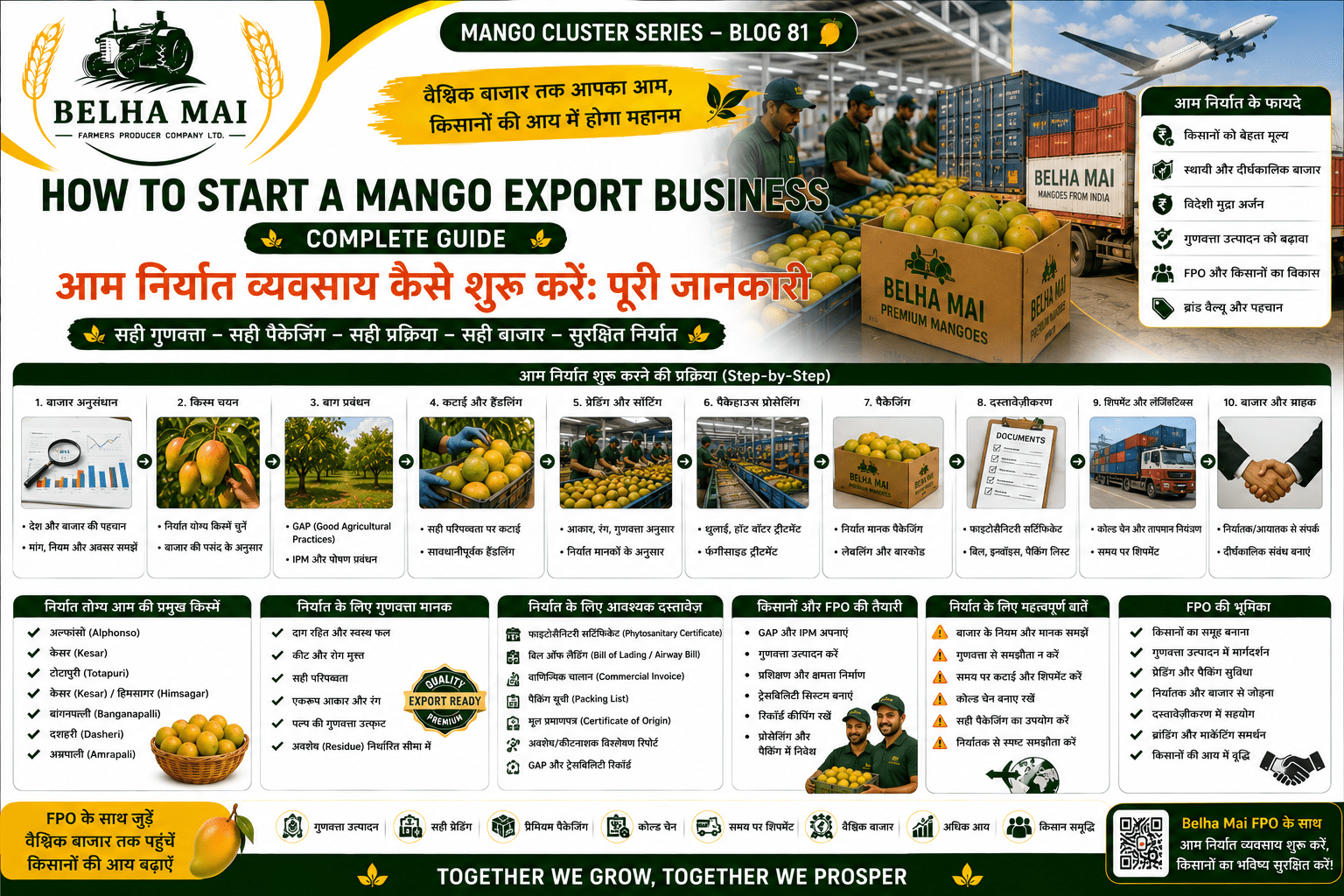
How to Start a Mango Export Business in India? Indian mangoes are known for taste, aroma, variety and cultural value. However, mango export is not a simple buying and selling activity. It requires quality control, proper sourcing, grading, packaging, documentation, treatment, cold chain, buyer linkage and compliance with importing-country requirements.
Many people think that mango export means buying mangoes from a mandi and sending them abroad. In reality, successful mango export starts from orchard-level planning. The exporter must understand variety, maturity, pest control, harvesting, post-harvest handling, packhouse process, logistics and buyer expectations.
For FPOs, mango export can become a powerful business opportunity. FPOs can organize farmers, aggregate produce, improve quality, maintain traceability and connect with exporters or international buyers.
आम निर्यात व्यवसाय कैसे शुरू करें
भारत में आम निर्यात व्यवसाय एक मजबूत अवसर है क्योंकि भारतीय आम अपने स्वाद, सुगंध, किस्म और सांस्कृतिक पहचान के लिए प्रसिद्ध हैं। लेकिन आम निर्यात केवल खरीद-बिक्री का काम नहीं है। इसके लिए quality control, proper sourcing, grading, packaging, documentation, treatment, cold chain, buyer linkage और importing-country requirements का पालन जरूरी है।
कई लोग सोचते हैं कि आम export का मतलब मंडी से आम खरीदकर विदेश भेजना है। वास्तव में सफल आम निर्यात orchard-level planning से शुरू होता है। Exporter को variety, maturity, pest control, harvesting, post-harvest handling, packhouse process, logistics और buyer expectations समझनी होती हैं।
FPO के लिए आम निर्यात एक शक्तिशाली business opportunity बन सकता है। FPO किसानों को organize कर सकता है, produce aggregate कर सकता है, quality सुधार सकता है, traceability maintain कर सकता है और exporters या international buyers से connect कर सकता है।
Step 1: Understand the Mango Export Market
The first step is market understanding. Before starting export, you must know which country demands which mango variety, what quality is required, what packaging is preferred, what treatment is needed and what price range is possible.
Important questions to study:
Which countries import Indian mangoes?
Which varieties are demanded?
What is the export season?
What quality grade is required?
What packaging size is preferred?
What treatment is required?
What documents are needed?
Who are the buyers?
What is the payment system?
What is the logistics cost?
Without market research, mango export can become risky.
चरण 1: आम निर्यात बाजार को समझें
पहला कदम market understanding है। Export शुरू करने से पहले यह जानना जरूरी है कि कौन सा देश कौन सी mango variety मांगता है, कौन सी quality चाहिए, कौन सी packaging पसंद की जाती है, कौन सा treatment जरूरी है और price range क्या हो सकती है।
महत्वपूर्ण सवाल:
कौन से देश Indian mangoes import करते हैं?
कौन सी varieties की demand है?
Export season क्या है?
कौन सा quality grade चाहिए?
कौन सा packaging size पसंद है?
कौन सा treatment जरूरी है?
कौन से documents चाहिए?
Buyers कौन हैं?
Payment system क्या है?
Logistics cost कितनी है?
Market research के बिना mango export risky हो सकता है।
Step 2: Select the Right Mango Varieties
Mango export depends heavily on variety selection. Different countries and buyers prefer different mango varieties. Some buyers prefer premium table mangoes, while some buyers may require processing-grade mangoes or pulp.
Important Indian mango varieties for export and premium markets include:
Alphonso,
Kesar,
Dasheri,
Langra,
Chausa,
Banganapalli,
Totapuri,
Amrapali,
and other region-specific varieties.
For Uttar Pradesh and North India, Dasheri, Langra and Chausa can be important varieties. FPOs should map local mango varieties and understand which variety has buyer demand.
चरण 2: सही आम किस्म चुनें
Mango export variety selection पर बहुत निर्भर करता है। अलग-अलग countries और buyers अलग-अलग mango varieties पसंद करते हैं। कुछ buyers premium table mangoes पसंद करते हैं, जबकि कुछ buyers processing-grade mangoes या pulp मांग सकते हैं।
Export और premium markets के लिए महत्वपूर्ण Indian mango varieties:
Alphonso,
Kesar,
Dasheri,
Langra,
Chausa,
Banganapalli,
Totapuri,
Amrapali,
और अन्य region-specific varieties।
Uttar Pradesh और North India के लिए Dasheri, Langra और Chausa महत्वपूर्ण varieties हो सकती हैं। FPO को local mango varieties map करनी चाहिए और यह समझना चाहिए कि किस variety की buyer demand है।
Step 3: Plan Orchard-Level Quality
Mango export starts from the orchard, not from the airport. If fruits are affected by pests, diseases, poor maturity, pesticide residue or physical damage, they may not qualify for export.
Export-oriented orchard practices should include:
quality planting material,
proper pruning,
canopy management,
soil testing,
balanced nutrition,
proper irrigation,
IPM,
pheromone traps,
fruit fly management,
orchard sanitation,
and record keeping.
Farmers should be trained before the season. Export quality cannot be created at the last moment.
चरण 3: बाग स्तर पर गुणवत्ता योजना बनाएं
Mango export orchard से शुरू होता है, airport से नहीं। यदि फल pests, diseases, poor maturity, pesticide residue या physical damage से प्रभावित हैं, तो वे export के लिए qualify नहीं कर सकते।
Export-oriented orchard practices में शामिल होना चाहिए:
quality planting material,
proper pruning,
canopy management,
soil testing,
balanced nutrition,
proper irrigation,
IPM,
pheromone traps,
fruit fly management,
orchard sanitation,
और record keeping।
किसानों को season से पहले training देनी चाहिए। Export quality अंतिम समय पर नहीं बनाई जा सकती।
Step 4: Register the Business Properly
A mango export business needs proper business registration and compliance. The exact registrations depend on the business structure, product type and export model.
Important registrations may include:
business registration,
PAN,
bank account,
GST where applicable,
Import Export Code,
APEDA registration,
FSSAI license where applicable,
and other compliance based on product and market.
If the FPO is not exporting directly, it can work with an existing exporter in the beginning. This reduces risk and helps the FPO learn the export process.
चरण 4: व्यवसाय का सही registration करें
Mango export business के लिए proper business registration और compliance जरूरी है। Exact registrations business structure, product type और export model पर निर्भर करते हैं।
महत्वपूर्ण registrations:
business registration,
PAN,
bank account,
GST जहां applicable हो,
Import Export Code,
APEDA registration,
FSSAI license जहां applicable हो,
और product व market के अनुसार अन्य compliance।
यदि FPO सीधे export नहीं कर रहा है, तो शुरुआत में existing exporter के साथ काम कर सकता है। इससे risk कम होता है और FPO export process सीखता है।
Step 5: Build Farmer Sourcing Network
A successful mango export business needs reliable sourcing. If the exporter cannot supply consistent quantity and quality, buyers may not continue.
A sourcing network should include:
registered farmers,
orchard mapping,
variety-wise farmer list,
expected production estimate,
harvest calendar,
quality protocol,
IPM plan,
and farmer-wise traceability.
FPOs are very useful in this stage because they already work with farmers and can organize supply.
चरण 5: किसान sourcing network बनाएं
Successful mango export business के लिए reliable sourcing जरूरी है। यदि exporter consistent quantity और quality supply नहीं कर सकता, तो buyers continue नहीं करेंगे।
Sourcing network में शामिल होना चाहिए:
registered farmers,
orchard mapping,
variety-wise farmer list,
expected production estimate,
harvest calendar,
quality protocol,
IPM plan,
और farmer-wise traceability।
इस stage में FPO बहुत उपयोगी है क्योंकि वह किसानों के साथ काम करता है और supply organize कर सकता है।
Step 6: Follow Good Agricultural Practices
Good Agricultural Practices help produce export-quality mangoes. Buyers want fruits that are clean, safe, uniform and traceable.
GAP-based mango production includes:
safe input use,
proper pesticide records,
soil and water management,
pest monitoring,
disease monitoring,
field hygiene,
harvest hygiene,
worker training,
and traceability records.
FPOs can create simple farmer record books to track orchard practices, sprays, harvesting dates and lot details.
चरण 6: Good Agricultural Practices अपनाएं
Good Agricultural Practices export-quality mangoes produce करने में मदद करती हैं। Buyers clean, safe, uniform और traceable fruits चाहते हैं।
GAP-based mango production में शामिल है:
safe input use,
proper pesticide records,
soil and water management,
pest monitoring,
disease monitoring,
field hygiene,
harvest hygiene,
worker training,
और traceability records।
FPO simple farmer record books बना सकता है जिसमें orchard practices, sprays, harvesting dates और lot details track हों।
Step 7: Harvest Mangoes Correctly
Export mangoes should be harvested at the right maturity stage. Immature mangoes may not ripen properly, while over-mature mangoes may become soft during transport.
Correct harvesting practices include:
harvest during cool hours,
identify proper maturity,
use harvesting tools,
avoid fruit fall,
harvest with small stalk where suitable,
keep fruits in shade,
use plastic crates,
and move fruits quickly to collection centre.
Rough harvesting can destroy export value.
चरण 7: आम की सही तुड़ाई करें
Export mangoes को सही maturity stage पर harvest करना चाहिए। Immature mangoes properly ripen नहीं होते, जबकि over-mature mangoes transport में soft हो सकते हैं।
Correct harvesting practices:
cool hours में harvest करें,
proper maturity identify करें,
harvesting tools use करें,
fruit fall से बचें,
जहां suitable हो small stalk के साथ harvest करें,
fruits को shade में रखें,
plastic crates use करें,
और fruits को जल्दी collection centre तक पहुंचाएं।
Rough harvesting export value को खत्म कर सकती है।
Step 8: Use Collection Centre and Crate System
After harvesting, mangoes should be collected at a clean and shaded collection centre. Fruits should not be kept in open sun or gunny bags.
A basic export-oriented collection centre should have:
shade,
clean floor,
plastic crates,
sorting tables,
de-sapping area,
record register,
weighing scale,
and farmer-wise lot system.
Crates reduce bruising and improve handling. FPOs can create a crate bank for member farmers.
चरण 8: Collection centre और crate system अपनाएं
Harvesting के बाद mangoes को clean और shaded collection centre पर लाना चाहिए। Fruits को open sun या gunny bags में नहीं रखना चाहिए।
Basic export-oriented collection centre में होना चाहिए:
shade,
clean floor,
plastic crates,
sorting tables,
de-sapping area,
record register,
weighing scale,
और farmer-wise lot system।
Crates bruising कम करते हैं और handling सुधारते हैं। FPO member farmers के लिए crate bank बना सकता है।
Step 9: De-Sapping, Cleaning and Sorting
De-sapping is important because mango latex can create stains and sap burn. After de-sapping, mangoes should be cleaned and sorted.
Remove fruits that are:
damaged,
diseased,
cracked,
immature,
over-mature,
fruit fly affected,
sap-burnt,
or physically injured.
Only good-quality fruits should enter the export grading line.
चरण 9: De-sapping, cleaning और sorting
De-sapping जरूरी है क्योंकि mango latex stains और sap burn पैदा कर सकता है। De-sapping के बाद mangoes को clean और sort करना चाहिए।
इन fruits को हटाएं:
damaged,
diseased,
cracked,
immature,
over-mature,
fruit fly affected,
sap-burnt,
या physically injured।
केवल good-quality fruits export grading line में जाने चाहिए।
Step 10: Grade Mangoes for Export
Export buyers prefer uniform mangoes. Grading should be done according to variety, size, weight, maturity, colour, shape and quality.
Export grading helps in:
uniform packing,
better presentation,
buyer confidence,
reduced rejection,
and better price negotiation.
Mixed-quality fruits should not be packed in the same export box. Variety-wise and grade-wise packing is very important.
चरण 10: Export के लिए आम की grading करें
Export buyers uniform mangoes पसंद करते हैं। Grading variety, size, weight, maturity, colour, shape और quality के अनुसार करनी चाहिए।
Export grading से मदद मिलती है:
uniform packing,
better presentation,
buyer confidence,
reduced rejection,
और better price negotiation में।
Mixed-quality fruits को एक ही export box में pack नहीं करना चाहिए। Variety-wise और grade-wise packing बहुत महत्वपूर्ण है।
Step 11: Use Recognized Packhouse or Proper Packhouse Linkage
For export, packhouse handling is very important. A packhouse helps in sorting, grading, treatment, packaging, labelling, quality inspection and shipment preparation.
A mango packhouse may include:
receiving area,
sorting tables,
washing or cleaning area,
grading system,
treatment facility where required,
drying area,
packing area,
cold storage,
traceability system,
and quality control.
FPOs can start with basic collection centres and then build linkage with recognized packhouses or exporters.
चरण 11: Recognized packhouse या proper packhouse linkage अपनाएं
Export के लिए packhouse handling बहुत महत्वपूर्ण है। Packhouse sorting, grading, treatment, packaging, labelling, quality inspection और shipment preparation में मदद करता है।
Mango packhouse में हो सकते हैं:
receiving area,
sorting tables,
washing या cleaning area,
grading system,
जहां required हो treatment facility,
drying area,
packing area,
cold storage,
traceability system,
और quality control।
FPO basic collection centres से शुरुआत कर सकता है और फिर recognized packhouses या exporters से linkage बना सकता है।
Step 12: Understand Treatment Requirements
Different countries may require different post-harvest treatments for mango export. Treatment may include hot water treatment, vapour heat treatment, irradiation or other approved methods depending on destination-country rules.
Treatment is used to reduce pest risk and meet phytosanitary requirements. Exporters should never guess treatment requirements. They should confirm buyer and importing-country norms before shipment.
FPOs can work with exporters and packhouses to understand treatment requirements.
Vapor Heat Treatment (VHT) for Mango Export
Vapor Heat Treatment, commonly known as VHT, is a post-harvest quarantine treatment used for mango exports. In this process, mangoes are exposed to controlled hot vapor to eliminate fruit fly infestation and other quarantine pests without damaging the fruit quality. VHT is especially important for exporting Indian mangoes to countries with strict phytosanitary requirements.
For mango exporters, VHT approval, proper grading, packaging, traceability, APEDA registration, and phytosanitary certification are important steps before shipment. Farmers and FPOs planning mango export must understand that export is not only about production, but also about post-harvest treatment, quality compliance, documentation, and buyer confidence.
चरण 12: Treatment requirements समझें
अलग-अलग countries mango export के लिए अलग-अलग post-harvest treatments मांग सकती हैं। Treatment में hot water treatment, vapour heat treatment, irradiation या destination-country rules के अनुसार अन्य approved methods शामिल हो सकते हैं।
Treatment pest risk कम करने और phytosanitary requirements पूरा करने के लिए किया जाता है। Exporters को treatment requirements guess नहीं करनी चाहिए। Shipment से पहले buyer और importing-country norms confirm करने चाहिए।
FPO exporters और packhouses के साथ मिलकर treatment requirements समझ सकता है।
Step 13: Export Packaging and Labelling
Export packaging protects mangoes during long-distance transport and creates buyer confidence. Packaging should be strong, clean, food-safe, ventilated and properly labelled.
Export labels may include:
product name,
variety,
grade,
net weight,
fruit count,
origin,
packer name,
FPO or company name,
batch number,
packing date,
traceability code,
and handling instructions.
Good packaging also helps build brand identity.
चरण 13: Export packaging और labelling
Export packaging long-distance transport के दौरान mangoes को protect करती है और buyer confidence बनाती है। Packaging strong, clean, food-safe, ventilated और properly labelled होनी चाहिए।
Export labels में हो सकते हैं:
product name,
variety,
grade,
net weight,
fruit count,
origin,
packer name,
FPO या company name,
batch number,
packing date,
traceability code,
और handling instructions।
Good packaging brand identity बनाने में भी मदद करती है।
Step 14: Maintain Cold Chain and Logistics
Mango is perishable, so logistics must be planned carefully. Export shipments may move by air or sea depending on destination, fruit stage, buyer requirement and cost.
Logistics planning should include:
pre-cooling where required,
cold storage,
refrigerated transport where needed,
proper stacking,
timely dispatch,
airport or port handling,
temperature monitoring,
and delivery schedule.
Poor logistics can damage even good-quality mangoes.
चरण 14: Cold chain और logistics maintain करें
Mango perishable fruit है, इसलिए logistics सावधानी से plan करना चाहिए। Export shipments destination, fruit stage, buyer requirement और cost के अनुसार air या sea से जा सकती हैं।
Logistics planning में शामिल होना चाहिए:
जहां required हो pre-cooling,
cold storage,
जहां needed हो refrigerated transport,
proper stacking,
timely dispatch,
airport या port handling,
temperature monitoring,
और delivery schedule।
Poor logistics good-quality mangoes को भी damage कर सकती है।
Step 15: Prepare Export Documents
Export documentation is a critical part of mango export business. Documents may vary depending on product type, destination country, buyer requirement and shipment mode.
Common export documents may include:
commercial invoice,
packing list,
phytosanitary certificate,
certificate of origin where required,
bill of lading or airway bill,
treatment certificate where required,
quality certificate where required,
insurance document where required,
purchase order or buyer contract,
and customs-related documents.
Exporters should work with experienced CHA, freight forwarders, APEDA guidance and buyer instructions.
चरण 15: Export documents तैयार करें
Export documentation mango export business का critical part है। Documents product type, destination country, buyer requirement और shipment mode के अनुसार बदल सकते हैं।
Common export documents:
commercial invoice,
packing list,
phytosanitary certificate,
certificate of origin जहां required हो,
bill of lading या airway bill,
treatment certificate जहां required हो,
quality certificate जहां required हो,
insurance document जहां required हो,
purchase order या buyer contract,
और customs-related documents।
Exporters को experienced CHA, freight forwarders, APEDA guidance और buyer instructions के साथ काम करना चाहिए।
Step 16: Find Genuine Buyers
Finding genuine buyers is one of the most important parts of export business. New exporters should be careful because international trade also has payment and fraud risks.
Buyer sources may include:
export promotion platforms,
trade fairs,
APEDA events,
B2B portals,
Indian embassies and trade offices,
importers,
supermarket chains,
wholesalers,
food distributors,
and referrals from existing exporters.
Before confirming a buyer, verify company details, payment terms, import requirements and past trade credibility.
चरण 16: Genuine buyers खोजें
Genuine buyers खोजना export business का सबसे महत्वपूर्ण हिस्सा है। New exporters को सावधान रहना चाहिए क्योंकि international trade में payment और fraud risks भी होते हैं।
Buyer sources:
export promotion platforms,
trade fairs,
APEDA events,
B2B portals,
Indian embassies and trade offices,
importers,
supermarket chains,
wholesalers,
food distributors,
और existing exporters से referrals।
Buyer confirm करने से पहले company details, payment terms, import requirements और past trade credibility verify करनी चाहिए।
Step 17: Start with Trial Shipment
A new mango exporter should start with trial shipments instead of taking very large orders immediately. Trial shipments help understand quality, packing, logistics, documentation and buyer feedback.
Trial shipment helps check:
fruit maturity,
packaging strength,
transit damage,
ripening behaviour,
buyer acceptance,
documentation process,
logistics cost,
and payment cycle.
After successful trials, the exporter or FPO can gradually increase volume.
चरण 17: Trial shipment से शुरुआत करें
New mango exporter को तुरंत बहुत बड़ा order लेने के बजाय trial shipments से शुरुआत करनी चाहिए। Trial shipment quality, packing, logistics, documentation और buyer feedback समझने में मदद करती है।
Trial shipment से check होता है:
fruit maturity,
packaging strength,
transit damage,
ripening behaviour,
buyer acceptance,
documentation process,
logistics cost,
और payment cycle।
Successful trials के बाद exporter या FPO धीरे-धीरे volume बढ़ा सकता है।
Common Mistakes in Mango Export Business
Mango export can fail if basic mistakes are made. New exporters should avoid shortcuts.
Common mistakes include:
buying ungraded mangoes from mandi,
ignoring maturity stage,
poor harvesting,
not managing fruit fly risk,
weak packaging,
no cold chain planning,
wrong treatment assumption,
incomplete documentation,
unverified buyer,
poor payment terms,
and overcommitting quantity.
Export business needs discipline, planning and patience.
आम निर्यात व्यवसाय की सामान्य गलतियां
यदि basic mistakes हों, तो mango export fail हो सकता है। New exporters को shortcuts से बचना चाहिए।
Common mistakes:
mandi से ungraded mangoes खरीदना,
maturity stage ignore करना,
poor harvesting,
fruit fly risk manage न करना,
weak packaging,
cold chain planning न होना,
wrong treatment assumption,
incomplete documentation,
unverified buyer,
poor payment terms,
और quantity overcommit करना।
Export business को discipline, planning और patience चाहिए।
Role of FPOs in Starting Mango Export Business
FPOs can play a major role in starting mango export business. Individual farmers cannot manage export requirements alone. FPOs can organize farmers, improve quality and connect with exporters.
An FPO can support export through:
farmer mobilization,
orchard mapping,
variety-wise production planning,
IPM training,
quality production,
harvesting protocol,
crate bank,
collection centre,
sorting and grading,
packaging,
traceability,
packhouse linkage,
exporter linkage,
documentation support,
and buyer communication.
For Belha Mai Farmers Producer Company Ltd., mango export should be developed step by step. The FPO can first strengthen quality production, grading, packaging and domestic premium buyer linkage. After that, it can move toward exporter tie-ups and international markets.
आम निर्यात व्यवसाय शुरू करने में FPO की भूमिका
FPO mango export business शुरू करने में बड़ी भूमिका निभा सकता है। Individual farmers export requirements अकेले manage नहीं कर सकते। FPO किसानों को organize कर सकता है, quality सुधार सकता है और exporters से जोड़ सकता है।
FPO export में support कर सकता है:
farmer mobilization,
orchard mapping,
variety-wise production planning,
IPM training,
quality production,
harvesting protocol,
crate bank,
collection centre,
sorting and grading,
packaging,
traceability,
packhouse linkage,
exporter linkage,
documentation support,
और buyer communication।
Belha Mai Farmers Producer Company Ltd. को mango export step by step develop करना चाहिए। FPO पहले quality production, grading, packaging और domestic premium buyer linkage मजबूत कर सकता है। उसके बाद exporter tie-ups और international markets की ओर बढ़ सकता है।
Business Model for Mango Export
A mango export business can follow different models.
Possible models include:
direct export by registered exporter,
FPO-exporter partnership,
FPO supplying graded mangoes to exporter,
contract supply to importers,
packhouse-based export model,
premium domestic and export hybrid model,
fresh mango export,
and processed mango export.
For a new FPO, the safest model may be to begin as a quality supplier to established exporters and gradually build direct export capacity.
Mango export business model
Mango export business अलग-अलग models से चल सकता है।
Possible models:
registered exporter द्वारा direct export,
FPO-exporter partnership,
FPO द्वारा exporters को graded mango supply,
importers को contract supply,
packhouse-based export model,
premium domestic and export hybrid model,
fresh mango export,
और processed mango export।
New FPO के लिए safer model यह हो सकता है कि पहले established exporters को quality supplier के रूप में शुरुआत करे और धीरे-धीरे direct export capacity बनाए।
Conclusion
Starting a mango export business requires planning, quality control and professional execution. It is not enough to buy mangoes and find a foreign buyer. Export success depends on orchard management, IPM, proper harvesting, post-harvest handling, grading, packhouse processing, packaging, treatment, cold chain, documentation and buyer trust.
For farmers, mango export can create better value if they produce quality fruit and work collectively. For FPOs, export business can become a long-term opportunity to improve farmer income and build a strong mango brand.
Belha Mai Farmers Producer Company Ltd. can use a step-by-step Mango Cluster strategy: first organize farmers, improve quality, create grading and packaging systems, connect with domestic premium buyers, then build export partnerships and later explore direct export.
निष्कर्ष
Mango export business शुरू करने के लिए planning, quality control और professional execution जरूरी है। केवल mangoes खरीदना और foreign buyer ढूंढना पर्याप्त नहीं है। Export success orchard management, IPM, proper harvesting, post-harvest handling, grading, packhouse processing, packaging, treatment, cold chain, documentation और buyer trust पर निर्भर करती है।
किसानों के लिए mango export बेहतर value बना सकता है, यदि वे quality fruit produce करें और collectively काम करें। FPO के लिए export business farmer income सुधारने और strong mango brand बनाने का long-term opportunity बन सकता है।
Belha Mai Farmers Producer Company Ltd. step-by-step Mango Cluster strategy अपना सकता है: पहले farmers organize करें, quality सुधारें, grading और packaging systems बनाएं, domestic premium buyers से connect करें, फिर export partnerships बनाएं और बाद में direct export explore करें।
FAQ in English + Hindi
FAQ 1: How do I start a mango export business?
Start with market research, business registration, IEC, APEDA registration, farmer sourcing, quality production, grading, packaging, packhouse linkage, documentation, logistics and genuine buyer connection.
प्रश्न 1: आम निर्यात व्यवसाय कैसे शुरू करें?
Market research, business registration, IEC, APEDA registration, farmer sourcing, quality production, grading, packaging, packhouse linkage, documentation, logistics और genuine buyer connection से शुरुआत करें।
FAQ 2: Which mango varieties are good for export?
Alphonso, Kesar, Dasheri, Langra, Chausa, Banganapalli, Totapuri, Amrapali and other regional varieties can be exported depending on buyer demand and destination market.
प्रश्न 2: निर्यात के लिए कौन सी आम किस्में अच्छी हैं?
Alphonso, Kesar, Dasheri, Langra, Chausa, Banganapalli, Totapuri, Amrapali और अन्य regional varieties buyer demand और destination market के अनुसार export हो सकती हैं।
FAQ 3: What documents are required for mango export?
Common documents may include commercial invoice, packing list, phytosanitary certificate, certificate of origin where required, airway bill or bill of lading, treatment certificate where required and customs documents.
प्रश्न 3: आम निर्यात के लिए कौन से documents चाहिए?
Common documents में commercial invoice, packing list, phytosanitary certificate, जहां required हो certificate of origin, airway bill या bill of lading, जहां required हो treatment certificate और customs documents शामिल हो सकते हैं।
FAQ 4: Can an FPO start mango export?
Yes, an FPO can start mango export directly or through exporter partnerships. FPOs can organize farmers, maintain quality, grade produce, manage traceability and connect with packhouses and exporters.
प्रश्न 4: क्या FPO आम निर्यात शुरू कर सकता है?
हां, FPO सीधे या exporter partnerships के माध्यम से mango export शुरू कर सकता है। FPO farmers organize कर सकता है, quality maintain कर सकता है, produce grade कर सकता है, traceability manage कर सकता है और packhouses व exporters से connect कर सकता है।
FAQ 5: What is the safest way for a new FPO to enter mango export?
A new FPO should first supply quality graded mangoes to established exporters or premium domestic buyers. After gaining experience, it can move toward direct export.
प्रश्न 5: New FPO के लिए mango export में entry का safest तरीका क्या है?
New FPO को पहले established exporters या premium domestic buyers को quality graded mangoes supply करने चाहिए। Experience मिलने के बाद direct export की ओर बढ़ सकता है।
FAQ 6: Is VHT treatment required for mango export?
Yes, VHT treatment may be required for exporting mangoes to specific countries with strict quarantine rules. It helps control fruit fly risk and supports phytosanitary compliance for international mango trade.
Internal Links Section
Related Mango Cluster Blogs
👉 Mango Farming in India: Complete Guide
https://belhamaifpo.com/agriculture/mango-farming-in-india/
👉 Mango Export Business in India
https://belhamaifpo.com/agriculture/mango-export-business-in-india/
👉 Mango Packaging for Export
https://belhamaifpo.com/agriculture/mango-packaging-for-export/
👉 Mango Supply Chain in India
https://belhamaifpo.com/agriculture/mango-supply-chain-in-india/
👉 Mango Grading and Sorting Process
https://belhamaifpo.com/agriculture/mango-grading-and-sorting-process/
👉 Mango Cold Storage Solutions
https://belhamaifpo.com/agriculture/mango-cold-storage-solutions/
👉 Role of FPOs in Mango Marketing
https://belhamaifpo.com/agriculture/role-of-fpos-in-mango-marketing/
हिंदी में संबंधित आम क्लस्टर ब्लॉग
👉 भारत में आम की खेती: पूरी जानकारी
https://belhamaifpo.com/agriculture/mango-farming-in-india/
👉 भारत में आम निर्यात व्यवसाय
https://belhamaifpo.com/agriculture/mango-export-business-in-india/
👉 निर्यात के लिए आम पैकेजिंग
https://belhamaifpo.com/agriculture/mango-packaging-for-export/
👉 भारत में आम सप्लाई चेन
https://belhamaifpo.com/agriculture/mango-supply-chain-in-india/
👉 आम की ग्रेडिंग और छंटाई प्रक्रिया
https://belhamaifpo.com/agriculture/mango-grading-and-sorting-process/
👉 आम कोल्ड स्टोरेज समाधान
https://belhamaifpo.com/agriculture/mango-cold-storage-solutions/
👉 आम मार्केटिंग में FPO की भूमिका
https://belhamaifpo.com/agriculture/role-of-fpos-in-mango-marketing/
External Authority Links
👉 DGFT Import Export Code Information
https://www.dgft.gov.in/
👉 APEDA Mango Export Information
https://apeda.gov.in/Mango
👉 APEDA Recognized Packhouses
https://apeda.gov.in/recognized-packhouses
👉 APEDA Packhouse Recognition Scheme
https://apeda.gov.in/apedawebsite/Announcements/Packhouse_Recognition_Scheme.htm
👉 FSSAI FoSCoS License / Registration Portal
https://foscos.fssai.gov.in/