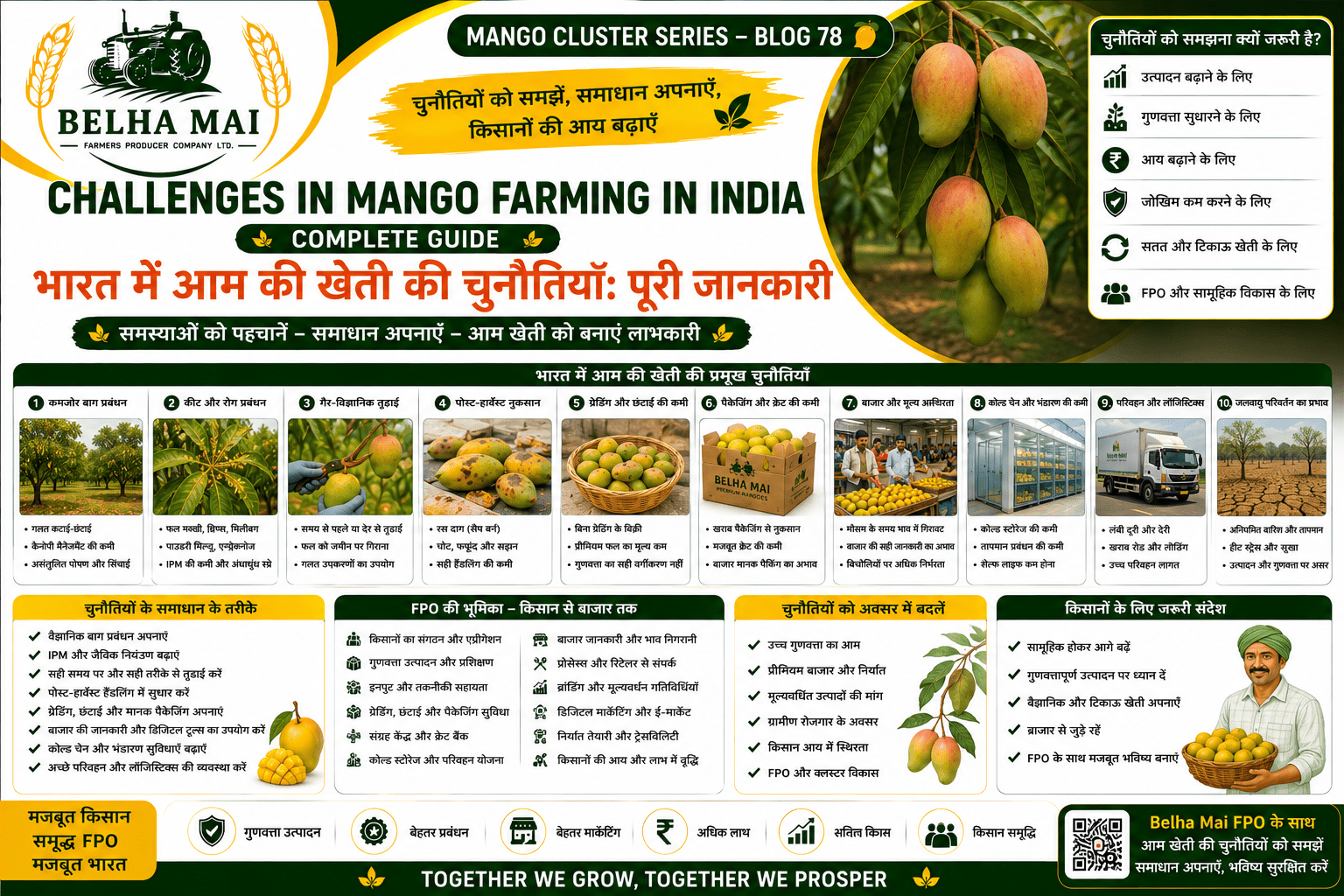
Mango farming in India has huge potential because mango is one of the most loved fruits in the country and has strong demand in domestic and export markets. India has many famous mango varieties such as Dasheri, Langra, Chausa, Alphonso, Kesar, Totapuri, Banganapalli and Amrapali.
However, mango farming is not free from challenges. Farmers face problems from climate change, irregular flowering, fruit drop, pests, diseases, low productivity, poor post-harvest management, weak grading, poor packaging, limited cold storage and market price fluctuation.
For small and marginal farmers, these problems become even more serious because they often lack technical guidance, proper tools, market information, storage facilities and direct buyer access.
भारत में आम की खेती की चुनौतियां
भारत में आम की खेती की बहुत बड़ी संभावना है क्योंकि आम देश का सबसे लोकप्रिय फल है और इसकी घरेलू तथा निर्यात बाजार में मजबूत मांग है। भारत में दशहरी, लंगड़ा, चौसा, अल्फांसो, केसर, तोतापुरी, बंगनपल्ली और आम्रपाली जैसी प्रसिद्ध आम किस्में हैं।
लेकिन आम की खेती में कई चुनौतियां भी हैं। किसान climate change, अनियमित flowering, fruit drop, कीट, रोग, कम productivity, खराब post-harvest management, कमजोर grading, खराब packaging, limited cold storage और market price fluctuation जैसी समस्याओं का सामना करते हैं।
छोटे और सीमांत किसानों के लिए ये समस्याएं और गंभीर हो जाती हैं क्योंकि उनके पास technical guidance, proper tools, market information, storage facility और direct buyer access की कमी होती है।
1. Climate Change and Weather Risk
Climate change is one of the biggest challenges in mango farming. Mango flowering and fruiting are highly sensitive to temperature, humidity, rainfall and wind. Sudden weather changes can affect flowering, pollination, fruit setting and fruit quality.
Common climate-related problems include:
unseasonal rain,
heat waves,
temperature fluctuation,
hailstorm,
strong winds,
high humidity,
and drought stress.
If rain occurs during flowering, it can affect pollination and increase disease pressure. High temperature during fruit development can reduce fruit quality. Strong winds or storms can cause fruit drop and branch damage.
1. जलवायु परिवर्तन और मौसम जोखिम
Climate change आम की खेती की सबसे बड़ी चुनौतियों में से एक है। आम में फूल और फल लगना तापमान, नमी, बारिश और हवा पर बहुत निर्भर करता है। अचानक मौसम बदलाव flowering, pollination, fruit setting और fruit quality को प्रभावित कर सकता है।
मौसम से जुड़ी सामान्य समस्याएं:
बेमौसम बारिश,
heat waves,
temperature fluctuation,
hailstorm,
strong winds,
high humidity,
और drought stress।
यदि flowering के समय बारिश होती है, तो pollination प्रभावित हो सकता है और रोगों का दबाव बढ़ सकता है। फल विकास के समय अधिक तापमान fruit quality को कम कर सकता है। तेज हवा या आंधी से fruit drop और शाखा damage हो सकता है।
2. Irregular Flowering
Irregular flowering is a common challenge in mango orchards. Some trees flower heavily in one year and very little in the next year. This affects regular income for farmers.
Irregular flowering may happen due to:
variety character,
tree age,
poor pruning,
nutrient imbalance,
excessive irrigation,
weather fluctuation,
pest attack,
and weak orchard management.
Farmers should understand that flowering management starts after harvest. Proper pruning, nutrition, canopy management and stress management are important for better flowering.
2. अनियमित फूल आना
आम बागों में irregular flowering एक सामान्य चुनौती है। कुछ पेड़ एक साल बहुत फूल देते हैं और अगले साल बहुत कम। इससे किसानों की नियमित आय प्रभावित होती है।
अनियमित flowering के कारण हो सकते हैं:
किस्म की प्रकृति,
पेड़ की उम्र,
खराब pruning,
nutrient imbalance,
excessive irrigation,
weather fluctuation,
pest attack,
और weak orchard management।
किसानों को समझना चाहिए कि flowering management harvest के बाद शुरू होता है। बेहतर flowering के लिए proper pruning, nutrition, canopy management और stress management जरूरी हैं।
3. Fruit Drop Problem
Fruit drop is another major challenge in mango farming. Some fruit drop is natural, but excessive fruit drop can reduce yield and income.
Fruit drop may occur due to:
poor pollination,
high temperature,
water stress,
nutrient deficiency,
pest attack,
disease infection,
strong winds,
and weak tree health.
Farmers often become worried when small fruits start falling. The solution is not random spraying. Farmers should first understand the reason and then follow expert advisory.
3. फल झड़ने की समस्या
Fruit drop आम की खेती की एक बड़ी चुनौती है। कुछ फल झड़ना सामान्य है, लेकिन ज्यादा fruit drop से yield और income कम हो जाती है।
फल झड़ने के कारण हो सकते हैं:
poor pollination,
high temperature,
water stress,
nutrient deficiency,
pest attack,
disease infection,
strong winds,
और weak tree health।
किसान अक्सर छोटे फल गिरते देखकर परेशान हो जाते हैं। इसका समाधान random spraying नहीं है। पहले कारण समझना चाहिए और फिर expert advisory के अनुसार काम करना चाहिए।
4. Pest Attack in Mango Orchards
Mango is affected by several pests. Pest attack can reduce flowering, fruit setting, fruit quality and market price.
Major mango pests include:
mango hopper,
fruit fly,
mealy bug,
thrips,
stem borer,
leaf webber,
and scale insects.
Fruit fly is especially serious because it damages fruits and creates problems for premium and export markets. Mango hopper is serious during flowering because it affects panicles and fruit setting.
Farmers should not depend only on repeated chemical spraying. Integrated Pest Management should be adopted.
4. आम बाग में कीट प्रकोप
आम में कई प्रकार के कीट लगते हैं। कीट attack flowering, fruit setting, fruit quality और market price को कम कर सकता है।
मुख्य आम कीट:
mango hopper,
fruit fly,
mealy bug,
thrips,
stem borer,
leaf webber,
और scale insects।
Fruit fly विशेष रूप से गंभीर है क्योंकि यह fruit damage करती है और premium व export market में समस्या पैदा करती है। Mango hopper flowering के समय गंभीर होता है क्योंकि यह panicles और fruit setting को प्रभावित करता है।
किसानों को बार-बार chemical spraying पर ही निर्भर नहीं रहना चाहिए। Integrated Pest Management अपनाना चाहिए।
5. Disease Problems in Mango
Diseases are another major challenge in mango farming. Mango diseases can affect flowers, leaves, fruits and post-harvest quality.
Important mango diseases include:
powdery mildew,
anthracnose,
dieback,
stem-end rot,
and sooty mould.
Powdery mildew can affect flowering and fruit set. Anthracnose can create black spots and reduce fruit market value. Stem-end rot can damage fruits after harvesting and during ripening.
Disease management needs orchard sanitation, canopy management, proper air circulation, timely monitoring and expert-based treatment.
5. आम में रोगों की समस्या
आम में रोग भी बड़ी चुनौती हैं। आम के रोग flowers, leaves, fruits और post-harvest quality को प्रभावित कर सकते हैं।
मुख्य आम रोग:
powdery mildew,
anthracnose,
dieback,
stem-end rot,
और sooty mould।
Powdery mildew flowering और fruit set को प्रभावित कर सकता है। Anthracnose काले धब्बे बनाकर market value कम करता है। Stem-end rot harvest के बाद और ripening के समय fruit damage कर सकता है।
रोग प्रबंधन के लिए orchard sanitation, canopy management, proper air circulation, timely monitoring और expert-based treatment जरूरी है।
6. Excessive Pesticide Cost
Many mango farmers spend a large amount on pesticides. Sometimes spraying is done without proper pest identification or expert advice. This increases cost and may also create pesticide residue issues.
Excessive pesticide use can cause:
higher production cost,
damage to beneficial insects,
residue risk,
buyer rejection,
and environmental impact.
Farmers should use need-based spraying. Pheromone traps, lures, sticky traps, UV or light traps, orchard sanitation and biological methods can reduce unnecessary pesticide use.
6. अधिक कीटनाशक खर्च
कई आम किसान कीटनाशकों पर बहुत पैसा खर्च करते हैं। कई बार कीट की सही पहचान या expert advice के बिना spray किया जाता है। इससे लागत बढ़ती है और pesticide residue की समस्या भी हो सकती है।
अधिक pesticide use से:
production cost बढ़ती है,
beneficial insects को नुकसान होता है,
residue risk बनता है,
buyer rejection हो सकता है,
और environment पर असर पड़ता है।
किसानों को need-based spraying अपनाना चाहिए। Pheromone traps, lures, sticky traps, UV या light traps, orchard sanitation और biological methods से unnecessary pesticide use कम हो सकता है।
7. Poor Orchard Management
Poor orchard management is a hidden challenge in mango farming. Many orchards are not pruned properly. Trees become dense, tall and unmanaged. This reduces sunlight and air circulation inside the canopy.
Poor orchard management causes:
low flowering,
higher pest pressure,
more disease incidence,
difficult harvesting,
poor fruit size,
and low quality.
Regular pruning, canopy management, weed control, soil health management and nutrition planning can improve orchard productivity.
7. खराब बाग प्रबंधन
Poor orchard management आम खेती की छिपी हुई चुनौती है। कई बागों में सही pruning नहीं होती। पेड़ घने, ऊंचे और unmanaged हो जाते हैं। इससे canopy के अंदर sunlight और air circulation कम हो जाता है।
खराब बाग प्रबंधन से:
low flowering,
higher pest pressure,
more disease incidence,
difficult harvesting,
poor fruit size,
और low quality होती है।
Regular pruning, canopy management, weed control, soil health management और nutrition planning से orchard productivity बेहतर हो सकती है।
8. Lack of Quality Planting Material
Mango is a long-term crop. If farmers plant poor quality or wrong variety plants, the mistake affects them for many years. Many farmers buy plants without checking nursery credibility.
Problems due to poor planting material include:
wrong variety,
disease-prone plants,
weak growth,
poor yield,
uneven fruit quality,
and long-term income loss.
Farmers should buy grafted plants from trusted nurseries. FPOs can help by arranging quality planting material collectively.
8. अच्छी पौध सामग्री की कमी
आम एक long-term crop है। यदि किसान खराब quality या गलत variety के पौधे लगा देते हैं, तो यह गलती कई वर्षों तक असर डालती है। कई किसान nursery credibility जांचे बिना पौधे खरीद लेते हैं।
खराब पौध सामग्री से समस्याएं:
wrong variety,
disease-prone plants,
weak growth,
poor yield,
uneven fruit quality,
और long-term income loss।
किसानों को trusted nurseries से grafted plants खरीदने चाहिए। FPO quality planting material की सामूहिक व्यवस्था कर सकता है।
9. Water and Irrigation Challenges
Mango trees are hardy, but water management is still important. Both water stress and excess irrigation can create problems.
Water stress can reduce fruit size and affect tree health. Excess irrigation can damage roots, increase disease risk and reduce flowering in some conditions.
Farmers need proper irrigation scheduling based on tree age, soil type, season and fruit stage. Drip irrigation and mulching can help conserve water.
9. पानी और सिंचाई की चुनौतियां
आम के पेड़ मजबूत होते हैं, लेकिन water management फिर भी जरूरी है। पानी की कमी और excessive irrigation दोनों समस्या पैदा कर सकते हैं।
Water stress fruit size कम कर सकता है और tree health प्रभावित कर सकता है। Excess irrigation roots को damage कर सकता है, disease risk बढ़ा सकता है और कुछ स्थितियों में flowering को कम कर सकता है।
किसानों को tree age, soil type, season और fruit stage के अनुसार irrigation scheduling करनी चाहिए। Drip irrigation और mulching से water conservation में मदद मिलती है।
10. Post-Harvest Losses
Post-harvest loss is a major challenge in mango farming. Many farmers lose income after harvesting because of poor handling, lack of crates, poor packaging, no grading and transport delays.
Post-harvest losses happen due to:
fruit falling on ground,
rough handling,
sap burn,
bruising,
poor sorting,
wrong packaging,
heat exposure,
and delayed transport.
Better harvesting tools, plastic crates, de-sapping, sorting, grading and packaging can reduce losses.
10. पोस्ट-हार्वेस्ट नुकसान
Post-harvest loss आम खेती की बड़ी चुनौती है। कई किसान harvesting के बाद खराब handling, crates की कमी, poor packaging, grading न होने और transport delay के कारण income खो देते हैं।
Post-harvest नुकसान के कारण:
fruit falling on ground,
rough handling,
sap burn,
bruising,
poor sorting,
wrong packaging,
heat exposure,
और delayed transport।
Better harvesting tools, plastic crates, de-sapping, sorting, grading और packaging से losses कम किए जा सकते हैं।
11. Lack of Grading and Packaging
Many mango farmers sell mixed-quality fruits. Premium fruits, medium fruits, damaged fruits and processing-grade fruits are sold together. This reduces the price of the entire lot.
Without grading and packaging, farmers cannot target premium buyers, retail chains, institutional buyers or export markets.
Grading helps farmers sell:
premium fruits at better prices,
medium fruits in wholesale markets,
processing-grade fruits to processors,
and rejected fruits separately.
11. ग्रेडिंग और पैकेजिंग की कमी
कई आम किसान mixed-quality fruits बेचते हैं। Premium fruits, medium fruits, damaged fruits और processing-grade fruits एक साथ बेच दिए जाते हैं। इससे पूरी खेप का भाव कम हो जाता है।
Grading और packaging के बिना किसान premium buyers, retail chains, institutional buyers या export markets को target नहीं कर पाते।
Grading से किसान बेच सकता है:
premium fruits better prices पर,
medium fruits wholesale markets में,
processing-grade fruits processors को,
और rejected fruits अलग।
12. Limited Cold Storage and Cold Chain
Mango is perishable and needs proper temperature management after harvesting. Many farmers do not have access to cold storage or cold chain. As a result, they are forced to sell quickly, sometimes at low prices.
Cold storage and cold chain can help in:
reducing spoilage,
improving shelf life,
transporting to distant markets,
supporting premium retail,
and preparing for export.
FPOs can create shared cold storage linkages or tie up with existing facilities.
12. सीमित कोल्ड स्टोरेज और कोल्ड चेन
आम जल्दी खराब होने वाला फल है और harvest के बाद proper temperature management की जरूरत होती है। कई किसानों के पास cold storage या cold chain access नहीं होता। इसलिए वे जल्दी बेचने के लिए मजबूर होते हैं, कई बार कम भाव पर।
Cold storage और cold chain मदद करते हैं:
spoilage कम करने में,
shelf life बढ़ाने में,
distant markets तक पहुंचने में,
premium retail support में,
और export preparation में।
FPO shared cold storage linkages बना सकता है या existing facilities से tie-up कर सकता है।
13. Market Price Fluctuation
Mango prices can change quickly during the season. When supply is high, prices may fall. Farmers who sell immediately after harvesting may not get good returns.
Price fluctuation happens due to:
seasonal oversupply,
weather-related production changes,
market arrivals,
quality variation,
transport cost,
middlemen influence,
and lack of storage.
Farmers need market information, grading, storage, processing linkage and direct buyer access to reduce price risk.
13. बाजार भाव में उतार-चढ़ाव
आम के भाव season में तेजी से बदल सकते हैं। जब supply ज्यादा होती है, तो भाव गिर सकते हैं। जो किसान harvesting के तुरंत बाद बेचते हैं, उन्हें अच्छा return नहीं मिल पाता।
Price fluctuation के कारण:
seasonal oversupply,
weather-related production changes,
market arrivals,
quality variation,
transport cost,
middlemen influence,
और storage की कमी।
Price risk कम करने के लिए किसानों को market information, grading, storage, processing linkage और direct buyer access चाहिए।
14. Dependence on Middlemen
Many mango farmers depend on local traders or commission agents because they lack direct buyer access. Middlemen provide market access, but over-dependence reduces farmer bargaining power.
Farmers often do not know:
real market price,
grade-wise price,
buyer requirement,
transport cost,
or final selling price.
FPOs can reduce this dependence by creating direct buyer linkage and collective marketing.
14. बिचौलियों पर निर्भरता
कई आम किसान local traders या commission agents पर निर्भर रहते हैं क्योंकि उनके पास direct buyer access नहीं होता। Middlemen market access देते हैं, लेकिन over-dependence किसान की bargaining power कम कर देती है।
किसानों को अक्सर पता नहीं होता:
real market price,
grade-wise price,
buyer requirement,
transport cost,
या final selling price।
FPO direct buyer linkage और collective marketing बनाकर इस निर्भरता को कम कर सकता है।
15. Lack of Processing and Value Addition
Fresh mango selling has limitations because mango is seasonal and perishable. If farmers do not have processing options, surplus mangoes may sell at very low prices or go waste.
Processing can create products such as:
mango pulp,
mango juice,
pickle,
chutney,
dried mango,
aam papad,
aamchur powder,
jam,
and candy.
Value addition helps farmers earn beyond the fresh fruit season.
15. प्रोसेसिंग और मूल्यवर्धन की कमी
Fresh mango selling की सीमाएं हैं क्योंकि आम seasonal और perishable है। यदि किसानों के पास processing options नहीं हैं, तो surplus mangoes बहुत कम भाव पर बिक सकते हैं या waste हो सकते हैं।
Processing से बनाए जा सकते हैं:
mango pulp,
mango juice,
pickle,
chutney,
dried mango,
aam papad,
aamchur powder,
jam,
और candy।
Value addition किसानों को fresh fruit season से आगे भी income देता है।
16. Export Readiness Challenges
Mango export requires quality, consistency, grading, packaging, traceability, pest control, cold chain and documentation. Many small farmers cannot manage these requirements alone.
Export readiness challenges include:
pest control,
pesticide residue management,
proper harvesting,
packhouse access,
standard packaging,
cold chain,
traceability,
documentation,
and buyer linkage.
FPOs can prepare farmers for export step by step.
16. निर्यात तैयारी की चुनौतियां
आम निर्यात के लिए quality, consistency, grading, packaging, traceability, pest control, cold chain और documentation जरूरी है। कई छोटे किसान इन requirements को अकेले manage नहीं कर पाते।
Export readiness challenges:
pest control,
pesticide residue management,
proper harvesting,
packhouse access,
standard packaging,
cold chain,
traceability,
documentation,
और buyer linkage।
FPO किसानों को step by step export के लिए तैयार कर सकता है।
How FPOs Can Solve Mango Farming Challenges
FPOs can play a major role in solving mango farming challenges. Individual farmers may not have resources, knowledge or market access. But collectively, farmers can access better services and better markets.
FPOs can help through:
quality planting material,
soil testing,
orchard advisory,
IPM training,
pheromone traps and lures,
input supply,
harvesting tools,
crate bank,
collection centre,
sorting and grading,
packaging,
cold storage linkage,
processing linkage,
market information,
buyer linkage,
and export preparation.
For Belha Mai Farmers Producer Company Ltd., these services can become part of a strong Mango Cluster development model.
FPO आम खेती की चुनौतियों को कैसे हल कर सकता है?
FPO आम खेती की चुनौतियों को हल करने में बड़ी भूमिका निभा सकता है। व्यक्तिगत किसान के पास resources, knowledge या market access सीमित हो सकता है। लेकिन सामूहिक रूप से किसान बेहतर services और markets तक पहुंच सकते हैं।
FPO मदद कर सकता है:
quality planting material,
soil testing,
orchard advisory,
IPM training,
pheromone traps and lures,
input supply,
harvesting tools,
crate bank,
collection centre,
sorting and grading,
packaging,
cold storage linkage,
processing linkage,
market information,
buyer linkage,
और export preparation।
Belha Mai Farmers Producer Company Ltd. के लिए ये services मजबूत Mango Cluster development model का हिस्सा बन सकती हैं।
Practical Solutions for Mango Farmers
Mango farmers can reduce challenges by adopting scientific and market-oriented practices.
Practical solutions include:
plant quality grafted plants,
select suitable varieties,
do soil testing,
follow pruning and canopy management,
adopt IPM,
use pheromone traps and lures,
avoid unnecessary spraying,
harvest at correct maturity,
use harvesting tools,
avoid fruit fall,
do de-sapping,
sort and grade mangoes,
use proper packaging,
connect with FPO,
and explore processing markets.
These steps can improve fruit quality and income.
आम किसानों के लिए व्यावहारिक समाधान
आम किसान scientific और market-oriented practices अपनाकर चुनौतियों को कम कर सकते हैं।
व्यावहारिक समाधान:
quality grafted plants लगाएं,
suitable varieties चुनें,
soil testing कराएं,
pruning और canopy management अपनाएं,
IPM अपनाएं,
pheromone traps और lures उपयोग करें,
unnecessary spraying से बचें,
correct maturity पर harvest करें,
harvesting tools उपयोग करें,
fruit fall से बचें,
de-sapping करें,
mangoes sort और grade करें,
proper packaging करें,
FPO से जुड़ें,
और processing markets explore करें।
इन कदमों से fruit quality और income बेहतर हो सकती है।
Conclusion
Challenges in mango farming in India are real, but they can be reduced through better knowledge, scientific orchard management, IPM, post-harvest handling, grading, packaging, cold chain, processing and market linkage.
Small farmers should not face these challenges alone. FPOs can organize farmers and provide collective solutions. Through FPO-led Mango Cluster development, farmers can reduce cost, improve quality, reduce losses and access better markets.
Belha Mai Farmers Producer Company Ltd. can use Mango Cluster development as a powerful model for farmer income growth, value addition, export readiness and rural business development.
निष्कर्ष
भारत में आम की खेती की चुनौतियां वास्तविक हैं, लेकिन बेहतर ज्ञान, scientific orchard management, IPM, post-harvest handling, grading, packaging, cold chain, processing और market linkage से इन्हें कम किया जा सकता है।
छोटे किसानों को इन चुनौतियों का सामना अकेले नहीं करना चाहिए। FPO किसानों को संगठित करके सामूहिक समाधान दे सकता है। FPO-led Mango Cluster development के माध्यम से किसान लागत कम कर सकते हैं, quality सुधार सकते हैं, losses कम कर सकते हैं और बेहतर markets तक पहुंच सकते हैं।
Belha Mai Farmers Producer Company Ltd. Mango Cluster development को farmer income growth, value addition, export readiness और rural business development का powerful model बना सकता है।
15. FAQ in English + Hindi
FAQ 1: What are the main challenges in mango farming in India?
The main challenges are climate change, irregular flowering, fruit drop, pests, diseases, high pesticide cost, poor orchard management, post-harvest losses, low prices, weak grading and limited market linkage.
प्रश्न 1: भारत में आम की खेती की मुख्य चुनौतियां क्या हैं?
मुख्य चुनौतियां हैं climate change, irregular flowering, fruit drop, pests, diseases, high pesticide cost, poor orchard management, post-harvest losses, low prices, weak grading और limited market linkage।
FAQ 2: Why do mango farmers face low prices?
Mango farmers face low prices due to seasonal oversupply, lack of grading, poor packaging, weak storage, dependence on middlemen and limited direct buyer access.
प्रश्न 2: आम किसानों को कम भाव क्यों मिलता है?
आम किसानों को seasonal oversupply, grading की कमी, poor packaging, weak storage, middlemen dependence और limited direct buyer access के कारण कम भाव मिलता है।
FAQ 3: How can farmers reduce pest problems in mango?
Farmers can reduce pest problems through Integrated Pest Management, regular monitoring, pheromone traps, lures, sticky traps, orchard sanitation, pruning and need-based spraying.
प्रश्न 3: किसान आम में कीट समस्या कैसे कम कर सकते हैं?
किसान Integrated Pest Management, regular monitoring, pheromone traps, lures, sticky traps, orchard sanitation, pruning और need-based spraying से कीट समस्या कम कर सकते हैं।
FAQ 4: How can post-harvest losses in mango be reduced?
Post-harvest losses can be reduced through proper harvesting, de-sapping, careful handling, plastic crates, sorting, grading, packaging, cold storage and timely transport.
प्रश्न 4: आम में post-harvest losses कैसे कम किए जा सकते हैं?
Proper harvesting, de-sapping, careful handling, plastic crates, sorting, grading, packaging, cold storage और timely transport से post-harvest losses कम किए जा सकते हैं।
FAQ 5: How can FPOs help mango farmers?
FPOs can help through quality planting material, soil testing, orchard advisory, IPM support, input supply, harvesting tools, grading, packaging, cold storage linkage, processing and buyer connection.
प्रश्न 5: FPO आम किसानों की मदद कैसे कर सकता है?
FPO quality planting material, soil testing, orchard advisory, IPM support, input supply, harvesting tools, grading, packaging, cold storage linkage, processing और buyer connection से मदद कर सकता है।
Internal Links Section
Related Mango Cluster Blogs
👉 Mango Farming in India: Complete Guide
https://belhamaifpo.com/agriculture/mango-farming-in-india/
👉 Mango Orchard Management Practices
https://belhamaifpo.com/agriculture/mango-orchard-management-practices/
👉 Pest and Disease Management in Mango Farming
https://belhamaifpo.com/agriculture/pest-and-disease-management-in-mango-farming/
👉 Mango Harvesting Techniques
https://belhamaifpo.com/agriculture/mango-harvesting-techniques/
👉 Post-Harvest Management of Mango
https://belhamaifpo.com/agriculture/post-harvest-management-of-mango/
👉 Mango Grading and Sorting Process
https://belhamaifpo.com/agriculture/mango-grading-and-sorting-process/
👉 Mango Cold Storage Solutions
https://belhamaifpo.com/agriculture/mango-cold-storage-solutions/
👉 Role of FPOs in Mango Marketing
https://belhamaifpo.com/agriculture/role-of-fpos-in-mango-marketing/
हिंदी में संबंधित आम क्लस्टर ब्लॉग
👉 भारत में आम की खेती: पूरी जानकारी
https://belhamaifpo.com/agriculture/mango-farming-in-india/
👉 आम बाग प्रबंधन: पूरी जानकारी
https://belhamaifpo.com/agriculture/mango-orchard-management-practices/
👉 आम की खेती में कीट और रोग प्रबंधन
https://belhamaifpo.com/agriculture/pest-and-disease-management-in-mango-farming/
👉 आम की तुड़ाई की सही तकनीक
https://belhamaifpo.com/agriculture/mango-harvesting-techniques/
👉 आम का कटाई के बाद प्रबंधन
https://belhamaifpo.com/agriculture/post-harvest-management-of-mango/
👉 आम की ग्रेडिंग और छंटाई प्रक्रिया
https://belhamaifpo.com/agriculture/mango-grading-and-sorting-process/
👉 आम कोल्ड स्टोरेज समाधान
https://belhamaifpo.com/agriculture/mango-cold-storage-solutions/
👉 आम मार्केटिंग में FPO की भूमिका
https://belhamaifpo.com/agriculture/role-of-fpos-in-mango-marketing/
External Authority Links
👉 NHB Mango Cultivation Guide
https://nhb.gov.in/report_files/mango/mango.htm
👉 ICAR-CISH Lucknow
https://www.cish.org.in/
👉 PPQS IPM Package of Practices for Mango
https://ppqs.gov.in/sites/default/files/mango_pop_final_-08.12.2022.pdf
👉 APEDA Mango Export Information
https://apeda.gov.in/Mango
👉 SFAC Farmer Producer Organisations Information
https://sfacindia.com/FPOS.aspx