भारत में कार्बन फार्मिंग: संपूर्ण मार्गदर्शिका
Introduction / परिचय
Carbon farming in India is an emerging opportunity that connects agriculture, climate action, soil health, and farmer income diversification. In simple words, carbon farming means adopting agricultural practices that reduce greenhouse gas emissions or increase carbon storage in soil, trees, and biomass. When these climate-positive benefits are properly measured, monitored, reported, and verified, they may be converted into carbon credits and sold in carbon markets. For Indian farmers and Farmer Producer Organizations, carbon farming is still a new and confusing subject, but it may become an important part of sustainable agriculture in the coming years.
भारत में कार्बन फार्मिंग एक उभरता हुआ अवसर है, जो agriculture, climate action, soil health और farmer income diversification को जोड़ता है। सरल शब्दों में, carbon farming का अर्थ है ऐसी कृषि पद्धतियाँ अपनाना जो greenhouse gas emissions को कम करें या मिट्टी, पेड़ों और biomass में carbon storage बढ़ाएँ। जब इन climate-positive benefits को सही तरीके से measure, monitor, report और verify किया जाता है, तो इन्हें carbon credits में बदला जा सकता है और carbon markets में बेचा जा सकता है। भारतीय किसानों और Farmer Producer Organizations के लिए carbon farming अभी एक नया और भ्रमित करने वाला विषय है, लेकिन आने वाले वर्षों में यह sustainable agriculture का एक महत्वपूर्ण हिस्सा बन सकता है।
Today, many farmers and FPOs hear words like carbon credit, carbon farming, climate finance, regenerative agriculture, MRV, and voluntary carbon market, but very few know how to actually participate. Most farmers do not have direct access to implementing agencies, carbon project developers, verification systems, or buyers. Even several agri-tech startups are exploring this space, but ground-level implementation with small farmers is still challenging. This is why carbon farming in India must be understood not as a quick income scheme, but as a structured, long-term, and organised approach to sustainable farming.
आज बहुत से किसान और FPOs carbon credit, carbon farming, climate finance, regenerative agriculture, MRV और voluntary carbon market जैसे शब्द सुनते हैं, लेकिन बहुत कम लोग जानते हैं कि वास्तव में इसमें भाग कैसे लिया जाए। अधिकांश किसानों के पास implementing agencies, carbon project developers, verification systems या buyers तक सीधी पहुँच नहीं होती। कई agri-tech startups भी इस क्षेत्र में काम करने की कोशिश कर रहे हैं, लेकिन छोटे किसानों के साथ ground-level implementation अभी भी चुनौतीपूर्ण है। इसलिए भारत में carbon farming को quick income scheme के रूप में नहीं, बल्कि sustainable farming के लिए एक structured, long-term और organised approach के रूप में समझना चाहिए।
What is Carbon Farming? / कार्बन फार्मिंग क्या है?
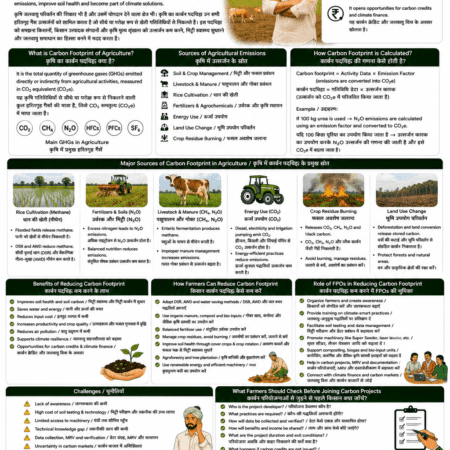
Carbon farming is a system of farming in which farmers adopt practices that reduce emissions or increase carbon sequestration. Carbon sequestration means capturing and storing carbon in soil, trees, roots, organic matter, and farm biomass. Agriculture can release emissions through residue burning, excessive tillage, poor water management in paddy, overuse of chemical inputs, and loss of soil organic carbon. Carbon farming tries to reduce these problems by improving farm practices.
Carbon farming खेती की एक ऐसी प्रणाली है जिसमें किसान emissions को कम करने या carbon sequestration बढ़ाने वाली practices अपनाते हैं। Carbon sequestration का अर्थ है carbon को मिट्टी, पेड़ों, जड़ों, organic matter और farm biomass में capture और store करना। Agriculture residue burning, excessive tillage, paddy में poor water management, chemical inputs के अत्यधिक उपयोग और soil organic carbon की कमी के कारण emissions release कर सकती है। Carbon farming इन समस्याओं को बेहतर farm practices के माध्यम से कम करने का प्रयास करती है।
Carbon farming does not mean stopping farming or reducing productivity. In fact, the best carbon farming models should improve soil health, water efficiency, input efficiency, biodiversity, and farm resilience. The purpose is to make farming more climate-smart while also protecting farmer livelihoods. If the environmental benefit is measurable and verified, it may also create a carbon credit opportunity.
Carbon farming का अर्थ खेती रोकना या productivity कम करना नहीं है। वास्तव में, best carbon farming models को soil health, water efficiency, input efficiency, biodiversity और farm resilience में सुधार करना चाहिए। इसका उद्देश्य खेती को अधिक climate-smart बनाना है, साथ ही farmer livelihoods की रक्षा करना भी है। यदि environmental benefit measurable और verified हो, तो यह carbon credit opportunity भी बना सकता है।
Why Carbon Farming Matters in India / भारत में कार्बन फार्मिंग क्यों महत्वपूर्ण है
India is one of the world’s largest agricultural economies, and millions of small and marginal farmers depend on farming for their livelihood. At the same time, agriculture is highly vulnerable to climate change. Irregular rainfall, heat stress, drought, floods, pest outbreaks, declining soil fertility, and rising input costs are already affecting farmers. Carbon farming can help farmers adapt to climate change while also reducing emissions from agriculture.
भारत दुनिया की सबसे बड़ी agricultural economies में से एक है, और करोड़ों छोटे व सीमांत किसान अपनी आजीविका के लिए खेती पर निर्भर हैं। साथ ही, agriculture climate change के प्रति अत्यधिक vulnerable है। अनियमित वर्षा, heat stress, drought, floods, pest outbreaks, declining soil fertility और rising input costs पहले से ही किसानों को प्रभावित कर रहे हैं। Carbon farming किसानों को climate change के अनुसार adapt करने में मदद कर सकती है और साथ ही agriculture से emissions कम कर सकती है।
Carbon farming matters in India because it connects environmental benefits with farmer-level action. Practices such as crop residue management, Direct Seeded Rice, reduced tillage, agroforestry, tree plantation, composting, bio-inputs, soil testing-based nutrient management, and water-saving irrigation can improve sustainability. These practices also match the needs of Indian smallholders because they can improve soil health and reduce long-term dependence on costly inputs.
भारत में carbon farming इसलिए महत्वपूर्ण है क्योंकि यह environmental benefits को farmer-level action से जोड़ती है। Crop residue management, Direct Seeded Rice, reduced tillage, agroforestry, tree plantation, composting, bio-inputs, soil testing-based nutrient management और water-saving irrigation जैसी practices sustainability को बेहतर बना सकती हैं। ये practices Indian smallholders की जरूरतों से भी मेल खाती हैं क्योंकि ये soil health सुधार सकती हैं और costly inputs पर long-term dependence कम कर सकती हैं।
How Carbon Farming Works in India / भारत में कार्बन फार्मिंग कैसे काम करती है
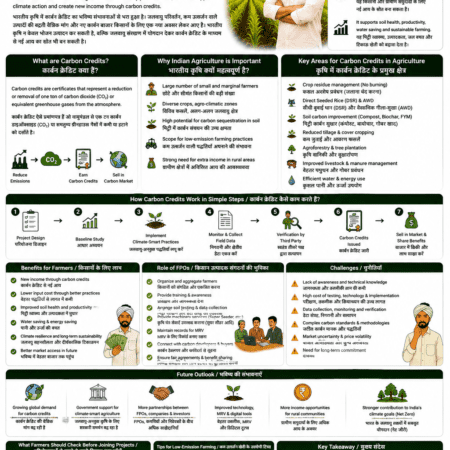
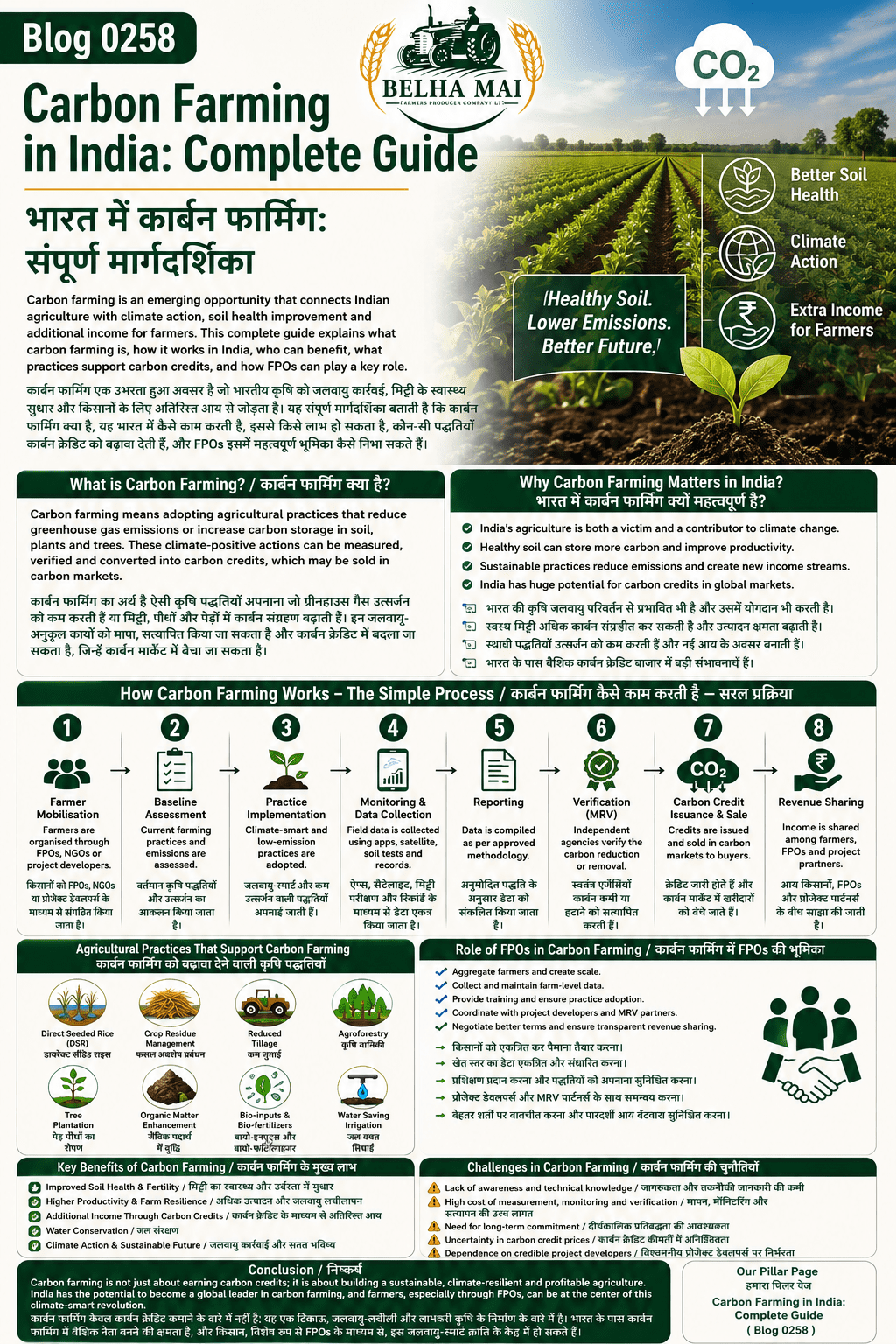
Carbon farming in India generally starts with farmer mobilisation. Since most Indian farmers have small landholdings, aggregation is necessary. Farmers may be organised through FPOs, cooperatives, NGOs, agri-tech companies, carbon project developers, or government-supported programmes. Once farmers are mobilised, a baseline is created to understand existing farming practices, emissions, soil condition, crop systems, irrigation methods, and residue management patterns.
भारत में carbon farming सामान्यतः farmer mobilisation से शुरू होती है। चूँकि अधिकांश भारतीय किसानों की landholdings छोटी होती हैं, इसलिए aggregation आवश्यक है। किसानों को FPOs, cooperatives, NGOs, agri-tech companies, carbon project developers या government-supported programmes के माध्यम से संगठित किया जा सकता है। किसानों को mobilise करने के बाद existing farming practices, emissions, soil condition, crop systems, irrigation methods और residue management patterns को समझने के लिए baseline तैयार की जाती है।
After baseline creation, farmers adopt selected climate-smart practices. These practices are monitored through field visits, mobile apps, satellite data, soil testing, crop records, photographs, GPS mapping, and farmer declarations. The collected data is reported under a selected methodology, verified by an independent agency, and then credits may be issued if the environmental benefit is accepted. After credits are sold, revenue is shared among stakeholders according to the project agreement.
Baseline creation के बाद किसान selected climate-smart practices अपनाते हैं। इन practices को field visits, mobile apps, satellite data, soil testing, crop records, photographs, GPS mapping और farmer declarations के माध्यम से monitor किया जाता है। Collected data को selected methodology के अंतर्गत report किया जाता है, independent agency द्वारा verify किया जाता है, और यदि environmental benefit स्वीकार होता है तो credits issue हो सकते हैं। Credits बेचने के बाद revenue project agreement के अनुसार stakeholders के बीच share किया जाता है।
Major Carbon Farming Practices in India / भारत में प्रमुख कार्बन फार्मिंग पद्धतियाँ
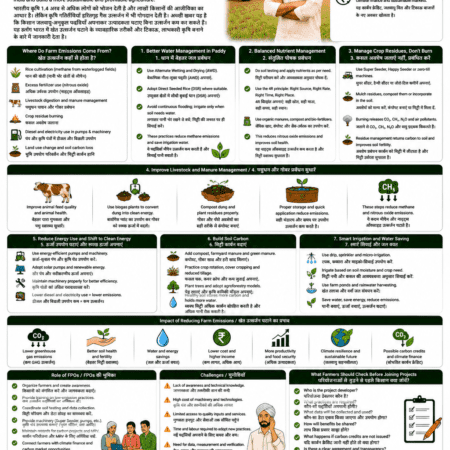
Direct Seeded Rice is one important practice that can support low-emission agriculture, especially in paddy-growing regions. Traditional puddled rice often uses more water and can contribute to methane emissions under flooded conditions. Direct Seeded Rice can reduce water use and support climate-smart rice cultivation where soil, weed management, and farmer training are suitable.
Direct Seeded Rice एक महत्वपूर्ण practice है जो low-emission agriculture को support कर सकती है, विशेषकर paddy-growing regions में। Traditional puddled rice अक्सर अधिक water use करता है और flooded conditions में methane emissions में योगदान दे सकता है। Direct Seeded Rice water use कम कर सकती है और जहाँ soil, weed management और farmer training उपयुक्त हों, वहाँ climate-smart rice cultivation को support कर सकती है।
Crop residue management is another important carbon farming practice. Instead of burning crop residue, farmers can use Super Seeder, mulching, composting, residue incorporation, or biomass-based solutions. This reduces air pollution, improves soil organic matter, and supports better soil structure. In regions where stubble burning is a serious issue, residue management can become a strong climate and public health intervention.
Crop residue management एक और महत्वपूर्ण carbon farming practice है। Crop residue जलाने के बजाय किसान Super Seeder, mulching, composting, residue incorporation या biomass-based solutions का उपयोग कर सकते हैं। इससे air pollution कम होता है, soil organic matter बढ़ता है और soil structure बेहतर होता है। जिन क्षेत्रों में stubble burning एक गंभीर समस्या है, वहाँ residue management एक मजबूत climate और public health intervention बन सकता है।
Agroforestry and tree plantation can store carbon in trees, roots, and biomass while also supporting biodiversity, shade, fodder, timber, fruit, and long-term farm resilience. Tree-based farming models may be useful where land, water, crop planning, and farmer interest are suitable. However, tree plantation projects must be planned carefully because carbon benefits depend on survival rate, species selection, spacing, growth, and long-term monitoring.
Agroforestry और tree plantation पेड़ों, जड़ों और biomass में carbon store कर सकते हैं, साथ ही biodiversity, shade, fodder, timber, fruit और long-term farm resilience को support कर सकते हैं। Tree-based farming models वहाँ उपयोगी हो सकते हैं जहाँ land, water, crop planning और farmer interest उपयुक्त हों। हालांकि tree plantation projects को सावधानी से plan करना चाहिए क्योंकि carbon benefits survival rate, species selection, spacing, growth और long-term monitoring पर निर्भर करते हैं।
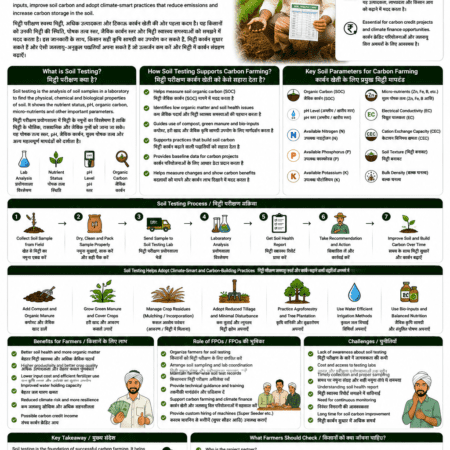
Bio-inputs, composting, organic matter addition, and soil health improvement also support carbon farming. When farmers improve soil organic matter, reduce unnecessary chemical input use, and follow soil testing-based nutrient planning, they can improve soil fertility and reduce emissions linked to inefficient input use. These practices are especially important for long-term soil productivity.
Bio-inputs, composting, organic matter addition और soil health improvement भी carbon farming को support करते हैं। जब किसान soil organic matter सुधारते हैं, unnecessary chemical input use कम करते हैं, और soil testing-based nutrient planning अपनाते हैं, तो वे soil fertility सुधार सकते हैं और inefficient input use से जुड़ी emissions को कम कर सकते हैं। ये practices long-term soil productivity के लिए विशेष रूप से महत्वपूर्ण हैं।
Role of FPOs in Carbon Farming / कार्बन फार्मिंग में FPOs की भूमिका
FPOs can become one of the strongest institutions for carbon farming in India because they can aggregate small farmers and create the scale required for carbon projects. A single small farmer may not be able to access carbon markets directly, but an FPO can organise hundreds or thousands of farmers under one programme. This makes data collection, training, monitoring, and implementation more practical.
FPOs भारत में carbon farming के लिए सबसे मजबूत institutions में से एक बन सकते हैं क्योंकि वे छोटे किसानों को aggregate करके carbon projects के लिए आवश्यक scale बना सकते हैं। एक अकेला छोटा किसान सीधे carbon markets तक नहीं पहुँच सकता, लेकिन एक FPO सैकड़ों या हजारों किसानों को एक programme के अंतर्गत संगठित कर सकता है। इससे data collection, training, monitoring और implementation अधिक practical हो जाता है।
The role of FPOs is not limited to farmer mobilisation. FPOs can maintain farmer-wise records, collect land and crop data, coordinate soil testing, promote Super Seeder and DSR services, support bio-input distribution, conduct training programmes, and work as local implementation partners for carbon project developers. This makes FPOs a natural bridge between farmers and climate finance agencies.
FPOs की भूमिका केवल farmer mobilisation तक सीमित नहीं है। FPOs farmer-wise records maintain कर सकते हैं, land और crop data collect कर सकते हैं, soil testing coordinate कर सकते हैं, Super Seeder और DSR services promote कर सकते हैं, bio-input distribution support कर सकते हैं, training programmes conduct कर सकते हैं, और carbon project developers के लिए local implementation partners के रूप में काम कर सकते हैं। इससे FPOs किसानों और climate finance agencies के बीच एक natural bridge बन जाते हैं।
Why Small Farmers Need Aggregation / छोटे किसानों को एग्रीगेशन की आवश्यकता क्यों है
Small farmers usually face many barriers in carbon farming. Their land size is small, documentation may be weak, digital records may be limited, and the cost of verification may be too high for individual participation. Carbon projects also require long-term commitment, monitoring, and proof of practice change. For an individual farmer, this process can be too complex.
छोटे किसान सामान्यतः carbon farming में कई barriers का सामना करते हैं। उनकी land size छोटी होती है, documentation कमजोर हो सकता है, digital records limited हो सकते हैं, और individual participation के लिए verification cost बहुत अधिक हो सकती है। Carbon projects को long-term commitment, monitoring और practice change के proof की भी आवश्यकता होती है। एक individual farmer के लिए यह process बहुत complex हो सकती है।
Aggregation solves this problem by bringing many farmers together. When an FPO aggregates farmers, the project becomes large enough for project developers and buyers to consider. Aggregation also helps reduce per-farmer cost of training, technology, monitoring, and verification. This is why FPO-led carbon farming may become a practical model for India.
Aggregation कई किसानों को एक साथ लाकर इस समस्या का समाधान करता है। जब FPO किसानों को aggregate करता है, तो project इतना बड़ा हो जाता है कि project developers और buyers उस पर विचार कर सकें। Aggregation training, technology, monitoring और verification की per-farmer cost को भी कम करने में मदद करता है। इसलिए FPO-led carbon farming भारत के लिए एक practical model बन सकती है।
Carbon Farming and Carbon Credits / कार्बन फार्मिंग और कार्बन क्रेडिट
Carbon farming and carbon credits are connected, but they are not exactly the same. Carbon farming refers to the actual farm practices that reduce emissions or store carbon. Carbon credits are the tradable units that may be issued after the climate benefit is measured and verified. This means carbon farming is the action, while carbon credit is the possible market outcome of that action.
Carbon farming और carbon credits जुड़े हुए हैं, लेकिन वे बिल्कुल समान नहीं हैं। Carbon farming उन actual farm practices को कहता है जो emissions कम करती हैं या carbon store करती हैं। Carbon credits वे tradable units हैं जो climate benefit को measure और verify करने के बाद issue हो सकते हैं। इसका अर्थ है कि carbon farming action है, जबकि carbon credit उस action का possible market outcome है।
Farmers should not assume that every carbon farming practice automatically creates carbon credits. To generate credits, the project must follow a recognized methodology, prove additionality, collect reliable data, complete MRV, and pass verification. Without this process, sustainable farming may still improve soil and climate resilience, but it may not generate saleable carbon credits.
किसानों को यह नहीं मानना चाहिए कि हर carbon farming practice अपने आप carbon credits बना देती है। Credits generate करने के लिए project को recognized methodology follow करनी होती है, additionality prove करनी होती है, reliable data collect करना होता है, MRV complete करना होता है, और verification pass करना होता है। इस process के बिना sustainable farming soil और climate resilience को तो सुधार सकती है, लेकिन saleable carbon credits generate नहीं कर सकती।
MRV in Carbon Farming / कार्बन फार्मिंग में MRV
MRV means Monitoring, Reporting, and Verification. It is the backbone of carbon farming projects because it proves whether the claimed climate benefit is real. Monitoring tracks farmer activities and practice adoption. Reporting converts collected data into project documentation. Verification is done by an independent third party that checks whether the carbon reduction or carbon removal is valid.
MRV का अर्थ है Monitoring, Reporting, and Verification। यह carbon farming projects की backbone है क्योंकि यही साबित करता है कि claimed climate benefit real है या नहीं। Monitoring farmer activities और practice adoption को track करती है। Reporting collected data को project documentation में बदलती है। Verification एक independent third party द्वारा किया जाता है, जो यह जांचता है कि carbon reduction या carbon removal valid है या नहीं।
For farmers, MRV may involve surveys, farm photographs, GPS mapping, input-use records, crop residue records, machinery usage records, soil testing, remote sensing, and field inspections. For FPOs, MRV means maintaining accurate data and supporting farmers in documentation. Poor MRV can fail the project, even if farmers have made real efforts.
किसानों के लिए MRV में surveys, farm photographs, GPS mapping, input-use records, crop residue records, machinery usage records, soil testing, remote sensing और field inspections शामिल हो सकते हैं। FPOs के लिए MRV का अर्थ है accurate data maintain करना और documentation में किसानों की मदद करना। Poor MRV project को fail कर सकता है, भले ही किसानों ने वास्तविक प्रयास किए हों।
Can Carbon Farming Increase Farmer Income? / क्या कार्बन फार्मिंग किसान आय बढ़ा सकती है?
Carbon farming may increase farmer income in two ways. First, better practices can improve soil health, reduce input waste, save water, reduce residue burning costs, and improve long-term productivity. These benefits may come directly from better farming. Second, if the project successfully generates and sells carbon credits, farmers may receive additional income or incentives based on the agreement.
Carbon farming किसान आय को दो तरीकों से बढ़ा सकती है। पहला, बेहतर practices soil health सुधार सकती हैं, input waste कम कर सकती हैं, water save कर सकती हैं, residue burning costs घटा सकती हैं, और long-term productivity में सुधार कर सकती हैं। ये benefits बेहतर farming से सीधे आ सकते हैं। दूसरा, यदि project successfully carbon credits generate और sell करता है, तो किसानों को agreement के आधार पर additional income या incentives मिल सकते हैं।
However, carbon farming income should not be presented as guaranteed income. Carbon credit revenue depends on project design, methodology, verification success, buyer demand, credit price, and revenue-sharing terms. Farmers and FPOs should treat carbon credit income as a future opportunity, not as immediate assured income. The first goal should be sustainable farming and soil health improvement.
हालांकि carbon farming income को guaranteed income के रूप में प्रस्तुत नहीं करना चाहिए। Carbon credit revenue project design, methodology, verification success, buyer demand, credit price और revenue-sharing terms पर निर्भर करता है। किसानों और FPOs को carbon credit income को future opportunity के रूप में देखना चाहिए, immediate assured income के रूप में नहीं। पहला लक्ष्य sustainable farming और soil health improvement होना चाहिए।
Challenges in Carbon Farming in India / भारत में कार्बन फार्मिंग की चुनौतियाँ
One major challenge is lack of awareness. Farmers and FPOs hear about carbon credits but often do not understand the process, contract terms, payment timeline, or implementing agencies. This creates confusion and makes farmers vulnerable to unrealistic promises. Clear farmer education is necessary before any project starts.
एक बड़ी चुनौती awareness की कमी है। किसान और FPOs carbon credits के बारे में सुनते हैं, लेकिन अक्सर process, contract terms, payment timeline या implementing agencies को नहीं समझते। इससे confusion पैदा होता है और किसान unrealistic promises के प्रति vulnerable हो जाते हैं। किसी भी project की शुरुआत से पहले clear farmer education आवश्यक है।
Another challenge is measurement. Soil carbon and emission reduction are not always easy to measure. Agriculture is diverse, and results differ according to soil, crop, climate, water, input use, and farmer behaviour. This makes MRV costly and complex. Strong technology and credible verification are needed to create trust in carbon farming projects.
दूसरी चुनौती measurement है। Soil carbon और emission reduction को हमेशा आसानी से measure नहीं किया जा सकता। Agriculture diverse है, और results soil, crop, climate, water, input use और farmer behaviour के अनुसार बदलते हैं। इससे MRV costly और complex हो जाता है। Carbon farming projects में trust बनाने के लिए strong technology और credible verification आवश्यक है।
A third challenge is implementation. Many startups and agencies may talk about carbon farming, but successful ground-level implementation requires farmer trust, local field teams, long-term engagement, data discipline, and transparent agreements. Without strong local institutions such as FPOs, carbon farming projects may remain only on paper.
तीसरी चुनौती implementation है। कई startups और agencies carbon farming की बात कर सकती हैं, लेकिन successful ground-level implementation के लिए farmer trust, local field teams, long-term engagement, data discipline और transparent agreements की आवश्यकता होती है। FPOs जैसे मजबूत local institutions के बिना carbon farming projects केवल paper तक सीमित रह सकते हैं।
What FPOs Should Ask Before Joining a Carbon Farming Project / कार्बन फार्मिंग प्रोजेक्ट से जुड़ने से पहले FPOs को क्या पूछना चाहिए
Before joining a carbon farming project, an FPO should ask who the project developer is, what experience they have, which methodology will be used, what carbon standard will be followed, how MRV will be done, whether farmers need to pay anything, and when payment may come. These questions are important because carbon farming contracts may continue for several years.
Carbon farming project से जुड़ने से पहले FPO को पूछना चाहिए कि project developer कौन है, उनका experience क्या है, कौन-सी methodology use होगी, कौन-सा carbon standard follow होगा, MRV कैसे किया जाएगा, क्या किसानों को कोई payment करनी होगी, और payment कब आ सकता है। ये प्रश्न महत्वपूर्ण हैं क्योंकि carbon farming contracts कई वर्षों तक जारी रह सकते हैं।
FPOs should also ask about carbon rights, revenue sharing, data ownership, farmer exit conditions, risk sharing, and dispute resolution. If these terms are unclear, the FPO should not rush into signing. Carbon farming can be a good opportunity only when the agreement protects farmers and the process is transparent.
FPOs को carbon rights, revenue sharing, data ownership, farmer exit conditions, risk sharing और dispute resolution के बारे में भी पूछना चाहिए। यदि ये terms clear नहीं हैं, तो FPO को signing में जल्दबाजी नहीं करनी चाहिए। Carbon farming तभी अच्छा अवसर बन सकती है जब agreement किसानों की रक्षा करे और process transparent हो।
Practical Carbon Farming Model for Indian FPOs / भारतीय FPOs के लिए व्यावहारिक कार्बन फार्मिंग मॉडल
A practical model for Indian FPOs can begin with a pilot project of 500 to 1,000 farmers. The FPO can select villages, identify crops, collect basic land records, organise farmer meetings, and map existing practices. The project can focus on a few measurable practices such as DSR, Super Seeder-based residue management, reduced tillage, bio-inputs, soil testing-based nutrient planning, agroforestry, or tree plantation.
भारतीय FPOs के लिए एक practical model 500 से 1,000 किसानों के pilot project से शुरू हो सकता है। FPO villages select कर सकता है, crops identify कर सकता है, basic land records collect कर सकता है, farmer meetings organise कर सकता है, और existing practices map कर सकता है। Project कुछ measurable practices जैसे DSR, Super Seeder-based residue management, reduced tillage, bio-inputs, soil testing-based nutrient planning, agroforestry या tree plantation पर focus कर सकता है।
The FPO can then partner with a credible carbon project developer or climate-tech company that can manage methodology, MRV, certification, and buyer linkage. In this model, the FPO becomes the aggregation and implementation partner, while the technical partner handles carbon-market requirements. This is more practical than expecting the FPO to independently create and sell carbon credits from the beginning.
इसके बाद FPO किसी credible carbon project developer या climate-tech company के साथ partnership कर सकता है, जो methodology, MRV, certification और buyer linkage manage कर सके। इस model में FPO aggregation और implementation partner बनता है, जबकि technical partner carbon-market requirements को handle करता है। यह शुरुआत में FPO से independently carbon credits create और sell करने की अपेक्षा करने से अधिक practical है।
Future of Carbon Farming in India / भारत में कार्बन फार्मिंग का भविष्य
The future of carbon farming in India is promising, but it will depend on trust, transparency, science, and farmer-friendly implementation. India has a large farming base, diverse cropping systems, strong FPO movement, growing digital agriculture infrastructure, and increasing interest in climate finance. If these elements are connected properly, India can become an important player in agriculture-based carbon projects.
भारत में carbon farming का भविष्य promising है, लेकिन यह trust, transparency, science और farmer-friendly implementation पर निर्भर करेगा। भारत के पास large farming base, diverse cropping systems, strong FPO movement, growing digital agriculture infrastructure और climate finance में बढ़ती रुचि है। यदि इन elements को सही तरीके से जोड़ा जाए, तो भारत agriculture-based carbon projects में एक महत्वपूर्ण player बन सकता है।
However, the future will not be built by slogans alone. Farmers need practical guidance, FPOs need institutional capacity, project developers need field-level implementation strength, and buyers need verified climate impact. Carbon farming in India will succeed only when it creates real environmental benefits and fair value for farmers.
हालांकि भविष्य केवल slogans से नहीं बनेगा। किसानों को practical guidance चाहिए, FPOs को institutional capacity चाहिए, project developers को field-level implementation strength चाहिए, और buyers को verified climate impact चाहिए। भारत में carbon farming तभी सफल होगी जब यह real environmental benefits और किसानों के लिए fair value create करेगी।
Conclusion / निष्कर्ष
Carbon farming in India is not just about carbon credits; it is about building a more sustainable, climate-resilient, and profitable agricultural system. It can help improve soil health, reduce emissions, conserve water, manage crop residue, support agroforestry, and create future climate finance opportunities. But it must be implemented with caution, proper measurement, transparent contracts, and farmer-first thinking.
भारत में carbon farming केवल carbon credits के बारे में नहीं है; यह एक अधिक sustainable, climate-resilient और profitable agricultural system बनाने के बारे में है। यह soil health सुधारने, emissions कम करने, water conserve करने, crop residue manage करने, agroforestry को support करने और future climate finance opportunities बनाने में मदद कर सकती है। लेकिन इसे caution, proper measurement, transparent contracts और farmer-first thinking के साथ implement करना होगा।
For Indian small farmers, FPOs can become the most practical gateway to carbon farming. By aggregating farmers, maintaining records, supporting sustainable practices, and working with credible agencies, FPOs can connect farmers with climate finance opportunities. Carbon farming in India is still evolving, but with the right model, it can become a strong pillar of sustainable rural transformation.
भारतीय छोटे किसानों के लिए FPOs carbon farming का सबसे practical gateway बन सकते हैं। किसानों को aggregate करके, records maintain करके, sustainable practices को support करके, और credible agencies के साथ काम करके FPOs किसानों को climate finance opportunities से जोड़ सकते हैं। भारत में carbon farming अभी विकसित हो रही है, लेकिन सही model के साथ यह sustainable rural transformation का एक मजबूत pillar बन सकती है।
Frequently Asked Questions (FAQs) / अक्सर पूछे जाने वाले प्रश्न
1. What is carbon farming in India?
Carbon farming in India means adopting agricultural practices that reduce emissions or increase carbon storage in soil, trees, and biomass, with the possibility of generating verified carbon credits.
1. भारत में carbon farming क्या है?
भारत में carbon farming का अर्थ है ऐसी कृषि पद्धतियाँ अपनाना जो emissions कम करें या मिट्टी, पेड़ों और biomass में carbon storage बढ़ाएँ, जिससे verified carbon credits generate होने की संभावना बन सकती है।
2. Can Indian farmers earn from carbon farming?
Indian farmers may earn from carbon farming if the project successfully measures, verifies, issues, and sells carbon credits. However, income is not guaranteed or immediate.
2. क्या भारतीय किसान carbon farming से आय कमा सकते हैं?
भारतीय किसान carbon farming से आय कमा सकते हैं यदि project successfully carbon credits को measure, verify, issue और sell करता है। हालांकि income guaranteed या immediate नहीं होती।
3. What practices support carbon farming?
Practices such as Direct Seeded Rice, crop residue management, Super Seeder use, reduced tillage, agroforestry, tree plantation, composting, bio-inputs, and water-saving irrigation can support carbon farming.
3. कौन-सी practices carbon farming को support करती हैं?
Direct Seeded Rice, crop residue management, Super Seeder का उपयोग, reduced tillage, agroforestry, tree plantation, composting, bio-inputs और water-saving irrigation जैसी practices carbon farming को support कर सकती हैं।
4. Why are FPOs important in carbon farming?
FPOs are important because they aggregate small farmers, maintain records, coordinate training, support implementation, and connect farmers with project developers and climate finance agencies.
4. Carbon farming में FPOs क्यों महत्वपूर्ण हैं?
FPOs इसलिए महत्वपूर्ण हैं क्योंकि वे छोटे किसानों को aggregate करते हैं, records maintain करते हैं, training coordinate करते हैं, implementation support करते हैं, और किसानों को project developers तथा climate finance agencies से जोड़ते हैं।
5. Is carbon farming the same as carbon credit?
No, carbon farming is the farming practice, while carbon credit is the tradable unit that may be created after the climate benefit is measured and verified.
5. क्या carbon farming और carbon credit एक ही हैं?
नहीं, carbon farming farming practice है, जबकि carbon credit वह tradable unit है जो climate benefit को measure और verify करने के बाद create हो सकता है।
Internal Links / आंतरिक लिंक
Carbon Credit, Climate Finance & Sustainable Farming Blog Series
कार्बन क्रेडिट, जलवायु वित्त और टिकाऊ खेती ब्लॉग श्रृंखला
Carbon Credit Basics / कार्बन क्रेडिट की मूल जानकारी
👉 What is Carbon Credit in Agriculture? — https://belhamaifpo.com/agriculture/what-is-carbon-credit-in-agriculture/
👉 How Carbon Credits Work for Farmers — https://belhamaifpo.com/agriculture/how-carbon-credits-work-for-farmers/
👉 Carbon Farming in India: Complete Guide — https://belhamaifpo.com/agriculture/carbon-farming-in-india-complete-guide/
👉 Can Small Farmers Earn from Carbon Credits? — https://belhamaifpo.com/agriculture/can-small-farmers-earn-from-carbon-credits/
👉 Carbon Credit Opportunities in Indian Agriculture — https://belhamaifpo.com/agriculture/carbon-credit-opportunities-in-indian-agriculture/
👉 Is Carbon Credit Income Real for Indian Farmers? — https://belhamaifpo.com/agriculture/is-carbon-credit-income-real-for-indian-farmer/
Role of FPOs, Companies & Business Models / FPOs, कंपनियों और व्यवसाय मॉडल की भूमिका
👉 Role of FPOs in Carbon Credit Projects — https://belhamaifpo.com/agriculture/role-of-fpos-in-carbon-credit-projects/
👉 Carbon Credit Companies in India and How They Work — https://belhamaifpo.com/agriculture/carbon-credit-companies-in-india-and-how-they-work/
👉 Can FPOs Aggregate Farmers for Carbon Credits? — https://belhamaifpo.com/agriculture/can-fpos-aggregate-farmers-for-carbon-credits/
👉 Carbon Credit Business Model for Farmer Producer Organizations — https://belhamaifpo.com/agriculture/carbon-credit-business-model-for-farmer-producer-organizations/
👉 Challenges in Carbon Credit Projects for Small Farmers — https://belhamaifpo.com/agriculture/challenges-in-carbon-credit-projects-for-small-farmers/
Soil Carbon, Carbon Sequestration & Measurement / मिट्टी कार्बन, कार्बन अवशोषण और मापन
👉 Soil Carbon and Sustainable Farming — https://belhamaifpo.com/agriculture/soil-carbon-and-sustainable-farming/
👉 Carbon Sequestration in Agriculture Explained — https://belhamaifpo.com/agriculture/carbon-sequestration-in-agriculture-explained/
👉 How to Measure Carbon Reduction on Farms — https://belhamaifpo.com/agriculture/how-to-measure-carbon-reduction-on-farms/
👉 MRV in Carbon Credit Projects: What Farmers Should Know — https://belhamaifpo.com/agriculture/mrv-in-carbon-credit-projects-what-farmers-should-know/
👉 Role of Soil Testing in Carbon Farming — https://belhamaifpo.com/agriculture/role-of-soil-testing-in-carbon-farming/
👉 Carbon Footprint of Agriculture Explained — https://belhamaifpo.com/agriculture/carbon-footprint-of-agriculture-explained/
👉 How to Reduce Farm Emissions in India — https://belhamaifpo.com/agriculture/how-to-reduce-farm-emissions-in-india/
Carbon Farming Practices / कार्बन खेती की पद्धतियाँ
👉 How Regenerative Agriculture Supports Carbon Credits — https://belhamaifpo.com/agriculture/how-regenerative-agriculture-supports-carbon-credits/
👉 Direct Seeded Rice and Carbon Credit Potential — https://belhamaifpo.com/agriculture/direct-seeded-rice-and-carbon-credit-potential/
👉 Agroforestry and Carbon Credit Income — https://belhamaifpo.com/agriculture/agroforestry-and-carbon-credit-income/
👉 Tree Plantation and Carbon Farming for Farmers — https://belhamaifpo.com/agriculture/tree-plantation-and-carbon-farming-for-farmers/
👉 Bio-Inputs and Low-Carbon Farming Systems — https://belhamaifpo.com/agriculture/bio-inputs-and-low-carbon-farming-systems/
👉 Organic Farming and Carbon Credit Opportunities — https://belhamaifpo.com/agriculture/organic-farming-and-carbon-credit-opportunities/
👉 Natural Farming and Climate Benefits — https://belhamaifpo.com/agriculture/natural-farming-and-climate-benefits/
👉 Water-Saving Farming and Carbon Reduction — https://belhamaifpo.com/agriculture/water-saving-farming-and-carbon-reduction/
👉 Crop Residue Management and Carbon Benefits — https://belhamaifpo.com/agriculture/crop-residue-management-and-carbon-benefits/
👉 Super Seeder, DSR, and Low-Emission Agriculture — https://belhamaifpo.com/agriculture/super-seeder-dsr-and-low-emission-agriculture/
Markets, Certification & Buyers / बाज़ार, प्रमाणन और खरीदार
👉 Voluntary Carbon Market Explained for Farmers — https://belhamaifpo.com/agriculture/voluntary-carbon-market-explained-for-farmers/
👉 Compliance Carbon Market vs Voluntary Carbon Market — https://belhamaifpo.com/agriculture/compliance-carbon-market-vs-voluntary-carbon-market/
👉 Carbon Credit Certification Process in Agriculture — https://belhamaifpo.com/agriculture/carbon-credit-certification-process-in-agriculture/
👉 Who Buys Agricultural Carbon Credits? — https://belhamaifpo.com/agriculture/who-buys-agricultural-carbon-credits/
Climate Finance & Future / जलवायु वित्त और भविष्य
👉 Sustainable Agriculture and Climate Finance — https://belhamaifpo.com/agriculture/sustainable-agriculture-and-climate-finance/
👉 Climate-Smart Agriculture and Carbon Farming — https://belhamaifpo.com/agriculture/climate-smart-agriculture-and-carbon-farming/
👉 Future of Carbon Credits in Indian Agriculture — https://belhamaifpo.com/agriculture/future-of-carbon-credits-in-indian-agriculture/
👉 Farmer Producer Organizations Complete Guide — https://belhamaifpo.com/farmer-producer-organisation/farmer-producer-organizations-fpos/
👉 Why Small Farmers Struggle in India — https://belhamaifpo.com/agriculture/why-small-farmers-struggle-in-india/
👉 Food Processing Industry in India — https://belhamaifpo.com/agriculture/food-processing-industry-in-india/
👉 SDGs & Our FPO — https://belhamaifpo.com/sdg-goals/
External Authority Links / बाहरी प्राधिकरण लिंक
👉 Ministry of Agriculture & Farmers Welfare — https://agriwelfare.gov.in/
👉 NITI Aayog — https://www.niti.gov.in/
👉 FAO Climate-Smart Agriculture — https://www.fao.org/climate-smart-agriculture/en/
👉 UNFCCC — https://unfccc.int/
👉 World Bank Climate-Smart Agriculture — https://www.worldbank.org/en/topic/climate-smart-agriculture
Follow Belha Mai FPO for More Updates / अधिक अपडेट के लिए Belha Mai FPO को फॉलो करें
👉 Website — https://belhamaifpo.com/
👉 Facebook — https://www.facebook.com/profile.php?id=61561043486818
👉 Instagram — https://instagram.com/belhamaifpo
👉 LinkedIn — https://www.linkedin.com/in/abhay-singh-ab5568280/
👉 YouTube — https://www.youtube.com/channel/UC9ZvojoTMCa7mU1-Q_Bh60A