कार्बन क्रेडिट किसानों के लिए कैसे काम करते हैं
Introduction / परिचय
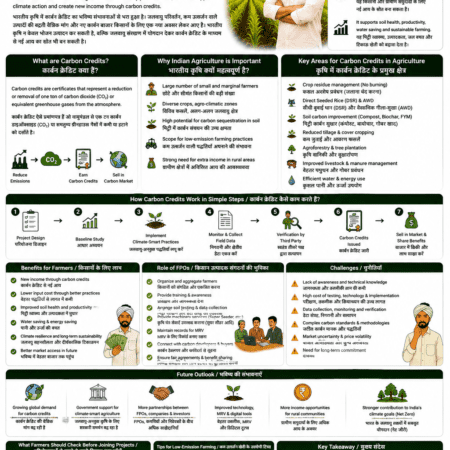
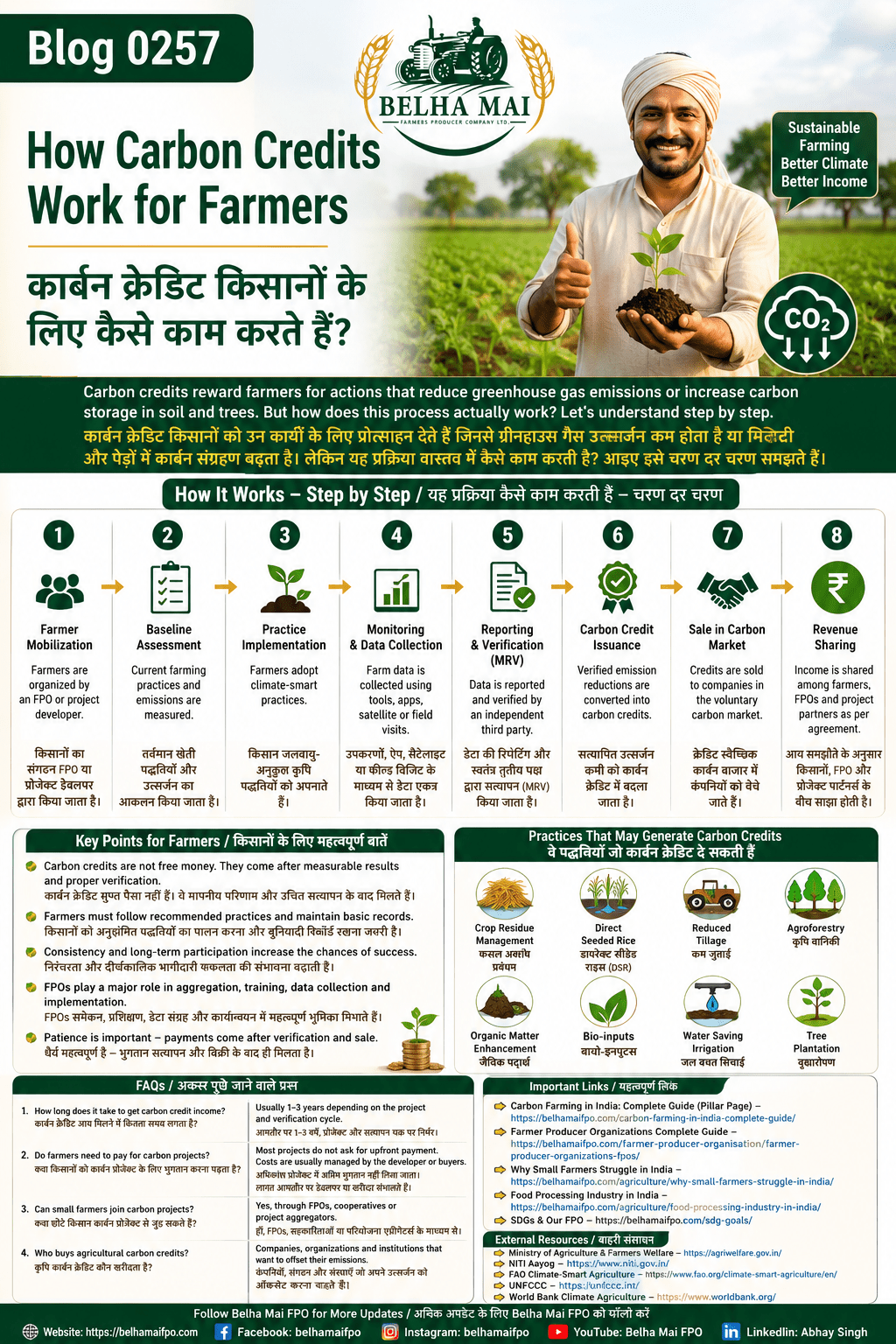
Carbon credits work for farmers by converting climate-friendly farming practices into measurable environmental benefits. When farmers reduce greenhouse gas emissions or increase carbon storage in soil, trees, or biomass, these improvements may be measured, verified, and converted into carbon credits. These credits can then be sold in carbon markets to companies that want to offset their emissions. However, farmers must understand one important point clearly: carbon credits do not work like a normal crop sale where the farmer produces and immediately receives payment. It is a longer process that involves farmer mobilisation, baseline assessment, practice adoption, monitoring, reporting, verification, credit issuance, market sale, and revenue sharing.
कार्बन क्रेडिट किसानों के लिए इस प्रकार काम करते हैं कि climate-friendly farming practices को measurable environmental benefits में बदला जाता है। जब किसान greenhouse gas emissions को कम करते हैं या मिट्टी, पेड़ों या biomass में carbon storage बढ़ाते हैं, तो इन सुधारों को मापा, सत्यापित किया जा सकता है और carbon credits में बदला जा सकता है। इसके बाद इन credits को carbon markets में उन कंपनियों को बेचा जा सकता है जो अपने emissions को offset करना चाहती हैं। लेकिन किसानों को एक महत्वपूर्ण बात स्पष्ट रूप से समझनी चाहिए: carbon credits सामान्य फसल बिक्री की तरह काम नहीं करते, जहाँ किसान उत्पादन करता है और तुरंत भुगतान प्राप्त कर लेता है। यह एक लंबी प्रक्रिया है जिसमें farmer mobilisation, baseline assessment, practice adoption, monitoring, reporting, verification, credit issuance, market sale और revenue sharing शामिल होते हैं।
Today, many farmers and Farmer Producer Organizations hear about carbon credits, but very few understand the actual working model. Most farmers do not know which agency to approach, what documents are required, how emissions are measured, who verifies the project, when income comes, and how the payment is divided. This lack of clarity creates confusion and sometimes unrealistic expectations. Therefore, the purpose of this blog is to explain how carbon credits work for farmers in a simple, practical, and farmer-friendly way.
आज बहुत से किसान और Farmer Producer Organizations carbon credits के बारे में सुनते हैं, लेकिन बहुत कम लोग इसके वास्तविक working model को समझते हैं। अधिकांश किसानों को यह नहीं पता होता कि किस agency से संपर्क करना है, कौन से documents चाहिए, emissions कैसे मापे जाते हैं, project को कौन verify करता है, income कब आती है, और payment कैसे बाँटा जाता है। इस clarity की कमी से confusion और कभी-कभी अवास्तविक expectations पैदा हो जाती हैं। इसलिए इस blog का उद्देश्य यह समझाना है कि carbon credits किसानों के लिए सरल, व्यावहारिक और किसान-अनुकूल तरीके से कैसे काम करते हैं।
What Farmers Actually Do in a Carbon Credit Project / कार्बन क्रेडिट प्रोजेक्ट में किसान वास्तव में क्या करते हैं
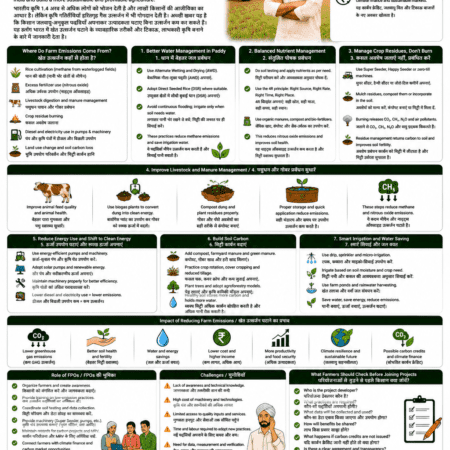
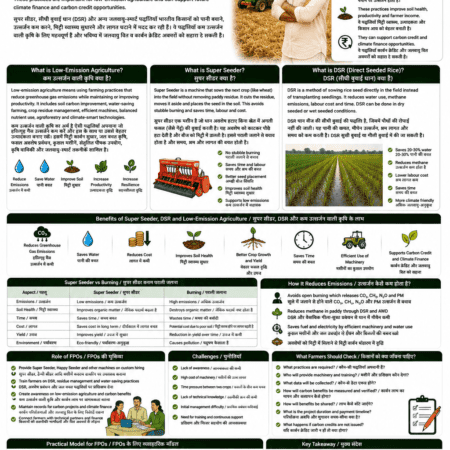
In a carbon credit project, farmers usually adopt selected sustainable farming practices that reduce emissions or increase carbon storage. These practices may include Direct Seeded Rice, reduced tillage, crop residue management, Super Seeder use, agroforestry, tree plantation, organic matter addition, bio-input application, water-saving irrigation, composting, and improved nutrient management. The exact practices depend on the crop, region, soil condition, project methodology, and the carbon standard being used.
Carbon credit project में किसान सामान्यतः ऐसी selected sustainable farming practices अपनाते हैं जो emissions को कम करती हैं या carbon storage बढ़ाती हैं। इन practices में Direct Seeded Rice, reduced tillage, crop residue management, Super Seeder का उपयोग, agroforestry, tree plantation, organic matter addition, bio-input application, water-saving irrigation, composting और improved nutrient management शामिल हो सकते हैं। कौन-सी practice अपनाई जाएगी, यह crop, region, soil condition, project methodology और carbon standard पर निर्भर करता है।
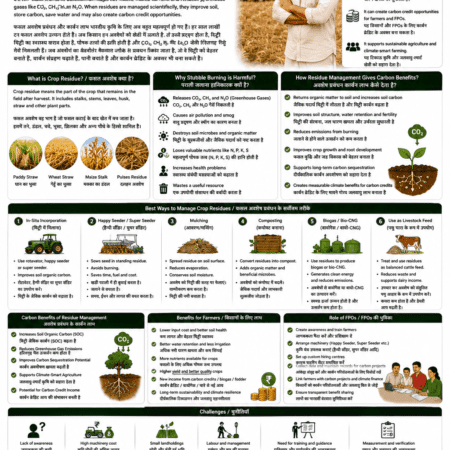
The farmer’s role is not only to adopt the practice but also to maintain consistency. Carbon projects require proof that the farmer has actually changed the farming practice compared to the earlier baseline. For example, if a farmer earlier burned crop residue and now manages it through Super Seeder or residue incorporation, this change must be recorded. If a farmer shifts from traditional puddled rice to Direct Seeded Rice, the project must document that change. Without proper records, carbon benefit cannot be verified.
किसान की भूमिका केवल practice अपनाने तक सीमित नहीं होती, बल्कि consistency बनाए रखना भी आवश्यक होता है। Carbon projects को यह प्रमाण चाहिए कि किसान ने पहले की baseline स्थिति की तुलना में वास्तव में farming practice बदली है। उदाहरण के लिए, यदि किसान पहले crop residue जलाता था और अब Super Seeder या residue incorporation के माध्यम से उसका प्रबंधन करता है, तो इस बदलाव को record करना आवश्यक है। यदि किसान traditional puddled rice से Direct Seeded Rice की ओर जाता है, तो project को इस बदलाव को document करना होगा। Proper records के बिना carbon benefit verify नहीं किया जा सकता।
Step 1: Farmer Mobilisation / चरण 1: किसानों का संगठन
The first step in any agricultural carbon credit project is farmer mobilisation. Individual small farmers usually cannot participate directly because carbon projects need scale, data, documentation, and long-term monitoring. Therefore, farmers are usually mobilised through FPOs, cooperatives, NGOs, agri-tech companies, project developers, or implementation agencies. The larger and more organised the farmer group, the better the chances of making the project practical.
किसी भी agricultural carbon credit project का पहला चरण farmer mobilisation होता है। अकेले छोटे किसान सामान्यतः सीधे भाग नहीं ले सकते क्योंकि carbon projects को scale, data, documentation और long-term monitoring की आवश्यकता होती है। इसलिए किसानों को आमतौर पर FPOs, cooperatives, NGOs, agri-tech companies, project developers या implementation agencies के माध्यम से संगठित किया जाता है। किसान समूह जितना बड़ा और organized होगा, project को practical बनाने की संभावना उतनी ही अधिक होगी।
This is where FPOs can play a very important role. An FPO can identify interested farmers, collect basic land and crop information, explain the project terms, support training, and coordinate with carbon project developers. For small farmers, the FPO acts as a bridge between the farmer and the carbon market. Without such aggregation, carbon credit participation becomes difficult and costly.
यहीं पर FPOs बहुत महत्वपूर्ण भूमिका निभा सकते हैं। एक FPO interested farmers की पहचान कर सकता है, basic land और crop information collect कर सकता है, project terms समझा सकता है, training support कर सकता है, और carbon project developers के साथ coordination कर सकता है। छोटे किसानों के लिए FPO किसान और carbon market के बीच एक bridge की तरह काम करता है। इस प्रकार के aggregation के बिना carbon credit participation कठिन और महंगी हो जाती है।
Step 2: Baseline Assessment / चरण 2: बेसलाइन आकलन
Baseline assessment means understanding what farmers were doing before the carbon project started. This may include current crop practices, fertilizer use, irrigation method, residue management, tillage system, soil condition, existing trees, yield records, and other farm-level details. Baseline is important because carbon credits are generated only when improvement is shown compared to the earlier situation.
Baseline assessment का अर्थ है यह समझना कि carbon project शुरू होने से पहले किसान क्या कर रहे थे। इसमें current crop practices, fertilizer use, irrigation method, residue management, tillage system, soil condition, existing trees, yield records और अन्य farm-level details शामिल हो सकते हैं। Baseline इसलिए महत्वपूर्ण है क्योंकि carbon credits तभी generate होते हैं जब पहले की स्थिति की तुलना में improvement दिखाया जा सके।
For example, if a farmer was already following sustainable practices before joining the project, the additional carbon benefit may be limited unless the project methodology recognizes it. Carbon credits are usually based on additionality, which means the project should create a new environmental benefit that would not have happened without the project intervention. This is why baseline data must be accurate and honest.
उदाहरण के लिए, यदि किसान project में शामिल होने से पहले ही sustainable practices अपना रहा था, तो additional carbon benefit सीमित हो सकता है, जब तक project methodology उसे recognize न करे। Carbon credits सामान्यतः additionality पर आधारित होते हैं, जिसका अर्थ है कि project से ऐसा नया environmental benefit बनना चाहिए जो project intervention के बिना नहीं होता। इसलिए baseline data accurate और honest होना आवश्यक है।
Step 3: Practice Implementation / चरण 3: कृषि पद्धतियों का क्रियान्वयन
After baseline assessment, farmers adopt the practices selected under the carbon project. These practices should be practical, affordable, and suitable for local farming conditions. For example, in paddy areas, Direct Seeded Rice or water-saving irrigation may be useful. In wheat areas, Super Seeder and crop residue management may help reduce residue burning. In horticulture and agroforestry systems, tree plantation and biomass growth may support carbon storage.
Baseline assessment के बाद किसान carbon project के अंतर्गत selected practices अपनाते हैं। ये practices practical, affordable और local farming conditions के अनुकूल होनी चाहिए। उदाहरण के लिए, paddy areas में Direct Seeded Rice या water-saving irrigation उपयोगी हो सकती है। Wheat areas में Super Seeder और crop residue management residue burning को कम करने में मदद कर सकते हैं। Horticulture और agroforestry systems में tree plantation और biomass growth carbon storage को support कर सकते हैं।
Practice implementation must be supported with training and follow-up. Farmers need to know what to do, when to do it, how to record it, and what mistakes to avoid. If the practice reduces emissions but reduces yield or increases cost too much, farmers may not continue it. Therefore, carbon credit projects must be designed in a way that supports both climate benefits and farmer livelihood.
Practice implementation को training और follow-up के साथ support करना आवश्यक है। किसानों को यह पता होना चाहिए कि क्या करना है, कब करना है, इसे कैसे record करना है, और किन गलतियों से बचना है। यदि कोई practice emissions तो कम करती है लेकिन yield कम कर देती है या cost बहुत बढ़ा देती है, तो किसान उसे जारी नहीं रखेंगे। इसलिए carbon credit projects इस प्रकार design होने चाहिए कि climate benefits और farmer livelihood दोनों को support करें।
Step 4: Monitoring and Data Collection / चरण 4: मॉनिटरिंग और डेटा संग्रह
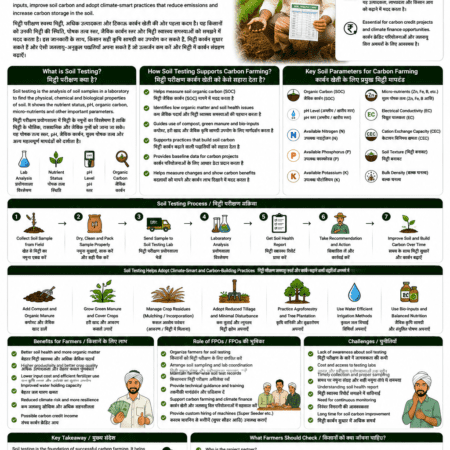
Monitoring and data collection are essential parts of carbon credit projects. Data may be collected through mobile apps, farmer surveys, field visits, satellite monitoring, soil testing, photographs, GPS mapping, input records, crop records, and machinery usage records. This information helps prove that farmers are actually following the required practices.
Monitoring और data collection carbon credit projects के essential parts हैं। Data mobile apps, farmer surveys, field visits, satellite monitoring, soil testing, photographs, GPS mapping, input records, crop records और machinery usage records के माध्यम से collect किया जा सकता है। यह information यह साबित करने में मदद करती है कि किसान वास्तव में required practices का पालन कर रहे हैं।
For farmers, this means documentation becomes very important. A farmer may be doing the right work in the field, but if there is no record, the project cannot prove the carbon benefit. FPOs can support farmers by maintaining farmer-wise records, crop-wise records, machinery service records, soil testing data, and training attendance. Strong documentation increases trust and improves the chances of successful verification.
किसानों के लिए इसका अर्थ है कि documentation बहुत महत्वपूर्ण हो जाता है। किसान खेत में सही काम कर रहा हो सकता है, लेकिन यदि उसका कोई record नहीं है, तो project carbon benefit को prove नहीं कर पाएगा। FPOs farmer-wise records, crop-wise records, machinery service records, soil testing data और training attendance maintain करके किसानों की मदद कर सकते हैं। Strong documentation trust बढ़ाता है और successful verification की संभावना को बेहतर करता है।
Step 5: MRV — Monitoring, Reporting and Verification / चरण 5: MRV — मॉनिटरिंग, रिपोर्टिंग और सत्यापन
MRV means Monitoring, Reporting, and Verification. It is one of the most important parts of how carbon credits work for farmers. Monitoring means tracking whether the farming practices are being followed. Reporting means preparing the project data according to the required methodology. Verification means an independent agency checks whether the reported carbon reduction or carbon removal is valid.
MRV का अर्थ है Monitoring, Reporting, and Verification। यह carbon credits किसानों के लिए कैसे काम करते हैं, इसका सबसे महत्वपूर्ण भाग है। Monitoring का मतलब है यह track करना कि farming practices का पालन हो रहा है या नहीं। Reporting का मतलब है project data को required methodology के अनुसार तैयार करना। Verification का मतलब है कि एक independent agency यह जांचती है कि reported carbon reduction या carbon removal valid है या नहीं।
Without MRV, carbon credits cannot be trusted. Buyers will only purchase credits when they believe that the climate benefit is real, measurable, additional, and verified. This is also the reason why farmers should not trust anyone who promises quick carbon credit income without explaining MRV. A genuine carbon project will always have a clear system for measurement, reporting, and verification.
MRV के बिना carbon credits पर trust नहीं किया जा सकता। Buyers तभी credits खरीदते हैं जब उन्हें विश्वास हो कि climate benefit real, measurable, additional और verified है। यही कारण है कि किसानों को ऐसे किसी व्यक्ति या agency पर भरोसा नहीं करना चाहिए जो MRV समझाए बिना quick carbon credit income का वादा करे। एक genuine carbon project में measurement, reporting और verification की clear system हमेशा होती है।
Step 6: Carbon Credit Issuance / चरण 6: कार्बन क्रेडिट जारी होना
After successful verification, carbon credits may be issued under a recognized carbon standard or methodology. This means the verified environmental benefit is converted into tradable carbon credits. One carbon credit usually represents one tonne of carbon dioxide equivalent reduced, removed, or avoided. However, issuance takes time and depends on project quality, documentation, verification outcome, and the rules of the carbon standard.
Successful verification के बाद carbon credits किसी recognized carbon standard या methodology के अंतर्गत issue किए जा सकते हैं। इसका अर्थ है कि verified environmental benefit को tradable carbon credits में बदला जाता है। एक carbon credit सामान्यतः एक tonne carbon dioxide equivalent के reduction, removal या avoidance को represent करता है। हालांकि issuance में समय लगता है और यह project quality, documentation, verification outcome और carbon standard के rules पर निर्भर करता है।
Farmers should understand that carbon credit issuance is not automatic. Merely adopting sustainable farming does not immediately create credits. The process must go through proper measurement and verification. This is why project developers, MRV platforms, and implementing agencies are important in the carbon credit ecosystem.
किसानों को यह समझना चाहिए कि carbon credit issuance automatic नहीं होता। केवल sustainable farming अपनाने से तुरंत credits नहीं बन जाते। पूरी प्रक्रिया proper measurement और verification से गुजरती है। यही कारण है कि carbon credit ecosystem में project developers, MRV platforms और implementing agencies महत्वपूर्ण होते हैं।
Step 7: Sale in the Carbon Market / चरण 7: कार्बन मार्केट में बिक्री
Once carbon credits are issued, they can be sold in the carbon market. Buyers are usually companies, organisations, institutions, or brands that want to offset part of their emissions or support climate action. Agricultural carbon credits may be sold in voluntary carbon markets, where buyers purchase credits voluntarily as part of sustainability, ESG, climate responsibility, or net-zero commitments.
जब carbon credits issue हो जाते हैं, तो उन्हें carbon market में बेचा जा सकता है। Buyers सामान्यतः companies, organisations, institutions या brands होते हैं जो अपने emissions के एक हिस्से को offset करना चाहते हैं या climate action को support करना चाहते हैं। Agricultural carbon credits voluntary carbon markets में बेचे जा सकते हैं, जहाँ buyers sustainability, ESG, climate responsibility या net-zero commitments के तहत credits voluntarily खरीदते हैं।
The price of carbon credits is not fixed like MSP or mandi price. It depends on market demand, project quality, standard used, buyer trust, type of credit, verification strength, and the story behind the project. A well-documented project with strong farmer participation and credible verification may receive better buyer interest than a weakly documented project.
Carbon credits की price MSP या mandi price की तरह fixed नहीं होती। यह market demand, project quality, standard used, buyer trust, type of credit, verification strength और project की story पर निर्भर करती है। Strong farmer participation और credible verification वाले well-documented project को weak documentation वाले project की तुलना में बेहतर buyer interest मिल सकता है।
Step 8: Revenue Sharing / चरण 8: आय का बँटवारा
After carbon credits are sold, revenue is shared according to the project agreement. The income may be divided among farmers, FPOs, project developers, MRV agencies, technology partners, and other stakeholders. The sharing model must be clearly explained before farmers join the project. Farmers should know whether they will receive direct payment, group-level benefit, input support, incentive payment, or a combination of these.
Carbon credits की sale के बाद revenue project agreement के अनुसार share किया जाता है। Income किसानों, FPOs, project developers, MRV agencies, technology partners और अन्य stakeholders के बीच बाँटी जा सकती है। Sharing model को किसानों के project में शामिल होने से पहले स्पष्ट रूप से समझाया जाना चाहिए। किसानों को यह पता होना चाहिए कि उन्हें direct payment मिलेगा, group-level benefit मिलेगा, input support मिलेगा, incentive payment मिलेगा, या इनका combination मिलेगा।
This is where transparency is very important. Farmers and FPOs should ask questions about carbon rights, payment timeline, revenue share, deduction of costs, contract period, and exit conditions. Carbon credit income may come after one or more years, depending on the project cycle. Therefore, farmers should not treat it as immediate income but as a long-term opportunity linked to sustainable farming.
यहीं पर transparency बहुत महत्वपूर्ण है। किसानों और FPOs को carbon rights, payment timeline, revenue share, cost deduction, contract period और exit conditions के बारे में प्रश्न पूछने चाहिए। Carbon credit income project cycle के अनुसार एक या अधिक वर्षों के बाद आ सकती है। इसलिए किसानों को इसे immediate income के रूप में नहीं, बल्कि sustainable farming से जुड़े long-term opportunity के रूप में देखना चाहिए।
Can Farmers Join Carbon Credit Projects Alone? / क्या किसान अकेले कार्बन क्रेडिट प्रोजेक्ट से जुड़ सकते हैं?
In most cases, small and marginal farmers cannot practically join carbon credit projects alone. The reason is simple: individual farms are small, verification costs are high, documentation requirements are heavy, and buyers prefer credible aggregated projects. A single farmer may not generate enough carbon benefit to justify the cost of certification and verification.
अधिकांश मामलों में छोटे और सीमांत किसान अकेले carbon credit projects से practically नहीं जुड़ सकते। कारण सरल है: individual farms छोटे होते हैं, verification costs अधिक होती हैं, documentation requirements भारी होती हैं, और buyers credible aggregated projects को प्राथमिकता देते हैं। एक अकेला किसान certification और verification की लागत को justify करने लायक पर्याप्त carbon benefit generate नहीं कर सकता।
This is why the role of FPOs becomes very powerful. FPOs can aggregate hundreds or thousands of farmers and create the scale required for a carbon project. They can also help maintain records, train farmers, coordinate field verification, and negotiate with project developers. For Indian smallholders, FPO-based carbon credit models may be one of the most practical ways to access climate finance.
इसीलिए FPOs की भूमिका बहुत शक्तिशाली हो जाती है। FPOs सैकड़ों या हजारों किसानों को aggregate करके carbon project के लिए आवश्यक scale तैयार कर सकते हैं। वे records maintain करने, किसानों को train करने, field verification coordinate करने और project developers से negotiation करने में भी मदद कर सकते हैं। भारतीय smallholders के लिए FPO-based carbon credit models climate finance तक पहुँचने का सबसे practical तरीका हो सकते हैं।
What Farmers Must Check Before Joining / किसानों को जुड़ने से पहले क्या जांचना चाहिए
Before joining any carbon credit project, farmers should clearly understand who is implementing the project, what practices are required, whether there is any upfront cost, how long the contract will continue, who owns the carbon rights, how the revenue will be shared, when payment may come, and what happens if the project does not generate credits. These questions protect farmers from unrealistic promises and unclear agreements.
किसी भी carbon credit project से जुड़ने से पहले किसानों को स्पष्ट रूप से समझना चाहिए कि project कौन implement कर रहा है, कौन-सी practices required हैं, क्या कोई upfront cost है, contract कितने समय तक चलेगा, carbon rights का ownership किसके पास होगा, revenue कैसे share होगा, payment कब आ सकता है, और यदि project credits generate नहीं करता तो क्या होगा। ये प्रश्न किसानों को unrealistic promises और unclear agreements से बचाते हैं।
FPOs should also check the credibility of the project developer or agri-tech company. Some companies may talk about carbon credits but may not have strong implementation capacity. A serious agency should be able to explain methodology, MRV, verification, buyer linkage, revenue sharing, farmer agreement, and risk clearly. If these points are not clear, the FPO should not rush into signing any agreement.
FPOs को project developer या agri-tech company की credibility भी जांचनी चाहिए। कुछ companies carbon credits की बात तो कर सकती हैं, लेकिन उनके पास strong implementation capacity नहीं हो सकती। एक serious agency को methodology, MRV, verification, buyer linkage, revenue sharing, farmer agreement और risk को स्पष्ट रूप से explain करना चाहिए। यदि ये points clear नहीं हैं, तो FPO को किसी agreement पर जल्दबाजी में sign नहीं करना चाहिए।
Practical Example for Farmers / किसानों के लिए व्यावहारिक उदाहरण
Suppose an FPO mobilises 1,000 farmers for a carbon credit project. Earlier, many farmers were burning crop residue, using traditional puddled rice, applying inputs without soil testing, and not maintaining farm records. Under the project, farmers are trained to use Super Seeder, adopt Direct Seeded Rice where suitable, improve residue management, use bio-inputs, follow soil testing-based nutrient planning, and maintain proper records.
मान लीजिए एक FPO carbon credit project के लिए 1,000 किसानों को mobilise करता है। पहले कई किसान crop residue जला रहे थे, traditional puddled rice अपना रहे थे, soil testing के बिना inputs apply कर रहे थे, और farm records maintain नहीं कर रहे थे। Project के अंतर्गत किसानों को Super Seeder का उपयोग, उपयुक्त स्थानों पर Direct Seeded Rice अपनाने, residue management सुधारने, bio-inputs का उपयोग करने, soil testing-based nutrient planning अपनाने और proper records maintain करने के लिए train किया जाता है।
The project developer then monitors these changes, collects data, prepares reports, and gets the claimed carbon benefits verified. After successful verification, carbon credits may be issued and sold to buyers. Revenue is then distributed as per the agreement. In this model, farmers benefit from better practices, the FPO builds institutional strength, and the project developer manages technical carbon-market requirements.
इसके बाद project developer इन बदलावों को monitor करता है, data collect करता है, reports तैयार करता है, और claimed carbon benefits को verify करवाता है। Successful verification के बाद carbon credits issue हो सकते हैं और buyers को बेचे जा सकते हैं। इसके बाद revenue agreement के अनुसार distribute किया जाता है। इस model में किसानों को बेहतर practices का लाभ मिलता है, FPO की institutional strength बढ़ती है, और project developer technical carbon-market requirements को manage करता है।
Conclusion / निष्कर्ष
Carbon credits work for farmers through a structured process, not through quick promises. The process begins with farmer mobilisation and baseline assessment, moves through sustainable practice implementation and data collection, and then depends on MRV, verification, credit issuance, market sale, and revenue sharing. Farmers must understand that carbon credit income is not guaranteed, not immediate, and not automatic. It depends on proper implementation and verified environmental results.
Carbon credits किसानों के लिए एक structured process के माध्यम से काम करते हैं, quick promises के माध्यम से नहीं। यह process farmer mobilisation और baseline assessment से शुरू होती है, फिर sustainable practice implementation और data collection से गुजरती है, और उसके बाद MRV, verification, credit issuance, market sale और revenue sharing पर निर्भर करती है। किसानों को समझना चाहिए कि carbon credit income guaranteed नहीं है, immediate नहीं है, और automatic नहीं है। यह proper implementation और verified environmental results पर निर्भर करती है।
For small farmers in India, the FPO model may become the most practical route to participate in carbon credit projects. FPOs can aggregate farmers, maintain records, coordinate training, support implementation, and connect with credible carbon project developers. If implemented carefully and transparently, carbon credits can become a future opportunity for climate-smart agriculture, farmer income diversification, and sustainable rural development.
भारत के छोटे किसानों के लिए FPO model carbon credit projects में भागीदारी का सबसे practical route बन सकता है। FPOs किसानों को aggregate कर सकते हैं, records maintain कर सकते हैं, training coordinate कर सकते हैं, implementation support कर सकते हैं, और credible carbon project developers से connect कर सकते हैं। यदि इसे सावधानी और transparency के साथ implement किया जाए, तो carbon credits climate-smart agriculture, farmer income diversification और sustainable rural development के लिए future opportunity बन सकते हैं।
Frequently Asked Questions (FAQs) / अक्सर पूछे जाने वाले प्रश्न
1. How do carbon credits work for farmers?
Carbon credits work for farmers when they adopt climate-friendly practices, the environmental benefits are measured and verified, credits are issued, and those credits are sold in carbon markets.
1. कार्बन क्रेडिट किसानों के लिए कैसे काम करते हैं?
Carbon credits किसानों के लिए तब काम करते हैं जब वे climate-friendly practices अपनाते हैं, environmental benefits को measure और verify किया जाता है, credits issue होते हैं, और उन्हें carbon markets में बेचा जाता है।
2. Do farmers get carbon credit money immediately?
No, farmers do not usually get carbon credit income immediately. Payment may come after monitoring, verification, credit issuance, and sale, which can take one or more years.
2. क्या किसानों को carbon credit का पैसा तुरंत मिलता है?
नहीं, किसानों को सामान्यतः carbon credit income तुरंत नहीं मिलती। Payment monitoring, verification, credit issuance और sale के बाद आता है, जिसमें एक या अधिक वर्ष लग सकते हैं।
3. Can small farmers participate in carbon credit projects?
Yes, small farmers can participate, but usually through FPOs, cooperatives, NGOs, or project aggregators because scale and documentation are important.
3. क्या छोटे किसान carbon credit projects में भाग ले सकते हैं?
हाँ, छोटे किसान भाग ले सकते हैं, लेकिन सामान्यतः FPOs, cooperatives, NGOs या project aggregators के माध्यम से, क्योंकि scale और documentation महत्वपूर्ण होते हैं।
4. What is MRV in carbon credit projects?
MRV means Monitoring, Reporting, and Verification. It is the process used to prove that carbon reduction or carbon storage has actually happened.
4. Carbon credit projects में MRV क्या होता है?
MRV का अर्थ है Monitoring, Reporting, and Verification। यह वह प्रक्रिया है जिससे यह साबित किया जाता है कि carbon reduction या carbon storage वास्तव में हुआ है।
5. Are carbon credits guaranteed income for farmers?
No, carbon credits are not guaranteed income. Income depends on project success, verification, market sale, buyer demand, and revenue-sharing agreements.
5. क्या carbon credits किसानों के लिए guaranteed income हैं?
नहीं, carbon credits guaranteed income नहीं हैं। Income project success, verification, market sale, buyer demand और revenue-sharing agreements पर निर्भर करती है।
Internal Links / आंतरिक लिंक
👉 Carbon Farming in India: Complete Guide — https://belhamaifpo.com/agriculture/carbon-farming-in-india-complete-guide/
👉 What is Carbon Credit in Agriculture? — https://belhamaifpo.com/agriculture/what-is-carbon-credit-in-agriculture/
👉 Farmer Producer Organizations Complete Guide — https://belhamaifpo.com/farmer-producer-organisation/farmer-producer-organizations-fpos/
👉 Why Small Farmers Struggle in India — https://belhamaifpo.com/agriculture/why-small-farmers-struggle-in-india/
👉 Food Processing Industry in India — https://belhamaifpo.com/agriculture/food-processing-industry-in-india/
👉 SDGs & Our FPO — https://belhamaifpo.com/sdg-goals/
External Authority Links / बाहरी प्राधिकरण लिंक
👉 Ministry of Agriculture & Farmers Welfare — https://agriwelfare.gov.in/
👉 NITI Aayog — https://www.niti.gov.in/
👉 FAO Climate-Smart Agriculture — https://www.fao.org/climate-smart-agriculture/en/
👉 UNFCCC — https://unfccc.int/
👉 World Bank Climate-Smart Agriculture — https://www.worldbank.org/en/topic/climate-smart-agriculture
Follow Belha Mai FPO for More Updates / अधिक अपडेट के लिए Belha Mai FPO को फॉलो करें
👉 Website — https://belhamaifpo.com/
👉 Facebook — https://www.facebook.com/profile.php?id=61561043486818
👉 Instagram — https://instagram.com/belhamaifpo
👉 LinkedIn — https://www.linkedin.com/in/abhay-singh-ab5568280/
👉 YouTube — https://www.youtube.com/channel/UC9ZvojoTMCa7mU1-Q_Bh60A