Introduction
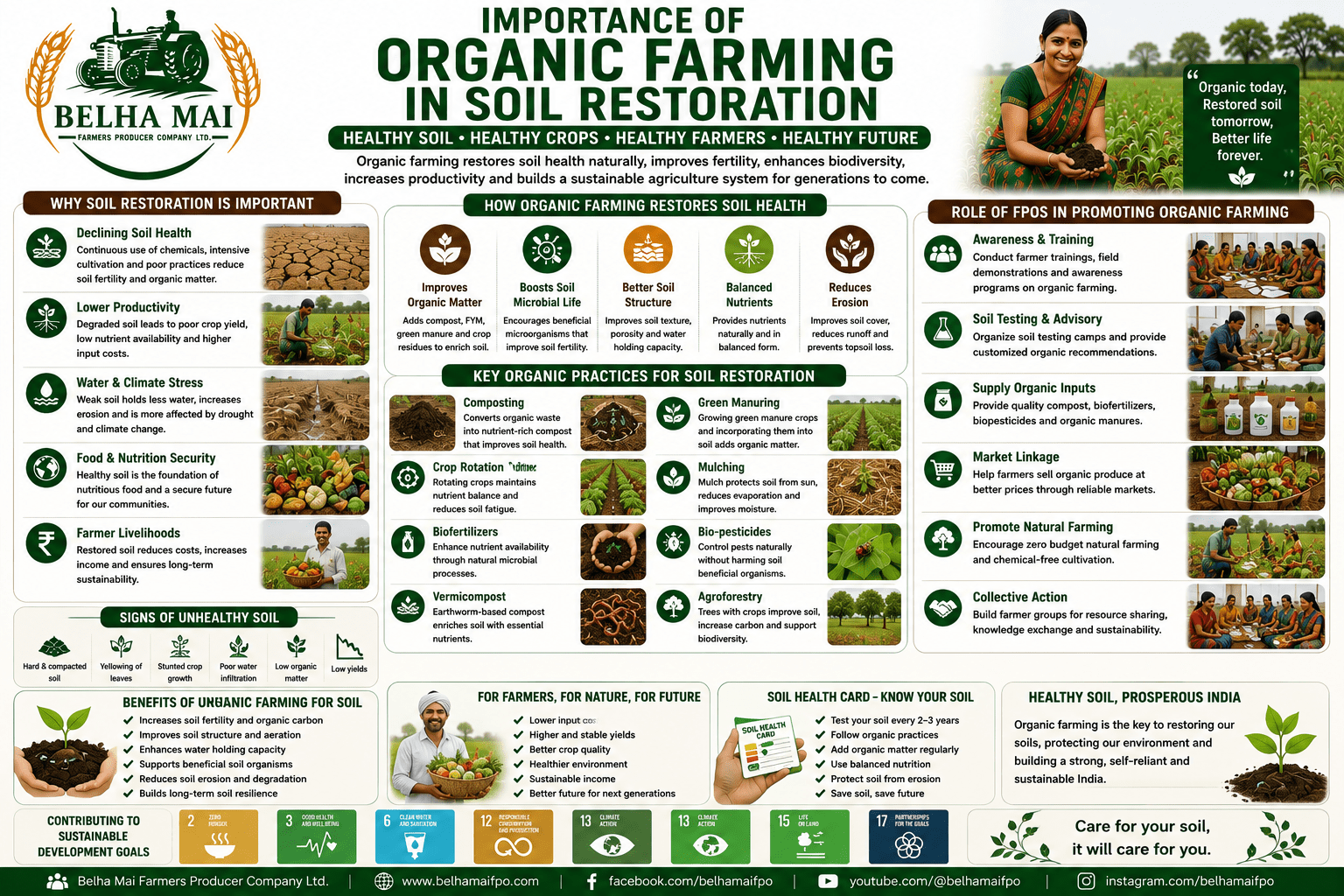
Importance of Organic Farming in Soil Restoration is a critical subject for Indian agriculture, sustainable farming, climate resilience, farmer income, and long-term food security. Soil is the foundation of agriculture, but many farming systems are facing declining organic matter, nutrient imbalance, soil compaction, erosion, water stress, and reduced biological activity.
Organic farming helps restore soil naturally by improving organic carbon, supporting soil microbes, increasing water-holding capacity, reducing chemical pressure, improving nutrient cycling, and building long-term fertility. It is not only an environmental practice; it is also an economic strategy for farmers who want to reduce input dependency and protect future productivity.
Farmer Producer Organizations can play an important role in promoting organic farming for soil restoration. Through awareness, training, composting units, bio-input supply, soil testing, market linkage, and collective farmer action, FPOs can help make organic soil restoration practical and scalable.
Importance of Organic Farming in Soil Restoration and Why It Matters
Importance of Organic Farming in Soil Restoration matters because soil degradation directly affects crop yield, farmer income, food quality, water efficiency, and climate resilience. When soil becomes weak, farmers spend more on inputs but may still get lower productivity.
Organic farming focuses on rebuilding soil as a living system. It improves the physical, chemical, and biological condition of soil. This means better soil structure, better nutrient availability, stronger root growth, improved microbial activity, and better moisture retention.
Soil restoration is a long-term investment. Healthy soil supports healthy crops, healthy farmers, and healthy rural economies.
Importance of Organic Farming in Soil Restoration Through Organic Matter
Organic matter is the heart of soil restoration. It improves soil fertility, water-holding capacity, structure, aeration, and microbial life. Without organic matter, soil becomes hard, dry, weak, and dependent on external inputs.
Organic farming adds organic matter through compost, farmyard manure, green manure, crop residues, vermicompost, mulching, biomass, and cover crops. These materials slowly enrich the soil and support natural fertility.
When organic matter improves, soil becomes more resilient. It can hold more moisture, support better roots, and provide nutrients more gradually to crops.
Importance of Organic Farming in Soil Restoration Through Compost
Compost is one of the most practical tools for soil restoration. It converts organic waste into nutrient-rich material that improves soil structure and fertility.
Farmers can prepare compost using crop residue, animal dung, leaves, household organic waste, farm biomass, and other biodegradable materials. Compost improves soil organic carbon and supports beneficial microorganisms.
FPOs can promote composting by organizing training, creating community compost units, and encouraging farmers to use farm waste productively instead of burning or discarding it.
Importance of Organic Farming in Soil Restoration Through Farmyard Manure
Farmyard manure has been used in Indian agriculture for generations. It improves soil fertility, adds organic matter, supports microbial life, and helps maintain long-term soil productivity.
When properly decomposed and applied, farmyard manure can reduce dependence on synthetic fertilizers and improve soil quality. It is especially useful when combined with soil testing and balanced nutrient management.
Organic farming encourages farmers to use locally available resources. Farmyard manure is one of the most accessible resources for many rural households.
Importance of Organic Farming in Soil Restoration Through Vermicompost
Vermicompost is a rich organic input prepared with the help of earthworms. It improves soil structure, nutrient availability, microbial activity, and plant growth.
Vermicompost can be prepared at household, farm, group, or FPO level. It can also become a rural enterprise opportunity for women, youth, and farmer groups.
Using vermicompost regularly can improve soil quality and reduce input costs over time. It is a practical solution for soil restoration and rural livelihood creation.
Importance of Organic Farming in Soil Restoration Through Green Manuring
Green manuring means growing specific crops and incorporating them into the soil to improve fertility. Green manure crops add biomass, improve nitrogen availability, and support soil structure.
Leguminous crops are especially useful because they help fix nitrogen and improve soil fertility naturally. Green manuring also supports microbial activity and reduces soil fatigue.
FPOs can promote green manuring by guiding farmers on suitable crops, timing, and field management. It is a low-cost soil restoration method that can be adopted by many farmers.
Importance of Organic Farming in Soil Restoration Through Crop Rotation
Crop rotation is an important organic farming practice for restoring soil health. Growing the same crop repeatedly can deplete specific nutrients and increase pest and disease pressure.
Rotating crops with pulses, legumes, millets, oilseeds, vegetables, green manure crops, and cover crops helps maintain nutrient balance and break pest cycles.
Crop rotation also improves biodiversity in the field. It supports better soil structure, reduces risk, and helps farmers build more resilient farming systems.
Importance of Organic Farming in Soil Restoration Through Mulching
Mulching is the practice of covering soil with organic material such as straw, leaves, crop residue, dry grass, or compost. It protects soil from direct sunlight, erosion, and moisture loss.
Mulching helps reduce evaporation, improve soil temperature, suppress weeds, and gradually add organic matter as the mulch decomposes.
In organic farming, mulching is an important tool for soil restoration because it protects the topsoil and supports biological activity.
Importance of Organic Farming in Soil Restoration Through Soil Microbes
Healthy soil is full of life. Soil microbes help decompose organic matter, release nutrients, improve soil structure, and support plant health. When microbial activity declines, soil becomes less fertile.
Organic farming supports soil microbes by adding compost, manure, crop residues, biofertilizers, and organic matter. It also reduces unnecessary chemical pressure that can disturb microbial balance.
Restoring microbial life is essential for long-term soil fertility. Living soil produces stronger crops and supports sustainable farming.
Importance of Organic Farming in Soil Restoration Through Biofertilizers
Biofertilizers contain beneficial microorganisms that help improve nutrient availability in soil. They can support nitrogen fixation, phosphorus solubilization, and better nutrient cycling.
Organic farming uses biofertilizers as part of soil restoration and integrated nutrient management. These inputs can reduce dependence on chemical fertilizers when used properly.
FPOs can help farmers access quality biofertilizers and learn correct application methods. Training is important because bio-inputs require proper handling and timing.
Importance of Organic Farming in Soil Restoration Through Biopesticides
Biopesticides help control pests and diseases using biological or natural methods. They can reduce chemical load on soil and protect beneficial organisms.
Organic farming promotes pest management through neem-based products, microbial biopesticides, botanical extracts, trap crops, beneficial insects, and integrated pest management.
Reducing chemical pesticide pressure helps protect soil biology and supports ecological balance. This is important for long-term soil restoration.
Importance of Organic Farming in Soil Restoration Through Reduced Chemical Dependency
One of the major benefits of organic farming is reduced dependency on excessive chemical inputs. Overuse of fertilizers and pesticides can disturb soil balance, reduce microbial life, and increase long-term input costs.
Organic farming does not mean farmers must stop all modern knowledge. It means farming should become more balanced, soil-based, and resource-conscious.
Reducing unnecessary chemical dependency improves soil health, lowers costs, and supports safer production systems. Farmers should adopt this transition gradually with proper training and market support.
Importance of Organic Farming in Soil Restoration Through Balanced Nutrition
Soil restoration requires balanced nutrition. Organic farming supports balanced nutrition by using compost, manure, biofertilizers, green manure, crop rotation, and locally available biomass.
However, soil testing remains important. Farmers need to know what their soil lacks and what corrective steps are required.
Organic farming works best when it is combined with scientific soil knowledge. FPOs can help farmers use soil reports and organic practices together.
Importance of Organic Farming in Soil Restoration Through Water Retention
Organic farming improves soil’s ability to hold water. Organic matter acts like a sponge, helping soil retain moisture and reduce drought stress.
This is especially important in rainfed and water-stressed farming areas. Soil with better organic matter can support crops during dry periods and reduce irrigation pressure.
Water retention is a major benefit of soil restoration. It improves crop resilience and reduces risk for farmers.
Importance of Organic Farming in Soil Restoration Through Soil Structure
Good soil structure allows roots, water, air, and microbes to function properly. Degraded soil may become compacted, hard, crusted, or poorly drained.
Organic farming improves soil structure by adding organic matter, supporting earthworms, reducing excessive tillage, and improving biological activity.
Better soil structure improves root growth, water infiltration, and crop health. This directly supports productivity and farmer income.
Importance of Organic Farming in Soil Restoration Through Erosion Control
Organic farming can help reduce soil erosion. Practices such as mulching, cover cropping, agroforestry, crop rotation, contour farming, and maintaining ground cover protect topsoil from wind and water erosion.
Topsoil is the most fertile part of soil. If it is lost, productivity declines and restoration becomes difficult.
Protecting soil from erosion is a major part of soil restoration. Organic farming provides practical methods for keeping soil covered and stable.
Importance of Organic Farming in Soil Restoration Through Agroforestry
Agroforestry combines trees with crops or livestock. It supports soil restoration by reducing erosion, adding leaf litter, improving biodiversity, enhancing microclimate, and increasing long-term carbon storage.
Trees also provide additional income through fruits, timber, fodder, fuelwood, and other products, depending on the species.
FPOs can promote agroforestry through planting material, training, and market linkage. Agroforestry connects soil restoration with income diversification and climate resilience.
Importance of Organic Farming in Soil Restoration Through Biodiversity
Biodiversity is important for soil restoration. Mixed crops, trees, pollinators, beneficial insects, earthworms, microbes, and natural vegetation support ecological balance.
Organic farming encourages biodiversity through crop rotation, mixed cropping, reduced chemical load, natural pest control, and habitat protection.
Biodiversity makes farming systems more resilient. It reduces pest risk, improves soil life, and supports long-term sustainability.
Importance of Organic Farming in Soil Restoration Through Climate Resilience
Climate change is increasing the risk of drought, heat stress, irregular rainfall, and extreme weather. Healthy soil can help farmers adapt to these challenges.
Organic farming improves climate resilience by increasing organic matter, improving water retention, reducing erosion, supporting biodiversity, and improving soil biology.
Soil restoration is one of the strongest climate adaptation strategies for farmers. When soil is healthy, crops can better withstand stress.
Importance of Organic Farming in Soil Restoration Through Lower Input Costs
Organic farming can help reduce input costs over time by using local resources such as compost, farmyard manure, biomass, crop residue, bio-inputs, and natural pest management methods.
Farmers often face high costs for fertilizers and pesticides. If soil health improves, crop response becomes better and input dependency can reduce.
Lower input costs improve net farmer income. This makes organic farming important not only for soil, but also for farmer livelihoods.
Importance of Organic Farming in Soil Restoration Through Farmer Income
Soil restoration supports farmer income by improving productivity, reducing input costs, improving crop quality, and increasing resilience. Organic farming can also create market opportunities when produce is linked with buyers who value responsible farming.
However, farmers need market support during the transition. Organic farming should be connected with aggregation, certification where required, branding, and market linkage.
FPOs can help farmers access better markets and build trust around organic or naturally grown produce.
Importance of Organic Farming in Soil Restoration Through Food Quality
Healthy soil supports better crop quality. Organic farming can improve the nutritional and ecological value of farming systems by promoting soil life, balanced nutrition, and reduced chemical residue pressure.
Consumers are becoming more aware of safe and responsibly produced food. This creates opportunities for farmer groups and FPOs to develop trusted rural brands.
Food quality begins with soil quality. Restoring soil is therefore important for both farmers and consumers.
Importance of Organic Farming in Soil Restoration Through Responsible Production
Organic farming supports responsible production by reducing waste, using local resources, protecting soil, conserving water, and promoting ecological balance.
Responsible production is important for sustainable development. It helps agriculture produce food without damaging the natural foundation on which farming depends.
FPOs can help farmers adopt responsible production practices collectively and connect them with institutional buyers, CSR partners, and sustainability-focused markets.
Importance of Organic Farming in Soil Restoration Through FPOs
FPOs can play a major role in promoting organic farming for soil restoration. They can organize farmer training, soil testing, input supply, composting, bio-input production, field demonstrations, documentation, and market linkage.
Many farmers hesitate to adopt organic practices because they fear yield loss, market uncertainty, or lack of guidance. FPOs can reduce this fear through collective learning and practical demonstrations.
FPOs can also aggregate organic or naturally grown produce and help farmers connect with better markets. This makes organic farming more practical for small farmers.
Importance of Organic Farming in Soil Restoration Through Training
Training is essential for organic farming. Farmers need to understand compost preparation, bio-input use, pest management, crop rotation, soil testing, organic matter improvement, and gradual transition planning.
FPOs, NGOs, CSR organizations, government departments, agricultural universities, and Krishi Vigyan Kendras can support training programs.
Training should be field-based and practical. Farmers trust methods more when they see results in nearby farms.
Importance of Organic Farming in Soil Restoration Through Market Linkage
Organic farming becomes more sustainable when farmers receive fair market value. If farmers adopt better practices but sell at ordinary prices, motivation may reduce.
FPOs can connect farmers with organic markets, health-conscious consumers, institutional buyers, retailers, processors, and direct marketing platforms.
Market linkage is important because soil restoration must also support farmer income. Sustainability must be both ecological and economic.
Importance of Organic Farming in Soil Restoration and SDGs
Organic farming and soil restoration are closely connected with Sustainable Development Goals. They support SDG 1 No Poverty, SDG 2 Zero Hunger, SDG 3 Good Health, SDG 6 Clean Water, SDG 8 Decent Work, SDG 12 Responsible Production, SDG 13 Climate Action, SDG 15 Life on Land, and SDG 17 Partnerships.
Restored soil improves food security, farmer income, climate resilience, biodiversity, and sustainable rural development.
This makes organic farming an important strategy for achieving SDG-linked agricultural transformation.
Belha Mai FPO and Organic Farming for Soil Restoration
Belha Mai Farmers Producer Company Ltd. recognizes that healthy soil is essential for sustainable agriculture and farmer prosperity. Soil restoration through organic farming can help farmers reduce costs, improve long-term productivity, and protect natural resources.
Through farmer awareness, soil health education, sustainable input support, training, farm services, value addition, and partnerships, FPOs like Belha Mai can help farmers adopt better soil restoration practices.
For Belha Mai FPO, organic farming is not only about chemical-free production. It is about restoring soil, improving livelihoods, and building a sustainable rural future.
Why Organic Soil Restoration Matters for India’s Future
India’s agricultural future depends on healthy soil. If soils continue to lose organic matter and biological strength, farmers will face higher costs and lower resilience.
Organic farming offers practical methods to rebuild soil health using local resources, farmer knowledge, scientific guidance, and collective action.
For India, soil restoration is essential for food security, climate resilience, farmer income, and sustainable rural development.
Conclusion
Importance of Organic Farming in Soil Restoration can be understood through one clear idea: soil must be treated as a living resource. Organic farming restores soil by increasing organic matter, supporting microbes, improving structure, conserving water, reducing erosion, balancing nutrients, and protecting biodiversity.
FPOs can help make organic farming practical by supporting training, soil testing, bio-inputs, composting, market linkage, and collective action.
For Belha Mai Farmers Producer Company Ltd., organic farming for soil restoration represents a path toward healthy soil, healthy crops, healthy farmers, and a sustainable future for rural India.
FAQ
What is the Importance of Organic Farming in Soil Restoration?
The importance of organic farming in soil restoration lies in improving organic matter, soil structure, microbial activity, water retention, nutrient cycling, biodiversity, and long-term farm productivity.
How does organic farming improve soil health?
Organic farming improves soil health through compost, farmyard manure, green manure, crop rotation, mulching, vermicompost, biofertilizers, reduced chemical pressure, and increased soil biological activity.
Why is organic matter important for soil restoration?
Organic matter improves soil fertility, water-holding capacity, microbial life, root growth, soil structure, and climate resilience. It is one of the most important elements of healthy soil.
Can organic farming reduce input costs?
Yes. Organic farming can reduce input costs over time by using local resources, compost, farmyard manure, bio-inputs, natural pest management, crop rotation, and improved soil health.
How can FPOs promote organic farming?
FPOs can promote organic farming through farmer training, soil testing, composting units, bio-input supply, demonstration plots, organic produce aggregation, market linkage, and partnerships.
Why should CSR organizations support organic farming and soil restoration?
CSR organizations should support organic farming and soil restoration because healthy soil improves farmer income, food security, climate resilience, biodiversity, water efficiency, and sustainable rural development.
Internal Links Section
👉 SDG Goals — https://belhamaifpo.com/sdg-goals/
👉 Farmer Producer Organizations Complete Guide —https://belhamaifpo.com/farmer-producer-organisation/farmer-producer-organizations-fpos/
👉 Soil Health Challenges in Indian Agriculture —https://belhamaifpo.com/sdg-goals/soil-health-challenges-in-indian-agriculture/
👉 Why FPOs are Key to Sustainable Agriculture —https://belhamaifpo.com/sdg-goals/why-fpos-are-key-to-sustainable-agriculture/
👉 Linking Local Farming Practices to Global Development Goals —https://belhamaifpo.com/sdg-goals/linking-local-farming-practices-to-global-development-goals/
👉 How Agriculture Can Reduce Rural Poverty in India —https://belhamaifpo.com/sdg-goals/how-agriculture-can-reduce-rural-poverty-in-india/
👉 Role of Collective Farming in Increasing Farmer Income — https://belhamaifpo.com/sdg-goals/role-of-collective-farming-in-increasing-farmer-income/
👉 How Grassroots Institutions Drive Sustainable Change —https://belhamaifpo.com/sdg-goals/how-grassroots-institutions-drive-sustainable-change/
👉 Farm Machinery Bank —https://belhamaifpo.com/farm-machinery-bank/
👉 Belha Mai FPO — https://belhamaifpo.com/
External Authority Links
👉 Soil Health Card Scheme — https://soilhealth.dac.gov.in/
👉 Ministry of Agriculture and Farmers Welfare — https://agriwelfare.gov.in/
👉 Paramparagat Krishi Vikas Yojana — https://pgsindia-ncof.gov.in/
👉 Indian Council of Agricultural Research — https://icar.org.in/
👉 National Centre of Organic and Natural Farming — https://nconf.dac.gov.in/
👉 United Nations Sustainable Development Goals — https://sdgs.un.org/goals
👉 National Bank for Agriculture and Rural Development — https://www.nabard.org/
👉 Small Farmers’ Agribusiness Consortium — https://sfacindia.com/
Follow Belha Mai FPO for More Updates
Website: https://belhamaifpo.com/
Facebook: https://www.facebook.com/profile.php?id=61561043486818
YouTube: https://www.youtube.com/channel/UC9ZvojoTMCa7mU1-Q_Bh60A
LinkedIn: https://www.linkedin.com/in/abhay-singh-ab5568280/
Instagram:https://instagram.com/belhamaifpo
Belha Mai Farmers Producer Company Ltd. supports farmers through better information, technology, market linkage, value addition, FPO awareness, rural development, women empowerment, soil health, organic farming, and sustainable agriculture.