Introduction
How Grassroots Institutions Drive Sustainable Change is an important subject for rural development, agriculture, climate action, poverty reduction, and community empowerment. Sustainable change cannot be created only through policies, schemes, or large institutions. It must also be built at the village level through organizations that work directly with people and understand local realities.
Grassroots institutions are local organizations that are connected with communities. These may include Farmer Producer Organizations, Self-Help Groups, cooperatives, village committees, community-based organizations, producer groups, and rural enterprises. Their strength lies in their closeness to the people they serve.
In rural India, grassroots institutions can drive sustainable change by organizing farmers, empowering women, creating local livelihoods, improving access to markets, promoting sustainable agriculture, connecting communities with government schemes, and building partnerships with development organizations.
How Grassroots Institutions Drive Sustainable Change Through Local Participation
How Grassroots Institutions Drive Sustainable Change begins with local participation. Development becomes stronger when people are not treated only as beneficiaries, but as active participants in planning and implementation.
Grassroots institutions allow farmers, women, youth, and rural families to take part in decision-making. They create platforms for meetings, discussions, training, planning, and collective action. This helps communities identify their own problems and work toward practical solutions.
When local people participate, development becomes more relevant and sustainable. Solutions are not imposed from outside. They are shaped by the needs, experience, and priorities of the community.
How Grassroots Institutions Drive Sustainable Change Through Farmer Collectivization
Farmer collectivization is one of the most powerful ways grassroots institutions create change. Small and marginal farmers often struggle because they work individually with limited resources, weak bargaining power, and poor market access.
Farmer Producer Organizations help farmers come together as members or shareholders. Through collective action, farmers can purchase inputs, access services, aggregate produce, negotiate better prices, and connect with markets.
This collective model helps convert small farmers into a stronger economic group. It improves confidence, reduces isolation, and creates a foundation for long-term rural development.
How Grassroots Institutions Drive Sustainable Change Through Rural Leadership
Sustainable change needs local leadership. Villages need people who can organize communities, coordinate with departments, manage projects, maintain records, build partnerships, and represent local interests.
Grassroots institutions help develop such leadership. Directors, board members, women leaders, youth coordinators, field staff, farmer group leaders, and community volunteers all become part of the development process.
Local leadership is important because it remains within the community. Even after a project ends, trained local leaders can continue guiding farmers, managing institutions, and supporting new initiatives.
How Grassroots Institutions Drive Sustainable Change Through Poverty Reduction
Poverty reduction is one of the most important outcomes of grassroots institutions. Rural poverty is often linked with low income, weak markets, lack of employment, high input costs, limited finance, and poor access to services.
Grassroots institutions can reduce poverty by improving income opportunities. FPOs can reduce input costs, improve market linkage, support value addition, create employment, and help farmers access schemes and finance.
When rural households earn better income, they can invest in education, health, nutrition, farming, housing, and enterprise. This creates long-term improvement in quality of life.
How Grassroots Institutions Drive Sustainable Change Through Women Empowerment
Women are central to rural life and agriculture, but their role is often under-recognized. Grassroots institutions can create platforms where women participate in training, leadership, income activities, decision-making, and entrepreneurship.
Women’s participation can happen through Self-Help Groups, FPOs, producer groups, processing units, packaging activities, value-added products, and community leadership roles. When women earn income and take decisions, families and communities become stronger.
Women empowerment is not only a social goal. It is also an economic development strategy. Grassroots institutions drive sustainable change by giving women a stronger place in the rural economy.
How Grassroots Institutions Drive Sustainable Change Through Sustainable Agriculture
Sustainable agriculture requires behaviour change at the farmer level. Farmers need practical knowledge, access to inputs, technical guidance, demonstrations, and market support to adopt better practices.
Grassroots institutions can promote soil testing, balanced fertilizer use, organic inputs, natural farming, crop diversification, water conservation, agroforestry, climate-resilient farming, and responsible input use.
Because these institutions are close to farmers, they can communicate in a practical way. They can organize training, field demonstrations, farmer meetings, and peer learning. This makes sustainable agriculture more acceptable and scalable.
How Grassroots Institutions Drive Sustainable Change Through Climate Action
Climate change is already affecting rural communities through irregular rainfall, heat stress, drought, floods, pest attacks, and crop uncertainty. Small farmers are especially vulnerable because they have limited resources to recover from crop losses.
Grassroots institutions can help communities prepare for climate risks. They can share weather information, promote water conservation, encourage crop diversification, support climate-resilient crops, promote agroforestry, and create awareness about sustainable farming.
Climate action becomes stronger when it is implemented locally. Grassroots institutions help convert climate awareness into field-level action.
How Grassroots Institutions Drive Sustainable Change Through Market Linkage
Market access is a major challenge for rural producers. Farmers may produce good crops, but without proper buyers, transport, storage, grading, and price information, they may not receive fair value.
Grassroots institutions can connect farmers with better markets. FPOs can aggregate produce, maintain quality, negotiate with buyers, create brands, explore institutional supply, and build long-term market relationships.
Better market linkage improves farmer income and reduces dependence on local middlemen. It also gives farmers confidence to invest in better production and quality improvement.
How Grassroots Institutions Drive Sustainable Change Through Value Addition
Value addition is a major pathway for rural transformation. When farmers sell only raw produce, their income remains limited. But when produce is cleaned, graded, processed, packaged, branded, and marketed, more value stays in the rural economy.
Grassroots institutions can support value addition through processing units, packaging centers, storage facilities, local brands, women-led enterprises, and farmer-owned supply chains.
Value addition creates employment for rural youth, women, machine operators, packaging workers, transport providers, and marketing teams. This helps villages move from production-only agriculture to enterprise-based development.
How Grassroots Institutions Drive Sustainable Change Through Youth Participation
Rural youth are important for the future of agriculture and village development. Many young people leave villages because they do not see opportunities in farming. Grassroots institutions can help change this mindset.
FPOs and other rural institutions can involve youth in digital work, market research, farm advisory, accounts, logistics, e-commerce, machinery services, branding, packaging, processing, and field coordination.
When youth see agriculture as an enterprise, they become more willing to participate in rural development. This creates a new generation of agri-entrepreneurs and rural leaders.
How Grassroots Institutions Drive Sustainable Change Through Knowledge Sharing
Knowledge is one of the most important resources in rural development. Farmers need timely information on crops, weather, soil, pest management, government schemes, finance, markets, machinery, and sustainable practices.
Grassroots institutions can become knowledge centers for rural communities. They can organize farmer meetings, training sessions, expert visits, demonstration plots, digital messages, videos, and advisory services.
When information reaches farmers at the right time, losses reduce and income improves. Knowledge sharing helps communities make better decisions and become more resilient.
How Grassroots Institutions Drive Sustainable Change Through Access to Government Schemes
Many government schemes are created for farmers, women, rural enterprises, farm machinery, food processing, irrigation, training, credit, and infrastructure. However, many people do not benefit because of lack of awareness or documentation challenges.
Grassroots institutions can bridge this gap. They can inform communities about schemes, support documentation, coordinate with departments, help farmers understand eligibility, and organize collective applications.
This improves last-mile delivery. Government schemes become more effective when grassroots institutions help connect them with real beneficiaries.
How Grassroots Institutions Drive Sustainable Change Through Financial Inclusion
Rural communities often face difficulties in accessing formal finance. Farmers and rural entrepreneurs may depend on informal credit because banks require documents, records, collateral, or business plans.
Grassroots institutions can support financial inclusion by helping farmers connect with banks, credit schemes, insurance services, financial literacy programs, and institutional finance. FPOs can also build their own credibility through audits, records, governance, and business planning.
Financial inclusion helps people invest in farming, machinery, processing, livestock, irrigation, education, and enterprise. This strengthens long-term rural development.
How Grassroots Institutions Drive Sustainable Change Through Rural Infrastructure
Rural development needs infrastructure. Farmers need input centers, aggregation points, warehouses, packhouses, processing units, machinery banks, training centers, digital systems, and transport support.
Individual farmers usually cannot create such infrastructure alone. Grassroots institutions can create shared infrastructure that serves many people.
Common infrastructure reduces wastage, improves quality, supports value addition, creates employment, and strengthens local markets. It becomes a community asset for long-term development.
How Grassroots Institutions Drive Sustainable Change Through Local Enterprise
Sustainable change becomes stronger when rural communities create their own enterprises. Local enterprise helps people earn income within the village economy instead of depending only on raw farming or migration.
Grassroots institutions can support enterprises in food processing, honey, amla products, mango products, flour milling, seed production, nursery development, bio-inputs, farm services, machinery rental, packaging, and local marketing.
Enterprise-based development creates jobs, improves income, supports youth participation, and keeps value within rural areas.
How Grassroots Institutions Drive Sustainable Change Through Social Trust
Trust is essential for development. Communities are more likely to participate when they trust the institution working with them. Grassroots institutions often have stronger trust because they are built from within the community.
Trust helps in mobilization, training, collective purchase, collective sale, scheme participation, women involvement, and partnership implementation. Without trust, even good programs may fail.
Grassroots institutions drive sustainable change because they can build relationships over time. They understand local culture, local problems, and local expectations.
How Grassroots Institutions Drive Sustainable Change Through Partnerships
Partnerships are important for scaling impact. Grassroots institutions need support from government departments, CSR organizations, NGOs, banks, NABARD, SFAC, universities, research institutions, technology providers, processors, exporters, and buyers.
Partnerships can bring finance, infrastructure, training, technology, market access, quality systems, and long-term development support. A strong grassroots institution can become a reliable implementation partner for rural projects.
This makes grassroots institutions important for CSR and grant agencies. They provide direct access to communities and help convert project goals into real field-level outcomes.
How Grassroots Institutions Drive Sustainable Change and SDGs
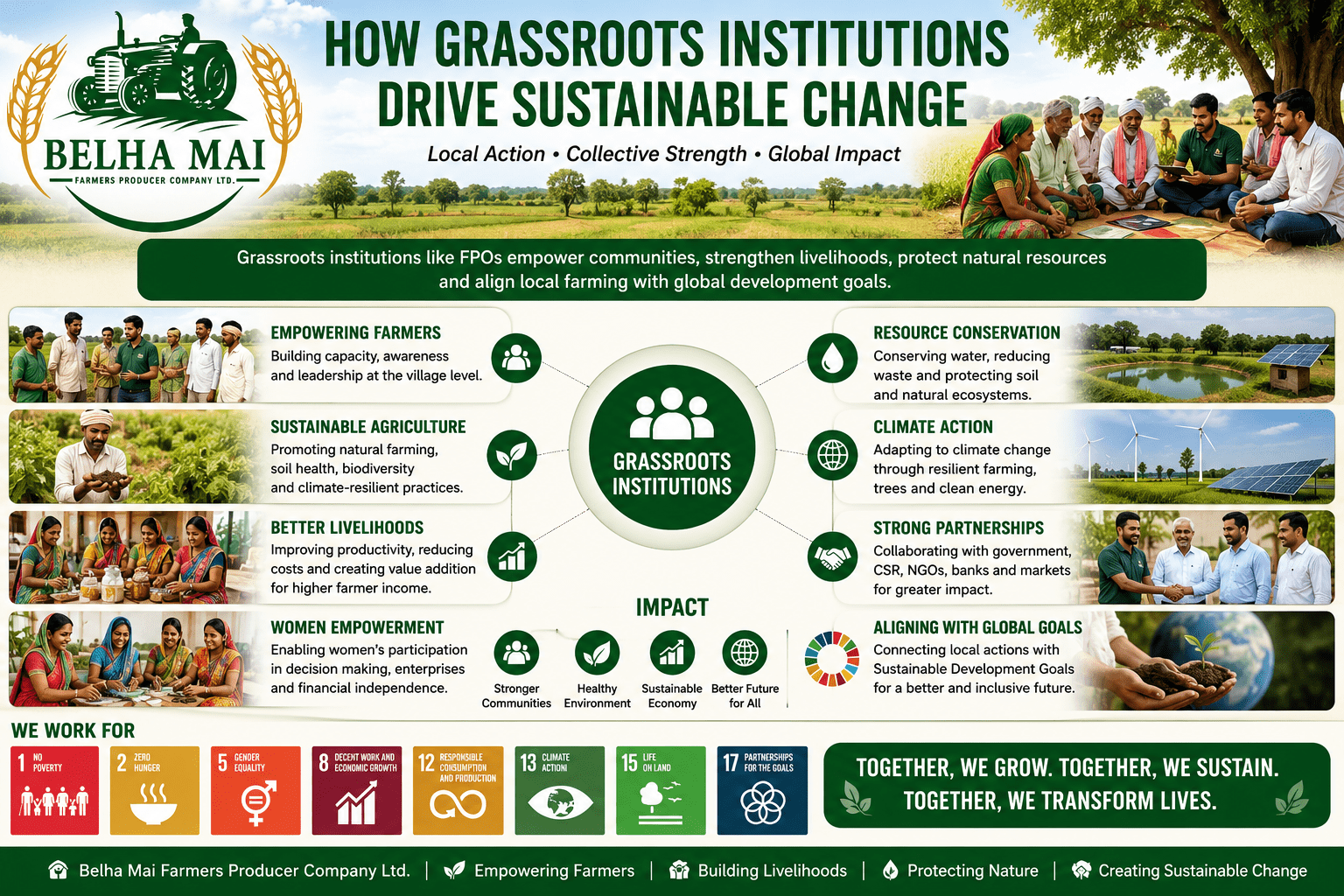
Grassroots institutions are closely connected with Sustainable Development Goals. They can support SDG 1 through poverty reduction, SDG 5 through women empowerment, SDG 8 through decent work, SDG 13 through climate action, SDG 15 through land and biodiversity protection, and SDG 17 through partnerships.
These goals may be global, but their success depends on local action. Grassroots institutions help bring global development goals into villages, farms, and rural communities.
This is why grassroots institutions are essential for sustainable development. They connect policy with people and vision with action.
Belha Mai FPO as a Grassroots Institution
Belha Mai Farmers Producer Company Ltd. represents the role of grassroots institutions in rural transformation. As an FPO, it works with farmers and supports them through collective strength, input services, farm machinery, market linkage, value addition, digital outreach, women participation, and sustainable agriculture.
The organization’s work reflects the idea that rural development must be built from the ground up. Strong farmer institutions can help communities access better opportunities, improve income, build local enterprises, and connect with development partners.
For Belha Mai FPO, sustainable change means creating stronger farmers, stronger women, stronger youth, stronger markets, and stronger rural systems.
Why Grassroots Institutions Matter for India’s Future
India’s future development depends greatly on its villages. Rural communities need stronger livelihoods, better agriculture, local enterprises, climate resilience, women empowerment, youth participation, and sustainable resource use.
Grassroots institutions can support all these areas because they are close to the community. They understand local realities and can implement practical solutions.
Large policies create direction, but grassroots institutions create movement. They help ensure that development reaches the people who need it most.
Conclusion
How Grassroots Institutions Drive Sustainable Change can be understood through one simple idea: sustainable development becomes real when communities participate. Grassroots institutions organize people, build trust, create leadership, improve livelihoods, empower women, promote sustainable agriculture, and connect villages with partnerships.
FPOs, cooperatives, SHGs, and community-based organizations are not small players. They are essential engines of rural transformation.
For India, strong grassroots institutions can help turn sustainable development from a global vision into village-level reality. For Belha Mai Farmers Producer Company Ltd., this path represents a farmer-led model for long-term rural change.
FAQ
How Grassroots Institutions Drive Sustainable Change?
Grassroots institutions drive sustainable change by organizing communities, building local leadership, improving livelihoods, empowering women, promoting sustainable agriculture, connecting people with schemes, and creating partnerships for long-term development.
What are grassroots institutions?
Grassroots institutions are local organizations that work directly with communities. Examples include Farmer Producer Organizations, Self-Help Groups, cooperatives, village committees, producer groups, and community-based organizations.
Why are grassroots institutions important for rural development?
Grassroots institutions are important because they understand local problems, build community trust, support participation, connect people with services, and help implement development programs at the village level.
How do FPOs work as grassroots institutions?
FPOs work as grassroots institutions by organizing farmers, reducing input costs, improving market access, supporting value addition, promoting sustainable agriculture, creating livelihoods, and connecting farmers with partners.
How do grassroots institutions support Sustainable Development Goals?
Grassroots institutions support Sustainable Development Goals by reducing poverty, empowering women, creating rural employment, promoting climate action, protecting land and biodiversity, and building partnerships.
Why should CSR organizations work with grassroots institutions?
CSR organizations should work with grassroots institutions because they provide direct access to communities and help implement rural development projects in a practical, trusted, and measurable way.
Internal Links Section
👉 SDG Goals — https://belhamaifpo.com/sdg-goals/
👉 Farmer Producer Organizations Complete Guide —https://belhamaifpo.com/farmer-producer-organisation/farmer-producer-organizations-fpos/
👉 How Farmer Producer Organizations Contribute to Sustainable Development Goals — https://belhamaifpo.com/sdg-goals/how-farmer-producer-organizations-contribute-to-sustainable-development-goals/
👉 Linking Local Farming Practices to Global Development Goals —https://belhamaifpo.com/sdg-goals/linking-local-farming-practices-to-global-development-goals/
👉 Why FPOs are Key to Sustainable Agriculture —https://belhamaifpo.com/sdg-goals/why-fpos-are-key-to-sustainable-agriculture/
👉 Belha Mai FPO — https://belhamaifpo.com/
External Authority Links
👉 United Nations Sustainable Development Goals — https://sdgs.un.org/goals
👉 NITI Aayog SDG India Index — https://www.niti.gov.in/sdg-india-index
👉 Ministry of Agriculture and Farmers Welfare — https://agriwelfare.gov.in/
👉 Small Farmers’ Agribusiness Consortium — https://sfacindia.com/
👉 National Bank for Agriculture and Rural Development — https://www.nabard.org/
Follow Belha Mai FPO for More Updates
Website: https://belhamaifpo.com/
Facebook: https://www.facebook.com/profile.php?id=61561043486818
YouTube: https://www.youtube.com/channel/UC9ZvojoTMCa7mU1-Q_Bh60A
LinkedIn: https://www.linkedin.com/in/abhay-singh-ab5568280/
Instagram: https://instagram.com/belhamaifpo
Belha Mai Farmers Producer Company Ltd. supports farmers through better information, technology, market linkage, value addition, FPO awareness, rural development, and sustainable agriculture.