Introduction
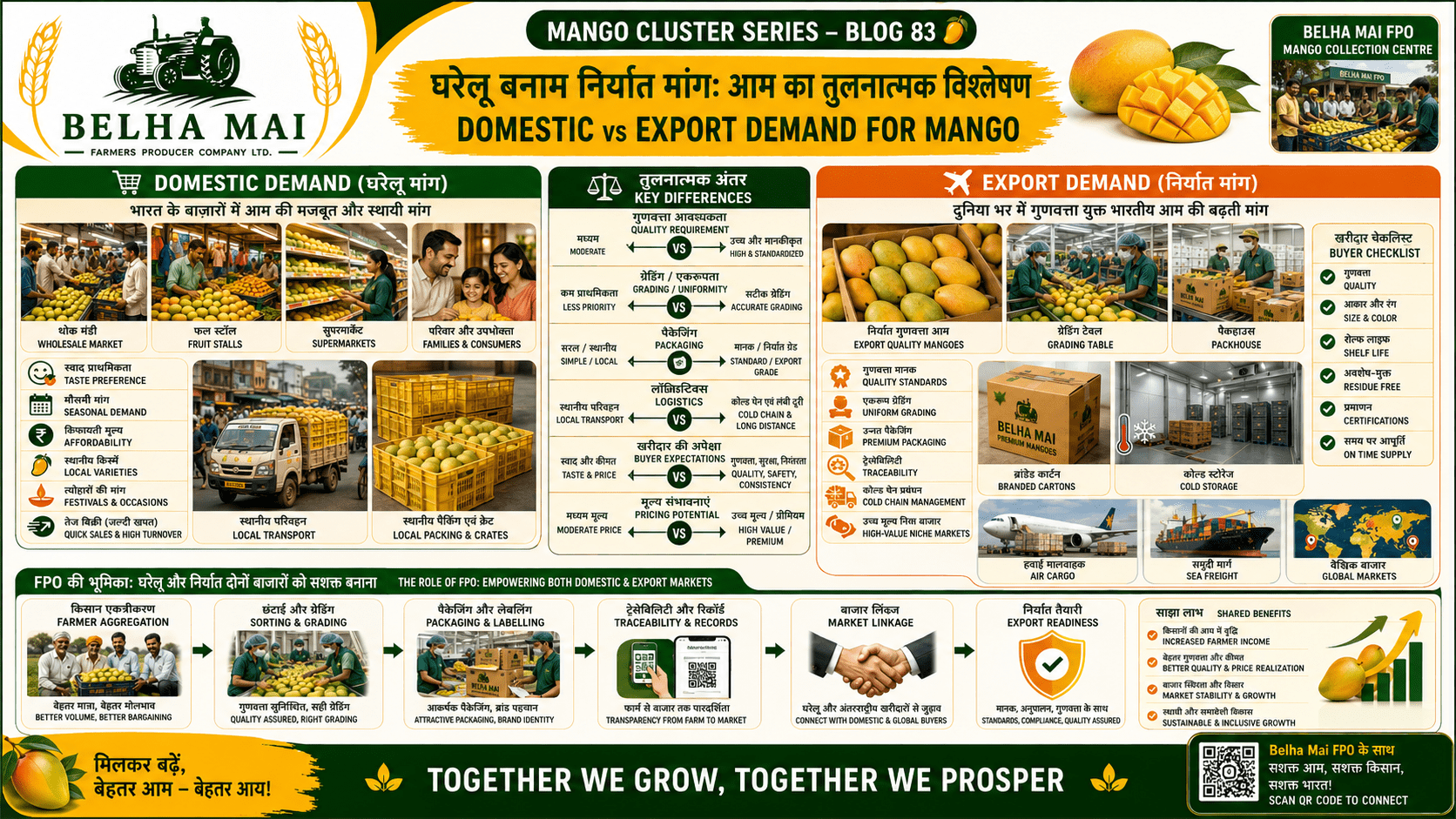
Domestic vs Export Demand for Mangoes which is one of India’s most popular fruits, and its demand exists in both domestic and export markets. However, domestic demand and export demand are not the same. Both markets have different expectations, quality standards, pricing systems, packaging needs, logistics requirements and buyer behaviour.
For mango farmers and FPOs, understanding this difference is very important. If farmers sell all mangoes in one mixed lot, they lose the opportunity to get better prices from premium domestic buyers, processors and exporters. A smart mango marketing strategy should divide fruits according to grade, variety and market demand.
Domestic markets usually absorb large volumes and accept a wider range of fruit quality. Export markets require stricter grading, packaging, traceability, treatment, cold chain and documentation. Both markets are important, but they need different strategies.
घरेलू बनाम निर्यात मांग: आम बाजार की समझ
आम भारत का सबसे लोकप्रिय फल है और इसकी मांग घरेलू तथा निर्यात दोनों बाजारों में होती है। लेकिन घरेलू मांग और निर्यात मांग एक जैसी नहीं होती। दोनों बाजारों की quality expectations, pricing system, packaging needs, logistics requirements और buyer behaviour अलग होते हैं।
आम किसानों और FPOs के लिए यह अंतर समझना बहुत जरूरी है। यदि किसान सभी आम एक mixed lot में बेच देते हैं, तो वे premium domestic buyers, processors और exporters से बेहतर भाव पाने का अवसर खो देते हैं। Smart mango marketing strategy में fruit को grade, variety और market demand के अनुसार अलग करना चाहिए।
Domestic market बड़ी मात्रा में आम absorb करता है और अलग-अलग quality को स्वीकार करता है। Export market strict grading, packaging, traceability, treatment, cold chain और documentation मांगता है। दोनों markets जरूरी हैं, लेकिन दोनों के लिए अलग strategy चाहिए।
What Is Domestic Mango Demand?
Domestic mango demand means demand within India. This includes local mandis, wholesale markets, retail fruit sellers, supermarkets, online grocery platforms, hotels, restaurants, processors, sweet shops and direct consumers.
India has a very large domestic mango market because mango is consumed by families across villages, towns and cities. Domestic demand is driven by taste, price, variety, season, region and consumer preference.
Domestic buyers may purchase:
fresh ripe mangoes,
raw mangoes,
table mangoes,
processing-grade mangoes,
premium gift boxes,
mango pulp,
pickle mangoes,
and value-added mango products.
घरेलू आम मांग क्या है?
Domestic mango demand का मतलब भारत के अंदर आम की मांग से है। इसमें local mandis, wholesale markets, retail fruit sellers, supermarkets, online grocery platforms, hotels, restaurants, processors, sweet shops और direct consumers शामिल हैं।
भारत में domestic mango market बहुत बड़ा है क्योंकि आम गांवों, कस्बों और शहरों में परिवारों द्वारा खूब खाया जाता है। Domestic demand taste, price, variety, season, region और consumer preference पर निर्भर करती है।
Domestic buyers खरीद सकते हैं:
fresh ripe mangoes,
raw mangoes,
table mangoes,
processing-grade mangoes,
premium gift boxes,
mango pulp,
pickle mangoes,
और value-added mango products।
What Is Export Mango Demand?
Export mango demand means demand from international buyers. Export buyers may include importers, wholesalers, supermarkets, ethnic Indian stores, premium fruit distributors, hotels, restaurants, processors and online international grocery platforms.
Export demand is more quality-sensitive. Buyers usually want fruits that are uniform, properly mature, pest-safe, clean, graded, packed and traceable.
Export mango demand may include:
fresh mangoes,
premium table mangoes,
mango pulp,
mango puree,
dried mango,
frozen mango,
mango pickle,
mango chutney,
aamchur powder,
and other processed products.
निर्यात आम मांग क्या है?
Export mango demand का मतलब international buyers से आने वाली आम की मांग से है। Export buyers में importers, wholesalers, supermarkets, ethnic Indian stores, premium fruit distributors, hotels, restaurants, processors और online international grocery platforms शामिल हो सकते हैं।
Export demand quality-sensitive होती है। Buyers सामान्य रूप से uniform, properly mature, pest-safe, clean, graded, packed और traceable fruits चाहते हैं।
Export mango demand में शामिल हो सकता है:
fresh mangoes,
premium table mangoes,
mango pulp,
mango puree,
dried mango,
frozen mango,
mango pickle,
mango chutney,
aamchur powder,
और अन्य processed products।
Key Difference Between Domestic and Export Demand
The biggest difference between domestic and export mango demand is quality discipline. Domestic markets may accept mixed grades, but export markets do not usually accept loose and mixed-quality fruits.
Domestic market focuses mainly on taste, price and availability. Export market focuses on quality, uniformity, compliance, traceability, packaging and shelf life.
Simple difference:
Domestic market: large volume, flexible quality, price-sensitive buyers
Export market: selected volume, strict quality, premium buyers
Domestic market: local transport and quick sale
Export market: long-distance logistics and cold chain
Domestic market: simple packaging may work
Export market: standard packaging and labelling required
घरेलू और निर्यात मांग में मुख्य अंतर
Domestic और export mango demand में सबसे बड़ा अंतर quality discipline है। Domestic markets mixed grades को भी accept कर सकते हैं, लेकिन export markets loose और mixed-quality fruits को सामान्य रूप से accept नहीं करते।
Domestic market मुख्य रूप से taste, price और availability पर ध्यान देता है। Export market quality, uniformity, compliance, traceability, packaging और shelf life पर ध्यान देता है।
सरल अंतर:
Domestic market: बड़ी मात्रा, flexible quality, price-sensitive buyers
Export market: selected quantity, strict quality, premium buyers
Domestic market: local transport और quick sale
Export market: long-distance logistics और cold chain
Domestic market: simple packaging चल सकती है
Export market: standard packaging और labelling जरूरी होती है
Quality Requirements in Domestic Market
Domestic mango market has different quality segments. Not all domestic buyers want the same fruit. Local mandis may accept mixed lots, while premium retail buyers may demand clean, uniform and well-packed mangoes.
Domestic quality segments include:
local mandi quality,
retail fruit stall quality,
premium supermarket quality,
gift box quality,
hotel and restaurant quality,
processing-grade quality,
and online delivery quality.
This means domestic market is not only low-quality market. Premium domestic markets can also give better prices if fruits are properly graded and packed.
घरेलू बाजार में गुणवत्ता की जरूरत
Domestic mango market में अलग-अलग quality segments होते हैं। सभी domestic buyers एक जैसे fruit नहीं चाहते। Local mandis mixed lots accept कर सकती हैं, जबकि premium retail buyers clean, uniform और well-packed mangoes मांग सकते हैं।
Domestic quality segments:
local mandi quality,
retail fruit stall quality,
premium supermarket quality,
gift box quality,
hotel and restaurant quality,
processing-grade quality,
और online delivery quality।
इसका मतलब है कि domestic market केवल low-quality market नहीं है। Premium domestic markets भी अच्छे भाव दे सकते हैं, यदि fruits properly graded और packed हों।
Quality Requirements in Export Market
Export market requires stricter quality. Mangoes must be selected carefully from orchard level itself. Export quality cannot be created only at the packhouse.
Export-quality mangoes should be:
properly mature,
uniform in size,
clean and attractive,
free from serious defects,
free from pest damage,
free from fruit fly infestation,
properly de-sapped,
graded variety-wise,
packed in standard boxes,
and traceable.
Export buyers may also require specific treatment, residue compliance and documentation depending on destination market.
निर्यात बाजार में गुणवत्ता की जरूरत
Export market stricter quality मांगता है। Mangoes को orchard level से ही carefully select करना पड़ता है। Export quality केवल packhouse में नहीं बनाई जा सकती।
Export-quality mangoes होने चाहिए:
properly mature,
size में uniform,
clean और attractive,
serious defects से free,
pest damage से free,
fruit fly infestation से free,
properly de-sapped,
variety-wise graded,
standard boxes में packed,
और traceable।
Export buyers destination market के अनुसार specific treatment, residue compliance और documentation भी मांग सकते हैं।
Variety Demand in Domestic Market
Domestic mango demand is strongly influenced by regional taste. Different parts of India prefer different varieties. For example, North Indian markets may have strong demand for Dasheri, Langra and Chausa. Western and southern markets may prefer Alphonso, Kesar, Banganapalli, Totapuri and other regional varieties.
Domestic consumers often choose mangoes based on:
taste,
sweetness,
aroma,
price,
ripeness,
local habit,
family preference,
and festival season.
For FPOs, domestic variety mapping is important because the right variety should be sent to the right market.
घरेलू बाजार में किस्म की मांग
Domestic mango demand regional taste से बहुत प्रभावित होती है। भारत के अलग-अलग हिस्सों में अलग-अलग varieties पसंद की जाती हैं। उदाहरण के लिए North Indian markets में Dasheri, Langra और Chausa की demand मजबूत हो सकती है। Western और southern markets में Alphonso, Kesar, Banganapalli, Totapuri और अन्य regional varieties पसंद की जा सकती हैं।
Domestic consumers mangoes चुनते हैं:
taste,
sweetness,
aroma,
price,
ripeness,
local habit,
family preference,
और festival season के आधार पर।
FPOs के लिए domestic variety mapping जरूरी है ताकि सही variety सही market में भेजी जा सके।
Variety Demand in Export Market
Export mango variety demand depends on buyer preference, destination country, shelf life, logistics and Indian diaspora demand. Some international buyers prefer premium table varieties, while others buy processing-grade mangoes or pulp.
Export-oriented varieties may include:
Alphonso,
Kesar,
Dasheri,
Langra,
Chausa,
Banganapalli,
Totapuri,
Amrapali,
and other region-specific varieties.
FPOs should not assume that all varieties are suitable for all export markets. Buyer demand must be studied before planning export.
निर्यात बाजार में किस्म की मांग
Export mango variety demand buyer preference, destination country, shelf life, logistics और Indian diaspora demand पर निर्भर करती है। कुछ international buyers premium table varieties पसंद करते हैं, जबकि कुछ processing-grade mangoes या pulp खरीदते हैं।
Export-oriented varieties:
Alphonso,
Kesar,
Dasheri,
Langra,
Chausa,
Banganapalli,
Totapuri,
Amrapali,
और अन्य region-specific varieties।
FPOs को यह assume नहीं करना चाहिए कि सभी varieties सभी export markets के लिए suitable हैं। Export planning से पहले buyer demand study करनी चाहिए।
Price Difference Between Domestic and Export Demand
Export mangoes may receive better prices, but only selected quality fruits can enter export markets. Export prices are not automatically available to all mangoes. Farmers must understand that export price comes with quality cost, grading cost, packaging cost, treatment cost, cold chain cost, documentation cost and buyer compliance.
Domestic markets may offer lower prices for mixed mangoes, but premium domestic markets can also give good returns. Sometimes domestic premium buyers may be easier and safer than export buyers for new FPOs.
Price depends on:
quality,
variety,
season,
grade,
market demand,
packaging,
distance,
logistics cost,
and buyer reliability.
घरेलू और निर्यात मांग में भाव का अंतर
Export mangoes बेहतर price पा सकते हैं, लेकिन केवल selected quality fruits export markets में जाते हैं। Export price सभी mangoes को automatically नहीं मिलता। किसानों को समझना चाहिए कि export price के साथ quality cost, grading cost, packaging cost, treatment cost, cold chain cost, documentation cost और buyer compliance भी जुड़ा होता है।
Domestic markets mixed mangoes के लिए कम price दे सकते हैं, लेकिन premium domestic markets भी अच्छा return दे सकते हैं। New FPOs के लिए कई बार domestic premium buyers export buyers से आसान और सुरक्षित हो सकते हैं।
Price निर्भर करता है:
quality,
variety,
season,
grade,
market demand,
packaging,
distance,
logistics cost,
और buyer reliability पर।
Packaging Difference
Packaging is another major difference between domestic and export demand. Domestic market packaging may include crates, baskets, cartons or retail packs depending on buyer type. Export packaging must be stronger, cleaner, ventilated, labelled and suitable for long-distance transport.
Domestic packaging may focus on:
low cost,
easy handling,
local transport,
retail display,
and quick turnover.
Export packaging focuses on:
fruit protection,
ventilation,
uniformity,
branding,
traceability,
stacking strength,
and buyer specification.
पैकेजिंग में अंतर
Packaging domestic और export demand के बीच बड़ा अंतर है। Domestic market packaging में buyer type के अनुसार crates, baskets, cartons या retail packs हो सकते हैं। Export packaging strong, clean, ventilated, labelled और long-distance transport के लिए suitable होनी चाहिए।
Domestic packaging का focus:
low cost,
easy handling,
local transport,
retail display,
और quick turnover पर हो सकता है।
Export packaging का focus:
fruit protection,
ventilation,
uniformity,
branding,
traceability,
stacking strength,
और buyer specification पर होता है।
Logistics Difference
Domestic mango supply usually moves through local transport, mandis, wholesale markets, retail shops and nearby cities. Export mango supply may require packhouse handling, cold storage, refrigerated transport, airport or port handling, air cargo or sea freight.
Domestic logistics may be simpler, but poor handling can still cause losses. Export logistics is more complex and requires timing, temperature management and documentation.
FPOs should calculate logistics cost carefully before deciding the market.
लॉजिस्टिक्स में अंतर
Domestic mango supply सामान्य रूप से local transport, mandis, wholesale markets, retail shops और nearby cities के माध्यम से जाती है। Export mango supply में packhouse handling, cold storage, refrigerated transport, airport या port handling, air cargo या sea freight की जरूरत हो सकती है।
Domestic logistics simple हो सकता है, लेकिन poor handling से फिर भी losses हो सकते हैं। Export logistics अधिक complex होता है और timing, temperature management और documentation मांगता है।
FPOs को market decide करने से पहले logistics cost carefully calculate करनी चाहिए।
Buyer Expectations in Domestic Market
Domestic buyers are diverse. A local fruit vendor may focus on price and ripeness. A supermarket may focus on uniformity and packaging. A hotel may want consistent supply. A processor may want quantity and pulp recovery.
Domestic buyer expectations may include:
good taste,
right ripeness,
reasonable price,
consistent supply,
clean appearance,
proper packaging,
and reliable delivery.
FPOs should not treat all domestic buyers the same. Each buyer segment needs a different approach.
घरेलू बाजार में buyer expectations
Domestic buyers अलग-अलग प्रकार के होते हैं। Local fruit vendor price और ripeness पर focus कर सकता है। Supermarket uniformity और packaging पर focus कर सकता है। Hotel consistent supply चाहता है। Processor quantity और pulp recovery देखता है।
Domestic buyer expectations:
good taste,
right ripeness,
reasonable price,
consistent supply,
clean appearance,
proper packaging,
और reliable delivery।
FPOs को सभी domestic buyers को एक जैसा नहीं मानना चाहिए। हर buyer segment के लिए अलग approach चाहिए।
Buyer Expectations in Export Market
Export buyers usually expect professional systems. They want mangoes that meet their quality and compliance requirements. They may also require certificates, treatment proof, traceability, standardized packing and timely shipment.
Export buyer expectations may include:
consistent quality,
uniform size,
proper maturity,
low defect level,
standard packaging,
traceability,
residue-safe production,
phytosanitary compliance,
cold chain,
and on-time shipment.
Export buyers value trust and consistency. One poor shipment can damage future business.
निर्यात बाजार में buyer expectations
Export buyers सामान्य रूप से professional systems expect करते हैं। वे चाहते हैं कि mangoes उनकी quality और compliance requirements पूरी करें। वे certificates, treatment proof, traceability, standardized packing और timely shipment भी मांग सकते हैं।
Export buyer expectations:
consistent quality,
uniform size,
proper maturity,
low defect level,
standard packaging,
traceability,
residue-safe production,
phytosanitary compliance,
cold chain,
और on-time shipment।
Export buyers trust और consistency को बहुत महत्व देते हैं। एक खराब shipment future business को नुकसान पहुंचा सकती है।
Domestic Market Advantages
Domestic market has many advantages for farmers and FPOs. It is large, familiar and easier to access compared to export markets. Payment cycles may be simpler in some local channels, and logistics may be shorter.
Advantages include:
large consumer base,
variety-wise regional demand,
lower documentation burden,
easier market entry,
quick sales,
local buyer relationship,
processing demand,
and lower compliance complexity.
For new FPOs, domestic premium market can be the first step before export.
घरेलू बाजार के लाभ
Domestic market किसानों और FPOs के लिए कई फायदे देता है। यह बड़ा, familiar और export markets की तुलना में easier to access होता है। कुछ local channels में payment cycles सरल हो सकते हैं और logistics shorter हो सकता है।
लाभ:
large consumer base,
variety-wise regional demand,
lower documentation burden,
easier market entry,
quick sales,
local buyer relationship,
processing demand,
और lower compliance complexity।
New FPOs के लिए domestic premium market export से पहले पहला कदम हो सकता है।
Export Market Advantages
Export market can offer premium opportunities for selected quality mangoes and processed mango products. It can help build brand identity and bring better recognition to Indian varieties.
Export market advantages include:
premium buyer access,
international brand visibility,
higher-value niche markets,
processed product opportunities,
foreign buyer relationships,
better quality discipline,
and long-term business growth.
However, export should be started only after proper preparation.
निर्यात बाजार के लाभ
Export market selected quality mangoes और processed mango products के लिए premium opportunities दे सकता है। यह brand identity बनाने और Indian varieties को बेहतर पहचान दिलाने में मदद कर सकता है।
Export market advantages:
premium buyer access,
international brand visibility,
higher-value niche markets,
processed product opportunities,
foreign buyer relationships,
better quality discipline,
और long-term business growth।
लेकिन export proper preparation के बाद ही शुरू करना चाहिए।
Which Market Should Farmers Choose?
Farmers should not think in terms of only domestic or only export. A smart approach is to divide mangoes by quality and send each grade to the right market.
A practical market strategy:
Premium fruits: export or premium domestic buyers
Grade A fruits: supermarkets, retail chains and wholesale buyers
Grade B fruits: local markets and institutional buyers
Processing-grade fruits: pulp, juice, pickle, chutney and aamchur units
Rejected fruits: should not enter food supply if unsafe or rotten
This grade-wise marketing improves total income and reduces wastage.
किसानों को कौन सा बाजार चुनना चाहिए?
किसानों को केवल domestic या केवल export के रूप में नहीं सोचना चाहिए। Smart approach यह है कि mangoes को quality के अनुसार divide किया जाए और हर grade को सही market में भेजा जाए।
Practical market strategy:
Premium fruits: export या premium domestic buyers
Grade A fruits: supermarkets, retail chains और wholesale buyers
Grade B fruits: local markets और institutional buyers
Processing-grade fruits: pulp, juice, pickle, chutney और aamchur units
Rejected fruits: यदि unsafe या rotten हों तो food supply में नहीं जाने चाहिए
इस grade-wise marketing से total income बढ़ती है और wastage कम होता है।
Role of FPOs in Domestic and Export Markets
FPOs can help farmers access both domestic and export markets. Individual farmers may not have enough quantity, grading facility, packaging system or buyer connection. FPOs can bridge this gap.
An FPO can support both markets through:
farmer aggregation,
quality production training,
IPM support,
harvest planning,
collection centres,
sorting and grading,
packaging,
traceability,
market information,
buyer negotiation,
processing linkage,
domestic premium buyer linkage,
exporter linkage,
and cold chain support.
For Belha Mai Farmers Producer Company Ltd., both domestic and export mango markets should be developed in a balanced way.
घरेलू और निर्यात बाजार में FPO की भूमिका
FPO किसानों को domestic और export दोनों markets तक पहुंचाने में मदद कर सकता है। Individual farmers के पास पर्याप्त quantity, grading facility, packaging system या buyer connection नहीं होता। FPO इस gap को bridge कर सकता है।
FPO दोनों markets में support कर सकता है:
farmer aggregation,
quality production training,
IPM support,
harvest planning,
collection centres,
sorting and grading,
packaging,
traceability,
market information,
buyer negotiation,
processing linkage,
domestic premium buyer linkage,
exporter linkage,
और cold chain support।
Belha Mai Farmers Producer Company Ltd. के लिए domestic और export mango markets को balanced way में develop करना चाहिए।
Strategy for Belha Mai FPO
For Belha Mai FPO, the best approach should be step-by-step market development. Direct export should not be the first step without strong quality and supply systems. The FPO can first build domestic premium supply and processing linkages, then move toward export partnerships.
A practical roadmap:
identify mango farmers,
map varieties and orchard area,
train farmers on quality production,
promote IPM and residue-safe practices,
set up collection and grading system,
develop branded packaging,
connect with domestic premium buyers,
link processing-grade mangoes with processors,
maintain traceability records,
build cold storage and logistics partnerships,
connect with exporters,
and later explore direct export.
Belha Mai FPO के लिए strategy
Belha Mai FPO के लिए सबसे अच्छा approach step-by-step market development होना चाहिए। Strong quality और supply systems के बिना direct export पहला कदम नहीं होना चाहिए। FPO पहले domestic premium supply और processing linkages बना सकता है, फिर export partnerships की ओर बढ़ सकता है।
Practical roadmap:
mango farmers identify करें,
varieties और orchard area map करें,
quality production पर farmers को train करें,
IPM और residue-safe practices promote करें,
collection और grading system set up करें,
branded packaging develop करें,
domestic premium buyers से connect करें,
processing-grade mangoes को processors से link करें,
traceability records maintain करें,
cold storage और logistics partnerships बनाएं,
exporters से connect करें,
और बाद में direct export explore करें।
Common Mistakes to Avoid
Farmers and FPOs should avoid common mistakes while targeting domestic and export markets.
Common mistakes include:
mixing all grades together,
sending poor-quality fruits to premium buyers,
assuming export price for all mangoes,
ignoring packaging,
not calculating logistics cost,
not checking buyer credibility,
ignoring cold chain needs,
no traceability,
poor harvesting,
and starting export without preparation.
Market success requires planning, quality and discipline.
सामान्य गलतियां जिनसे बचना चाहिए
किसानों और FPOs को domestic और export markets target करते समय सामान्य गलतियों से बचना चाहिए।
Common mistakes:
सभी grades मिलाकर बेचना,
poor-quality fruits premium buyers को भेजना,
सभी mangoes के लिए export price assume करना,
packaging ignore करना,
logistics cost calculate न करना,
buyer credibility check न करना,
cold chain needs ignore करना,
traceability न रखना,
poor harvesting,
और बिना preparation export शुरू करना।
Market success के लिए planning, quality और discipline जरूरी है।
Conclusion
Domestic vs export demand for mango is an important topic for farmers and FPOs. Domestic markets provide large volume, quick sales and diverse buyer opportunities. Export markets provide premium opportunities but require strict quality, packaging, traceability, treatment, cold chain and documentation.
The best strategy is not to choose only one market. Farmers and FPOs should divide mangoes grade-wise and market-wise. Premium fruits can go to export or premium domestic buyers. Medium fruits can go to domestic retail and wholesale markets. Processing-grade fruits can go to pulp, pickle, juice, dried mango and aamchur units.
Belha Mai Farmers Producer Company Ltd. can build a strong Mango Cluster model by balancing domestic demand, export demand, processing demand and farmer income improvement.
निष्कर्ष
Domestic vs export demand for mango किसानों और FPOs के लिए महत्वपूर्ण विषय है। Domestic markets large volume, quick sales और diverse buyer opportunities देते हैं। Export markets premium opportunities देते हैं लेकिन strict quality, packaging, traceability, treatment, cold chain और documentation मांगते हैं।
सबसे अच्छी strategy केवल एक market चुनना नहीं है। Farmers और FPOs को mangoes को grade-wise और market-wise divide करना चाहिए। Premium fruits export या premium domestic buyers को जा सकते हैं। Medium fruits domestic retail और wholesale markets में जा सकते हैं। Processing-grade fruits pulp, pickle, juice, dried mango और aamchur units में जा सकते हैं।
Belha Mai Farmers Producer Company Ltd. domestic demand, export demand, processing demand और farmer income improvement को balance करके मजबूत Mango Cluster model बना सकता है।
FAQ in English + Hindi
FAQ 1: What is the difference between domestic and export mango demand?
Domestic mango demand is within India and accepts different quality segments. Export demand is international and usually requires strict grading, packaging, traceability, treatment, cold chain and documentation.
प्रश्न 1: Domestic और export mango demand में क्या अंतर है?
Domestic mango demand भारत के अंदर होती है और अलग-अलग quality segments को accept करती है। Export demand international होती है और सामान्य रूप से strict grading, packaging, traceability, treatment, cold chain और documentation मांगती है।
FAQ 2: Is export market always better than domestic market?
No, export market is not always better for every farmer or every fruit. Export gives premium value only for selected quality fruits. Premium domestic markets can also give good returns.
प्रश्न 2: क्या export market हमेशा domestic market से बेहतर होता है?
नहीं, export market हर किसान या हर fruit के लिए हमेशा बेहतर नहीं होता। Export premium value केवल selected quality fruits को देता है। Premium domestic markets भी अच्छा return दे सकते हैं।
FAQ 3: Which mangoes are suitable for export?
Export-suitable mangoes are properly mature, clean, uniform, pest-safe, defect-free, graded, packed, traceable and compliant with buyer and destination-country requirements.
प्रश्न 3: कौन से आम export के लिए suitable हैं?
Export-suitable mangoes properly mature, clean, uniform, pest-safe, defect-free, graded, packed, traceable और buyer व destination-country requirements के अनुसार compliant होने चाहिए।
FAQ 4: How should FPOs divide mangoes for different markets?
FPOs should grade mangoes into premium, Grade A, Grade B, processing grade and reject grade. Each grade should be sent to the right market or buyer.
प्रश्न 4: FPO mangoes को अलग-अलग markets के लिए कैसे divide करे?
FPO mangoes को premium, Grade A, Grade B, processing grade और reject grade में divide करे। हर grade को सही market या buyer को भेजना चाहिए।
FAQ 5: Can domestic market give premium prices?
Yes, premium domestic buyers such as supermarkets, online platforms, hotels, gift box buyers and high-quality retailers can pay better prices for graded and well-packed mangoes.
प्रश्न 5: क्या domestic market premium prices दे सकता है?
हां, supermarkets, online platforms, hotels, gift box buyers और high-quality retailers जैसे premium domestic buyers graded और well-packed mangoes के लिए बेहतर price दे सकते हैं।
Internal Links Section
Related Mango Cluster Blogs
👉 Mango Farming in India: Complete Guide
https://belhamaifpo.com/agriculture/mango-farming-in-india/
👉 Mango Export Business in India
https://belhamaifpo.com/agriculture/mango-export-business-in-india/
👉 How to Start a Mango Export Business
https://belhamaifpo.com/agriculture/how-to-start-a-mango-export-business/
👉 Mango Price Trends in India
https://belhamaifpo.com/agriculture/mango-price-trends-in-india/
👉 Mango Supply Chain in India
https://belhamaifpo.com/agriculture/mango-supply-chain-in-india/
👉 Role of FPOs in Mango Marketing
https://belhamaifpo.com/agriculture/role-of-fpos-in-mango-marketing/
👉 Mango Grading and Sorting Process
https://belhamaifpo.com/agriculture/mango-grading-and-sorting-process/
हिंदी में संबंधित आम क्लस्टर ब्लॉग
👉 भारत में आम की खेती: पूरी जानकारी
https://belhamaifpo.com/agriculture/mango-farming-in-india/
👉 भारत में आम निर्यात व्यवसाय
https://belhamaifpo.com/agriculture/mango-export-business-in-india/
👉 आम निर्यात व्यवसाय कैसे शुरू करें
https://belhamaifpo.com/agriculture/how-to-start-a-mango-export-business/
👉 भारत में आम के भाव का ट्रेंड
https://belhamaifpo.com/agriculture/mango-price-trends-in-india/
👉 भारत में आम सप्लाई चेन
https://belhamaifpo.com/agriculture/mango-supply-chain-in-india/
👉 आम मार्केटिंग में FPO की भूमिका
https://belhamaifpo.com/agriculture/role-of-fpos-in-mango-marketing/
👉 आम की ग्रेडिंग और छंटाई प्रक्रिया
https://belhamaifpo.com/agriculture/mango-grading-and-sorting-process/
External Authority Links
👉 APEDA Mango Export Information
https://apeda.gov.in/Mango
👉 APEDA Mango Pulp Information
https://apeda.gov.in/MangoPulp
👉 Agmarknet Official Market Price and Arrival Portal
https://agmarknet.gov.in/
👉 NHB Mango Cultivation Guide
https://nhb.gov.in/report_files/mango/mango.htm
👉 ICAR-CISH Lucknow
https://www.cish.org.in/