Role of FPOs in Amla Value Chain

Introduction
Role of FPOs in amla value chain is becoming increasingly important as India’s amla industry continues to face major challenges related to:
- trader domination,
- weak post-harvest infrastructure,
- low farmer bargaining power,
- and limited farmer participation in value addition.
Although India is one of the world’s largest producers of amla (Indian Gooseberry), orchard owners still receive the lowest share of profits in the supply chain.
In most regions:
- farmers bear orchard expenses throughout the year,
- while intermediaries and traders capture the largest margins during marketing and processing.
The current supply chain generally works like this:
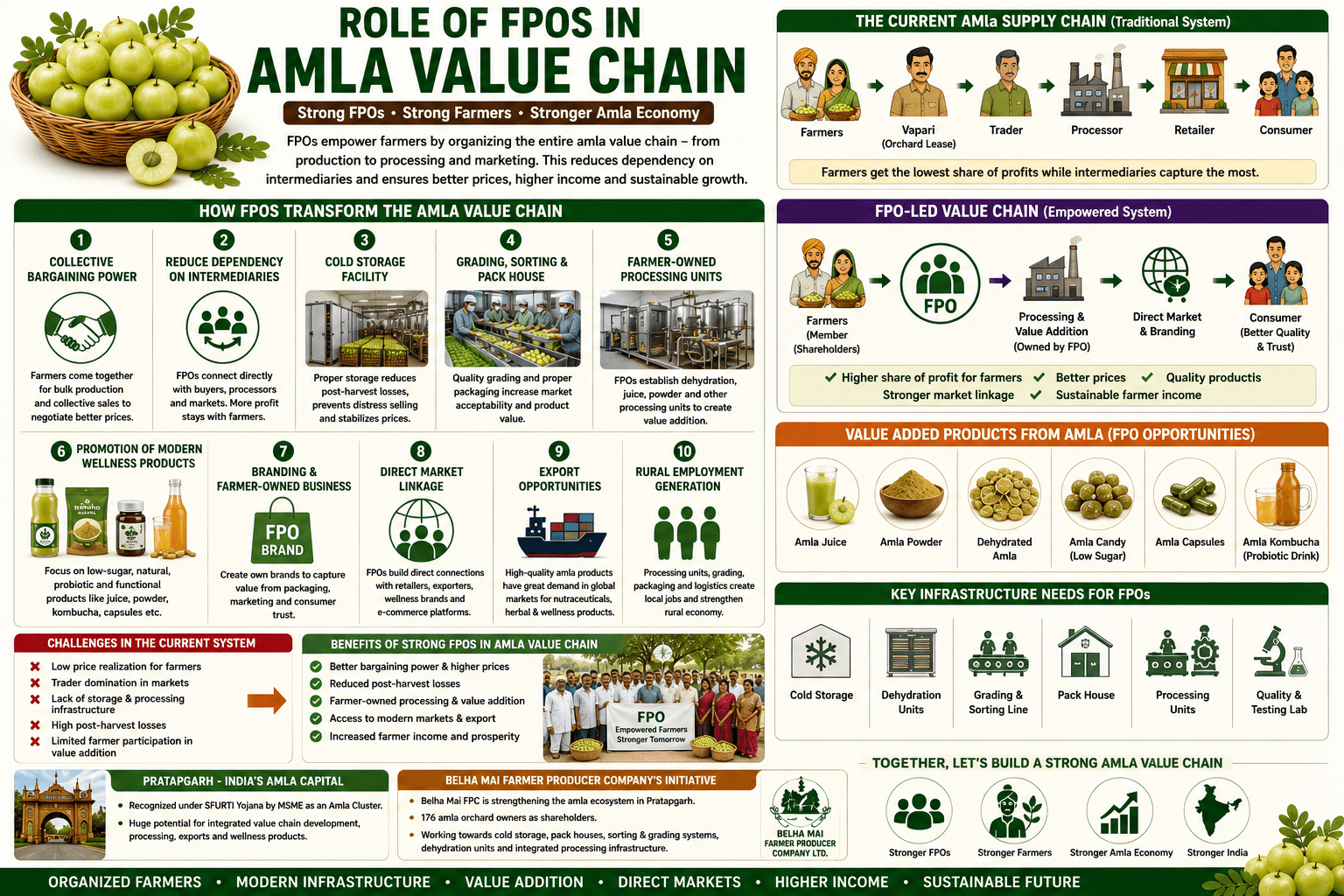
Farmer → Vapari → Trader → Processor → Retailer → Consumer
As a result:
- farmers remain financially vulnerable,
- distress selling is common,
- and most value addition happens outside farming communities.
Farmer Producer Organizations (FPOs) can fundamentally transform this system by enabling:
- collective bargaining,
- direct market linkage,
- farmer-owned processing,
- infrastructure development,
- and value-added product manufacturing.
In this blog, we will understand:
- role of FPOs in the amla value chain,
- current challenges,
- opportunities in processing and wellness products,
- infrastructure needs,
- and how farmer-led institutions can reshape the future of India’s amla economy.
👉 To Learn more on Amla farming in India: complete guide for Farmers, Processing & Business Opportunities : https://belhamaifpo.com/farmer-producer-organisation/amla-farming-in-india/
What Is an FPO?
An FPO (Farmer Producer Organization) is a collective organization formed by farmers to improve:
- marketing,
- processing,
- bargaining power,
- input procurement,
- and overall farmer income.
FPOs help small and marginal farmers work collectively like a business enterprise.
👉 To Learn more about What is a Farmer Producer Organization (FPO) in India? https://belhamaifpo.com/agriculture/what-is-fpo-in-india/
How the Role of FPOs in Amla Value Chain Can Transform Farmer Income
India’s amla industry still remains largely:
- fragmented,
- unorganized,
- and trader dominated.
Major challenges include:
- weak storage systems,
- poor market linkage,
- post-harvest losses,
- lack of processing infrastructure,
- and limited farmer ownership in value addition.
This is where FPOs can play a transformational role.
👉 Update yourself with this blog Amla market price trends in India : https://belhamaifpo.com/agriculture/amla-market-price-trends-in-india/
1. Collective Bargaining Power
One of the biggest roles of FPOs in amla value chain is improving farmer bargaining power.
When farmers work individually:
- traders dominate pricing,
- market information remains weak,
- and farmers often accept distress prices.
Through collective marketing:
- farmers can negotiate better rates,
- aggregate produce,
- and reduce dependency on intermediaries.
2. Reducing Trader and Vapari Dependence
In many amla-growing regions:
- Vapari lease orchards,
- traders control mandi sales,
- and processors procure through intermediaries.
Meanwhile:
- farmers bear yearly orchard management costs,
- but major profits are captured by traders and processors.
FPOs can reduce this dependency by:
- directly aggregating produce,
- connecting farmers with processors,
- and developing farmer-owned marketing systems.
3. Development of Cold Storage Infrastructure
Fresh amla has limited shelf life.
Without proper storage:
- prices crash during harvest season,
- farmers are forced into distress selling,
- and post-harvest losses increase.
FPOs can establish:
- cold storage units,
- scientific warehouses,
- and integrated storage systems.
This helps:
- stabilize prices,
- improve shelf life,
- and increase farmer bargaining power.
👉 Learn more on Value-added products from amla: https://belhamaifpo.com/agriculture/value-added-products-from-amla/
4. Pack Houses, Grading and Sorting Systems
Most amla-growing clusters still lack:
- grading systems,
- sorting lines,
- pack houses,
- and scientific post-harvest handling.
FPO-led infrastructure can:
- improve product quality,
- standardize produce,
- reduce wastage,
- and improve market acceptance.
5. Farmer-Owned Processing Units
One of the most important roles of FPOs in amla value chain is enabling farmer participation in value addition.
Instead of selling only raw fruits, FPOs can establish:
- juice units,
- dehydration plants,
- powder processing units,
- herbal product manufacturing,
- and wellness product businesses.
This allows farmers to participate in higher-value markets.
6. Promotion of Modern Wellness Products
The global wellness industry is shifting toward:
- low-sugar products,
- probiotics,
- kombucha,
- functional beverages,
- and nutraceuticals.
However, many small-scale processors in India still focus heavily on:
- sugary murabba,
- sweet candy,
- and sugar-preserved products.
FPOs can help modernize the sector by promoting:
- low-sugar wellness products,
- probiotic beverages,
- dry amla powder,
- kombucha,
- and functional nutrition products.
This can help position amla as a global superfood.
👉 Read more on Amla processing business in India (complete guide) : https://belhamaifpo.com/agriculture/amla-processing-business-in-india/
7. Branding and Farmer-Owned Businesses
FPOs can build:
- regional brands,
- farmer-owned wellness products,
- and direct-to-consumer businesses.
Branding helps farmers capture value from:
- packaging,
- marketing,
- and product identity.
This significantly improves income potential.
8. Direct Market Linkage
FPOs can directly connect with:
- processors,
- exporters,
- retailers,
- nutraceutical companies,
- and wellness brands.
Direct linkage reduces:
- middlemen dependency,
- price manipulation,
- and market inefficiencies.
9. Export Opportunities
Scientific processing and quality control can help FPOs enter:
- herbal exports,
- nutraceutical markets,
- wellness products,
- and functional food sectors.
Products with export potential include:
- dry amla powder,
- extracts,
- capsules,
- kombucha,
- and herbal supplements.
10. Rural Employment Generation
FPO-led value addition creates employment in:
- processing,
- packaging,
- grading,
- logistics,
- marketing,
- and rural enterprises.
This strengthens rural economies significantly.
Why Modern Infrastructure Is Essential
A modern amla value chain requires:
- cold storage,
- dehydration units,
- grading systems,
- pack houses,
- fermentation infrastructure,
- and scientific processing facilities.
Without infrastructure:
- post-harvest losses remain high,
- prices stay unstable,
- and farmers remain dependent on intermediaries.
Pratapgarh’s Emerging Role in Amla Value Chain Development
Pratapgarh is widely recognized as one of India’s most important amla-growing regions and is known as the traditional Amla Capital of India.
The district is recognized:
- under SFURTI Yojana by MSME as an Amla Cluster,
- and under NHB cluster development initiatives.
This creates huge opportunities for:
- integrated value-chain development,
- farmer-owned processing,
- dehydration,
- wellness products,
- and export-oriented value addition.
Belha Mai Farmer Producer Company’s Initiative
Belha Mai Farmer Producer Company is playing an important role in strengthening the amla ecosystem in Pratapgarh.
The organization currently has:
- 176 amla orchard owners as shareholders
and is actively working toward:
- cold storage,
- pack houses,
- grading and sorting systems,
- dehydration units,
- and integrated processing infrastructure.
This initiative has the potential to create a modern farmer-led value-chain ecosystem for India’s amla sector.
Conclusion
Role of FPOs in amla value chain is becoming increasingly critical for the future of India’s amla economy.
At present:
- farmers bear the highest production risks,
- intermediaries dominate markets,
- and processors capture most value addition profits.
FPOs can fundamentally transform this system through:
- collective marketing,
- farmer-owned processing,
- infrastructure development,
- direct market linkage,
- and modern wellness product innovation.
Scientific infrastructure combined with farmer-led value addition can help:
- reduce post-harvest losses,
- improve price realization,
- stabilize markets,
- and significantly increase farmer income.
The work being undertaken in Pratapgarh by Belha Mai Farmer Producer Company represents an important step toward building a sustainable and farmer-driven amla value-chain ecosystem in India.
Some Useful Links :-
👉 https://www.uphorticulture.in/