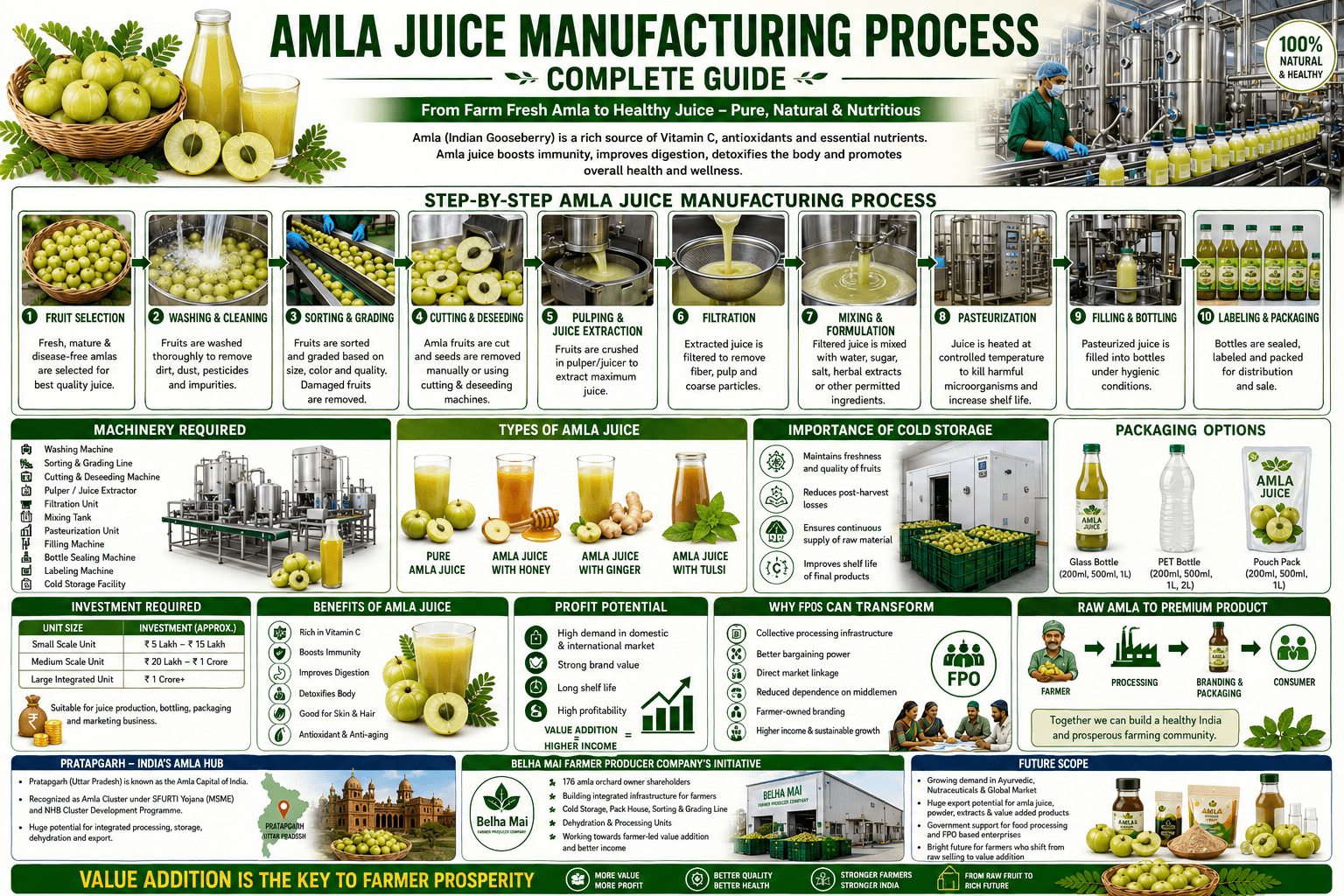
Amla Juice Manufacturing Process


Introduction
Amla juice manufacturing process is becoming one of the fastest-growing sectors in India’s herbal and nutraceutical industry. Amla (Indian Gooseberry) is widely known for its exceptionally high Vitamin C content, antioxidant properties, and medicinal value, making amla juice one of the most demanded natural health beverages in India.
Today, amla juice is widely consumed for:
- immunity boosting,
- digestion,
- detoxification,
- skin and hair health,
- and overall wellness.
The market for amla juice is growing rapidly because consumers are increasingly shifting toward:
- herbal drinks,
- Ayurvedic products,
- natural immunity boosters,
- and preventive healthcare solutions.
However, despite rising demand, most orchard owners still receive very low prices because value addition and processing are mainly controlled by traders and processors instead of farmers themselves.
In this blog, we will understand:
- amla juice manufacturing process,
- raw material requirements,
- machinery,
- processing steps,
- storage,
- packaging,
- profit opportunities,
- challenges,
- and the role of FPOs in transforming the amla processing ecosystem.
👉 To learn more about Amla farming in India: complete guide for Farmers, Processing & Business Opportunities : https://belhamaifpo.com/farmer-producer-organisation/amla-farming-in-india/
Why Amla Juice Demand Is Increasing
India’s wellness and nutraceutical industry is growing rapidly.
Consumers today prefer:
- natural health drinks,
- preservative-free beverages,
- and immunity-boosting products.
Major Reasons Behind Rising Demand
High Vitamin C Content
Amla is one of the richest natural sources of Vitamin C.
Ayurvedic Importance
Widely used in Ayurveda for centuries.
Immunity Booster
Demand increased significantly after rising health awareness.
Detox and Wellness Trend
Consumers prefer natural detox beverages.
Export Potential
Global demand for herbal drinks is increasing rapidly.
👉 To learn more about Amla processing business in India (complete guide) : https://belhamaifpo.com/agriculture/amla-processing-business-in-india/
Raw Material Required for Amla Juice Manufacturing
Main Raw Material
- Fresh mature amla fruits
Other Ingredients
Depending on product type:
- Water
- Salt
- Sugar
- Preservatives
- Herbal extracts
- Stabilizers
High-quality fruits improve:
- juice recovery,
- taste,
- shelf life,
- and nutritional value.
Machinery Required for Amla Juice Manufacturing
Modern juice processing units generally require:
- Washing machine
- Sorting and grading line
- Cutting and deseeding machine
- Pulper or juice extractor
- Filtration unit
- Mixing tank
- Pasteurization unit
- Filling machine
- Bottle sealing machine
- Labeling machine
- Cold storage facility
Scientific processing infrastructure improves:
- hygiene,
- production efficiency,
- shelf life,
- and product quality.
Step-by-Step Amla Juice Manufacturing Process
1. Fruit Selection
Healthy, mature, and disease-free fruits are selected.
Proper sorting improves:
- juice quality,
- taste,
- and shelf life.
2. Washing and Cleaning
Fruits are washed thoroughly to remove:
- dust,
- dirt,
- pesticide residues,
- and impurities.
Food-grade washing systems are preferred.
3. Sorting and Grading
Fruits are graded based on:
- size,
- maturity,
- and quality.
Damaged fruits are removed.
Scientific grading improves:
- uniformity,
- processing efficiency,
- and final product quality.
4. Cutting and Deseeding
Amla fruits are cut and seeds are removed using:
- manual systems,
- or cutting and deseeding machines.
This improves extraction efficiency.
5. Pulping and Juice Extraction
The deseeded fruits are crushed or pulped using:
- pulper machines,
- grinders,
- or juice extractors.
The juice is separated from the pulp.
6. Filtration
The extracted juice is filtered to remove:
- fiber,
- coarse particles,
- and impurities.
This improves texture and appearance.
7. Mixing and Formulation
Ingredients like:
- water,
- sugar,
- salt,
- herbal extracts,
- or preservatives
may be added depending on product formulation.
8. Pasteurization
The juice is heated under controlled temperature to:
- kill harmful microorganisms,
- improve shelf life,
- and maintain product safety.
9. Filling and Bottling
Juice is filled into:
- PET bottles,
- glass bottles,
- or food-grade containers.
Automatic filling machines improve hygiene and speed.
10. Labeling and Packaging
Products are labeled and packed for:
- retail markets,
- wholesalers,
- online sales,
- and exports.
Proper branding increases market value significantly.
Importance of Cold Storage and Post-Harvest Infrastructure
One of the biggest problems in India’s amla industry is the lack of:
- cold storage,
- grading systems,
- pack houses,
- and integrated post-harvest infrastructure.
Currently, most farmers have no scientific storage facility.
As a result:
- huge post-harvest losses occur,
- prices crash during peak season,
- and traders dominate the market.
Cold storage and scientific post-harvest systems help:
- extend shelf life,
- maintain raw material quality,
- and stabilize processing supply.
👉Learn more about Amla storage and shelf life management : https://belhamaifpo.com/agriculture/amla-storage-and-shelf-life-management/
Investment Required for Amla Juice Manufacturing Unit
Small-Scale Unit
👉 ₹5 lakh – ₹15 lakh
Suitable for:
- local retail,
- small bottling,
- and direct marketing.
Medium-Scale Unit
👉 ₹20 lakh – ₹1 crore
Includes:
- semi-automatic machinery,
- grading systems,
- and larger production capacity.
Large Integrated Processing Unit
👉 ₹1 crore+
Includes:
- cold storage,
- automated bottling,
- dehydration systems,
- and export-oriented infrastructure.
Profit Potential in Amla Juice Business
Amla juice has:
- high consumer demand,
- strong branding potential,
- and better margins than raw fruit selling.
Value addition significantly increases profitability.
Profit Drivers
- Brand value
- Quality
- Packaging
- Distribution
- Direct market linkage
The Biggest Problem: Farmers Get the Lowest Share
Despite producing the raw material, orchard owners often receive the lowest share in the value chain.
The current supply chain usually works like this:
Farmer → Vapari → Trader → Processor → Retailer → Consumer
What Happens
- Farmers bear orchard expenses
- Traders control mandi sales
- Processors buy through intermediaries
- Major profits go to brands and traders
This is one of the biggest structural problems in India’s amla economy today.
Why FPOs Can Transform Amla Juice Manufacturing
Farmer Producer Organizations (FPOs) can completely reshape the amla processing ecosystem.
Role of FPOs
Collective Processing Infrastructure
FPOs can establish:
- juice processing units,
- cold storage,
- grading systems,
- and packaging facilities.
Direct Farmer Ownership
Farmers become stakeholders in value addition.
Better Market Linkage
Direct linkage with:
- retailers,
- wellness brands,
- herbal industries,
- and exporters.
Reduction of Middlemen
Direct processing improves farmer margins.
Farmer-Owned Branding
FPOs can build regional wellness brands.
Pratapgarh’s Emerging Role in Amla Processing
Pratapgarh is widely recognized as one of India’s most important amla-growing regions.
The district is recognized:
- under SFURTI Yojana by MSME as an Amla Cluster,
- and under NHB cluster development initiatives.
This creates huge opportunities for:
- juice processing,
- cold storage,
- dehydration,
- branding,
- and export-oriented value addition.
Belha Mai Farmer Producer Company’s Initiative
Belha Mai Farmer Producer Company is playing a major role in strengthening the amla value chain in Pratapgarh.
The organization currently has:
- 176 amla orchard owners as shareholders
and is actively working toward developing:
- cold storage,
- pack houses,
- sorting and grading lines,
- dehydration systems,
- and integrated processing infrastructure.
This initiative can make Pratapgarh a pioneering model for farmer-led amla processing and value addition in India.
Conclusion
Amla juice manufacturing process is becoming one of the most promising agro-processing businesses in India because of rising demand for herbal and immunity-boosting products.
However, the biggest challenge today is that orchard owners still remain disconnected from processing profits due to trader-controlled supply chains and weak post-harvest infrastructure.
Scientific juice processing units, cold storage systems, grading infrastructure, and FPO-led value addition can completely transform the amla economy by:
- reducing losses,
- improving quality,
- increasing farmer bargaining power,
- and creating farmer-owned brands.
The work being undertaken in Pratapgarh by Belha Mai Farmer Producer Company represents an important step toward building a farmer-led integrated amla processing ecosystem in India.
Some useful links: