

Introduction
Amla harvesting techniques and best practices play a crucial role in determining fruit quality, shelf life, market price, and overall profitability of the orchard. Even after years of careful orchard management, improper harvesting and post-harvest handling can lead to heavy losses for farmers.
Amla (Indian Gooseberry) is widely used in:
- Ayurveda
- Murabba production
- Candy manufacturing
- Juice processing
- Herbal products
- Nutraceutical industries
Therefore, maintaining fruit quality during harvesting becomes extremely important for both fresh market sales and processing industries.
In major amla-growing regions like Pratapgarh, harvesting season is one of the busiest and most economically important periods for orchard owners. However, it is also the stage where many farmers face severe pricing pressure from traders and middlemen.
In this blog, we will understand:
- Proper harvesting techniques
- Best harvesting time
- Maturity indicators
- Grading and sorting
- Post-harvest handling
- Storage methods
- Transportation practices
- Common farmer challenges
- Role of FPOs in improving post-harvest management.
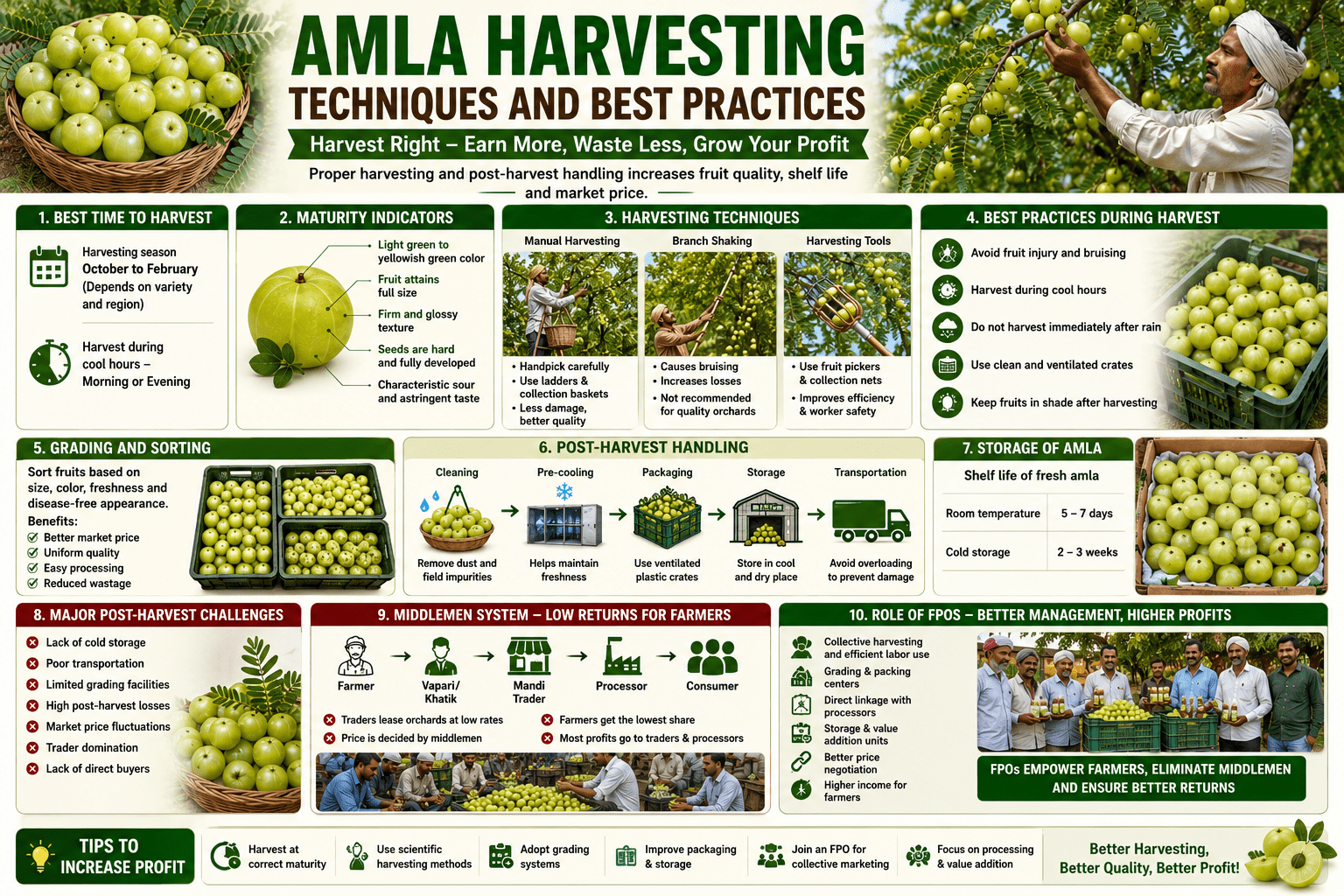
Best Time for Amla Harvesting

Harvesting at the correct maturity stage is essential for obtaining:
- Better market prices
- Higher Vitamin C content
- Improved shelf life
- Better processing quality
Harvesting Season in India
Amla harvesting generally starts from:
- October to February
depending on:
- variety,
- climate,
- and regional conditions.
👉 To lear more about Amla farming in India: complete guide for Farmers, Processing & Business Opportunities : https://belhamaifpo.com/farmer-producer-organisation/amla-farming-in-india/
Maturity Indicators in Amla
Farmers should identify proper maturity before harvesting.
Signs of Mature Fruits
Color Change
- Fruits become light green to yellowish-green
Fruit Size
- Fruits attain full size depending on variety
Hardness
- Mature fruits become firm and glossy
Seed Maturity
- Seeds inside become hard and fully developed
Taste
- Characteristic sour and astringent flavor develops
Harvesting immature fruits reduces:
- juice quality,
- processing recovery,
- and shelf life.
Why Amla Harvesting Techniques and Best Practices Matter
1. Manual Harvesting

Proper amla harvesting techniques and best practices help farmers achieve better market prices and longer shelf life. Manual harvesting is the most common method in India.
Process
- Fruits are handpicked carefully
- Bamboo ladders are used for tall trees
- Collection baskets are used during harvesting
Advantages
- Less fruit damage
- Better quality control
- Suitable for fresh market
Disadvantages
- Labor intensive
- Higher harvesting cost
2. Branch Shaking Method
In some traditional orchards, branches are shaken using bamboo poles.
Problem With This Method
- Causes bruising
- Damages fruits
- Increases post-harvest losses
- Reduces shelf life
Proper amla harvesting techniques and best practices help farmers achieve better market prices and longer shelf life. This method should be minimized in commercial orchards.
3. Use of Harvesting Tools
Modern orchards increasingly use:
- fruit pickers,
- collection nets,
- and pruning-based harvesting systems.
These methods improve:
- efficiency,
- worker safety,
- and fruit quality.
Best Practices During Harvesting
Avoid Fruit Injury
Bruised fruits spoil faster and receive lower market prices.
Harvest During Cool Hours
Morning or evening harvesting is preferred.
Avoid Wet Harvesting
Do not harvest immediately after rain because moisture increases fungal risk.
Use Clean Containers
Plastic crates are better than gunny bags because they reduce fruit damage.
Keep Fruits in Shade
Direct sunlight after harvesting reduces quality and freshness.
Grading and Sorting of Amla


Grading improves market value and buyer confidence.
Fruits Are Sorted Based On
- Size
- Color
- Freshness
- Disease-free appearance
- Processing quality
Benefits of Grading
- Better market price
- Uniform quality
- Easier processing
- Reduced wastage
Lear more about Amla farming profit per acre in India : https://belhamaifpo.com/agriculture/amla-farming-profit-per-acre-in-india-cost-income-complete-business-guide/
Post-Harvest Handling Practices
Post-harvest management is one of the weakest links in the amla value chain today.
Recommended Practices
Cleaning
Dust and field impurities should be removed carefully.
Pre-Cooling
Helps maintain freshness during transportation.
Packaging
Use ventilated plastic crates or cartons.
Storage
Store fruits in cool and dry conditions.
Transportation
Avoid overloading to reduce crushing damage.
👉 Lear more about Amla plantation cost and returns analysis : https://belhamaifpo.com/agriculture/amla-plantation-cost-and-returns-analysis-in-india-complete-profit-guide/
Storage of Amla Fruits
Fresh amla has limited shelf life under normal conditions.
Storage Recommendations
| Storage Method | Approximate Shelf Life |
|---|---|
| Room temperature | 5–7 days |
| Cold storage | 2–3 weeks |
Processing soon after harvesting helps reduce losses.
Major Post-Harvest Problems Faced by Farmers
Although India produces huge quantities of amla, orchard owners face major post-harvest challenges.
Common Problems
- Lack of cold storage
- Poor transportation
- Limited grading facilities
- High post-harvest losses
- Market price fluctuations
- Trader domination
- Lack of direct buyers
In many regions:
- Uttar Pradesh
- Punjab
- Haryana
- Uttarakhand
- Chhattisgarh
farmers are forced to lease orchards to Vapari or middlemen traders during harvest season.
👉 Learn about Popular varieties of amla in India : https://belhamaifpo.com/agriculture/popular-varieties-of-amla-in-india/
How Traders Dominate the Harvesting System


The current supply chain often works like this:
Farmer → Vapari/Khatik → Mandi Trader → Processor → Consumer
What Happens
- Traders take orchards on lease
- Farmers lose control over harvesting
- Prices are dictated by middlemen
- Payments are delayed
- Farmers receive very low margins
Meanwhile, processors and traders earn significantly higher profits from:
- Murabba
- Candy
- Juice
- Powder
- Herbal products
The farmer bears orchard expenses throughout the year but often receives the smallest share of the value chain.
Role of FPOs in Post-Harvest Management

Farmer Producer Organizations (FPOs) can play a transformative role in improving amla harvesting and post-harvest systems.
How FPOs Help
Collective Harvesting
Reduces labor costs and improves efficiency.
Grading and Packing Centers
Ensures standardized quality.
Direct Linkage With Processors
Eliminates unnecessary intermediaries.
Storage Infrastructure
Reduces distress sale pressure.
Value Addition
FPOs can produce:
- Murabba
- Candy
- Juice
- Pickles
- Herbal products
This helps retain higher profits within farming communities.
Best Practices to Increase Farmer Profit
Use Scientific Harvesting Methods
Avoid fruit bruising and physical damage.
Harvest at Correct Maturity
Improves processing quality and market value.
Adopt Grading Systems
Uniform quality attracts better buyers.
Improve Packaging
Reduces transportation losses.
Join an FPO
Collective marketing increases bargaining power.
Focus on Processing
Value addition significantly improves profitability.
Conclusion
FPO-led training programs on amla harvesting techniques and best practices can help orchard owners reduce exploitation and improve income. Amla harvesting techniques and best practices are critical for improving fruit quality, reducing losses, and increasing farmer income. Proper harvesting, grading, storage, and transportation directly affect profitability and market success.
Regions like Pratapgarh continue to remain major amla hubs because of their strong orchard culture and processing demand. However, the biggest challenge today lies in post-harvest exploitation by middlemen and trader-controlled mandi systems.
Farmer Producer Organizations (FPOs) can become the key solution by helping farmers collectively manage harvesting, grading, processing, storage, and direct marketing.
A stronger FPO ecosystem can ensure that the real value of amla cultivation finally reaches the orchard owners who invest years of labor, care, and resources into maintaining these orchards.
👉 Learn about Amla plantation cost and returns analysis : https://belhamaifpo.com/agriculture/amla-plantation-cost-and-returns-analysis-in-india-complete-profit-guide/
Some helpful Links:
👉 https://nduat.org/ , https://ayush.gov.in/
👉 https://nhb.gov.in/schemes.aspx